2026 RFP Bidding: Process, Tips, Automations & Examples

Article written by
Aparna Rajendran

INSIDE THE ARTICLE
SHARE THIS ARTICLE
Summary
The average RFP win rate in 2026 is 45%. High-performing teams consistently beat it, not because they work harder, but because they work with a better system. This guide covers the full 2026 RFP bidding process: how to decide which opportunities are worth pursuing, how to build responses that win, and how agentic AI is compressing what used to take 25 hours into under one.
RFPs used to be a grind. Weeks of wrangling SMEs, copying answers from last quarter's spreadsheet, reformatting for the fifteenth time at 11 PM before a deadline. That was the standard.
In 2026, it still is, for teams that haven't adapted.
But high-performing proposal teams? They're operating on a completely different level. They're using agentic AI to parse 100-page tender documents in minutes, auto-populate up to 80% of standard answers, route low-confidence responses for expert review, and export directly in the buyer's original format. No reformatting. No fire drills.
This guide covers everything: the full 2026 RFP bidding lifecycle, how to make smarter Go/No-Go decisions, what great content looks like at every stage, and which automation tools are actually worth your time.
What Is RFP Bidding?
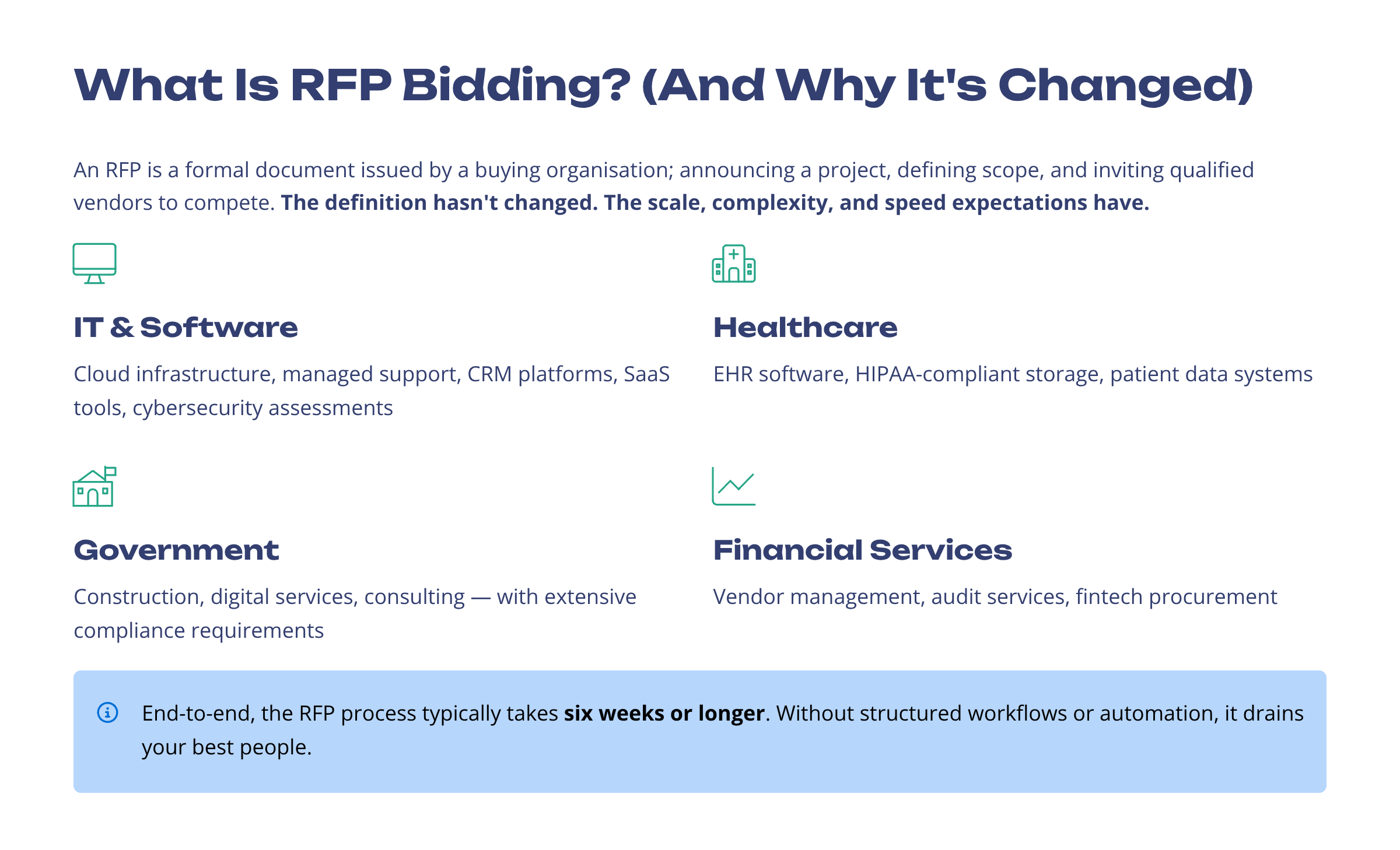
An RFP, i.e., Request for Proposal is a formal document issued by a buying organization. It announces a project, defines scope and requirements, and invites qualified vendors to compete for the contract. RFP bidding is everything that happens after: the evaluation, the response, the strategy, the submission.
That definition hasn't changed. What has changed is the scale and complexity of what's expected in a response and how fast it needs to happen.
RFPs now show up across virtually every industry:
- IT services: cloud infrastructure, managed support, cybersecurity assessments
- Software procurement: CRM platforms, SaaS tools, custom applications
- Healthcare: EHR software, HIPAA-compliant storage, patient data systems
- Government contracts: construction, digital services, consulting
- Marketing and advertising: agency-of-record selections, campaign management
- Financial services: vendor management, audit services, fintech procurement
End-to-end, the RFP process typically takes six weeks or longer depending on project complexity, team size, and vendor count. For teams without structured workflows or automation, it can easily stretch longer and drain your best people in the process.
Tired of the midnight reformatting? See how SparrowGenie handles it →
The 2026 RFP Bidding Process: Step by Step
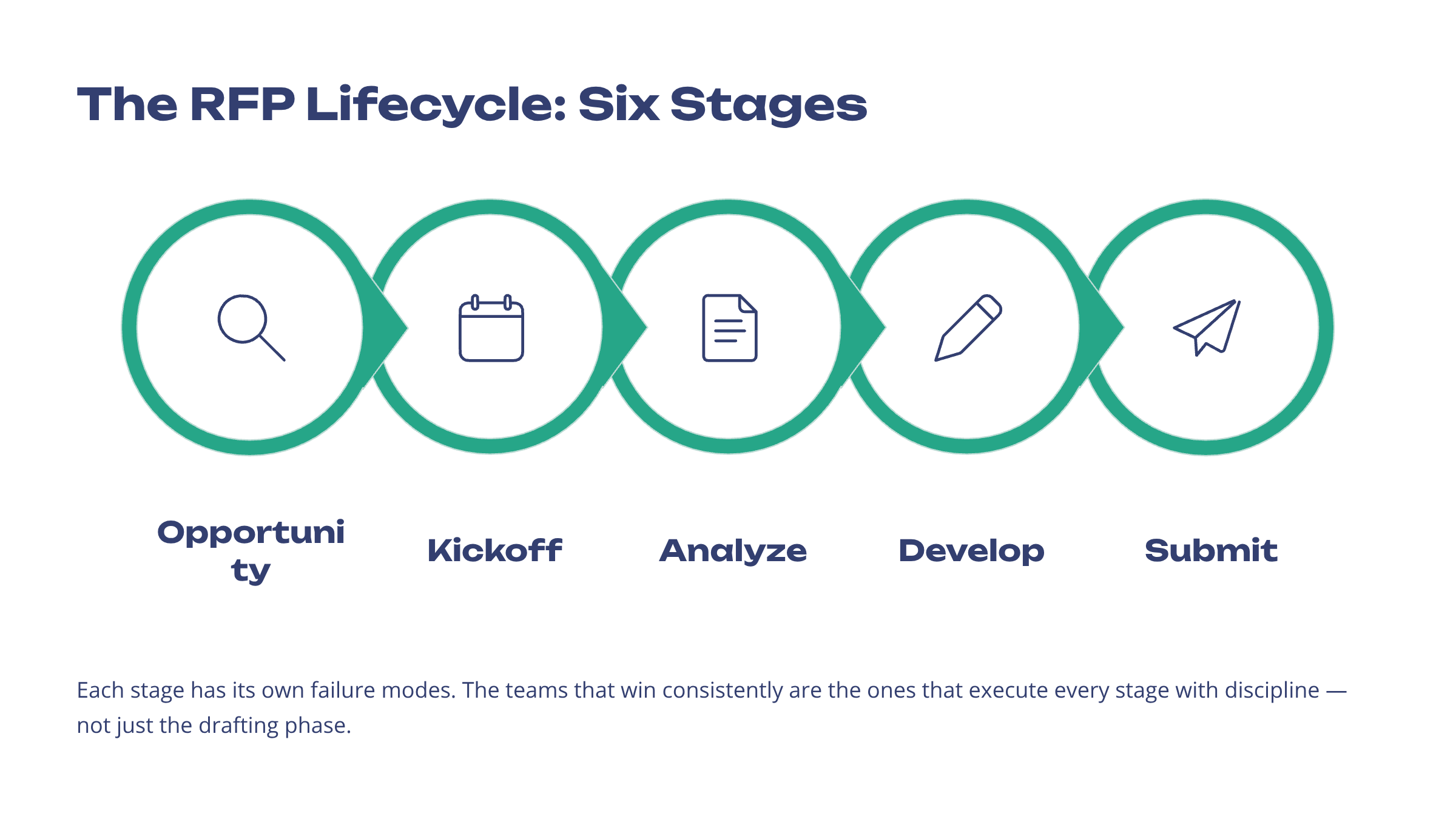
Here's the full lifecycle, and where most teams lose time (or lose the deal).
Stage 1: Opportunity Identification & Go/No-Go Decision
Before a single word of the proposal is written, the most important decision happens: should you bid at all?
Teams that apply a Go/No-Go filter consistently bid less and win more. It's not about being selective for the sake of it, it's about protecting your team's bandwidth for RFPs you can actually win.
2026 Best Practice: Multi-Gate Evaluation System
Gate | Timing | Goal | Output |
|---|---|---|---|
Gate 0 | Within hours of receipt | Eliminate obvious non-starters | Advance or No-Bid |
Gate 1 | Within 24 hours | Full Go/No-Go score | Go / Conditional / No-Go |
Gate 2 | After Q&A / before pricing lock | Re-check changed assumptions | Confirm or reverse |
Gate 3 | 48–24 hours pre-submit | Submission-readiness check | Submit or Stand Down |
The 7-criteria scoring model (100-point weighted):
- Capability fit (20 pts) — can you actually deliver?
- Proof readiness (15 pts) — do you have relevant case studies and references?
- Win probability (15 pts) — is there a realistic path against likely competitors?
- Commercial quality (15 pts) — margin potential and manageable bid cost
- Capacity and schedule (15 pts) — do you have the bandwidth and SME availability?
- Compliance burden (10 pts) — can you meet all mandatory requirements?
- Terms risk (10 pts) — are contract terms acceptable or mitigatable?
Score thresholds: 4.0–5.0 is a strong Go. 3.0–3.9 is conditional. Below 3.0, decline professionally and redirect your resources.
Automatic No-Go triggers: Inability to technically comply, inability to meet the delivery timeline, a fundamentally unacceptable commercial model, or legal/security/ethical constraints that make the bid unworkable. Any single one kills the bid.
Stage 2: Kickoff and Response Planning
Once you have a confirmed Go, the clock starts. A strong kickoff aligns every contributor on requirements, roles, messaging, and timelines, before anyone starts typing.
Key outputs to produce at kickoff:
- Compliance matrix: maps every RFP requirement to the specific section addressing it. Creating this one document can improve response completeness by over 40%.
- Responsibility assignment: who drafts, who reviews, who approves, with hard dates.
- Win themes: 3–5 differentiators that carry through the entire proposal.
- Risk register: flag compliance gaps, SME bottlenecks, or weak sections before drafting begins.
Stage 3: Deep RFP Analysis
Read the RFP a minimum of twice. Once for comprehension, once for compliance. In 2026, AI tools can parse 100-page tender documents in minutes, auto-detecting questions, flagging mandatory requirements, and building a first-draft compliance matrix automatically.
Manual analysis checklist:
- Highlight every evaluation criterion and its stated weight
- Identify all formatting, page limit, and attachment requirements
- Flag overly specific technology requirements or unrealistic delivery timelines
- Identify the Q&A window and plan strategic questions that signal your diligence to evaluators
Stage 4: Content Development and Response Drafting
This is where deals are won or lost. Five principles that separate winning proposals from the rest:
- Mirror the buyer's language. Use their exact headings, numbering, and terminology. Evaluators scoring dozens of proposals need to navigate your document without friction.
- Anchor on outcomes, not features. Quantify impact. "Reduced onboarding time by 30% within 60 days" beats "improved efficiency" every time.
- Validate pain before proposing a solution. Confirm your understanding of the buyer's challenges before presenting your approach.
- Lead with proof. Every bold claim needs a case study, data point, reference, or certification behind it. Proposals without evidence feel weak to evaluators.
- Use your content library intelligently. Pull from pre-approved answers for standard security and compliance sections, but customize everything to the specific opportunity's context.
Your best answers shouldn't live in someone's inbox. Build a governed Knowledge Hub with SparrowGenie →
Stage 5: Review, Quality Assurance & Submission
The final review is not a spell-check. It's a compliance audit. Run your completed draft against the compliance matrix before anyone hits submit.
Pre-submission checklist:
- Every RFP question addressed (cross-referenced against compliance matrix)
- No mandatory requirements missed
- Formatting instructions followed: font, page limits, file naming
- Financial terms reviewed, no dealbreakers accepted inadvertently
- All attachments included and correctly labeled
- Legal and compliance sign-off complete
- Submission portal confirmed
Pro tip: Submit early. Last-minute submissions risk technical failures on e-procurement portals and eliminate your buffer for catching errors.
Stage 6: Post-Submission Analysis and Knowledge Capture
Run a short post-mortem after every RFP cycle, win or lose. What content was reused effectively? Which sections caused SME delays? What new questions need to be added to the knowledge library?
Teams with systematic insight routines are significantly less likely to sit in the bottom tier of win-rate performance. Every RFP is a learning opportunity, whether you win it or not.
RFP Automation in 2026: The Agentic AI Revolution
Here's the shift that defines 2026: the dominant narrative moved from generative AI (systems that write content) to agentic AI, systems that autonomously execute multi-step workflows with human oversight at defined checkpoints.
Instead of AI helping you draft a section, agentic systems can autonomously analyze RFP requirements, pull relevant case studies from your content library, flag compliance gaps, route low-confidence answers for expert review, and export in the buyer's original format, all without constant human prompting.
What Automation Actually Delivers in 2026
Metric | Result with AI Automation |
|---|---|
Response time reduction | 53% faster through auto-population |
Response completeness improvement | 42% via AI-generated compliance matrices |
Proposal creation speed | Up to 80% faster, intake to submission |
RFPs handled without adding headcount | 3x more |
Average drafting time | From ~25 hours manual to ~17 minutes with AI |
I-native from day one. Not bolted on. Explore the SparrowGenie platform →
Key Automation Use Cases
1. RFP Shredding / Document Parsing
AI instantly parses multi-page, inconsistently formatted RFP documents, identifying questions, mandatory requirements, evaluation criteria, and deadlines. This replaces hours of manual document analysis.
2. Auto-Population from Knowledge Library
AI matches incoming RFP questions to pre-approved answers in your content library, drafting 60–80% of a standard response without human input. Low-confidence matches are flagged for SME review, not left blank.
3. Compliance Matrix Generation
Automatically maps every stated requirement to the relevant response section, preventing omissions and ensuring complete coverage before submission.
4. Go/No-Go Decision Intelligence
AI tools now analyze deal risk factors and past win/loss outcomes to generate evidence-based Go/No-Go recommendations, reducing reliance on gut calls.
5. Workflow Routing and Approvals
Role-based routing sends sections to the right reviewers (Sales, Legal, Security, Compliance) automatically, with escalation paths and deadline tracking built in.
6. Dynamic Compliance Checking
Real-time compliance dashboards scan completed responses for completeness and adherence to RFP instructions before submission, catching gaps your team would miss at 1 AM.
7. Predictive Analytics for Strategic Bidding
Advanced tools assess win probability based on historical data, helping teams prioritize high-value opportunities and confidently skip low-probability bids.
Top RFP Automation Platforms in 2026
Not all platforms are equal and not all of them have kept pace with the shift to agentic AI. Here's how the leading tools stack up:
Platform | Best For | Key Differentiator | Agentic AI? |
|---|---|---|---|
SparrowGenie | Enterprise teams, DDQs, security questionnaires | AI-native workflow, governed Knowledge Hub, confidence scoring, original-format export | Yes, full workflow |
AutogenAI | Large teams needing narrative writing + governance | Highest writing quality, FedRAMP authorized for government | Partial |
Loopio | High-volume standardized questionnaires | Portal automation auto-fills web-based procurement portals | Partial |
Responsive (RFPIO) | Compliance-heavy enterprise workflows | Deep CRM integrations, mature content library management | Partial |
SEQUESTO | High-growth teams needing speed + governance | "James" AI agent orchestrates full workflows; native Word/Excel/PPT integration | Yes — full |
Inventive AI | Tech-forward enterprises with complex integrations | Multi-agent architecture, zero-interrupt SME workflows via Slack/Teams | Yes — multi-agent |
AutoRFP.ai | Teams needing raw speed for simple drafts | Complete draft responses in seconds, real-time collaboration | Partial |
SparrowGenie in 2026: What's New
SparrowGenie's March 2026 platform upgrade introduced capabilities that move it firmly into agentic AI territory:
- SmartMapping: uploads your RFP and auto-builds a project framework with designated sections, owners, and response timelines
- Obligation Tracking: monitors commitments, exceptions, and follow-ups as live components within each project
- Genie AI for First Drafts: generates drafts using secure, approved content with human approval loops and full audit trails
- Original-Format Export: returns documents in the buyer's format, eliminating last-minute reformatting entirely
Here's the thing most competitors don't want to talk about: they bolt AI onto legacy architecture and call it innovation. SparrowGenie was built AI-native from the ground up, which means the governed Knowledge Hub, confidence scoring, and zero data retention aren't afterthoughts. They're the foundation.
Expert Tips to Win More RFPs in 2026
Here are a few tips to win more RFPs in 2026.
Before the RFP Arrives
- Build your content library proactively. Maintain a living repository of approved answers to frequently asked questions on security, compliance, company background, and implementation methodology. Assign content owners and review quarterly. Outdated information is worse than no information — it damages credibility and loses deals.
- Establish capture management. Start building relationships with target accounts before their RFPs are published. The best proposals are built on intelligence gathered over months, not days.
- Define your ICP and use it as a filter in every Go/No-Go decision. Opportunities outside your ICP have statistically lower win probability and should face higher scoring thresholds.
- Never bid on a wired RFP. If the document references a specific competitor's proprietary technology multiple times, or the incumbent has been there for years without issues, win probability is near zero. Log a No-Go and redirect your best people.
During the Response
- Ask strategic questions during the Q&A window. Thoughtful clarifying questions signal diligence, open a dialogue with evaluators, and uncover the buyer's underlying pain points that may not be explicit in the RFP document.
- Use a compliance matrix. Always. Never submit without cross-referencing every question against it. A single missed mandatory requirement can trigger automatic disqualification regardless of overall proposal quality.
- Balance automation with authenticity. AI drafts handle compliance and standard sections — but your win themes and value proposition must be written fresh for each opportunity. Generic boilerplate kills competitive edge.
Formatting and Submission
- Mirror the RFP structure exactly. Use the buyer's exact headings, question numbers, and section order. Evaluators scoring dozens of proposals will penalize any submission that makes their job harder.
- Follow every formatting rule as if it's an evaluation criterion. Page limits, font sizes, file naming conventions, and attachment formats are often compliance checkpoints, ignoring them signals carelessness.
- Frame outcomes, not features. Every capability you describe should tie to a quantifiable business impact: time saved, revenue unlocked, risk reduced, or costs avoided.
Common RFP Mistakes to Avoid
Here are a few very common RFP mistakes that you can possibly avoid in future.
Mistake | Impact | Fix |
|---|---|---|
Submitting generic, unedited responses | Evaluators recognize recycled content immediately | Personalize to the buyer's specific pain points and language |
Missing mandatory requirements | Automatic disqualification in many procurement processes | Use a compliance matrix and pre-submission checklist |
Skipping the vendor Q&A window | Misses intelligence and relationship-building opportunities | Plan 3–5 strategic questions for every RFP |
Overextending the team without triage | Dilutes quality across too many responses | Apply Go/No-Go scoring rigorously to protect team bandwidth |
Accepting poor contract terms under deadline pressure | Creates downstream liability | Conduct legal review at Gate 1, not Gate 3 |
Over-relying on AI without human validation | AI can draft confidently but incorrectly on niche technical claims | Always maintain human review loops for AI-generated content |
SparrowGenie flags low-confidence answers automatically, so your team reviews what matters.
RFP Bidding Benchmarks: 2026
Metric | 2026 Benchmark | High-Performer Target |
|---|---|---|
Average win rate | 45% | 50%+ |
Average advancement rate (shortlist) | 46% | 55%+ |
Average response time (draft + submission) | ~20–25 hours | <5 hours (with AI) |
Proposals handled per team/month | 12–16 | 30+ (with AI) |
Response time reduction with AI automation | 53–80% | — |
Content reuse via AI auto-draft | 60–80% auto-drafted | — |
The Future: What Comes After 2026?
The platforms that will dominate the next cycle are moving from AI-assisted writing to fully governed agentic proposal factories, where the system reads the RFP, executes the entire workflow, routes for approvals, and exports the final document, with humans focused exclusively on strategy and oversight.
Key trends to watch:
- Proactive RFP intelligence: AI agents that monitor procurement portals and notify teams of relevant opportunities before formal RFPs are even issued
- Real-time competitor intelligence during response: AI that enriches drafts with current competitive positioning and buyer-specific research
- Cross-RFP learning loops: systems that analyze win/loss patterns across every submission and continuously refine your content library
- Vertical-specific agents: specialized AI trained on government contracting, healthcare procurement, or financial services RFP conventions
Organizations that treat AI not as a drafting assistant but as an intelligent orchestration layer for their entire proposal process will hold a structural advantage that compounds over time.
The question isn't whether to automate RFPs. It's whether you want to be the team that still hasn't by 2027.
Ready to see what agentic RFP automation looks like in practice? Book a 15-minute demo now.
Ready to see how AI can transform your RFP process?
Product Marketer at SparrowGenie
Being a Product Marketer at SparrowGenie, Aparna helps sales teams work faster with secure, AI-powered proposal automation. She turns complex features into simple stories, builds messaging that resonates, and keeps a close pulse on what customers actually need. She loves shaping clear, helpful content that shows how SparrowGenie makes RFP work easier, faster, and a lot less stressful.
Frequently Asked Questions (FAQs)
Related Articles

Build Your Revenue Engine: The ALIGN Framework for Revenue Operations

Proposal Creation Software: Transforming RFPs into Revenue Engines