The RFP Process Explained: From Creation to Vendor Selection

Article written by
Kate Williams

INSIDE THE ARTICLE
SHARE THIS ARTICLE
Summary
The RFP process is one of the most critical and most misunderstood parts of enterprise buying. From defining requirements to evaluating vendors and negotiating contracts, every step influences cost, risk, and long-term outcomes. This guide breaks down the entire RFP process, step by step, from early discovery to post-award vendor onboarding. You’ll learn how to write clearer RFP documents, run fair evaluations, avoid common mistakes, and choose the right vendors with confidence.
The RFP process looks simple on paper. Write requirements. Invite vendors. Pick the best one. In reality, it’s one of the most time-consuming, politically sensitive, and high-stakes workflows inside any organization.
Teams spend weeks aligning stakeholders, clarifying requirements, reviewing responses, and defending decisions. And yet, studies show that 65–75% of RFPs fail to deliver the expected outcome, often due to vague requirements, rushed timelines, or poor evaluation frameworks.
This guide breaks down the entire RFP process end to end, from the moment a business need is identified to final vendor selection and onboarding. Not theory. Not templates. Just how the process actually works when done right.
What Is an RFP?
A Request for Proposal (RFP) is a structured procurement document used by organizations to invite qualified vendors to submit detailed proposals for a specific project, product, or service.
Unlike price-only sourcing, the RFP process evaluates vendors across multiple dimensions, such as technical capability, experience, cost, implementation approach, and long-term fit.
When executed well, RFPs turn vendor selection into a transparent, defensible, and data-driven decision. When executed poorly, they turn into months of rework, stakeholder conflict, and buyer’s remorse.
See how teams streamline responses and evaluations with SparrowGenie.
The RFP Process at a Glance
Most enterprise RFPs follow six core phases:
- Discovery and pre-planning
- RFP creation
- RFP administration
- Proposal evaluation
- Vendor selection and negotiation
- Post-award onboarding
The average RFP lifecycle spans 6–10 weeks, depending on complexity and governance requirements. Let’s break each phase down.
Phase 1: Discovery and Pre-Planning
If the RFP process were a building, this phase is the foundation. And like most foundations, it’s invisible until something cracks.
Teams often rush past discovery because it doesn’t feel like “real work.” No vendors. No documents. No deadlines. Just meetings, alignment, and uncomfortable questions. But this phase is where most RFPs are won or lost before they even exist.
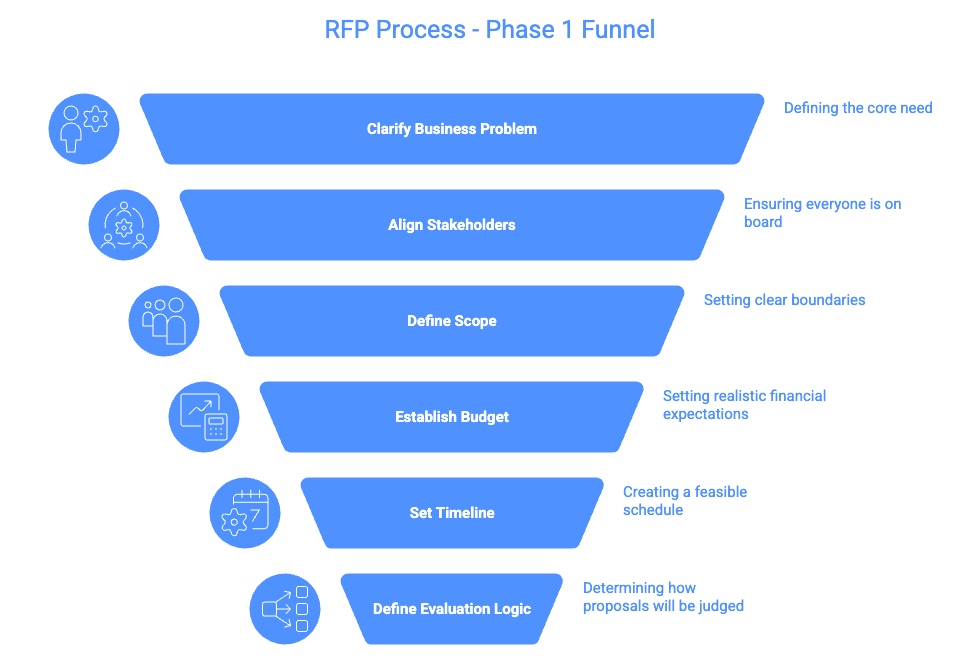
1. Clarifying the Real Business Problem
The most common mistake in RFPs is confusing a solution request with a business need.
“We need a new CRM.”
“We want an RFP tool.”
“We’re looking for a vendor to modernize X.”
Those are outcomes, not problems. Strong discovery starts by answering:
- What’s broken today?
- What’s the cost of doing nothing?
- What changes if this project succeeds?
This is where teams translate symptoms into measurable goals:
- Reducing sales cycle time
- Improving compliance confidence
- Scaling operations without adding headcount
- Lowering long-term risk or total cost of ownership
When the problem isn’t clearly defined, requirements become scattered, vendors talk past each other, and evaluation turns subjective later.
2. Identifying and Aligning Stakeholders Early
Most RFP failures don’t come from bad vendors. They come from internal misalignment. Different stakeholders care about different things:
- Business teams want outcomes and speed
- Finance wants predictability and cost control
- Legal wants risk mitigation
- IT and Security want control, compliance, and integration clarity
- Procurement wants fairness and defensibility
Discovery is the moment to surface these priorities and resolve conflicts before they show up as last-minute objections during evaluation. High-performing teams do a few things deliberately:
- Map stakeholders by influence and decision power
- Define who owns requirements, scoring, and final approval
- Agree on what “non-negotiable” actually means
- Lock decision rules upfront
Skipping this step almost guarantees scope changes and stalled decisions later.
3. Defining Scope Without Over-Prescribing Solutions
Another common failure in early RFP planning is over-specification. Teams either stay too vague or go too far in the other direction, prescribing exactly how vendors must solve the problem. Both are risky. Effective discovery draws a clear boundary:
- What outcomes must be achieved
- What constraints exist (budget, compliance, integrations, timelines)
- What flexibility vendors have to propose alternative approaches
This balance encourages innovation without creating ambiguity. A good rule of thumb: define what success looks like, not how vendors must get there.
4. Establishing Budget Reality, Not Budget Guesswork
Budgets decided in isolation almost always break during evaluation. Discovery should include:
- Market research to understand realistic pricing ranges
- Internal cost benchmarks
- The cost of delay or failure if the project stalls
This doesn’t mean publishing a fixed number. It means ensuring stakeholders are aligned on what is affordable, what is aspirational, and what is unrealistic. Clear budget alignment prevents two common problems:
- Vendors proposing wildly mismatched solutions
- Internal sticker shock late in the process
5. Setting a Timeline That Vendors Can Actually Meet
Timelines often reflect internal urgency, not external reality. Discovery is where teams pressure-test:
- How complex the requirements are
- How many stakeholders must review responses
- Whether the timeline allows for meaningful vendor questions
As a baseline, complex RFPs should allow at least 15–20 business days for vendor responses. Anything less reduces response quality and vendor participation. A realistic timeline protects decision quality, not just speed.
6. Defining Evaluation Logic Before Writing Questions
One of the most overlooked discovery activities is deciding how proposals will be judged before deciding what to ask. This includes:
- Which criteria matter most
- How they will be weighted
- What trade-offs are acceptable
When evaluation logic is defined early:
- Questions become sharper
- Requirements stay focused
- Scoring is defensible and consistent
When it’s defined late, teams reverse-engineer justification after the fact.
Why Phase 1 Matters More Than Any Other Stage
Phase 1 doesn’t produce a document. It produces clarity. And clarity is what allows:
- Vendors to respond accurately
- Evaluators to score consistently
- Leaders to approve decisions confidently
Most RFP pain downstream can be traced back to shortcuts taken here. The teams that invest properly in discovery don’t just run smoother RFPs. They make better decisions with fewer surprises.
Watch how SparrowGenie brings clarity and control to every RFP stage.
Phase 2: Creating the RFP Document
The RFP document is not just paperwork. It is the single source of truth for vendors, evaluators, and decision-makers throughout the vendor selection process.
A well-written RFP aligns internal stakeholders, sets clear expectations for suppliers, and creates a defensible framework for evaluation. A poorly written one does the opposite, it introduces ambiguity, increases clarification cycles, and makes proposal comparison subjective and risky.
This phase is where many organizations unintentionally sabotage their own procurement process.
Core Sections Every RFP Needs
A strong RFP document follows a clear, predictable structure. While formats vary by industry, most effective RFP templates include the following core sections:
- Company background
Provides vendors with context about your organization, market, scale, and operating environment so proposals are grounded in reality rather than assumptions. - Project overview and objectives
Clearly explains the business problem, desired outcomes, and success criteria. This section anchors the entire RFP and influences how vendors shape their solution. - Scope of work (SOW)
Details what is in scope, what is out of scope, and what deliverables are expected. A well-defined scope prevents proposal inflation and later disputes. - Technical and functional requirements
Outlines system capabilities, integrations, compliance needs, security standards, and performance expectations. This is often the most scrutinized section of any RFP. - Timeline and milestones
Sets expectations for proposal submission, evaluation, contract award, and project delivery. Realistic timelines lead to higher-quality vendor responses. - Budget guidelines and pricing structure
Indicates budget range, pricing format, and commercial expectations. Even directional guidance helps vendors propose solutions aligned with financial reality. - Submission instructions
Specifies response format, required documents, page limits, deadlines, and submission method. Clear instructions reduce disqualification risk and evaluation friction. - Evaluation criteria and scoring methodology
Explains how proposals will be assessed, what matters most, and how decisions will be made. Transparency here builds trust and improves proposal quality. - Terms and conditions
Establishes the legal framework, including IP rights, confidentiality, liability, and contractual obligations.
When any of these sections are missing or vaguely written, vendors fill in the gaps themselves. That’s how you end up with proposals that look impressive individually but are impossible to compare side by side.
Mandatory vs Desired Requirements: A Critical Distinction
One of the most common mistakes in writing an RFP is failing to clearly classify requirements.
This distinction matters far more than most teams realize.
- Mandatory requirements are non-negotiable. These are pass/fail criteria such as regulatory compliance, security certifications, minimum experience, or critical technical capabilities. If a vendor misses even one mandatory requirement, their proposal should be disqualified.
- Desired requirements represent preferences, enhancements, or value-added capabilities. They help differentiate strong proposals but should not eliminate otherwise qualified vendors.
Clearly labeling each requirement as mandatory or desired improves:
- Proposal consistency
- Evaluation efficiency
- Legal defensibility
- Vendor confidence in the fairness of the process
Failure to do this is one of the leading causes of vendor confusion, evaluation disputes, and post-award challenges.
Defining RFP Evaluation Criteria Upfront
Evaluation criteria should be finalized before the RFP is issued, not adjusted mid-process to fit preferred vendors or internal opinions.
This is where many procurement teams get into trouble.
A structured RFP evaluation framework typically uses a weighted scoring model that reflects business priorities rather than treating all criteria equally. A common example looks like this:
- Technical capability – 40%
Does the vendor meet functional, technical, security, and integration requirements? - Cost and commercial terms – 25%
Is pricing competitive, transparent, and aligned with long-term value rather than just upfront cost? - Vendor experience and credibility – 20%
Has the vendor delivered similar projects successfully? Do references support their claims? - Implementation timeline – 10%
Can the vendor realistically meet delivery milestones without excessive risk? - Support and service quality – 5%
What level of post-implementation support, SLAs, and customer success is offered?
Each criterion should be supported by a clear scoring rubric that defines what different score levels mean. This ensures evaluators apply criteria consistently and reduces subjective interpretation.
Organizations using structured, weighted scoring models report significantly higher stakeholder confidence and fewer post-decision disputes compared to subjective or price-led evaluations.
Why Phase 2 Deserves More Attention Than It Gets
Creating the RFP document is not a drafting exercise. It is a decision-design exercise.
The quality of your RFP document directly determines:
- The quality of vendor responses
- The speed of evaluation
- The defensibility of your final decision
- The long-term success of the selected vendor relationship
Teams that invest time here don’t just run smoother RFPs. They make better, faster, and more confident vendor selection decisions.
See how SparrowGenie helps teams respond faster without cutting corners.
Phase 3: RFP Administration and Vendor Management
If Phase 2 defines what vendors should respond to, Phase 3 determines how fairly and consistently the process is run.
This stage is less visible than evaluation or selection, but it carries heavy risk. Poor RFP administration leads to biased outcomes, legal exposure, frustrated vendors, and internal mistrust. Strong administration, on the other hand, creates confidence that the procurement process is controlled, transparent, and defensible.
At its core, Phase 3 is about fairness, control, and process discipline.
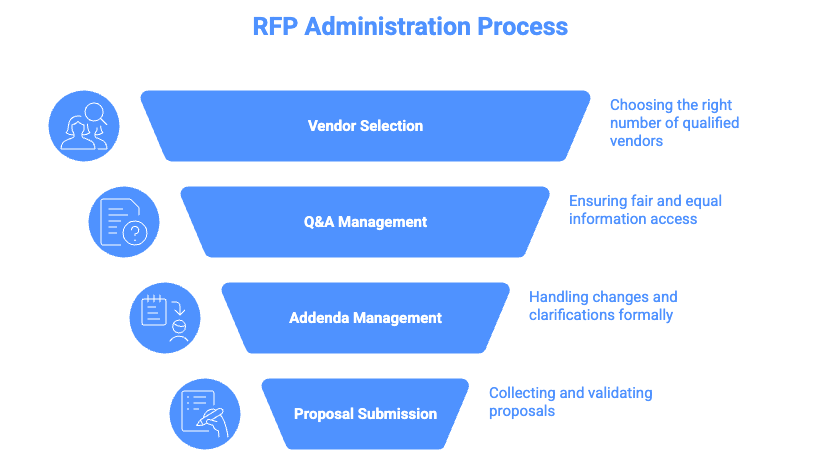
Invite the Right Number of Vendors
One of the most common misconceptions in procurement is that inviting more vendors increases competition and improves outcomes. In reality, it does the opposite.
Most successful RFP processes invite 5–8 qualified vendors. This range balances healthy competition with manageable evaluation effort.
- Inviting too few vendors limits choice and leverage.
- Inviting too many overwhelms evaluators, increases review fatigue, and reduces proposal quality.
Vendor selection at this stage should be intentional. Invitations are typically based on:
- Market research and prior experience
- Capability and solution fit
- Financial stability
- Industry reputation
- Strategic alignment
For complex or unfamiliar categories, many organizations issue an RFI (Request for Information) first to shortlist vendors before moving into a formal RFP.
The goal is not volume. It’s signal quality.
Managing the RFP Q&A Process
The Q&A period is where most RFPs either gain clarity or lose control.
A structured RFP Q&A process ensures all vendors have equal access to information and prevents hidden advantages. Best practices include:
- Set a fixed Q&A window
Questions are accepted only during a defined period, usually closing midway through the response timeline. - Require written question submissions
All questions should be submitted through a single, documented channel to maintain an audit trail. - Share answers with all vendors
Responses must be distributed to every participating vendor at the same time to preserve fairness. - Issue formal addenda for material changes
If a question reveals an error, ambiguity, or requirement change, it should be addressed through an official RFP addendum.
Informal side conversations, off-the-record clarifications, or one-on-one explanations introduce bias and legal risk. Even when well-intentioned, they undermine the integrity of the vendor selection process.
Managing Addenda and Amendments
When clarifications result in changes to requirements, timelines, or scope, organizations must issue formal RFP addenda or amendments.
Each addendum should:
- Reference the specific section being modified
- Clearly state what has changed
- Be shared with all vendors simultaneously
- Allow adequate time for vendors to adjust responses
Addenda become binding parts of the RFP and, eventually, the contract. Poorly managed amendments create confusion and expose organizations to disputes later.
Collecting and Validating Proposal Submissions
Proposal submission may seem administrative, but this step directly affects evaluation efficiency and fairness.
The RFP should clearly specify:
- Submission format (PDF, Word, online portal)
- Required documents and attachments
- Naming conventions and structure
- Submission deadline and timezone
- Page limits or response constraints
Clear proposal submission guidelines reduce disqualification risk and speed up evaluation. Once proposals are received, teams should immediately perform a compliance validation check, confirming:
- Submission was on time
- All required documents are included
- Mandatory requirements are addressed
- Format and structure rules are followed
Proposals that fail basic compliance checks should be disqualified before evaluation begins. This protects the process and prevents wasted effort.
Why Phase 3 Is Often Undervalued and Why It Matters
RFP administration doesn’t feel strategic. There are no flashy decisions or visible outcomes.
But this phase is what ensures that:
- Vendors trust the process
- Evaluators trust the results
- Leadership can defend the final decision
- The organization avoids procedural challenges
When Phase 3 is run well, evaluation becomes easier, faster, and far less contentious. When it’s rushed or informal, even strong RFPs unravel.
See how SparrowGenie supports complex RFPs without losing human oversight.
Phase 4: Evaluating and Scoring Proposals
This is the phase where the RFP process either earns credibility or completely loses it. Up until this point, you’ve designed the process. Phase 4 is where you prove that the process actually works. It’s where structure replaces opinion, and where stakeholder trust is either reinforced or quietly eroded.
Poor evaluation turns even a well-written RFP into a political exercise. Strong evaluation turns complex vendor decisions into something measurable, defensible, and repeatable.
Step 1: Compliance Screening (Pass / Fail)
Before any scoring begins, proposals must pass a baseline compliance review. This step exists to protect the integrity of the RFP evaluation process. Proposals that fail mandatory criteria should not advance, no matter how compelling the solution appears.
Common compliance checks include eliminating proposals that:
- Miss the submission deadline
- Lack required documents or certifications
- Fail regulatory, legal, or security requirements
- Ignore mandatory formatting or submission instructions
This is a strict pass/fail gate, not a judgment call. Allowing non-compliant proposals to move forward undermines fairness and exposes the organization to disputes later.
Step 2: Independent Weighted Scoring
Once proposals pass compliance, they move into detailed evaluation using a weighted RFP scoring model. Each evaluator scores proposals independently, using the predefined criteria and scoring rubric established during RFP creation. This independence is critical. It prevents:
- Early anchoring around a preferred vendor
- Groupthink driven by louder voices
- Political bias entering the scoring phase
Independent scoring also surfaces meaningful differences in interpretation. When one evaluator scores a proposal highly and another scores it poorly, that variance becomes a valuable signal, not a problem. Typical evaluation categories include:
- Technical and functional fit
- Commercial and pricing structure
- Vendor experience and references
- Implementation approach and timeline
- Support model and service levels
Each score should be documented with brief rationale. This documentation becomes essential during consensus discussions and executive review.
Step 3: Consensus Scoring and Alignment
After independent scoring, the evaluation team comes together for consensus scoring sessions. The goal here is not to average scores blindly. It’s to:
- Review scoring variances
- Understand the reasoning behind high and low scores
- Align on a shared interpretation of evaluation criteria
- Agree on final weighted scores for each vendor
These discussions are where blind spots are corrected and assumptions are challenged. Strong facilitation is important to ensure that no single function or individual dominates the conversation.
Consensus scoring significantly improves:
- Decision quality
- Stakeholder buy-in
- Auditability of the vendor selection process
It also makes it easier to explain why a vendor ranked higher or lower, not just that they did.
Step 4: Vendor Due Diligence
Before creating a final shortlist, teams should validate what vendors claimed in their proposals. RFP due diligence typically includes:
- Reference checks with existing or past customers
- Financial stability and viability assessment
- Delivery and implementation risk analysis
- Review of past performance on similar projects
- Validation of certifications, compliance, and legal standing
This step protects against over-polished proposals that don’t reflect reality. It also helps surface hidden risks that may not be obvious from written responses alone. Due diligence is especially critical for long-term, high-value, or mission-critical engagements.
Step 5: Creating the Shortlist
Based on weighted scores and due diligence findings, the evaluation team creates a shortlist of finalists. Most RFP processes shortlist 2–4 vendors. This number keeps final evaluation focused while preserving competitive tension. Shortlisted vendors typically move on to:
- Best and Final Offer (BAFO) requests
- Live presentations or solution demonstrations
- Deeper technical or commercial discussions
At this stage, the goal is no longer broad comparison. It’s final validation.
Why Phase 4 Is the Most Scrutinized Stage of the RFP Process
Evaluation is where every earlier decision is tested.
If requirements were vague, scoring becomes subjective.
If criteria weren’t defined upfront, consensus becomes political.
If documentation is weak, decisions become hard to defend.
Teams that treat Phase 4 as a structured, disciplined process consistently make better vendor selection decisions, and face far fewer internal and external challenges afterward.
See how modern teams run RFPs with speed, accuracy, and confidence.
Phase 5: Vendor Selection and Negotiation
At this stage, the RFP process shifts gears. You are no longer comparing options at a distance. You are confirming which vendor you can actually commit to. The focus moves from broad evaluation to risk reduction, expectation alignment, and deal clarity.
This phase is where good RFPs become real contracts or fall apart due to overreach, rushed negotiations, or misaligned expectations.
Best and Final Offer (BAFO)
The Best and Final Offer (BAFO) is a structured opportunity for shortlisted vendors to strengthen their proposals based on evaluation feedback. Rather than reopening the entire RFP, the BAFO process allows organizations to:
- Refine pricing and commercial terms
- Address identified gaps or weaknesses
- Clarify assumptions and delivery commitments
- Respond to outstanding questions from evaluators
BAFOs are typically requested from 2–4 finalists and are time-bound to maintain momentum. Importantly, BAFO is not a free-for-all renegotiation. It should be governed by clear instructions that specify:
- What vendors can and cannot change
- Which sections are open for revision
- The evaluation criteria for BAFO submissions
This controlled approach improves outcomes without undermining the fairness or structure of the original RFP process.
Final Presentations and Vendor Demonstrations
Shortlisted vendors are often invited to deliver final presentations or live demonstrations as part of the vendor selection process. These sessions serve a different purpose than written proposals. They help decision-makers assess factors that are difficult to evaluate on paper, including:
- Team fit and credibility
The people presenting are often the people who will deliver the project. Their clarity, confidence, and domain understanding matter. - Communication and responsiveness
How vendors handle questions, challenges, and pushback is a strong predictor of future working relationships. - Implementation realism
Live discussions reveal whether timelines, resourcing, and delivery plans are practical or overly optimistic. - Stakeholder confidence
Executives, IT leaders, legal teams, and business owners need to feel confident that the vendor understands their priorities.
Strong vendors tailor these sessions by audience, focusing on ROI and outcomes for executives, technical depth for IT teams, and risk management for legal and security stakeholders. Weak vendors recycle generic sales decks.
Contract Negotiation: Turning Proposals into Commitments
Once a preferred vendor emerges, attention turns to contract negotiation. This is not the time to introduce entirely new requirements or materially change the deal. The contract should reflect what was requested in the RFP and proposed by the vendor. Effective RFP negotiation best practices include:
- Staying within RFP scope
Major scope changes undermine the integrity of the procurement process and increase risk. - Improving terms, not weakening them
Negotiations should enhance buyer protections, service levels, and commercial clarity, not dilute commitments made in the proposal. - Documenting every change
All negotiated terms, assumptions, and concessions should be formally recorded to create a clear audit trail. - Never starting work before contract execution
Beginning work without a signed contract exposes organizations to legal, financial, and governance risk.
Common negotiation focus areas include pricing adjustments, payment terms, service level agreements (SLAs), implementation milestones, intellectual property rights, liability limitations, and termination clauses.
Why Phase 5 Requires Discipline, Not Speed
There is often pressure to “just get it signed” once a preferred vendor is identified. That’s when mistakes happen. Phase 5 exists to ensure that:
- The selected vendor truly aligns with expectations
- Commercial and delivery risks are addressed
- The organization is protected contractually
- The transition from RFP to execution is clean
Teams that rush this phase often pay for it later, through scope disputes, delivery delays, or costly renegotiations.
Phase 6: Post-Award Vendor Onboarding
The RFP process does not end when the contract is signed. In many organizations, this is where discipline quietly drops off. The deal is closed, the team moves on, and onboarding is treated as an operational handoff. That’s a mistake. Post-award vendor onboarding is where RFP promises turn into delivery reality. This phase determines whether the selected vendor actually delivers the outcomes outlined in their proposal or slowly drifts off course. Strong onboarding is not about paperwork. It’s about alignment, accountability, and momentum.
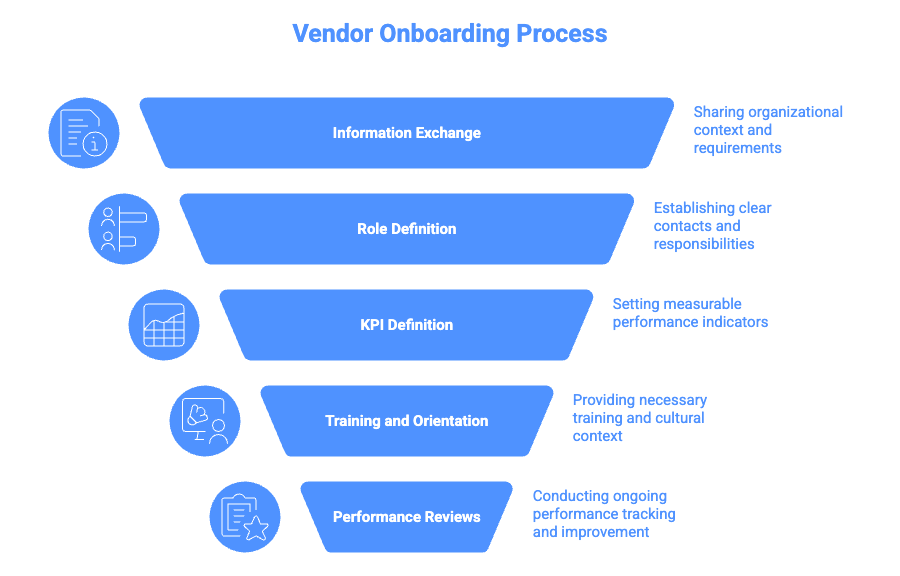
Information Exchange and Documentation
The first step in the vendor onboarding process is structured information exchange. Both sides need to clearly understand the operating environment they’re stepping into. This typically includes:
- Organizational context, mission, and business priorities
- Project background and decision rationale from the RFP
- Billing contacts and financial processes
- Security, compliance, and data handling requirements
- Outstanding documentation such as insurance certificates, certifications, and attestations
This step prevents early confusion and ensures the vendor is operating with the same assumptions that guided their proposal.
Role Definition and Communication Alignment
Many vendor issues don’t stem from capability gaps. They stem from unclear ownership. Effective onboarding establishes:
- Primary and secondary contacts on both sides
- Decision-making authority and escalation paths
- Communication cadence (weekly, bi-weekly, monthly)
- Reporting formats and checkpoints
This clarity reduces dependency bottlenecks and prevents the “I thought someone else owned that” problem that derails projects early.
Defining KPIs and Success Metrics
One of the most overlooked onboarding steps is translating RFP commitments into measurable performance indicators. During onboarding, teams should:
- Map proposal claims to concrete KPIs
- Define baseline metrics
- Agree on performance thresholds and review frequency
- Align incentives and consequences where applicable
KPIs might include delivery timelines, quality benchmarks, system uptime, compliance adherence, or service responsiveness. What matters is that success is defined before issues arise, not after.
Training and Orientation
Even the best vendor cannot perform effectively without context. Onboarding often includes:
- System access and technical training
- Security and compliance orientation
- Process walkthroughs
- Cultural expectations and working norms
This step ensures the vendor’s delivery team understands not just what to do, but how your organization operates.
Ongoing Performance Reviews and Governance
Onboarding does not end after the first kickoff meeting. High-performing organizations establish a cadence of ongoing vendor performance management:
- Regular check-ins to track KPIs
- Issue and risk reviews
- Continuous improvement discussions
- Periodic re-alignment on goals and scope
This governance loop ensures early issues are surfaced and addressed before they escalate into contractual disputes or failed outcomes.
Why Phase 6 Is the Real Test of the RFP Process
Every phase before this is about decision-making. Phase 6 is about execution. A disciplined onboarding process ensures:
- The vendor delivers what was promised
- Stakeholders remain aligned post-award
- Performance is tracked objectively
- Long-term value is realized from the RFP effort
Organizations that treat onboarding as a formality often wonder why “great vendors” underperform. The problem usually isn’t the vendor. It’s the handoff.
See how modern teams manage RFPs end to end.
RFI vs RFP vs RFQ: When to Use Each
RFI, RFP, and RFQ are often used interchangeably in conversation. In practice, they serve very different purposes within the procurement and vendor selection process. Using the wrong document at the wrong stage doesn’t just slow things down. It creates confusion for vendors, misaligned expectations for stakeholders, and poor decision outcomes for buyers. Understanding when to use each is a core procurement skill.
RFI: Request for Information
An RFI (Request for Information) is used at the earliest stage of the sourcing process, when organizations are still trying to understand the market. At this point, requirements are often high-level, and teams may not yet know:
- What solutions exist
- Which vendors are viable
- Whether to build, buy, or partner
RFIs are exploratory by design. They focus on gathering information rather than evaluating proposals. Typical use cases for an RFI include:
- Mapping available solutions and capabilities
- Understanding emerging technologies or vendors
- Narrowing a long vendor list into a shortlist
- Validating assumptions before committing to an RFP
RFIs are non-binding and informal. There is no obligation to buy, score, or select a vendor. The output is market insight, not a decision.
RFP: Request for Proposal
An RFP (Request for Proposal) is used once requirements are reasonably clear and the organization is ready to evaluate how vendors would solve a defined problem. This is the most comprehensive and structured procurement document. RFPs are appropriate when:
- The project is complex or high-impact
- Multiple evaluation criteria matter beyond price
- Solutions may differ in approach or methodology
- Long-term partnerships are being considered
- Risk, compliance, and delivery capability are critical
RFP responses are evaluated using predefined criteria such as technical fit, experience, pricing, implementation approach, and support model. The goal of an RFP is not just to choose a vendor. It is to choose the right approach, the right partner, and the best long-term value.
RFQ: Request for Quotation
An RFQ (Request for Quotation) is used when requirements are fully defined and price is the primary differentiator. RFQs assume that:
- Specifications are clear and standardized
- There is little variation in how vendors deliver
- Commercial terms are the deciding factor
Common RFQ scenarios include:
- Commodity purchases
- Hardware or standardized services
- Repeat buys with known specifications
- Final pricing confirmation after an RFP shortlist
RFQs are transactional by nature. Evaluation is typically price-led, with minimal qualitative assessment.
Why Using the Wrong Document Causes Problems
Misusing these documents creates avoidable friction:
- Running an RFQ when requirements are unclear forces vendors to guess
- Issuing an RFP when you’re still exploring the market wastes time
- Using an RFI when you need firm pricing delays decisions
Each document exists to answer a different question:
- RFI asks: What’s possible?
- RFP asks: What’s the best solution?
- RFQ asks: What’s the best price?
Using the right tool at the right stage makes the entire procurement process faster, fairer, and more effective.
Common RFP Mistakes to Avoid
Most failed RFPs don’t fail because of bad intent. They fail because of avoidable mistakes made early, repeated often, and rarely corrected.
These mistakes compound risk, slow decisions, frustrate stakeholders, and ultimately lead to poor vendor selection. Understanding them on both the issuer and vendor side, is critical to running an effective RFP process.
Common RFP Mistakes by Issuers
These mistakes originate on the buyer side and quietly undermine the entire procurement process.
Vague or Ambiguous Requirements
Unclear requirements are the fastest way to get unusable proposals. When expectations are loosely defined, vendors interpret them differently, leading to responses that vary wildly in scope, pricing, and approach. This makes objective comparison nearly impossible.
Vagueness also increases clarification cycles and raises the risk of post-award disputes when vendors deliver something different from what stakeholders expected.
Fix: Define requirements with clear outcomes, constraints, and examples. Precision beats verbosity.
Unrealistic Timelines
Rushed RFP timelines often reflect internal pressure rather than external reality. Short response windows limit vendor participation, reduce proposal quality, and discourage thoughtful solutions. Vendors either decline to respond or submit rushed, generic answers.
Evaluation timelines can also break when stakeholders aren’t available, creating bottlenecks and frustration.
Fix: Align timelines with complexity. For most complex RFPs, 15–20 business days for responses is a reasonable minimum.
Poor Stakeholder Alignment
Many RFPs are written by one team and evaluated by many. When stakeholders aren’t aligned upfront, requirements change mid-process, scoring criteria shift, and decisions stall during final approval. This is one of the most common causes of delayed or abandoned RFPs.
Fix: Align stakeholders during discovery. Lock priorities, decision rights, and trade-offs before issuing the RFP.
Price-Only Decision Making
Choosing the lowest-priced vendor may look defensible, but it often leads to higher total cost of ownership. Price-only decisions ignore delivery risk, support quality, scalability, and long-term value. They also encourage vendors to underbid and recover costs later through change requests.
Fix: Use weighted scoring that balances cost with capability, experience, and risk.
Undefined or Changing Evaluation Criteria
When evaluation criteria aren’t clearly defined or worse, are changed during evaluation, trust erodes quickly. Vendors lose confidence in the fairness of the process, and internal stakeholders struggle to justify decisions.
Fix: Define evaluation criteria and scoring rubrics before issuing the RFP. Apply them consistently.
Common RFP Mistakes by Vendors
Even well-run RFPs can fail when vendors submit weak or careless responses.
Generic, Boilerplate Responses
Recycling old proposals signals low effort and poor understanding of the buyer’s context. Evaluators can quickly tell when a response hasn’t been tailored to their industry, problem, or language. Generic answers rarely score well.
Fix: Mirror the buyer’s terminology, priorities, and success criteria. Customization matters.
Ignoring Instructions
This is one of the fastest ways to get disqualified. Missing required documents, exceeding page limits, ignoring formatting rules, or submitting late all signal risk and lack of attention to detail.
Fix: Treat submission instructions as mandatory requirements. Use a compliance checklist before submitting.
Jargon-Heavy Language
Overly technical or buzzword-heavy responses alienate non-technical evaluators and obscure value. If stakeholders can’t clearly understand what you’re proposing, confidence drops, even if the solution is strong.
Fix: Use plain language. Explain technical concepts in terms of business impact.
Feature Dumping Instead of Outcome Framing
Listing features without tying them to outcomes forces evaluators to do the translation work themselves. Buyers care less about what a product does and more about what it enables - speed, efficiency, compliance, or risk reduction.
Fix: Frame features as benefits tied to measurable outcomes.
Poor Formatting and Structure
Dense walls of text, inconsistent formatting, and unclear navigation make proposals hard to review. Even strong solutions can score poorly if evaluators struggle to find answers or compare responses across vendors.
Fix: Use clear headings, tables, bullet points, and consistent structure aligned to the RFP questions.
Why These Mistakes Matter More Than Teams Realize
RFP mistakes don’t just affect scores. They affect:
- Evaluation confidence
- Decision speed
- Stakeholder trust
- Long-term vendor success
Most RFP failures aren’t dramatic. They’re slow, quiet, and expensive. Teams that actively avoid these mistakes on both sides of the process, consistently achieve better outcomes, fewer disputes, and stronger partnerships.
How Technology Is Changing the RFP Process
AI-powered RFP platforms now enable:
- Automated requirement analysis
- Faster proposal creation
- Built-in compliance checks
- Centralized knowledge reuse
- Real-time collaboration
Organizations using modern RFP tools report dramatically shorter cycles and higher-quality decisions compared to manual workflows.
See how teams fix the RFP mangement process, not just the document.
Conclusion
The RFP process is not just a procurement formality. It’s a decision system that shapes vendor relationships, long-term costs, and execution success.
When run well, a structured RFP process brings clarity to complex buying decisions. It aligns stakeholders early, sets fair expectations for vendors, replaces gut feel with defensible scoring, and reduces risk at every stage, from discovery to onboarding. When run poorly, it does the opposite: slows teams down, creates internal friction, and locks organizations into avoidable compromises.
What this guide makes clear is that successful RFPs are not about writing longer documents or inviting more vendors. They’re about clear requirements, disciplined evaluation, and controlled execution across every phase of the RFP lifecycle.
This is also where modern RFP teams are rethinking how the process is run. As RFP volumes grow and buying committees become more complex, manual coordination, scattered knowledge, and ad-hoc scoring models start to break down.
Platforms like SparrowGenie are built for this reality, helping teams centralize approved answers, apply consistent evaluation logic, respond faster without sacrificing accuracy, and maintain control across security, compliance, and stakeholder reviews. The goal isn’t to replace human judgment, but to support it with structure, speed, and confidence.
Ultimately, the organizations that win more RFPs, and make better vendor decisions, are the ones that treat the RFP process as a strategic capability, not a reactive task.
Master the process, and every RFP becomes less about paperwork and more about making the right call.
Ready to see how AI can transform your RFP process?
Product Marketing Manager at SurveySparrow
A writer by heart, and a marketer by trade with a passion to excel! I strive by the motto "Something New, Everyday"