How to Fix Proposal Approval Chaos & Boost Deal Velocity

Article written by
Kate Williams

INSIDE THE ARTICLE
SHARE THIS ARTICLE
Summary
Slow, messy approval workflows are killing deals and burning out sales teams. This blog breaks down how manual email chains and Slack chases lead to missed deadlines, wrong pricing, and lost revenue. Learn how to build an intelligent approval system—with automation, smart routing, and clear accountability—that slashes turnaround times and boosts team performance.
Tired of proposals dying in inbox purgatory, chasing “the latest” security answer, and the last-minute redlines nuking your timeline?
Good. Because proposal approval chaos is solvable. In this playbook, you’ll turn scattered content and ad-hoc reviews into a governed workflow that ships compliant drafts in minutes, routes only what’s risky, and moves deals at the speed your forecast demands.
What do we mean by “Proposal Approval Chaos”?
Proposal approval chaos is what happens when every RFP, RFI, questionnaire, DDQ, renewal, and custom proposal turns into a one-off crisis instead of a governed, guided workflow.
You’ll recognize it if:
- Response content lives in docs, Slack, email, and tribal memory.
- Security/legal/commercial language gets rewritten from scratch for every buyer.
- There’s no single source of truth, so every stakeholder wants to “just take one last look.”
- Approvers get looped in too late, so they panic-edit at the 11th hour to protect the company.
Chaos shows up as delay. Delay shows up in the pipeline as slippage.
Now let’s call it what it is: revenue drag.
And if you’re in a competitive deal, drag = dead.
Why Does Approval Chaos Destroy Deal Velocity?
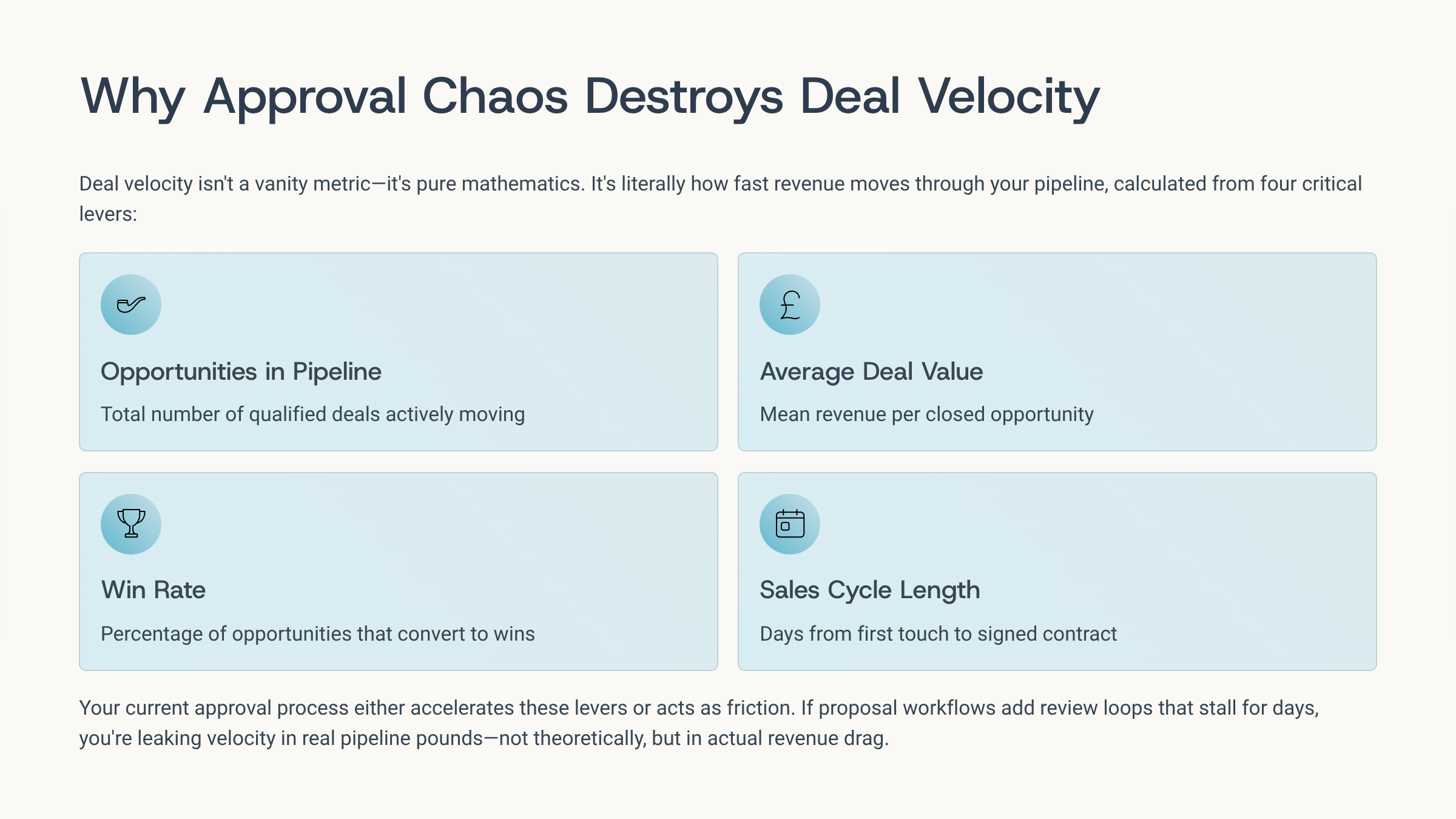
Deal velocity is not a vanity metric. It’s math. It’s literally how fast revenue moves through your pipeline.
Velocity comes from four levers:
- Number of opportunities in pipeline
- Average deal value
- Win rate
- Sales cycle length (in days)
Those four are multiplied together (1, 2, 3) and then divided by sales cycle length (4). If you can increase any of the first three or shrink the last one, your velocity goes up.
Now look at your current approval process.
Ask yourself:
- Does our proposal workflow help us send more qualified proposals to more buyers faster?
- Does it make it easy to package higher-value configurations and expansions without needing a mini war-room?
- Does it help us close at a higher rate by guiding the buyer through the decision instead of just “sending the PDF and praying”?
- Does it cut review time or does it add review loops that stall for days?
If the answer is “no” to any of those, you’re leaking velocity in real terms. Not theoretically. In pipeline dollars.
Root Cause for the Proposal Approval Chaos
Most teams still do proposal approvals like this:
- Buyer drops an RFP or “Can you send us a proposal by EOD?”
- Sales scrambles.
- Everyone else “reviews” instead of “advises.”
- We ship whatever we could get signed off.
That’s response mode.
Response mode is high-effort, low win rate. Because you’re letting the buyer (or procurement, or InfoSec) define the entire frame. You’re just filling boxes.
High-performing teams do something very different: they prescribe.
Prescribing means you proactively shape the narrative, the requirements, and even the evaluation lens — instead of just answering what was asked.
In enterprise deals, winning teams don’t blindly accept buyer checklists. They say, openly: “These requirements are written for the old way of doing things. You told us you actually want [X outcome, Y risk reduction, Z governance model]. We’re going to respond in that frame.”
That move — reframing outdated asks into forward-looking value — does two things:
- It positions you as a trusted advisor, not a vendor.
- It justifies why your answer is “the right answer,” not “non-compliant.”
That is not theory. That’s how experienced enterprise sellers turn misaligned RFPs into winnable cycles: they step in, reshape expectations, and guide the buyer toward modern criteria instead of legacy templates.
If you’re not doing that, Legal will keep “fixing language,” Security will keep “protecting posture,” and you’ll keep losing to the vendor who guided procurement instead of obeying procurement.
The New Model: Governed, Guided, Auditable Proposal Approvals
Let’s break down what “good” actually looks like.
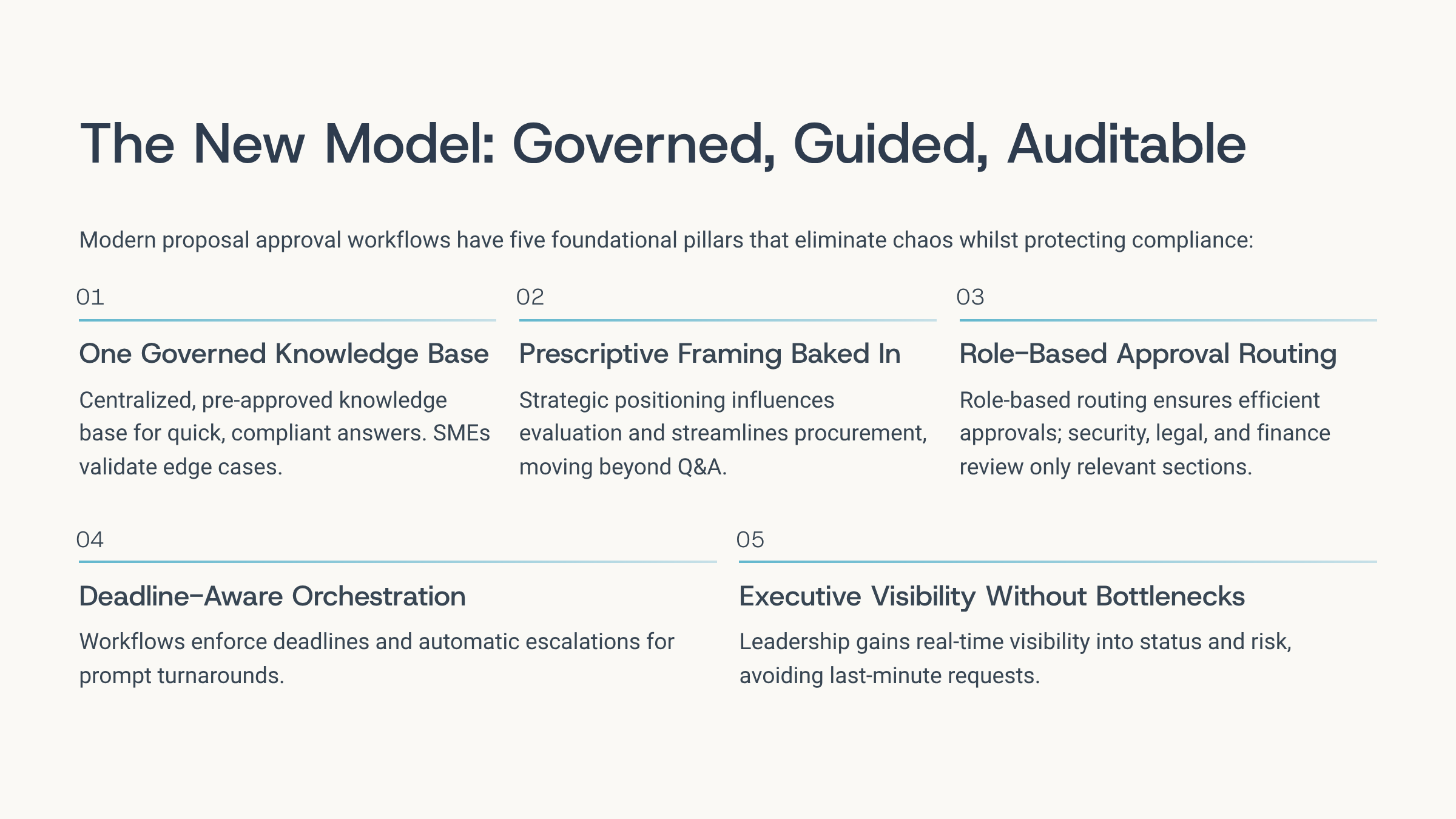
A modern proposal / RFP approval workflow has five pillars:
- One governed knowledge base, not 47 docs
SMEs spend 10 minutes validating edge cases, not 3 hours retyping boilerplate.
- Pre-approved answers for security, compliance, architecture, roadmap, commercials.
- Each answer has an owner, a last-reviewed date, and an expiry.
- Low-confidence answers (outdated, conflicting, or missing proof) are auto-flagged for SME review — not the entire doc.
- Prescriptive framing baked in
You’re not just filling in Q&A. You’re injecting positioning: “Here’s how progressive teams handle this today, and here’s how we support that model.” How to Win More RFPs
That’s how you shift the evaluation in your favor — and reduce back-and-forth later when procurement asks, “Why don’t you do it the old way?”
- Role-based approval routing
Security only sees security. Legal only sees liability/terms. Finance only sees pricing structure. No more “reply-all and hope someone reads slide 37.” - Deadline-aware orchestration
The workflow knows: “This must go out Thursday 4 PM to hit the portal/board review/renewal window.” So it enforces fast turnarounds and escalations automatically instead of relying on “friendly nudges.” - Executive visibility, not executive bottleneck
Leadership sees status and risk (“at 92% compliance confidence, pending legal signoff”), not a 57-page attachment at 11:58 PM.
That’s how you get from “please approve ASAP” chaos to an approval engine that runs like pipeline infrastructure.
7-Step Playbook to Fix Proposal Approvals and Accelerate Deal Velocity
This is the operating model I recommend to CROs, RevOps, Proposal Teams, Security, and Legal.
1. Define the standard proposal package
Lock the structure. Scope. T&Cs range. Support model. Service levels. Security posture. No freestyle. When there’s a standard default, “exceptions” become visible, measurable, and auditable.
2. Centralize source-of-truth content
Build (or adopt) a governed content library for proposal language, RFP responses, and approval-ready answers. Every reusable block should have:
- Owner
- Last review date
- Confidence level
- Evidence/attachment
If this feels “heavy,” reframe: you are trading random Slack scrambles for controlled reuse at scale. That’s how you stop rewriting the same answer 32 times a quarter.How to Win More RFPs
3. Route only what’s risky
Don’t send the whole doc to Legal. Send only the paragraphs that fall outside standard commercial language. Don’t send the whole doc to Security. Send only the claims that touch encryption, data residency, auditability, and breach notification.
You will literally cut review time in half just by not forcing experts to proofread what they’ve already approved.
4. Walk the buyer through the proposal live
Never “fire off the PDF” and hope. Best practice: book a review call, walk them through pricing, delivery model, responsibilities, assumptions, and risk language before you ever hand them the doc. Why? Because if they see something confusing and you’re not there to clarify, they stall. And once a buyer stalls, that deal sits.Are you missing this key to boo…
If you absolutely must send it asynchronously, record a quick walkthrough video and send that first — then send the actual document after they’ve watched it. This keeps context intact and prevents “we’re going with someone cheaper” knee-jerk reactions based on a misunderstood line item. Are you missing this key to boo…
5. Track engagement signals
Modern proposal delivery gives you visibility into:
- Who opened it
- How long they spent in each section
- Which parts got forwarded internally
- How many total views across the buying committee (10+ views is normal in multi-stakeholder enterprise buys)
Use that data like radar. If Security is camped on Terms & Liability for 14 minutes, you know exactly what to preempt in your follow-up. That’s how you keep momentum instead of waiting in silence.
6. Attach an expiry
Don’t leave proposals open forever. Give a review/accept-by date that aligns with the buyer’s own internal approval cadence. Deadlines force internal consensus. No deadline = “We’ll circle back next quarter.” This alone pulls deals forward and keeps sales cycle length from ballooning.
Pro tip: Don’t always expire on the last day of the month. Mid-month expiries give you room to recover slippage without blowing your forecast.
7. Instrument the dashboard
If you can’t measure it, the chaos will creep back. At minimum, track:
- Time to first draft
- Time in legal review
- Time in security review
- Total cycle from “RFP received / proposal requested” to “final signed submission sent”
- % of answers using approved language
- % of answers with current owner + valid review date
- Final compliance/accuracy confidence of the submission
This is how you turn “approvals feel slow” into “Security is now the bottleneck +4.6 days avg, so let’s fix that with better default language.”
How Clean Approvals Increase Each Lever of Sales Velocity
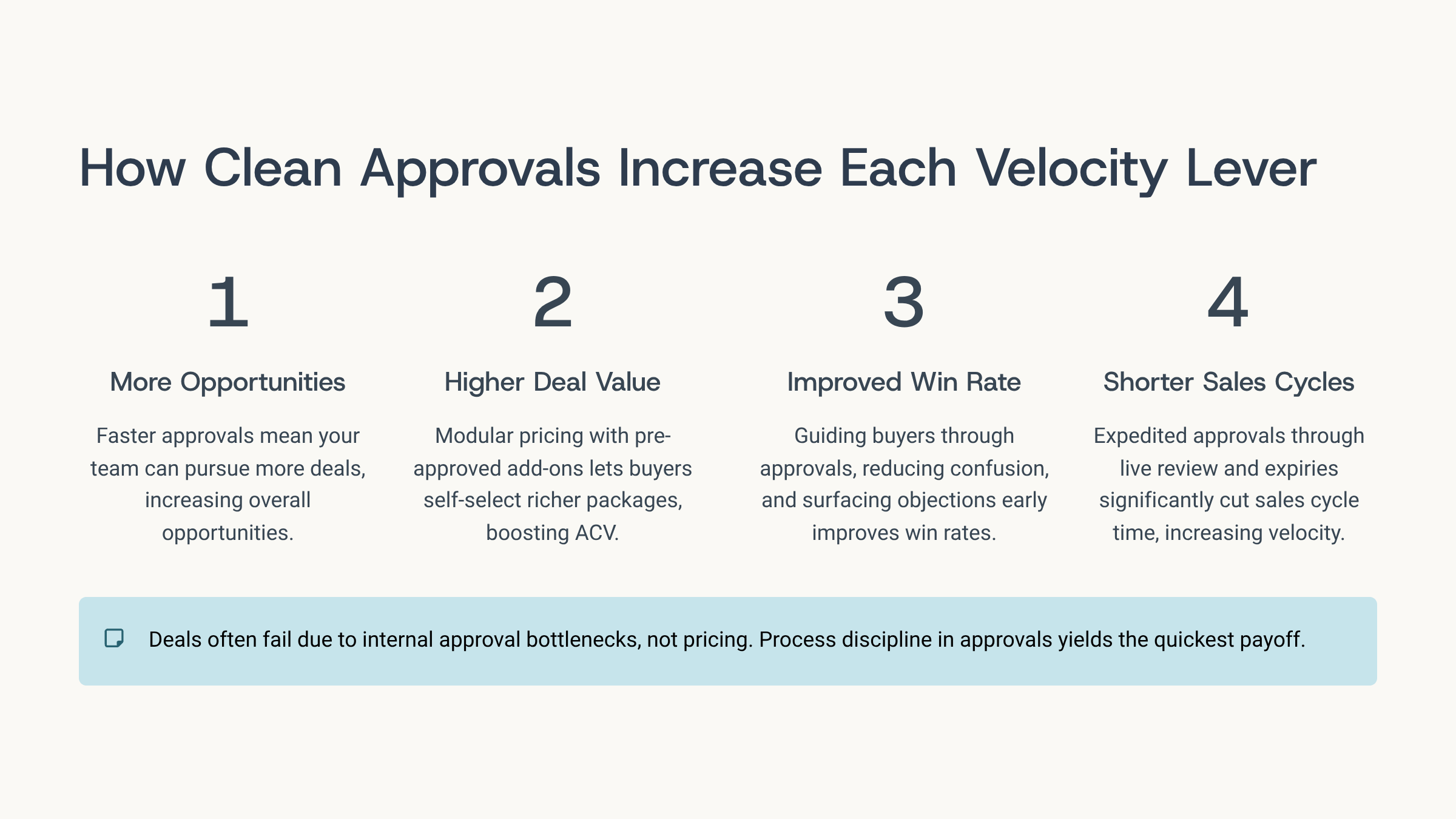
Let’s map the impact straight to the four levers of velocity.
1. Number of opportunities
When it takes hours (not weeks) to generate a compliant, on-brand, defensible proposal, your team can respond to more viable deals — including “smaller” ones you would’ve ignored because the approval effort used to be too painful. That means more total shots on goal.
2. Average deal value
Your approval workflow should support modular pricing (core + add-ons + expansion paths), not force a single flat number. When you can present options cleanly — and get them pre-approved — buyers self-select into richer packages without negotiation drag. That quietly lifts ACV.
3. Win rate
When you control framing, guide the buyer through the approval logic, and respond like a strategic advisor (not a desperate vendor), you don’t just “send a quote.” You reduce confusion, surface objections early, and build internal consensus across the buying committee. That drives higher close rates even in tight budget environments.
Also: prescribing modern best practice (not just parroting back legacy requirements) positions you as the partner who “gets it,” not commodity line items.
4. Sales cycle length
This is where approval chaos hurts you the most — and where process discipline pays off the fastest. Most deals don’t die because of pricing. They die because “the proposal is stuck with legal” or “security still has questions.” If your workflow routes only the deltas, if you review live, if you set expiries, and if you chase in-the-moment (right when they’re reading), you cut days or even weeks off cycle time.
Shorter cycle = mathematically higher velocity.
How to Roll Out a Scalable Proposal Approval Process
Sales wants speed. Legal wants protection. Security wants accuracy. Finance wants predictability. RevOps wants visibility. Everyone’s incentives clash unless you design the system to protect all of them without asking any of them to work harder.
The unlock is this:
- Sales shouldn’t “wing it.”
- Legal shouldn’t “rewrite everything.”
- Security shouldn’t “get dragged in at the end.”
- Execs shouldn’t “get surprised at forecast review.”
You fix that with:
- A governed content library of approved answers.
- A routing model that only escalates true exceptions.
- A review motion that’s live and prescriptive, not “Here’s the PDF when you get a sec.”
Once those three are in place, you’ll see something interesting:
- Fewer midnight escalations
- Fewer blown deadlines
- Fewer “this doesn’t sound like us” edits
- More deals closing on the timeline you forecasted, not two quarters later
That’s not just nicer. That’s material pipeline control.
Final words
No. Proposal approval chaos is not “just part of enterprise sales.” It is fixable.
Yes. You can implement a governed, auditable, prescriptive approval workflow that protects compliance, accelerates submission, and drives higher deal velocity—without adding headcount and without forcing Security, Legal, and RevOps to manually police every answer on every RFP.
What this really means is: If your CRM is the system of record, your proposal/RFP workflow can become the system of action — the engine that reads the ask, assembles approved language, routes only what’s risky, walks the buyer through the story, and drives the deal to signature on the timeline you actually forecasted.
If you want that outcome, this is literally what SparrowGenie is built to do: a secure, AI-powered sales intelligence engine that centralizes approved content, enforces compliant workflows, and helps revenue teams move faster without losing control. SparrowGenie keeps humans in charge, keeps answers accurate, and keeps deals moving.
Ready to see how AI can transform your RFP process?
Product Marketing Manager at SurveySparrow
A writer by heart, and a marketer by trade with a passion to excel! I strive by the motto "Something New, Everyday"