10 Proven Capture Management Tactics That Secure Major Deals

Article written by
Kaushik Natarajan

INSIDE THE ARTICLE
SHARE THIS ARTICLE
Summary
This guide breaks down 10 proven tactics that the best capture teams use to secure major deals, from rigorous go/no-go frameworks and early stakeholder engagement to competitive intelligence, win theme development, and AI-powered capture workflows.
Most proposal teams are playing defense. They wait for an RFP to land, scramble to assemble responses, and hope their offer stands out against competitors who may have been quietly positioning themselves for months.
That approach rarely wins the big ones.
Capture management flips the script. It is the disciplined, proactive process of identifying, qualifying, and pursuing high-value contracts long before a formal RFP is even released. Where reactive proposal writing starts at the starting gun, capture management starts 12 to 18 months earlier, shaping requirements, building relationships, and developing win strategies that make your proposal the one evaluators already expect to see.
The difference in outcomes is staggering. Organizations with structured capture processes routinely achieve win rates of 40 to 60 percent, compared to the industry average of roughly 21 percent.
So how do the best capture teams do it? Here are 10 proven tactics that separate market leaders from bid-and-hope competitors.
1. Implement a Rigorous Go/No-Go Framework
Why This Is the First Gate That Matters
Pursuing every opportunity that comes across your desk is the fastest way to burn resources and tank your win rate. A disciplined go/no-go framework forces your team to evaluate whether a deal is genuinely winnable and strategically aligned before you invest a single dollar in pursuit.
Without qualification rigor, your bid and proposal budget gets spread thin across low-probability pursuits. One technology firm that implemented a structured go/no-go process eliminated 30 percent of low-fit RFPs from their pipeline and reallocated those resources to high-potential deals, dramatically improving their overall win rate.
How to Build Your Go/No-Go Matrix
Effective qualification looks at multiple dimensions simultaneously. Score each factor against a standardized matrix before committing:
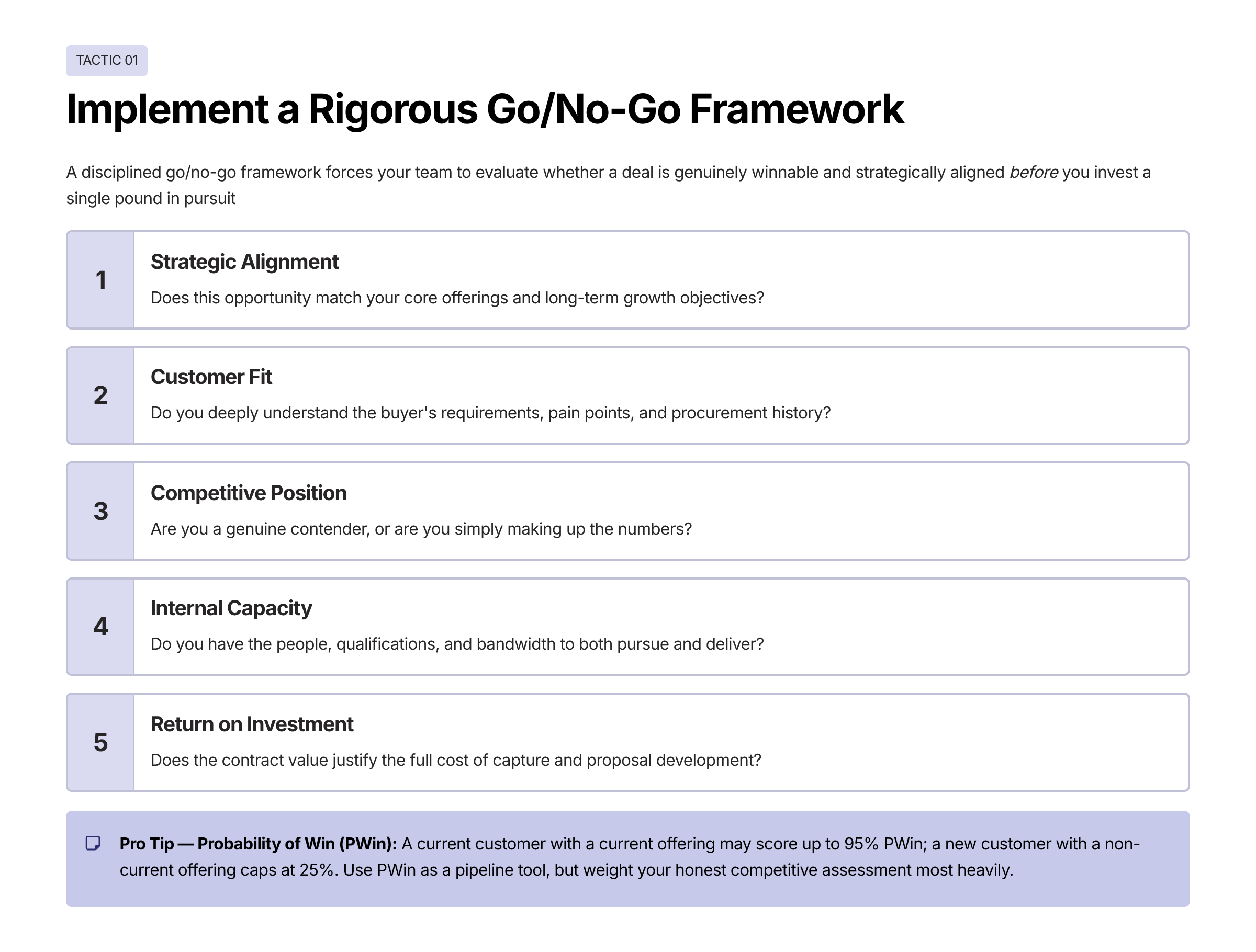
- Strategic alignment: Does this opportunity match your core offerings and long-term growth objectives?
- Customer fit: Do you deeply understand the buyer's requirements, pain points, and procurement history?
- Competitive position: Are you a genuine contender, or are you making up the numbers?
- Internal capacity: Do you have the people, qualifications, and bandwidth to both pursue and deliver?
- Return on investment: Does the contract value justify the cost of capture and proposal development?
Using Probability of Win as a Quantitative Input
The Probability of Win (PWin) metric brings structure to your go/no-go decision. It blends weighted criteria across customer familiarity, competitive landscape, solution fit, and past performance. A common model sets maximum PWin thresholds based on how well you know the customer and the offering: a current customer with a current offering might score up to 95 percent, while a new customer with a non-current offering caps at 25 percent.
Pro tip: PWin is a useful pipeline management tool, but leading capture experts caution against over-reliance. What matters more is an honest assessment of your competitive position against specific rivals.
Want to stop wasting bid resources on low-fit RFPs? See how SparrowGenie helps teams qualify smarter.
2. Engage Early, Long Before the RFP Drops
The Pre-RFP Advantage
If you are only engaging when an RFP lands in your inbox, you are already behind. Teams that engage with prospects before the RFP stage are statistically twice as likely to win. Early engagement lets you shape requirements, understand decision drivers, and build the kind of relationships that convert you from an unknown vendor to a preferred partner.
For strategic, large-scale contracts, capture planning should begin 12 to 18 months before the bid. Even for medium-value deals, consistent pre-solicitation engagement through industry briefings, responses to sources sought notices, and RFI participation creates a meaningful advantage when the formal solicitation drops.
What Pre-RFP Engagement Looks Like in Practice
- Monitor agency forecasts, RFIs, and sources sought notices to spot emerging opportunities early.
- Schedule discovery meetings with program managers and end users to uncover goals, constraints, and evaluation priorities.
- Review past solicitations and FOIA requests to understand what previous contractors succeeded or failed at delivering.
- Attend industry days and respond to RFIs to signal capability and start building trust.
- Document every interaction and piece of customer intelligence for use in proposal development.
The Highest-Leverage Move: Shaping Requirements
The most advanced capture teams do not just respond to requirements. They help write them. By sharing thought leadership, capability briefings, and solution concepts with stakeholders during the pre-solicitation phase, skilled capture managers can influence how requirements are structured. This often tilts evaluation criteria in their favor. It is the highest-leverage activity in capture management, and it only becomes possible through sustained early engagement.
3. Build a Comprehensive Capture Plan
The Capture Plan as a Living Document
A capture plan is the operational backbone of every pursuit. It is not a one-time document you file and forget. It is a dynamic, evolving roadmap that captures customer intelligence, competitive analysis, solution strategy, teaming decisions, and pricing rationale in a single place.
The Shipley methodology recommends that every capture plan include a thorough opportunity assessment, a competitive assessment, an assessment of your own capabilities, a teaming assessment, and an initial price-to-win analysis.
Core Components of an Effective Capture Plan
Section | Purpose |
|---|---|
Opportunity Overview | Contract size, timeline, key requirements, evaluation criteria |
Customer Intelligence | Decision-makers, hot buttons, procurement history, past performance expectations |
Competitor SWOT, incumbent strengths and vulnerabilities, likely pricing | |
Win Strategy & Themes | Top 1-2 win themes aligned to customer priorities |
Solution Framework | Mapping of your capabilities to customer requirements |
Teaming Strategy | Partner roles, workshare split, small business considerations |
Price-to-Win Analysis | Competitive pricing benchmarks and target price range |
Risk Register | Performance, compliance, and competitive risks with mitigations |
Action Plan & Timeline | Milestones, decision gates, customer call plan |
Establishing Decision Gates
Effective capture plans include formal decision gate reviews at key milestones. These gates prevent teams from persisting in unwinnable pursuits through sunk-cost momentum. At Gate 1, assess strategic fit. At Gate 2, evaluate solution readiness. At Gate 3, validate pricing and compliance. Each gate is a checkpoint where you decide whether to advance, modify the strategy, or cut your losses and redirect resources.
Building a capture plan is easier when your knowledge base is already organized, verified, and searchable.
4. Map and Engage Key Stakeholders
Why Stakeholder Mapping Is Non-Negotiable
No one awards high-value contracts to organizations they do not know. Major deals involve networks of decision-makers, influencers, technical evaluators, contracting officers, and end users. Each has different priorities and different levels of authority. A sophisticated capture team maps this entire ecosystem and develops tailored engagement plans for each key contact.
Building a Stakeholder Engagement Plan
- Identify the full buying team: Map the contracting officer, program manager, technical evaluators, end users, and budget holders separately.
- Understand each stakeholder's motivations: What does the contracting officer prioritize? What does the program manager care about? What keeps end users up at night?
- Differentiate levels of influence: Not all stakeholders carry equal weight. Identify your internal champions and executive sponsors who can advocate for your solution.
- Track all interactions: Document every meeting, email, and phone call. These records become invaluable when crafting proposal narratives and win themes.
The data speaks for itself. Deals pursued through warm, relationship-led channels achieve win rates of 30 to 40 percent, compared to just 10 to 18 percent for cold outbound pursuits.
5. Conduct Deep Competitive Intelligence
Intelligence Gathering as a Strategic Weapon
Understanding the competitive landscape enables you to differentiate your offering, anticipate evaluator objections, and develop pricing strategies that are competitive without sacrificing margin. Competitive intelligence is not a one-time activity. It should be ongoing throughout the capture lifecycle.
Key Intelligence Sources and Methods
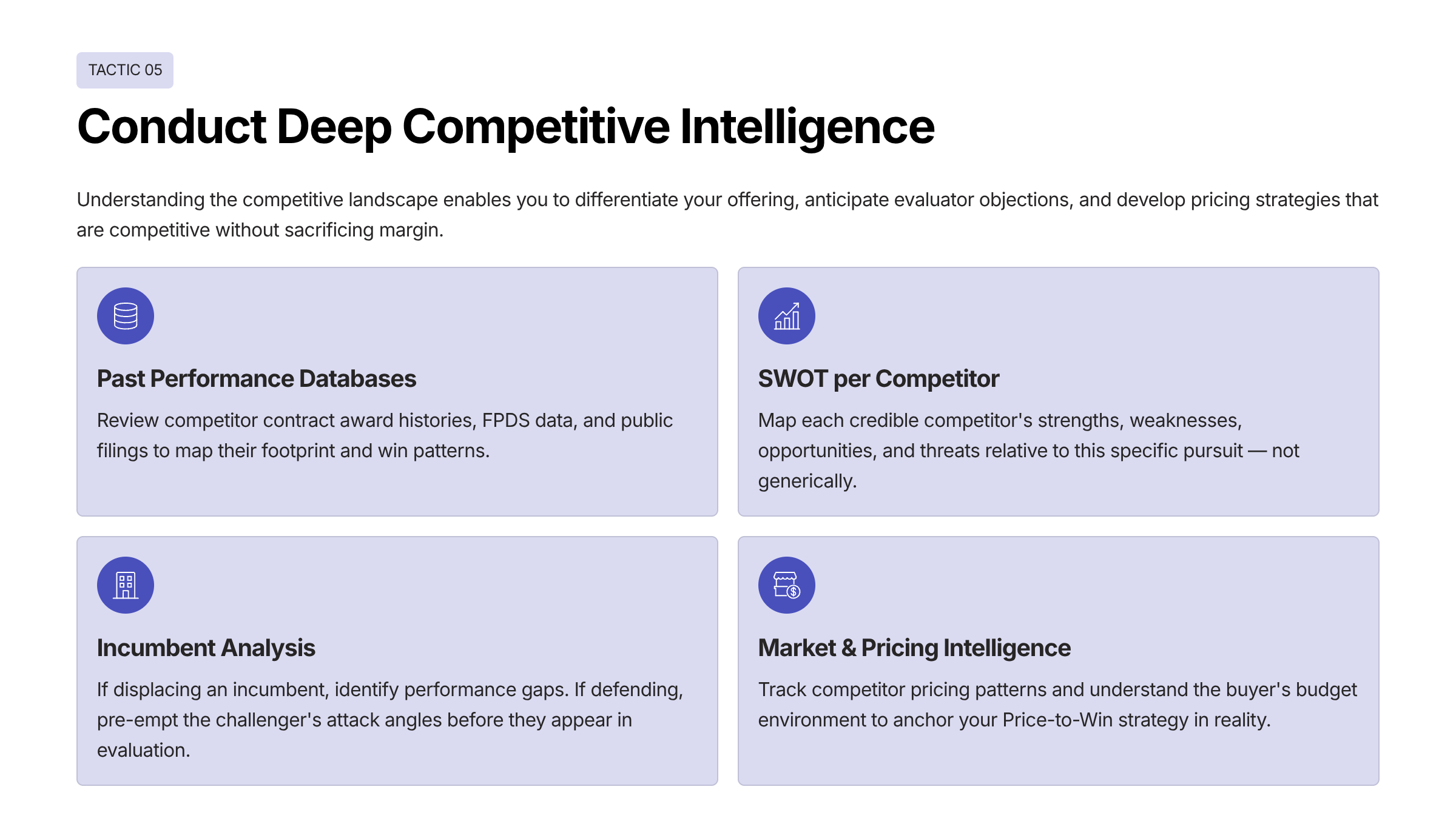
- Past performance databases: Review competitor contract award histories and public filings.
- SWOT analysis on each credible competitor: Map their strengths, weaknesses, opportunities, and threats relative to this specific pursuit.
- Win/loss data from similar bids: Analyze why competitors won comparable contracts.
- Incumbent analysis: If displacing an incumbent, identify performance gaps and customer pain points. If defending as the incumbent, pre-empt challenger attack angles.
- Market and pricing intelligence: Track competitor pricing patterns and understand the buyer's budget environment to shape your Price-to-Win strategy.
Use Bidder Comparison Charts to systematically map your strengths and weaknesses against each credible competitor across the evaluation criteria that matter most. This analysis directly informs which differentiators to emphasize in your proposal and how aggressively to price.
Stop losing deals to competitors who simply organized their knowledge better.
6. Develop a Customer-Centric Solution Framework
Aligning Your Solution to Customer Hot Buttons
A winning proposal does not just describe what you do. It shows exactly how your solution addresses the customer's explicit and implicit requirements, in language the customer recognizes as their own. The customer-centric solution framework is built during the capture phase and handed off to the proposal team as the backbone for all content.
Steps to Build the Solution Framework
- Identify and prioritize customer requirements. Separate mandatory compliance items from high-value differentiators that drive scoring.
- Map your solution features to each requirement. Create a requirements traceability matrix that ensures complete coverage.
- Highlight unique differentiators. Focus on capabilities that are genuinely superior to the alternatives your customer could choose.
- Quantify measurable benefits. Win themes built around specific, provable outcomes are far more persuasive than generic capability claims.
- Preview the solution with the client. Validate your approach through customer meetings before RFP release to position your solution as the reference point.
One consulting firm increased its win rate by 20 percent after systematically customizing solution frameworks for each major client based on detailed needs analysis.
7. Craft Compelling Win Themes and Discriminators
The Architecture of a Winning Narrative
Win themes are the concise, compelling messages that run as a consistent thread throughout your proposal. They align your solution's unique value with the buyer's highest priorities and answer the evaluator's fundamental question: Why should we select your company?
Effective win themes have three structural components: the Feature (what is important to you), the Benefit (what is important to your customer, expressed in their terms), and the Proof (quantifiable evidence that substantiates the benefit).
Types of Win Themes
Type | Description | Example |
|---|---|---|
Discriminator | Uniquely yours. No competitor can claim it. | We are the only provider with a certified FedRAMP High ATO on this platform. |
Differentiator | Superior to most, though not exclusive to you. | Our 97.8% uptime record over 5 years exceeds the 99.5% SLA requirement. |
Non-unique Strength | Table stakes, but must be stated if evaluators need it. | As a certified small business, we meet the set-aside requirements. |
Ghost/Turnaround | Converts a weakness into a positive, or surfaces a competitor vulnerability. | Our dedicated transition team eliminates the top incumbent risk: loss of institutional knowledge. |
Win themes function across three phases: during capture (shaping positioning strategy), during proposal writing (focusing writer effort), and during evaluation (giving evaluators language to justify selection).
Your win themes are only as strong as the proof behind them. Build a knowledge base that delivers evidence on demand.
8. Build a Strategic Teaming Architecture
Why the Right Team Wins the Right Contracts
Many major contracts require a team-based approach where capabilities, certifications, geographic coverage, and small business requirements must be assembled into a coherent offering. Teaming decisions made during the capture phase determine whether you have the full capability stack to win, not just the proposal content to respond.
Building Your Teaming Strategy
- Identify capability gaps: Map what you cannot self-perform or lack the past performance to credibly claim.
- Select partners for strategic value: Choose teammates based on their ability to strengthen your competitive position, not just their willingness to accept workshare.
- Negotiate teaming agreements early: Exclusive teaming agreements prevent your differentiators from appearing in competitor proposals.
- Define workshare clearly: Ambiguous workshare creates friction at execution. Define roles, responsibilities, and percentages at the teaming agreement stage.
- Assess the team's PWin: As a subcontractor, evaluate the prime's realistic probability of win before signing an exclusive agreement. 40 percent of zero is still nothing.
For recompete contracts, subcontractors should carefully evaluate whether they are teaming with an incumbent who has a strong track record or a challenger whose competitive position is unproven.
9. Conduct Rigorous Color Team Reviews
Structured Reviews as Quality Gates
Color team reviews are the most cost-effective way to improve proposal quality. They serve as structured checkpoints that catch compliance gaps, sharpen win themes, and pressure-test solution messaging before submission. They transform the capture strategy developed pre-RFP into a polished, evaluator-ready document.
The Color Team Review Sequence
Review | Timing | Purpose | Who Participates |
|---|---|---|---|
Blue Team | Proposal kickoff | Validate win themes, confirm compliance matrix, align strategy | Capture leads, proposal manager, compliance specialists |
Pink Team | First full draft | Assess solution strength, narrative structure, Section L/M alignment | SMEs, technical leads, solution architects |
Red Team | Near-final draft | Independent evaluation simulation. Score against RFP criteria, identify weaknesses | Independent reviewers who did not draft content |
Gold Team | Final polish | Executive sign-off, final messaging coherence, risk review | Senior leadership, business development |
The goal is a persuasive proposal that meets all RFP requirements, conveys a unified message, reflects a cost-effective solution, and addresses the customer's priorities as shaped by pre-RFP capture intelligence.
10. Implement Price-to-Win Analysis
Competitive Pricing as a Science, Not a Guess
Price-to-Win is a structured methodology for determining the optimal bid price based on competitive intelligence, customer budget constraints, and value perception, rather than simply marking up internal costs. In highly competitive procurements, organizations that skip this analysis frequently lose to competitors who price more strategically, even when their technical solution is superior.
The Price-to-Win Methodology
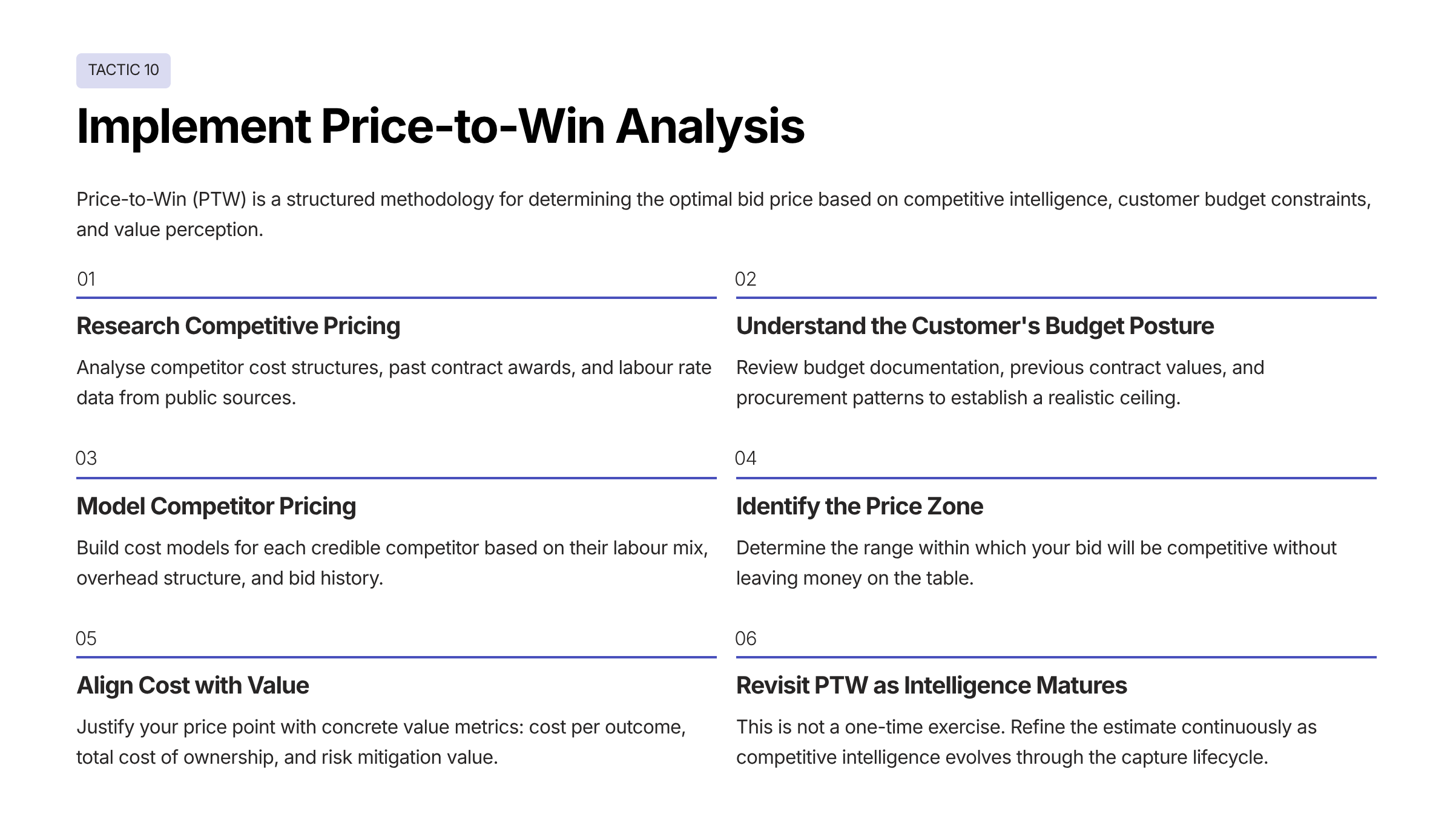
- Research the competitive pricing landscape: Analyze competitor cost structures, past contract awards, and labor rate data.
- Understand the customer's budget posture: Review budget documentation, previous contract values, and procurement patterns.
- Model competitor pricing: Build cost models for each credible competitor based on their labor mix, overhead structure, and bid history.
- Identify the price zone: Determine the range within which your bid will be competitive without leaving money on the table.
- Align cost with value: Justify your price point with concrete value metrics such as cost per outcome, total cost of ownership, and risk mitigation value.
- Revisit PTW as intelligence evolves: This is not a one-time exercise. As competitive intelligence matures during the capture phase, refine the estimate.
Bonus: Build a Continuous Win/Loss Learning Loop
Every deal outcome, win or loss, is a rich source of strategic intelligence. Organizations that build a disciplined win/loss analysis program compound their competitive advantage over time, identifying systematic patterns in evaluation criteria, pricing sensitivity, and proposal messaging effectiveness.
What a Post-Bid Debrief Should Capture
- Why evaluators scored your proposal higher or lower than competitors.
- Which win themes resonated and which fell flat.
- Whether your pricing was competitive, too high, or unnecessarily low.
- What the customer valued most that your team underemphasized.
Where Insights Should Flow Back
- Content library: Update proposal templates, past performance narratives, and solution frameworks.
- Capture plan templates: Refine go/no-go criteria based on patterns across wins and losses.
- Competitive intelligence database: Update competitor profiles with new pricing, staffing, and performance data.
- Sales coaching: Train capture managers and proposal writers on recurring objection patterns.
A closed-loop debrief process strongly correlates with higher shortlisting rates and overall bid success.
How AI Is Transforming Capture Management
The capture management discipline is undergoing rapid transformation as AI moves beyond basic automation to actively support multi-step capture workflows. Leading government contractors and enterprise sales teams are now deploying AI agents that autonomously monitor opportunity databases, score bid fitness, track amendments, and draft compliance matrices. This frees human capture managers to focus on what they do best: strategy, relationships, and pricing judgment.
Traditional Capture Flow | AI-Assisted Capture Flow |
|---|---|
Manual opportunity search | Always-on opportunity monitoring |
Human RFP shredding (hours) | Automated requirement extraction (minutes) |
Periodic competitor research | Continuous competitive tracking |
Manual compliance checklists | Auto-generated compliance artifacts |
Reactive bid/no-bid meetings | AI-scored fit analysis with recommendations |
The strongest implementations maintain controlled autonomy. AI surfaces intelligence and highlights risk, while humans apply strategic judgment and maintain client relationships. Proposal quality improves when capture managers stop doing low-value scanning and focus instead on persuasion, positioning, and deal strategy.
AI-assisted capture management is not a future trend. Teams are using it right now.
Key Metrics for Capture Program Success
Tracking the right metrics enables capture leaders to continuously improve their process and make data-driven investment decisions. Here are the benchmarks that matter:
Metric | Definition | Benchmark |
|---|---|---|
Win Rate | Percentage of captured opportunities resulting in contract award | Structured programs: 40-60% vs. industry average ~21% |
Capture Ratio | Total contract value won divided by total value pursued | Higher is better. Track trend over rolling 12 months |
B&P Cost per Win | Total bid and proposal spend divided by number of wins | Decreases as qualification rigor improves |
Go/No-Go Filter Rate | Percentage of reviewed opportunities declined | Healthy programs decline 30-50% of initial leads |
Customer Engagement Score | Frequency and quality of pre-RFP stakeholder touchpoints | Tracked per pursuit. Higher scores correlate with wins |
Conclusion: Building a Capture Culture
These 10 tactics are most powerful when they are embedded in an organizational culture of capture rather than applied as isolated techniques. This means investing in dedicated capture managers for major pursuits, establishing formal decision gate rhythms, building competitive intelligence infrastructure, and creating feedback loops that turn every outcome into a learning asset.
Organizations that master capture management do not just win more. They win better. They pursue fewer opportunities with greater intelligence and close at rates that dramatically outperform industry averages.
The compounding effect of early engagement, disciplined qualification, competitive intelligence, and refined messaging is what separates market leaders from reactive bid-and-hope competitors.
Ready to move from manual RFP shredding to AI-powered capture workflows?
SparrowGenie combines AI-powered knowledge management with confidence scoring and governed responses to help you respond faster, qualify smarter, and win more. See it in action.
Ready to see how AI can transform your RFP process?
Kaushik Natarajan is the Head of Solution Engineering at SurveySparrow with over a decade of experience in the CRM and customer experience industry. He has previously worked with companies such as Yellow.ai, Freshworks, Newgen Software, and CRMNEXT. Kaushik specializes in requirements gathering, solution architecture, and bridging the gap between technical capabilities and business objectives. His hands-on experience with CRM consulting and implementations gives him unique insight into what drives successful technology adoption.
Frequently Asked Questions (FAQs)
Related Articles

Automated Proposal Generator: Faster Drafts, Cleaner Approvals, Stronger Wins

Why AI Proposal Writing Needs the Human Touch