Top 10 Loopio Competitors & Alternatives in 2026

Article written by
Kate Williams

INSIDE THE ARTICLE
SHARE THIS ARTICLE
Summary
Loopio may have dominated the RFP automation market for nearly a decade, but 2026 marks a clear shift toward AI-native platforms that are faster, smarter, and more collaborative. This blog explores why teams are looking for Loopio alternatives and dives deep into the top 10 Loopio competitors & alternatives, including SparrowGenie, Responsive, SiftHub, AutoRFP.ai, and others that are redefining proposal management with real-time automation, built-in security, and measurable ROI.
For nearly a decade, Loopio ruled the RFP software world. From 2017 to 2024, it was the gold standard for proposal teams everywhere - organized, reliable, and way better than spreadsheets.
But the game has changed. The global RFP software market is projected to reach $7.84 billion by 2035, growing at a 10.5% CAGR Business Research Insights, and m ost of that growth is being fueled by AI-native platforms.The new wave of AI-native RFP tools aren’t just faster; they’re fundamentally smarter. They learn your company’s voice, auto-fill complex questionnaires, and sync answers in real time - no manual updates, no chaos.
Loopio’s leadership run in the RFP landscape is finally being challenged, and 2026 is shaping up to be the year everything shifts.
Here’s a closer look at why users are switching and the 10 Loopio competitors & alternatives redefining how enterprise teams win deals today.
What is Loopio?
Loopio is one of the most recognized RFP automation platforms in the enterprise space. Founded in 2014, it helped sales, presales, and proposal teams organize their content libraries, collaborate on responses, and accelerate RFP submissions.
Its central pitch? Turning RFP chaos into control. Loopio lets teams store approved answers, reuse previous responses, and collaborate across departments. The platform’s clean interface, strong permissions model, and integration ecosystem (Salesforce, Slack, Microsoft Teams) made it the industry’s early benchmark for RFP response software.
But in 2026, the game has changed. The rise of AI-native RFP tools has made speed, real-time accuracy, and collaboration table stakes, not nice-to-haves. And that’s exactly where Loopio struggles to keep up.
Why Are Users Switching to Loopio Alternatives?
Loopio still works. But for many teams, it’s started to feel... heavy.
The biggest issues users report?
- Manual library maintenance: Updating answers is still a time sink. Loopio relies on human upkeep rather than real-time content sync.
- Limited AI automation: Its AI feels like an “add-on,” not native. While it can autofill some answers, context awareness is often limited.
- Slower scalability: For enterprises managing thousands of proposals, Loopio’s rigid workflows can’t handle rapid iteration or multi-product complexity.
- High pricing tiers: Growing teams face expensive per-seat plans, pushing them to look for more flexible pricing models.
- No deep analytics or predictive insights: While Loopio tracks completion, it doesn’t measure why responses win or lose.
Users today want speed, context, and automation without compromise. Over the past two years, RFP automation has also evolved from a content repository into a full-blown revenue enablement ecosystem. Tools now integrate live data, learn your company’s voice, and collaborate in real time across sales, legal, and InfoSec.
Teams are switching to Loopio competitors for three key reasons:
- AI-Native Platforms: Tools like SiftHub, SparrowGenie, and AutoRFP.ai automatically sync content from internal systems; no library upkeep is required.
- Better Collaboration: New platforms bring real-time editing, SME tagging, and approval workflows built for distributed teams.
- ROI and Speed: With automation reducing turnaround time by 60–80%, modern tools pay for themselves in weeks.
That’s why 2026 isn’t about just “managing RFPs” anymore. It’s about accelerating them securely and intelligently.
Looking out for the best Loopio alternative?
Best Loopio Competitors & Alternatives: Quick Glance
Here is a quick glance into the best 10 loopio competitors & alternatives in the RFP automation market.
Tool | Pros | Cons | G2 Rating | Pricing |
|---|---|---|---|---|
SparrowGenie | Trusted, confidence-scored answers | Needs disciplined knowledge upkeep | 4.5 | Custom |
Responsive | Mature enterprise workflows | Complex setup | 4.5 | Custom |
SiftHub | Very fast first drafts | Limited governance | 4.6 | Custom |
QorusDocs | Strong Microsoft 365 integration | Manual-heavy | 4.4 | Custom |
Ombud | Quick setup | Poor scaling for complex RFPs | 4.7 | Custom |
Upland Qvidian | Strong compliance & governance | Dated UX | 4.3 | Custom |
AutoRFP.ai | Very fast AI drafts | Limited auditability | 4.9 | From $899/month |
1up | Easy to use | Shallow knowledge reuse | 4.9 | Free + from $250/month |
PandaDoc | Great for sales proposals | Not built for RFPs | 4.7 | Free + from $49/month |
Arphie | Instant time-to-value | Limited visibility | 5.0 | Custom |
Want to explore an AI-powered RFP automation tool?
Top 10 Loopio Competitors & Alternatives for Enterprises in 2026
If you ask us what’s the top-rated loopio alternatives? Here’s an in-depth look at the top contenders giving Loopio serious competition this year based on real user reviews, G2 data, pricing insights, and feature analysis.
1. SparrowGenie
Best for Secure, AI-Driven Sales-Enablement Automation
SparrowGenie has quickly emerged as a powerful Loopio alternative by combining RFP automation, proposal generation, and knowledge management into one secure AI system.
Best Features
- High trust in answers
Confidence-scored responses tied to approved knowledge reduce reviewer anxiety, especially for legal, InfoSec, and compliance-heavy sections. - Real workflow visibility
Live progress by section and owner helps teams spot blockers early instead of discovering gaps during the final submission crunch. - Strong governance foundation
Role-based access, audit trails, and version history make it easier to defend answers internally and externally. - Knowledge compounds over time
The Train → Test → Improve → Conflict loop means every RFP strengthens future responses instead of creating more content debt.
SparrowGenie Drawbacks
- Not optimized for ultra-light use
For teams handling very few or basic RFPs, the depth may feel heavier than needed. - Onboarding is structured, not instant
Faster than legacy enterprise tools but more deliberate than pure plug-and-play AI writers. - Best value shows at scale
ROI becomes clearer with higher RFP volume and cross-functional involvement.
G2 Rating: 4.5/5
Pricing: Custom
Choose SparrowGenie if:
- Accuracy and accountability matter as much as speed
- Multiple teams must review and sign off
- RFPs are strategic, not transactional
Interested in SparrowGenie?
2. Responsive (formerly RFPIO)
Best for Large Enterprises
Source: Responsive
Responsive (formerly RFPIO) is one of the most established names in the RFP space, especially among large enterprises with complex, high-volume response operations.
Feature Highlights
- Mature enterprise workflows
Built for large teams with layered reviews, approvals, and structured processes that have evolved over years. - Strong content library depth
Centralized answer repositories work well for organizations with extensive historical RFP content. - Broad enterprise adoption
Familiar tool for proposal managers in regulated and procurement-heavy industries. - Handles volume reliably
Performs well when teams are responding to dozens or hundreds of RFPs simultaneously.
Responsive Drawbacks
- Complex setup and administration
Configuration, onboarding, and ongoing admin effort are frequently cited pain points. - AI feels additive, not native
Automation helps, but still relies heavily on manual curation and human-driven workflows. - Cost escalates quickly
Pricing scales with users, usage, and add-ons, which can surprise teams post-purchase. - Slower time-to-value for new teams
Best suited for organizations already running formal proposal ops.
G2 Rating: 4.5/5
Pricing: Custom (enterprise-tier)
Choose Responsive if:
- You operate at true enterprise scale
- You already have formal proposal governance in place
- Stability and legacy depth matter more than speed
3. SiftHub
Best for Zero-Maintenance RFP Automation
Source: SiftHub
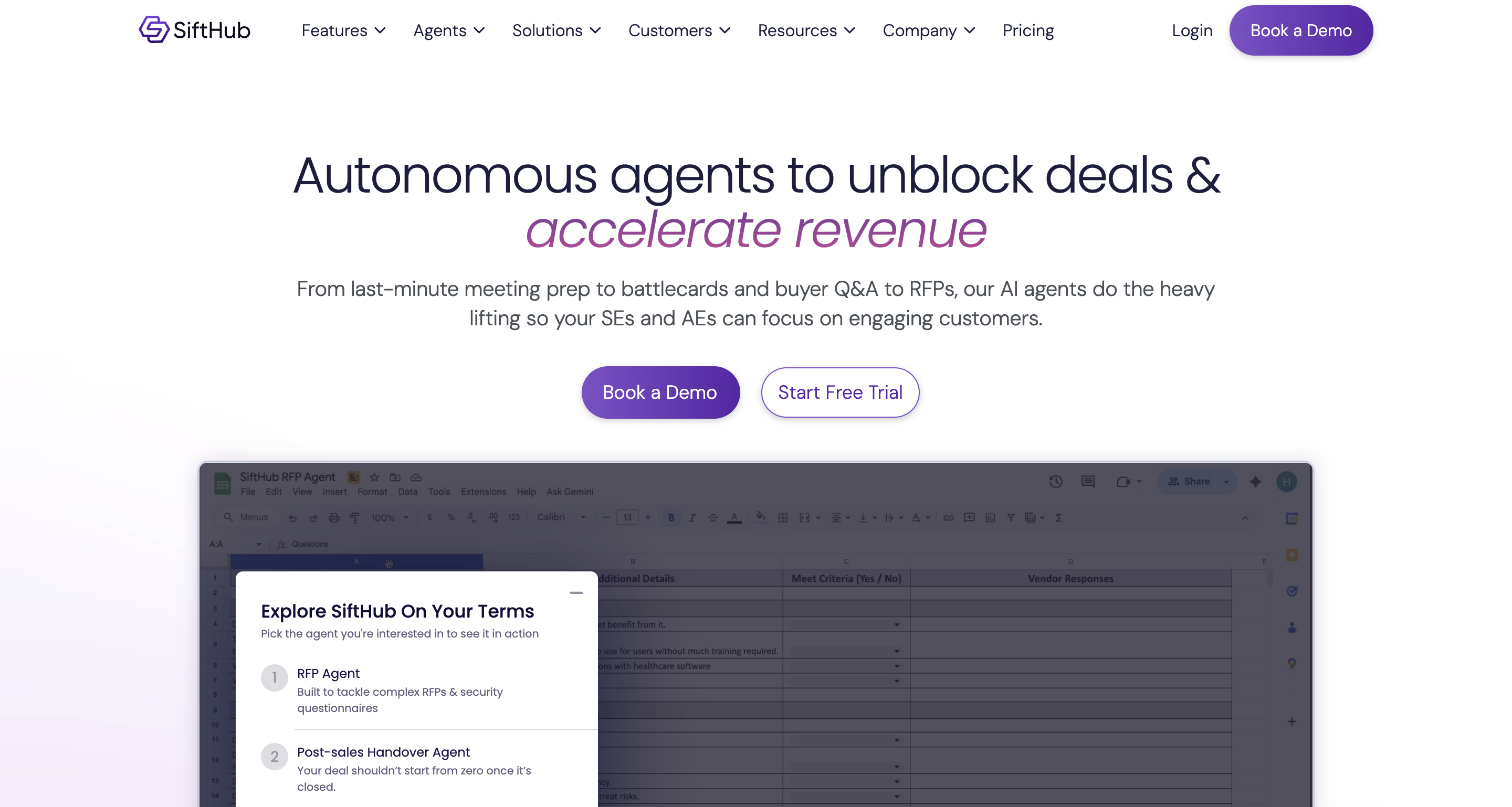
SiftHub SiftHub positions itself as an AI-forward platform focused on generating fast first drafts by deeply integrating with existing document workflows.
Feature Highlights
- Very fast initial drafts
Strong at reducing blank-page time and accelerating early-stage responses. - Modern AI-native experience
Feels lighter and more contemporary than legacy RFP platforms. - Plays well with familiar tools
Designed to work closely with Google Docs and Microsoft Word environments. - Lower friction adoption
Easier to trial and experiment with compared to heavier enterprise tools.
SiftHub Drawbacks
- Limited governance depth
Not built for strict audit trails, layered approvals, or compliance-heavy workflows. - Knowledge quality depends on inputs
Without strong content hygiene, answer reliability can vary. - Less visibility across large teams
Progress tracking and ownership clarity can feel thin at scale. - Better for drafting than final defense
Teams often rely on manual checks before submission.
G2 Rating: 4.5/5
Pricing: Custom
Choose SiftHub if:
- Speed is the primary bottleneck
- You want AI to handle early drafts
- Your RFPs are lighter and less regulated
4. QorusDocs
Best for Microsoft 365-Centric Teams
Source: QorusDoc
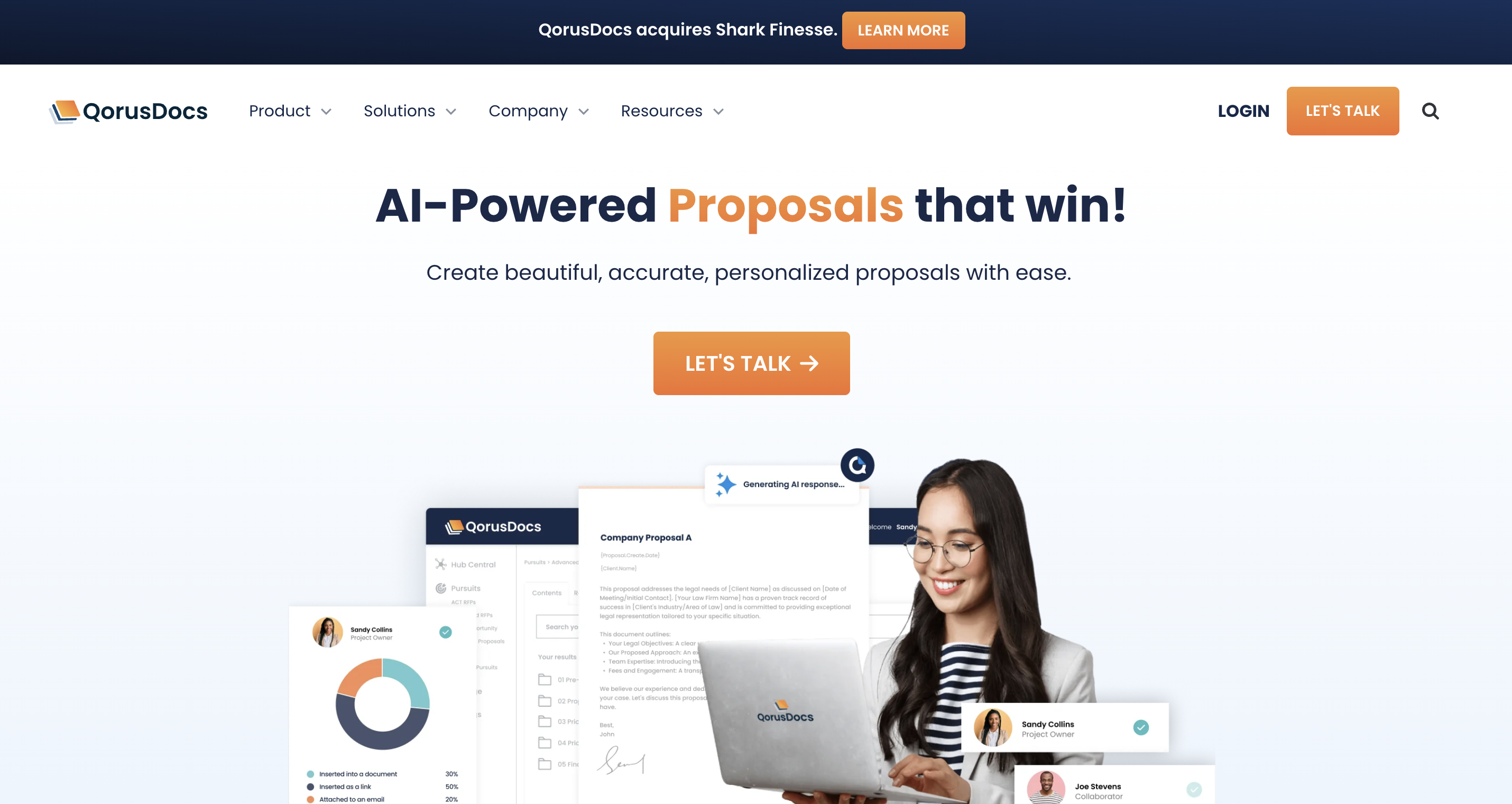
QorusDocs is built for organizations deeply embedded in Microsoft Word, PowerPoint, and SharePoint, extending automation directly inside those tools.
Feature Highlights
- Native Microsoft integration
Strong fit for teams living entirely inside Office 365. - Document formatting control
Excellent for proposals where layout, branding, and structure are critical. - Template-driven consistency
Helps enforce brand and content standards across documents. - Multi-document support
Useful beyond RFPs for proposals, bids, and sales collateral.
QorusDoc Drawbacks
- Heavier reliance on manual effort
Automation focuses more on assembly than intelligence. - AI capabilities are limited
Less emphasis on learning, confidence scoring, or answer validation. - Steeper learning curve
Power comes with complexity, especially for non-technical users. - Less purpose-built for RFP strategy
Strong document tool, weaker RFP-specific intelligence.
G2 Rating: 4.4/5
Pricing: Custom
Choose QorusDocs if:
- Microsoft is your operational backbone
- Design and formatting precision matter deeply
- You need proposal automation beyond just RFPs
5. Ombud
Best for Compliance-Heavy Teams
Source: Ombud
Ombud focuses on lowering adoption friction, aiming to make AI-assisted RFP responses accessible without heavy process overhead.
Feature Highlights
- Quick to get started
Minimal setup compared to traditional enterprise tools. - Lightweight AI assistance
Helps teams respond faster without overhauling workflows. - Lower operational burden
Appeals to teams without dedicated proposal managers. - Good for smaller teams
Works well when collaboration needs are simple.
Ombud Drawbacks
- Limited governance and controls
Not ideal for regulated or compliance-heavy environments. - Less suited for complex RFPs
Struggles with multi-stakeholder reviews and deep validation needs. - Knowledge depth doesn’t compound strongly
Past responses don’t evolve as systematically over time. - Visibility drops at scale
Harder to manage when multiple teams are involved.
G2 Rating: 4.7/5
Pricing: Custom
Choose Ombud if:
- You want quick wins without process overhaul
- RFPs are occasional and relatively simple
- You value ease over deep control
6. Upland Qvidian
Best for Regulated Industries
Source: Upland Qvidian
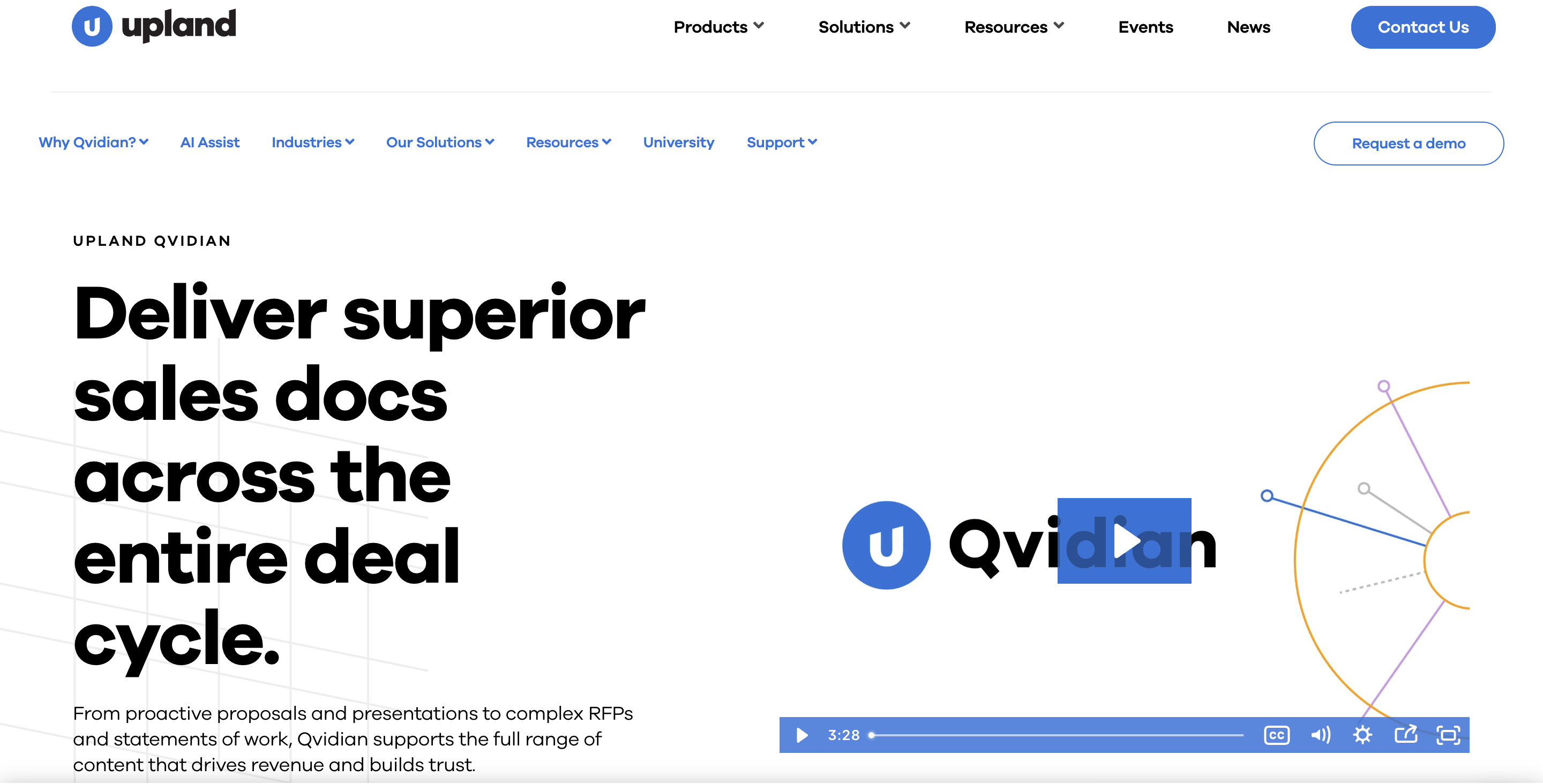
Qvidian Upland Qvidian is a long-standing proposal management platform designed for large enterprises that prioritize control, consistency, and compliance over speed.
Feature Highlights
- Strong governance and control
Versioning, approvals, and audit trails are well suited for regulated industries. - Consistency across large teams
Helps standardize messaging when many contributors are involved. - Enterprise-grade reliability
Built for long-term use in complex organizations. - Deep proposal lifecycle support
Covers more than just RFPs, including broader bid and proposal processes.
Qvidian Drawbacks
- Dated user experience
Interface and workflows feel heavy compared to newer tools. - Limited AI intelligence
Automation focuses on process, not answer quality or learning. - Longer onboarding cycles
Implementation and training take time. - High total cost of ownership
Pricing, add-ons, and services can add up quickly.
G2 Rating: 4.3/5
Pricing: Custom (enterprise-only)
Choose Upland Qvidian if:
- Compliance and control outweigh speed
- You operate in heavily regulated environments
- You already run mature proposal operations
7. AutoRFP.ai
Best for Unlimited User Access & AI Drafting with Minimal Setup
Source: AutoRFP.ai
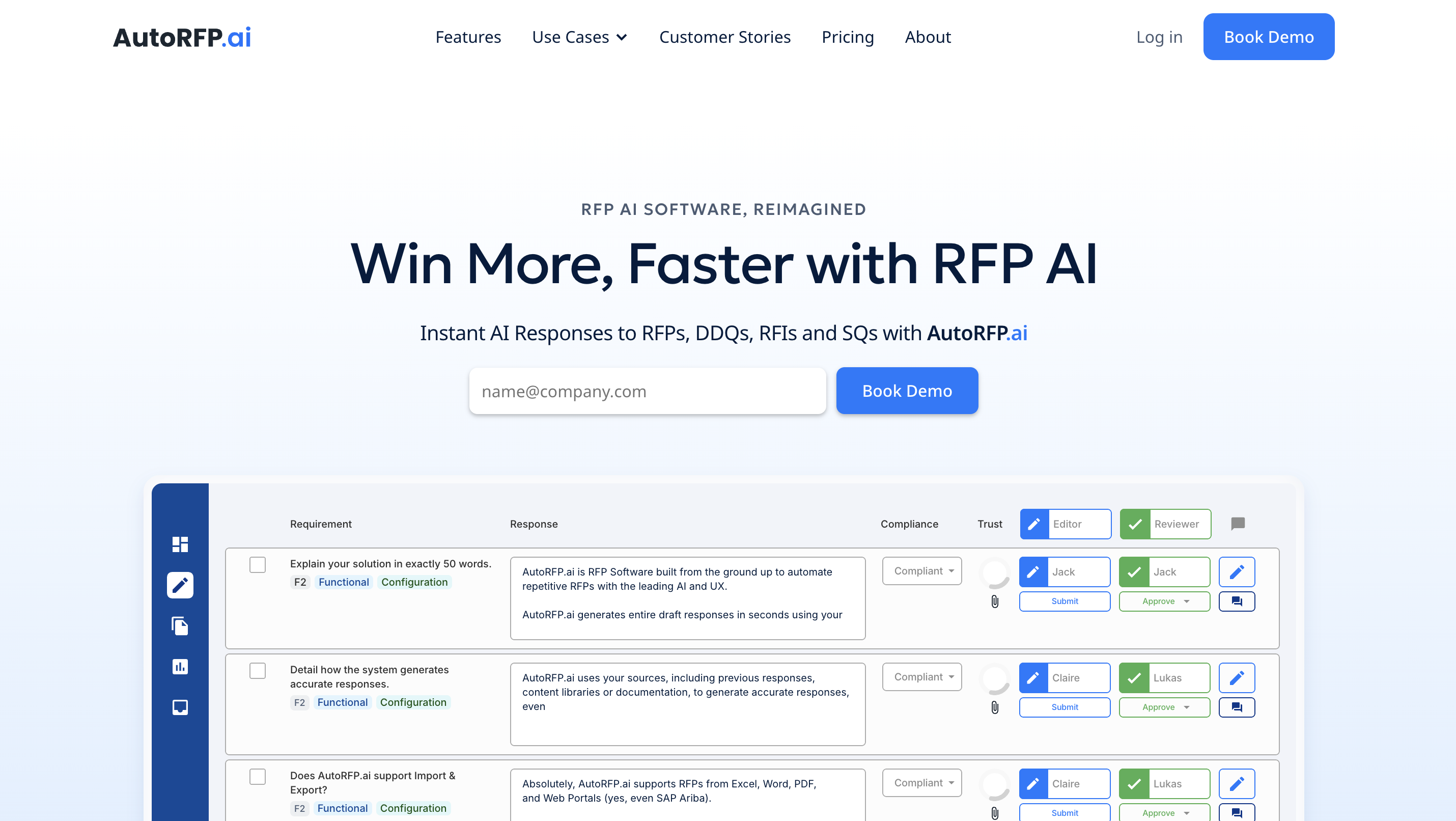
AutoRFP.ai is positioned as a speed-first RFP tool that focuses on using AI to generate responses quickly, especially for teams that want results without heavy process overhead.
Feature Highlights
- Very fast first drafts
Strong at turning RFP documents into usable answers quickly, reducing blank-page time. - Low setup effort
Easier to get started compared to traditional enterprise RFP platforms. - Simple, AI-forward experience
Designed around AI answering rather than complex workflows. - Good for repetitive RFPs
Performs well when questions are similar across bids.
AutoRFP.ai Drawbacks
- Limited governance and auditability
Not built for strict compliance, approvals, or defensible answer trails. - Knowledge quality depends heavily on inputs
Without well-curated source content, accuracy can vary. - Collaboration depth is light
Multi-team ownership, review tracking, and escalation are basic. - AI assists drafting, not decision-making
Human review remains critical for high-stakes sections.
G2 Rating: 4.9/5
Pricing: Starts from $899/month
Choose AutoRFP.ai if:
- Speed matters more than structure
- You want quick AI-generated drafts without process change
- Your RFPs are relatively straightforward and repeatable
Searching for an AutoRFP alternative that checks all your boxes?
8. 1Up
Best for AI-Assisted First Drafts
Source: 1up
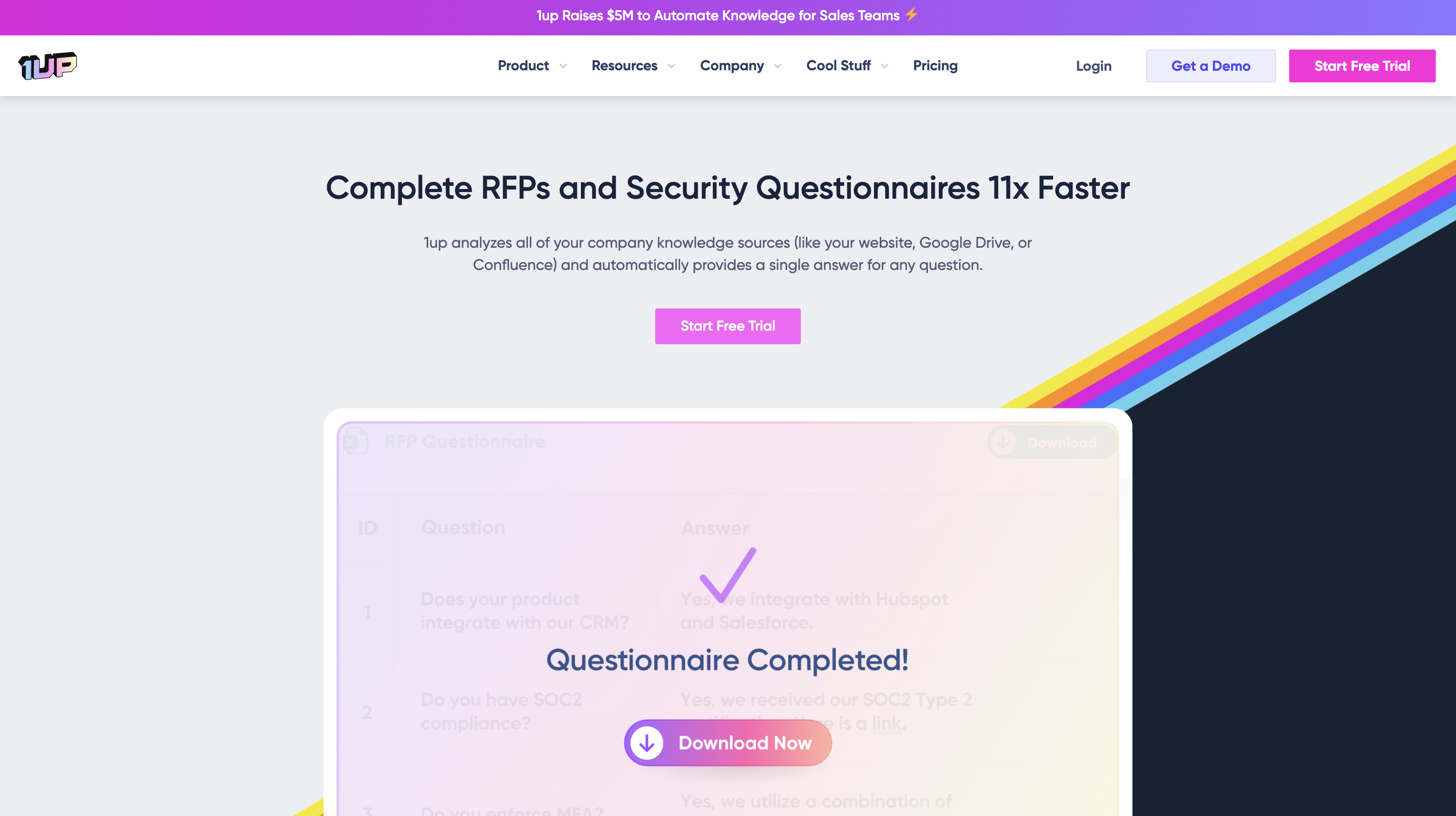
1up positions itself as an AI-powered RFP assistant focused on accelerating draft creation rather than managing the full RFP lifecycle.
Feature Highlights
- Fast AI-generated responses
Useful for getting initial answers on the page quickly. - Simple, modern interface
Easy to test without heavy onboarding. - Helpful for repetitive questions
Handles common RFP sections reasonably well. - Lower barrier to entry
Appeals to teams new to AI-assisted RFP tools.
1Up Drawbacks
- Limited governance and validation
Answers still need careful human review. - Weak collaboration workflows
Not built for large, multi-team responses. - Knowledge management is shallow
Learning does not compound strongly over time. - Better as an assistive layer than a system
Often used alongside other tools.
G2 Rating: 4.9/5
Pricing: Has a free plan, but the starter plan starts from $250/month
Choose 1up if:
- You want AI help without heavy process changes.
- RFPs are relatively straightforward
- Speed matters more than auditability
9. PandaDoc
Best for SMBs and Fast Deals
Source: PandaDoc
PandaDoc is not a traditional RFP tool, but many teams use it for outbound proposals, pricing documents, and contracts rather than complex RFP responses.
Feature Highlights
- Excellent document creation experience
Clean UI with strong templates and design flexibility. - Built-in e-signatures and tracking
Helps move deals forward after the proposal is sent. - Fast adoption across sales teams
Minimal training required. - Great for high-volume outbound proposals
Especially effective for SMB and mid-market sales teams.
PandaDoc Drawbacks
- Not purpose-built for RFPs
Lacks structured Q&A workflows and evaluator alignment. - Weak knowledge reuse for RFPs
Content reuse is manual compared to RFP-focused platforms. - Limited cross-functional review depth
Not ideal for legal, InfoSec, and SME-heavy responses. - Scales better for sales docs than RFPs
Complex bids require workarounds.
G2 Rating: 4.7/5
Pricing: Has a free plan, but the business plan starts from $49.
Choose PandaDoc if:
- Proposals and contracts matter more than RFPs
- Speed and deal execution are the priority
- Your sales team owns most documents end to end
10. Arphie
Best for Lightweight AI Assistance Inside Existing Workflows
Arphie focuses on helping teams answer RFPs faster using AI, without replacing existing tools or introducing heavy structure.
Feature Highlights
- Quick time-to-value
Can be used almost immediately with minimal setup. - Works alongside existing processes
Does not force teams to change how they work overnight. - Good for small to mid-sized teams
Especially where proposal ownership is centralized. - Reduces drafting effort
Helpful for repetitive and standard questions.
Arphie Drawbacks
- Limited workflow visibility
Hard to track ownership, progress, and blockers. - Not built for complex approvals
Falls short in compliance-heavy scenarios. - Knowledge quality varies
Output quality depends heavily on inputs. - Doesn’t replace a full RFP system
More assistant than platform.
G2 Rating: 5/5
Pricing: Custom
Choose Arphie if:
- You want AI help without operational overhead
- Your RFP volume is moderate
- Governance requirements are light
Looking for the best Loopio competitor & alternative?
How to Switch from Loopio to a Modern RFP Automation Platform
Most teams don’t wake up one day and say, “Let’s replace Loopio.” They feel it first. Slower reviews. More manual cleanup. AI helps a bit but not where it matters most.
Switching isn’t about ripping out a tool. It’s about fixing what’s quietly slowing deals down.
Let’s break it down.
Step 1: Be clear on why you’re switching (before you look at tools)
The biggest mistake teams make is starting with feature checklists.
Instead, ask:
- Where do RFPs actually stall today?
- Which sections create the most rework or anxiety?
- Who slows things down unintentionally? Legal, InfoSec, SMEs, or everyone?
Common reasons teams move on from Loopio:
- Heavy reliance on manual answer curation
- Limited confidence in AI-generated responses
- Weak visibility into ownership and blockers
- Content libraries growing faster than trust in them
If the problem is speed alone, you may not need a full platform change. If the problem is accuracy, accountability, and cross-team coordination, you probably do.
Step 2: Audit your existing Loopio content (don’t migrate blindly)
Most Loopio instances have years of content. Some of it gold. Some of it dangerous.
Before switching:
- Identify answers that are approved and still valid
- Flag outdated or conflicting responses
- Separate reusable knowledge from one-off submissions
This step matters because modern RFP automation platforms rely on knowledge quality, not just storage. Migrating everything as-is only recreates the same problems in a new UI.
Step 3: Redesign your workflow, not just your toolset
Loopio is library-first. Many modern platforms are workflow-first. That shift is important.
Look for platforms that let you:
- Assign clear owners by section, not just documents
- See progress and blockers in real time
- Route unclear or risky questions for review early
- Track confidence or validation levels, not just completion
The goal is fewer surprises in the last 48 hours before submission.
Step 4: Treat AI as a reviewer, not just a writer
This is where most modern platforms differ fundamentally.
Instead of asking: “Can the AI fill answers quickly?”
Ask:
- Where does the AI source answers from?
- Can teams see how reliable an answer is?
- Does the system flag uncertainty or conflict?
- Can humans override and improve future outputs?
The best platforms don’t just generate text. They help teams decide what’s safe to submit.
That’s a big mental shift, especially for legal and security stakeholders.
Step 5: Pilot with one real RFP, not a demo dataset
Avoid migrations that start with weeks of configuration before value. A smarter approach:
- Pick one active RFP
- Run it end-to-end in parallel
- Measure response time, review cycles, and rework
- Get feedback from sales, legal, and SMEs
If the tool reduces coordination overhead and reviewer stress on a real bid, adoption will follow naturally.
Step 6: Plan for compounding value, not just faster drafts
Loopio works best when humans constantly curate content. Modern RFP automation platforms should:
- Learn from wins and losses
- Improve answers over time
- Reduce future review effort, not increase it
- Turn every submission into better starting material
If the platform doesn’t get smarter with use, you’re just changing tools, not outcomes.
What a successful switch actually looks like
Teams that switch successfully usually see:
- Fewer last-minute escalations
- Higher trust in AI-assisted answers
- Clearer ownership across departments
- Faster reviews, not just faster drafts
And most importantly, RFPs stop feeling like fire drills and start feeling like a repeatable system.
That’s the real upgrade.
Interested in the best Loopio alternative?
How to Choose the Right RFP Response Software for Your Team
Switching from Loopio (or any legacy tool) isn't just about finding a cheaper option. It's about finding the right fit for how your team actually works.
Here's what to look for before you commit.
Start with your workflow, not the feature list.
Every RFP tool claims AI-powered automation and a content library. That's table stakes. The real question is whether the tool fits your response process, from intake and Go/No-Go decisions through collaboration, review, and submission. If your team handles 10+ RFPs a month across multiple stakeholders, you need a platform built for speed without sacrificing accuracy.
Ask how the AI actually works.
This is where most evaluations go wrong. Some tools bolt AI onto a legacy system and call it innovation. Others are built AI-native from the ground up. The difference matters. A bolt-on approach means the AI is limited by the old architecture underneath. An AI-native platform like SparrowGenie can deliver features like confidence scoring on every generated answer, a self-improving knowledge hub, and AI-generated prospect briefings, because the intelligence layer isn't an afterthought.
Look at what happens after the AI generates an answer.
Speed without trust is a non-starter for enterprise teams. You want to see exactly how confident the system is in each response, where that answer came from, and how the knowledge base improves over time. A train-test-improve loop means the system gets smarter with every RFP your team completes, not just bigger.
Check the security posture, for real.
If your team handles security questionnaires, DDQs, or anything compliance-sensitive, vague promises won't cut it. Look for specifics: SOC 2 Type II certification, zero data retention policies, data isolation between accounts, and clear documentation on how AI models handle your content. Enterprise buyers deserve more than a badge on a webpage.
Test before you buy.
This sounds obvious, but not every vendor makes it easy. If a platform won't let you run a real RFP through it before signing a contract, that tells you something. A free trial or interactive demo should be non-negotiable in your evaluation.
Think beyond the sticker price.
A tool that costs less but requires manual library maintenance, constant re-training, or heavy admin overhead will end up costing you more in hours than you save in dollars. Factor in onboarding time, ongoing content management effort, and how much of your team's workflow the platform actually automates end to end.
The right RFP response software shouldn't just replace what you have. It should make your team faster, more accurate, and more confident in every response they send out.
Conclusion
Loopio paved the way. But 2026 demands more than well-maintained libraries and manual coordination. Modern RFP automation is about secure, AI-driven collaboration where accuracy, accountability, and speed move together, not in conflict.
While platforms like Responsive, Ombud, and SiftHub each solve parts of the problem, teams looking to fundamentally change how RFPs get done are moving toward systems like SparrowGenie, where trusted answers, governed workflows, and cross-functional visibility are built into the process.
If your RFPs still depend on last-minute reviews and human memory to stay accurate, that’s your signal. The next generation of teams isn’t just responding faster. They’re responding smarter, with confidence they can defend. And that’s exactly where SparrowGenie fits.
Because in modern revenue operations, the teams that automate intelligently don’t just close first. They close better.
Ready to see how AI can transform your RFP process?
Product Marketing Manager at SurveySparrow
A writer by heart, and a marketer by trade with a passion to excel! I strive by the motto "Something New, Everyday"