Go/No-Go Framework for RFPs: How to Evaluate RFP Fit Fast

Article written by
Aparna Rajendran

INSIDE THE ARTICLE
SHARE THIS ARTICLE
Summary
Your proposal team is working hard. But if you're responding to every RFP that lands in your inbox, you're probably burning hours and budget on deals you were never going to win. The Go/No-Go framework fixes that. It's a simple, structured way to evaluate RFP fit before a single word of the proposal gets written. This guide walks you through the full framework: the 6 core evaluation criteria, a weighted decision matrix, a 45-minute meeting structure, and the cognitive traps that kill good decisions. The goal? Bid less, win more, and stop letting bad-fit RFPs drain your best people.
RFP is a trap! (Mostly)
Your team gets an RFP. It's a big logo. The deal size looks great. Sales is excited. So you dive in.
Forty hours later, you've got a polished proposal. And then you lose. Not because your answer was bad, but because you never had a real shot to begin with. The RFP was wired for a competitor. The incumbent had a 3-year relationship. Your pricing was out of range before the ink was dry on the first page.
Here's the thing: this isn't bad luck. It's a decision-making problem. And there's a fix.
It's called the Go/No-Go framework. And if your proposal team isn't using one, you're probably spending six figures a year on bids you were never going to win.
The Real Cost of Chasing Every RFP
Before we get into how the framework works, let's talk about what it costs you not to have one. Because the numbers are eye-opening.
The average RFP response takes 25 hours to complete. At a loaded cost of $75/hour, a 40-hour response costs $3,000 in direct labor alone. A complex enterprise proposal can exceed $15,000. Research puts the average annual cost of bids that don't result in wins at $725,000.
And 62% of proposal professionals say workload is their single greatest stressor.
Think about what that really means. One SaaS company was responding to 30+ RFPs per quarter with a 3-person team. Their win rate? 12%. More than half of those RFPs were cold inbound leads with no prior relationship, low budget alignment, or requirements that clearly favored a competitor. They weren't short on effort. They were short on qualification.
The Go/No-Go framework doesn't reduce your ambition. It sharpens it. You stop chasing the wrong deals so you can win more of the right ones.
See how SparrowGenie cuts RFP analysis time by 70%, book a quick demo.
What Is a Go/No-Go Framework, Exactly?
A Go/No-Go framework is a structured, criteria-based evaluation process that tells you whether to invest time and resources responding to a specific RFP, RFI, or RFQ before any proposal work begins.
Think of it as a binary checkpoint. You pause, evaluate the opportunity against predefined criteria, and make one of two calls: proceed with a full response, or decline and redirect your resources to a better opportunity.
The term originates from NASA launch procedures, where mission control runs a checklist with every station before a rocket lifts off. One No-Go stops the launch. The same logic applies to proposals: if critical red flags emerge, you walk away, regardless of how attractive the deal looks on paper.
It's not about being conservative. It's about being strategic.
Why Selective Bidding Actually Wins More Deals
Here's the counterintuitive truth: bidding less can mean winning more.
Win rates climb 20 to 30 percentage points when teams become more selective. Firms that cut proposal volume by approximately 38% saw the total value of awards grow 52% year-over-year, with median win rates climbing to around 50% (Deltek's 2025 A&E Clarity Study). Teams using AI for RFP qualification report reducing initial analysis time by 70-80% and handling about 30% more RFPs without adding headcount.
When you focus on fewer, better-fit opportunities, your team has more time to customize, sharpen win themes, and write proposals that actually resonate. Quality beats volume every time in this game.
5 Signs Your Team Needs a Go/No-Go Process Right Now
Not sure if this applies to you? Here are the tell-tale patterns.
Your win rate on competed opportunities sits below 20%. Your proposal team is perpetually overloaded while sales keeps complaining about slow turnaround. Leadership regularly overrides the no-bid recommendation for political reasons. You genuinely can't remember the last RFP your team declined. Post-loss reviews reveal you were never competitive, but nobody knew until after submission.
If two or more of those resonate, keep reading. This is for you.
The 6 Core Criteria That Drive Every Go/No-Go Decision
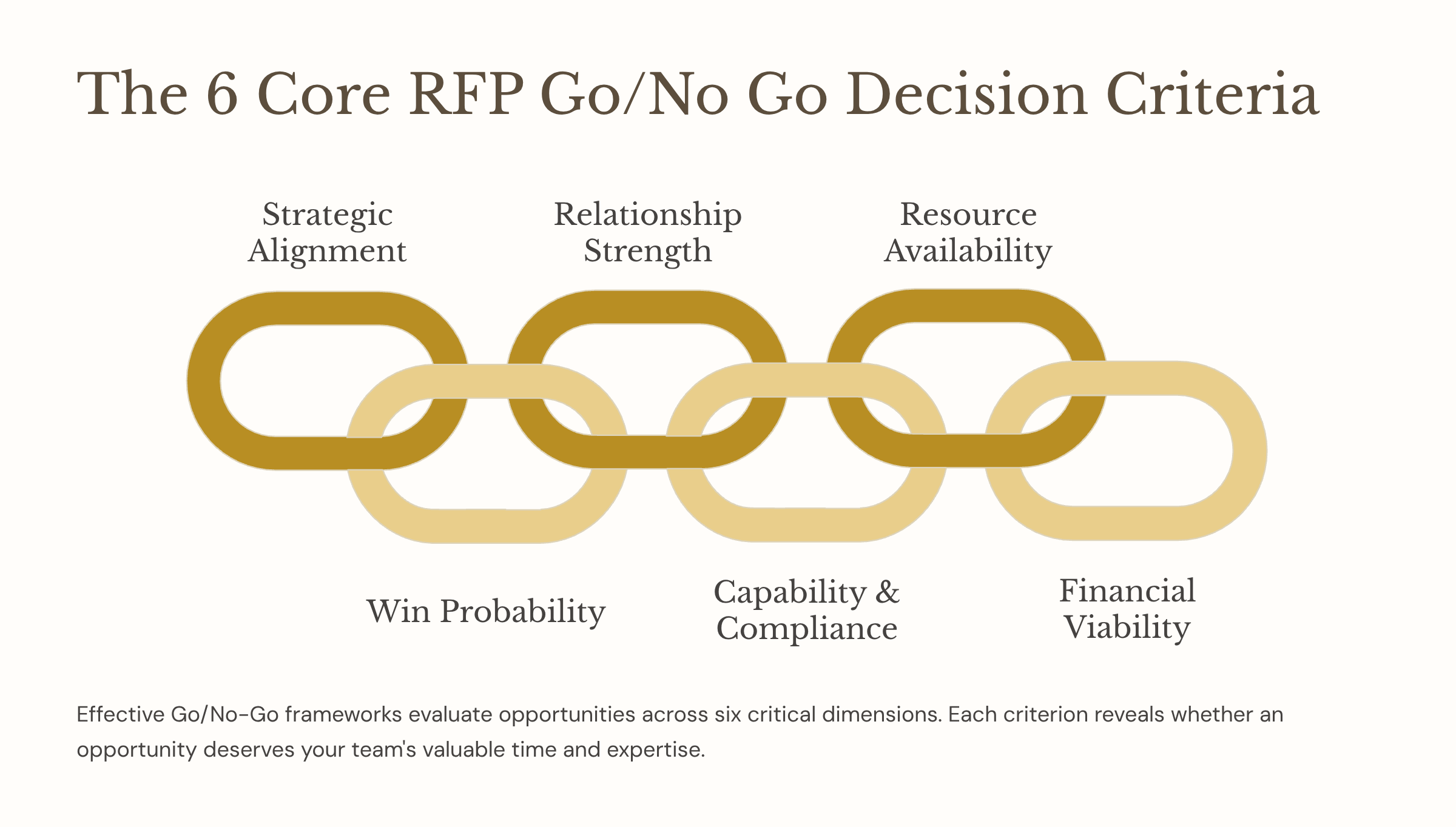
Effective Go/No-Go frameworks evaluate opportunities across six dimensions.
1. Strategic Alignment
Does this opportunity actually advance your business goals? Start here. Ask: Does this customer fit your ideal customer profile in terms of industry, size, and geography? Does the RFP align with what you're best at delivering? Does winning this deal open a new market, create a reference customer, or support a specific growth target?
Example: A cybersecurity vendor specializing in financial services receives an RFP from a large healthcare system. The deal looks great on paper. But do they have healthcare-specific experience? The strategic fit question becomes: Are we willing to invest in building that capability just to win this one deal? Often, the honest answer is no.
2. Win Probability
This is the single most important criterion. And it's where teams are most likely to fool themselves.
Incumbents win new contracts between 60-90% of the time. Are you defending or displacing? Does the RFP language favor you, or does it read like a spec sheet for a competitor's product? Did your company help the prospect develop their requirements? (If yes, your win probability jumps significantly.) How many competitors are likely bidding, and who are they?
Red flag: An RFP references a specific competitor's proprietary technology seventeen times. The customer has used that vendor for three years. Win probability? Close to zero. Smart teams log a No-Go and move on.
3. Relationship Strength
Cold inbound RFPs from public portals with zero prior engagement? Treat these with serious skepticism. The buyer may just be fulfilling a procurement requirement to collect multiple quotes. Ask: Have you worked with this customer before? Have you met the actual decision-makers, or is all contact routed through procurement? Do you understand their real pain points beyond what's written in the RFP document?
4. Capability and Compliance
Can you actually do the job? This sounds obvious, but teams regularly pursue RFPs where they have gaps they're hoping to paper over. Do you meet all mandatory requirements, certifications, and qualifications? Do you have relevant case studies and past performance in similar engagements? Are there compliance flags that would require you to "figure it out if you win"?
A cautionary tale from one practitioner: "I once bid on a project requiring a specific certification we didn't have. We won, then spent nine months and $200,000 trying to obtain the certification. We should have walked away."
5. Resource Availability
Can your team produce a quality response by the deadline without heroics? And if you win, can you deliver without jeopardizing existing commitments? Proposal teams that constantly operate at full capacity produce lower-quality responses. This criterion forces an honest reckoning with team bandwidth.
6. Financial Viability
Is the potential revenue large enough to justify the investment? Does the expected margin justify the risk? Does the buyer's stated budget actually align with your pricing?
Rule of thumb: If producing the proposal will cost 5% or more of the potential contract value, and your win probability is below 30%, the expected ROI is likely negative. Walk away.
Want AI to score your next RFP for fit before your team lifts a finger? That's SparrowGenie.
How to Build a Go/No-Go Decision Matrix: Step by Step
Knowing that you need a Go/No-Go process is one thing. Actually building one that your team will use consistently, without it becoming a bureaucratic nightmare, is where most companies get stuck.
The good news? It doesn't have to be complicated. The framework below gives you a practical, step-by-step structure you can adapt to your team's size, deal complexity, and velocity. Whether you're a 2-person proposal team or a 20-person bid center, the core logic is the same: replace gut feel with a repeatable system, and your decisions get faster, smarter, and a lot easier to defend internally.
Here's how to build it.
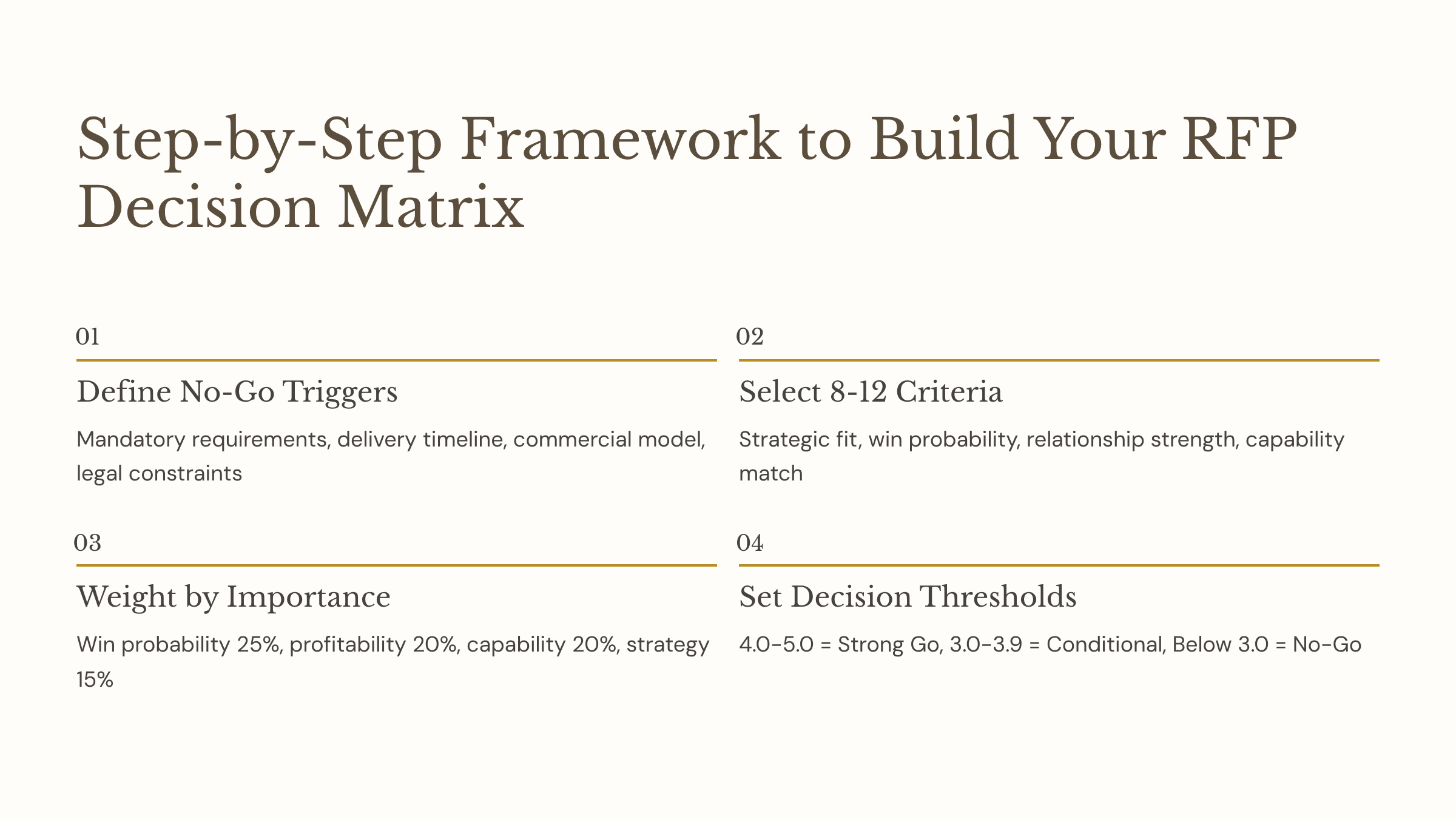
Step 1: Define Your No-Go Triggers
Before scoring anything, run a quick binary check. Any single "No" here ends the evaluation immediately. Can we technically comply with all mandatory requirements? Can we meet the delivery timeline with available capacity? Is the commercial model fundamentally acceptable in terms of budget, terms, and risk allocation? Are there legal, security, or ethical constraints that make this unworkable?
If any of these fail, log a No-Go with clear rationale and send a professional no-bid letter. No scoring required.
Step 2: Select 8-12 Evaluation Criteria
Break the six core dimensions into specific sub-criteria. Good candidates include strategic fit and ICP alignment, win probability and competitive position, customer relationship strength, capability and requirements match, compliance and mandatory requirements, reference or case study value, proposal complexity, resource availability, profit margin and financial viability, and delivery risk.
Step 3: Weight Criteria by Importance
Not all factors matter equally. Here's a sample weighting for a B2B SaaS company:
Win probability — 25%. Evaluates incumbent status, RFP language signals, competitive landscape, relationship depth.
Profitability and financial viability — 20%. Evaluates deal size, margin after delivery, budget alignment, payment terms.
Capability and compliance — 20%. Evaluates mandatory requirements match, certifications, security standards, SLAs.
Strategic alignment — 15%. Evaluates ICP fit, industry focus, ARR potential, geographic alignment.
Resource availability — 10%. Evaluates team capacity, competing priorities, delivery timeline feasibility.
Risk and red flags — 10%. Evaluates legal, data/security, reputational, and implementation risk.
Align these weights with leadership before you start scoring. In regulated industries like healthcare or fintech, compliance may deserve a higher weight.
Step 4: Define Your 1-5 Scoring Scale
Score 5 (Excellent): Clear advantage, perfect alignment, low risk. For win probability, this means you're the incumbent with a satisfied customer or you have a clear inside track.
Score 4 (Good): Strong fit with minor gaps. Prior relationship, positive engagement, differentiation is clear.
Score 3 (Neutral): 50/50 proposition. Even playing field, no incumbent advantage identified.
Score 2 (Weak): Significant gaps or risks. New entrant with limited competitive intelligence.
Score 1 (Poor): Major misalignment, deal-killer territory. Challenger against a happy incumbent; RFP language favors a competitor.
Step 5: Set Your Decision Thresholds
Weighted score of 4.0 to 5.0: Strong Go. Commit resources. Schedule kickoff within 48 hours.
Weighted score of 3.0 to 3.9: Conditional Go. Proceed only if specific mitigations are feasible, such as partnering, scope negotiation, or pricing adjustment.
Weighted score below 3.0: No-Go. Decline. Capture rationale. Send a professional, positive no-bid letter.
Critical rule: Even if the overall score is acceptable, one deal-killer, a missing mandatory certification, unacceptable legal terms triggers an automatic No-Go regardless of total score.
Step 6: Document and Socialize
Create a bid/no-bid template that guides evaluators through each criterion. Define who scores, who approves, and who communicates the decision. Set a cadence: score within 48 hours of RFP receipt. Maintain a decision log to track outcomes and continuously improve your framework over time.
SparrowGenie auto-generates your compliance matrix the moment an RFP lands, no manual parsing needed. Book a free demo now.
How to Run an Effective Go/No-Go Meeting (45 Minutes, No More)
Keep the group small, five to seven people maximum so you maintain speed and accountability.
Must attend: Opportunity owner (AE or BDR), Proposal Manager, Executive Sponsor for large deals. Should attend: Subject Matter Expert (technical or delivery lead), Finance Representative. As needed: Legal or Compliance.
Come prepared. The meeting validates analysis, not creates it. Everyone should show up with the full RFP reviewed, preliminary scores submitted, competitive intelligence in hand, and resource availability confirmed.
The agenda runs like this: 5 minutes for the opportunity owner to summarize and state a preliminary recommendation. 20 minutes to review each criterion in the pre-scored matrix, surface disagreements, and adjust scores. 5 minutes to explicitly ask: "Is there any factor that should disqualify this opportunity regardless of score?" 5 minutes to make the final decision. 5 minutes to document rationale with 3-5 bullet points. 5 minutes to define next actions.
The Cognitive Traps That Kill Good RFP Decisions
Even with a scoring matrix, teams fall into predictable traps. Watch for these.
Confirmation bias. Teams look for reasons to say yes, not reasons to say no. Make it someone's job to argue for No-Go.
Sunk cost fallacy. Past investment in understanding a prospect is not a reason to submit a bad proposal today.
Political pressure. When a VP insists on bidding despite a low score, make the trade-off visible. "If we pursue this 15% win-probability opportunity, here are the three qualified opportunities we won't have capacity for."
Deal fever. Large deal size creates irrational excitement. Score it objectively. A $5M deal with a 5% win rate has an expected value of $250K. A $1M deal with a 60% win rate has an expected value of $600K. The math doesn't lie.
Not Every RFP Needs a 60-Minute Evaluation
Right-size your process to the opportunity.
Basic tier: 5 core yes/no questions covering capability, strategy, profitability, relationship, and competition. Best for small teams and simple RFPs. Takes 10-15 minutes.
Intermediate tier: True/false checklist with up to 20 statements. Score 80%+ to bid. Best for teams with 1-2 proposal coordinators handling moderate-complexity RFPs. Takes 20-30 minutes.
Advanced tier: Weighted scoring matrix with stakeholder input, thresholds, and a decision log. Best for enterprise teams and high-stakes proposals. Takes 45-60 minutes.
Start where you are. A 15-minute checklist beats no process every time.
10 Essential Go/No-Go Checklist Questions
Before committing any resources, every proposal team should be able to answer these:
- Does this opportunity align with our business strategy and growth priorities?
- Do we have the technical expertise and past performance to compete effectively?
- Is the client's budget confirmed and aligned with our pricing structure?
- Are we the incumbent? If not, how strong is the incumbent's position?
- If there is an incumbent, is the customer actually satisfied with their performance?
- Do we have a strong relationship with the client or an internal advocate?
- Does the RFP language favor a competitor based on technical specs or feature requirements?
- Will winning require significant new investment in staff, technology, or certifications?
- Can the work be delivered within the client's timeline without straining existing commitments?
- Would winning this deal strengthen our market positioning or generate a valuable case study?
What Happens After You Decide
If it's a Go: Send an intent-to-bid letter to signal professionalism. Immediately allocate resources and block calendars. Schedule a proposal kickoff within 48 hours and align on win themes. Revisit the lowest-scoring areas in the matrix and address them directly in the proposal.
If it's a No-Go: Communicate internally first — notify sales and account management with clear rationale. Write a brief, professional, and positive no-bid letter stating that the opportunity doesn't align with current focus and expressing genuine interest in future opportunities. Set a follow-up reminder for 3-6 months out. Many RFPs result in failed implementations or changed requirements, which creates an opening later.
How AI Accelerates Go/No-Go Decisions
Manual evaluation of a 50-page RFP takes 2-3 hours just for reading, extracting requirements, and flagging red flags. AI-powered RFP automation platforms are changing this significantly.
Automated RFP parsing extracts critical details, scope, requirements, deadlines, evaluation criteria, and generates a first-draft compliance matrix in minutes, not hours.
Compliance gap detection instantly scans RFP requirements against your company's certifications, past responses, and capability database. You know your gaps before you commit.
Win probability modeling analyzes historical win/loss data, competitor behavior, and client preferences to estimate success probability before resources are committed.
Risk surfacing flags delivery risks like aggressive timelines, unusual contract clauses, onerous liability terms, and security requirements automatically.
Faster stakeholder alignment consolidates scoring, risk flags, and opportunity summaries in a single dashboard so decision-makers can review and sign off in minutes instead of days.
Teams using AI for RFP qualification report reducing initial analysis time by 70-80% and handling approximately 30% more RFPs without adding headcount. That's not a small efficiency gain. That's a structural advantage.
Platforms like SparrowGenie bring this capability directly into your RFP workflow. The AI handles the heavy lifting on initial qualification analysis so your proposal team can spend their time where it actually matters: crafting winning responses on the right deals.
Ready to qualify smarter? See SparrowGenie in action - 15 minutes, no fluff.
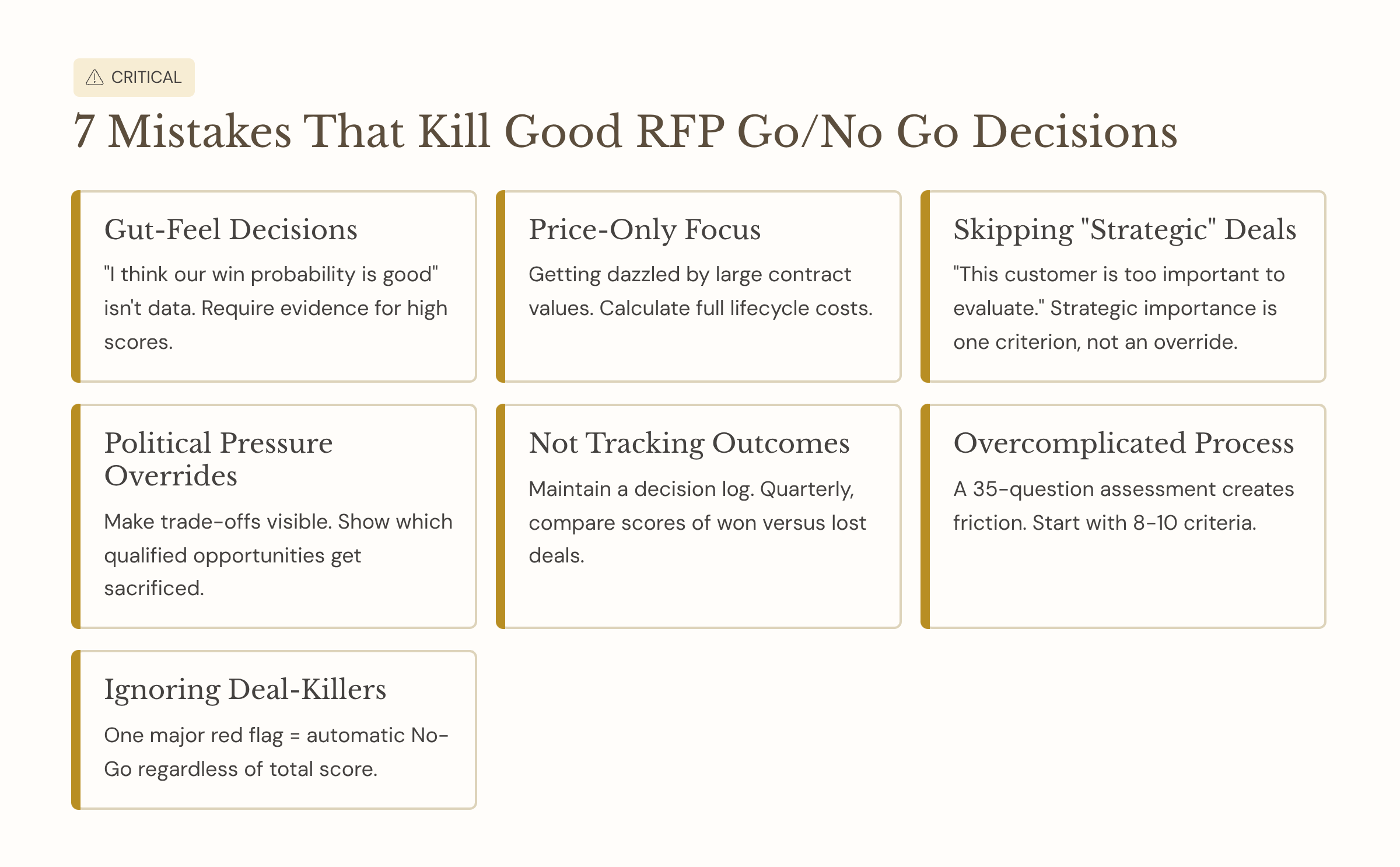
7 Go/No-Go Mistakes to Avoid
Gut-feel decisions. "I think our win probability is pretty good" isn't data. Require evidence for high scores. If you can't answer with facts, score low.
Price-only focus. Getting dazzled by a large contract value. Calculate the full lifecycle cost including compliance burden, delivery cost, and margin pressure.
Skipping the process for "strategic" deals. "This customer is too important to evaluate." Strategic importance is one criterion, not an automatic override. Score it honestly.
Political pressure overrides. A VP insists on bidding despite a low score. Make trade-offs visible. Show which qualified opportunities get sacrificed if you pursue this one.
Not tracking outcomes. Decide go/no-go but never revisit your accuracy. Maintain a decision log. Quarterly, compare scores of won versus lost deals and adjust your weights accordingly.
Overcomplicated process. A 35-question assessment taking four hours creates friction and teams start skipping it. Start with 8-10 criteria and a 30-minute meeting.
Ignoring deal-killers. The overall score looks acceptable despite one major red flag. Explicitly identify deal-killers upfront. One = automatic No-Go regardless of total score.
SparrowGenie flags deal-killers automatically so your team never chases the wrong RFP again. Explore Genie AI in a 15-minute demo.
Closing the Loop: How to Get Better Over Time
The Go/No-Go framework improves with use, but only if you track outcomes systematically. Maintain a decision log tracking opportunity name, final score, decision made, and eventual outcome. Run quarterly reviews comparing average scores of won deals versus lost deals. Adjust criteria weights based on what actually predicts wins in your market, not just what feels important. Retroactively score past RFPs to validate your framework and show leadership how it would have performed historically. And celebrate smart No decisions. Walking away from the wrong deal is a strategic win. Treat it that way.
As one expert puts it: "The key to making good bid decisions is not picking the deals you are going to win, but discarding the deals that you are going to lose." That sentence is worth printing and putting on the wall.
Final Thought
Most proposal teams are trying to win more by doing more. More hours. More bids. More heroics. But the data tells a different story. The teams consistently hitting 50%+ win rates aren't working harder. They're qualifying smarter.
A Go/No-Go framework doesn't slow you down. It stops you from running fast in the wrong direction.
You can start simple. A 15-minute checklist beats no process every time. Build in the scoring matrix as you go. Track your outcomes. Adjust your weights. And slowly, methodically, watch your win rate climb while your team's stress levels drop.
That's what it looks like when proposal management becomes a competitive advantage instead of a cost center.
Ready to Qualify Smarter and Win More?
SparrowGenie helps proposal teams evaluate RFP fit instantly with AI-powered analysis, automate first drafts, and route approvals without the chaos. Book a 15-minute demo now.
Ready to see how AI can transform your RFP process?
Product Marketer at SparrowGenie
Being a Product Marketer at SparrowGenie, Aparna helps sales teams work faster with secure, AI-powered proposal automation. She turns complex features into simple stories, builds messaging that resonates, and keeps a close pulse on what customers actually need. She loves shaping clear, helpful content that shows how SparrowGenie makes RFP work easier, faster, and a lot less stressful.