Content Libraries for Proposals: Your Edge for Consistent Wins

Article written by
Kate Williams

INSIDE THE ARTICLE
SHARE THIS ARTICLE
Summary
Most sales teams sit on goldmine content that’s impossible to find when they need it—case studies buried in downloads folders, outdated security briefs, or orphaned pricing sheets. A purpose-built content library creates a single source of truth, smart tagging, version control, and usage analytics. The result? Proposal time slashed, messaging unified, rep adoption sky-high, and win rates climbing steadily.
If every RFP/RFI/DDQ feels like rebuilding the same house from scratch, you don’t have a content problem—you have a library problem. A governed, searchable proposal content library turns scattered answers, policies, and proof into a single source of truth that ships first drafts fast, keeps SMEs out of the weeds, and reduces deal risk.
What Belongs in a High-Performance Proposal Content Library?
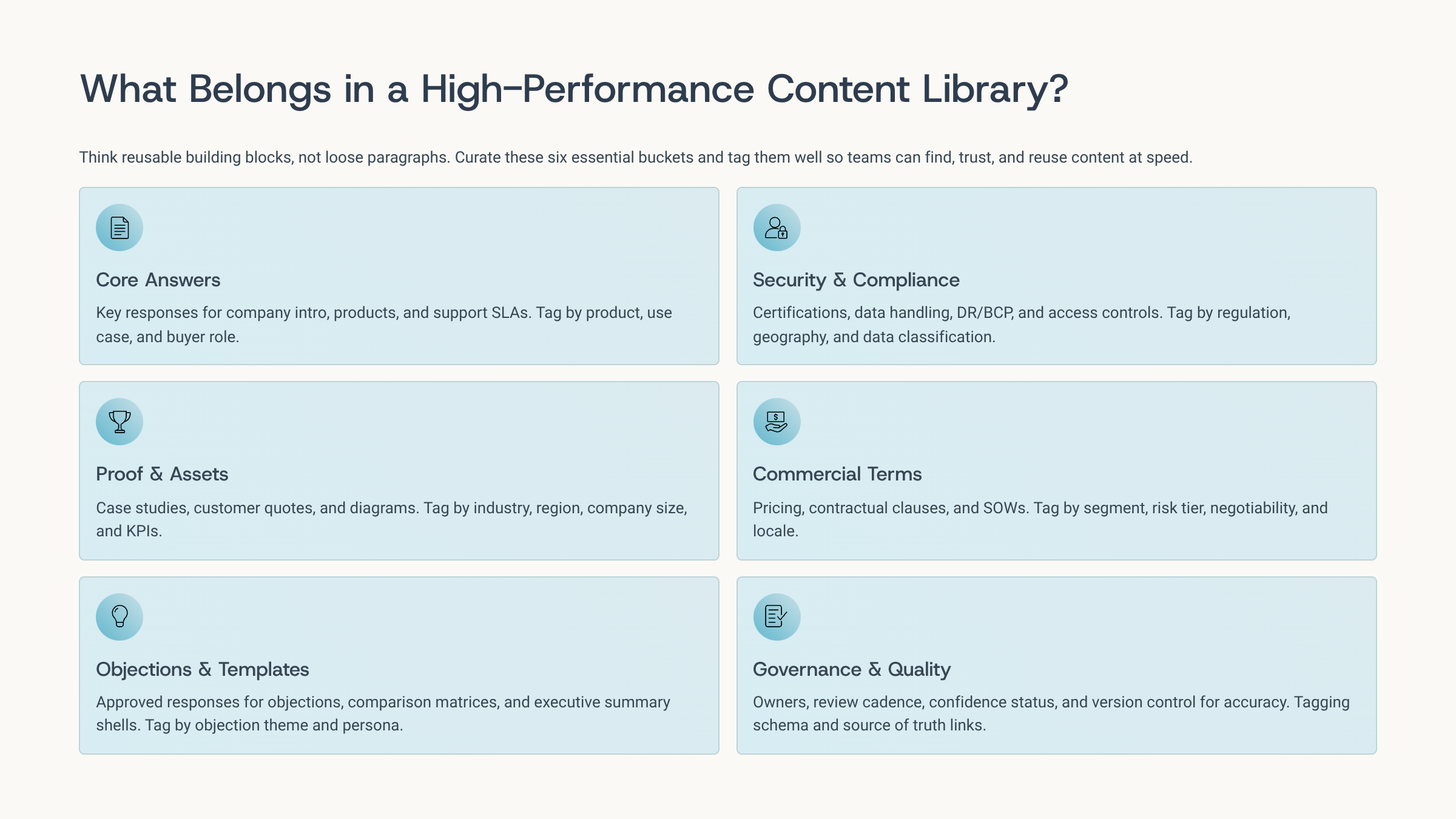
Think reusable building blocks, not loose paragraphs. Curate these six buckets and tag them well so teams can find, trust, and reuse them at speed.
- Core Answers (Top 200–500)
Company intro & differentiators; product capabilities & safe language; implementation templates; support/SLAs.
Metadata: product, use case, buyer role, lifecycle, owner, confidence, next review. - Security, Compliance & Privacy
Certifications/attestations; data handling & DR/BCP; access controls & audit logging; DPAs & sub-processors.
Metadata: regulation (GDPR/CCPA/HIPAA), geography, data class, approvals. - Proof & Assets
Case studies with metrics; customer quotes; analyst/third-party validation; diagrams, data-flows, screenshots.
Metadata: industry, region, size, KPI improved, source/citation, product version. - Commercials & Variants
Pricing guardrails; contractual clauses & redline guidance; SOW/renewals; industry/geo forks & localization.
Metadata: segment (SMB/MM/ENT), risk tier, negotiability, locale/currency. - Objections & Scaffolding
Standard objections with approved responses; comparison matrices (sanitized); exec summary shells; portal-ready answer formats.
Metadata: objection theme, sensitivity, persona, format constraints. - Governance, Findability & Quality
Owner/steward; review cadence; confidence status; citations/source of truth; tagging/synonyms/collections; “gold” version rules.
Why this order? Teams assemble fastest when core answers and security are rock-solid, proof is attached, and commercial/legal text is governed. Objections and templates speed personalization, while governance keeps the whole system accurate over time.
Challenges in Maintaining a Content Library
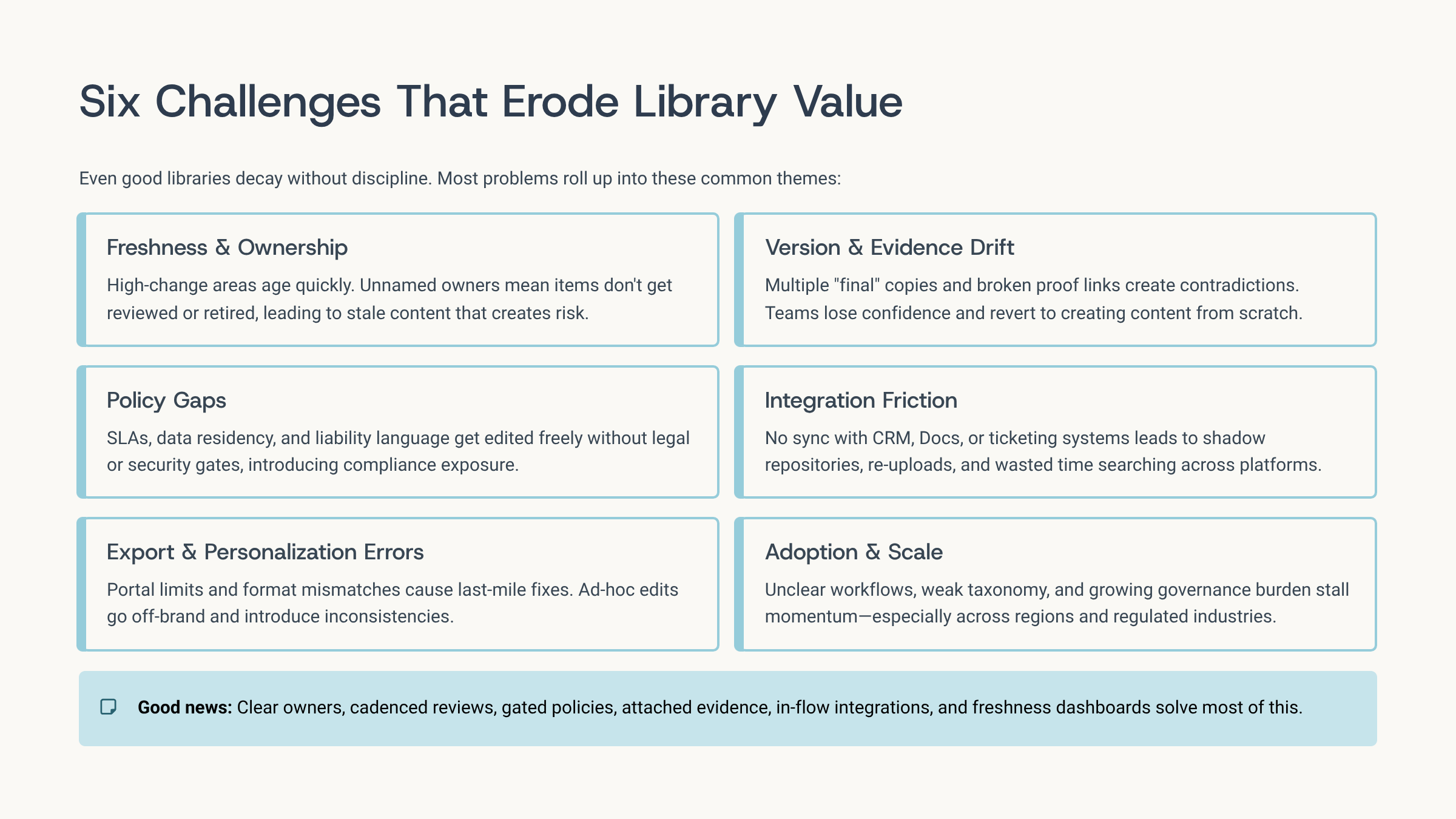
Even good libraries decay without discipline. Most problems roll up into six themes:
- Freshness & Ownership – High-change areas age quickly; unnamed owners mean items don’t get reviewed or retired.
- Version & Evidence Drift – Multiple “final” copies and broken proof links create contradictions and risk.
- Policy Gaps – SLAs, residency, and liability language get edited freely without legal/security gates.
- Integration Friction – No sync with CRM/Docs/Ticketing leads to shadow repos and re-uploads.
- Export & Personalization Errors – Portal limits and format mismatches cause last-mile fixes; ad-hoc edits go off-brand.
- Adoption & Scale – Unclear workflows, weak taxonomy, and growing governance load stall momentum—especially across regions/regulated industries.
Good news: clear owners, cadenced reviews, gated policies, attached evidence, in-flow integrations, and freshness/usage dashboards solve most of this.
How to Create an Effective Proposal Content Library
Build it like a product, govern it like compliance, and measure it like revenue—in six moves:
Define Scope & Operating Model
Outcomes (time-to-first-draft ↓, review time ↓, defects ↓, shortlist ↑); roles (Owner/Steward/Reviewer/Contributor); what’s reusable vs. deal-specific with R/A/G edit rules.
Inventory & “Goldenize”
Pull last 6–12 months of RFx; de-dupe into modular blocks; attach receipts (certs/diagrams/links); strip buyer names; set initial confidence (Auto-Use/Review/Restricted).
Design Information Architecture
Atomic blocks (one idea each); metadata schema (product/feature/industry/geo/regulation/role/use-case/confidence/owner/reviews); controlled vocabulary + synonyms; starter collections (e.g., “FinServ Security Pack – NA”).
Governance & Review Cadence
Named SME + backup; 30/90/180-day cycles tied to releases/cert renewals; workflow from Draft→Review→Publish→Expiry; full version history with change reasons.
Findability & Assembly Speed
Faceted search; portal-ready variants with character-limit versions and DOCX/PDF exports; exec summary scaffolds; exception routing when confidence is below threshold or policy-gated.
Integrate, Roll Out, Improve
CRM pre-filters; Docs/Drive as file source; Office/Browser add-ins; ticketing for update requests.
30–60–90 Rollout strategy:
- 0–30: Inventory, metadata, top 200 goldenized, two pilot teams.
- 31–60: Integrations, routing, exports, training (“assemble → personalize last”).
- 61–90: Add variants, retire stale, publish KPI dashboard, stand up monthly content council.
Pro tips: write claims with receipts; short labels reps actually search; pre-build regulated-industry packs; one gold version per concept; fork intentionally, merge with rules.
Benefits of a Sorted Sales Content Library
When your library is governed, modular, and wired into where work happens, the upside shows up fast—in cycle time, review load, and win rates. Here’s what improves first, and how to measure it.
- Faster drafts – 60–80% of a proposal assembled in minutes from approved modules.
- Shorter reviews – Pre-vetted language cuts time-in-review across Security, Legal, Product.
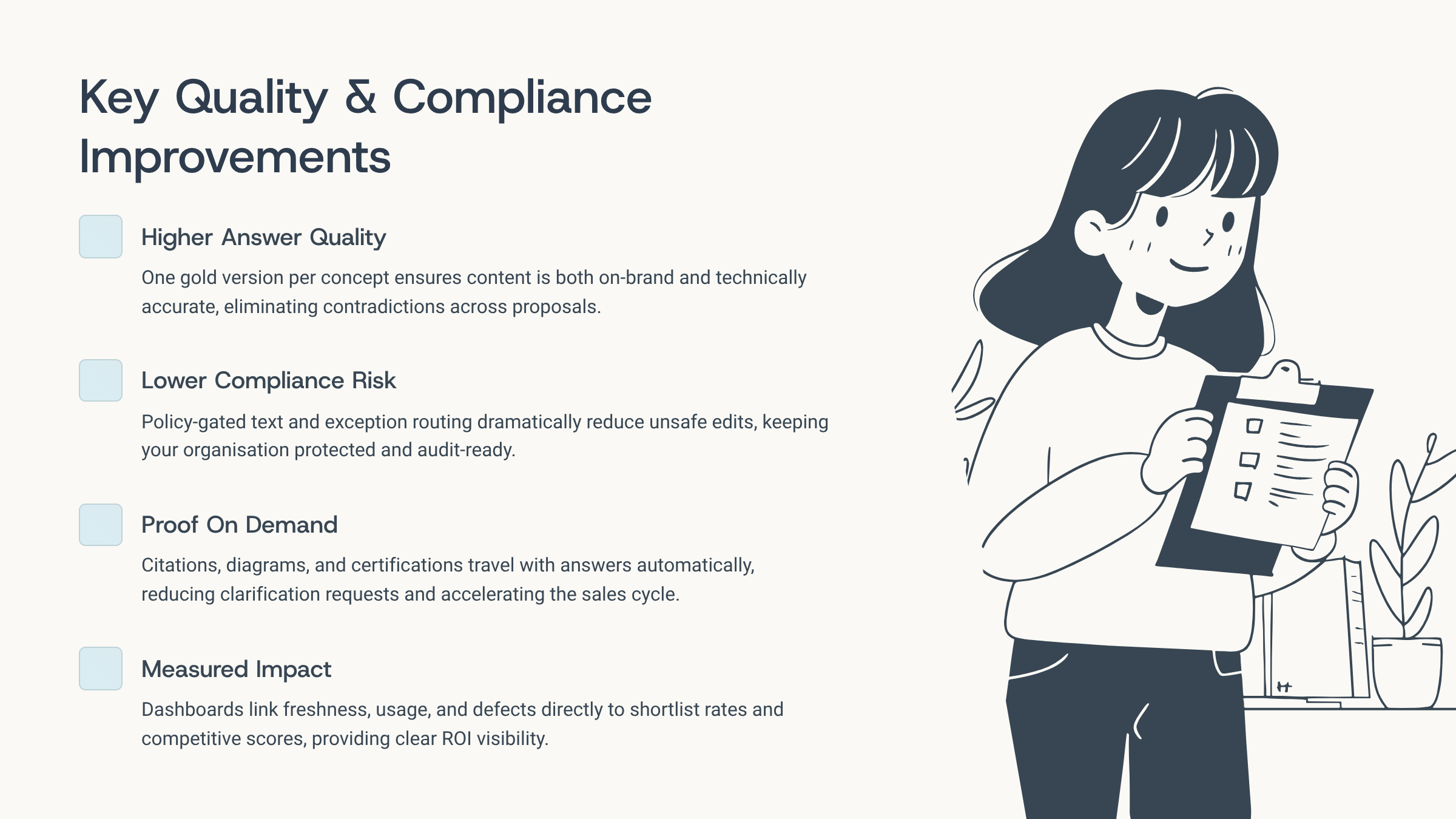
- Higher answer quality – One gold version per concept; on-brand and technically right.
- Lower compliance risk – Policy-gated text and exception routing reduce unsafe edits.
- Proof on demand – Citations, diagrams, and certs ride with answers; fewer clarifications.
- Measured impact – Dashboards link freshness/usage/defects to shortlist rate and points gained.
KPIs to track:
- Velocity: time-to-first-draft ↓ 40–70%; time-in-review ↓ 30–50%
- Quality: defect rate ↓ 50%+
- Freshness: ≥90% of top items with owner + next review
- Adoption: ≥75% of submissions assembled from the library
- Win impact: higher shortlist rate; better security/compliance scores
Treat these metrics as operating guardrails—not vanity stats. If drafts aren’t faster, reviews aren’t lighter, and scores aren’t rising, inspect the library: ownership, evidence, policy gates, and integrations are where the wins (or leaks) live.
Sales Platforms with Built-in Libraries that Help Win Faster
Here’s how five platforms bring “library-first” workflows into everyday selling and RFx.
SparrowGenie
What it is: SparrowGenie is a secure, AI-powered response & proposal workspace that centralizes reusable answers, security language, proofs, and visuals.
Why it helps: Governed modules (owners/expiries), grounded drafting, and exception-only SME routing keep submissions accurate, compliant, and on-brand—while cutting review loops.
Responsive
What it is: Responsive.ai is a strategic response management tool with governed libraries, tags, custom fields, and merge-tag automation.
Why it helps: Standardizes inputs and auto-populates approved language to reduce manual edits and contradictions.
Loopio
What it is: Loopio is an RFP software centered on a curated answer library with maintenance guidance.
Why it helps: Searchable, trusted responses accelerate drafting and reduce rework.
Salesforce (Sales Cloud + CRM Content/Files)
What it is: Sales Cloud has native content libraries with versioning/permissions, available inside CRM records.
Why it helps: Keeps gold-source files next to opportunities for faster assembly and fewer outdated shares.
HubSpot (Sales Hub)
What it is: HubSpot has trackable Documents + Playbooks that surface guided content on contact/deal records.
Why it helps: Reps insert the right asset/script at the right moment and see engagement to prioritize follow-ups.
How to compare (quick lens):
- Findability – tags/fields/semantic search/collections
- Governance – owners/permissions/versioning/expiries
- In-flow access – content surfaced inside CRM/work tools
- Automation – merge tags, auto-populate, portal-ready exports
If your goal is “draft in minutes, reviews on rails,” you need more than stored paragraphs—you need a governed, searchable library wired into where selling happens. SparrowGenie brings that library-first approach to proposals and RFx, with secure AI to keep every line accurate, traceable, and fast.
Sales Content Management with SparrowGenie
SparrowGenie democratizes knowledge with one single source of truth—secure, governed, and built for speed. Centralize reusable answers, security language, proofs, visuals, and templates as modular “gold” blocks with owners, expiries, and version history. Confidence Scores, policy gates (for SLAs/residency/liability), and attached “receipts” (citations, diagrams, certs) keep every line accurate and defensible, while semantic search, collections, and in-flow access (CRM, docs, portals) put the right block at your team’s fingertips.
Conclusion
Great proposals aren’t magic—they’re systems. Stock a governed library with modular answers, mapped evidence, and smart metadata, and your team shifts from copy-pasting to composing. Drafts start faster. Reviews get lighter. Risk goes down. Scores go up. Remember the mantra: personalize last, govern always, measure everything. That’s how content turns into a competitive edge.
Ready to operationalize it end-to-end?
Check out SparrowGenie to centralize your proposal knowledge, enforce governance, and generate grounded first drafts from your secure library—so sales teams respond faster, stay compliant, and win more, consistently.
Ready to see how AI can transform your RFP process?
Product Marketing Manager at SurveySparrow
A writer by heart, and a marketer by trade with a passion to excel! I strive by the motto "Something New, Everyday"
Frequently Asked Questions (FAQs)
Related Articles

AI for RFP Responses: How to Turn Your 10-Day Marathon Into a 2-Day Sprint