How to Respond to an RFP: The Complete Guide to Winning More Deals in 2026

Article written by
Kate Williams

INSIDE THE ARTICLE
SHARE THIS ARTICLE
Summary
Let's skip the preamble. You are here because responding to RFPs takes too long, costs too much energy, and your win rate is not where it should be. This guide covers everything from the go/no-go decision to post-submission debriefs, with practical steps you can put to work on your next proposal.
Whenever an RFP lands on your desk, panic creeps in. This happens certainly because no one really prepares you on how to tackle each RFP without feeling monotonously chaotic. But can we escape the panic or RFP?
Not really, huh?
Companies source roughly 30 to 40 percent of their sales revenue through deals that involve RFPs. Yet the average win rate across the industry sits at just 45 percent. And in federal contracting, as many as 80 percent of proposals get eliminated for non-compliance before a single evaluator reads the actual content.
Those numbers tell a clear story. Most teams are not losing because their product is weak. They are losing because their RFP response process is broken.
This guide walks you through every stage of the RFP response lifecycle, from the initial go/no-go decision to post-submission debriefs. No fluff. No vague advice. Just the practical steps that separate winning proposal teams from the rest.
Let's get into it.
What Is an RFP Response and Why Does It Matter?
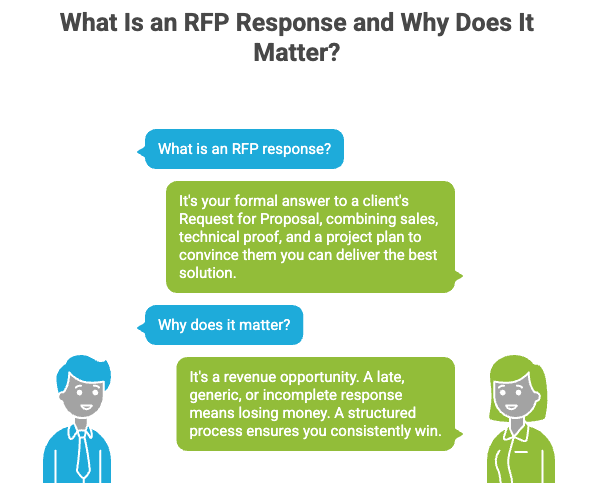
An RFP response is your formal answer to a client's Request for Proposal. It is part sales pitch, part technical proof, and part project plan, all rolled into a single document. The goal is straightforward: convince the evaluator that your team understands their problem and can deliver the best solution.
Here's the thing. An RFP is not just a document. It is a revenue opportunity. When your response is late, generic, or missing key requirements, you are not just losing a proposal. You are leaving real money on the table.
That is why having a structured, repeatable RFP response process matters. It is the difference between reacting to every new RFP like a fire drill and running a disciplined operation that consistently wins.
Step 1: The Go/No-Go Decision
Every minute you spend on an RFP you should not pursue is time stolen from one you could actually win. Before your team invests a single hour, run the opportunity through a structured evaluation.
Key Questions to Ask Before You Commit
- Fit: Does this opportunity match your ideal customer profile? Can you realistically meet the technical requirements and timeline?
- Deal Size: Is the contract value worth the effort required to respond? Think about ACV relative to the resource investment.
- Win Probability: Do you have an existing relationship with the prospect? Is this a warm lead or a cold RFP you stumbled across?
- Competitive Landscape: Were the requirements written with a specific vendor in mind? If the scope feels unusually narrow or the deadline is unreasonably short, it might be a wired deal.
- Resource Reality: Can your team handle this alongside existing workload without burning out your SMEs?
Build a simple scoring framework that weighs these factors. Assign numerical scores, set a threshold, and stick to it. The discipline to say no to poor-fit RFPs is what frees your team to say yes with full commitment when it counts.
SparrowGenie helps teams make smarter go/no-go decisions by centralizing past proposal data and win/loss history, so you stop guessing and start qualifying with confidence.
Step 2: Assemble Your Response Team and Plan the Project
Once you have committed to responding, the clock starts. Teams that wait several days before mobilizing lose momentum and compress the entire writing window. Treat the RFP arrival as a trigger event.
What to Do in the First 48 Hours
- Identify every stakeholder who needs to contribute: sales, product, legal, finance, security, and compliance.
- Break the RFP into sections and assign a clear owner for each one.
- Set internal deadlines that build in buffer time before the actual submission date.
- Schedule a kickoff meeting to align the team on strategy, win themes, and key differentiators.
- Establish a single point of contact who coordinates responses and resolves conflicts.
Companies that have a dedicated RFP or proposal manager essentially eliminate the risk of losing proposals due to missed deadlines. Define roles, responsibilities, and escalation paths before any writing begins so everyone knows who makes the final call on strategy, content, and formatting.
Typical RFP Response Timelines
- Simple sourcing RFPs: Around 4 weeks
- Standard RFPs: 6 to 10 weeks
- Complex enterprise RFPs: 12 weeks or more, especially when legal reviews, security audits, or multiple stakeholders are involved
Work backward from the submission deadline. Fix draft deadlines, review stages, and final formatting milestones. Never leave portal uploads and attachments for the last 24 hours.
Step 3: Build Your Compliance Matrix
Before you write a single word of narrative, build your compliance matrix. This is a table that maps every RFP requirement to exactly where you address it in your response.
Using a compliance matrix can improve response completeness by 42 percent. That is not a minor optimization. It is the difference between making the shortlist and getting eliminated in the first round.
How to Build It
Read the entire RFP and extract every requirement statement. Look for words like shall, must, will, and should. For each requirement, record these data points:
Data Point | Description |
|---|---|
Requirement Reference | RFP section and paragraph number |
Requirement Description | Clear summary of what is demanded |
Compliance Status | Fully comply, partially comply, or do not comply |
Proposal Response Location | Exact section where you address it |
Assigned Owner | Specific team member responsible |
Risk Assessment | Potential challenges or concerns |
Deadline Tracking | Individual requirement due dates |
If you cannot meet a requirement, note it as partial or alternative approach and explain why your alternative is equivalent or better. Never try to hide non-compliance. Evaluators will find it, and it looks dishonest.
Step 4: Research the Client and Develop Your Win Strategy
Generic responses lose deals. The proposals that win consistently are the ones that demonstrate a deep understanding of the client's world, not just their requirements.
Client Research Checklist
- Review their website, recent press releases, and annual reports.
- Identify their key challenges, strategic initiatives, and growth goals.
- Research their industry trends and competitive landscape.
- Understand their current tech stack and integration requirements.
- Connect with your sales team to gather intel from previous conversations.
Read the RFP not just for what it asks, but for what it reveals. When buyers describe their current-state problems, those sections tell you what matters most to them. Reference specific details about the client throughout your response. Mention their recent acquisition, expansion plans, or industry-specific challenges. Show them you have done your homework.
Crafting Your Win Themes
Before anyone starts writing, answer a fundamental question: Why should you win this deal? What are three to five key messages that differentiate you from competitors?
High-performing proposal teams use win themes 71 percent of the time, compared to just 42 percent for low-performing teams. Each win theme should be clear, memorable, differentiating, important to the client, and backed by evidence.
Here is a quick example. Instead of writing something vague like "we offer 24/7 customer support," a strong win theme would be: "Our dedicated support team ensures zero-downtime operations with guaranteed two-hour on-site response, so critical systems never stall your business."
See the difference? One is a feature. The other is a business outcome tied directly to the client's pain.
Want to build RFP responses that actually convert?
SparrowGenie's AI-powered content library gives your team instant access to approved, high-performing answers, so every response starts strong instead of starting from scratch.
Step 5: Write the Response
This is where deals are won or lost. Your content needs to be compelling, accurate, and tailored to the prospect's specific needs.
The Cover Letter
Your cover letter is your first impression. Keep it to one page. Address it to a named individual, restate the client's objectives in your own words, highlight three to four differentiators with at least one quantifiable proof point, and close with a clear next step. Make it warm and client-focused. Every line should answer: why should they care?
The Executive Summary
The executive summary is often the only section all evaluators read completely. Decision-makers may read nothing else. It must be compelling, complete, and concise.
Open with a one to two paragraph hook that addresses their most pressing pain point. Follow it with your win themes, a clear demonstration that you understand their requirements (not just repeating them, but showing you grasp the underlying challenges), a high-level approach in non-technical language, and a closing commitment.
What does not belong? Your founding story, generic capability statements, detailed technical specs, or pricing details. Save those for their proper sections.
Content Development Best Practices
- Map each RFP question to your response strategy before writing.
- Use conversational, accessible language. Avoid jargon unless it is industry-appropriate.
- Focus on benefits and outcomes, not just features. Replace "our platform includes advanced AI capabilities" with "you will generate RFP responses in under 10 minutes instead of spending 2 days."
- Include micro-case studies of two to three sentences with specific metrics. They are more persuasive than pages of general capability descriptions.
- Use active voice throughout: "We will migrate 200 servers" not "200 servers will be migrated."
- Be specific: "Deliver weekly status reports every Monday by 10am" not "provide regular updates."
The Technical Approach
Structure this with a high-level overview, detailed methodology broken into phases, tools and technologies, quality assurance procedures, innovation highlights, and risk management plans. For each phase, spell out the objective, specific activities, deliverables, timeline, and success criteria.
Pricing
Be transparent and easy to compare. Break down your pricing and demonstrate the ROI of each component. When your upfront price is higher, show total cost of ownership to make the long-term value clear. Make it easy for evaluators to build a strong internal business case on your behalf.
Step 6: Collaborate with SMEs Without the Bottleneck
Subject matter experts provide critical technical knowledge. They are also the biggest bottleneck in most RFP processes. When SME utilization runs above 80 percent on proposal work alone, your entire pipeline slows down.
How to Make SME Collaboration Actually Work
- Send specific questions with context about the client and opportunity. Do not dump an entire RFP section on them.
- Provide pre-drafted responses they can review and validate, rather than asking them to write from scratch.
- Give realistic deadlines with buffer time built in.
- Timebox their input windows to respect their schedules.
- Show appreciation for their contributions and share win outcomes.
The best proposal teams treat SMEs like a scarce resource, because they are. The less friction you create for them, the faster and better their input will be.
Tired of chasing SMEs through Slack and email?
SparrowGenie routes the right questions to the right experts with built-in approval workflows, so your proposal team stops waiting and starts moving.
Step 7: Review, Refine, and Quality-Check Everything
No proposal should ship without a structured review process. The most disciplined teams use a color-team review framework:
Review | When | Focus |
|---|---|---|
Pink Team | ~50% complete | Review strategy, outline, and win themes. Is the plan sound? |
Red Team | ~90% complete | Full content review. Is it compelling? Are all requirements answered? Use fresh eyes. |
Gold Team | Final | Compliance check. Every requirement addressed? All forms completed? Formatting correct? |
The Two-Pass Compliance Review
- First pass (48 hours before deadline): Verify every requirement has a response and all attachments are included.
- Second pass (24 hours before deadline): Have someone who was not involved in writing review the entire submission against the original RFP with fresh eyes.
Pre-Submission Checklist
- Every requirement from the compliance matrix addressed
- All required forms and certifications included
- Page limits met, not exceeded
- Formatting matches RFP specs: font, margins, layout
- Pricing matches between summary and detail sections
- No typos or grammar errors
- File naming conventions followed
- Submitted to the correct portal or address
- Confirmation of receipt obtained
Step 8: Design and Format for Impact
Visuals matter more than most teams realize. Process flow diagrams, timelines, and organization charts communicate complex information quickly and break up dense text. Teams that use personalized, well-designed graphics consistently see higher finalist and win rates.
Design Best Practices
- Comply strictly with RFP formatting requirements for font, margins, color, and page limits.
- Use charts, graphs, and infographics to represent complex data visually.
- Personalize graphics by embedding the prospect's name, logo references, and details unique to their project.
- Every graphic should have a clear purpose and be referenced in the surrounding text. Add clarification, not decoration.
- Use headings, subheadings, and white space to make the document scannable.
Step 9: Avoid These Common RFP Response Mistakes
Even experienced proposal teams fall into these traps. Here is what to watch for:
Mistake | How to Avoid It |
|---|---|
Generic, boilerplate responses | Start every RFP with a discovery session. Personalize by referencing the buyer's systems, terminology, and constraints. |
Failing to differentiate | Identify genuine differentiators for this specific buyer and weave them throughout the entire response. |
Ignoring the buyer's pain points | Read the RFP for problems, not just requirements. Mirror their language and connect your solution to relieving their specific pain. |
Weak proof points | Maintain an updated case study repository. Select proof points that match the buyer's industry and context. |
Missing requirements | Use your compliance matrix as a checklist during every review stage. |
Ignoring formatting instructions | Treat formatting specs as part of the evaluation criteria. Build a checklist and stick to it. |
Late kickoffs | Mobilize within 48 hours of RFP release. No exceptions. |
Outdated content library | Review your content library quarterly. Validate every metric and case study for accuracy. |
Step 10: Use AI and Automation to Work Smarter
The RFP response automation market is growing fast, projected to reach $2.43 billion by 2029 from $0.9 billion in 2024. And there is a reason. AI tools can dramatically reduce the manual grind without sacrificing quality.
What AI Can Do for Your RFP Response Process
- Auto-answer questions: AI platforms can auto-answer 70 to 80 percent of RFP questions by pulling from curated knowledge bases, often completing a first draft in minutes.
- Document parsing: AI can break down complex RFPs, identify requirements, and flag compliance criteria automatically.
- Compliance matrix generation: Automatically produce compliance matrices by cross-referencing RFP requirements with your historical responses.
- Go/no-go intelligence: AI agents can analyze deal risk factors and past win/loss outcomes to generate evidence-based recommendations.
- Content personalization: AI tools can tailor responses by industry, buyer role, and specific RFP requirements.
Here is the important caveat. While AI and templates speed up responses, unvalidated generic content kills your competitive edge. Use automation to handle compliance, formatting, and first drafts. But make sure your value proposition, differentiators, and proof points come through with specific, relevant examples. Clients can spot generic AI-generated content. And that is where the human-AI partnership matters most.
SparrowGenie combines AI-powered auto-answering with a governed content library, so your team gets fast first drafts built on approved, accurate answers.
Step 11: Post-Submission — Debrief and Improve
The work does not end when you hit submit. Capturing lessons learned after every RFP creates a compounding advantage over time.
Immediate Post-Submission Actions
- Send a professional confirmation email to the prospect.
- Document lessons learned while the process is still fresh.
- Follow up based on the prospect's procurement timeline.
Internal Debrief
Hold a debrief within one week of submission. Send a standard set of questions to the team a couple of days before, collect responses anonymously, sort them by topic, and then use the meeting to problem-solve rather than information-gather.
Track These Metrics for Continuous Improvement
- Response time from RFP receipt to submission
- Win rate by deal size, industry, and response team
- Content reuse ratio across proposals
- SME engagement time per project
After every proposal outcome, win or lose, update your content library. Prioritize strategies that worked. Drop the ones that did not. This is how you build a proposal operation that gets stronger with every cycle.
Quick Reference: What Goes Into an RFP Response?
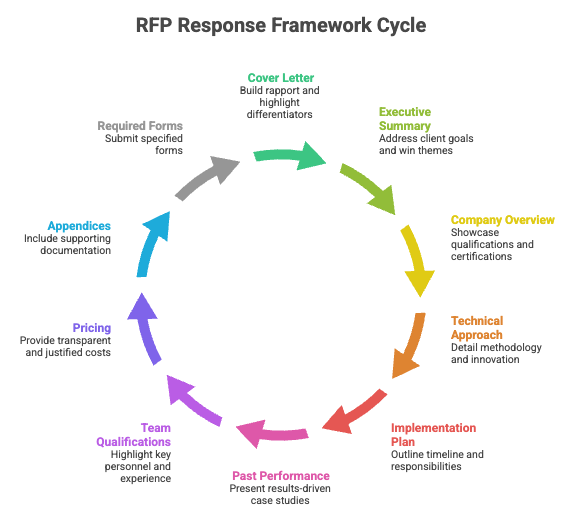
While the exact structure should mirror whatever the RFP specifies, most winning proposals follow this general framework:
- Cover Letter — One page. Builds rapport, expresses interest, highlights three to four differentiators.
- Executive Summary — One to three pages. Addresses client goals, win themes, high-level approach.
- Company Overview — Relevant qualifications and certifications.
- Technical Approach — Detailed methodology, tools, innovation, risk management.
- Implementation Plan — Timeline, milestones, responsibilities, onboarding support.
- Past Performance — Relevant, recent, results-driven case studies.
- Team Qualifications — Key personnel, experience, organizational structure.
- Pricing — Transparent, detailed, with ROI justification.
- Appendices — Certifications, references, supporting documentation.
- Required Forms — As specified in the RFP.
Why Proposal Teams Are Switching to SparrowGenie
Most RFP response processes are held together by spreadsheets, Slack threads, and sheer willpower. Your SMEs are stretched thin. Your content library is a mess of outdated Google Docs. And every new RFP feels like starting from scratch.
SparrowGenie was built to fix that.
It is a secure, AI-powered RFP automation platform designed specifically for sales and proposal teams that handle high volumes of RFPs, DDQs, security questionnaires, and complex proposals. Not a generic AI tool bolted onto a document editor. A purpose-built system that understands how proposal teams actually work.
What Makes SparrowGenie Different
Here are a few key factors that make SparrowGenie different from other RFP tools.
AI That Understands Context, Not Just Keywords
SparrowGenie does not just match questions to answers. It uses contextual AI to interpret even the most unstructured RFPs and questionnaires, mapping them accurately and generating high-quality first drafts with confidence scores. You know exactly how reliable each answer is before you review it.
A Knowledge Hub with Full Lifecycle Intelligence
Most platforms give you a content library. SparrowGenie gives you a knowledge hub with dedicated modules for training, testing, improvement, and conflict resolution. Your content does not just sit there. It gets smarter, stays current, and resolves contradictions before they become compliance risks.
Company Intelligence Built Into Every Project
Before your team writes a single answer, SparrowGenie auto-generates a structured, evidence-based company overview of the prospect, covering what they do, their industry, revenue scale, and product ecosystem. No more wasting hours on manual research. Your SMEs start with real context instead of guessing.
Obligation Tracking That Keeps Commitments Visible
During proposal cycles, teams make dozens of commitments: sharing documents, confirming feasibility, delivering revisions, getting approvals. SparrowGenie tracks every obligation inside the project itself, with assignees, due dates, statuses, and a full activity log. No more chasing commitments through email and task boards.
Collaboration That Actually Flows
Role-based workflows, inline commenting, one-click assignments, and built-in approval routing mean your proposal managers stop playing traffic cop. The right questions go to the right SMEs. Reviews happen in context. Approvals do not stall in someone's inbox.
Lightning-Fast First Drafts
Upload your RFP document, and SparrowGenie auto-generates responses in minutes, not days. Your team spends time refining and tailoring instead of writing from a blank page. Teams using SparrowGenie report 50 to 60 percent faster proposal creation and handle 3x more RFPs without adding headcount.
Real-Time Project Dashboard
Get a bird's-eye view of every active RFP, who owns what, where the blockers are, and which deadlines are approaching. No more status meetings to figure out where things stand.
White-Glove Onboarding and Dedicated Success
SparrowGenie is not a self-serve tool you figure out on your own. Every team gets high-touch onboarding tailored to their workflows, plus a dedicated customer success partner. You are not just buying software. You are getting a team that cares about your win rate.
Who Is SparrowGenie Built For?
Growth-stage B2B companies & enterprises handling 10 or more RFPs per month. Teams where SME bottlenecks slow down deal cycles. Proposal managers tired of chasing answers across five different tools. Sales leaders who see RFPs as revenue, not paperwork.
If your team is still stitching together proposals with shared folders, email chains, and legacy templates, and you are feeling the pain of inconsistent messaging, missed deadlines, and SME burnout, SparrowGenie is built for exactly this moment.
Frequently Asked Questions About Responding to RFPs
How long does it take to respond to an RFP?
It depends on complexity. Simple sourcing RFPs take around 4 weeks. Standard RFPs run 6 to 10 weeks. Complex enterprise RFPs with legal, security, and multi-stakeholder reviews can take 12 weeks or more.
What is a compliance matrix and why do I need one?
A compliance matrix maps every RFP requirement to where you address it in your response. It improves response completeness by up to 42 percent and ensures nothing falls through the cracks during review.
How can AI help with RFP responses?
AI can auto-answer 70 to 80 percent of common questions from your knowledge base, parse complex documents, generate compliance matrices, and personalize content by industry and buyer role. The key is pairing AI speed with human review to maintain accuracy and differentiation.
What is a win theme in an RFP response?
A win theme is a clear, memorable message that explains why the client should choose you over competitors. Strong win themes are specific, evidence-backed, and tied directly to the client's pain points. High-performing teams use them in 71 percent of their proposals.
What is the biggest mistake teams make when responding to RFPs?
Submitting generic, boilerplate responses. Evaluators can immediately tell when a proposal has not been tailored to their specific needs. Start every response with client-specific research and weave your differentiators throughout the entire document.
The Bottom Line
Responding to an RFP is not just about answering questions. It is about positioning your team as the clear, credible, and differentiated choice.
The teams that win consistently are not necessarily the ones with the best product. They are the ones with the best process: disciplined go/no-go decisions, structured compliance tracking, compelling win themes, efficient SME collaboration, and a continuous improvement loop that gets sharper with every submission.
That is what separates a proposal team that reacts from one that wins.
And if your team is ready to move faster, respond smarter, and close more deals without burning out your people, that is exactly what SparrowGenie was built for.
Ready to transform your RFP response process?
SparrowGenie helps proposal teams automate first drafts, collaborate with SMEs in real time, track compliance, and submit winning proposals faster. All with enterprise-grade security and AI you can trust.
Ready to see how AI can transform your RFP process?
Product Marketing Manager at SurveySparrow
A writer by heart, and a marketer by trade with a passion to excel! I strive by the motto "Something New, Everyday"