Loopio vs Responsive vs SparrowGenie: Which RFP Tool Fits You Best?

Article written by
Aparna Rajendran

INSIDE THE ARTICLE
SHARE THIS ARTICLE
Summary
Choosing the right RFP tool is no longer just about answering faster; it’s about automation depth, AI maturity, usability, and total cost of ownership. In this comparison, we break down Loopio, Responsive (formerly RFPIO), and SparrowGenie across features, pricing, AI capabilities, integrations, and ideal use cases. Whether you’re a mid-market team seeking ease of use, an enterprise chasing maximum automation, or a fast-growing company evaluating AI-first RFP software for 2026, this guide will help you decide which platform fits you best.
There’s no shortage of RFP tools in the market. You shortlist a few, pick what looks best on paper, and move forward. But once real RFP volume kicks in, the cracks show. The system struggles to scale, workflows slow down, and what felt efficient early on starts draining time, budget, and team energy.
Choosing the right RFP response software isn’t just a tooling decision. It directly impacts deal velocity, response quality, and how stretched your sales and presales teams feel as RFP volumes grow and timelines shrink. That’s why more organizations are actively evaluating RFP automation software that can deliver speed, accuracy, and consistency without falling apart at scale.
This blog takes a practical, side-by-side look at Responsive vs Loopio vs SparrowGenie, with SparrowGenie positioned as a modern RFP automation alternative. Using real-world research, we break down how each platform works in practice, their strengths and limitations, pricing realities, AI maturity, integrations, and ideal use cases so you can confidently choose the RFP software that actually fits your needs today and scales with you tomorrow.
If you want to skip the deep dive and jump straight to any section, just click the heading below:
- Understanding the RFP Software Landscape
- Platform Overviews
- Loopio: Strengths, Limitations, AI Capabilities, & More
- Responsive (RFPIO): Strengths, Limitations, AI Capabilities, & More
- SparrowGenie: Strengths, Limitations, AI Capabilities, & More
- Loopio vs Responsive (RFPIO) vs SparrowGenie: A Side-by-Side Comparison
- Quick Buyer Takeaway
- Which Tool Is the Right Choice and When?
- Conclusion
Understanding the RFP Software Landscape
Before comparing RFP tools side by side, it helps to step back and understand how the RFP software market has evolved. What started as simple content repositories has matured into intelligent RFP automation software that blends AI, structured workflows, and performance analytics.
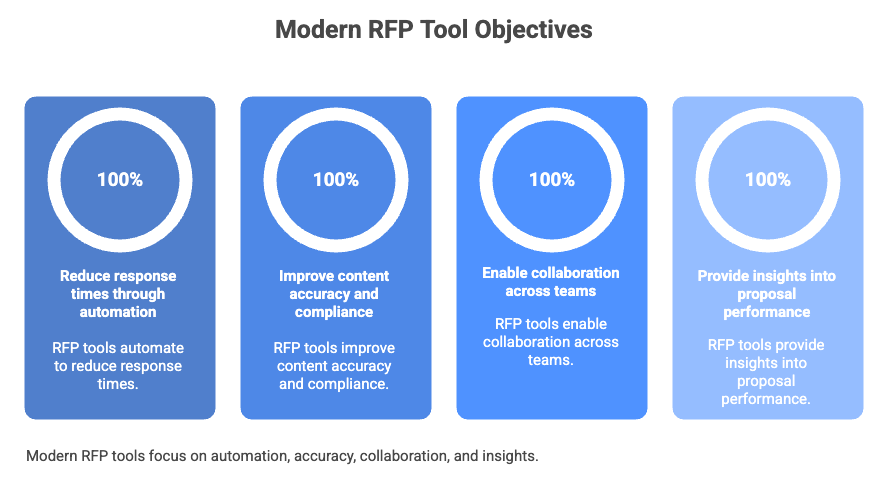
Modern RFP response software is designed to help teams:
- Reduce RFP response time through automation and reuse
- Improve answer accuracy, consistency, and compliance
- Enable cross-functional collaboration between sales, legal, security, and product teams
- Track insights like win rates, response quality, and proposal performances.
This shift explains why platforms like Loopio, Responsive (formerly RFPIO), and SparrowGenie are no longer competing on basic document management. Today, the real differentiators are AI maturity, governance, scalability, and how well the software holds up under real enterprise RFP pressure.
Learn more here.
Looking for an RFP automation tool that can also be your complete sales enablement platform?
Platform Overviews
Before getting into feature-by-feature comparisons, it helps to understand how each platform positions itself in the RFP software landscape and the kind of teams it’s built for.
Loopio
Loopio is one of the most widely adopted RFP response software platforms, known for its strong content library and structured workflows. It’s designed primarily for sales-led teams that handle a consistent volume of inbound RFPs and rely heavily on reusing approved answers.
At its core, Loopio focuses on centralizing institutional knowledge, standardizing responses, and helping proposal teams move faster through reuse and collaboration. Its AI capabilities are layered on top of an existing content-first model, making it a solid fit for organizations with mature RFP processes and well-maintained answer libraries.
Responsive
Responsive (formerly RFPIO) positions itself as a comprehensive RFP automation software built for large, process-heavy organizations. It goes beyond basic RFPs to support RFIs, RFQs, security questionnaires, and due-diligence workflows at an enterprise scale.
The platform emphasizes governance, configurability, and cross-functional collaboration, making it popular with teams that involve legal, security, compliance, and multiple business units in every response. Responsive competes on depth and control, with AI designed to assist within highly structured, rule-driven environments.
SparrowGenie
SparrowGenie represents a newer generation of AI-powered RFP software, built around speed, confidence, and human-in-the-loop control. Instead of starting with static libraries, it uses AI to understand questions, pull answers from verified knowledge sources, and clearly signal where human review is needed.
The platform is designed for modern sales and presales teams that want to reduce back-and-forth, handle complex RFPs faster, and collaborate across Slack, Teams, and shared workspaces. SparrowGenie competes less on legacy process depth and more on AI maturity, confidence scoring, and scalability without operational overhead.
Why these three platforms are often compared
All three tools aim to solve the same core problem: helping teams respond to RFPs faster and more accurately. Where they differ is how they approach automation, whether through reuse-first libraries, process-heavy governance, or AI-led response generation. Understanding these positioning differences sets the foundation for a more meaningful comparison in the sections that follow.
Loopio: Strengths, Limitations, AI Capabilities, & More
Source: Loopio
What Is Loopio?
Loopio is an established RFP response software platform designed to help sales, presales, and revenue operations teams standardize and scale their responses to RFPs, RFIs, and DDQs. Loopio is primarily used to centralize approved content, enforce consistency across proposals, and reduce inefficiencies caused by duplicate work and ad hoc collaboration. Its value lies in creating a single source of truth for responses while bringing structure and accountability to the RFP process.
How Loopio Software Works in Practice
Loopio software is built around a centralized content library model, supported by workflow and collaboration features. After logging in through the Loopio login, teams typically operate as follows:
- Approved RFP, security, and compliance responses are stored in a centralized answer library.
- Incoming RFPs are imported and broken down into individual questions.
- Questions are matched to existing content using tags, metadata, and AI-assisted suggestions.
- Proposal managers assign ownership to subject-matter experts and track progress at a section level.
- AI supports light rewriting and adaptation but depends largely on the quality of existing content.
- Final responses are exported into buyer-ready formats such as Word or Excel.
This approach is why Loopio is often recognized in RFP software evaluations for predictable workflows, ease of adoption, and operational consistency rather than aggressive automation.
Strengths of Loopio Software
From an enterprise lens, Loopio’s strengths are operational rather than experimental. Here are a few major strengths summarized from the real user reviews of Loopio:
- Strong content reuse reduces response time and improves consistency across deals.
- An intuitive interface minimizes training and onboarding friction for sales teams.
- Established workflows for assignment, review, and approval support governance.
- Dependable customer success and implementation support.
- Well-suited for organizations managing a consistent, repeatable volume of RFPs.
These capabilities make Loopio a reliable option for teams prioritizing control, adoption, and process maturity.
G2 Rating: 4.6/5
Limitations and Considerations
Despite its strengths, real user reviews also mention that Loopio software presents limitations that can surface as organizations scale or deal complexity increases:
- AI capabilities are incremental and less effective for nuanced, multi-part questions.
- High dependence on ongoing library curation and governance.
- Limited flexibility for highly customized or non-standard questionnaires.
- Can introduce administrative overhead in large, multi-entity deployments.
- Lacks built-in confidence indicators or source validation for answers.
As a result, RevOps and presales often begin exploring Loopio alternatives when they require deeper automation, AI-driven confidence, or more adaptive workflows across complex enterprise deals.
Loopio AI Capabilities
Loopio positions AI as an efficiency layer on top of its established content library, helping teams reduce manual effort while maintaining consistency.
- Magic auto-answering from library
Loopio’s Magic feature analyzes questions and automatically suggests or fills answers from the existing content library, covering a significant portion of repetitive RFP and security questions. - Generative GPT-based drafting
GPT-style AI is layered on top of Magic to generate new content, rephrase answers, or adjust tone, while remaining grounded in approved library content. - Bulk answer generation
Teams can generate hundreds of answers at once within a project, creating a fast first draft that SMEs review and refine. - NLP-driven question understanding
Magic uses natural language processing to interpret question intent and match it to relevant answers, going beyond basic keyword search. - AI-assisted response automation toolkit
Loopio frames AI as a toolkit that supports faster drafting across RFPs, RFIs, DDQs, and security questionnaires without replacing human ownership.
Loopio’s AI is best suited for organizations with a mature content library that want to accelerate reuse and reduce time-to-first-draft, rather than fully automate complex responses.
Loopio Pricing
Pricing is often a key factor in enterprise evaluations of RFP response software, and Loopio is generally seen as one of the more predictable options. Loopio pricing typically starts around $20,000 per year and scales based on users, features, and integrations. While it isn’t a low-cost solution, its transparent pricing model appeals to RevOps teams that value budget control and, compared to RFPIO, often delivers a more predictable total cost of ownership for standardized RFP workflows.
Looking for RFP software that ticks all your boxes?
Bottom Line on Loopio
Loopio is a reliable RFP response software for organizations that prioritize consistency, reuse, and operational stability over advanced automation. It works best for sales-led teams managing a predictable volume of standard RFPs, where a well-maintained content library and structured workflows deliver steady efficiency gains. For enterprises with mature processes and a strong focus on adoption and governance, Loopio remains a dependable choice, though teams seeking deeper AI-driven automation may eventually look at Loopio alternatives.
Responsive (RFPIO): Strengths, Limitations, AI Capabilities, & More
Source: Responsive
What Is RFPIO?
Responsive, formerly known as RFPIO, is a leading enterprise-grade RFP software designed to automate and manage complex response workflows at scale. When buyers ask, “What is RFPIO?” or “What is RFPIO used for?”, the answer is straightforward: RFPIO (now branded as Responsive) is used to automate, govern, and optimize responses to RFPs, RFIs, DDQs, and security questionnaires across large, multi-department organizations.
Often referred to interchangeably as Responsive RFP, Responsive RPIO, or Responsive.io, the platform positions itself as a strategic response management system rather than just a repository of answers. It is best suited for organizations with high RFP volumes, mature proposal teams, and sophisticated compliance requirements.
How Responsive RFP Software Works in Practice
After accessing the platform via the RFPIO login, users manage the full lifecycle of proposal responses within a single system. Here is how Responsive.io works in practice for sales teams:
- Central Q&A repository powering RFPs, RFIs, and security questionnaires.
- AI suggests answers based on historical responses and metadata.
- Large RFPs are broken into projects with multi-editor collaboration.
- Strong SME workflows with comments, assignments, and approvals.
- Advanced modules support security reviews and due-diligence workflows.
Unlike simpler tools, Responsive is built for scale. This makes it a powerful RFP automation software choice for enterprises responding to hundreds of requests annually.
Key Benefits of Responsive
In practice, here are the key benefits of being responsive, as said by the users:
- Built for complex, enterprise-scale RFPs with many stakeholders.
- Handles security and compliance questionnaires particularly well.
- Deep configuration for approvals, roles, and governance.
- AI reduces response time for repetitive sections.
- Strong onboarding and hands-on implementation support.
Along with these key benefits, Responsive differentiates itself through advanced AI agents.
G2 Rating: 4.5/5
Limitations and Considerations
Despite its power, Responsive RFPIO has setbacks too. Here are a few of them summarized from real user reviews across G2:
- Steeper learning curve compared to lighter RFP tools.
- Navigation can feel overwhelming on very large projects.
- AI suggestions sometimes lack contextual nuance.
- Ongoing library upkeep is mandatory to maintain accuracy.
- Pricing grows quickly as more users or modules are added.
These factors are why some teams evaluating what Responsive is used for ultimately decide it’s too complex for their needs and look to simpler tools instead.
Responsive AI Capabilities
Responsive applies AI across drafting, formatting, and content governance, with a strong emphasis on enterprise control and process depth.
- AI writing agent for first drafts
Responsive AI generates tailored first-draft responses using trusted library content and prior successful answers, particularly effective for security questionnaires and DDQs. - AI import and formatting agent
Complex questionnaires are automatically ingested, structured, and formatted, reducing manual setup and preparation work. - Ask Responsive conversational assistant
A chatbot-style interface allows users to query organizational content in natural language and receive context-aware answers instantly. - AI-driven content governance
AI helps identify and clean redundant, obsolete, or trivial (ROT) content in the library, improving accuracy over time. - Generative assistance for summarization and expansion
Users can summarize, expand, or tailor responses for different audiences or word limits without rewriting from scratch.
Responsive uses AI to support scale, governance, and process complexity, making it a strong fit for large organizations with heavy compliance and cross-functional involvement.
Responsive.io Pricing
RFPIO pricing is fully quote-based and not publicly listed on responsive.io, with costs typically structured on a per-user basis. When evaluating RFPIO cost, buyers should factor in add-ons like integrations, advanced analytics, sandbox environments, and professional services, which can significantly impact the total investment. As a result, Responsive is generally positioned as a premium RFP software, best justified for high-volume, compliance-heavy, or highly regulated use cases.
Bottom Line on Responsive (RFPIO)
Responsive is a strong fit for large, process-heavy organizations that manage high volumes of complex RFPs, RFIs, and security questionnaires and need strict governance across multiple teams. Its strength lies in enterprise control, configurability, and compliance rather than simplicity or speed, making it a solid choice when consistency, auditability, and scale matter more than lightweight workflows or aggressive AI-driven automation.
Looking for RFP software that ticks all your boxes? Connect with us!
SparrowGenie: Strengths, Limitations, AI Capabilities, & More
What's SparrowGenie?
SparrowGenie is a modern, AI-native entrant redefining what RFP software 2026 looks like. At its core, what is RFP software? It’s a system that helps organizations create, manage, automate, and analyze responses to Requests for Proposal (RFPs), RFIs, and related questionnaires. In rfp software, the expectation has shifted from simple content storage to intelligent automation, speed, and contextual accuracy.
SparrowGenie was built from the ground up as AI RFP software, not a legacy rfp management software retrofitted with AI. This design choice prioritizes rapid time-to-value, minimal setup, and conversational intelligence—especially appealing to sales-led and growth teams seeking modern automation without enterprise overhead.
How SparrowGenie Works as Modern RFP Management Software
Unlike traditional tools that require months of content curation, SparrowGenie learns directly from your existing proposal history and connected systems. Teams use the platform to:
- Upload an RFP or questionnaire and let AI map questions automatically.
- Answers are generated from a governed knowledge hub, not generic AI.
- Each response is confidence-scored so teams know what needs review.
- Sales, presales, legal, and security collaborate in one secure workspace.
- Teams can also ask questions directly from Slack or Teams mid-deal.
This approach reflects where RFP software is headed: less manual library maintenance and more adaptive, context-aware generation.
Key Strengths of SparrowGenie
SparrowGenie consistently delivers value in real-world usage, based on early but credible user feedback and buyer evaluations. SparrowGenie's key strengths, summarized from the real G2 user reviews, include
- Dramatically faster first drafts, often in minutes instead of days.
- Confidence scoring reduces blind trust in AI-generated answers.
- Designed around real presales workflows, not just RFP admins.
- Secure, human-in-the-loop controls for sensitive enterprise data.
- Strong ROI positioning for teams handling high-value deals.
Taken together, these strengths position SparrowGenie as a high-impact option for teams that want measurable speed and confidence gains without compromising control or security.
G2 Rating: 4.5/5
Limitations and Considerations
Like any emerging platform, SparrowGenie also has areas that buyers should evaluate carefully, especially in larger or more conservative enterprise environments.
- Smaller public review footprint compared to legacy vendors.
- Requires thoughtful setup of knowledge sources early on.
- Enterprises may want deeper proof points as adoption scales.
- Marketplace integrations are still growing.
- Change management is needed for teams new to AI-led workflows.
For most teams, these limitations are less about capability gaps and more about readiness, adoption, and scale, factors that become easier to address as AI-led workflows mature across the organization.
SparrowGenie AI Capabilities
SparrowGenie takes an AI-first approach, using automation to handle the heavy lifting while keeping humans firmly in control of final outputs.
- AI-powered RFP and proposal generation
Teams can generate complete RFPs or proposals from a natural-language brief or through a guided builder, reducing document creation time dramatically. - Automated response drafting
SparrowGenie auto-drafts accurate responses to RFPs, security questionnaires, and proposals, turning traditionally manual work into AI-assisted workflows. - Secure, governed AI workflows
The platform emphasizes AI-secure, human-led controls, with approvals and safeguards designed for sensitive enterprise data. - Smart content and template intelligence
AI combines internal knowledge with industry-specific templates, ensuring responses are context-aware rather than generic. - Embedded AI assistant for GTM teams
Sales and presales teams get on-demand access to product specs, competitive insights, and approved answers, enabling consistent responses across deals.
SparrowGenie is designed for teams that want AI to drive speed and scale without sacrificing trust, governance, or human oversight.
SparrowGenie Pricing
SparrowGenie uses a custom pricing model rather than fixed, seat-based plans. Pricing is positioned at the lower end of the market compared to traditional rfp management software, with a focus on predictable costs and fast time-to-value.
SparrowGenie typically bundles onboarding and implementation and is designed to deploy in weeks, not months. This makes it a strong option for teams evaluating AI RFP software in 2026 that want modern automation without the long contracts and high entry costs of legacy RFP platforms.
Bottom Line
When asking, "What is the best RFP software?" the answer depends on context. SparrowGenie is not trying to replace enterprise-heavy platforms; instead, it offers a modern, AI-first take on RFP management software.
If your priorities are speed, affordability, and AI-driven assistance, with lower tolerance for legacy complexity, SparrowGenie represents a compelling vision of where AI RFP software is heading.
Ready to explore SparrowGenie?
Loopio vs Responsive (RFPIO) vs SparrowGenie: A Side-by-Side Comparison
Here is a quick side-by-side comparison cheat sheet for Loopio vs Responsive vc SparrowGenie:
Category | Loopio | Responsive (RFPIO) | SparrowGenie |
|---|---|---|---|
Market Position | Mid-market RFP response leader | Enterprise-grade response management platform | AI-native challenger |
Best For | First-time RFP software adopters, regulated teams | Large enterprises with high RFP / DDQ volume | Sales-led, budget-conscious, agile teams |
RFP Volume Sweet Spot | 20–100 RFPs/year | 100–500+ RFPs/year | 10–50 RFPs/month |
Core Focus | Usability, content quality, governance | Maximum automation, integrations, scale | Speed, AI-first drafting, affordability |
Ease of Use | ⭐⭐⭐⭐ | ⭐⭐⭐⭐ | ⭐⭐⭐⭐⭐ |
Onboarding Time | 15–60 days | 1–3+ months | 15 - 30 days |
AI Approach | Assisted AI (answer matching + cited generation) | Agent-based AI (autonomous workflows) | AI-native learning from past proposals |
Automation Rate (Claimed / Observed) | ~55% | Up to ~80% | ~50–60% (early-stage) |
Content Library | Structured, governed, manual curation | Advanced governance + AI cleanup | Minimal manual setup; AI learns context |
Collaboration & Workflow | Simple, intuitive, high SME adoption | Complex approvals, enterprise workflows | Embedded in Slack & Teams |
Integrations | Core CRM & collaboration tools | 20+ native + 75+ APIs (best-in-class) | Essential CRM & collaboration tools |
Analytics & Reporting | Basic–moderate | Advanced BI & proposal analytics | Limited (early-stage) |
Security & Compliance | SOC 2 Type II, ISO 27001/9001, GDPR | Enterprise-grade, strong InfoSec focus | Secure by design, limited public audits |
Pricing Model | Seat-based, transparent | Seat-based, custom & premium | Low-cost, disruptive pricing |
Starting Price | ~$20,000/year | Custom | Custom |
Hidden / Add-On Costs | Some integrations, services | Integrations, AI, sandboxes, services | Minimal (bundled) |
Proven ROI & Case Studies | Strong, Forrester-validated | Strong, mostly vendor-reported | Limited (early validation) |
Key Strengths | Adoption, support, reliability | Automation depth, integrations, scale | Speed, AI-native design, affordability |
Key Limitations | Lower AI ceiling than RFPIO | Steep learning curve, high cost | Comparatively new in the market |
Overall Fit Summary | Best balance of usability & governance | Best for complex enterprise automation | Best for fast, modern, low-cost RFPs |
Quick Buyer Takeaway
- Choose Loopio if you want the safest, most user-friendly RFP software with proven ROI and strong compliance.
- Choose Responsive (RFPIO) if you need maximum RFP automation, deep integrations, and enterprise governance and have the budget and team maturity.
- Choose SparrowGenie if you want AI-first RFP software for 2026 that delivers speed and value without enterprise complexity.
Which Tool Is the Right Choice and When?
Not every RFP platform fits every organization or growth stage. The right choice depends on RFP volume, deal complexity, governance needs, and how mature your RevOps function is.
Loopio: Right for Structured, Reuse-Driven RFP Teams
Loopio is the right choice if:
- You manage a steady, predictable flow of RFPs with repeatable questions.
- Your team values strong answer reuse and consistency over deep automation.
- Sales teams need a tool that’s easy to adopt with minimal training.
- You already have (or are willing to maintain) a well-governed content library.
- You want predictable workflows without heavy process customization.
Loopio is a better fit when:
- RFPs are mostly sales-led and standardized.
- Speed gains come from reuse, not AI-led drafting.
- RevOps priorities center on adoption, consistency, and control.
Responsive: Right for Enterprise-Scale, Process-Heavy Organizations
Responsive is the right choice if:
- You handle high volumes of complex RFPs, RFIs, and security questionnaires.
- Responses involve multiple departments like legal, security, compliance, and IT.
- Governance, approvals, and auditability are non-negotiable.
- You need granular role controls and configurable workflows.
- Your organization can support ongoing library and process management.
Responsive is a better fit when:
- RFPs are large, compliance-driven, and highly structured.
- RevOps teams prioritize control, reporting, and enterprise alignment.
- You’re willing to trade simplicity for depth and configurability in rfp automation tools.
SparrowGenie: Right for Teams That Want AI-Led Speed Without Losing Control
SparrowGenie is the right choice if:
- RFPs are slowing down deals due to manual drafting and stakeholder bottlenecks.
- You want AI to actively draft responses, not just suggest reused content.
- Confidence, accuracy, and source control matter as much as speed.
- Sales and presales teams collaborate across Slack, Teams, and shared workspaces.
- You’re focused on reducing response time without increasing operational overhead.
SparrowGenie is a better fit when:
- Deal sizes are growing, and response quality directly impacts revenue.
- RevOps teams want measurable gains in speed and win rates.
- You need AI -powered rfp response tool that scales without turning into an admin-heavy process.
Confused about which platform to choose? Experience a live demo and get to know more!
Conclusion
The debate around Loopio vs. Responsive vs. SparrowGenie isn’t about which platform is objectively best; it’s about fit. Loopio delivers simplicity and trust, Responsive offers unmatched enterprise automation, and SparrowGenie is a bold, easy-to-use, AI-native platform.
As rfp automation continues to evolve, aligning your choice with your team’s maturity, budget, and growth plans will matter far more than chasing features alone.
Ready to see how AI can transform your RFP process?
Product Marketer at SparrowGenie
Being a Product Marketer at SparrowGenie, Aparna helps sales teams work faster with secure, AI-powered proposal automation. She turns complex features into simple stories, builds messaging that resonates, and keeps a close pulse on what customers actually need. She loves shaping clear, helpful content that shows how SparrowGenie makes RFP work easier, faster, and a lot less stressful.