Top 10 SiftHub Alternatives in 2026

Article written by
Aparna Rajendran

INSIDE THE ARTICLE
SHARE THIS ARTICLE
Summary
This guide breaks down the top 10 SiftHub alternatives in 2026, not with a generic feature checklist, but with honest assessments of what each platform actually does well, where it falls short, and which type of team it's genuinely built for. Whether you're a lean proposal team exploring your first serious automation tool or an enterprise RevOps leader evaluating a platform switch, this comparison gives you the clarity to decide without sitting through five sales demos first.
SiftHub is a capable AI-powered knowledge discovery and sales enablement platform. It connects data silos, surfaces answers fast, and helps revenue teams respond to RFPs and security questionnaires without the usual back-and-forth chaos.
But as teams grow, RFP volumes increase, and enterprise compliance requirements get tighter, SiftHub starts showing its edges.
Users on G2 consistently flag a few sticking points. Formatting issues in AI-generated responses. Limited enterprise-level customization. No citation tracking to know which source fed a specific answer. Integration depth struggles when document sets get large or when complex CRM/ERP pipelines enter the picture. Scaling challenges for multi-department workflows. These aren't deal-breakers for smaller teams, but they become real friction points for mid-market and enterprise proposal teams handling 10, 20, 30+ RFPs a month.
So if you're evaluating SiftHub alternatives, you're in good company. This guide covers the top 10 options available in 2026, with detailed breakdowns of pricing, features, strengths, and honest weaknesses, so you can make the right call for your team.
What to Look For in a SiftHub Alternative
Before we jump into the list, let's quickly set the benchmark. A great RFP automation and sales enablement platform should automate at least 70–80% of initial RFP responses from your existing content library, handle structured Q&A formats as well as narrative proposals, offer real collaboration features (not just document sharing), maintain enterprise-grade security and compliance (SOC 2, ISO 27001, SSO), and provide transparent pricing. It should also integrate with your existing stack — Salesforce, Slack, Microsoft Teams, Google Drive — and support knowledge lifecycle management, not just answer retrieval.
With that in mind, here are the top 10 SiftHub alternatives worth your attention in 2026.
1. SparrowGenie
Best AI-Native RFP Automation for Growth-Stage Enterprises
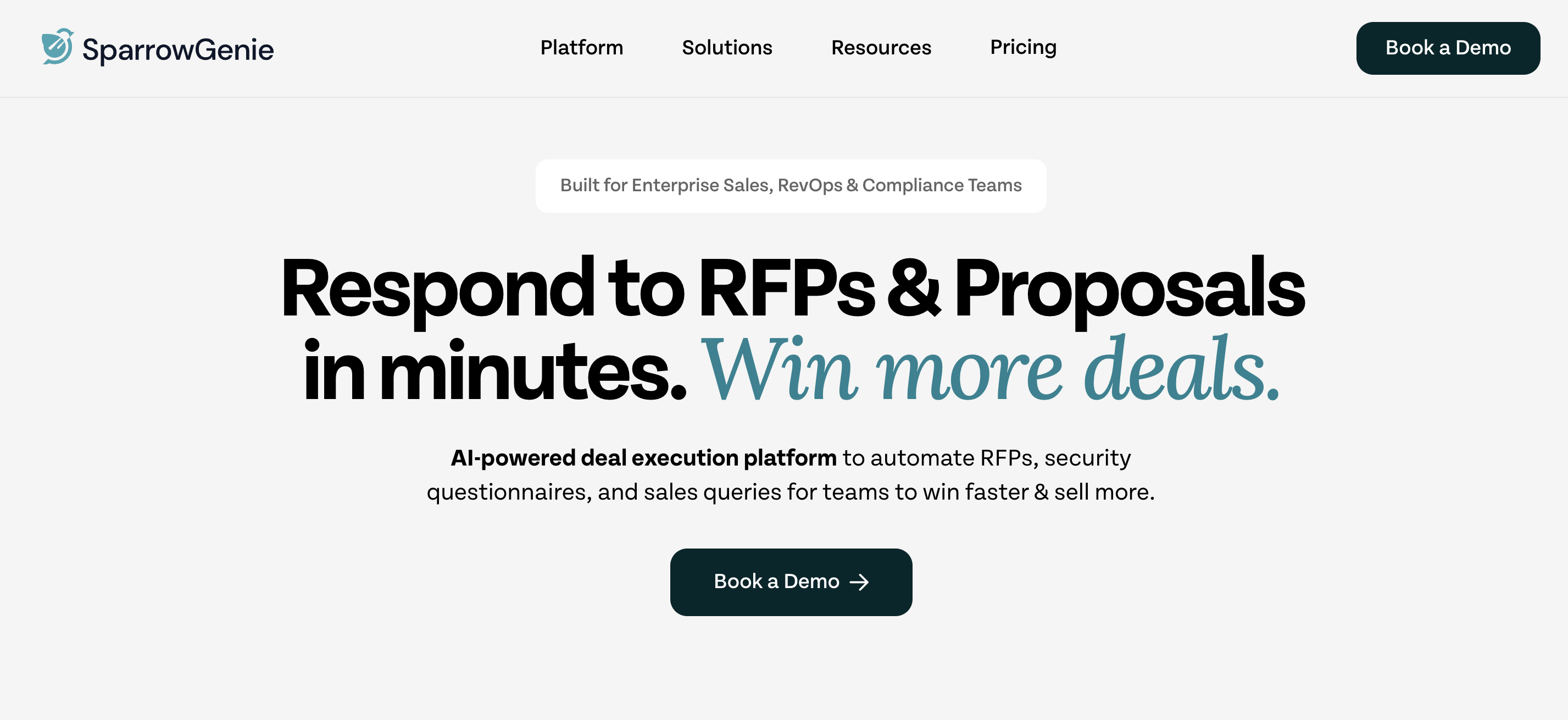
If you're looking for a modern, AI-powered RFP automation platform that doesn't cost an arm, a leg, and three SMEs, SparrowGenie deserves your full attention.
Built on an AI-native architecture, SparrowGenie is purpose-built for enterprise sales teams handling RFPs, DDQs, security questionnaires, and complex proposals. It automates the heavy lifting while keeping humans firmly in control of the final output. That distinction matters, AI assists, never replaces.
Most RFP tools were built in an era before modern AI. They bolt on AI features as afterthoughts. SparrowGenie was designed from the ground up with AI at the center, which means faster drafts, smarter content suggestions, and a knowledge hub that actually learns from your existing proposals and documents.
Key Features
Here's what the platform delivers in practice: automated proposal generation from your content library (first drafts in minutes, not days), AI-powered RFP management with precision responses that match your brand voice and compliance requirements, AI-driven sales intelligence with real-time access to product details and competitive positioning from within the platform, and cross-team collaboration across sales, marketing, legal, and product without licensing friction.
The platform also provides a governed workspace with role-based access, version control, and audit trails, plus the only full lifecycle knowledge hub in the market, with dedicated modules for Training, Testing, Improvement, and Conflict Resolution. No other platform offers this complete stack. And its contextual heuristics engine interprets even the messiest, most unstructured questionnaire formats.
Quick facts: Starting at $9,999/year. Part of the SurveySparrow family. Best for enterprise sales teams needing affordable AI-native RFP automation.
The pricing advantage is real. SparrowGenie is significantly more accessible than Loopio or Responsive. For growth-stage companies with tight budgets and ambitious revenue targets, that pricing gap is substantial. You get enterprise-grade AI automation at a price point that doesn't require a board sign-off.
Honest weaknesses: Launched in 2025, so the platform is newer with a track record still building. Integration ecosystem is growing, but not yet as wide as Responsive or Loopio.
That said, for teams that prioritize AI-first architecture, cross-team collaboration, and affordability alongside genuine enterprise capabilities, SparrowGenie is the most compelling option on this list.
See how SparrowGenie handles your next RFP in minutes, not days.
2. Responsive (formerly RFPIO)
Best for Large Enterprises with Complex Workflows
Source: Responsive
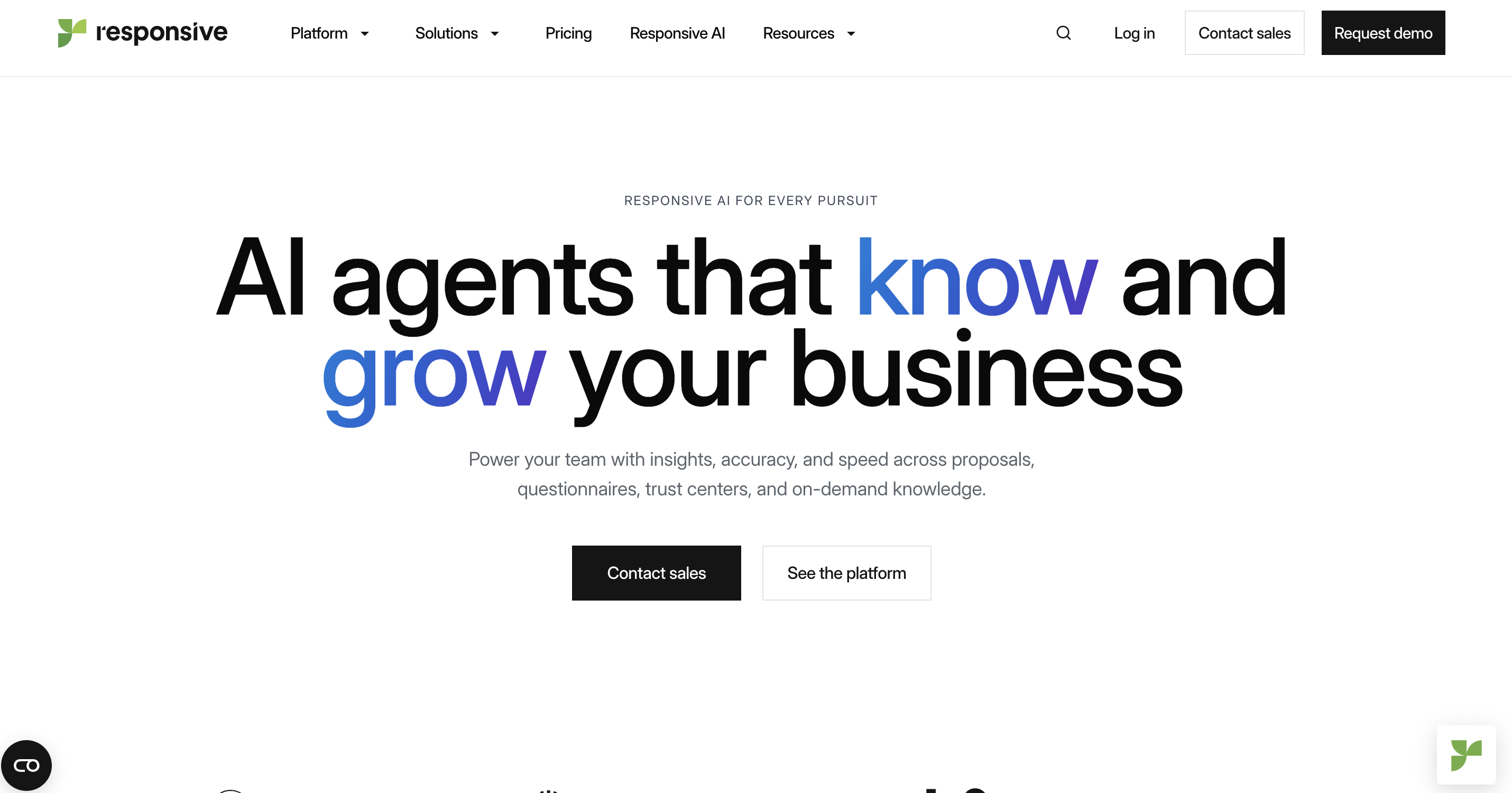
Responsive is the 800-pound gorilla of the RFP software space. Originally launched as RFPIO, it rebranded to Responsive as the platform evolved from pure RFP automation into a broader response management solution. It's the top-ranked SiftHub alternative on G2, and for enterprise teams managing high volumes of concurrent proposals, it earns that position.
Key Features
Key features include native AI-powered content generation with a semantic recommendation engine, cross-department workflow automation with enterprise governance, advanced content governance and analytics, 30+ native integrations including Salesforce, Slack, Microsoft Office, and major CRM/ERP systems, and support for high-volume global operations across multiple teams.
Quick facts: Project and user-based pricing. Best for mid-to-large enterprises with complex, project-heavy workflows.
For enterprise teams managing dozens of simultaneous RFP projects with strict governance requirements, Responsive is genuinely excellent. The workflow automation is deep, the content governance is mature, and the integration ecosystem is wide.
Honest weaknesses: Costs scale fast with seats and AI usage. They shifted from unlimited to capped entitlements on users and projects, a move that frustrated many existing customers. No robust support for RFPs submitted via web portals. Complex pricing structure requires a sales call to get actual numbers.
Bottom line: Responsive is the right call for large enterprises where budget is secondary to capability and governance. For growth-stage companies, the cost trajectory is a real concern.
Wondering how SparrowGenie stacks up against Responsive? Let's show you.
3. Loopio
Best for Content-Driven Teams Wanting Clean Governance
Source: Loopio
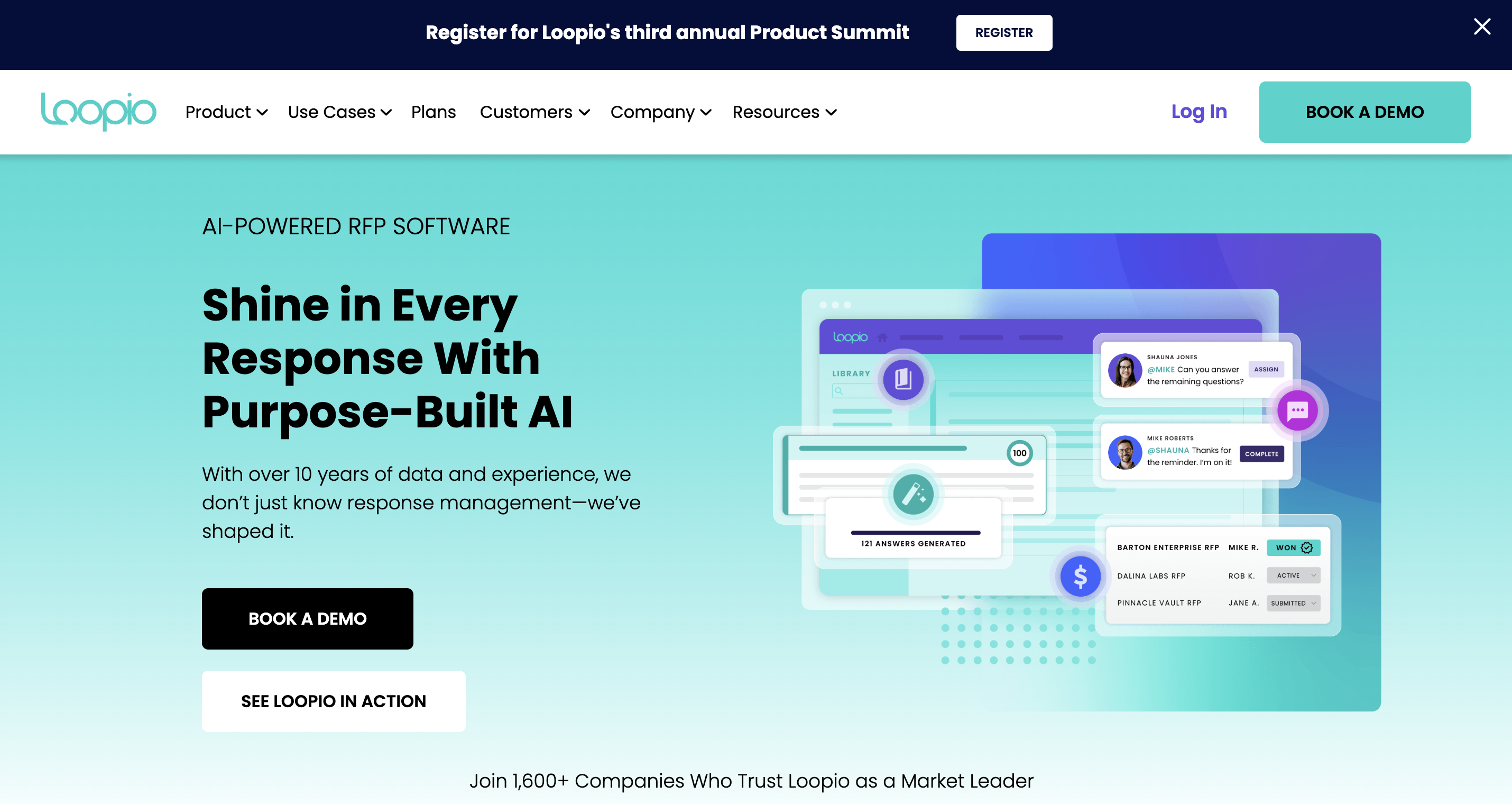
Loopio is a household name in the proposal management world, serving 1,700+ companies globally. Its philosophy centers on a curated, well-governed content library, the idea being that if your library is clean, your proposals will be consistent, compliant, and high quality.
Key Features
For teams with dedicated content managers who treat the knowledge library as a living asset, Loopio is a genuinely strong platform. Key features include a smart content library with AI-powered suggestions based on team usage patterns, auto-fill capabilities from your curated content base, AI-assisted library cleanup that detects duplicate and outdated content, web portal export support, transparent AI workflows with granular permission levels, and strong integrations with Salesforce, Slack, and Microsoft products.
Quick facts: Starts ~$20K/year. Per-user, annual subscription. Best for small-to-mid teams with dedicated content managers wanting a clean UI.
The platform works beautifully when someone is actively maintaining the library. But that maintenance is non-trivial. Teams often describe spending significant time curating, deduplicating, and updating content, effort that adds up fast. The AI-assisted cleanup helps, but it doesn't eliminate the overhead entirely. The per-user pricing model also limits broader adoption across an organization.
Honest weaknesses: $20K+ even for small teams once implementation is factored in. Static library approach requires significant manual curation investment. Per-user pricing limits cross-functional adoption. Partial tone and language customization for AI-generated content.
4. Inventive AI
Best for Enterprise Teams Prioritizing Zero Hallucination
Source: Inventive AI
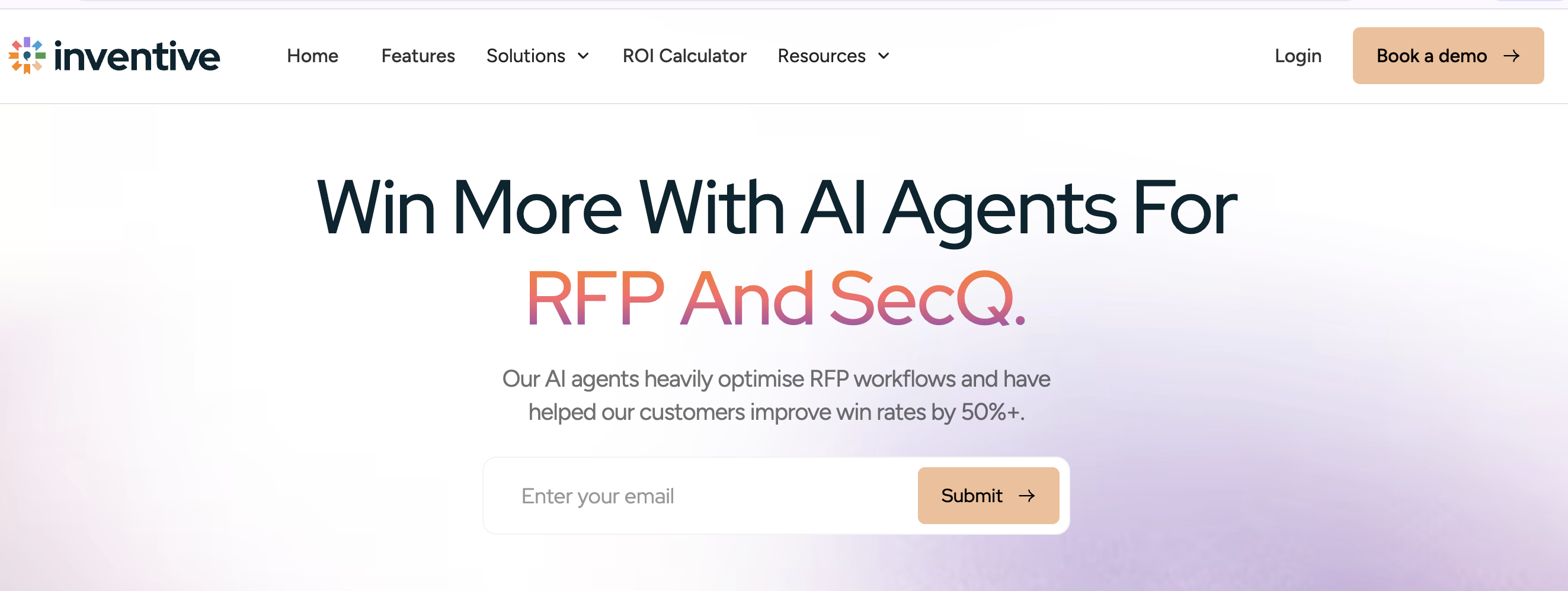
Inventive AI positions itself as the enterprise-grade AI alternative in the RFP space, built on a multi-agent AI architecture that claims 90% faster RFP completion and 95%+ context-aware response accuracy. Its headline differentiator is inline citations, every response traces back to a source, making hallucinations visible and correctable.
Key Features
Key features include a multi-agent AI system with separate agents for context understanding, response generation, and content checking; custom workflows configurable per department; an AI Content Manager that actively detects stale and duplicate data; live integrations with Google Drive, SharePoint, Confluence, and Slack; a proprietary conflict resolution AI for handling contradictory source data; and claims of 66% reduction in post-generation editing time.
Quick facts: Quote-based (custom pricing). Gartner Peer Insights: 5/5. Best for enterprise teams handling complex, high-volume RFPs.
Inventive AI makes big claims, and for enterprise teams where hallucinated answers carry compliance risk, the inline citation approach is genuinely valuable. Knowing exactly which document fed an answer creates accountability that many tools lack.
Honest weaknesses: Enterprise pricing may be prohibitive for smaller teams. Newer platform with market presence still building. Custom pricing lacks transparency for budget planning. Marketing-heavy claims need independent validation.
If your team handles high-stakes, compliance-heavy proposals and zero hallucination is a non-negotiable, Inventive AI is worth evaluating. Go in with clear questions about pricing and reference customers.
Want AI-precision without the enterprise price tag? SparrowGenie delivers.
5. 1up
Best Entry-Level Option for Small Teams Starting with RFP Automation
Source: 1Up
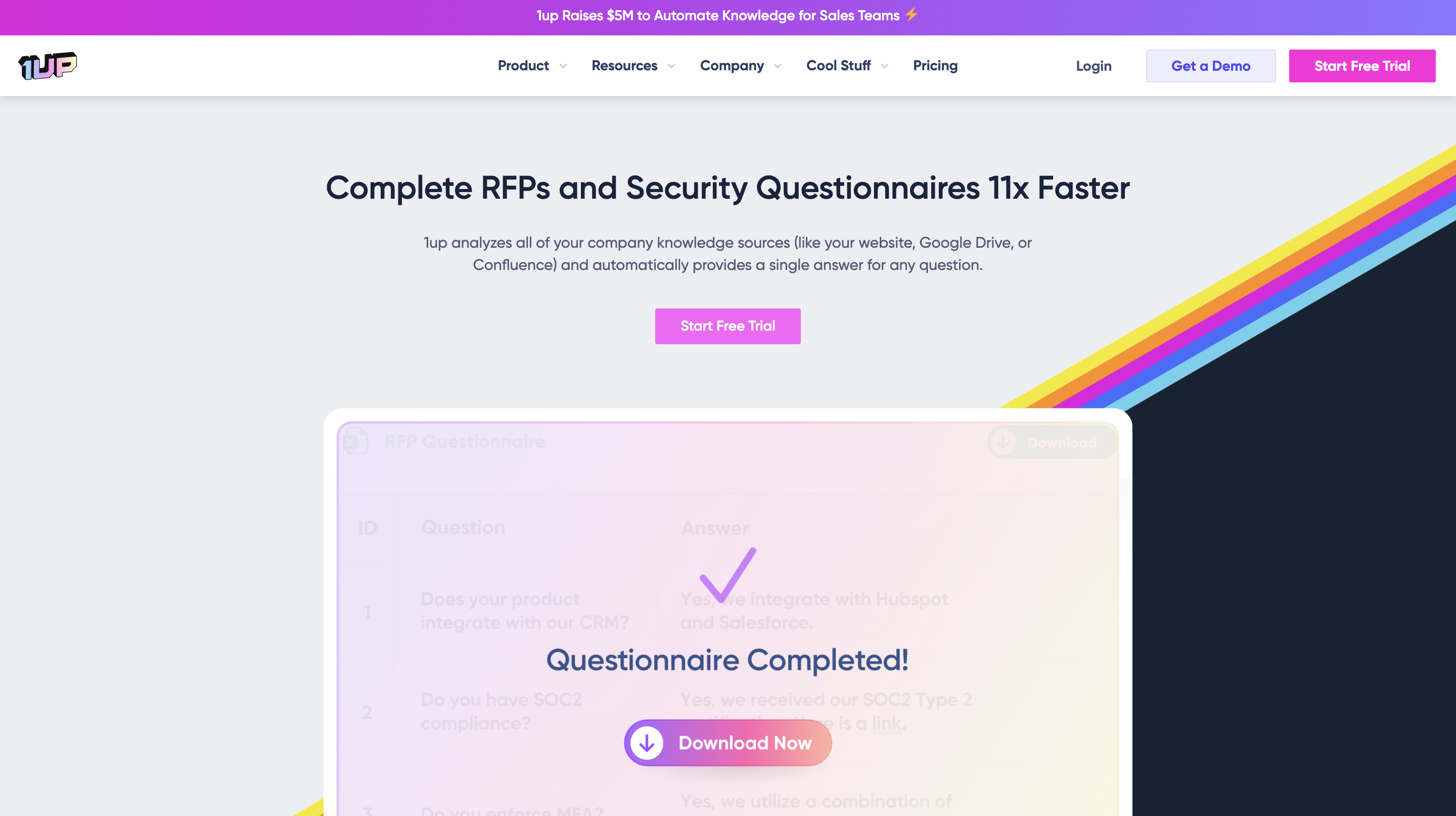
Not every team needs enterprise-grade everything on day one. If you're a small or mid-sized team handling security questionnaires and repetitive RFP tasks, and you want to get started with AI-powered automation without a major procurement process, 1up is worth a look.
1up is a knowledge automation assistant purpose-built for quick answer generation from company knowledge bases. It connects with Slack and Microsoft Teams, meaning SMEs can answer questions in their natural workflow without switching tools.
Key Features
Key features include AI-powered RFP response generation from uploaded company knowledge, Slack and Teams integration for just-in-time answer retrieval, pre-defined templates for common questionnaire formats, and a freemium entry point, free plan, Starter at $250/month, Pro at $850/month.
Quick facts: Free plan available. 14-day free trial. Best for small teams needing quick RFP and questionnaire automation.
1up is great for getting started. But as your RFP complexity and volume grows, the platform's limitations become apparent fast. It lacks deep context understanding for complex, multi-section RFP questions. Response quality can feel basic compared to enterprise platforms. It's limited in scalability and insufficient for enterprise-level compliance and governance workflows.
Think of 1up as a strong first step into RFP automation. For teams that outgrow basic tools but aren't ready for Responsive or Loopio pricing, there's a gap that platforms like SparrowGenie fill directly.
6. AutoRFP.ai
Best for Transparent Pricing and High-Volume Q&A Workflows
Source: AutoRFP.ai
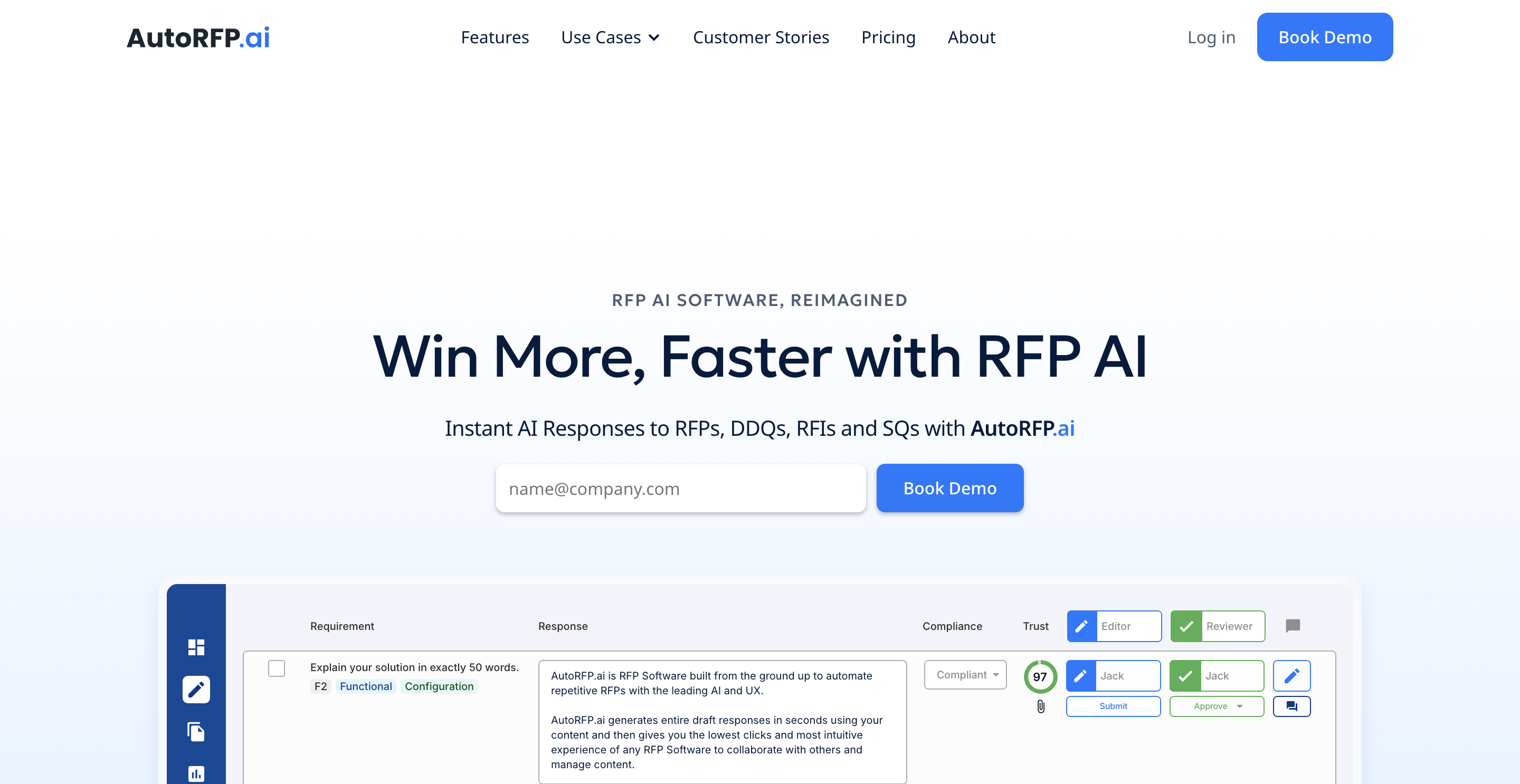
AutoRFP.ai stands out in a crowded market for one reason most platforms fail at: fully transparent, publicly available pricing with no per-seat fees. If you're tired of sales call theater just to get a budget number, that alone might earn it a spot on your shortlist.
ISO/IEC 27001:2022 certified and built on a private Azure AI instance, AutoRFP.ai takes data security seriously for teams handling sensitive RFP content.
Key Features
Key features include AI Q&A generation that handles 70–90% of RFP questions automatically, a content library buildable from as few as 2 past RFPs, a "Magic" button for instant answer retrieval, a Word add-in for working directly in Microsoft Word, unlimited users on all plans (no per-seat surprises), and a 30-day money-back guarantee.
Quick facts: Scale plan at $899/month (24 projects/year). Accelerate at $1,299/month (50 projects/year). Unlimited users. ISO 27001 certified. Best for high-volume Q&A teams wanting transparent pricing.
AutoRFP.ai shines for structured, high-volume Q&A RFPs where speed and accuracy matter. But the platform is primarily built for questionnaire-style RFPs, if your team regularly produces narrative proposals, executive summaries, or custom-formatted bid documents, you'll find it limiting.
Honest weaknesses: Project-capped model can limit very high-volume teams. Primarily Q&A focused, not suited for narrative or design-forward proposals. Newer platform still building enterprise track record. No multi-agent AI approach for complex workflow automation.
Looking for AI that handles both Q&A and narrative proposals? Meet SparrowGenie.
7. Arphie
Best for Security Questionnaire Automation in Tech and SaaS
Source: Arphie
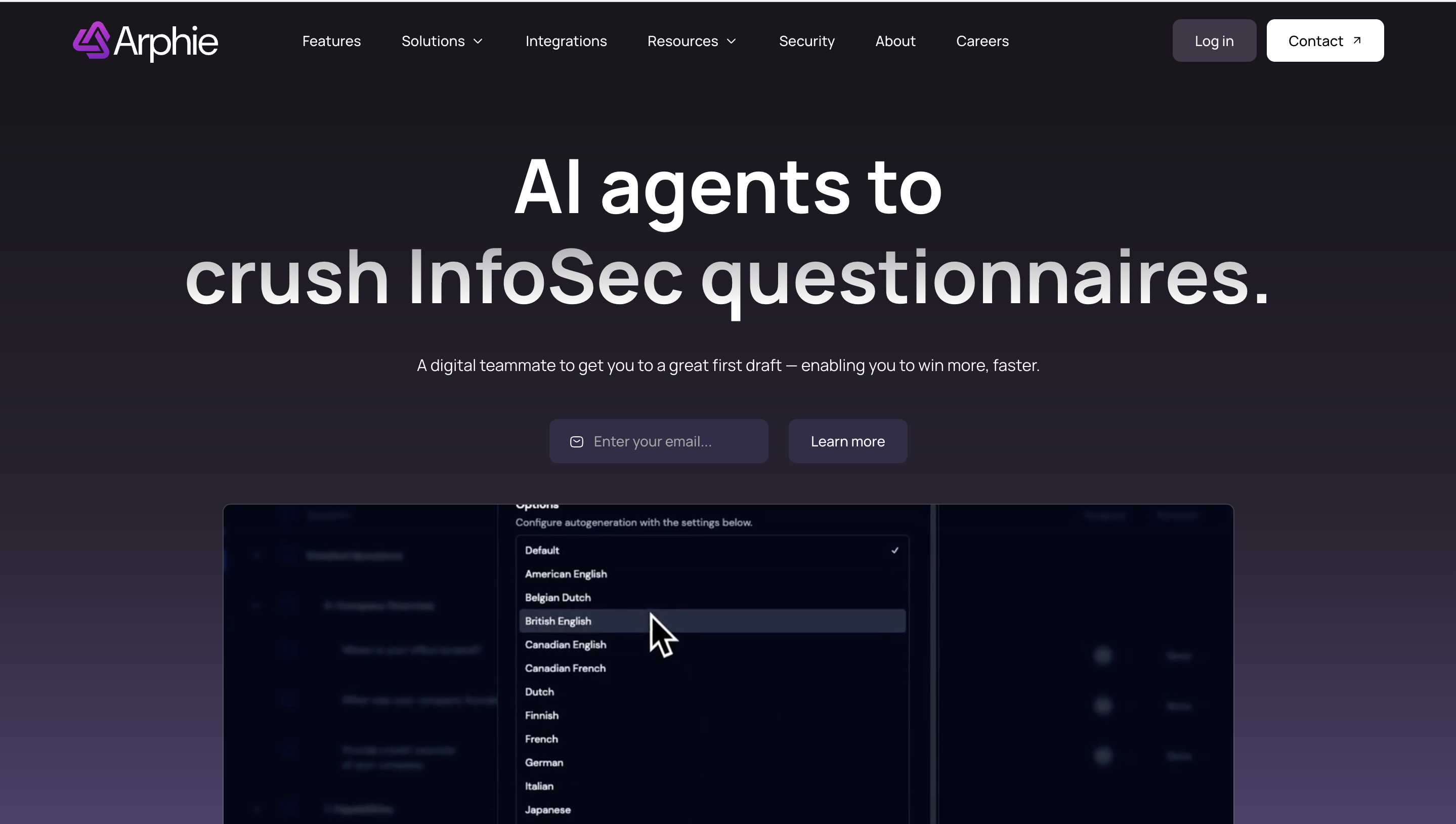
If your team's primary pain point is security questionnaires and vendor due diligence forms, Arphie was built specifically for you. It's an AI-native tool designed around structured, Q&A-driven workflows like DDQs, SOC 2 questionnaires, and GDPR compliance forms.
Arphie's standout feature is its per-project pricing model, which eliminates the seat-based barriers that prevent broader SME participation. If your security team, legal counsel, and product managers all need to contribute answers, they can, without adding to a per-seat cost.
Key Features
Key features include an AI drafting agent that auto-fills 80%+ of security questionnaire forms, confidence scores and source citations on every answer, a chatbot interface for "how to answer this question" guidance, live integrations with Google Drive, SharePoint, and Notion, zero data retention with AI model providers, SOC 2 Type II certification, and SAML 2.0 SSO support.
Quick facts: Quote-based per-project pricing. Most teams go live within a week. Best for tech/SaaS teams handling security questionnaires and vendor forms.
Arphie is excellent for structured security and compliance questionnaires. It's not the right fit for sales proposals, narrative RFPs, or complex multi-section bid documents. If your proposal work goes beyond security questionnaires, you'll need either a separate tool or a platform like SparrowGenie that handles the full proposal lifecycle.
Honest weaknesses: Limited capability for narrative proposals and long-form content. Pricing not publicly available. Advanced automation for complex enterprise workflows is limited. Smaller team may mean less mature support infrastructure for enterprise edge cases.
8. Qvidian (Upland Software)
Best for Regulated Industries with Long Compliance Histories
Source: Qvidian
Qvidian has been in the proposal management space for nearly 50 years. That's not a typo. With 200,000+ users worldwide and 1,000+ companies including major banks and financial institutions, it brings institutional credibility that newer platforms simply cannot match.
If you're in financial services, banking, insurance, or another heavily regulated industry where your proposal platform needs to pass vendor risk assessments and compliance reviews, Qvidian's track record is a genuine asset.
Key Features
Key features include a content library with pre-approved language, branding guidelines, and compliance clauses; AutoFill for automated RFP question response; multi-step reviewer workflows built for compliance-heavy sign-off processes; visual analytics dashboards; real-time document collaboration; and an AI Assist add-on for AI-powered response suggestions.
Quick facts: Custom/enterprise pricing. Capterra: 4.4/5. Support rating: 4.6/5. 200,000+ users worldwide. Best for large banks and financial services organizations.
Here's the honest assessment: Qvidian is a legacy platform with legacy AI capabilities. The AI Assist feature exists as a paid add-on rather than native architecture. For teams that need modern AI-first automation, faster first drafts, semantic search across knowledge bases, intelligent content recommendations, Qvidian will feel dated.
Honest weaknesses: AI capabilities lag significantly behind modern AI-native platforms. Slower response cycles with heavier manual content management overhead. AI Assist is a paid add-on, not core functionality. Limited customization for context-specific or industry-nuanced responses.
Qvidian earns its spot for regulated industries where stability, compliance history, and enterprise scale matter more than cutting-edge AI. For everyone else, it's fighting with tools from a different era.
Enterprise AI without the legacy overhead. SparrowGenie is built for 2026.
9. Proposify
Best for Design-Forward Sales Proposals
Source: Proposify
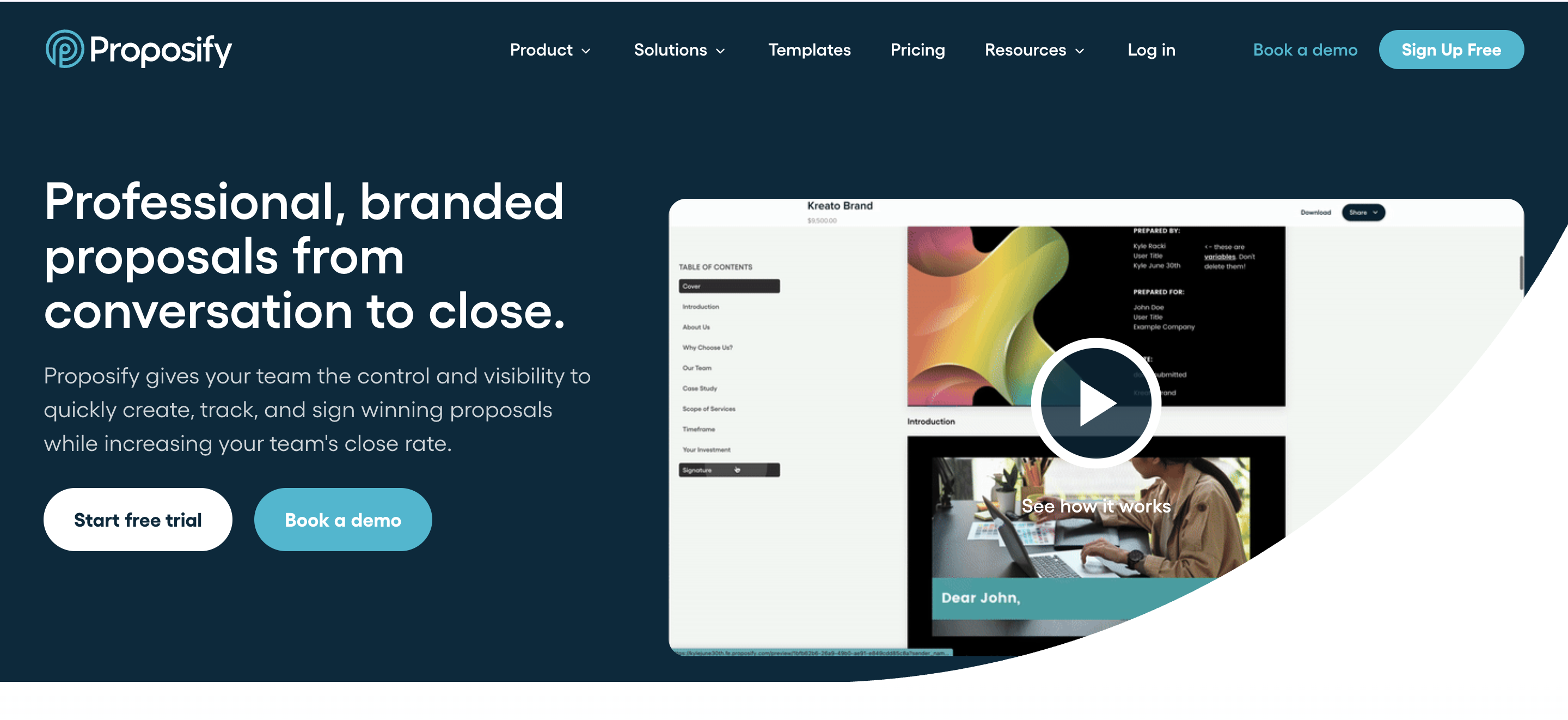
Proposify occupies a distinct niche in this comparison: it's not really an RFP automation tool in the traditional sense. It's a proposal design and management platform focused on creating visually stunning, professionally presented sales proposals. Think magazine-spread quality with built-in e-signatures and proposal tracking.
For sales teams where the visual impression of a proposal matters, technology consultancies, creative agencies, enterprise software companies selling to design-conscious buyers, Proposify fills a genuine gap.
Key Features
Key features include professional proposal templates with magazine-quality design capabilities, a built-in e-signature workflow (no DocuSign required), proposal tracking and analytics showing when buyers open and engage, a content library for reusable sections and branded elements, and team collaboration features for proposal review and approval.
Quick facts: Affordable subscription pricing. Design-centric category. Best for teams that need professional, design-forward proposals.
It's important to be clear about what Proposify is not: it's not built for RFP automation. It doesn't handle complex questionnaire-based RFPs, security questionnaires, or the compliance-heavy workflows that enterprise buyers require. The AI features are limited compared to purpose-built RFP automation platforms.
Honest weaknesses: Lacks deep RFP automation capabilities, not built for questionnaire workflows. Not suited for security questionnaire or DDQ automation. Limited AI-powered response generation compared to modern RFP tools. No governance or compliance workflow features for enterprise sign-off processes.
If your challenge is writing beautiful proposals that win, Proposify is worth it. If your challenge is responding to 30-page RFPs with 200 questions while managing SME contributions across three departments, look elsewhere.
10. DeepRFP
Best Affordable Option for SMBs and Lean Proposal Teams
Source: DeepRFP
DeepRFP closes out this list as the most accessible full-featured RFP automation tool available in 2026. At $75/user/month with no hidden fees, a 7-day free trial with no credit card required, and SOC 2 compliance out of the box, it's built for SMBs and lean proposal teams that need serious capability without enterprise pricing.
The platform's multi-agent AI architecture is its technical highlight: six specialized AI agents handle different aspects of the proposal lifecycle, from initial RFP analysis through compliance matrix generation.
Key Features
Key features include six specialized AI agents (RFP Response Generator, Proposal Writer, Questionnaire Responder, Proposal Reviewer, Compliance Matrix Generator, and Custom RFP Analyzer), 20+ integrated tools covering editing, reviewing, and drafting workflows, virtual SMEs powered by uploaded company documents, SOC 2 compliance with auto-purged data retention, and a self-serve free trial with instant access.
Quick facts: $75/user/month. SOC 2 compliant. 7-day free trial, no credit card. Best for SMBs, freelancers, and small proposal teams.
DeepRFP is purpose-built for B2B SMBs, which means it reaches its ceiling at enterprise scale. For Fortune 500 procurement workflows, complex multi-department coordination, or organizations with strict governance requirements, you'll outgrow DeepRFP faster than you'd like.
Honest weaknesses: Less enterprise-focused than Responsive, Loopio, or SparrowGenie. Newer platform still building market presence and customer references. May struggle with highly complex enterprise-scale compliance workflows. Primarily optimized for B2B/SMB — Fortune 500 procurement edge cases not well supported.
Growing past SMB? SparrowGenie scales with your ambition.
How to Choose the Right SiftHub Alternative for Your Team
The right platform depends on three things: your team size, your RFP volume, and your budget ceiling.
Choose SparrowGenie if you're a growth-stage or mid-market enterprise handling 10+ RFPs/month, want AI-native architecture without the legacy platform price tag, need cross-team collaboration across sales, legal, and product as a daily reality, and want enterprise compliance features, governance, audit trails, role-based access, without paying $20K+ to get started.
Choose Responsive or Loopio if you're a large enterprise with 50+ concurrent RFPs and a dedicated proposal operations team, deep integration with enterprise CRM and ERP systems is non-negotiable, and governance at scale is your primary requirement with budget not a constraint.
Choose Inventive AI if hallucination-free AI with inline citations is a compliance requirement and you're running complex, high-volume enterprise RFPs with multi-department coordination.
Choose 1up or DeepRFP if you're a small team or startup getting started with RFP automation for the first time and budget is the primary constraint.
Choose AutoRFP.ai if pricing transparency matters and you want project-based billing without per-seat surprises, with your primary use case being structured Q&A questionnaires at scale.
Choose Arphie if security questionnaires and DDQs are your main volume driver and SOC 2 certification with zero data retention are strict requirements.
Choose Qvidian if you're in financial services or another heavily regulated industry where vendor stability matters as much as features.
Choose Proposify if your proposals need to look stunning and e-signature with proposal tracking are core workflow requirements.
Conclusion: The Right Tool Respects Your Team's Intelligence
The best RFP automation tool isn't the one with the most features. It's the one your team will actually use, that fits your budget, and that solves your specific pain points without creating new ones.
SiftHub is a solid platform for sales enablement and knowledge discovery. But as your team grows, as your RFP volumes increase, and as your compliance requirements get more serious, the gaps become real.
Of the 10 alternatives covered here, SparrowGenie stands out as the most compelling option for growth-stage and mid-market enterprises in 2026. It combines AI-native architecture, full proposal lifecycle management, enterprise security, and cross-team collaboration at a price point that doesn't require a multi-year commitment to make financial sense.
For large enterprises where budget is secondary to governance depth, Responsive and Loopio remain strong choices. For SMBs getting started, 1up and DeepRFP lower the barrier to entry meaningfully. For security questionnaire specialists, Arphie is purpose-built.
But if you're a proposal team that's tired of SME burnout, late submissions, copy-paste chaos, and inconsistent responses costing you deals, SparrowGenie is worth your next 30 minutes.
See SparrowGenie in Action
Book a free 30-minute demo. Bring your messiest RFP. We'll show you what AI-secured, human-powered proposal automation looks like in practice.
Ready to see how AI can transform your RFP process?
Product Marketer at SparrowGenie
Being a Product Marketer at SparrowGenie, Aparna helps sales teams work faster with secure, AI-powered proposal automation. She turns complex features into simple stories, builds messaging that resonates, and keeps a close pulse on what customers actually need. She loves shaping clear, helpful content that shows how SparrowGenie makes RFP work easier, faster, and a lot less stressful.