Digital Contract Management: Why Your Contracts Are Killing Growth (And How to Fix It)

Article written by
Kate Williams

INSIDE THE ARTICLE
SHARE THIS ARTICLE
Summary
Still managing contracts in folders, emails, and spreadsheets? That chaos is costing you revenue, renewals, and sanity. This blog unpacks how modern digital contract management centralizes access, automates renewals, tracks obligations, and turns contracts into strategic assets. Learn how AI-powered systems save millions, prevent risk, and turn every contract into a growth lever—not a liability.
Every quarter, your pipeline sprints—and then trips over a contract. Not pricing. Not product. Paper. Version roulette, inbox redlines, missing approvers, and “Who has the latest MSA?” kill momentum in silence. This isn’t a people problem; it’s a system problem. Digital contract management (modern CLM) turns contracts from attachments into a governed, searchable, automated workflow—so deals move from draft to e-signature without the drama. Let's dive into the details of contract management.
What is Digital Contract Management?
Digital contract management—often called CLM—is the end-to-end, data-driven system that creates, negotiates, approves, e-signs, stores, and monitors contracts using governed templates, automated workflows, and analytics. Instead of files drifting through inboxes, agreements move on rails: standardized intake, rules-based assembly, exception-only reviews, a unified redlining workspace, embedded e-signature, obligation/renewal tracking, and a searchable, metadata-rich repository. The result is faster cycle times, lower risk, cleaner renewals, and clear KPIs across Sales, Legal, Finance, and CS—turning contracts from bottlenecks into a measurable growth engine.
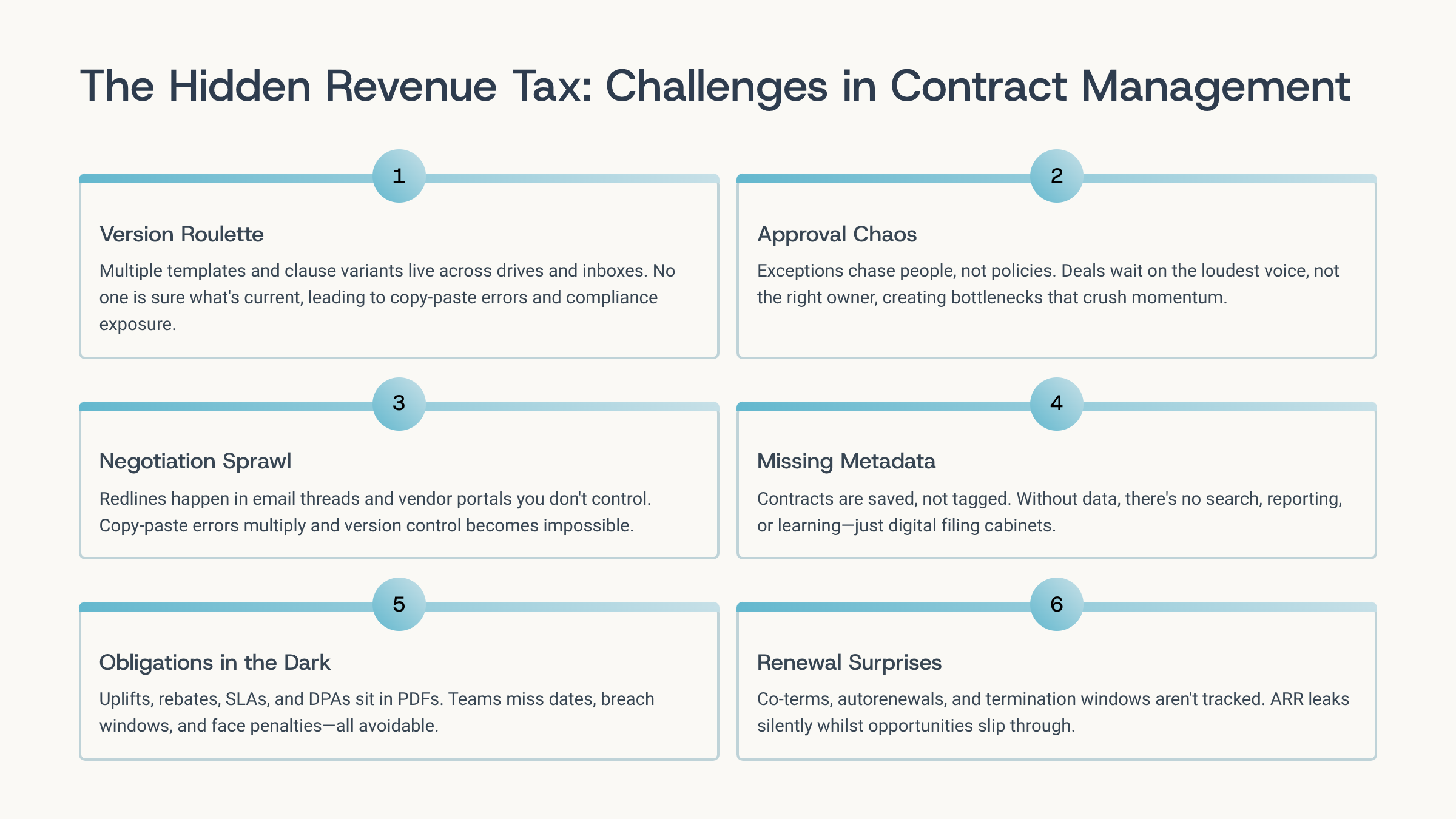
Challenges in Contract Management (The Hidden Revenue Tax)
If any of these feel familiar, your contracts may be slowing down your revenue growth:
- Version roulette: Multiple templates and clause variants live across drives and inboxes. No one is sure what’s current.
- Approval chaos: Exceptions chase people, not policies. Deals wait on the loudest voice, not the right owner.
- Negotiation sprawl: Redlines happen in email threads and vendor portals you don’t control—copy-paste errors multiply.
- Missing metadata: Contracts are saved, not tagged. Without data, there’s no search, reporting, or learning.
- Obligations in the dark: Uplifts, rebates, SLAs, and DPAs sit in PDFs; teams miss dates or breach windows.
- Renewal surprises: Co-terms, autorenewals, and termination windows aren’t tracked—ARR leaks silently.
- Audit and compliance risk: No single trail of who changed what, when, and why; retention policies are ad hoc.
Longer cycle times, higher risk exposure, and avoidable revenue leakage.
What Is Contract Management Software?
Contract Management Software (often called CLM) converts contracts from static documents into governed, searchable, measurable records that move through a defined lifecycle. Instead of “files + email,” you get:
- Structured intake: Standardized requests, auto-classified by type and risk
- Authoring & assembly: Rules-based templates, clause libraries, data merge fields
- Reviews & approvals: Policy-driven routing, parallel/sequential flows, SLAs
- Negotiation workspace: Redlines in one place, change tracking, secure sharing
- E-signature: Embedded signing with identity checks and audit trails
- Obligation & renewal control: Owners, dates, alerts, playbooks
- Central repository: Metadata-rich search, lineage, permissions
- Analytics & AI: Cycle-time dashboards, risk variance, portfolio insights
It turns “who has the latest version?” into “here’s the truth, governed.” It’s the operating system for your agreements.
Benefits of Contract Management Software
The right CLM doesn’t add steps; it removes stalls. The impact shows up in speed, safety, and revenue capture.
Velocity
- Contract cycle time drops with standardized intake, exception-only approvals, and embedded e-sign.
- First-draft creation falls from hours to minutes via rules-driven assembly.
- Time-in-review becomes measurable by function (Legal, Security, Finance), so you fix the real bottlenecks.
Risk & Compliance
- Clause governance reduces variance and flags risky insertions.
- Immutable audit trails, role-based access, and defensible retention strengthen compliance.
- Obligation tracking prevents missed SLAs, penalties, and reputational hits.
Revenue & Control
- Renewal radar (90/60/30) with playbooks raises on-time actions and captured uplifts.
- Discount leakage tied to clause concessions is visible—and therefore fixable.
- Portfolio analytics surface which terms stall deals and where to optimize playbooks.
Team Experience
- Sales gets a prescriptive path; Legal focuses on novel risk, not boilerplate.
- Finance works from the “signed truth” for billing and revenue recognition.
- Everyone searches once and finds the right answer—no Slack archaeology.
Benefits are the destination. To reach them, you need a clear path. Let’s map the flow that keeps every agreement moving.
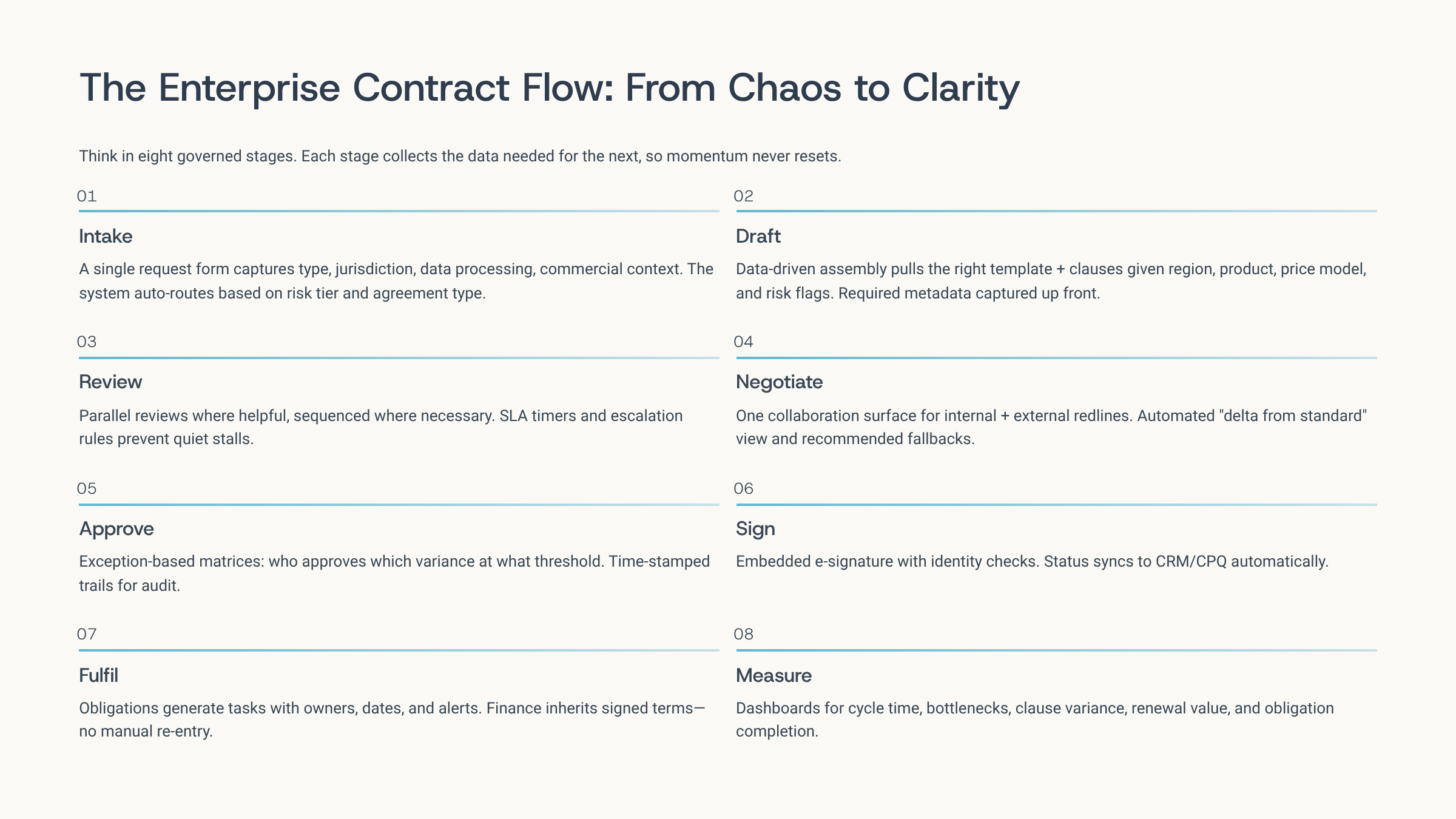
The Enterprise Contract Flow (From Chaos to Clarity)
Think in eight governed stages. Each stage collects the data needed for the next, so momentum never resets.
Intake
- A single request form captures type, jurisdiction, data processing, and commercial context.
- The system auto-routes based on risk tier and agreement type (NDA, MSA, SOW, DPA, Order Form).
Draft
- Data-driven assembly pulls the right template + clauses given region, product, price model, and risk flags.
- Required metadata is captured up front: parties, term, governing law, SLAs, pricing model, renewal terms.
Review
- Parallel reviews were helpful (e.g., Legal & Security) and sequenced where necessary (e.g., Finance after pricing finalization).
- SLA timers and escalation rules prevent quiet stalls.
Negotiate
- One collaboration surface for internal + external redlines.
- Automated “delta from standard” view and recommended fallbacks.
Approve
- Exception-based matrices: who approves which variance at what threshold.
- Time-stamped trails for audit; no approvals lost in email.
Sign
- Embedded e-signature with identity checks; tamper-evident final artifacts linked to metadata.
- Push status back to CRM/CPQ automatically.
Fulfill
- Obligations generate tasks in ticketing/CS systems with owners, dates, and alerts.
- Finance and billing inherit the signed terms—no manual re-entry.
Measure
- Dashboards for cycle time, bottlenecks, clause variance, renewal value, and obligation completion.
- The quarterly clause board updates standards based on real outcomes.
With the flow in place, AI stops being hype and starts compounding judgment. Here’s where it actually helps.
AI in Contract Management (Practical, Not Hype)
AI should automate contract management, speed routine work, highlight risk, and make decisions auditable—without replacing counsel where it matters.
High-Value Uses
- Clause variance & risk scoring: Instantly highlights deviations from standard, explains risk in plain language, and suggests policy-approved alternates.
- Data extraction: Pulls parties, terms, SLAs, pricing, DPAs, and renewal mechanics into structured fields—no more manual typing.
- Summaries & answer assist: “What changed since v5?” or “Show all APAC MSAs allowing net-45 on rollout fees.”
- Negotiation coach: Provides fallback options and trade rationales aligned to your playbooks.
- Renewal intelligence: Detects co-term conflicts, uplift clauses, and termination windows; powers 90/60/30-day actions.
Guardrails
- Grounding: AI outputs must be tied to your approved clause library and policies.
- Confidence scores: Show how sure the system is and when to escalate to counsel.
- Human-in-the-loop: Non-standard risk, pricing edges, and novel clauses always go to humans.
- Auditability: Every AI suggestion logs the source, rationale, and final human decision.
With governance, flow, and AI lined up, the last question is execution: how do you bring this to life without chaos? Let’s talk rollout with a platform that connects proposals to contracts end-to-end.
Contract Management with SparrowGenie
SparrowGenie brings secure, AI-assisted contract workflows to the same place your proposals and RFx live—so teams move from intake → draft → approve → sign on rails. You democratize knowledge with one single source of truth while keeping governance tight.
What you get
- Governed templates & clause libraries: Enterprise standards with allowed alternates; exception-only routing.
- AI assist that’s grounded: Genie AI summarizes deltas, extracts key data, flags risky insertions, and recommends policy-approved fallbacks with confidence scores.
- Negotiation in one workspace: Internal + external redlines tracked to the clause level, not buried in email.
- Embedded e-signature: Identity checks and tamper-evident trails; status syncs to CRM/CPQ automatically.
- Obligation & renewal ops: Owners, dates, alerts, and playbooks to capture uplifts and prevent surprises.
- Analytics that matter: Cycle-time by function, clause variance trends, renewal radar, obligation completion rates, discount leakage tied to concessions.
Why it fits enterprise teams
- Secure by design: SSO, role-based access, least-privilege, immutable history, configurable retention.
- Works where you work: CRM, ticketing, and billing integrations ensure the “signed truth” flows downstream.
- Human + AI partnership: Legal stays focused on high-risk, Sales gets prescriptive speed, Finance trusts the numbers.
If your deals slow down after the proposal, connect the dots. Unify creation, negotiation, and signature—then measure the lift.
Conclusion: Make Contracts a Growth Engine
Contracts shouldn’t be the last mile that breaks your sprint. With modern, AI-assisted, secure contract management, you standardize what’s standard, spotlight what’s risky, and automate everything in between. The impact shows up in weeks: faster cycles, fewer escalations, cleaner renewals, and measurable lift in win rates.
If you’re ready to connect proposals, approvals, and contracts end-to-end—without chaos—SparrowGenie helps you move from request to signed with governed speed and secure AI assistance.
Ready to see how AI can transform your RFP process?
Product Marketing Manager at SurveySparrow
A writer by heart, and a marketer by trade with a passion to excel! I strive by the motto "Something New, Everyday"