Best RFP Tools for Enterprise Sales Automation

Article written by
Aparna Rajendran

INSIDE THE ARTICLE
SHARE THIS ARTICLE
Summary
Enterprise sales teams are under pressure to respond to RFPs faster, with greater accuracy and less manual effort. This blog explores today’s top RFP tools, comparing AI-driven automation, governance, and usability, to help revenue leaders choose the right platform to streamline responses, boost productivity, and turn RFPs into a competitive advantage.
Enterprise sales teams are under more pressure than ever to respond to complex RFPs, RFIs, RFQs, and security questionnaires faster, more accurately, and without burning out subject-matter experts. As RFP volumes rise and buying committees demand deeper, more customized responses, rfp tools have evolved from simple content repositories into sophisticated, AI-driven revenue platforms.
This blog highlights the significance of RFP tools for revenue teams, the best RFP tools, and how they help teams respond smarter, reduce manual effort, and keep pace with modern buying demands.
What Is an RFP Tool?
An RFP tool is purpose-built software that helps organizations create, manage, and automate RFP responses at scale. Instead of chasing answers across emails, spreadsheets, and outdated documents, RFP tools centralize knowledge, coordinate teams, and dramatically reduce response time.
Modern rfp tools are no longer simple document repositories. Today’s rfp automation tools use AI to draft answers, reuse approved content, manage workflows, and deliver buyer-ready outputs, making them some of the top productivity tools for RFP automation in enterprise sales.
Looking for an RFP tool that makes your RFP life better?
What Does an RFP Tool Actually Do?
A robust RFP tool enables teams to:
- Instantly import and structure RFPs, RFIs, and RFQs
- Reuse accurate, approved answers from a centralized knowledge source
- Auto-draft responses using rfp ai tools
- Assign questions, track progress, and manage reviews
- Enforce governance, accuracy, and compliance
- Export responses in the exact format buyers expect
The best rfp response tools remove manual work while keeping humans in control.
Why Modern Enterprise Sales Teams Need Advanced RFP Automation Tools
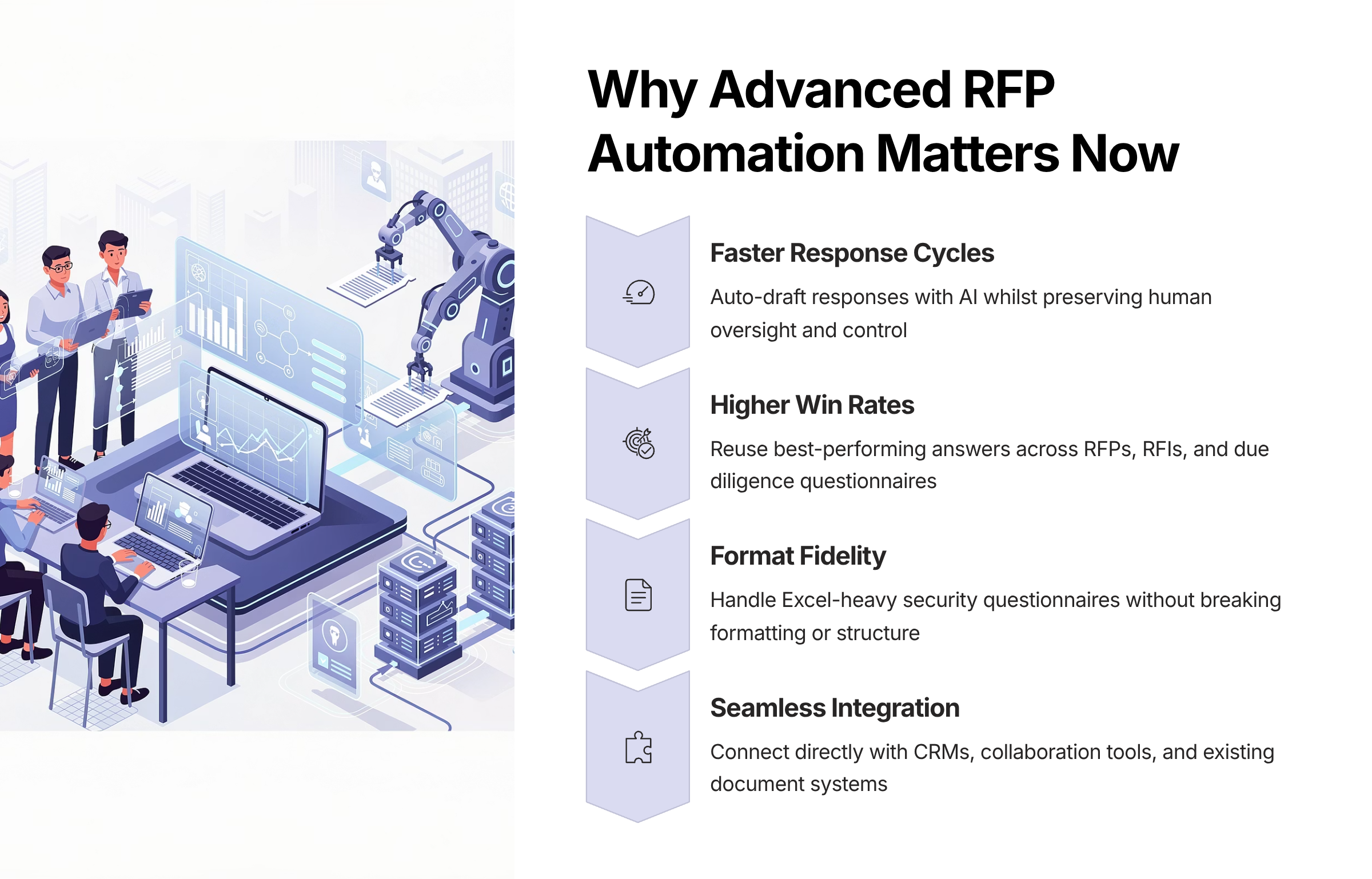
Manual RFP processes slow deal velocity and drain high-value talent. Enterprise-ready rfp automation tools now address this by:
- Auto-drafting responses with AI while preserving human oversight
- Reusing best-performing answers across RFPs, RFIs, and DDQs
- Handling Excel-heavy security questionnaires without breaking formatting
- Integrating directly with CRMs, collaboration tools, and document systems
The switch to automated rfp tools leads to faster response cycles, higher win rates, and more selling time for reps.
Interested in an advanced RFP tool perfect for your enterprise sales teams?
What to Look for in the Best RFP Management Tools
Before comparing vendors, enterprise buyers should evaluate RFP management tools across six critical dimensions:
- AI depth – Drafting vs. suggestion-only automation
- Knowledge model – Traditional Q&A libraries vs. AI-native approaches
- Excel & portal handling – Essential for procurement and InfoSec teams
- Security & compliance – SOC 2, ISO 27001, private AI, data residency
- Integrations – CRM, Microsoft 365, Slack/Teams, sales enablement
- Governance & analytics – Content freshness, usage, and ROI tracking
Now, let's look at the top RFP tools for enterprise sales teams that are really efficient.
Top RFP Tools for Enterprise Sales Automation
Here are the top 5 RFP automation tools that I have picked from the lot that make sales teams' lives easier:
1. SparrowGenie
A Sales-First, AI-Native RFP Tool Built for Enterprise Velocity
SparrowGenie has quickly positioned itself among the leading RFP AI tools by flipping the traditional model on its head. Instead of forcing enterprise sales teams to bend around rigid proposal software, SparrowGenie is designed around how modern revenue teams actually work: fast-moving, cross-functional, and deeply embedded in existing systems.
At its core, SparrowGenie is a next-generation RFP automation tool that combines human-controlled AI, deep workflow orchestration, and enterprise governance. The result is a platform that doesn’t just help you respond to RFPs, it helps you run RFPs as a predictable, measurable sales motion.
Core Features
SparrowGenie stands out in the crowded landscape of RFP tools through a tightly integrated set of AI and workflow capabilities:
- AI Mapping & Confidence-Scored Drafting
Instantly structure RFPs using AI Mapping or guided Contextual Mapping, then auto-draft answers from your approved knowledge base. Every response is confidence-scored so reviewers know exactly where to focus. - Knowledge Hub (Train, Validate, Improve)
A verified source of truth that ingests files, links, integrations, and Q&A pairs, then continuously tests accuracy, flags weak or conflicting answers, and publishes improvements instantly. - Sales-First Collaboration & Workflow Orchestration
A centralized, secure workspace that coordinates Sales, Presales, Legal, and IT with role-based access, SLA enforcement, escalations, and clear ownership across every handoff. - Live RFP Visibility & Performance Analytics
Track progress by section and owner in real time, monitor review health, measure response velocity, and use executive dashboards to forecast risk and performance across all RFPs. - Buyer-Ready Outputs with Stack-Wide Sync
Deliver responses in the exact format buyers expect, Excel, documents, or portals, while syncing seamlessly with your existing CRM, content, and collaboration tools.
Why Sales Teams Choose SparrowGenie
From an enterprise sales perspective, SparrowGenie excels as one of the top productivity tools for RFP automation:
- Sales-owned automation rather than proposal-team-only tooling
- Excel-first strength, critical for security questionnaires and procurement forms
- Human-led AI, reducing hallucination risk and increasing executive trust
- End-to-end visibility, from first draft to buyer-ready submission
- Actionable analytics, turning RFP activity into strategic insight
For organizations asking what tools can help streamline the RFP process without adding headcount, SparrowGenie is often a compelling answer.
Drawbacks to Watch Out
No tool is perfect, and SparrowGenie has a few trade-offs buyers should weigh:
- Newer ecosystem: Compared to incumbents like Loopio or Responsive, with fewer long-term reference accounts
- Document format coverage: Still expanding, with Excel being strongest today and Word/PDF support continuing to mature
- Not ideal for ultra-conservative buyers: Buyers who require decades-long vendor track records before adoption
These are typical considerations for AI-native platforms that prioritize speed and innovation over legacy breadth.
G2 Rating
G2 Rating: 4.5 / 5
Early reviewers consistently highlight time savings, Excel fidelity, and reduced SME interruptions, key differentiators among modern RFP response tools.
Pricing Overview
SparrowGenie uses custom enterprise pricing, tailored to your RFP volume, workflows, and integration needs. Pricing is designed to scale with usage and value, not per-seat limits, making it well suited for cross-functional sales, presales, and security teams.
Best for enterprises that want flexible pricing aligned to real RFP automation outcomes, not rigid tiers.
Summary for Buyers
Choose SparrowGenie if:
- Your sales team owns RFPs and security questionnaires
- You need AI-driven speed without sacrificing accuracy or governance
- Excel-heavy RFPs are a daily reality
- You want measurable impact from your leading AI tools for RFP responses, not just a content library
In short, SparrowGenie is best positioned for enterprise sales organizations that want AI-powered RFP automation to feel like a competitive advantage, not an administrative burden.
2. Responsive
The Enterprise-Grade Engine for Strategic Response Management
Source: Responsive
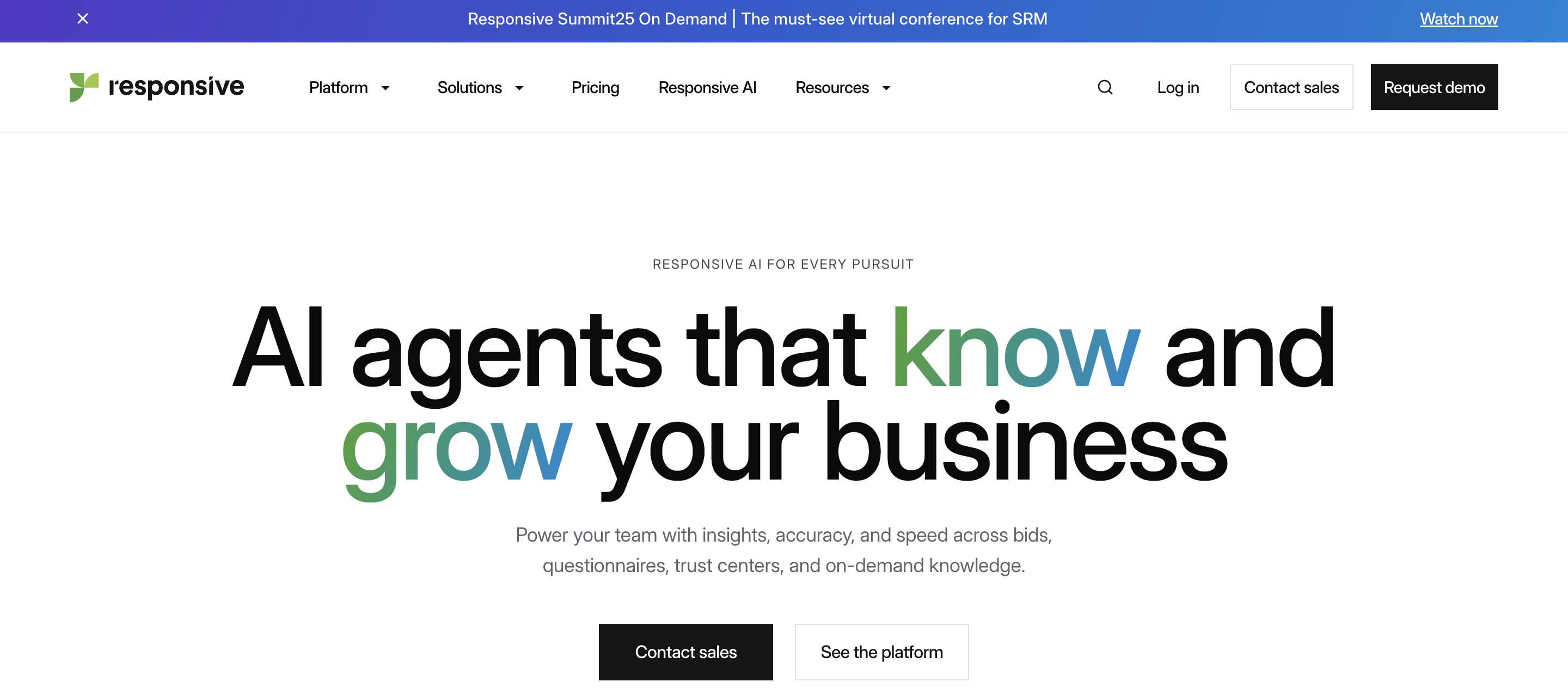
If your organization is juggling high-volume RFPs, RFIs, DDQs, and vendor security questionnaires across multiple teams and regions, Responsive (formerly RFPIO) is built for that level of complexity. It’s widely positioned as a strategic response management platform (not just a Q&A library), with AI-driven workflow automation, deep integrations, and governance designed for global scale.
Core Features
- Responsive AI + AI Agents (Speed with Control)
Uses your trusted content to draft and recommend answers, aiming to help teams deliver responses significantly faster, while keeping SMEs and reviewers in the loop. - TRACE Score™ (Confidence + Explainability)
Adds an “industry-first” scoring layer to AI-generated responses across trust, relevance, accuracy, completeness, and explainability, so teams can prioritize review where it matters. - Agent Studio (No-Code Workflow Automation)
A no-code environment to build and run custom AI agents for tasks like content cleanup, tagging, compliance checks, and identifying outdated info, plus monitoring and governance controls. - Enterprise Integrations + APIs (Fits Your Stack)
Built for enterprise ecosystems, including Slack/Teams integrations and strong integration positioning (with a broad integrations story and API-led extensibility). - Portfolio Management and Analytics (Run RFPs Like a Revenue Program)
Designed to manage complex RFx portfolios with assignments, collaboration, and reporting, helpful for spotting bottlenecks, measuring velocity, and improving consistency across regions and business units.
Why Enterprises Pick Responsive
- Built for global scale: Responsive highlights broad enterprise adoption and large-scale usage, including claims like “25+ of the Fortune 100” and “$800B+ in total opportunities managed.”
- Serious automation posture: AI agents and Agent Studio are positioned for teams that want more than suggestions, i.e., repeatable, governed automation.
- Strong cross-functional fit: Commonly used across proposal, sales, and InfoSec/security questionnaire workflows, useful when you need one system of record for responses and approvals.
Drawbacks to Watch Out
- Learning curve for occasional contributors: Research and user feedback frequently point to higher complexity vs. more usability-first tools, especially for SME adoption at scale.
- Pricing can feel opaque: Costs are typically quote-based and can expand with add-ons, integrations, and enterprise requirements; plan for procurement diligence and negotiation time.
G2 Rating
G2 Rating: 4.5/5
Rated highly for enterprise power and scale, with mixed feedback around usability and complexity.
Pricing
Responsive pricing is custom/quote-based. It publicly lists editions (including Lite and Emerging, with additional tiers such as Growth and Enterprise) and directs buyers to “Get pricing,” rather than publishing fixed rates.
Summary for Buyers
Choose Responsive if you’re looking for enterprise-ready rfp management tools that can handle high volume, complex approvals, and deep integrations, especially when you want leading ai tools for rfp responses plus governed automation (agents, scoring, orchestration). If your priority is lightweight usability for broad SME participation, expect more enablement effort or evaluate more “sales-first” options alongside it.
3. Loopio
Proven Response Management with Enterprise-Grade Governance
Source: Loopio
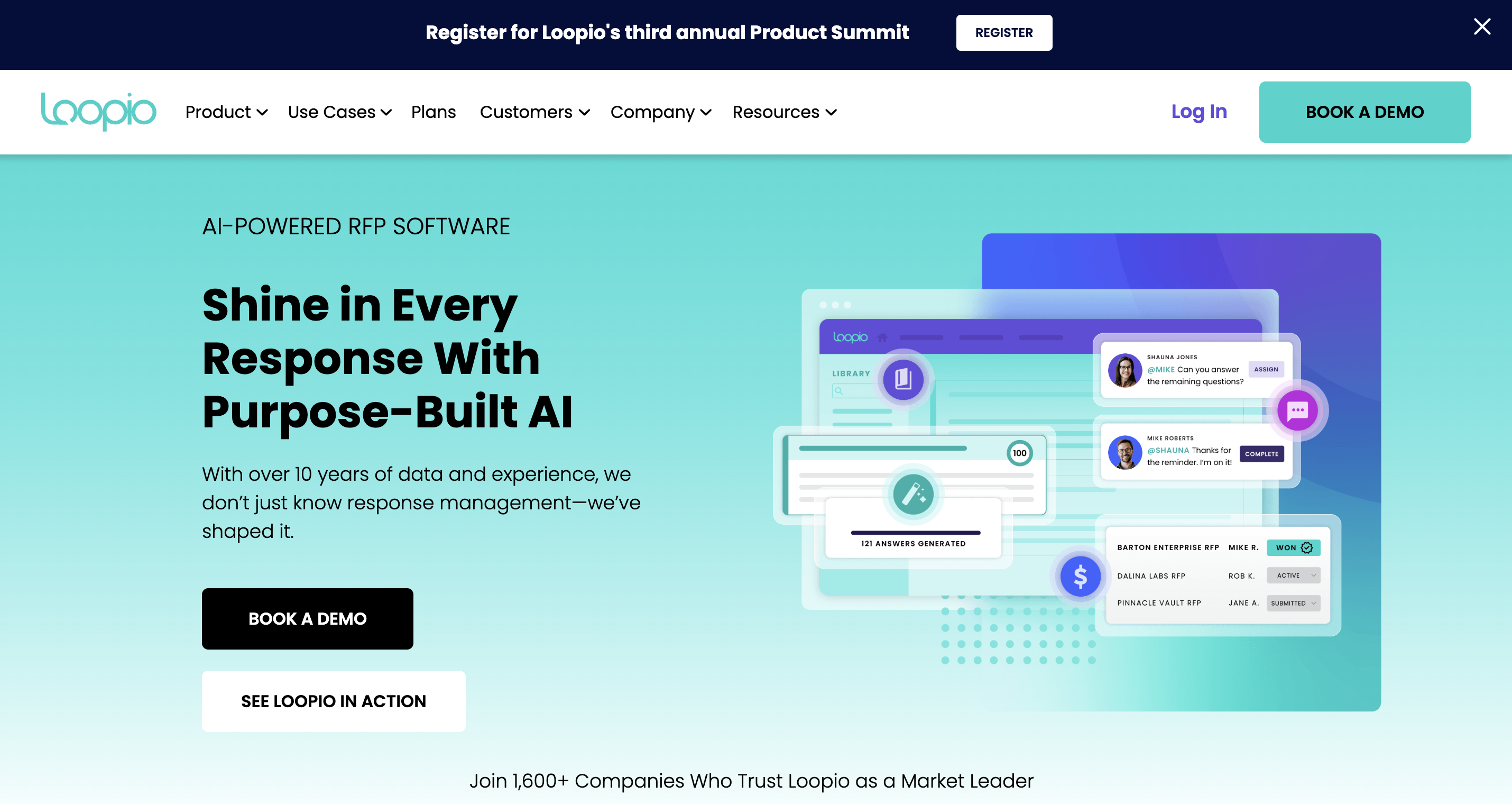
Loopio is one of the most established and widely adopted rfp management tools, trusted by enterprise and mid-market organizations that want structure, control, and reliability in their RFP, RFI, DDQ, and security questionnaire workflows. With over a decade in the category, Loopio is often viewed as the “safe choice” for teams that value usability and governance over aggressive, AI-native experimentation.
Rather than replacing structured processes, Loopio enhances them, layering AI into a disciplined response management framework built for scale, compliance, and collaboration.
Core Features
- Intelligent Import & AI-Assisted Auto-Fill (“Magic”)
Automatically detects questions from Word, Excel, and portal-based RFPs, then uses AI to suggest answers from your content library, giving teams a fast, review-ready first draft. - Centralized Content Library with Governance
A robust, curated Q&A repository with tagging, review cycles, version control, multilingual support, and analytics, designed to keep responses accurate, current, and compliant. - Structured Collaboration & Review Workflows
Assign questions to SMEs, track progress, manage approvals, and collaborate in real time without losing accountability or auditability. - Portal & Browser-Based RFP Automation
A browser extension enables teams to import and respond directly within buyer portals, reducing copy-paste work and preserving formatting. - Analytics, Reporting & Integrations
Built-in reporting on content usage, response velocity, and team workload, plus integrations with Salesforce, HubSpot, Slack, Microsoft Teams, Google Drive, and SharePoint.
Why Teams Choose Loopio
- Ease of use and adoption: Frequently praised for intuitive UX and fast onboarding compared to heavier enterprise platforms.
- Strong governance: Ideal for organizations that require tight control over content accuracy, brand, and compliance.
- Balanced AI approach: AI assists and accelerates work without fully removing human review, appealing to risk-aware enterprises.
- Mature ecosystem: Backed by years of customer feedback, integrations, and enterprise deployments.
Loopio is often shortlisted by buyers evaluating rfp response tools that need to work well for both proposal teams and occasional SME contributors.
Drawbacks to Watch Out
- Ongoing library maintenance: To keep automation effective, teams typically need a dedicated content owner or proposal manager.
- Less AI-native than newer entrants: Compared to newer rfp ai tools, Loopio relies more heavily on a traditional library model rather than continuous semantic learning.
- Can feel structured for sales-led teams: Organizations without a formal proposal function may find it more process-heavy than sales-first alternatives.
G2 Rating
G2 Rating: 4.6 / 5
Loopio consistently ranks at or near the top of the RFP software category for usability, support, and overall satisfaction.
Pricing
Loopio's pricing starts at $20,000/year. It uses custom, quote-based pricing for enterprises. Costs typically vary based on:
- Number of users
- RFP volume and use cases (RFPs, DDQs, security questionnaires)
- Required integrations, governance features, and support level
Pricing is positioned for mid-market to enterprise teams and generally scales with seat count and feature depth.
Summary for Buyers
Choose Loopio if:
- You have a structured proposal or RFP team
- Content governance, compliance, and consistency are critical
- You want a proven, easy-to-adopt platform with embedded AI
- You prefer controlled automation over fully generative, AI-native approaches
In short, Loopio is best suited for organizations that want dependable, well-governed rfp automation tools with strong usability, rather than bleeding-edge experimentation.
Looking for a Loopio alternative?
4. AutoRFP.ai
AI-Native RFP Automation Without the Library Overhead
Source: AutoRFP.ai
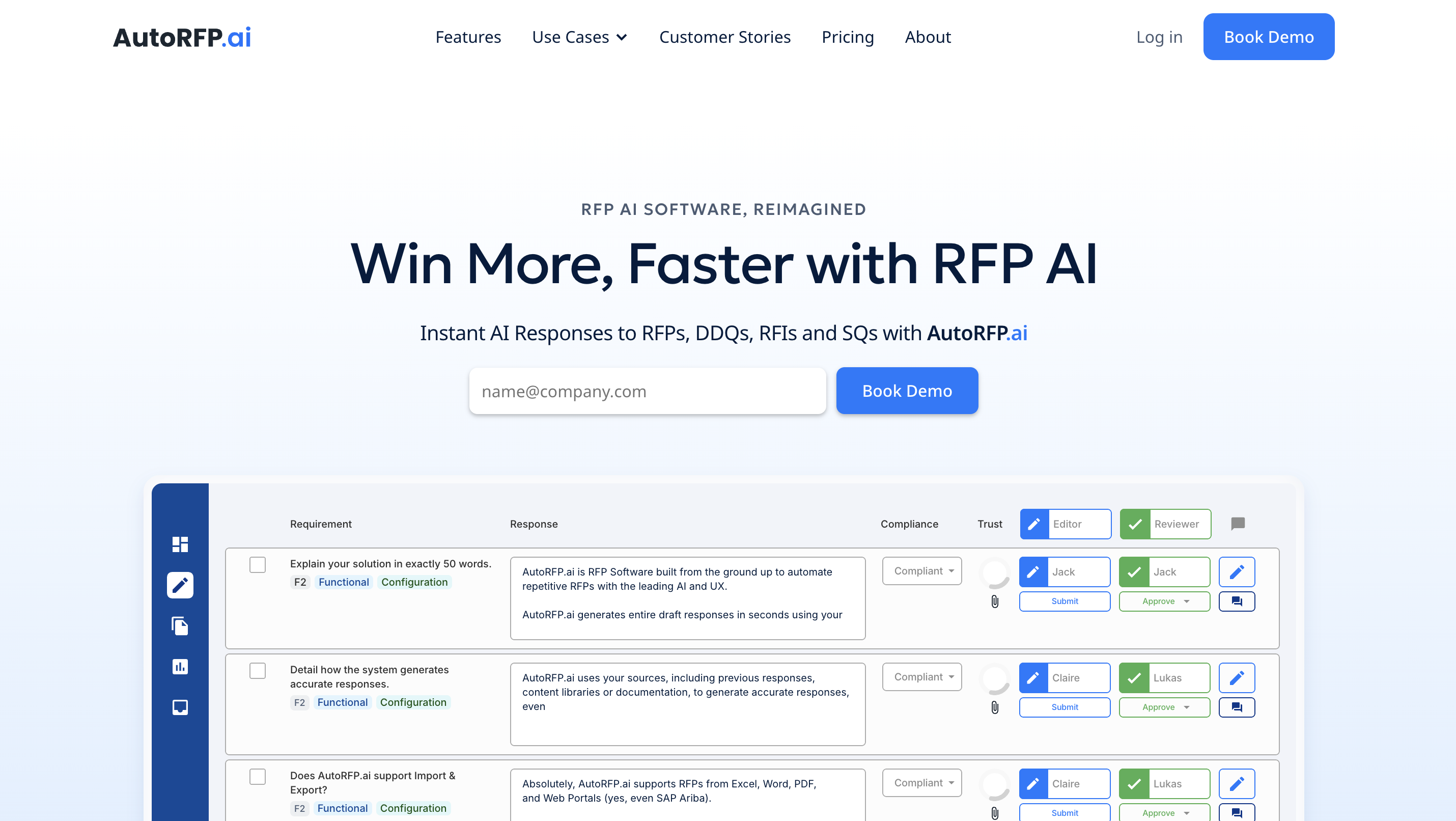
AutoRFP.ai represents a newer generation of rfp ai tools built specifically to eliminate the operational drag of traditional Q&A libraries. Instead of asking teams to curate and maintain thousands of answers, AutoRFP.ai uses generative AI and semantic search to draft near-complete RFP responses directly from your existing documents, prior proposals, and connected knowledge sources.
For enterprise sales teams asking what tools streamline the RFP and RFQ process with the least administrative burden, AutoRFP.ai is often shortlisted as a high-automation, AI-forward alternative to legacy platforms.
Core Features
- AI-First Drafting with Semantic Search
Upload an RFP and AutoRFP.ai drafts responses by semantically searching across your documents, past RFPs, and integrated sources, producing high-coverage first drafts in minutes. - Library-Less Knowledge Model
Eliminates the need for rigid Q&A libraries. The system continuously learns from completed RFPs and source documents, reducing manual upkeep and content curation. - Broad Format & Portal Support
Handles large Excel questionnaires, long Word and PDF RFPs, and procurement portals (e.g., SAP Ariba), with export back into original buyer-ready formats. - Enterprise Security & Private AI
Built on private AI infrastructure with SOC 2 and ISO 27001 certifications, strong data isolation, and clear policies against training public models on customer data. - Unlimited Users with Transparent Access
Designed for cross-functional collaboration across Sales, Presales, Legal, and Security, without penalizing occasional contributors.
Why Teams Choose AutoRFP.ai
- Maximum automation: Among the most aggressive leading AI tools for RFP responses, often cited for very high first-draft coverage.
- Minimal admin overhead: Ideal for teams that lack dedicated proposal or content managers.
- Fast time-to-value: Little setup compared to traditional rfp management tools.
- Predictable collaboration: Unlimited users make it easier to involve SMEs without licensing friction.
For buyers evaluating top productivity tools for RFP automation, AutoRFP.ai is particularly appealing when speed and scale matter more than strict content governance.
Drawbacks to Watch Out
- AI-forward mindset required: Teams accustomed to tightly curated libraries may need to adapt to a semantic, document-driven model.
- Less traditional governance: While secure, it offers fewer built-in content approval and lifecycle controls than legacy enterprise platforms.
- Younger platform: Fewer long-term enterprise reference accounts compared to incumbents like Loopio or Responsive.
G2 Rating
G2 Rating: 4.9 / 5
Users frequently highlight real-time savings, strong draft quality, and reduced SME interruptions compared to manual or library-heavy tools.
Pricing
AutoRFP.ai's pricing starts at $899/month. AutoRFP.ai is known for transparent, subscription-based pricing, typically published by tier and usage rather than fully opaque quotes. Plans generally include:
- Unlimited users
- Full AI drafting capabilities
- Enterprise security features
Pricing scales primarily with RFP/project volume, making costs easier to forecast than many legacy rfp response tools.
Summary for Buyers
Choose AutoRFP.ai if:
- You want AI-native RFP automation with minimal setup
- Your team lacks the resources to maintain large content libraries
- Speed and response volume matter more than rigid governance
- You’re exploring which AI RFP tools are better than Loopio for automation-first use cases
In short, AutoRFP.ai is best suited for enterprises that want rfp automation tools to behave like an intelligent drafting engine, reducing friction, accelerating responses, and letting sales teams focus on closing rather than curating content.
5. 1up.ai
Lightweight, AI-Powered RFP Drafting for Speed-Focused Teams
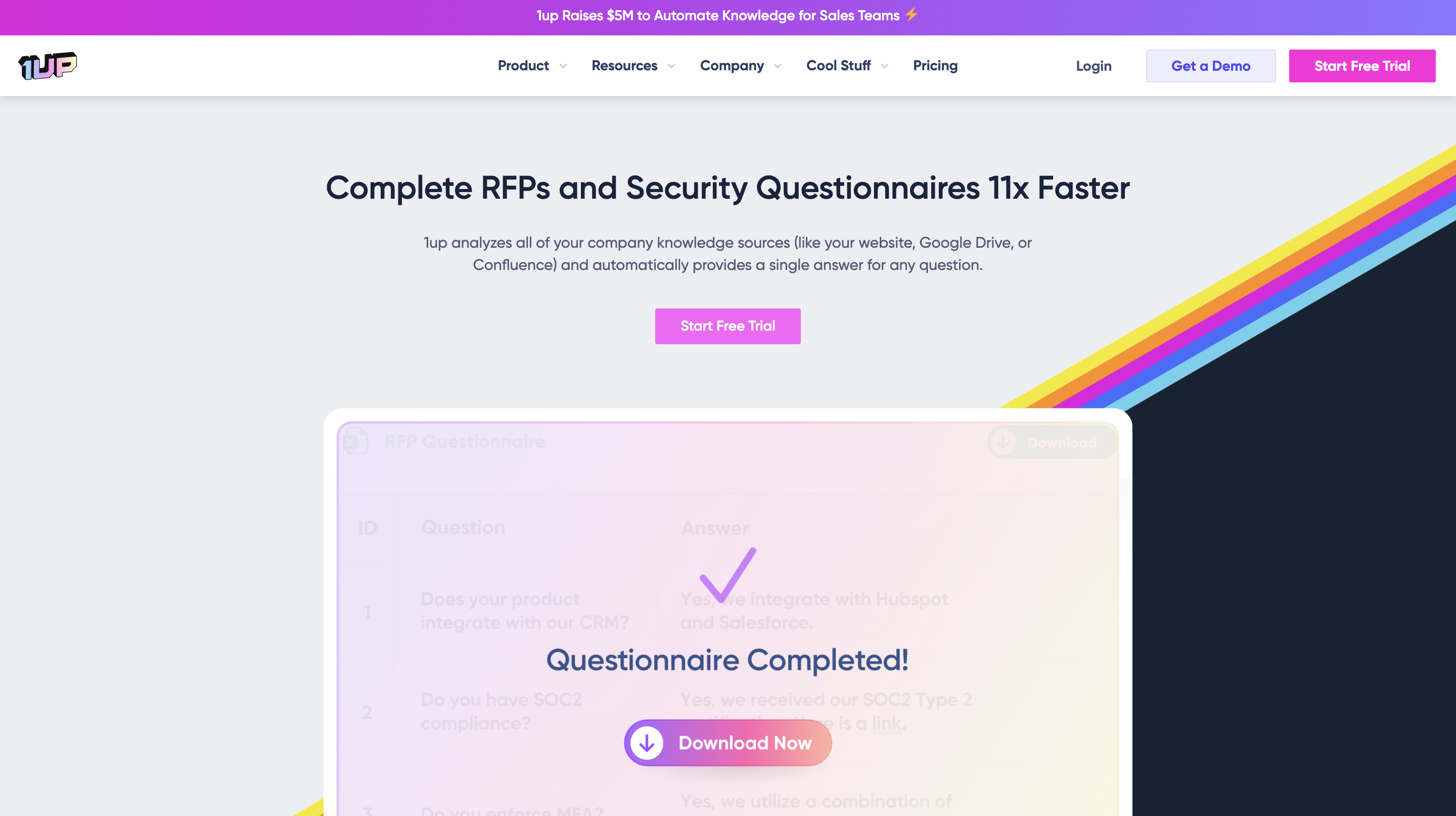
1up.ai positions itself as a fast, AI-first RFP drafting tool designed to help sales and presales teams generate high-quality first drafts with minimal setup. Unlike heavier RFP management tools built around long-term governance and workflow orchestration, 1up.ai focuses on accelerating the writing phase of RFPs using generative AI, making it a popular option for teams prioritizing speed and simplicity.
It’s often evaluated by buyers asking what tools can help streamline the RFP process without committing to a full enterprise response management platform.
Core Features
- AI-Powered RFP Drafting
Generates first-draft answers from prompts, documents, and prior content, reducing manual writing time and accelerating early response cycles. - Document-Based Knowledge Input
Uses uploaded files and reference materials as sources for drafting, avoiding heavy upfront Q&A library setup. - Tone & Style Controls
Allows teams to guide response tone, length, and structure so drafts align with brand and buyer expectations. - Simple Collaboration & Editing
Supports shared editing and iteration on drafts without complex workflow configuration. - Quick Export to Buyer Formats
Outputs content into common RFP formats (Word/Docs), enabling teams to finalize responses in familiar tools.
Why Teams Choose 1up.ai
- Very fast time-to-value: Minimal configuration compared to traditional rfp tools
- Strong drafting assistance: Helpful for teams that struggle with blank pages or tight deadlines
- Low operational overhead: No need for dedicated content librarians or complex governance
- Good entry point to AI: Often used alongside existing processes rather than replacing them
1up.ai is frequently used as a productivity layer rather than a full rfp automation tool.
Drawbacks to Watch Out
- Limited end-to-end workflow: Lacks deep orchestration, SLAs, and portfolio-level management
- Light governance: Not ideal for highly regulated enterprises needing audit trails and strict content controls
- Drafting-focused: Best suited for creation, not long-term response intelligence or analytics
For buyers comparing leading AI tools for RFP responses, 1up.ai trades enterprise depth for speed and simplicity.
G2 Rating
G2 Rating: 4.9 / 5
Users highlight ease of use and faster drafting, with some noting gaps for complex enterprise use cases.
Pricing
1up has a free version, but pricing starts from $250/month. 1up.ai typically offers subscription-based pricing, often positioned as more accessible than large enterprise RFP platforms. Pricing varies by usage and features, making it attractive for teams testing AI-assisted RFP responses without a large upfront commitment.
Summary for Buyers
Choose 1up.ai if:
- Your primary bottleneck is writing speed, not workflow complexity
- You want AI help drafting responses without heavy implementation
- You’re looking for a lightweight alternative or complement to existing rfp response tools
- You’re early in evaluating rfp ai tools and want fast wins
In short, 1up.ai works best as a drafting accelerator, not a full replacement for enterprise-grade rfp management tools, but a useful option for teams that value speed over structure.
Looking for an alternative RFP tool?
Quick RFP Tools Comparison for Buyers
Below is a quick, buyer-focused comparison of the top 5 RFP tools most often shortlisted as Responsive alternatives. This table highlights what each platform does best, where buyers should be cautious, and how real users rate them.
Tool | Key Strengths (Pros) | Buyer Watchouts (Cons) | G2 Rating | Buyer Summary |
|---|---|---|---|---|
SparrowGenie | Human-led AI reduces risk, strong Excel handling, clear cross-team ownership, fast time-to-value | Newer platform, integrations and ecosystem still expanding | 4.5 / 5 | Best for teams that want AI speed with trust, control, and sales ownership |
Responsive | Enterprise-grade workflows, agent-based automation, strong governance and integrations | Complex setup, steeper learning curve, pricing can escalate | 4.5 / 5 | Ideal for large, complex RFx programs that can absorb operational overhead |
Loopio | Easy adoption, strong content governance, dependable performance | Ongoing library maintenance, AI feels assistive vs. transformative | 4.6 / 5 | A safe, proven choice for structured teams prioritizing consistency |
AutoRFP.ai | Very fast AI drafting, unlimited users, minimal admin effort | Lighter governance, less control for regulated environments | 4.9 / 5 | Strong fit when speed, scale, and low friction matter most |
1up.ai | Quick drafting help, simple setup, low commitment | Not end-to-end RFP management, limited workflows and reporting | 4.9 / 5 | Best used as a drafting accelerator, not a full platform |
Each of these top 5 tools solves a different RFP challenge: speed, governance, automation, or ease of use. The right choice depends less on features and more on which friction you want to eliminate first.
Your hunt for the perfect RFP tool might end here. Book a demo now.
Conclusion
Enterprise RFPs are no longer a back-office function. They’re a frontline revenue lever, one that directly impacts deal velocity, win rates, and seller productivity. As this blog has shown, today’s rfp tools fall into two broad camps: legacy platforms that optimize proposal management and modern rfp ai tools that optimize how sales teams actually operate.
This is where SparrowGenie clearly stands apart.
While many rfp automation tools focus on libraries, workflows, or drafting in isolation, SparrowGenie connects the entire motion, from intake to buyer-ready output, around sales ownership, governed AI, and real-time execution. It doesn’t just help teams respond faster; it helps them respond smarter, with confidence scoring, live visibility, enterprise governance, and insights that turn missed questions into growth opportunities.
For organizations asking:
- Who offers the best sales RFP automation tools?
- What tools can help streamline the RFP process without slowing sales?
- Which AI RFP tools are better aligned to modern revenue teams?
SparrowGenie is built to be the answer. In a landscape crowded with capable rfp response tools, SparrowGenie is purpose-built for the teams closest to the deal. If your goal is to reduce RFP drag, protect accuracy, and turn response management into a competitive advantage, not an operational tax, SparrowGenie isn’t just another option. It’s the platform designed for where enterprise sales is headed next.
Ready to see how AI can transform your RFP process?
Product Marketer at SparrowGenie
Being a Product Marketer at SparrowGenie, Aparna helps sales teams work faster with secure, AI-powered proposal automation. She turns complex features into simple stories, builds messaging that resonates, and keeps a close pulse on what customers actually need. She loves shaping clear, helpful content that shows how SparrowGenie makes RFP work easier, faster, and a lot less stressful.