RFP Automation Software: From Manual Mess to Measurable Wins

Article written by
Kate Williams

INSIDE THE ARTICLE
SHARE THIS ARTICLE
Summary
RFPs are slow, repetitive, and painful—but they don’t have to be. This blog explains how RFP automation software transforms the process: auto-filling common answers, routing questions to the right people, and tracking what wins. If your team dreads every RFP, it’s time to fix the system and start closing deals instead of losing them.
Responding to RFPs is one of the most universally dreaded tasks in enterprise sales. It’s tedious, time-consuming, and often feels like solving a puzzle that someone else scrambled on purpose.
But what if that dreaded process didn’t have to drain your time, energy, and will to live? That’s exactly where RFP automation software steps in—not to replace your expertise, but to eliminate the chaos that’s slowing down your response cycles and hurting your win rates. In this blog, let's brush up on what exactly the challenges are in RFP response, what RFP response software is, and the impact, benefits, and a lot more that drives the revenue engine smarter and faster.
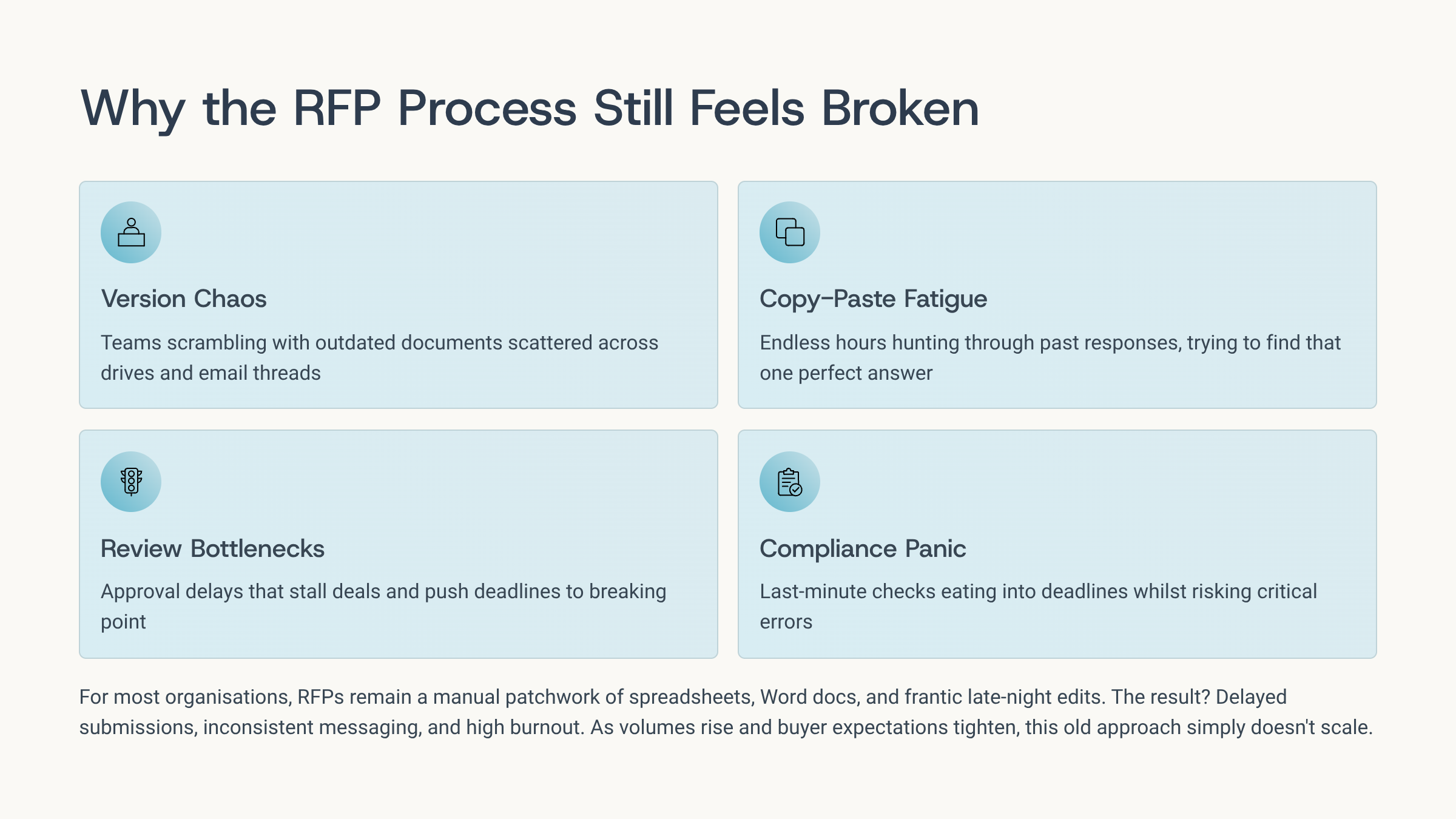
Why the RFP Process Still Feels Broken
Ask anyone who’s handled RFPs, and you’ll hear the same pain points repeated like a loop:
- Version chaos between teams using outdated documents
- Copy-paste fatigue from hunting past responses
- Review bottlenecks that stall deals
- Compliance checks that eat into deadlines
For most organizations, RFPs remain a manual patchwork of spreadsheets, Word docs, and frantic late-night edits.
The result? Delayed submissions, inconsistent messaging, and high burnout.
As volumes rise and buyer expectations tighten, this old approach simply doesn’t scale. That's exactly where automation comes into the picture and disrupts the traditional RFP responses.
What Is RFP Automation Software?
RFP automation software is built to take the manual, error-prone, repetitive grind out of responding to complex RFPs, RFIs, and DDQs. It uses AI, machine learning, and natural language processing to understand context, retrieve relevant answers, and generate complete, compliant drafts—without human teams spending hours in spreadsheets and email threads.
Instead of relying on scattered folders and tribal knowledge, automation software connects all the moving parts of your proposal workflow into one governed system. Here’s how it typically works:
- AI Parsing: The system scans every RFP document—PDF, Excel, or portal upload—and automatically detects questions, sections, and requirements.
- Smart Matching: Using contextual search, it matches each query with the most relevant pre-approved content from your central library.
- AI-Generated Drafts: It builds first-pass responses instantly, formatted to match the buyer’s template.
- Workflow Automation: Built-in workflows route each section to the right reviewer or SME for quick approval.
- Final Assembly: Once approved, the system exports the response in the buyer’s preferred format—ready to submit.
The best platforms go beyond just text generation—they embed version control, access permissions, analytics, and security compliance, ensuring your responses are not only fast but also fully auditable.
From Chaos to Clarity: How RFP Automation Changes Everything
Before automation, every RFP cycle feels like déjà vu: chasing SMEs for answers, reformatting outdated documents, scrambling hours before submission. No one knows which version is final, who’s reviewing what, or whether the content even aligns with your latest messaging and product updates.
With automation, that fragmented process is replaced by a single, intelligent workflow that connects people, content, and compliance in one place.
Here’s what that transformation looks like:
1. Instant Organization
Your proposal data, policies, and past responses aren’t scattered across drives and inboxes anymore. Automation tools turn that chaos into a centralized, searchable repository—your single source of truth. Teams can find verified answers in seconds instead of hours.
2. Smarter Drafting
AI doesn’t just retrieve old text—it understands context. It learns how your organization phrases technical details, adapts tone to match your brand voice, and personalizes responses for every buyer. The result? Polished, human-quality drafts ready for review almost instantly.
3. Streamlined Collaboration
Instead of endless email threads, reviewers and SMEs work within the same shared workspace. Approvals, redlines, and comments happen in real time, making cross-functional collaboration seamless and cutting approval time.
4. Compliance Without the Panic
Every approved response is version-controlled and audit-ready. Automation ensures teams always use the latest, verified answers—so you meet every compliance and security requirement without manual checks or last-minute chaos.
5. Continuous Learning
Each completed RFP teaches the system what works. The more you use it, the smarter it gets—surfacing better answers, predicting question intent, and helping teams replicate their best-performing responses over time.
In short, RFP automation replaces reactive firefighting with proactive precision. Teams move faster, stay aligned, and deliver responses that reflect strategy, not survival.
The Hidden ROI of RFP Automation
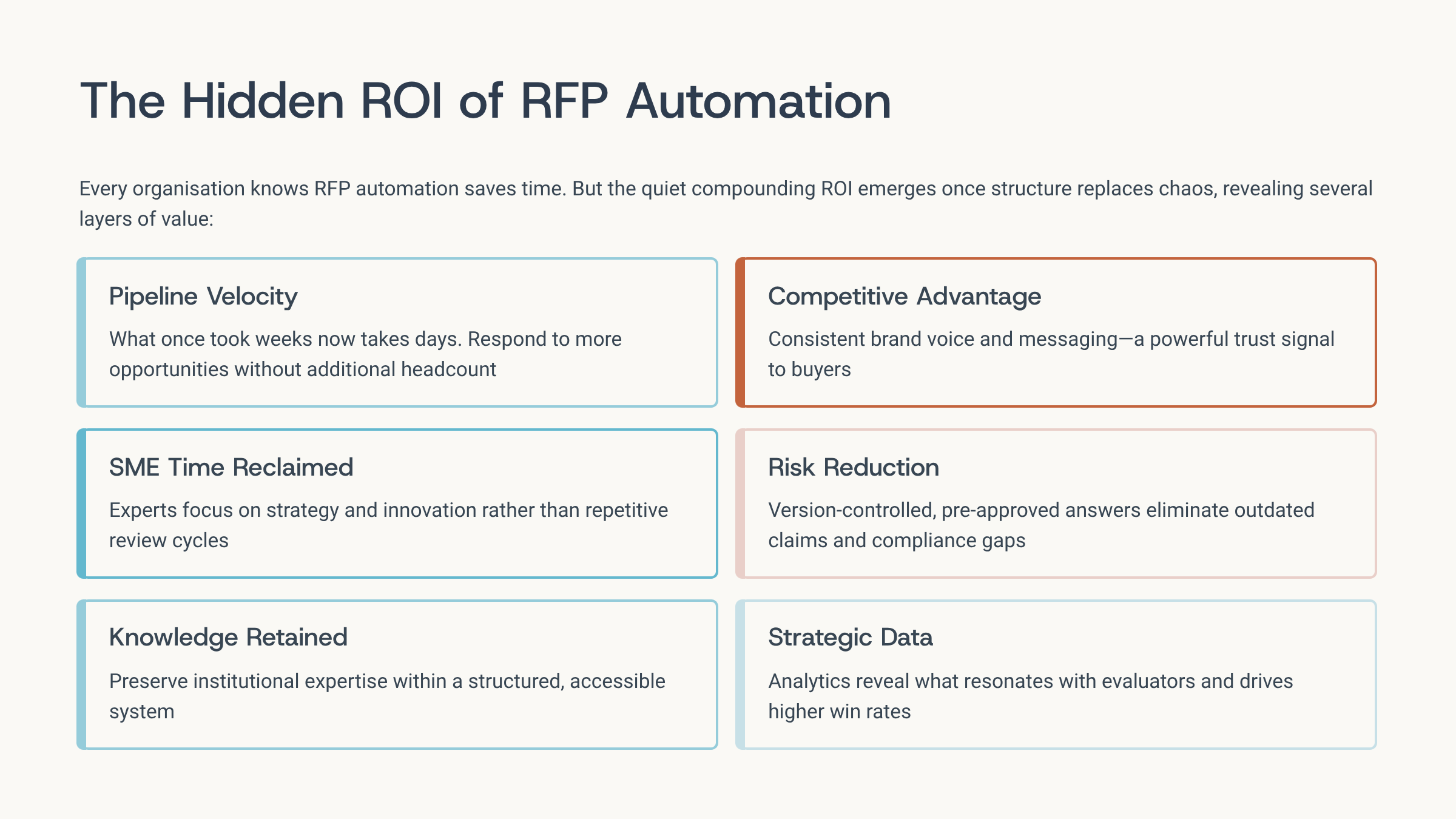
Every organization knows RFP automation saves time. But what often goes unnoticed is the quiet compounding ROI that emerges once structure replaces chaos.
When RFPs stop being reactive marathons and start running on predictable, governed workflows, several layers of value begin to reveal themselves:
1. Time Translates to Pipeline Velocity
What once took weeks now takes days—or even hours. By automating question detection, content matching, and reviews, teams can respond to more opportunities in the same time frame, increasing proposal volume without hiring additional headcount.
2. Consistency Becomes a Competitive Advantage
RFP automation eliminates the patchwork of tone, terminology, and templates that creep in over time. Every response reflects one consistent brand voice and message—a subtle but powerful trust signal to buyers deciding between near-identical proposals.
3. SME Time Reclaimed
Subject-matter experts are often pulled into repetitive review cycles, answering the same questions repeatedly. Automation frees them to focus on strategic, high-value inputs—product innovation, solutioning, and customer insights—rather than administrative churn.
4. Governance Reduces Risk
Each answer is version-controlled, pre-approved, and compliant by design. That means no more outdated claims, missing disclosures, or risky attachments that trigger red flags during buyer evaluation or legal review.
5. Institutional Knowledge Retained
When key team members move on, they don’t take the organization’s proposal expertise with them. Automation platforms preserve tribal knowledge within a structured, accessible system—turning knowledge into a renewable resource rather than a liability.
6. Data That Fuels Strategy
Analytics expose which sections resonate most with evaluators, which questions cause delays, and which proposal types yield higher win rates. Armed with this data, teams can iterate with precision—turning every RFP into a feedback loop for smarter future responses.
When you add it all up, the hidden ROI isn’t just faster RFPs—it’s a healthier revenue engine. Your team reclaims bandwidth, reduces burnout, and builds a scalable foundation for consistent, measurable growth.
How to Build a High-Performance RFP Workflow
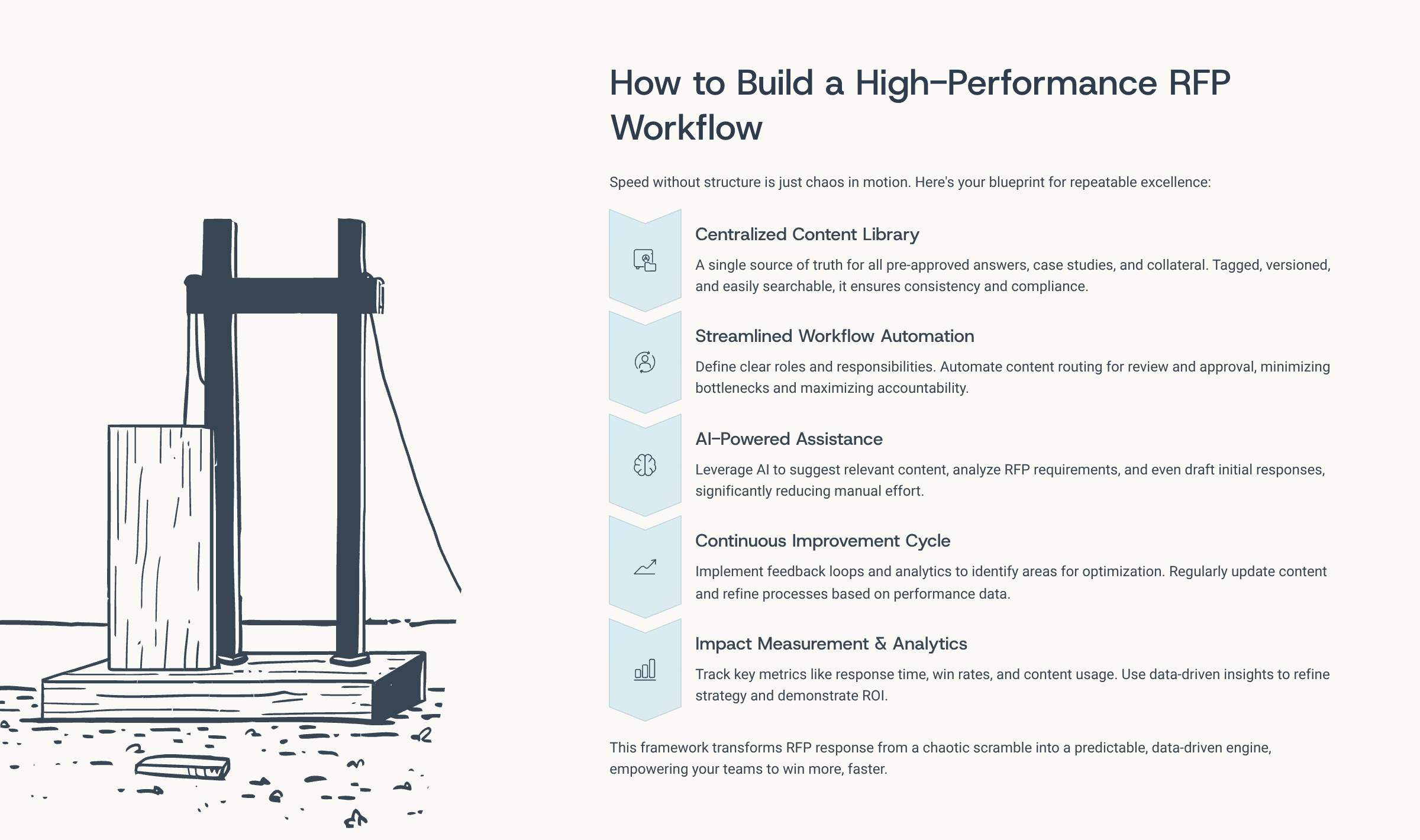
Once automation enters the picture, the next challenge isn’t speed—it’s structure. You can’t scale efficiency without a framework that ensures accuracy, governance, and collaboration across teams. That’s where a high-performance RFP workflow comes in.
Think of it as your proposal operations blueprint—a system that aligns people, process, and technology to deliver repeatable excellence.
Here’s how to build one that actually works:
1. Start with a Centralized Content Library
Your content library is the foundation. Every pre-approved answer, company fact, compliance clause, and product description should live here—tagged, versioned, and easily searchable. This single source of truth prevents teams from reusing outdated or unverified content and ensures every proposal reflects your latest messaging and policies.
2. Define Clear Roles and Review Workflows
A winning RFP doesn’t happen by accident—it’s a chain of coordinated approvals. Assign ownership at every stage: author, SME, reviewer, legal, and final approver. Automated routing ensures nothing slips through the cracks and helps maintain accountability and auditability across teams.
3. Integrate the Tech Stack
Don’t treat your RFP platform as a standalone island. Integrate it with your CRM, content management systems, project management tools, and communication channels (like Teams or Slack) so data and updates flow automatically. This eliminates duplication and keeps your sales, product, and compliance teams working from the same source of truth.
4. Embed Compliance Early
Rather than treating compliance as a post-submission scramble, build it directly into your workflow. Pre-approved templates, version control, and access permissions ensure compliance-by-design, not compliance-by-panic.
5. Measure, Learn, and Improve
Use analytics dashboards to track performance—turnaround times, win rates, reviewer bottlenecks, and content reuse frequency. Then, refine. The most mature RFP teams treat automation as a living system, continuously learning and evolving with every submission.
A high-performance RFP workflow doesn’t just make teams faster—it makes them predictable, data-driven, and scalable. It’s the difference between “submitting” proposals and “strategically winning” them.
Top 5 RFP Automation Software Platforms in 2025
If you’re exploring automation, you’ll find no shortage of tools promising to simplify your RFP process. But the best platforms go beyond templates and text matching - they combine AI intelligence, collaboration, governance, and analytics to help teams scale.
Here are five of the most capable RFP automation software solutions making waves in 2025:
1. Responsive
Known for its intuitive AI engine, Responsive automates answer recommendations and collaboration across large teams. Its analytics dashboard helps track content performance and win metrics, making it ideal for enterprises managing high RFP volumes.
Best for: Enterprise RFP teams handling complex, multi-departmental submissions.
2. Loopio
Loopio focuses on content governance and efficiency. Its strong content library, smart tagging, and project workflows help teams respond faster while maintaining compliance. Integration with CRMs and communication tools keeps proposal work connected.
Best for: Mid-to-large organizations needing scalable content management.
3. Qvidian
Qvidian has long been a trusted name in proposal automation, particularly for enterprises with mature sales operations. It offers deep integration with CRM systems, structured templates for brand consistency, and guided automation workflows that help teams build proposals quickly while maintaining accuracy and compliance. Its analytics tools also provide insight into team productivity and proposal success rates, helping leaders identify where efficiency or content quality can improve.
Best for: Large organizations with established sales processes looking for end-to-end automation and analytics-driven proposal management.
4. RocketDocs
RocketDocs blends a strong content management foundation with a collaboration layer designed for proposal and sales teams. Its Smart Response™ technology and integration options make it a good fit for highly regulated industries.
Best for: Financial and compliance-heavy organizations prioritizing control and security.
5. SparrowGenie
Built for modern enterprise sales and proposal teams, SparrowGenie combines secure AI automation with deep contextual understanding. Genie AI parses RFPs, maps questions, and generates accurate, brand-aligned answers backed by a centralized, governed knowledge hub. It doesn’t just automate — it ensures accuracy, compliance, and measurable win-rate impact.
Best for: Organizations seeking secure, human-powered AI that democratizes knowledge and accelerates deal velocity.
Each of these platforms solves a different slice of the RFP challenge — but the right one depends on your priorities.
Conclusion: The Future of RFPs Isn’t Faster—It’s Smarter
Every company is chasing speed. But in the world of RFPs, speed without structure is just chaos in motion. The teams that truly win aren’t the ones replying faster — they’re the ones responding smarter, with data, alignment, and confidence baked into every answer.
So the next time an RFP lands in your inbox, ask yourself — are you responding to survive, or building to win?
SparrowGenie helps you do the latter — every single time.
Democratize knowledge. Simplify collaboration. Win more RFPs—without the burnout.
Ready to see how AI can transform your RFP process?
Product Marketing Manager at SurveySparrow
A writer by heart, and a marketer by trade with a passion to excel! I strive by the motto "Something New, Everyday"