How AI is Revolutionizing RFP Management in 2026: Cut Response Time by 60%

Article written by
Vipin Thomas

INSIDE THE ARTICLE
SHARE THIS ARTICLE
Summary
AI is transforming RFP management by automating tasks and enhancing accuracy, enabling sales teams to handle increasing volumes efficiently. Solutions like SparrowGenie cut response times and boost win rates, making AI adoption essential for staying competitive in today's fast-evolving business environment. This shift not only speeds up processes but also significantly improves the effectiveness of RFP responses.
In today's business environment, your sales team's success shouldn't be limited by how many RFPs they can process. Yet that's exactly what's happening across industries, with top performers spending more time on paperwork than building relationships.
Let me share what we've discovered about these growing RFP challenges and how AI-powered solutions are transforming RFP management altogether.
What Is Causing the RFP Crisis Across Sales Teams Today
If you're feeling overwhelmed by RFP requests lately, you're not imagining things.
RFP volumes surged an astonishing 77% last year alone.
What was once manageable has transformed into a productivity nightmare consuming days or weeks of valuable selling time.
We've seen this pattern play out repeatedly across B2B sales organizations. Instead of focusing on relationship-building and strategic selling, star performers find themselves trapped in an endless cycle of RFP responses. The math simply doesn't work anymore; there aren't enough hours to handle both core selling activities and the mounting pile of RFPs.
This challenge hits close to home for us at SurveySparrow. Our own sales teams spent countless hours hunting down information, coordinating with subject matter experts, and manually assembling responses. All this tedious work pulled our focus away from what truly matters: securing new business.
That shared pain point is precisely why we created SparrowGenie, to transform wasted effort into efficiency, automate the manual grind, and help sales teams refocus on selling.
The True Cost of RFPs for Sales Leaders and Revenue Teams
When we dug into the research, the numbers painted a concerning picture.
The average company now handles 175 RFPs annually, up from 162 just last year. For enterprise organizations, that workload quadruples, placing enormous strain on already stretched teams.
The trend shows no signs of slowing down. 64% of teams experienced a 30% jump in requests over the past year, yet most companies can only respond to about 65% of incoming RFPs. That means potential revenue is walking out the door simply because teams lack capacity.
Source: 0penasset.com
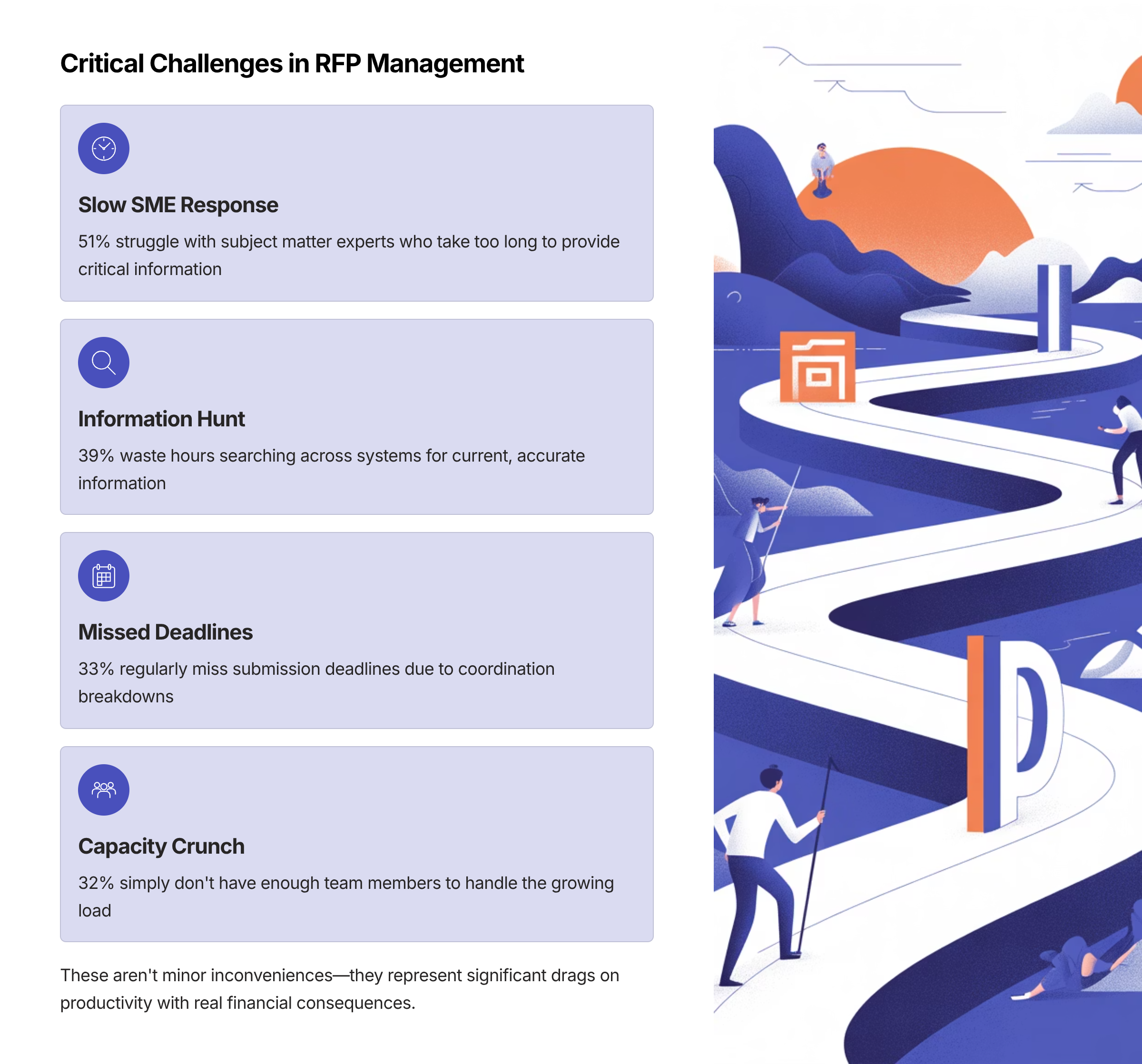
When we spoke with sales professionals about their biggest RFP-related challenges, these four issues came up consistently:
- 51% struggle with slow subject matter expert response times
- 39% waste hours searching for current information
- 33% regularly miss submission deadlines
- 32% simply don't have enough team members to handle the growing load
These aren't minor inconveniences; they represent significant drags on productivity and revenue.
Each missed opportunity has real financial consequences:
- RFP-based deals cost 5 times more to pursue than standard sales deals
- Companies collectively lose an estimated $200 billion annually due to inefficiencies
- 62% of proposal professionals work more than 40 hours weekly solely on RFPs
- A staggering 20% of RFPs never even get completed due to capacity constraints
- Sales teams invest between 25-30 hours on each RFP using traditional methods
When teams fall behind, enterprise organizations feel the pressure most acutely, with 34% citing capacity issues as their biggest challenge. Sales-led proposals suffer particularly badly; they're four times more likely to miss deadlines than when proposal managers take charge.
Why Are Traditional RFP Processes Failing Sales Teams?
Most RFP processes weren’t designed for today’s volume, speed, or complexity. What once worked with a handful of requests now breaks under constant deadlines, cross-functional reviews, and growing compliance demands. The problem isn’t effort. It’s that the system itself no longer holds, especially when the following bottlenecks still exist in it:
1. Manual Data Gathering
Picture your team spending hours digging through emails, combing through shared drives, and messaging colleagues just to find one critical piece of information:
- Teams lose 2-3 full days in back-and-forth communications for complex RFPs
- Nearly 20% of work hours get consumed by searching for information
- It typically takes 8 separate attempts to pinpoint the right information 80% of the time
- Without a centralized knowledge base, the same questions get researched repeatedly
"Last week, we missed a $1.2 million opportunity because two departments were working with different versions of product specifications," one sales director told us. "By the time we realized the discrepancy, the deadline had passed."
This isn't just inefficient; it's a high-stakes challenge that directly impacts win rates and revenue.
2. Repetitive Tasks
Approximately 70% of RFP time is consumed by mundane tasks like extracting requirements, formatting documents, and making minor edits.
The redundancy is staggering...
80% of RFP questions are essentially reworded versions of previous requests. Yet without proper knowledge management, teams recreate responses from scratch time after time.
As deadlines approach, the pressure intensifies. 53% of evaluation scores come in during the final week, with 10% arriving on the very last day. This time crunch explains why teams end up missing approximately 20% of RFPs entirely.
One sales operations leader described it as "death by a thousand cuts"; no single task is overwhelming, but the cumulative effect drains productivity.
3. Collaboration Breakdowns
RFP responses require input from multiple stakeholders. When collaboration breaks down, the entire process grinds to a halt:
- Poor communication costs organizations an average of $26,000 per employee annually
- 86% of executives identify inadequate collaboration as the primary cause of workplace failures
- Subject matter experts become bottlenecks, with 51% of teams struggling to engage them effectively
- 70% of proposal writers begin drafting before outlines are even approved, leading to extensive rewrites
Version control becomes a nightmare as well. Approximately 37% of professionals report regularly dealing with errors in their final proposals.
"We once submitted a proposal with pricing from three years ago because someone pulled from an outdated file," a proposal manager shared. "It cost us the deal and damaged our credibility with a potential long-term client."
These challenges explain why teams using traditional methods see their effectiveness drop by 20-25% when managing multiple RFPs simultaneously. The old approach simply doesn't scale.
How Is AI Transforming RFP Management for Modern Sales Teams?
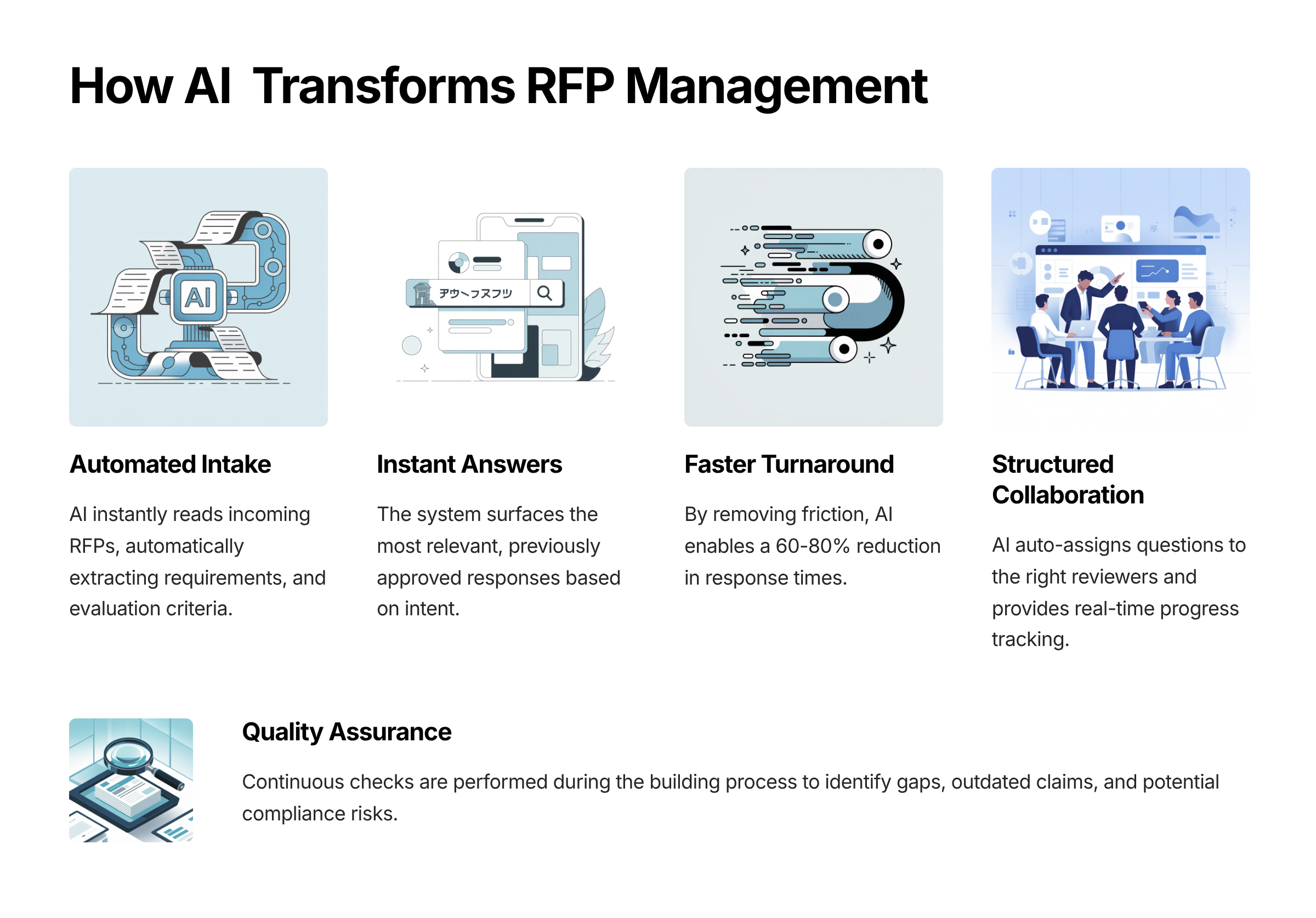
AI is a savior for sales teams approaching the entire process, from intake to submission. Instead of reacting under pressure, teams are shifting to structured, repeatable workflows that scale with demand. Here's how AI is making RFP management hassle-free for sales teams today:
1. Automated RFP Intake and Requirement Extraction
AI reads incoming RFPs the moment they arrive and automatically extracts requirements, questions, and evaluation criteria. This eliminates manual parsing and reduces the risk of missing critical sections under time pressure.
2. Instant Access to Verified, Approved Answers
Instead of searching across folders and emails, AI surfaces the most relevant, previously approved responses based on intent, not keywords. This prevents teams from rewriting the same answers and reduces inconsistencies across submissions.
3. Faster Turnaround Without Added Headcount
By removing search, rework, and coordination overhead, companies transitioning from manual processes to AI-driven solutions reduce response times by 60% on average, with some achieving up to 80% faster workflows. Speed comes from removing friction, not increasing workload.
4. Structured Collaboration Across Teams
AI-powered RFP platforms automatically assign questions to the right reviewers, track progress in real time, and keep all contributors aligned. SMEs, legal, security, and sales teams know exactly what they own and when it’s due.
5. Built-In Accuracy, Compliance, and Quality Checks
AI continuously checks responses for gaps, outdated claims, conflicting data, and compliance risks while the proposal is being built. This prevents last-minute surprises and reduces the risk of disqualification.
6. Repeatable, Scalable RFP Workflows
AI transforms RFPs from one-off emergencies into a repeatable system. Teams can handle more RFPs in parallel without burnout or additional hires, even during peak demand periods.
With SparrowGenie, what once required days of searching, coordinating, and drafting can now be completed in a fraction of the time, automated, optimized, and positioned to win.
RFP Management: Before vs After AI
The impact of AI is easiest to see when you compare how RFPs were handled before automation versus how modern teams operate today.
Aspect | Before AI | After AI |
|---|---|---|
RFP intake | Manual reading and parsing | Automatic requirement extraction |
Answer discovery | Searching emails, folders, and docs | Instant access to verified responses |
Repetitive work | Same answers rewritten repeatedly | Intent-based reuse of best responses |
Collaboration | Email threads and Slack chaos | Structured, real-time workflows |
Quality checks | Last-minute manual reviews | Continuous accuracy and compliance checks |
Turnaround time | 25–30 hours per RFP | 60–80% faster response cycles |
Scalability | Limited by team size | Scales without added headcount |
This shift explains why AI-powered RFP management is quickly becoming the new baseline. Teams that adopt it move faster, submit cleaner responses, and stay competitive without burning out their best people.
Six Key Benefits of AI-Powered RFP Tools
When teams talk about AI in RFPs, speed usually gets all the attention. But the real value goes deeper. The biggest gains show up in consistency, collaboration, and control, the things that quietly determine whether an RFP gets submitted on time and actually wins. Here are 6 significant benefits that lead to the wins:
1. AI-Powered Content Discovery
Traditional process: Teams spend hours hunting for information across disparate systems.
AI solution: The right content finds you instantly.
SparrowGenie's AI technology:
- Extracts key RFP requirements within minutes, not hours
- Pre-fills responses by analyzing past winning proposals
- Automatically routes specific questions to the appropriate subject matter experts
- Ensures content stays current by connecting to live data sources
Organizations implementing AI-powered content discovery report reducing search time by up to 70%, freeing teams to focus on strategy rather than administrative tasks.
2. Smart Answer Suggestions
Traditional process: Teams rewrite similar answers repeatedly, often with inconsistent quality.
AI solution: Your best previous responses become the foundation for new submissions.
SparrowGenie's AI:
- Automatically matches incoming RFP questions to high-performing past responses
- Ranks suggested answers with confidence scores to guide decision-making
- Understand the intent behind questions for more precise matching
- Refines tone and clarity to maximize impact with evaluators
Early adopters report an 80% faster workflow, enabling them to handle significantly more RFPs without additional resources.
3. Improved Accuracy & Compliance
Traditional process: Manual reviews miss critical errors that can disqualify otherwise strong proposals.
AI solution: Systematic quality control catches issues before submission.
SparrowGenie delivers:
- Real-time quality checks that identify errors, inconsistencies, and gaps
- Automated compliance scanning to prevent regulatory risks
- Smart insights that refine responses for higher win probability
- Version tracking that prevents outdated content from resurfacing
Teams leveraging AI for compliance report an 80% improvement in win rates within the first year of implementation.
4. Seamless Collaboration
Traditional process: Endless email chains, missed communications, and coordination headaches.
AI solution: Structured workflows that keep everyone on the same page.
SparrowGenie enables:
- Automatic assignment of sections to the appropriate experts
- Real-time collaborative editing for faster teamwork
- Streamlined approval workflows for leadership and legal teams
- Live version control that prevents duplicate or conflicting edits
Organizations report that AI-powered collaboration speeds up approvals by 50%, ensuring on-time submissions even for complex RFPs.
5. Data-Driven Insights
Traditional process: Limited visibility into what works and what doesn't across proposals.
AI solution: Continuous learning that improves your approach with every submission.
SparrowGenie provides:
- Predictive success scoring based on historical win patterns
- Content gap analysis with specific improvement recommendations
- Competitive benchmarking to strengthen positioning
- Message optimization for maximum evaluator impact
These insights transform RFP management from a reactive process to a strategic advantage, continuously refining your approach based on real-world results.
6. Scalable & Adaptive
Traditional process: RFP capacity directly tied to team size, creating bottlenecks during busy periods.
AI solution: Flexible capacity that scales to meet changing demands.
SparrowGenie offers:
- Simultaneous processing of multiple RFPs without delays
- Continuous learning that improves suggestions over time
- Multi-language support for global proposal management
- Seamless integration with existing enterprise systems
Whether responding to 10 RFPs or 100, AI scales effortlessly, boosting efficiency without adding to workload or headcount.
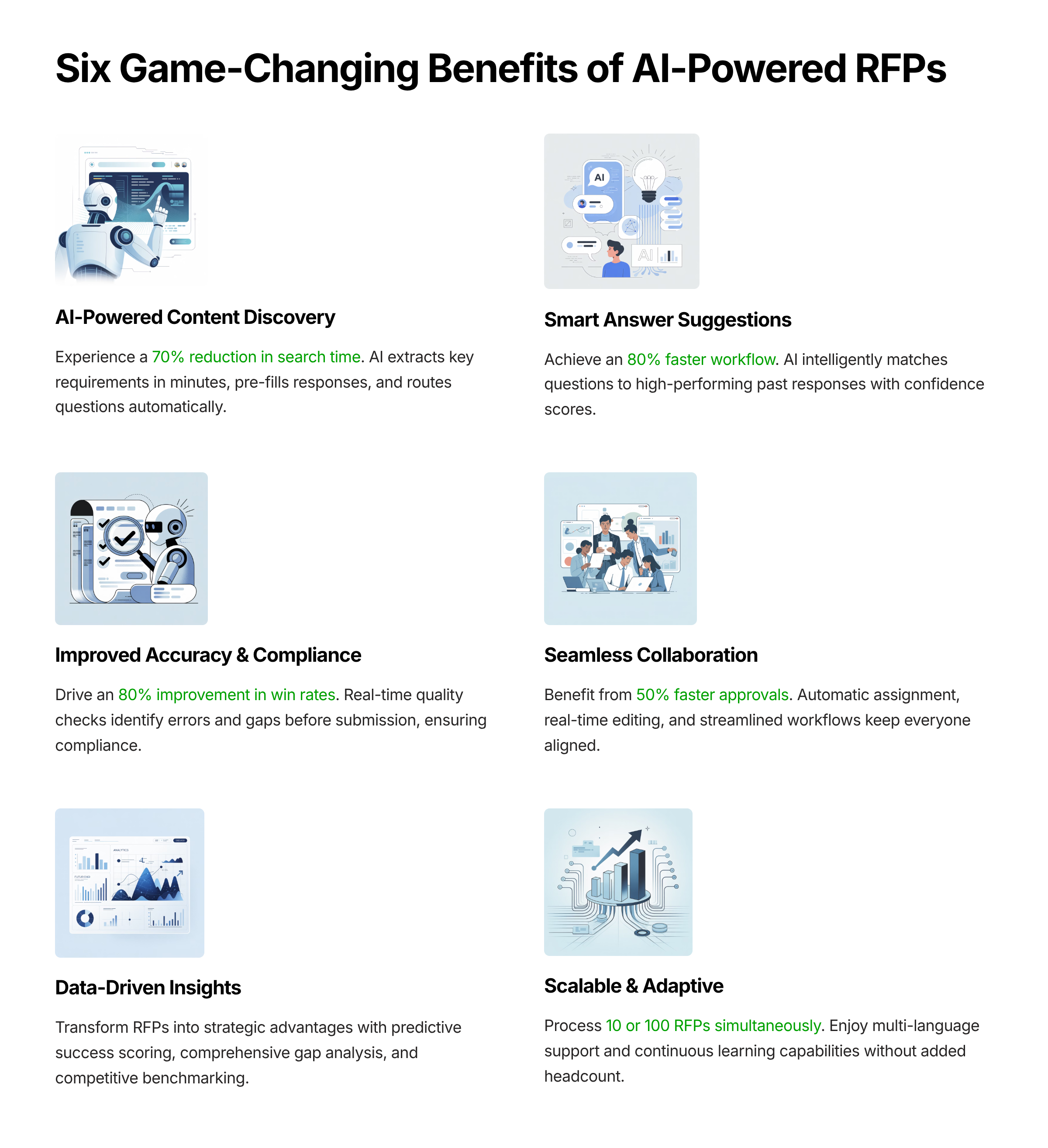
Together, these benefits shift RFPs from a reactive, high-stress scramble to a repeatable advantage. AI doesn’t just help teams do more RFPs. It helps them do better ones, without burning out the people responsible for winning the work.
What Will RFP Management Look Like in 2026 and Beyond?
As we look to the coming year, the transformation of RFP management is accelerating. According to industry projections for 2026:
- 84% of teams expect AI to enable faster content creation
- 60% plan to leverage automation for more personalized RFP responses
- 56% will implement AI for improved staff scheduling and workload management
- 40% anticipate simpler content handling processes through automation
These aren't just aspirational goals; they represent the new competitive baseline. Organizations that fail to evolve risk falling increasingly behind as competitors leverage AI to respond faster, with greater precision, and at lower costs.
How Can Sales Teams Fix Their RFP Process?
Teams adopting AI-powered tools like SparrowGenie are fundamentally reshaping what's possible in RFP management. By responding faster with greater precision and strategic focus, they're winning more than just deals; they're securing stronger partnerships, higher-value contracts, and a reputation for delivering excellence.
The transformation from manual processes to AI-powered efficiency isn't just about doing more with less; it's about empowering your sales team to focus on what they do best: building relationships and closing business.
It's no longer a question of whether AI will transform RFP management; it already has. The only question remaining is whether your team will lead the transformation or struggle to catch up.
Ready to see how SparrowGenie can transform your RFP process?
Schedule a personalized demo today and discover how our AI-powered solution can cut your response time by 60% while improving win rates.
Ready to see how AI can transform your RFP process?
VP Revenue Operations at SurveySparrow and Business Unit head for SparrowGenie. With 18+ years in B2B SaaS—including leadership roles at Freshworks and MangoApps—I’ve led go-to-market, customer success, and revenue operations across high-growth teams. My focus consistently has been building predictable, repeatable revenue engines, aligning cross-functional teams, and driving outcomes that scale. SparrowGenie emerged from that journey—born as an internal fix for RFP bottlenecks, it’s now evolving into a category-defining product in sales automation and enablement.