Top Agency Services for RFPs & Proposal Success: How to Choose the Best Partner

Article written by
Kate Williams

INSIDE THE ARTICLE
SHARE THIS ARTICLE
Summary
If RFPs still feel like group therapy sessions mixed with a fire drill, you’re not alone. Most teams are one messy proposal away from losing their sanity or their deal. This blog breaks down RFPs and proposal agencies, modern RFP tech, and how a smarter workflow can turn that chaos into a competitive edge. Let’s fix the madness.
When RFPs get to be too much to handle for your internal team, it's an obvious inclination you'll have towards RFP agencies who could do the heavy lifting and rescue your team from the hectic mundanity. And plus, the benefits of having an agency onboard are immense. But what about now, when the RFP software is solving a chunk of your RFP issues? In this blog, let's get all the answers on why to choose an RFP agency, the benefits, 7 best RFP agencies across the globe, when to go for an agency and when to go for software, and much more.
Why Do Teams Need RFP Agencies?
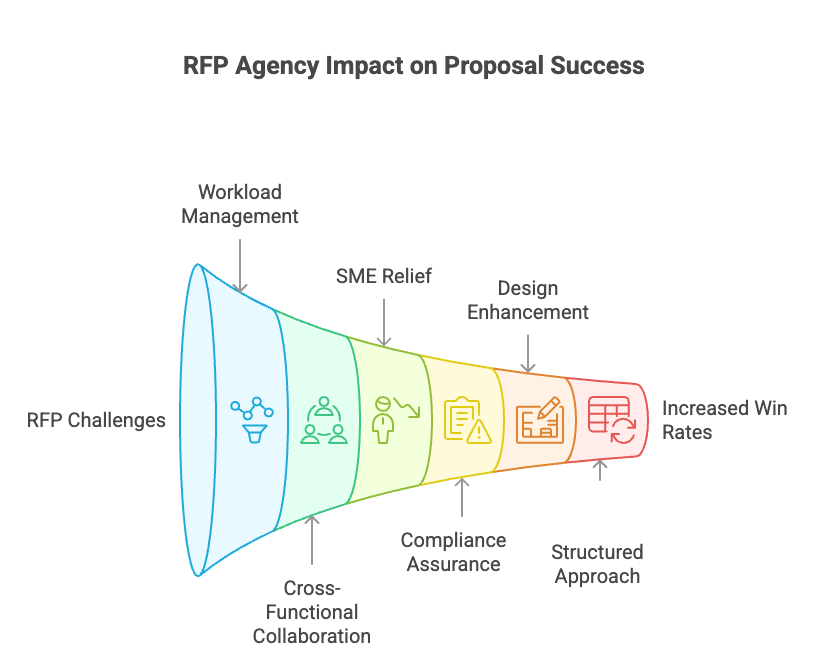
One misconception drives most decisions: that teams hire proposal agencies because they’re “short on time.” But time is only the surface-level problem. Below it, you’ll find deeper structural issues: ones that RFP automation alone can’t always fix.
Organizations turn to agencies because:
1. Workloads grow faster than headcount
Entering new markets, adding products, or chasing bigger deals usually doubles RFP volume. Many SaaS teams hit a point where internal resources simply can’t keep up.
2. Modern RFPs demand cross-functional collaboration
Technical specs, cybersecurity narratives, compliance sections, onboarding plans, pricing logic, case studies, no single owner controls all of it.
3. SMEs are stretched thin
The experts who hold the answers are also running the product, security operations, and engineering. RFP agencies reduce their load to essential reviews instead of full drafting.
4. Evaluation criteria are stricter than ever
Government, healthcare, and enterprise RFPs rely on structured scoring systems. RFP and proposal agencies know how evaluators think and write directly to that logic.
5. Proposal design now affects win rates
Readable layouts, structured visuals, and narrative clarity influence scoring. Most teams aren’t trained in proposal design principles.
6. High-value bids cannot rely on improvisation
Without method, content library, review process, and governance, teams work reactively. RFP agencies replace improvisation with a predictable, evaluator-aligned system.
When an RFP can swing your quarter, you can’t rely on guesswork.
What Exactly Do RFP and Proposal Agencies Do?
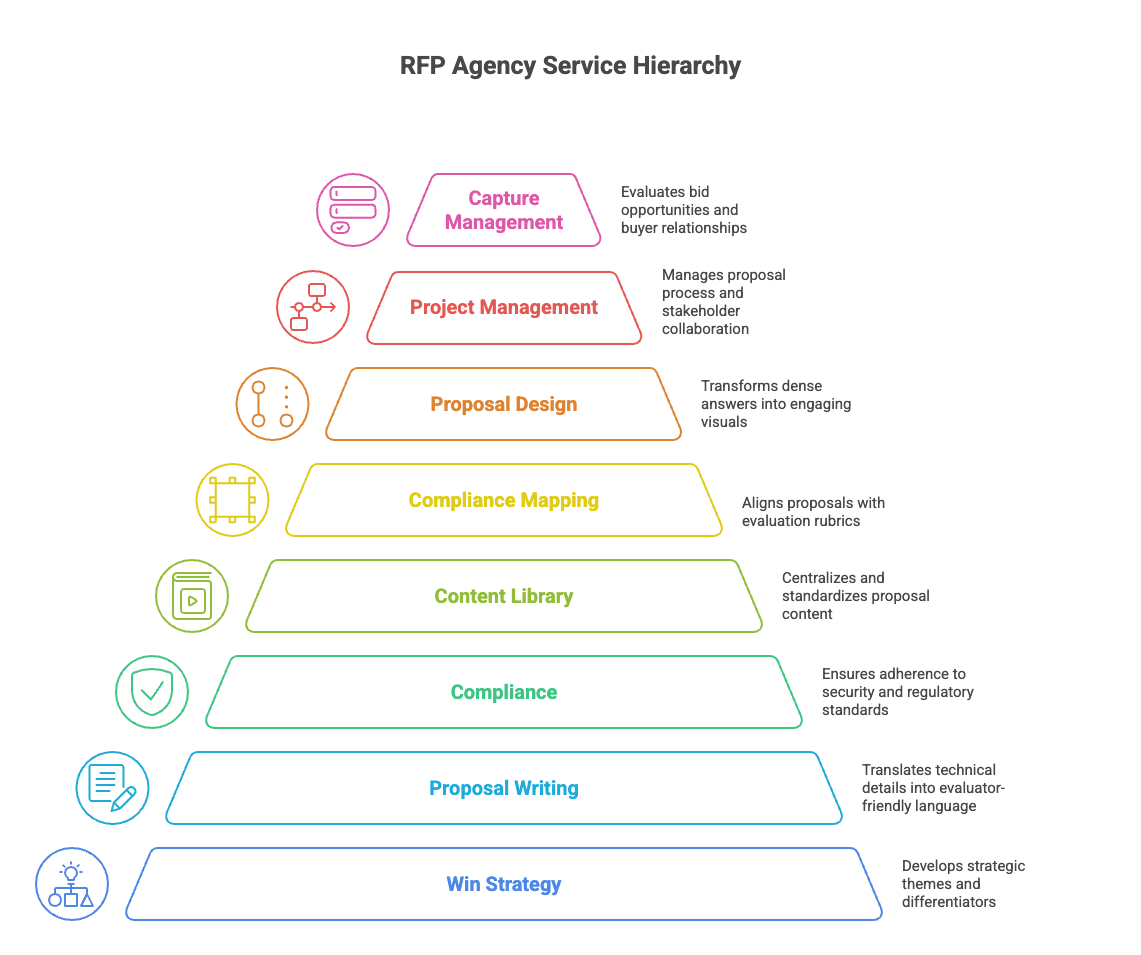
Most people assume RFP and proposal agencies “help with writing.” Writing is only one part of their job and arguably not even the biggest part. Strong proposal agencies function like a specialized operating system built around evaluator psychology, compliance, and competitive differentiation.
Below are the core service categories explained:
1. Win Strategy & Narrative Architecture
Every winning proposal begins long before the first sentence is written. Agencies run win-strategy workshops that identify differentiators, competitive positioning, pricing logic, strategic themes, and value drivers for each persona. These narratives then serve as the backbone of the entire response.
This is the difference between answering questions and crafting a compelling story.
2. Proposal Writing, Editing & Technical Drafting
Proposal agencies translate complex technical explanations into evaluator-friendly language without diluting accuracy. They ensure that every requirement is addressed directly, benefits are clear, answers are structured logically, redundant content is removed, tone remains consistent, and the narrative flows across multiple contributors.
Specialized RFP agencies know how evaluators read. They write accordingly.
3. Security, Compliance & Regulatory Alignment
In SaaS and regulated industries, this might be the most valuable service of all.
RFP agencies help teams articulate SOC 2, ISO, HIPAA, and GDPR compliance, data handling standards, risk management practices, cybersecurity policy details, and business continuity and DR processes. They understand that a technically incorrect or poorly articulated security answer kills deals instantly.
4. Content Library Development & Audit
A strong proposal function depends on a well-maintained, audit-ready content library. Proposal agencies help centralize past responses, rewrite outdated answers, standardize messaging, remove contradictions, build reusable modules, and categorize content by topic, product, and industry.
This reduces future response time dramatically.
5. Compliance Mapping & Evaluation Matrix Alignment
For government, public sector, and many enterprise buyers, compliance determines scoring. Agencies ensure that every requirement is met, non-negotiable elements are addressed, mandatory language is included, and answers map cleanly to evaluation rubrics.
Compliance alignment is often the difference between a top-tier score and disqualification.
6. Proposal Design & Information Architecture
Design isn’t aesthetics; it’s evaluator experience. Top RFP agencies transform dense answers into clean layouts, structured visuals, diagrams, charts, infographics, and executive summaries that stand out.
Better design improves readability, reduces evaluator fatigue, and increases scoring consistency.
7. Project & Stakeholder Management
Proposal chaos usually stems from misalignment. These proposal agencies manage kickoff, SME collaboration, review cycles, version control, timelines, compliance checks, and final submission.
8. Capture Management (GovCon & Large Enterprises)
Capture management ensures you should pursue the bid in the first place. It includes competitive intelligence, buyer relationship mapping, early evaluation, bid/no bid analysis, and pricing strategy guidance.
For government contracts, it’s non-negotiable.
Who Are the Top RFP Agencies Worldwide?
Not all RFP agencies are built the same. Some are methodology-first, some are writing-first, some are design-first, and some are GovCon-exclusive. Understanding each agency’s strengths helps proposal managers, sales leaders, RevOps heads, and bid teams choose the right partner for the right kind of deal.
Below is a detailed breakdown of the top players from your research, expanded into a comprehensive resource.
1. Shipley Associates
The Global Standard for Proposal Methodology
Headquarters: Utah, USA
Type: Global consulting & training powerhouse
Best For: Enterprises, defense contractors, and teams building long-term, internal proposal capability
Known For: Inventing the industry-standard “Color Team” process
What Makes Shipley Unique
Shipley practically wrote the rulebook for modern proposal development. Their Color Team Reviews (Pink Team for storyboarding, Red Team for near-final review, and Gold Team for pricing & executive polish) are now the default framework used by most Fortune 500 proposal functions.
Their approach is structured, repeatable, evaluator-aligned, and research-backed.
Shipley consultants are often former evaluators, capture managers, or senior proposal strategists with decades of experience.
Specialized Services
- Proposal audits and maturity assessments
- Corporate team training (APMP-aligned)
- Capture management consulting
- Price-to-Win modeling (PTW)
- Executive summary crafting
- Storyboarding workshops
- Full RFP response development
Ideal For
Teams that want capability building rather than one-off support. Shipley is less about volume writing and more about creating a long-term winning machine.
Pricing Context
Premium-tier. Training and capture services can be expensive, but ROI is typically high for large enterprises.
2. Hudson Succeed
The Outsourced RFP Department for Global Companies
Headquarters: UK with operations across US & Europe
Type: High-volume bid writing & bid management agency
Best For: Companies that want a “done-for-you” proposal team
Win Rate Claims: 87% success rate (publicly advertised)
What Makes Hudson Stand Out
Hudson is structured like a multi-division RFP engine:
- Hudson Succeed — bid writing services
- Hudson Discover — opportunity sourcing
- Hudson Helpline — real-time support for in-house teams
They combine daily bid tracking, writers across industries, and process-driven governance. Hudson is built to support organizations that want predictable proposal output without expanding internal headcount.
Specialized Services
- RFP writing & editing
- Bid pipeline management
- Opportunity scanning across 50+ countries
- High-volume proposal support
- Technical writing and design
- Bid strategy & evaluator mapping
Where They Excel
Global companies wanting to respond to dozens or hundreds of tenders per year. High consistency. Strong quality-control process.
Pricing Context
Mid- to high-tier depending on volume. They offer both subscription and pay-per-bid models.
3. Lohfeld Consulting Group
The GovCon & Defense Proposal Heavyweight
Headquarters: Maryland, USA
Type: Capture strategy & proposal management for US Federal/DoD
Best For: Vendors targeting multi-million or multi-billion federal contracts
Known For: Strength-Based Winning® methodology
Why Lohfeld Dominates GovCon
Lohfeld isn’t just an RFP agency; it’s a capture powerhouse. They operate where the stakes are highest: defense, homeland security, aerospace, federal IT modernization, and government-wide acquisition contracts (GWACs).
Their approach focuses on:
- understanding evaluation factors
- mapping proposal sections to technical scoring
- ghosting the competition
- leveraging pre-RFP capture insights
- shaping proposals to maximize SF330/SF1449/Section L&M compliance
Specialized Services
- Capture readiness assessments
- Strength-Based solution development
- Section L & M compliance mapping
- Government-specific pricing strategy
- Storyboarding and solutioning
- Proposal leadership for major federal bids
Where They Excel
Federal RFPs that involve:
- complex scoring rubrics
- strict compliance requirements
- high-value contracts
- technical discriminators
- classified or sensitive data
Pricing Context
High-end. Engagements often span months and involve senior consultants.
4. The RFP Firm
Fast, Agile Government & Commercial Bid Support
Headquarters: USA
Type: Nimble proposal support for SMBs and mid-market government contractors
Best For: Contractors needing rapid turnarounds and flexible engagement
Known For: Emergency bid response capability
Why They’re Different
The RFP Firm thrives in compressed timelines. While larger consultancies may decline last-minute bids, The RFP Firm specializes in rapid response and fractional proposal support.
Specialized Services
- GSA schedule proposals
- State & local proposals
- Emergency multi-writer support
- Full bid management
- Editing and compliance review
Where They Excel
Teams with:
- stretched proposal departments
- urgent opportunities
- unpredictable bid volume
- limited GovCon expertise
Pricing Context
Mid-tier. More affordable than Lohfeld, ideal for SMBs entering government contracting.
5. Strategic Proposals
The European Authority on Proposal Excellence
Headquarters: UK & Netherlands
Type: High-end proposal consulting, design, and benchmarking
Best For: Enterprise SaaS, technology companies, BFSI, telco, and professional services
Known For: Award-winning design and psychology-based proposals
What Makes Them Stand Out
Strategic Proposals operates like a blend of:
- proposal consultancy
- design agency
- behavioral science lab
Their Proposal Benchmarker™ is one of the most respected maturity frameworks in the industry. It evaluates content clarity, narrative design, evaluator experience, information hierarchy, competitive messaging, and proposal design.
Specialized Services
- High-end proposal design
- Storytelling & narrative architecture
- Capability benchmarking
- Proposal audits
- Executive summary design
- Coaching for bid teams
Where They Excel
High-value enterprise proposals that need to communicate complexity with simplicity.
Pricing Context
Premium. Focused on quality and transformation rather than volume.
6. Thornton & Lowe
UK’s Trusted Partner for Public Sector & Healthcare Bids
Headquarters: Manchester/Bolton, UK
Type: Public-sector bid writing & tender management
Best For: SMEs bidding for NHS, local council, social care, construction, and FM contracts
Known For: 75%+ audited win rate + in-house Bid Writer Academy
What Makes Them Unique
Thornton & Lowe specializes deeply in UK public sector procurement, especially tenders that emphasize:
- Social Value
- Equality, Diversity & Inclusion
- Environmental and sustainability commitments
- Community impact
Their writers are trained internally through a rigorous academy that standardizes quality.
Specialized Services
- Tender writing for NHS & councils
- Social value narratives
- Framework and DPS submissions
- Evaluation-compliant structure
- In-house training for bidders
- 360-degree bid management
Where They Excel
Public sector proposals where narrative detail, structure, and compliance matter more than visual design.
Pricing Context
Mid-tier and accessible for SMEs.
7. TenderJunction
APAC’s Gateway to India’s Government Tender Market
Headquarters: New Delhi, India
Type: Tender writing + end-to-end eProcurement support
Best For: Companies entering India’s government procurement ecosystem
Known For: Deep expertise in GeM (Government e-Marketplace)
Why TenderJunction Matters
India’s tendering ecosystem is:
- bureaucratic
- fragmented
- highly competitive
- process-heavy
- digitally complex
TenderJunction helps both Indian and international companies navigate:
- EMD (Earnest Money Deposits)
- technical compliance
- GeM portal processes
- price-based (L1) competition
- documentation and vendor registration
Specialized Services
- Government tender tracking (10,000+ departments)
- GeM support
- Pricing strategies for L1 bids
- Technical and commercial writing
- Compliance documentation
- Vendor enrollment and credentialing
Where They Excel
Any business targeting India’s public sector opportunities, particularly in tech, healthcare, and infrastructure.
Pricing Context
Lower than Western agencies; ideal for regional expansion initiatives.
Summary Table
Agency | Best For | Strengths | Pricing Tier |
|---|---|---|---|
Shipley | Enterprises & GovCon | Methodology, training, strategy | High |
Hudson Succeed | Multi-sector, global teams | Volume, opportunity tracking | Mid–High |
Lohfeld Consulting | US Federal & Defense | Capture, compliance, scoring | High |
The RFP Firm | SMB GovCon | Fast turnarounds, flexible support | Mid |
Strategic Proposals | Enterprise SaaS & BFSI | Design, storytelling, benchmarking | High |
Thornton & Lowe | UK Public Sector | Social value, compliance | Mid |
TenderJunction | India/APAC | GeM expertise, tender volume | Low–Mid |
RFP Agency or RFP Software: Which Fits Best?
Teams usually reach a point where their RFP workload outgrows the ad-hoc hacks - old folders, reused answers, last-minute SME scrambling. And when that happens, one big question surfaces:
"Do we bring in an agency, or do we invest in RFP software?"
Both options are solid, but they tackle completely different problems.
When Agencies Make More Sense
If the deal is strategic, competitive, or tied to seven-figure revenue, an agency often becomes the smarter choice. Why?
1. High-stakes storytelling
Agencies excel at shaping your narrative - positioning, differentiation, clarity, and polish. They’re your external pitch team.
2. Deep proposal craftsmanship
They handle structure, editing, formatting, compliance, and all the “heavy lift” writing work.
3. Surge capacity
When internal teams are overloaded or understaffed, agencies absorb the extra volume.
4. Cross-functional orchestration
A good agency becomes the glue between sales, product, InfoSec, and legal.
In summary, agencies are best when the proposal needs creativity, tight messaging, and strategic framing, not just fast answers.
When RFP Software Is the Better Bet
Software, especially AI-powered RFP platforms, shines when your pain is scale and speed.
1. High RFP volume
Software eliminates repetitive work - auto-filling answers, managing reviews, pulling approved content.
2. Knowledge consistency
A central library ensures sales, legal, product, and InfoSec all speak the same language.
3. Workflow control
Auto-assign tasks, set deadlines, track versions, and stay audit-clean.
4. Faster drafting
AI agents produce first drafts using verified answers, cutting days into hours.
5. Compliance and accuracy
Software enforces governance that manual processes simply can’t match.
Software like SparrowGenie wins when you need order, speed, and scale without adding headcount.
Interested to know more?
The Real Insight: You Don’t Actually Have to Choose
This isn’t a binary decision.
Software fixes the operational engine. Agencies elevate the narrative.
The best teams use software to handle 80–90% of the day-to-day RFP load, and they call in agencies for make-or-break bids where storytelling and strategic framing decide the deal.
If you’re drowning in volume: software first. If you’re chasing a flagship enterprise deal: agency first. If you want a mature, repeatable, high-win-rate proposal function: both, intentionally.
How Do You Pick the Right RFP Agency?
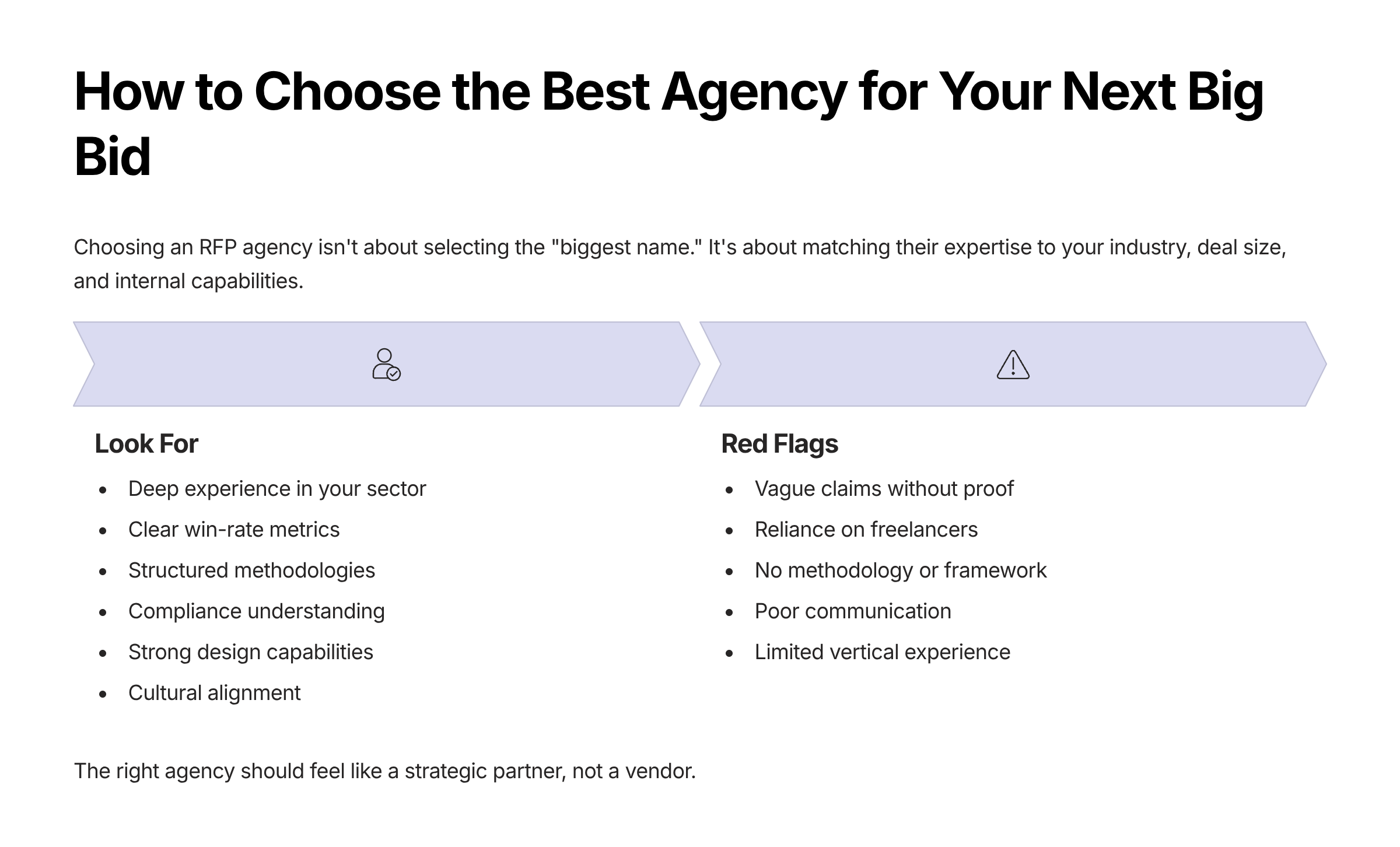
Choosing an RFP or proposal agency is less about outsourcing writing and more about finding a partner who can help you win a high-stakes deal. Here’s a streamlined way to evaluate the right one.
1. Check Their Industry Fit
You want an agency that already understands your market, compliance language, and buyer expectations. Ask for relevant samples and win stories.
2. Assess Their Narrative Strength
A strong agency doesn’t just fill answers, they shape the story that makes you stand out. If their samples feel generic, keep looking.
3. Review Their Actual Process
Forget the fancy portfolio. Focus on how they gather inputs, manage revisions, handle compliance, and keep teams aligned under tight timelines.
4. Look for Multidisciplinary Talent
For enterprise RFPs, you need writers who can work with product, legal, security, and solution engineers, not just generalists.
5. Confirm They Can Handle Pressure
Big bids come with brutal deadlines. Make sure they’ve delivered high-quality work during crunch cycles before.
6. Ensure They Plug Into Your Tools
If you use an RFP platform, they should be comfortable working inside your library, updating content, and keeping everything version-clean.
7. Talk to Real Clients
Not curated testimonials, actual references. Ask about timelines, rewrites, communication, and whether the agency truly moved the needle.
8. Focus on ROI, Not Price
The question isn’t “How much?”. It’s “Will this agency increase our odds of winning a deal worth 10–100x the cost?”
Quick takeaway: For your biggest bids, pick an agency with proven wins in your industry, tight processes, and strong narrative skills. It’s not about output, it’s about improving your win probability.
What Drives Real Proposal Success?
Winning proposals aren’t luck. They’re the result of measurable, predictable factors that consistently separate high-performing teams from everyone else. If you want to understand whether your proposal function is actually working, these are the metrics that matter.
1. Win Rate (Overall + Competitive)
The most direct signal of effectiveness. Track both general win rate and competitive win rate. If competitive win rate is dropping, your positioning or narrative is off, even if volume stays high.
2. Time to First Draft
This shows how efficiently your team can move from intake → draft. High-performing teams keep this under a few days by using templates, knowledge bases, or AI agents.
3. Review Cycle Time
Most delays happen between SMEs, Legal, Security, and Product. Measure how long each handoff takes. If internal reviews stretch too long, your bottleneck isn’t writing, it’s coordination.
4. Content Accuracy & Error Rate
Track how often answers require rewrites, corrections, or are flagged by compliance. Consistency here is a huge predictor of final quality and overall customer trust.
5. Library Coverage & Freshness
If your content library (or knowledge hub) isn’t up-to-date, your drafts will never be accurate. High performers maintain 80–90% coverage of recurring questions with verified answers.
6. Proposal Throughput
How many RFPs your team can handle per quarter without burnout or quality drops. Throughput reveals maturity; if volume goes up and quality stays constant, your process is working.
7. Stakeholder Satisfaction
Sales, Legal, InfoSec, and Product should all feel the process is reliable, predictable, and worth their time. If everyone complains, your system isn’t scalable.
8. Cost per Proposal
Measures true efficiency. Includes writing time, SME hours, reviews, tools, and external help. As processes improve, cost per proposal should trend down without affecting quality.
Quick insight: The teams that win more aren’t writing better, they’re managing better. Fast drafts, accurate libraries, tight reviews, and clear workflows directly correlate with higher win rates.
How Does RFP Software Improve the Process?
Even the best agencies can only go so far when a team’s internal process is messy. That’s where modern RFP technology steps in. It strengthens the operational backbone so agencies, and internal teams, can focus on strategy instead of firefighting.
Today’s platforms help teams:
- Centralize knowledge into one governed workspace
- Maintain a continuously updated answer library for recurring questions
- Auto-generate high-quality first drafts using verified content
- Surface confidence scores and citations so reviewers know what needs attention
- Speed through compliance-heavy sections with accurate, pre-approved language
- Manage workflows, deadlines, and reviews without manual chasing
- Free up SMEs so they contribute expertise instead of drowning in admin work
This doesn’t replace agency talent. It amplifies it, making every proposal faster, more consistent, and far easier to get across the finish line. Debug the system, and the storytelling shines.
Conclusion
RFPs shape deal velocity, competitive advantage, and how your quarter ends. Teams that win consistently have a system that keeps answers accurate, drafts fast, and the story clear. Agencies help you craft the narrative, and tools like SparrowGenie remove the chaos behind the scenes. Together, they turn long proposal cycles into quick, confident submissions. If you want to win on purpose and not by accident, strengthen your people, process, and platform now. Buyers remember the teams that respond fast and stay consistent; everything else gets forgotten.
Ready to see how AI can transform your RFP process?
Product Marketing Manager at SurveySparrow
A writer by heart, and a marketer by trade with a passion to excel! I strive by the motto "Something New, Everyday"