Request for Proposal Software Explained: How It Works in 2026

Article written by
Kate Williams

INSIDE THE ARTICLE
SHARE THIS ARTICLE
Summary
This blog breaks down how Request for Proposal (RFP) software transforms the way enterprises handle complex, multi-stakeholder proposal workflows. It explains what RFP software is, how it automates creation, collaboration, and evaluation, and why it’s critical for faster, compliant, and data-driven decision-making.
Trying to manage RFPs manually is like trying to bake a cake during a power cut—you’ve got ingredients everywhere, half-finished steps, people shouting instructions from different rooms, and no clue if the final outcome will actually hold together. Between outdated answers, missing SME inputs, clashing edits, and approvals that move slower than airport security lines, the whole process drains time and energy.
RFP software changes the game by bringing clarity, automation, and structure to a workflow that’s been chaotic for far too long. In this blog, we’ll break down what it does, how it works, and why modern teams can’t afford to stick to the old recipe anymore.
What Is Request for Proposal (RFP) Software?
Request for proposal software is the system that replaces the messy, multi-tool juggle behind creating or responding to complex proposals. Instead of searching through old folders, rewriting answers from scratch, and coordinating approvals through endless emails, teams work inside one secure platform that manages the entire RFP lifecycle from start to finish.
The idea is simple: take a process that has always been slow and error-prone, and turn it into something organized and repeatable. Modern platforms use automation, templates, AI-generated suggestions, and centralized knowledge to help teams move faster while keeping every detail consistent. It removes the guesswork for procurement teams issuing RFPs, speeds up response quality for sales and pre-sales, and gives legal and compliance cleaner control over the entire workflow.
The end result is a predictable, auditable RFP process that supports better decisions, stronger proposals, and faster momentum across the business. Request for proposal softwares like SparrowGenie transforms what was once a logistical nightmare into a controlled, measurable process that drives deal velocity.
How Does RFP Software Work?
RFP software is a workflow engine built to manage complexity at scale. Let’s break down the typical flow:
Step 1: Proposal Creation
Users start with pre-approved templates or build custom RFPs from scratch. They can define project scope, evaluation criteria, timelines, and budgets. AI engines analyze previous projects to recommend better phrasing, relevant answers, or pricing logic, reducing redundant work.
Step 2: Content Management
All request for proposal documents—questions, responses, and reference files, are centralized in a secure workspace. Version control keeps everyone on the same page, so no one’s sending outdated drafts or mismatched PDFs.
Step 3: Collaboration & Task Assignment
The system automatically maps sections to subject-matter experts (SMEs) based on their expertise. No more manually forwarding 80-question documents; the right people are tagged, notified, and tracked through completion.
Step 4: Automated Responses
Modern request for proposal tools use AI and machine learning to repurpose content from prior responses. That means repetitive answers (like company policies, certifications, or pricing models) get auto-suggested, while humans fine-tune nuance and context.
Step 5: Review, Evaluation & Scoring
Once responses are received, teams use built-in scoring models and comparison tools to evaluate each proposal against weighted criteria. This brings data-driven objectivity to what was once a subjective process.
Step 6: Approval & Contracting
Finally, integrations with digital signature and contract management tools enable seamless closure - taking proposals from draft to deal without leaving the platform.
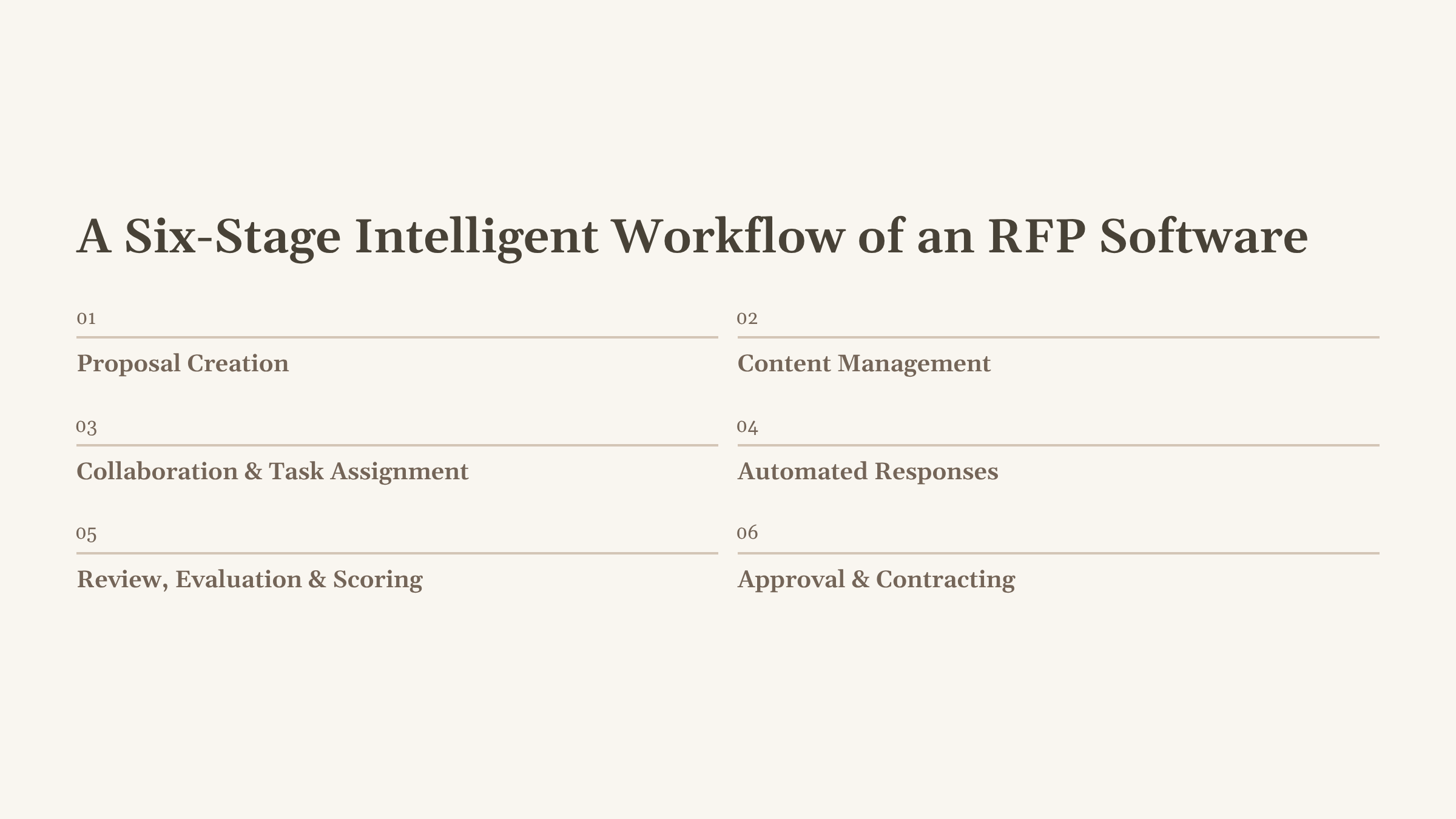
It’s end-to-end visibility, accountability, and accuracy - something manual processes simply can’t achieve.
Key Features That Set RFP Software Apart
Modern request for proposal software goes far beyond document management. It’s built to handle complexity, scale across teams, and deliver measurable outcomes. Here are the features that make it indispensable for enterprise sales and procurement operations:
1. Centralized Content Library
A secure, searchable repository that stores approved responses, templates, and compliance data. Teams can reuse accurate, on-brand content instead of starting from scratch each time.
2. AI-Assisted Response Generation
AI analyzes past proposals and auto-suggests the best answers for new RFPs. This reduces manual writing, minimizes human error, and helps teams respond up to 70% faster.
3. Automated Workflow Management
Assign tasks, track progress, and set deadlines effortlessly. Automated reminders and approval flows ensure every section moves forward without delays or version conflicts.
4. Role-Based Access & Compliance Control
Maintain enterprise-grade security with customizable permissions and review checkpoints. Legal and compliance teams can validate content before submission, ensuring regulatory accuracy.
5. Seamless Integrations
Connects directly with CRMs, collaboration tools, and document management systems like Salesforce, Slack, and SharePoint—keeping all RFP activity aligned within existing workflows.
6. Real-Time Analytics & Scoring
Measure efficiency, track win rates, and evaluate vendor responses through built-in dashboards. Data-backed insights help leadership optimize content, processes, and performance.
SparrowGenie and other similar platforms with these features transform request for proposal management from a reactive task into a strategic, intelligence-driven function, giving enterprises speed, control, and a competitive edge in every bid.
Why Organizations Adopt RFP Software
Enterprises don’t invest in request for proposal software just to “go digital.” They do it because manual RFP management is costly, inconsistent, and nearly impossible to scale.
Here’s what drives adoption across modern sales and procurement teams:
1. To Eliminate Manual Chaos
Email threads, scattered documents, and version confusion slow everything down. RFP software centralizes workflows, ensuring every stakeholder works from a single, accurate source.
2. To Improve Response Speed & Quality
AI-assisted drafting, reusable content, and automated workflows help teams deliver complete, compliant proposals in days instead of weeks—without sacrificing quality.
3. To Standardize Processes Across Departments
Whether it’s sales, pre-sales, or legal, everyone follows the same structured process. That means consistent branding, accurate answers, and faster internal approvals.
4. To Strengthen Governance & Compliance
Having review cycles, audit trails, and access controls helps lower the risks of breaking rules and keeping data safe, which is very important for industries that have
5. To Gain Measurable Visibility
Analytics reveal where time is lost, which content wins most often, and how proposal quality impacts deal outcomes—turning RFPs into a measurable business function.
Organizations adopt request for proposal software like SparrowGenie to replace reactive processes with proactive intelligence, freeing teams from admin work and enabling them to focus on what really matters: winning more business.
How to Choose the Right RFP Software
Selecting the right request for proposal software isn’t just about features; it’s about finding a platform that fits your enterprise’s workflow, integrates seamlessly with your tech stack, and scales as your business grows.
Here’s what to look for when evaluating solutions:
1. Ease of Use
The platform should simplify complex workflows, not add another layer of training. A clean, intuitive interface ensures faster adoption across teams from procurement to sales and legal.
2. Advanced AI Capabilities
Choose software with adaptive AI that learns from your past proposals, recommends better answers, and improves over time. Static automation is yesterday’s game.
3. Secure Architecture
Enterprise-grade protection is non-negotiable. Look for SOC 2, ISO 27001, and GDPR compliance to safeguard sensitive data throughout the proposal lifecycle.
4. Integration Depth
Request for proposal tools should fit into your existing ecosystem - CRM (Salesforce, HubSpot), collaboration (Slack, Teams), and document systems (SharePoint, Drive) - for continuous data flow and minimal context switching.
5. Scalability & Performance
As your volume of RFPs, RFIs, and security questionnaires grows, the software should scale without slowing down. Multi-team support, global access, and performance reliability are essential.
6. Analytics & Reporting
The right tool doesn’t just manage responses; it measures success. Look for real-time dashboards tracking turnaround time, win rates, and content effectiveness.
7. Dedicated Support & Training
Even the best platform needs a strong partner. Ensure there’s onboarding assistance, responsive support, and ongoing training to keep your team performing at its best.
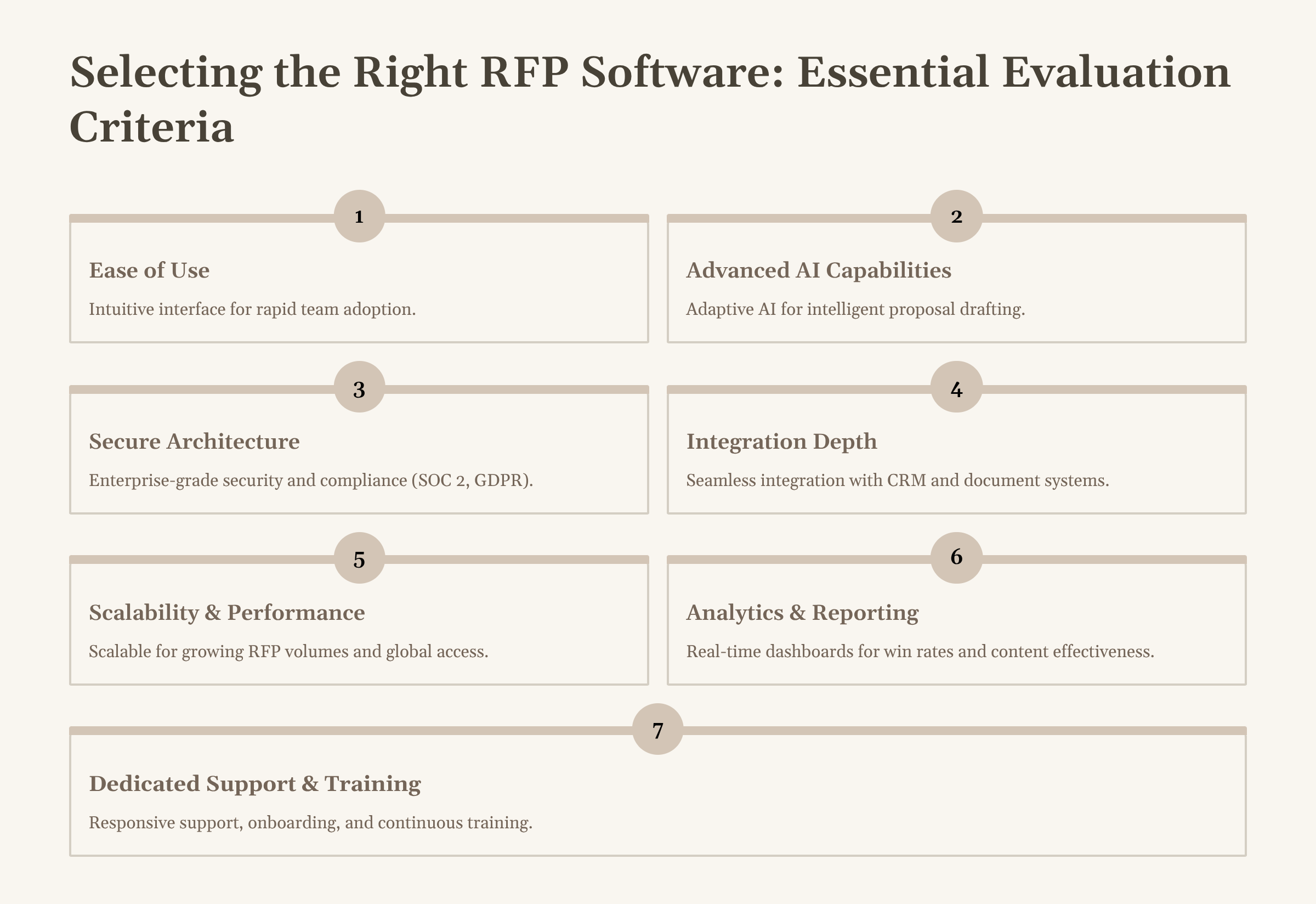
The ideal RFP software should align with your business strategy, secure your data, and deliver measurable ROI, not just manage documents.
The Future of RFP Management Is Intelligent and Predictive
The RFP process is no longer just about automation; it’s entering an era of intelligence and foresight.
Until recently, RFP tools focused on speeding up repetitive tasks. But now, the smartest platforms are learning from every proposal, every response, and every win (or loss) to help teams make better decisions before they even start writing.
Here's what the next generation of requests for proposal management looks like:
1. Predictive Win Intelligence
AI will analyze past performance, industry trends, and content patterns to predict which proposals have the highest probability of success. Teams will prioritize opportunities that align with their strengths — not guesswork.
2. Confidence Scoring & Content Validation
Instead of hoping every answer is accurate, systems will assign confidence scores to each response based on data quality, relevance, and approval history. Low-confidence answers will be flagged for human review instantly.
3. Smart Knowledge Governance
AI will monitor your content library in real time, flagging outdated or non-compliant material, and suggesting replacements before they cause risk. Knowledge management becomes proactive, not reactive.
4. Human-AI Collaboration by Design
The future isn’t about replacing proposal managers; it’s about augmenting them. Intelligent RFP systems will act like trusted copilots, handling admin-heavy tasks while humans focus on storytelling, persuasion, and strategy.
5. Predictive Workflows & Automation
RFP software will automatically assign tasks based on expertise, predict bottlenecks, and reroute workloads dynamically, ensuring every deadline is met without the last-minute scramble.
In short, the future of request for proposal management is predictive, data-driven, and human-centered. Enterprises that embrace this shift will move from chasing deadlines to winning faster, smarter, and more securely with AI, not as a shortcut, but as a competitive edge.
Why SparrowGenie Is the Smarter Choice for Modern RFP Teams
SparrowGenie is a secure, end-to-end AI-powered RFP automation engine built to power every stage of an RFP response. Instead of juggling tools, teams work inside one system that handles intelligence, collaboration, delivery, and data in a single flow.
- Genie Intelligence Layer
RFP parsing, question detection, library search, context retrieval, AI draft generation with confidence scores, and automated compliance workflows; all working together to eliminate manual effort and raise response quality. - Secure Workspace
Role-based access, real-time editing, comments, approvals, and task management ensure every stakeholder sees exactly what they need, when they need it. - Proposal Delivery & Insights
Auto-formatted Word/PDF proposals, analytics on win rates and turnaround time, gap detection, and continuous library learning help teams refine their process with every submission. - Data & Content Sources
Deep integrations with Salesforce, HubSpot, Confluence, Drive, SharePoint, product docs, security sheets, past proposals, website links, and FAQs keep every answer accurate, up-to-date, and instantly accessible.
SparrowGenie brings all of these together so RFP responses aren’t just faster; they’re consistently smarter, cleaner, and backed by a secure, intelligent system.
Conclusion
Enterprises that still run RFPs through spreadsheets and inboxes aren’t just slow; they’re losing ground. The next generation of leaders will rely on intelligent, secure, and predictive requests for proposal platforms like SparrowGenie, which learn, adapt, and scale with every proposal.
Ready to see how AI can transform your RFP process?
Product Marketing Manager at SurveySparrow
A writer by heart, and a marketer by trade with a passion to excel! I strive by the motto "Something New, Everyday"