Compliance Management for RFPs: Stop Letting Legal Bottleneck Your Deals

Article written by
Kate Williams

INSIDE THE ARTICLE
SHARE THIS ARTICLE
Summary
Traditional RFP compliance reviews create deal-killing bottlenecks, averaging 15 days and missing 30% of deadlines. Companies lose millions when legal becomes the constraint. Modern compliance management uses pre-approved content libraries and smart workflows to reduce review time to 2 days while maintaining safety, enabling 40% more deal closures.
If your RFPs end with a legal fire drill, it’s not bad luck—it’s bad design. Compliance risks surface late, inboxes explode, and “final_v12” ships at 11:59 PM. The fix isn’t more reviewers; it’s compliance-by-design: flag risks at intake, route by exception, attach the right evidence, and maintain traceable approvals. This guide shows how to build a faster, safer RFP compliance management workflow that turns Legal from a blocker to an accelerator.
With the stakes clear, let’s define exactly what RFP compliance management is—so every team member speaks the same language in the next section.
What Is RFP Compliance Management?
Before you optimize, align on definitions. Precision here prevents “good-faith” missteps later in the process.
RFP compliance management is the repeatable process of identifying, assessing, and mitigating regulatory, contractual, and policy risks across the RFP lifecycle—intake → development → review → submission → archive. It ensures the response aligns with requirements (privacy, security, IP, sourcing, certifications, flowdowns) and that every high-risk clause has an owner, evidence, and approval you can defend.
Key components:
- Risk discovery: Spot disqualifiers and obligations early.
- Routing & ownership: Assign the right SME with SLAs and escalation.
- Answer governance: Use vetted, current, reusable language with citations.
- Evidence control: Centralize policies, reports, certs, and expiry dates.
- Traceability: Record who decided what, why, and when.
Now that we know the target state, let’s unpack why teams still struggle—so we can address root causes, not symptoms.
Where does RFP compliance break?
If your process feels slow or brittle, it’s usually due to a few predictable blockers. Identify them, and you unlock speed and safety together.
- Late risk discovery: Privacy, IP, funding, or sourcing constraints appear during red team—forcing rewrites or no-bids.
- Everything goes to Legal: Without thresholds, Legal is routed every clause, creating bottlenecks.
- Flowdown complexity: Subcontractor/vendor obligations get missed or inconsistently applied.
- Version chaos: No single source of truth for approved language, owners, and last-reviewed dates.
- Stale evidence: Expired certifications and outdated policies trigger rework and credibility gaps.
- Low visibility: Leaders can’t see where reviews stall or which risks keep recurring.
.png)
Ready to pressure-test your current setup? The quick self-check below reveals where you’re leaking time or taking unnecessary risk.
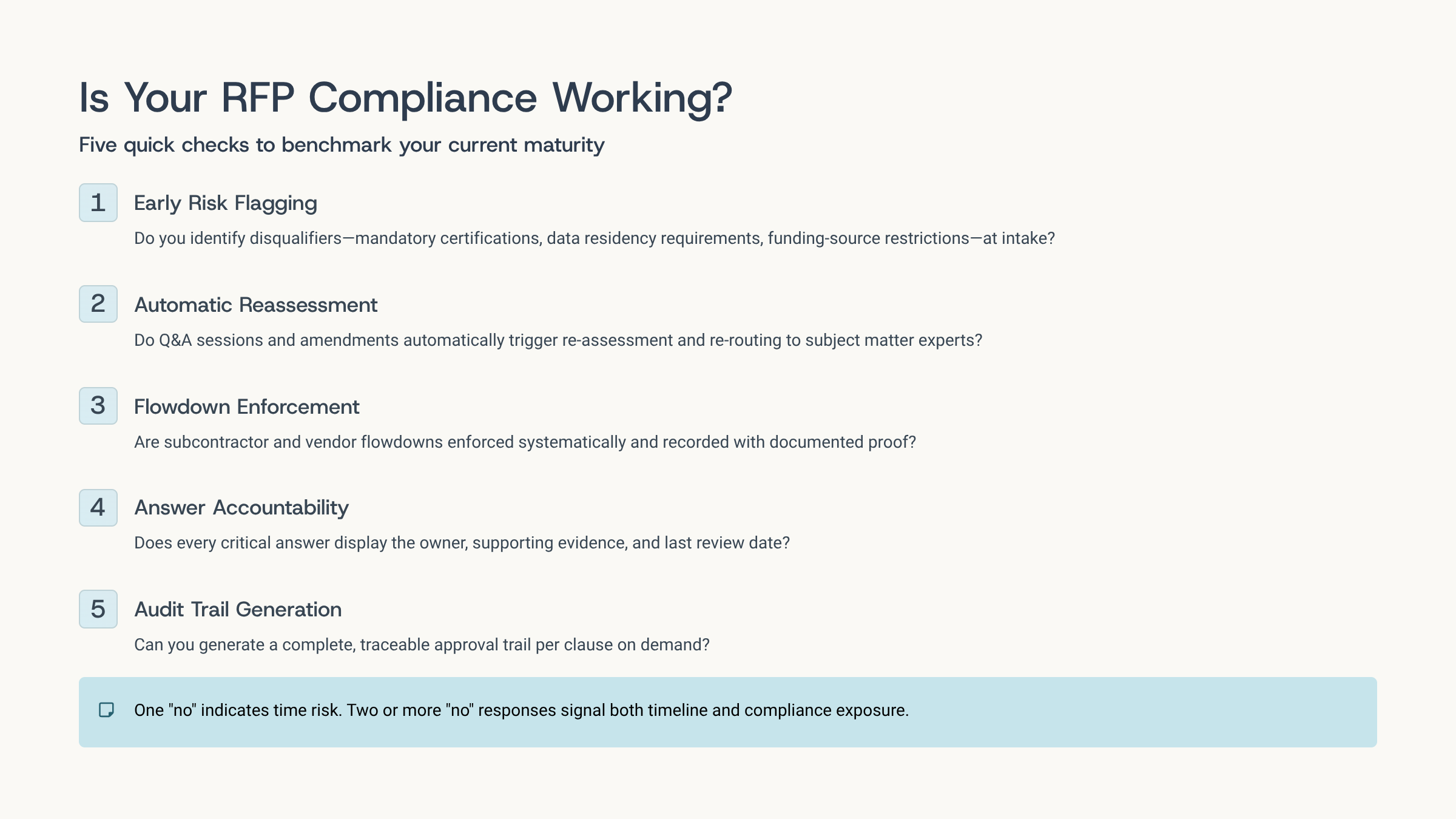
Is your RFP compliance working? (5 quick checks)
Use this five-question gate to benchmark your current maturity. No dashboards required—just honest answers.
Answer yes/no:
- Do you flag disqualifiers (e.g., mandatory certifications, data residency, funding-source restrictions) at intake?
- Do Q&A and amendments auto-trigger re-assessment and re-routing to SMEs?
- Are subcontractor/vendor flowdowns enforced and recorded with proof?
- Does every critical answer show owner + evidence + last review date?
- Can you generate a traceable approval trail per clause on demand?
One “no” = time risk. Two or more “no’s” = timeline + compliance risk.
If you hit any “no,” technology can help—but only if it’s built for compliance-by-design. Let’s clarify what those platforms actually do.
What do RFP Compliance Management Platforms do?
Think of these platforms as an operating system for compliant, on-time submissions—not another place for content to go and die.
RFP compliance management platforms are purpose-built systems that operationalize compliance-by-design. They:
- Parse RFP docs (including attachments/Q&A) to surface risk triggers.
- Route clauses by policy thresholds (exception-only to Legal).
- Maintain a governed answer library with citations and review dates.
- Track flowdowns to vendors/subs and collect acknowledgements.
- Provide lifecycle telemetry (status, bottlenecks, SLAs, KPIs).
- Produce audit-ready trails (decisions, owners, rationale, evidence).
In short, they reduce legal review volume, shorten cycle time, and cut defects—without compromising control.
Tools are only as valuable as the outcomes they deliver. Next, here’s what an effective platform should unlock for your team.
What result can a strong RFP compliance platform deliver?
These aren’t just “nice-to-haves”—they’re the measurable outcomes you expect to see.
- Faster submissions: SMEs only see high-impact clauses; standard items auto-approve via policy.
- Fewer defects: Approved language + current evidence = fewer contradictions and flags.
- Lower risk exposure: Flowdown enforcement and proof reduce legal/regulatory surprises.
- Higher win rates: Clean, consistent, compliant answers increase evaluator trust.
- Scalability: Reusable decisions and governed libraries improve with every submission.
- Executive visibility: Dashboards expose chronic bottlenecks and training gaps.
To realize these benefits, you need a practical path. The next section gives you a step-by-step framework you can adopt immediately.
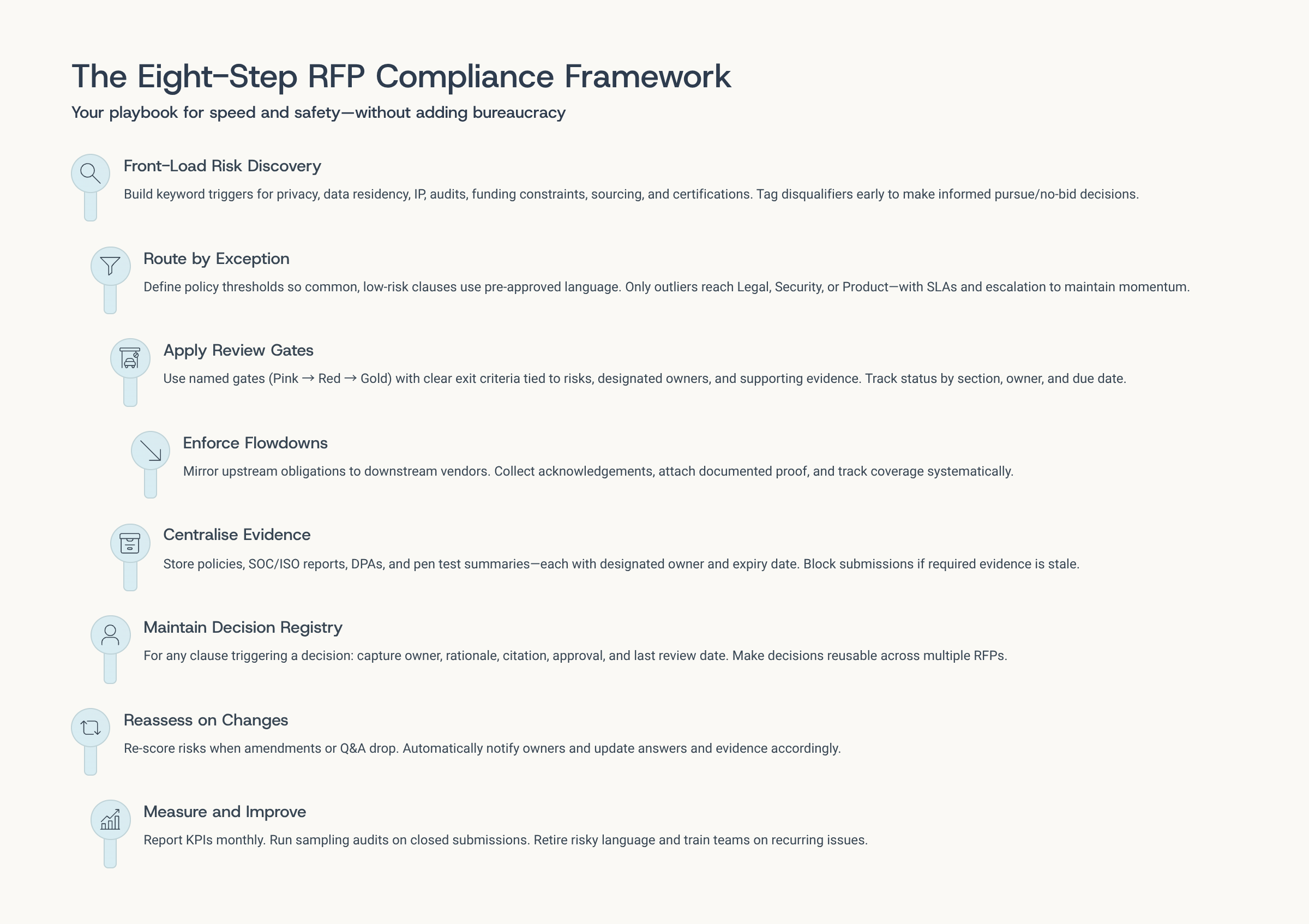
RFP Compliance Framework that Speeds Reviews Safely
Use this sequence as your playbook. It’s deliberately simple so teams can execute without adding bureaucracy.
1. Front-Load Risk Discovery at Intake
Build a keyword/trigger checklist: privacy, data residency, IP ownership, audits/reporting cadence, funding constraints, country-of-origin/sourcing, facility clearances, certifications. Tag disqualifiers early to make informed pursue/no-bid calls.
2. Route by Exception (Not by Default)
Define policy thresholds. Common/low-risk clauses use pre-approved language; only outliers hit Legal/Security/Product. Add SLAs and escalation to keep deals moving.
3. Apply Audit-Grade Review Gates
Use named gates (e.g., Pink → Red → Gold) with exit criteria tied to risks, owners, and evidence. Track status by section, owner, and due date.
4. Enforce Vendor/Subcontractor Flowdowns
Mirror upstream obligations downstream. Collect acknowledgements, attach proof, and track coverage.
5. Centralize Evidence & Certifications
Store policies, SOC/ISO reports, DPAs, pen test summaries, and references—each with owner and expiry. Block submissions if required evidence is stale.
6. Maintain a Decision Registry
For any clause that triggers a decision, capture the owner, rationale, citation, approval, and last review date. Make decisions reusable across RFPs.
7. Reassess on Amendments & Q&A
Re-score risks when amendments drop. Auto-notify owners and update answers/evidence.
8. Measure, Learn, Improve
Report KPIs monthly. Run sampling audits on closed submissions. Retire risky language and train teams on recurring issues.
A framework is a theory until it lands in your org chart.
Next up: an implementation checklist that RevOps can drive without slowing deals.
How can RevOps roll this out fast? (Action checklist)
This is the minimal viable rollout—clear owners, clear rules, and just enough process to scale without friction.
Policy & Governance
- Define risk appetite and routing thresholds (self-serve vs. Legal).
- Document pursue/no-bid criteria tied to disqualifiers.
- Establish SLA and escalation rules per risk category.
Workflow & Ownership
- Stand up cross-functional intake (Sales, Legal, Security, Product).
- Assign named owners for sections and high-risk clauses.
- Use clear exit criteria for each review gate.
Content & Evidence
- Build a governed answer library with citations and last-reviewed dates.
- Centralize evidence (policies, certs, DPAs) with expiry tracking and alerts.
- Maintain a decision registry for exception handling.
Systems & Reporting
- Instrument status tracking (by section/owner/stage).
- Monitor KPIs: time in legal review, defect rate, flowdown coverage, amendment turnaround, and % answers with owner+date.
- Run independent spot-checks and refresh stale answers quarterly.
With the checklist in hand, the natural next question is: which platform actually does this well—and how? Here’s how SparrowGenie operationalizes the model.
How Does SparrowGenie Deliver Compliance-by-Design—Without Slowing Deals?
You need outcomes, not another repository. SparrowGenie is built to automate the hard parts while preserving control.
SparrowGenie operationalizes compliance-by-design without adding bureaucracy:
- Risk-Aware Intake: Detects privacy, IP, sourcing, certification, and funding triggers across RFP docs and attachments—so disqualifiers are flagged on day one.
- Exception-Only Routing: Routes only high-risk clauses to Legal/Security/Product with SLAs and escalation; standard items use approved language by default.
- Governed Answer Library: Centralized, versioned responses with citations, owners, and last review dates—reusable across bids.
- Decision Registry & Audit Trails: Every exception stores owner, rationale, and proof—exportable for audits and customer reviews.
- Lifecycle Telemetry: Real-time dashboards show bottlenecks, late owners, unresolved risks, and flowdown coverage—so leaders can intervene early.
Outcome: faster cycles, fewer defects, lower risk, and submissions that stand up under scrutiny.
When you adopt SparrowGenie, compliant speed accelerates, and RFP compliance management becomes a cakewalk that your teams can do quickly and easily. Let’s wrap with the mindset that makes it stick.
Conclusion
RFP compliance shouldn’t be a late-stage scramble. When you front-load risk discovery, route by exception, enforce flowdowns, and govern answers with evidence and dates, Legal becomes an accelerator—not a bottleneck. With a platform like SparrowGenie, you can operationalize this end-to-end: early detection, disciplined routing, traceable approvals, and audit-ready outputs. That’s how you submit faster, reduce risk, and win more—without the midnight panic.
Next step: run the self-check with your last three RFPs, quantify the gaps, and pilot the framework on your next submission. Momentum starts with one disciplined cycle.
Ready to see how AI can transform your RFP process?
Product Marketing Manager at SurveySparrow
A writer by heart, and a marketer by trade with a passion to excel! I strive by the motto "Something New, Everyday"