How To Win More Tenders in 2026? Key Steps, Process, & Best Practices

Article written by
Aparna Rajendran

INSIDE THE ARTICLE
SHARE THIS ARTICLE
Summary
Tender bidding in 2026 is no longer a volume game. The teams winning 60%+ of their bids are not submitting more proposals. They are submitting fewer, better-qualified responses backed by structured qualification frameworks, governed review processes, and AI-powered automation. This guide covers the complete 8-stage tender bidding process, bid/no-bid decision frameworks, buyer evaluation methods (MEAT, QCBS, LCS), win rate benchmarks across industries, and 10 proven best practices to help proposal managers, sales leaders, and bid teams win more tenders with less wasted effort.
Most organizations are still losing more bids than they win.
The average proposal win rate has climbed to around 45 percent, the highest in five years. That sounds encouraging until you realize that most contractors still win only 20 to 30 percent of the bids they chase. The gap between average and top performers (who consistently clear 60 percent) is not about talent or luck. It is about process.
The teams winning more tenders are not submitting more proposals. They are submitting fewer, better-qualified, better-prepared responses, backed by structured bid management software, disciplined qualification frameworks, and AI-powered automation that frees their people to focus on strategy instead of formatting.
This guide breaks down the complete tender bidding process, from opportunity capture to post-bid learning, with practical frameworks, evaluation methods, and best practices grounded in what is actually working right now.
Whether you are a proposal manager, sales leader, or procurement specialist, this is your playbook for winning more with less wasted effort.
Want to see how AI-powered RFP automation can cut your tender response time by half?
What Is Tender Bidding?
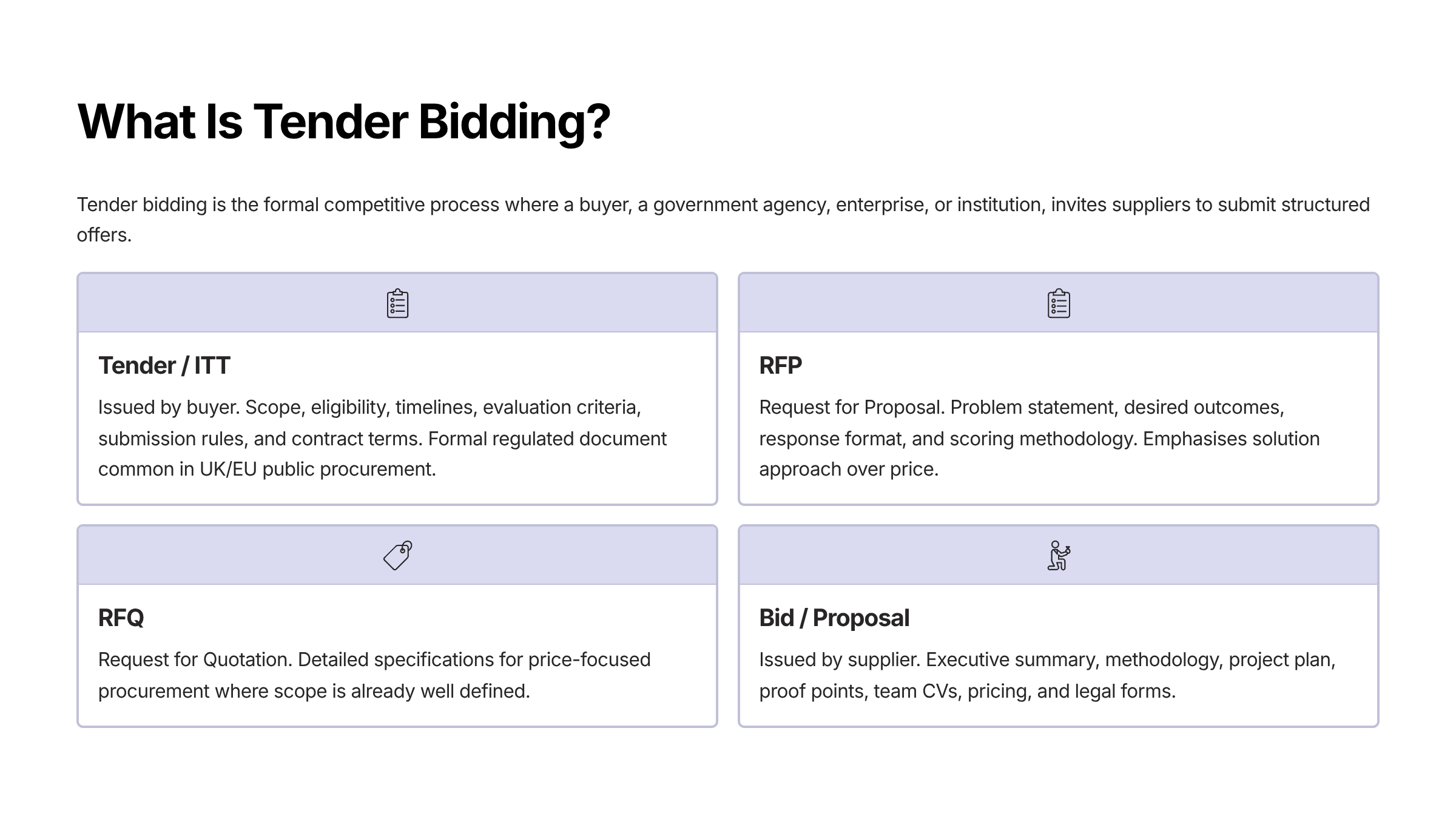
Tender bidding is the formal competitive process where a buyer, whether a government agency, enterprise, or institution, invites suppliers to submit structured offers to deliver a product, service, or project at agreed terms and price.
The buyer publishes an invitation document. It could be an Invitation to Tender (ITT), a Request for Proposals (RFP), or a Request for Quotation (RFQ). This document spells out the scope, requirements, evaluation criteria, and submission rules. Suppliers then respond with a bid package that typically covers their approach, methodology, timeline, pricing, compliance evidence, and proof of capability.
The buyer scores all responses against predefined criteria and awards the contract to the best-fit submission.
How Do Tender, Bid, RFP, and RFQ Differ?
These terms get used interchangeably, but they represent different artifacts in the procurement flow:
Term | What It Contains |
|---|---|
Tender (issued by buyer) | Scope summary, eligibility, timelines, evaluation criteria, submission rules, and contract terms |
RFP / Request for Proposal (issued by buyer) | Problem statement, desired outcomes, response format, and scoring methodology |
RFQ / Request for Quotation (issued by buyer) | Detailed specifications for price-focused procurement |
ITT / Invitation to Tender (issued by buyer) | Formal regulated document common in UK/EU public procurement |
Bid or Proposal (issued by supplier) | Executive summary, methodology, project plan, proof points, team CVs, pricing, and legal forms |
Tender management is the overarching discipline. Buyers issue tenders. Suppliers respond with bids. Those bids contain proposals. Simple enough, but keeping this hierarchy clear matters when you are navigating complex RFP response processes.
What Are the Main Types of Tender Processes?
Different procurement contexts demand different tendering models. Understanding which model you are dealing with shapes how you qualify, price, and structure your response.
Open Tendering: Any eligible supplier can submit a bid. Opportunities are widely advertised on public portals and e-procurement systems. Best suited for large government contracts where transparency and competitive pricing are the primary goals.
Restricted (Selective) Tendering: Only pre-qualified or specifically invited suppliers may bid. Organizations first submit a Pre-Qualification Questionnaire (PQQ), after which a shortlist of 3 to 5 suppliers is invited for full bids. Faster and ensures quality submissions.
Two-Stage Tendering: Stage 1 evaluates technical proposals without prices. Only technically qualified bidders proceed to Stage 2 for pricing. Useful when specifications are still evolving or when early supplier input is needed.
Negotiated Tender: The buyer negotiates directly with one or a limited number of pre-selected suppliers. Used for specialized, proprietary, or emergency procurements.
Framework Agreements and Dynamic Purchasing Systems: Suppliers tender once to join a framework, then compete for individual call-off contracts within it. Nearly 19 percent of all published notices represent frameworks that control over 74 percent of total contract value.
RFx Methods (RFP, RFQ, RFI): RFPs emphasize solution approach, RFQs focus on price for clearly scoped items, and RFIs gather market intelligence before formal tendering.
Single-Source / Sole Source: A buyer selects one supplier without competitive bidding. Typically for proprietary tech, emergency needs, or follow-on contracts. Subject to strict justification in public procurement.
The Complete Tender Bidding Process: 8 Stages
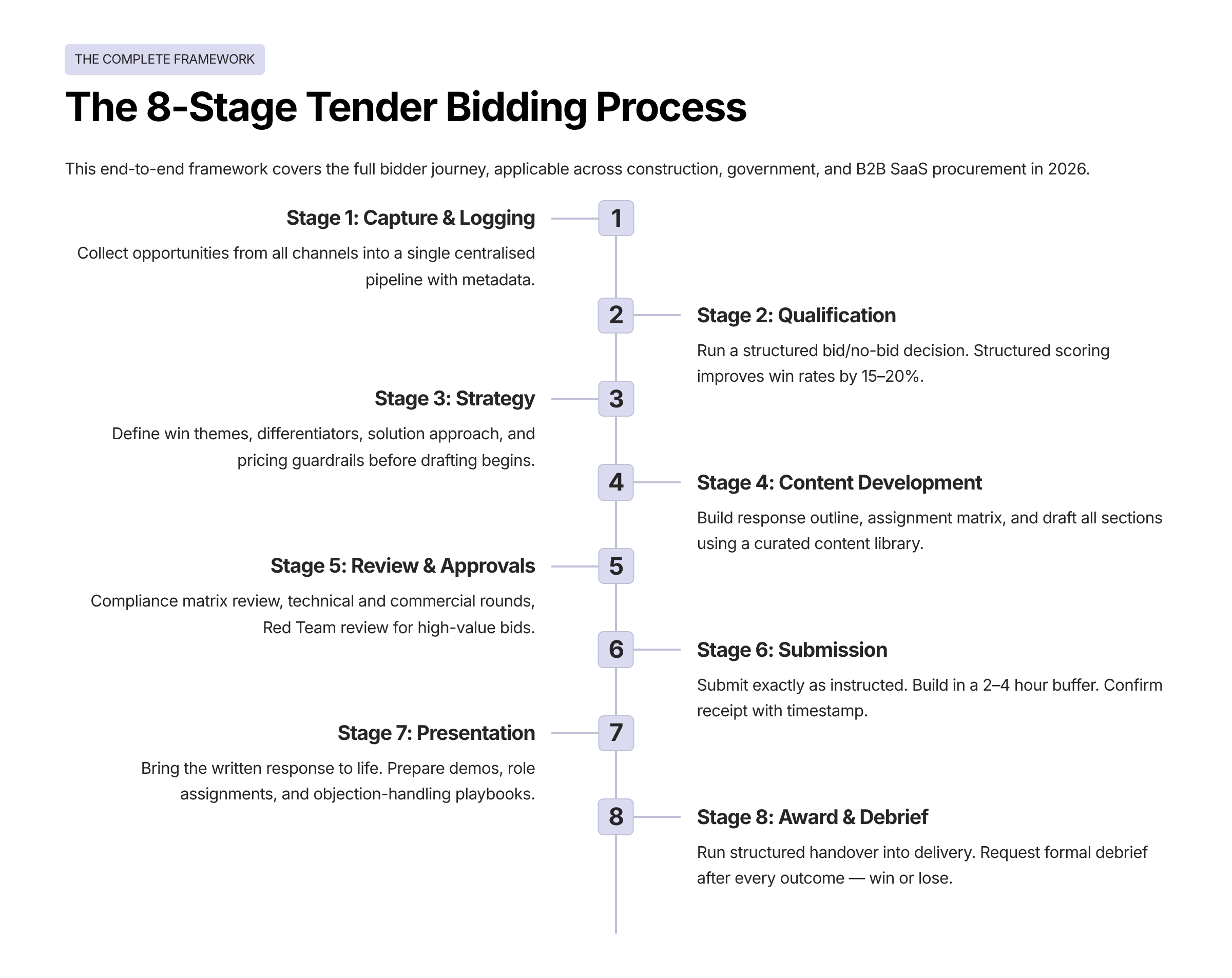
Here is the end-to-end framework that covers the full bidder journey. These stages apply across construction, government, and B2B SaaS procurement in 2026.
Stage 1: Tender Capture and Logging
New tender opportunities are collected from all channels, including public portals, partner networks, direct invitations, and framework alerts, and registered in a single centralized pipeline.
Monitor e-procurement portals, set keyword alerts, and log each opportunity with metadata: client, scope, estimated value, deadline, portal access, and internal owner. The goal is a clean pipeline where nothing falls through the cracks.
Stage 2: Qualification and the Bid/No-Bid Decision
This is where most organizations leave money on the table. Poor qualification is cited as one of the most common causes of wasted bid effort.
Score each opportunity using a structured bid/no-bid framework. Check for immediate knockouts like eligibility thresholds, mandatory certifications, or unacceptable contract terms. Align sales, delivery, finance, and leadership quickly. Document the decision rationale.
Teams using structured bid/no-bid scoring improve win rates by 15 to 20 percent. Why? Because they stop burning capacity on low-probability opportunities and channel their energy where it counts.
SparrowGenie's Go/No-Go framework helps proposal teams qualify opportunities faster, with AI-assisted scoring and compliance checks built in. See it in action.
Stage 3: Bid Strategy and Solution Design
Before a single word is drafted, the team aligns on how to win. This means defining win themes, differentiators, and the solution approach.
Analyze the buyer's pain points, strategic priorities, and evaluation weighting. Lock 3 to 5 win themes tied directly to evaluator priorities. Shape the technical approach, delivery model, partnerships, and commercial direction. Set pricing guardrails. Schedule review gates.
Here is a number that should get your attention: 88 percent of high-win-rate teams have a defined customer insight process, and 71 percent use formal win themes. Teams that skip strategy and jump straight to drafting consistently produce compliant but uncompetitive bids.
Stage 4: Response Planning and Content Development
Now the actual writing begins. Build a response outline and an assignment matrix mapping every question to an owner and deadline.
Draft answers, methodology narratives, project plans, CVs, and case studies. Reuse and adapt approved content from a centralized RFP content library, but tailor it to the specific tender context. Track gaps and questions for SMEs.
One critical best practice: the proposal team should own the first draft. SMEs validate accuracy and provide proof points, but proposal-led drafting produces sharper, more persuasive responses every time. Plan for 40 to 80 person-hours for a standard bid, and well over 200 hours for large, complex tenders.
Stage 5: Review, Pricing Finalization, and Approvals
The draft gets tightened through structured reviews. Run a compliance review, mapping every requirement to a response location using a compliance matrix. Conduct technical, commercial, and editorial reviews in separate rounds.
Finalize pricing with finance and leadership. Confirm margin guardrails. Log assumptions. Obtain legal and risk sign-offs. And for high-value bids, run a Red Team review where uninvolved colleagues score the response as if they were the evaluator.
65 percent of high-win teams use formal review and governance structures. Late-stage rewrites are almost always a symptom of weak upstream planning.
Stage 6: Submission and Clarification Management
Submit the complete response package exactly as instructed. Follow exact formatting, file naming, and section requirements. Confirm receipt and store proof of delivery with timestamp.
Then coordinate responses to buyer clarification questions and Best and Final Offer (BAFO) requests, protecting your value story throughout.
A critical warning: late submissions are rejected in formal procurement, even if seconds late. Non-compliant bids are typically eliminated before scoring begins, regardless of price or quality. Build in a 2 to 4 hour buffer before the actual deadline.
Stage 7: Presentation, Interview, and Negotiation
If shortlisted, the written response comes to life through a presentation or interview. Build a focused presentation that mirrors your win themes and evaluation criteria. Prepare demos, role assignments, and a Q&A objection-handling playbook.
When preferred-bidder status is reached, commercial negotiations begin. Refine delivery schedules, payment milestones, and performance measures. Document all agreed changes and get legal sign-off before committing.
Stage 8: Award, Handover, and Debrief
If awarded, run a structured handover into delivery covering scope, risks, assumptions, timelines, and obligations. Make sure bid commitments are fully understood by the delivery team.
If not awarded, request a formal debrief from the buyer. In UK public sector procurement, buyers are legally obliged to provide this feedback. Review individual question scores, evaluator comments, and winner scoring.
In all cases, update your content library, templates, pricing assumptions, and bid playbook with debrief insights. Log outcomes and review trends quarterly.
Organizations that systematically capture and apply post-bid insights see up to 30 percent increases in revenue and 50 percent improvement in win rates. That is too significant to ignore.
SparrowGenie's Obligations module tracks every commitment made during the bid process, ensuring nothing gets lost in handover. Learn more.
How Do You Build a Bid/No-Bid Decision Framework?
One of the highest-leverage investments in tender management is a structured bid/no-bid decision process. Without one, teams fall into the bid-everything trap, which erodes profitability and team capacity.
The 5-Factor Scoring Model
Score each factor from 1 (poor fit) to 5 (excellent fit), then multiply by its weight:
Factor | Weight | Key Question |
|---|---|---|
Strategic fit | 25% | Does this align with our target markets and growth priorities? |
Win probability | 30% | Do we have relationships, incumbent advantage, or a clear differentiator? |
Capability and capacity | 20% | Can we evidence relevant experience? Do we have delivery capacity? |
Profitability and commercials | 15% | Is the budget realistic? Are contract terms commercially acceptable? |
Risk and compliance | 10% | Are there disqualifying legal, security, or operational risks? |
Decision Thresholds
4.0 to 5.0 (Strong bid): Pursue aggressively. 3.0 to 3.9 (Conditional bid): Pursue if capacity allows and specific gaps can be closed. 2.0 to 2.9 (Weak bid): Decline unless a compelling strategic reason overrides. 1.0 to 1.9 (No-bid): Allocate resources elsewhere.
Also define automatic red flags. Any single issue, like a liability clause your legal team cannot accept or a mandatory certification you do not hold, should trigger a no-bid regardless of how well other factors score.
How Do Buyers Evaluate Tender Bids?
Understanding how buyers score bids is essential to structuring winning responses. Three dominant evaluation approaches in 2026:
MEAT (Most Economically Advantageous Tender)
The most common method in EU/UK public procurement and large private tenders. Evaluates both quality and price using weighted criteria. A typical structure: 60 percent quality (methodology, delivery approach, risk management, social value) and 40 percent price. For complex or high-risk contracts, quality weighting may increase to 70 to 80 percent.
QCBS (Quality-Cost Based Selection)
Common in World Bank, multilateral development bank, and Indian government procurement. Technical and commercial proposals are evaluated separately. Bidders scoring below the minimum qualifying score on technical evaluation are eliminated before commercial proposals are even opened.
LCS (Least Cost Selection)
Technical proposals are evaluated on a pass/fail basis. Only compliant bids are price-ranked, and the lowest price wins. Used for well-defined, low-complexity procurements.
What Are Tender Bid Win Rate Benchmarks in 2026?
Knowing where you stand against industry benchmarks is the starting point for continuous improvement:
Metric | 2026 Benchmark |
|---|---|
Overall average win rate | 45% |
Enterprise (5,000+ employees) | 47% |
Mid-market (500 to 4,999 employees) | 45% |
SMB (under 500 employees) | 42% |
Insurance sector | 52% |
Technology sector | 46% |
Healthcare sector | 44% |
Government / Public sector | 40% |
Top-performing teams | 60%+ |
Average time per proposal | 25 hours (down 17% from 2024) |
Teams completing bids in under 10 days | 64% |
Firms using AI in proposals | 68% |
The gap between 42 percent (SMB average) and 60+ percent (top performers) is not explained by company size. It is explained by process maturity, qualification discipline, and content infrastructure.
10 Best Practices to Maximize Tender Win Rates
Here are the 10 best practices to maximize tender win rates:
1. Start with Customer Insight Before Drafting
High-performing teams treat customer insight as a prerequisite. Capture what the buyer is optimizing for, what they fear, and what success looks like internally, before a single line is written. Pull signals from annual reports, strategy documents, and pre-market engagement briefings.
2. Apply Rigorous, Disciplined Qualification
71 percent of high-win teams run a formal go/no-go qualification step. Define deal-breakers once, covering legal, delivery, security, margin, and capacity, then screen every opportunity early. Selective teams with limited capacity often win more because they focus on high-fit opportunities.
3. Lock Win Themes Early
Win themes are the strategic messages that run through the entire response, connecting your unique strengths to the buyer's explicit priorities. Lock 3 to 5 win themes before content development begins, and use them to guide the executive summary, solution story, and commercials.
4. Make SMEs Validators, Not First-Draft Writers
SME-led drafting is one of the strongest predictors of low bid performance. 94 percent of high-win teams use proposal-led drafting with SME review or joint collaboration. Only 6 percent rely on SMEs writing first drafts. The proposal team owns structure, clarity, and persuasion.
5. Maintain a Curated RFP Content Library
Winning teams maintain a single, governed source of truth for past tender responses, certifications, case studies, CVs, and compliance statements. Standardize structure while customizing value narratives to the specific tender. This reduces duplication, prevents outdated answers, and shortens response cycles.
SparrowGenie's AI-powered content library learns from your best responses, auto-suggests relevant answers, and flags outdated content before it ever reaches a submission.
6. Run Structured, Multi-Stage Reviews
Implement at minimum two reviews: a mid-process compliance and technical review, and a pre-submission commercial and editorial review. For high-value bids, add a Red Team review. Late-stage rewrites are almost always a sign of weak upstream planning.
7. Optimize Digital Submission Hygiene
Rehearse portal submissions before deadline day. Validate file types, file sizes, section requirements, and naming conventions. Log submission confirmations and timestamps. Always build in a 2 to 4 hour buffer.
8. Write to Evaluation Criteria in the Buyer's Language
Map each response directly to the scoring question and criteria. Use the buyer's exact terminology. Mirror their stated priorities. Demonstrate value through measurable outcomes rather than generic capability claims. Every sentence should earn its place.
9. Use Daily Tender Alerts for Pipeline Building
Organizations using daily tender alerts report 25 to 40 percent faster bid qualification and 15 to 20 percent higher shortlist rates compared to manual monitoring. Teams with alerts submit more bids because they qualify faster and focus on winnable opportunities.
10. Track KPIs and Improve Continuously
Track a core dashboard: win rate, shortlist rate, bid/no-bid ratio, qualification velocity, cycle time, and cost per win. Shortlist rate is a particularly powerful early warning signal. Drops in shortlist rate signal issues with response quality or competitive positioning before win rate changes become visible.
What Are the Most Common Mistakes That Lose Tenders?
Understanding failure modes is as important as following best practices. These are the most frequent causes of bid rejection in 2026:
Mistake | Impact | How to Avoid |
|---|---|---|
Missing or incorrect documents | Automatic disqualification | Pre-submission checklist mapped to every requirement |
Not answering the question asked | Low quality scores | Answer what was asked, not what you want to say |
Company-centric, not customer-centric | Weak differentiation | Focus on outcomes and impact, not company history |
Pricing or takeoff errors | Under/over-pricing, rejected bids | Verify calculations, get updated supplier quotes |
Scope misalignment | Technical rejection | Raise clarification RFIs early, conduct site visits |
Filler content or passive voice | Poor evaluator impression | Active voice, every sentence earns its place |
Outdated certifications or pricing | Disqualification | Regularly update the content library, validate all dates |
Portal submission errors / late filing | Automatic rejection | Rehearse uploads, build 2-4 hour buffer |
No post-bid debrief process | Repeated mistakes | Request debriefs, log scores, update playbooks |
How Is AI Changing Tender Bidding in 2026?
AI adoption in proposal management has crossed from early experimentation to competitive necessity. 68 percent of proposal teams now use AI in some form, and AI-powered tools reduce response time by 50 to 70 percent.
Here is where AI delivers measurable impact across the tender lifecycle:
Opportunity discovery: NLP-powered AI scans portals simultaneously, extracting relevant tenders based on industry, geography, and budget thresholds, eliminating manual monitoring across dozens of portals.
Document analysis: AI parses complex tender documents in seconds, structuring requirements, eligibility criteria, and deadlines into a clean summary. What used to take 3 hours now takes 5 minutes.
Automated eligibility checking: Systems cross-reference tender requirements against your stored credential profile and flag eligibility gaps before any resources are committed.
AI-assisted drafting: First-pass proposal drafts are generated from approved content libraries. Teams review and customize rather than write from scratch.
Compliance and consistency checks: AI evaluates responses for outdated information, conflicting statements, missing sections, and format violations across all bid sections.
Data-driven strategy: Every tender submitted creates a data point. AI aggregates outcomes to reveal which bid values, categories, and response patterns drive win rates.
But here is the thing: AI amplifies the operating model it is plugged into. A weak process executed faster is still a weak process. The highest-performing teams use AI to eliminate administrative burden and free human bandwidth for strategy, customer insight, and relationship-building.
SparrowGenie combines AI-native drafting, confidence scoring, and zero data retention (ZDR) architecture so your proposals are faster AND more secure. See the difference.
How Are ESG Requirements Shaping Tenders in 2026?
Environmental, Social, and Governance (ESG) criteria have transitioned from optional differentiators to mandatory compliance requirements across public and large private tenders.
India's GeM ecosystem now requires that environmental criteria constitute a minimum 20 percent of evaluation scoring on new invitations for bids, with a trajectory toward 35 to 40 percent. Over 50 percent of all Indian government tender invitations are expected to require environmental compliance.
Buyers are embedding specific, verifiable ESG questions rather than broad sustainability declarations. They want verified carbon reduction evidence, supply chain audit commitments, science-based targets, and governance reporting structures.
The strategic implication is clear: suppliers who have invested in environmental certification and embedded sustainability into their proposals are gaining preferential treatment. Those who treat ESG as a compliance footnote face progressive exclusion from the largest procurement frameworks.
India-Specific E-Procurement: What You Need to Know
India's digital procurement infrastructure is one of the world's largest. Tender bidding in India requires specific platform literacy across key portals:
Central Public Procurement Portal (CPPP): eprocure.gov.in, the national platform for central government ministries.
Government e-Marketplace (GeM): gem.gov.in, mandatory for government procurement of standard goods and services, now integrating sustainability criteria.
State Portals: etenders.gov.in and 28+ state-specific e-procurement platforms.
Defence eProcurement: defproc.gov.in for Ministry of Defence procurement.
India-specific compliance requirements include a Digital Signature Certificate (DSC) for all e-submissions, Udyam/MSME registration for EMD exemptions and purchase preference, Make in India local content declarations, exact GST and PAN name matching, and an Earnest Money Deposit (EMD) of typically 1 to 2 percent of estimated contract value.
What KPIs Should You Track for Tender Performance?
KPI | Typical Target |
|---|---|
Alert relevance rate | 20 to 40% of incoming alerts |
Qualification velocity | Decision within 24 hours of RFP receipt |
Bid/no-bid ratio | 20 to 40% of qualified alerts proceed to bid |
Average proposal hours | Under 25 hours per standard proposal |
Shortlist rate | 30 to 50% of submitted bids should shortlist |
Win rate | 40 to 60% of shortlisted bids won |
Cost per win | Track bid team hours x blended rate / wins |
Debrief capture rate | 100% of losses should generate a debrief request |
Shortlist rate deserves special attention. It is the most powerful early warning signal in your bid management dashboard. Drops in shortlist rate expose issues with response quality, compliance, or competitive positioning, often before win rate changes become visible.
How Can SparrowGenie Help You Win More Tenders?
Every stage of the tender bidding process we have covered in this guide comes down to one question: how do you move faster without sacrificing quality or security?
That is precisely what SparrowGenie is built for.
SparrowGenie is an AI-powered RFP automation and proposal management platform designed for enterprise sales, pre-sales, and bid teams handling high volumes of RFPs, DDQs, security questionnaires, and tender responses. It does not replace your team. It makes your team faster, sharper, and more consistent.
Here is how SparrowGenie maps directly to the tender lifecycle:
Smarter Qualification with Go/No-Go Frameworks
Remember that bid/no-bid decision framework we walked through earlier? SparrowGenie builds that discipline directly into your workflow. AI-assisted qualification scoring helps your team evaluate opportunities against your criteria before committing a single hour of bid effort. No more gut-feel decisions. No more chasing tenders you were never going to win.
AI-Native Drafting from Your Best Responses
SparrowGenie's content library is not a static document dump. It is a living, AI-powered knowledge base that learns from your highest-scoring past responses. When a new tender lands, the platform auto-suggests relevant answers, adapts them to the specific context, and gives your proposal team a strong first draft to refine, not a blank page to stare at.
The result? What used to take days of repetitive writing gets compressed into hours of strategic editing.
Confidence Scoring That Catches Problems Before Submission
Here is where things get interesting. SparrowGenie's confidence scoring evaluates every response for accuracy, relevance, and completeness before it ever reaches the buyer. Think of it as a built-in quality gate that flags outdated content, weak answers, and compliance gaps across your entire proposal, automatically.
No more last-minute panic reviews. No more outdated certifications slipping through.
Company Intelligence for Customer-Centric Proposals
One of the best practices we highlighted was starting with customer insight before drafting. SparrowGenie's Company Intelligence feature generates AI-powered prospect briefings, pulling together the buyer's strategic priorities, recent news, and key decision-maker context so your team can tailor win themes to what actually matters to the evaluator.
This is how you stop writing company-centric proposals and start writing customer-centric ones.
Obligations Tracking So Nothing Gets Lost in Handover
Winning the tender is only half the story. The commitments you make in your proposal need to flow seamlessly into delivery. SparrowGenie's Obligations module automatically captures and tracks every promise, timeline, and deliverable from your bid, creating a clear handover document that your delivery team can actually use.
No more misaligned expectations. No more forgotten commitments.
Enterprise-Grade Security That Does Not Slow You Down
For teams handling sensitive government tenders, financial services RFPs, or healthcare procurement, security is not optional. SparrowGenie is built on a zero data retention (ZDR) architecture with full data isolation, SOC 2 Type II certification, and compliance with GDPR and CCPA standards. Your proposal data is never used to train AI models. Ever.
This is not security as a marketing checkbox. It is security as a competitive advantage, especially when your buyers are asking ESG and data governance questions in their evaluation criteria.
What This Means for Your Win Rate
Let's bring it back to the numbers. The tender bidding benchmarks we covered show that top-performing teams hit 60+ percent win rates through process discipline, content governance, and strategic use of AI. SparrowGenie gives you the infrastructure to execute on all three.
Faster qualification. Stronger first drafts. Built-in quality gates. Customer-centric positioning. Airtight compliance. Secure architecture.
That is how you stop bidding on everything and start winning what matters.
Ready to see the difference? Book a SparrowGenie demo and find out how your team can respond to tenders faster, with more confidence, and with enterprise-grade security built in from day one.
Your Tender Bidding Playbook: The Takeaway
Tender bidding success in 2026 comes down to three compounding capabilities: discipline (knowing which tenders to pursue and which to decline), execution quality (structured processes, governed reviews, and curated content), and systematic learning (treating every bid outcome as data that improves the next one).
The organizations consistently achieving 60+ percent win rates share clear characteristics. They qualify ruthlessly. They start with customer insight, not internal capability bragging. They lock win themes before anyone starts drafting. Their proposal team owns authorship while SMEs validate. They run formal multi-stage reviews. They treat the content library as a living strategic asset. They use AI to eliminate administrative burden, not to replace strategic judgment. And they request debriefs after every outcome.
The competitive gap between structured and unstructured bidding organizations is widening every year. The path to above-average win rates is not submitting more bids. It is submitting better-qualified, better-prepared, and better-positioned bids against a smaller, more carefully selected opportunity set.
Ready to transform your tender bidding process? SparrowGenie gives your team AI-powered drafting, confidence scoring, compliance automation, and a governed content library, all with SOC 2 Type II certified, zero data retention security. Book your demo today.
Ready to see how AI can transform your RFP process?
Product Marketer at SparrowGenie
Being a Product Marketer at SparrowGenie, Aparna helps sales teams work faster with secure, AI-powered proposal automation. She turns complex features into simple stories, builds messaging that resonates, and keeps a close pulse on what customers actually need. She loves shaping clear, helpful content that shows how SparrowGenie makes RFP work easier, faster, and a lot less stressful.
Frequently Asked Questions (FAQs)
Related Articles

Digital Contract Management: Why Your Contracts Are Killing Growth (And How to Fix It)
Loopio vs Responsive vs SparrowGenie: Which RFP Tool Fits You Best?