10 Best Tender Management Software in 2026: Ranked & Reviewed

Article written by
Kate Williams

INSIDE THE ARTICLE
SHARE THIS ARTICLE
Summary
Responding to tenders shouldn't feel like a fire drill every single time. But for most teams, it does: late submissions, SME bottlenecks, copy-paste errors, and proposals that go out the door half-baked. This guide cuts through the noise. We've ranked and reviewed the 10 best tender management software platforms, covering everything from enterprise procurement giants like SAP Ariba and Ivalua to AI-first bidder tools like SparrowGenie and Altura. Whether you're issuing tenders or responding to them, managing 10 RFPs a month or 100, in public sector procurement or B2B SaaS sales, there's a platform on this list built for exactly your situation.
Tender management is one of those workflows that looks simple from the outside but quietly eats your team alive from the inside.
You get an RFP or tender document. Your team scrambles. Someone chases the SME who's on vacation. Another person pastes answers from last year's submission, hoping no one notices the client name is wrong. The deadline hits. You submit something mediocre. And then you lose — not because your product wasn't good, but because your proposal wasn't.
It happens at small companies. It happens at global enterprises. And it happens because most teams are still running a multi-million-dollar bid process on email chains, shared folders, and spreadsheets that would make a 2005 consultant proud.
The good news? In 2026, the tender management software market is genuinely impressive. There are tools built for every type of team, buyer-side or bidder-side, public sector or SaaS, early-stage or enterprise-scale.
This guide breaks down the 10 best options, ranked with real data, honest pros and cons, and guidance on which platform fits which type of organization. Let's get into it.
Tired of slow proposal cycles? See how SparrowGenie helps B2B teams respond to RFPs in hours, not days. Book a free demo.
What Is Tender Management Software?
Tender management software automates the full lifecycle of tendering, from identifying the right opportunities and building your bid through evaluation, submission, and post-award tracking.
A good platform replaces the fragmented mess of email, spreadsheets, and shared drives with a centralized, structured, and auditable workflow. The best ones add AI on top: auto-generating first drafts, scoring RFP fit, flagging compliance risks, and alerting teams when deadlines are at risk.
The market broadly splits into two camps. Buyer-side platforms like SAP Ariba, Bonfire, and Jaggaer are built for organizations issuing and evaluating tenders, ensuring fair process and compliance. Bidder-side platforms like SparrowGenie and Altura are built for teams responding to tenders, focused on speed, quality, and win rates.
Most organizations need one of these, not both. The right choice depends on which side of the table you sit on, and how complex your process is.
1. SparrowGenie
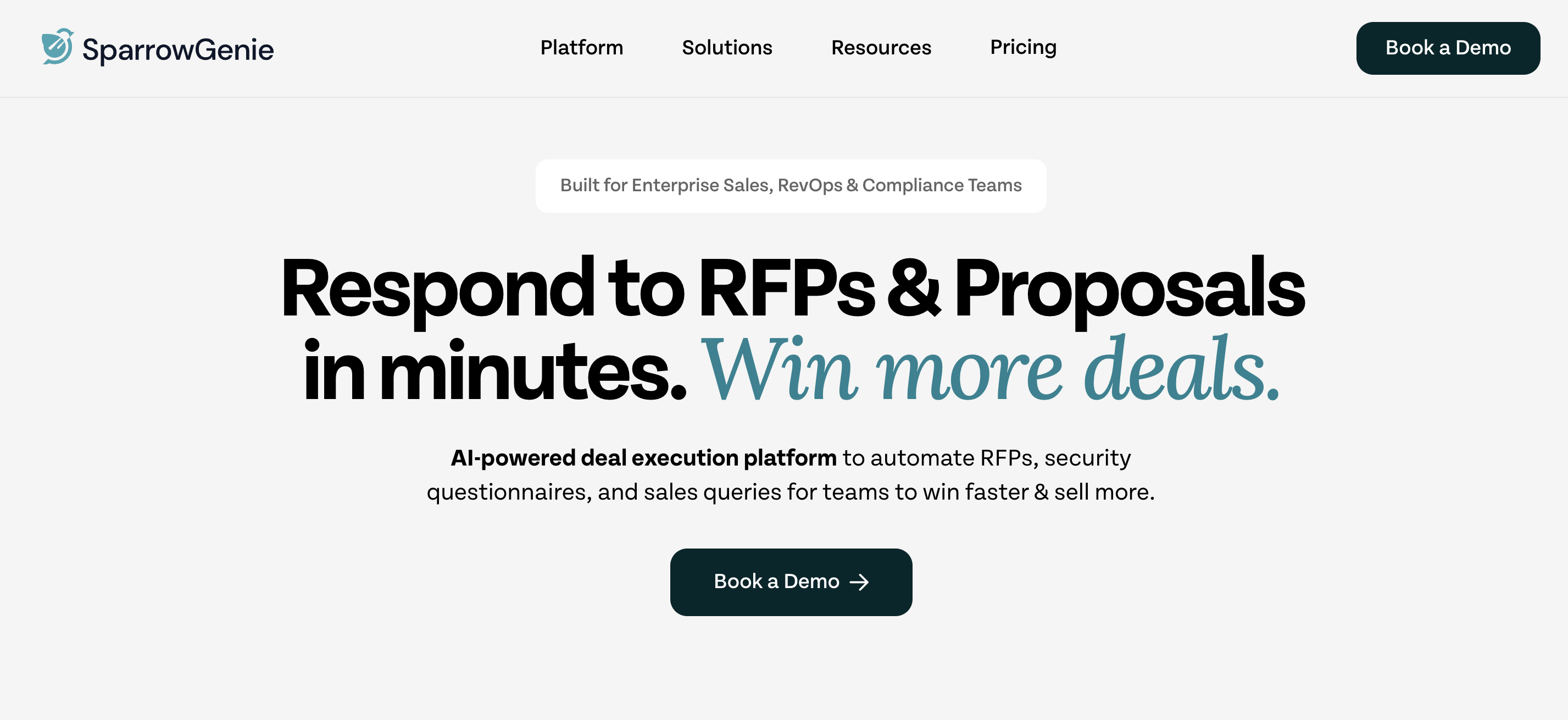
Category: AI-Powered RFP & Proposal Automation
Pricing: Custom pricing based on team size and RFP volume
AI Capabilities: Auto-response generation, SME routing, knowledge hub, real-time dashboard
Best For: B2B SaaS, IT services, fintech, cybersecurity, and professional services teams
Let's start here, because this is the one that actually understands the RFP problem from the inside out.
Most tender management software is built for the buyer side, issuing tenders, evaluating bids, managing supplier relationships. SparrowGenie flips that. It's built for the teams on the other side of the table: the ones writing the responses, chasing the approvals, and trying to win the deal.
SparrowGenie is a secure, AI-powered platform built specifically for growth-stage B2B companies that respond to RFPs, DDQs, security questionnaires, and vendor registration forms. It's not a generic document tool that was retrofitted for proposal work. It was designed from the ground up for proposal teams who are overwhelmed, time-constrained, and tired of chasing down the same SMEs every single week.
What makes it different
Most RFP tools give you a content library and a basic AI that pastes old answers into new forms. SparrowGenie goes further. It uses contextual intelligence to interpret even the most unstructured tender documents, auto-generates high-quality first drafts in minutes, and routes them through role-based approval workflows so nothing slips through the cracks.
The Knowledge Hub isn't just a document dump, it includes dedicated modules for training, testing, improvement, and conflict resolution. No other platform in this list offers this. When your SME leaves and takes three years of institutional knowledge with them, SparrowGenie is what keeps the answers alive.
Key capabilities
- Lightning-fast first draft generation from your uploaded content library
- Contextual understanding across RFPs, DDQs, security questionnaires, and sales proposals
- Real-time project dashboard showing all active RFPs, blockers, and deadlines at a glance
- Seamless collaboration with role-based workflows and in-line commenting
- White-glove onboarding and dedicated customer success from day one
- Integrates with Salesforce, HubSpot, Slack, Teams, Google Drive, and more
Who it's built for
SparrowGenie's sweet spot is B2B SaaS companies, IT services firms, fintechs, and cybersecurity teams handling 10+ RFPs or security questionnaires per month. If your team is at growth stage (Series B through early enterprise) and RFPs are tied to deals worth $30K+ ACV, this is the platform engineered for you.
The typical outcome: 80% faster proposal creation, 3x more RFPs handled without adding headcount, and measurably higher win rates. Not because of magic, because the process finally has structure.
The honest take: SparrowGenie is newer to the market compared to SAP Ariba or Loopio, which means the brand recognition isn't there yet. But the product depth, AI capability, and support model are genuinely impressive, especially for teams that are scaling and need a platform that grows with them.
See SparrowGenie in action. Book a 15-minute demo and get a first draft generated from your own content in real time.
2. SAP Ariba Sourcing
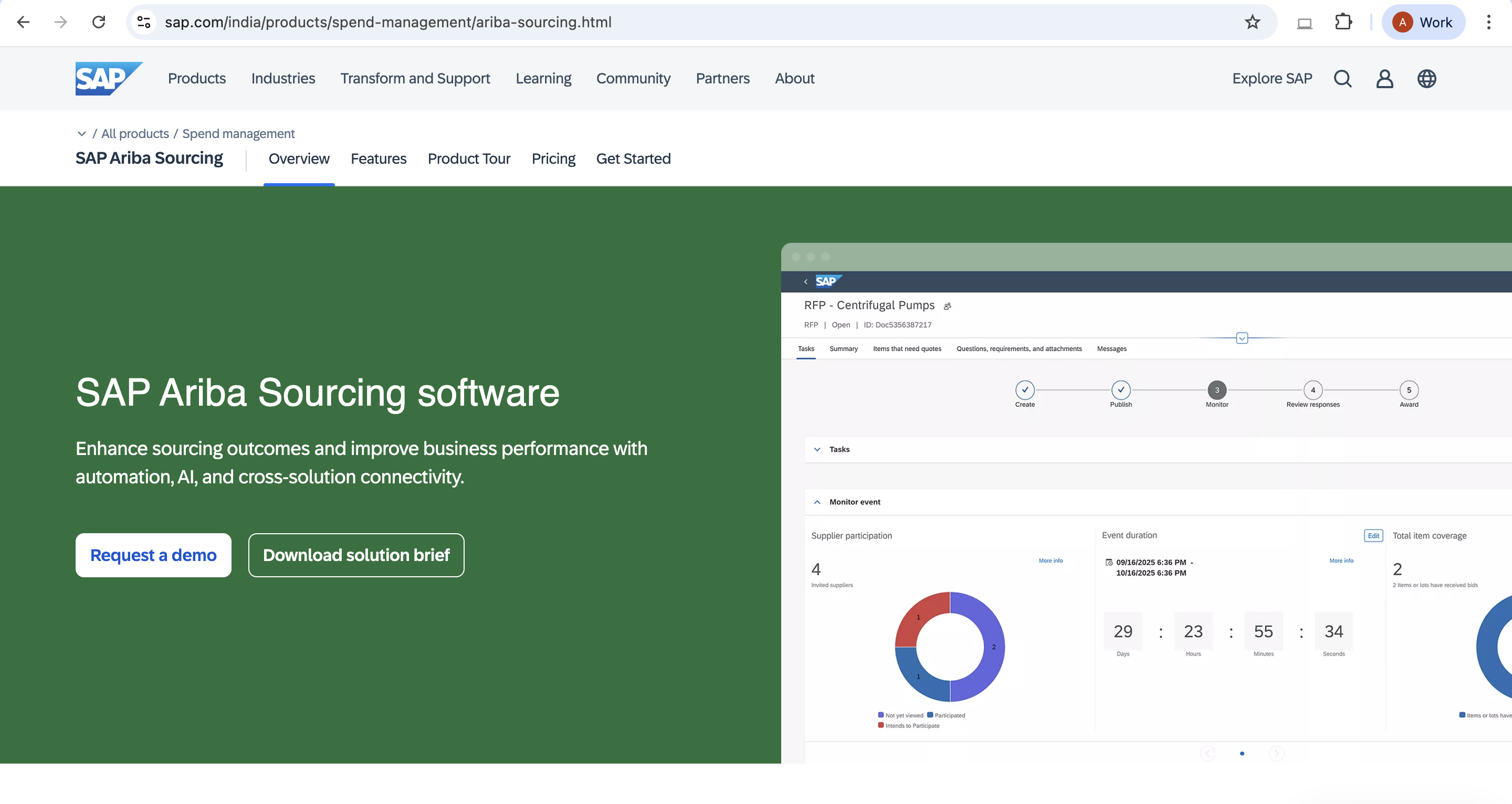
Source: SAP Ariba Sourcing
Category: Enterprise Source-to-Pay
G2 Rating: Leader, won G2's 2025 Best Software for Enterprise Companies award
Pricing: Custom enterprise pricing (direct consultation required)
AI Capabilities: Spend analytics, supplier risk management, automated bid evaluation
Best For: Large enterprises and public-sector agencies already running SAP
If you work in enterprise procurement, you already know SAP Ariba. It's been the dominant force in the space for decades and for good reason.
SAP Ariba is the infrastructure layer that global organizations trust for sourcing, supplier management, and tender governance at scale. We're talking end-to-end source-to-pay capability, a supplier network with millions of connected vendors worldwide, and audit trails that satisfy the most demanding compliance teams on the planet.
What makes it different
The network effect is Ariba's biggest moat. When you're connected to millions of suppliers through the Ariba Network, sourcing and tendering become dramatically faster. You're not starting from scratch every time, the supplier relationships, the compliance data, the historical benchmarks are all there.
The integration with SAP ERP is also genuinely seamless in a way that third-party tools can't replicate. If your finance, procurement, and operations teams are all on SAP, Ariba turns tendering into a connected, visible, organization-wide process rather than an isolated workflow.
Key capabilities
- Advanced tender and RFP creation with structured workflows
- Electronic bid submission, automated collection, and evaluation
- Supplier relationship management across millions of global vendors
- Risk management and compliance monitoring built in
- Deep integration with SAP ERP and the broader SAP ecosystem
- Robust audit trails and spend analytics
Who it's built for
Large enterprises that are already in the SAP ecosystem, or public-sector agencies that need robust, globally scalable procurement governance. If your annual procurement spend is significant and your compliance requirements are complex, Ariba is built to handle it.
This is not a platform for mid-market teams or companies still figuring out their procurement process. The investment in time, money, and internal resources, is substantial.
The honest take: Complex setup, expensive licensing, and a UI that users consistently describe as tab-heavy and click-intensive. Implementation projects are long. If you're not already on SAP, the switching cost is real. But for organizations that are already in the ecosystem and need procurement infrastructure that scales globally, there's nothing that matches Ariba's depth.
3. Oracle Procurement Cloud
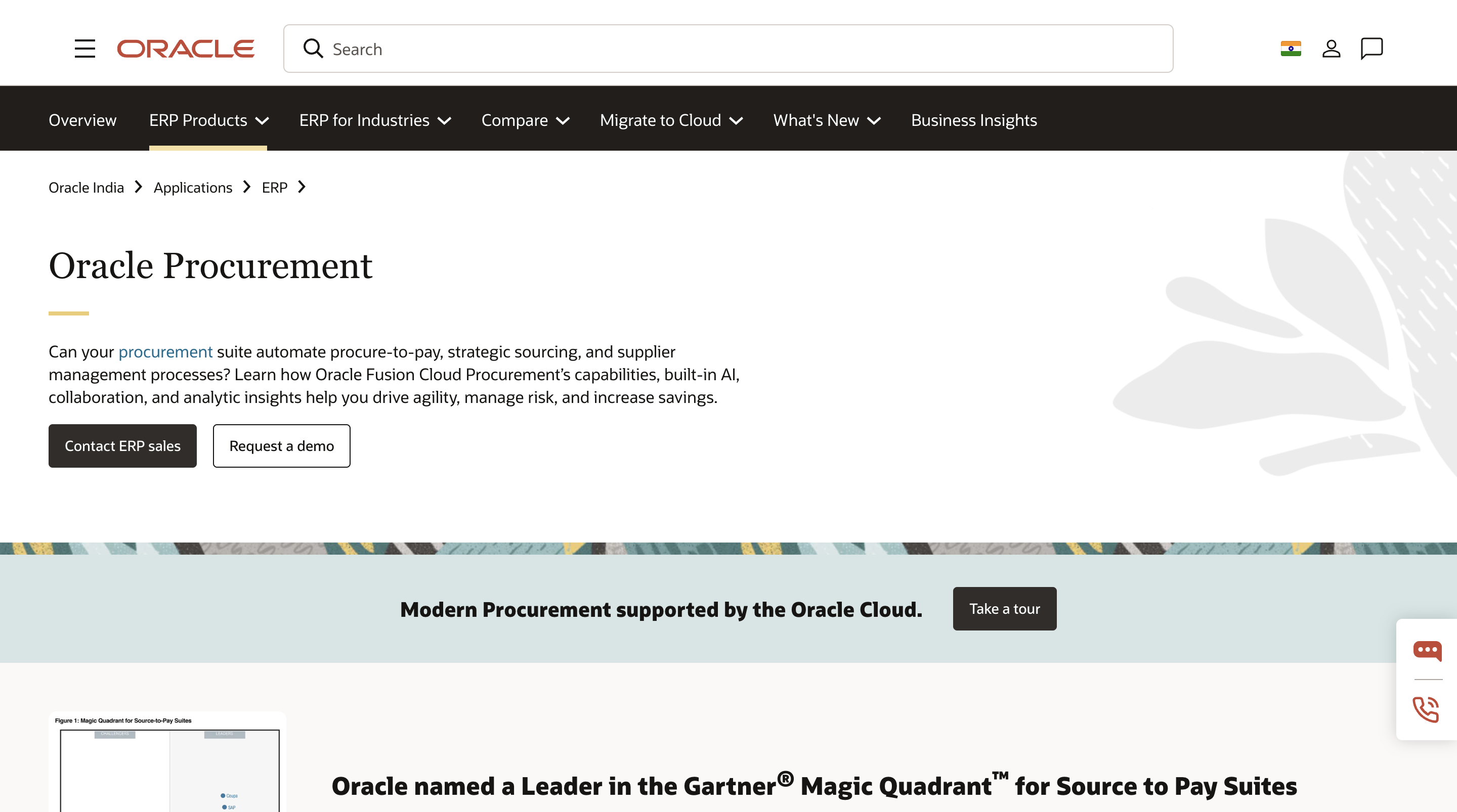
Source: Oracle
Category: Enterprise Source-to-Pay
G2 Rating: 4.1/5 | Capterra: 4.2/5 (5 reviews)
Pricing: Sourcing: $650/user/month | Contracts: $400/user/month | Supplier Qualification: $575/user/month
AI Capabilities: Intelligent automation for repetitive tasks, real-time tracking and analytics
Best For: Enterprises already on Oracle Cloud ERP building a single-vendor procurement stack
The thing about Oracle Procurement Cloud is that it's not trying to compete with everyone. It's trying to be the best procurement solution for Oracle shops, and at that specific job, it's very good.
If your organization is already running Oracle Cloud ERP, adding Oracle Procurement Cloud isn't a big leap. The data flows naturally, the user experience is consistent, and you're not managing another vendor relationship or another set of integrations. Everything lives in one place.
What makes it different
The configurability of Oracle's sourcing workflows is a genuine strength. You can build complex, multi-stage evaluation processes, define supplier qualification criteria in detail, and set up approval hierarchies that match how your organization actually works, not a generic template someone else designed.
Real-time tracking is also a standout feature. Leadership teams get visibility into tender status, supplier responses, and pipeline risk without having to chase down a procurement manager for a status update.
Key capabilities
- End-to-end sourcing, tendering, and contract management
- Configurable sourcing workflows that match complex organizational structures
- Real-time tender tracking and analytics dashboards
- Supplier qualification and performance management
- Intelligent automation for routine approval and routing tasks
- Native integration with Oracle Cloud ERP and Finance modules
Who it's built for
Enterprises that are already invested in the Oracle Cloud ecosystem and want to consolidate their procurement stack with a single vendor. If you're building a unified source-to-pay process on Oracle infrastructure, this is the logical choice.
If you're not on Oracle ERP, the value proposition weakens significantly. You'd be taking on a heavy platform at a high per-user cost for functionality you could get more affordably elsewhere.
The honest take: The pricing is steep, $400–$650/user/month adds up fast for larger teams. Outside the Oracle ecosystem, the adoption curve is harder to justify. And with only 46 G2 reviews, the user feedback base is thinner than you'd expect for a platform at this price point. But for Oracle shops? It's the natural, well-integrated choice.
4. Jaggaer
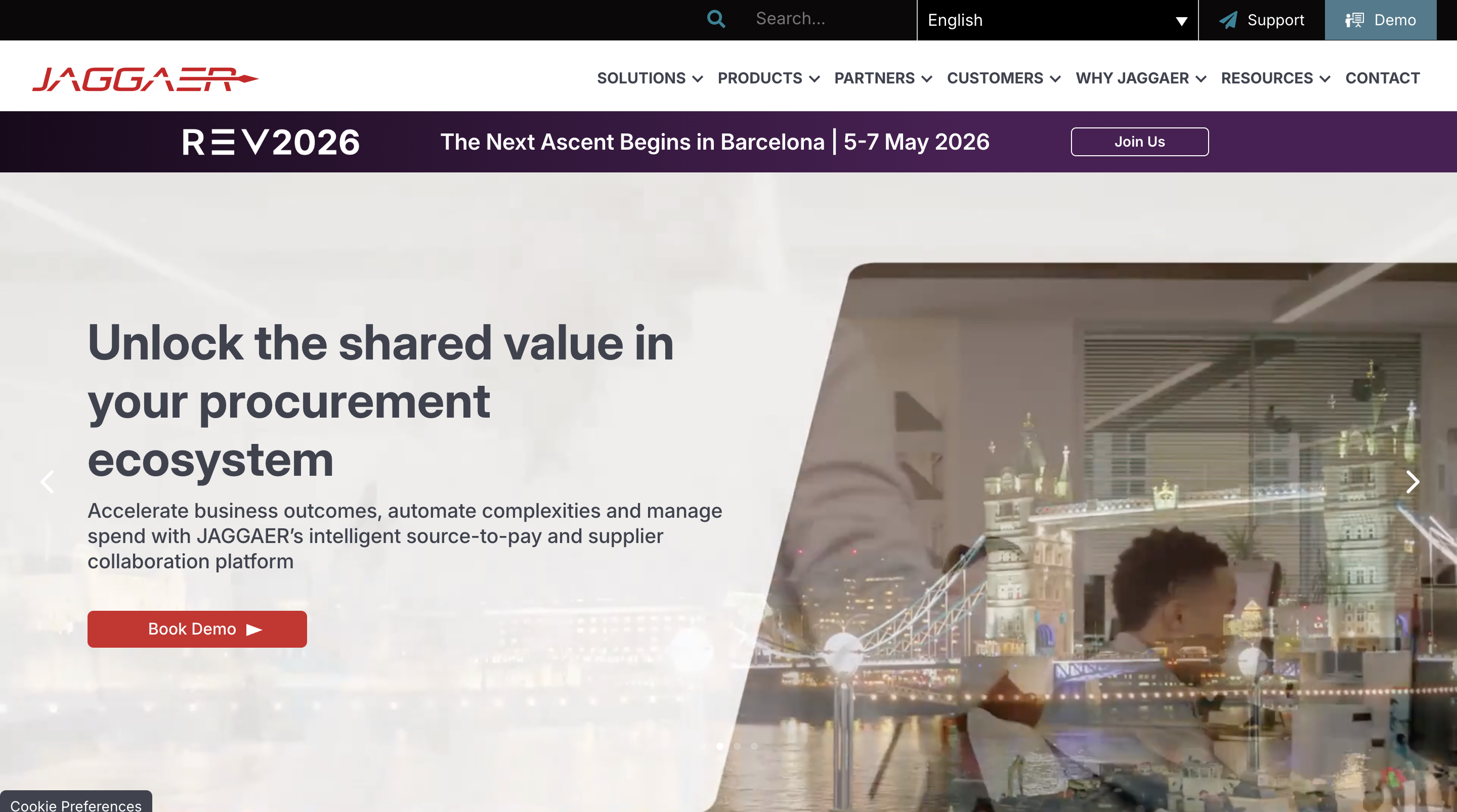
Source: Jaggaer
Category: Enterprise Source-to-Pay
G2 Rating: ~4.3/5 | Capterra: 4.1/5 (21 reviews)
Pricing: From ~$45,000/year (quote-based, varies by modules and team size)
AI Capabilities: AI spend analytics, automated bid evaluation, supplier intelligence across 10M+ network
Best For: Mid-to-large enterprises in manufacturing, education, healthcare, or public sector
Jaggaer is one of those platforms that doesn't get talked about in SaaS circles but is absolutely embedded in industries like manufacturing, higher education, and public procurement. If you work in those worlds, you've likely come across it.
The platform handles the full source-to-pay journey and has built deep, industry-specific solutions over many years. It's not a generic procurement tool that happens to support manufacturing, it's built around the actual workflows, supplier dynamics, and compliance requirements of those industries.
What makes it different
The 10M+ supplier network is a meaningful advantage. For industries where supplier diversity, qualification, and performance tracking matter, having that network pre-built saves enormous setup time. You're not manually onboarding vendors from scratch.
The e-auction and strategic sourcing tools are also particularly mature. If your procurement team runs competitive bid events, reverse auctions, or multi-round RFx processes, Jaggaer has the tooling to support sophisticated sourcing strategies, not just basic template-based tendering.
Key capabilities
- Strategic sourcing and e-tendering with structured bid evaluation
- Access to a 10M+ global supplier network
- Contract lifecycle management from award through renewal
- AI-powered spend analytics and supplier performance tracking
- Multi-language support for global procurement teams
- Industry-specific modules for manufacturing, education, healthcare, and public sector
Who it's built for
Mid-to-large enterprises that need comprehensive, auditable procurement in industries with complex supplier relationships and regulatory requirements. If you're in manufacturing, higher education, or the public sector and you handle significant procurement volume, Jaggaer has probably been built with your use case in mind.
It's not the right fit for fast-moving SaaS companies or teams that need quick deployment and a simple interface. The platform is built for depth, not speed of onboarding.
The honest take: The learning curve is real and the interface is complex. Some users have raised concerns about support quality following the company's recent organizational changes, which is worth factoring into your evaluation. At ~$45,000/year minimum, it's also a significant investment. But for organizations with the right profile — and the procurement maturity to use it well, Jaggaer delivers genuine depth that lighter tools can't match.
5. Ivalua
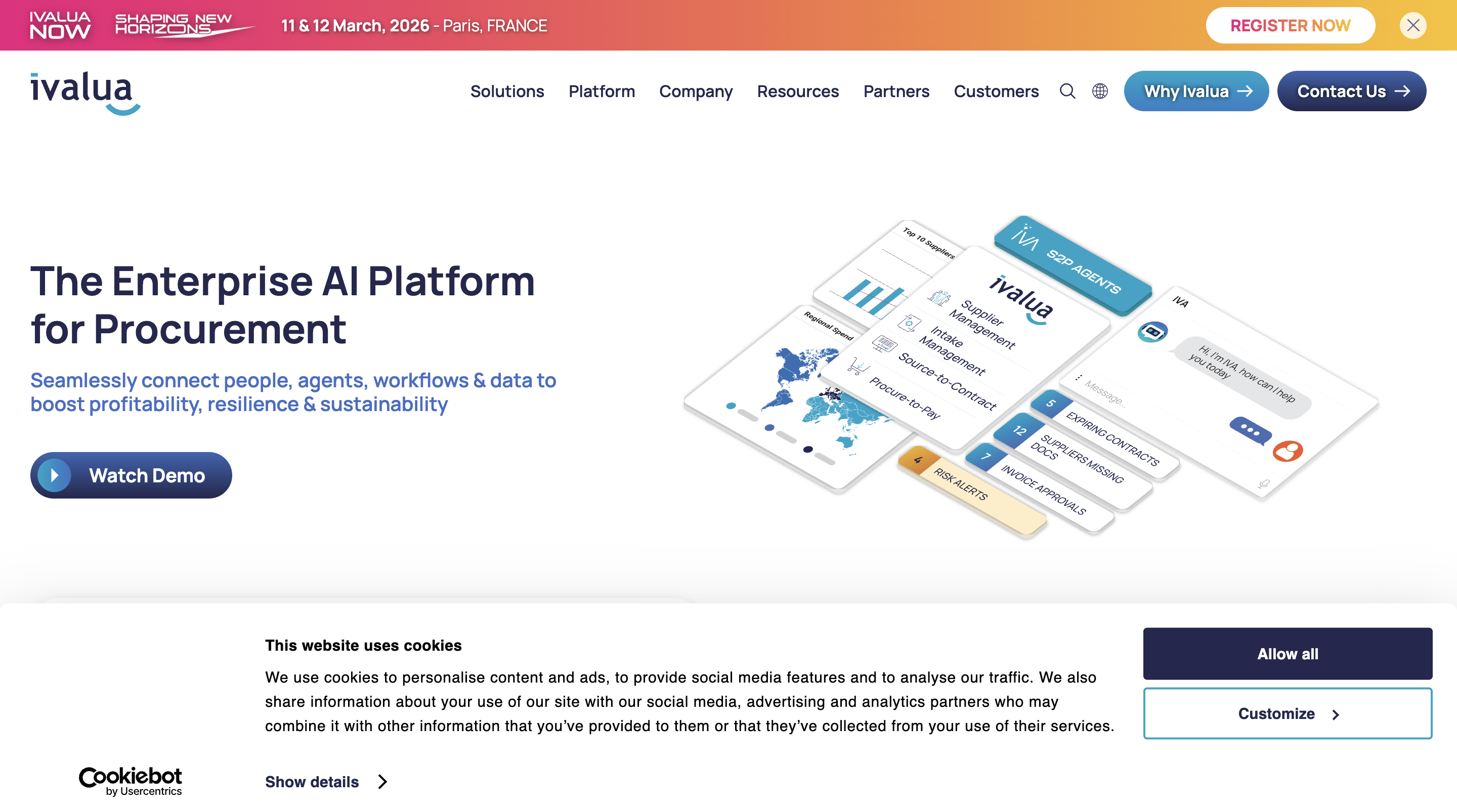
Source: Ivalua
Category: AI-Powered Source-to-Pay
G2 Rating: 4.3/5 (83 reviews) | 2025 Gartner Magic Quadrant Leader
Pricing: Custom enterprise pricing; Forrester TEI study reports 393% ROI and $32M in average benefits
AI Capabilities: AI agents automating 40–70% of procurement tasks, predictive analytics, supplier risk intelligence
Best For: Global enterprises with mature procurement teams and complex, multi-category requirements
Ivalua sits at the premium end of the procurement market, trusted by 500+ global companies including Whirlpool and Crédit Agricole, and recognized as a 2025 Gartner Magic Quadrant Leader. It's the platform organizations turn to when their procurement complexity has outgrown everything else.
What sets Ivalua apart isn't just feature breadth. It's the underlying architecture. A single unified data model means every module: sourcing, contracts, purchasing, invoicing; shares the same data in real time. No syncing between systems, no reconciliation headaches, no version control nightmares.
What makes it different
The configurability is genuinely exceptional. Most enterprise platforms give you configuration within defined guardrails. Ivalua lets you reshape workflows, data models, and approval hierarchies to match how your organization actually operates, not the other way around.
The AI agent layer is also ahead of most competitors. Ivalua claims 40–70% automation of procurement tasks through its AI agents, handling routine approvals, flagging anomalies, recommending next actions, and summarizing supplier risk data. That's not marketing language; it's reflected in the Forrester ROI data.
Key capabilities
- Full procurement lifecycle: sourcing, contracts, P2P, and invoicing in one unified platform
- AI agents for 40–70% task automation across procurement workflows
- Supplier risk and performance management with real-time intelligence
- Highly configurable workflows, no developer resources required for most changes
- Advanced analytics for tender performance, spend visibility, and supplier benchmarking
- ISO 27001, SOC 2, and HIPAA certified, no application breach on record
Who it's built for
Global enterprises with mature procurement organizations, complex category requirements, and the internal resources to manage a serious implementation. If you're managing procurement across multiple business units, geographies, and spend categories, and you need a platform that can be configured precisely to your operating model, Ivalua is worth the investment.
It's not the right choice for organizations that need to be live in 30 days or that don't have dedicated procurement operations resources.
The honest take: Gartner Peer Insights user satisfaction sits at 2.9/5, significantly lower than the analyst recognition would suggest. That gap tells a story about implementation complexity and the gap between what the platform can do and how hard it is to get there. The Forrester ROI numbers are impressive, but they assume a well-resourced implementation. Go in with clear scope, strong internal ownership, and realistic timelines.
Running 10+ RFPs a month and still in spreadsheets? SparrowGenie gets you live and generating first drafts in days. See it for yourself.
6. Coupa
Source: Coupa
Category: Cloud Spend Management
G2 Rating: ~4.3/5 | Capterra: ~4.2/5
Pricing: From $549/year (custom subscription model based on modules and seats)
AI Capabilities: Smart spend analytics, AI-driven sourcing insights, proprietary benchmark data
Best For: Mid-to-large organizations looking to standardize all spend management on a single cloud platform
Coupa approaches procurement from a different angle than the pure-play sourcing platforms. Rather than building the deepest possible sourcing tool, it built the broadest possible spend management suite, and embedded sourcing and tendering inside it.
The result is a platform where your tender workflow isn't an isolated procurement function. It's connected to budgets, purchase orders, invoices, expenses, and supplier contracts, all in one place. For finance and operations leaders who want a unified view of where money is going, that's genuinely valuable.
What makes it different
The proprietary spend data is a real differentiator. Coupa aggregates anonymized spend data across its customer base to give sourcing teams benchmark intelligence, what are similar companies paying for similar categories, which suppliers are performing well across the market, where are the cost-saving opportunities. That kind of insight doesn't exist in isolated procurement tools.
The UI is also notably more intuitive than most enterprise procurement platforms. User adoption tends to be higher with Coupa than with platforms like Ivalua or Jaggaer, which matters when you're rolling out across a large organization with mixed levels of procurement sophistication.
Key capabilities
- Sourcing events and structured tender workflows
- Supplier engagement portal and performance tracking
- AI-driven spend analytics with proprietary benchmark data
- Automated approval workflows and contract management
- Integration with SAP, NetSuite, Microsoft Dynamics, and more
- Expense management and e-invoicing via Coupa Pay
Who it's built for
Mid-to-large organizations that want to consolidate all spend management - sourcing, procurement, invoicing, and expenses, on a single cloud platform. If the business objective is spend visibility and control across the organization, not just better tender management, Coupa delivers that unified view.
If you only need tender management and RFP response capability, there are more focused tools that will serve you better at lower cost.
The honest take: Customization is limited compared to Ivalua or Jaggaer. Several users flag a buggy mobile app and inconsistent support response times. The platform also lacks full project accounting capability, which matters for professional services firms. But for the right profile, mid-to-large organizations standardizing on one cloud spend platform, Coupa is a strong, widely-adopted choice.
7. Bonfire (Euna Procurement)
Source: Bonfire Euna Procurement
Category: Public Sector Strategic Sourcing
Capterra Rating: 4.5/5
Pricing: From $499/year; scales by organization size (up to ~$1,000/year per GetApp)
AI Capabilities: Automated bid scoring, auto-tabulation of evaluation results
Best For: Municipalities, universities, and public agencies that need transparent, defensible award decisions
Public procurement has a unique problem that private-sector platforms don't fully appreciate. It's not just about speed or cost savings. It's about fairness, transparency, and producing decisions that can withstand scrutiny from auditors, from losing vendors, and sometimes from courts.
Bonfire was built with exactly that constraint in mind. Now part of Euna Procurement, it's become the go-to platform for municipalities, universities, and government agencies that need to run rigorous, collaborative evaluation processes without the administrative chaos of physical binders and email-based scoring.
What makes it different
The evaluation workflow is where Bonfire genuinely shines. Multiple evaluators can score bids simultaneously using online scorecards, results are automatically tabulated, and the platform generates side-by-side bid comparisons that make award decisions clear and defensible. The entire process creates a full audit trail without anyone having to manually document anything.
The 98% user adoption rate is remarkable and worth taking seriously. In the public sector, where technology rollouts often struggle with resistant stakeholders and limited IT support, a platform that evaluators actually like using is rare.
Key capabilities
- End-to-end RFP and bid management with structured workflows
- Collaborative online scorecards with automated score tabulation
- Side-by-side bid comparison for clear, defensible evaluations
- Reverse auctions for competitive price events
- Vendor communication portal for Q&A management
- Contract and performance management post-award
- Full audit trails for compliance and legal defensibility
Who it's built for
Public sector entities - municipalities, school boards, universities, and government agencies, that run structured tender processes and need to demonstrate fairness and transparency in their award decisions. If your procurement team regularly faces FOIA requests, audit scrutiny, or vendor challenges, Bonfire gives you the documentation infrastructure to handle them confidently.
It's not a full P2P suite and it's not designed for high-volume commercial procurement. The focus is squarely on evaluation quality and process integrity.
The honest take: Bonfire does one thing exceptionally well transparent, collaborative bid evaluation and doesn't try to be everything else. For the right use case, that focus is a feature, not a limitation. The value-for-money rating of 3.8/5 on GetApp suggests some users find the pricing high for the scope, but the adoption rate and ease-of-use scores tell a different story. If your team is still shuffling physical binders during evaluation panels, Bonfire will feel like a revelation.
8. Proactis
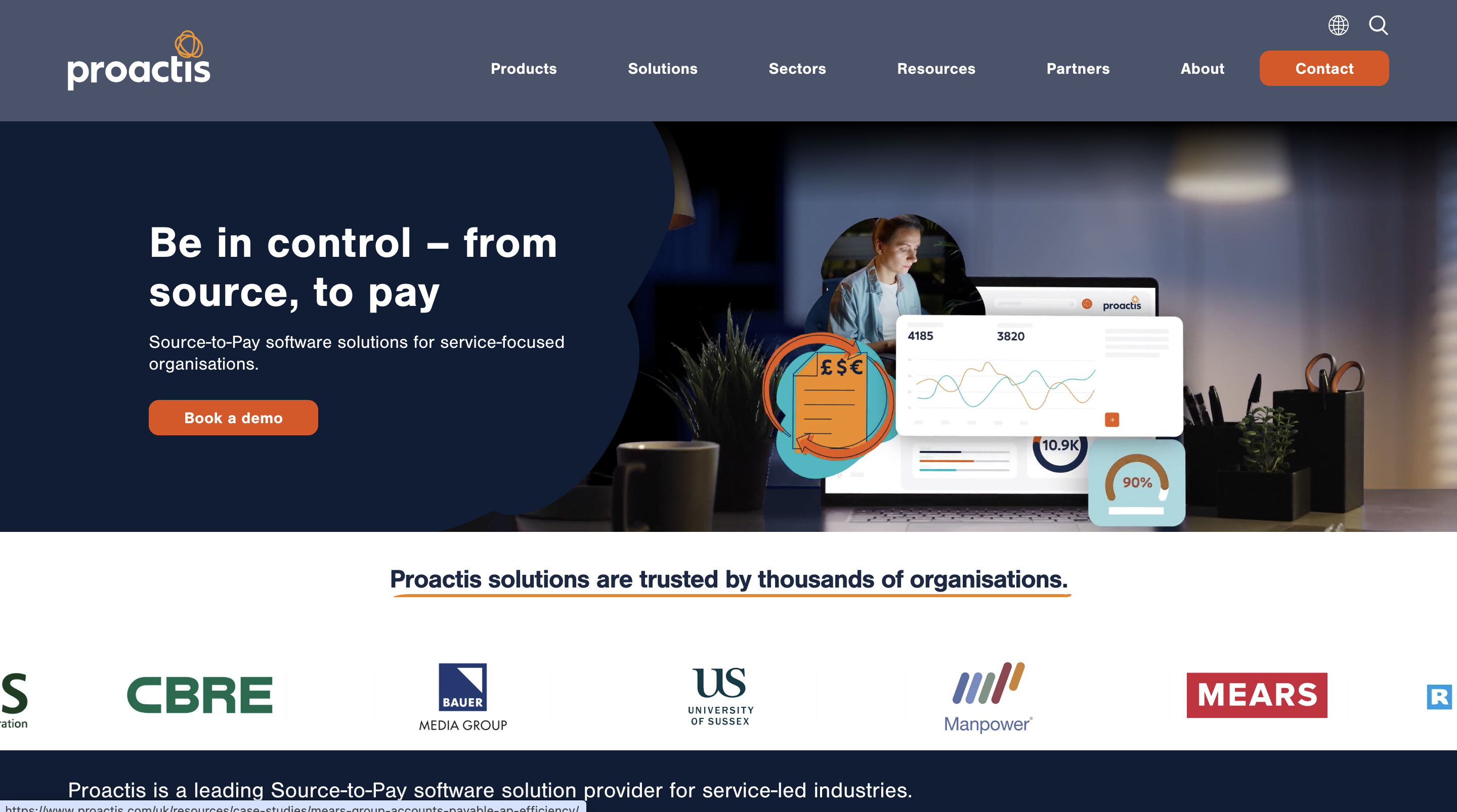
Source: Proactis
Category: Mid-Market Procurement Suite
G2 Rating: 4.8/5 | Capterra: 4.4/5 (13 reviews)
Pricing: ~£14,810/unit/year (UK Government G-Cloud listing); subscription-based
AI Capabilities: AI-powered invoice data extraction, spend analytics
Best For: Mid-sized organizations and local authorities in the UK and Europe
Proactis doesn't get the headlines that SAP Ariba or Coupa do, but it has quietly been serving mid-market procurement teams in the UK and Europe for decades. With 3M+ users worldwide and a product that covers tendering, supplier management, contract lifecycle, and invoice processing in one platform, it's a mature and capable option for organizations that don't need enterprise-scale complexity.
The platform is particularly well-suited to UK and European procurement teams navigating public sector compliance requirements, local authority regulations, and the kind of structured tendering processes that those environments demand.
What makes it different
Deployment flexibility is a genuine differentiator. Unlike most modern procurement tools that are cloud-only, Proactis supports cloud, SaaS, desktop, and mobile deployment — giving organizations with legacy infrastructure or strict data residency requirements more options than most competitors offer.
The customer support scores stand out too. A 4.5/5 support rating on Capterra is notably higher than many enterprise procurement platforms, where support quality frequently drops after the sales process is complete.
Key capabilities
- E-tendering with digital bid submissions and structured evaluations
- Supplier management and performance tracking
- Contract lifecycle management from award through renewal
- AI-powered invoice data extraction and processing
- Budget management and spend control
- Integrations with SAP, Oracle, Microsoft Dynamics, Unit4, and more
- Available on cloud, SaaS, desktop, and mobile
Who it's built for
Mid-sized organizations, local authorities, and public sector bodies in the UK and Europe that need a solid, compliant procurement platform without the complexity and cost of enterprise-tier solutions. If you've outgrown basic tools but the full SAP Ariba implementation feels like overkill, Proactis sits comfortably in the middle ground.
It's not the right fit for organizations outside of Europe or those needing a large ecosystem of third-party integrations beyond the major ERPs.
The honest take: The review volume is thin — 4 reviews on G2 and 13 on Capterra — which makes it harder to get a robust read on real-world performance at scale. Smaller market presence compared to tier-one platforms also means a smaller partner and integration ecosystem. But the product ratings are strong, the support scores are genuinely good, and for the right UK/EU mid-market profile, Proactis offers a balance of capability and cost that larger platforms can't match.
9. SynerTrade
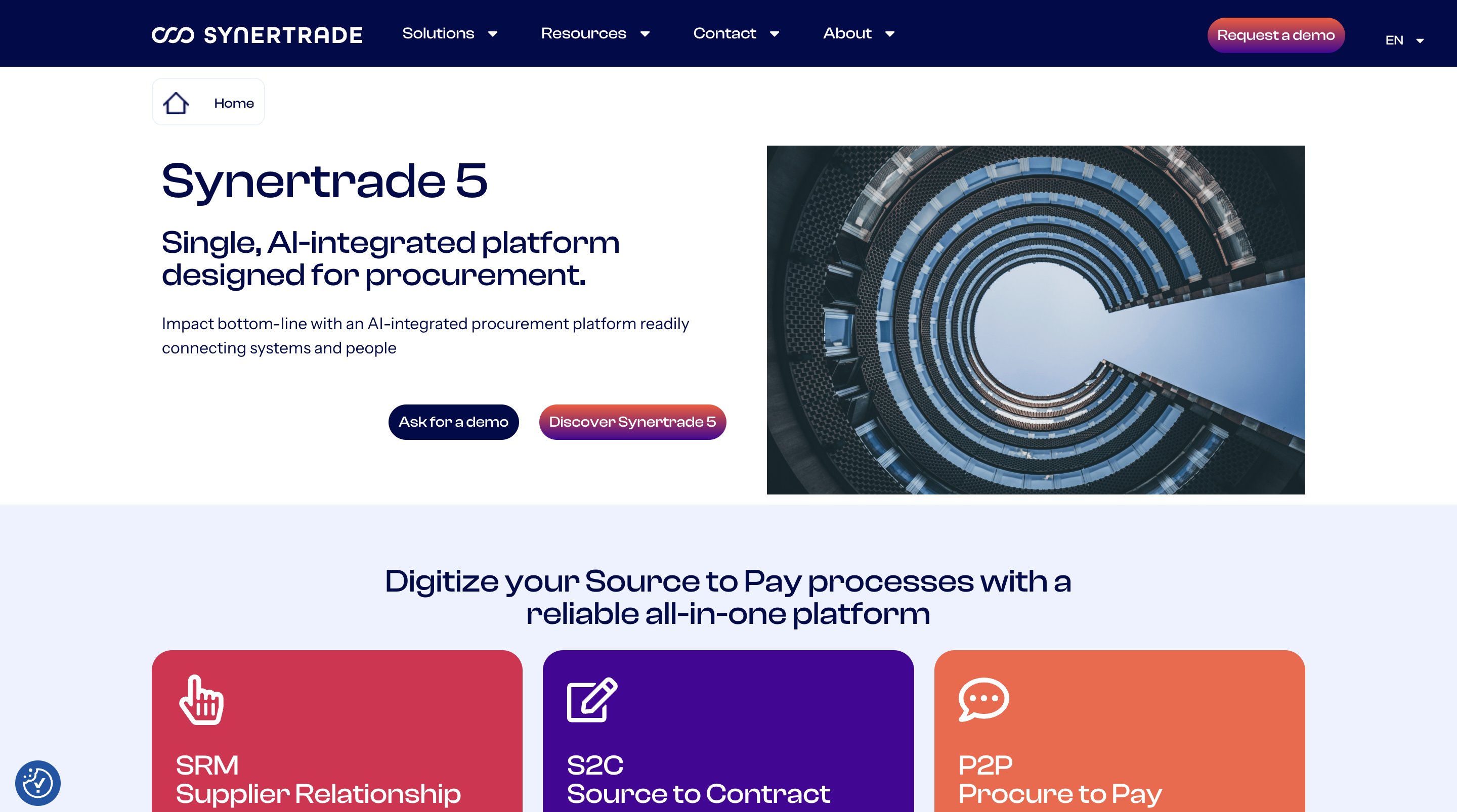
Source: SynerTrade
Category: Strategic Sourcing and Supplier Collaboration
G2 Rating: 4.2/5
Pricing: Usage-based model starting from $0.01 (no per-user fee; unlimited users)
AI Capabilities: AI contract summaries, spend anomaly detection, next-action recommendations (SynerTrade v5)
Best For: Mid-to-large European organizations focused on strategic sourcing and supplier collaboration
SynerTrade has been a fixture in European procurement for years, but the v5 release brought it into a different conversation — one about AI-powered procurement intelligence rather than just workflow automation.
The platform covers e-sourcing, RFx management, supplier collaboration, online auctions, and contract lifecycle management. But what makes SynerTrade worth a closer look in 2026 is the combination of its AI layer and its pricing model — two things that set it apart from almost every other platform in this category.
What makes it different
The no-per-user pricing is genuinely unusual in this market. Most enterprise procurement platforms charge by the seat, which means costs scale linearly as your team grows or as you try to extend access to occasional users like finance reviewers or department heads. SynerTrade's usage-based model removes that friction — everyone who needs access can have it without a budget conversation every time.
The v5 AI capabilities are also more practical than the typical "AI-powered" marketing claim. Contract summaries that actually save review time, anomaly detection that flags spend irregularities before they become problems, and next-action recommendations that keep sourcing projects moving — these are tools that fit naturally into how procurement teams work.
Key capabilities
- E-sourcing and full RFx management with template-based tender creation
- Online auctions and advanced bid analysis
- Supplier management with risk assessment and performance tracking
- Spend visibility and reporting across categories
- Contract lifecycle management with AI-powered summaries and anomaly detection
- Persona-based UX that adapts to different roles across the procurement team
- Mobile-friendly design and no per-user fee structure
Who it's built for
Mid-to-large organizations in Europe — particularly those with large, diverse procurement teams where per-seat licensing creates cost and adoption barriers. If your sourcing strategy depends heavily on supplier collaboration and you need procurement intelligence that goes beyond basic tender management, SynerTrade v5 delivers that at a pricing model that scales favorably.
It's less suited for organizations outside Europe or those that need deep integration with a broad ecosystem of tools beyond major ERP systems.
The honest take: Lower brand recognition outside of Europe, fewer integrations compared to the major platforms, and a smaller community of implementation partners. For organizations that primarily need strong RFP response capability rather than strategic sourcing and supplier collaboration, there are more focused alternatives. But for European procurement teams that want AI-powered sourcing without per-user pricing, SynerTrade v5 is a genuinely interesting option.
10. Altura
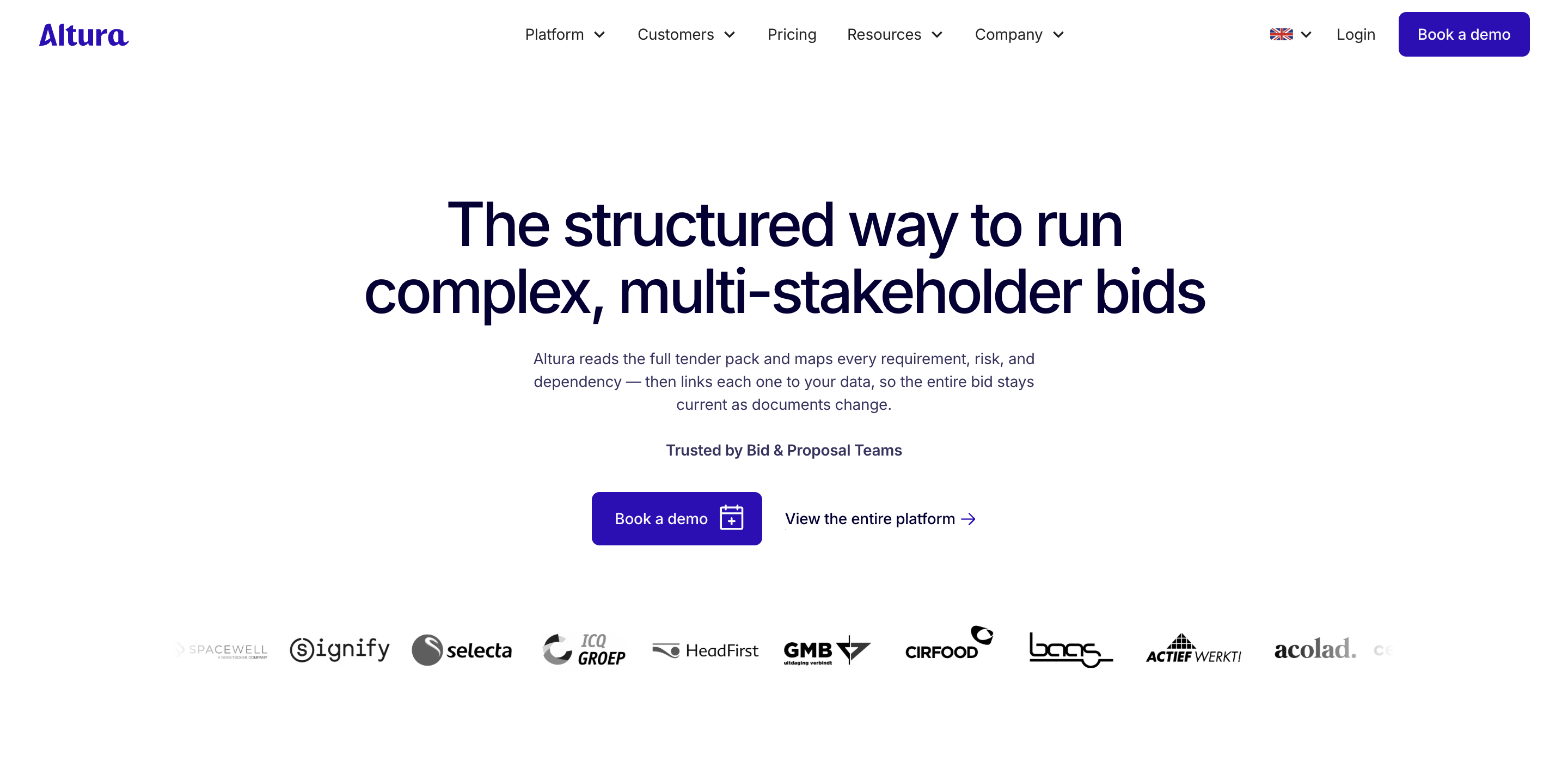
Source: Altura
Category: AI Bid Management
G2 / Capterra: Newer entrant, limited formal reviews as of early 2026
Pricing: ~£24,000/year (personalized pricing available on request)
AI Capabilities: Automated analysis of 15+ tender documents in under a minute, AI requirement extraction and risk scoring, AI-assisted proposal drafting from past tenders
Best For: Bid managers and commercial directors handling complex, multi-stakeholder tenders in NL/BE/UK
Altura is doing something on the bidder side that most platforms haven't attempted seriously: using AI to actually read and understand the tender document before you write a single word of response.
That sounds like a small thing. It isn't. A complex tender pack can run to dozens of documents, requirements specs, technical annexes, legal terms, evaluation criteria, supplier questionnaires. Understanding what's actually being asked, what the risks are, and how your response should be structured used to require hours of careful manual review. Altura compresses that into minutes.
What makes it different
The AI document analysis is the core differentiator. Altura analyzes 15+ tender documents simultaneously, extracts every requirement and dependency, scores risks, and maps each element back to your organizational data and past tender responses. The bid team starts from a structured, intelligence-rich foundation rather than a blank page and a stack of PDFs.
The learning loop is also meaningful. Altura tracks which content from past tenders contributed to wins and which didn't. Over time, the platform gets smarter about what good looks like for your specific organization in your specific market — building a data-backed institutional knowledge base that improves every future bid.
Key capabilities
- Automated analysis of full tender packs, 15+ documents in under one minute
- AI-driven requirement extraction, risk scoring, and dependency mapping
- Bid/no-bid qualification workflows to filter opportunities before investing time
- AI-assisted proposal drafting that learns from your past winning tenders
- Real-time team collaboration with structured task management
- Buyer Q&A tracking and management throughout the tender process
- Bid performance analytics and post-submission reporting
- ISO 27001 certified and GDPR compliant
Who it's built for
Bid managers, commercial directors, and proposal teams handling complex, high-stakes, multi-stakeholder tenders — particularly in the Netherlands, Belgium, and UK where structured public and commercial tendering is prevalent. If your team regularly works through 50-page tender packs with multiple evaluation criteria, mandatory compliance requirements, and tight submission windows, Altura's AI analysis capability is designed for exactly that pressure.
It's not the right fit for teams handling high-volume, relatively straightforward RFP responses where speed of drafting matters more than deep document analysis.
The honest take: As a newer platform, the formal review data is limited — which makes independent third-party validation harder to find. The ~£24,000/year price point is a meaningful investment, particularly for smaller bid teams. The geographic focus (primarily NL/BE/UK) also means the platform's track record and market fit may not translate as directly to other regions. But for bid managers who spend hours manually interpreting complex tender documents, Altura's AI analysis capability represents a genuinely step-change in how that work gets done.
RFP response teams across B2B SaaS and IT services use SparrowGenie to cut turnaround from days to hours. Ready to see how? Let's talk.
Quick Comparison: All 10 Platforms at a Glance
Platform | Category | G2/Capterra Rating | Pricing | AI Capability |
|---|---|---|---|---|
SparrowGenie | RFP Automation | Strong early reviews | Custom | Auto-drafts, routing, knowledge hub |
SAP Ariba | Enterprise S2P | G2 Leader | Custom enterprise | Spend analytics, risk mgmt |
Oracle Procurement | Enterprise S2P | G2: 4.2/5 | $405–650/user/mo | Intelligent automation |
Jaggaer | Enterprise S2P | 4.3 / 4.1 | From ~$45K/yr | AI spend analytics |
Ivalua | AI-Powered S2P | G2: 4.3/5 | Custom enterprise | AI agents (40–70% automation) |
Coupa | Spend Management | ~4.3/5 | From $549/yr | Smart spend analytics |
Bonfire | Public Sector | Capterra: 4.5 | From $499/yr | Auto bid scoring |
Proactis | Mid-Market Proc. | Capterra: 4.4 | ~£14,810/yr | AI invoice processing |
SynerTrade | Strategic Sourcing | G2: 4.2/5 | Usage-based | AI summaries, anomaly detection |
Altura | AI Bid Mgmt | New entrant | ~£24K/yr | Full AI tender analysis |
How to Choose the Right Tender Management Software
There's no single best platform here. The right choice depends on where you sit in the tender process, what your tech stack looks like, and how mature your team is.
Are you issuing tenders or responding to them?
This is the most important filter. Buyer-side teams need platforms like SAP Ariba, Bonfire, Jaggaer, or Ivalua. Bidder-side teams writing proposals and winning deals should look at SparrowGenie or Altura.
What's your ERP landscape?
If you're on SAP, start with Ariba. On Oracle, Oracle Procurement Cloud is the natural fit. On a multi-ERP or hybrid landscape, Coupa or Ivalua give you flexibility to connect across systems.
How complex are your tenders?
For high-volume RFP response, SparrowGenie's automation delivers fast ROI. For complex, multi-stakeholder bids requiring deep document analysis and risk scoring, Altura's AI engine is purpose-built for that challenge.
What's your industry?
Construction teams should look at Procore. Public sector agencies should evaluate Bonfire. Manufacturing and education organizations have Jaggaer built for their workflows. B2B SaaS, IT services, and fintech teams are SparrowGenie's home ground.
What are your compliance requirements?
For heavily regulated industries, prioritize tools with strong audit trails, ISO 27001, and SOC 2 certifications. SparrowGenie, Ivalua, and Altura all meet enterprise security standards.
SparrowGenie is built for B2B teams handling 10+ RFPs a month. Explore the platform and see why growth-stage companies choose it over legacy tools.
Key Trends Shaping Tender Management in 2026
AI is moving up the stack.
It's no longer about keyword matching or template filling. The best platforms in 2026 use AI for requirement interpretation, risk detection, draft generation, and win probability scoring. Ivalua, Altura, and SparrowGenie are leading this shift.
Usage-based pricing is gaining traction.
SynerTrade's no-per-user model is a sign of where the market is heading. As tender volumes scale, per-seat pricing becomes expensive fast and vendors are responding.
Cloud-native is now the baseline.
On-premise deployments are effectively dead for new procurement software. Every serious platform in 2026 runs cloud-first, with faster update cycles and lower infrastructure overhead.
Predictive analytics are becoming table stakes.
Tools increasingly use historical bid data to forecast win probability, assess supplier reliability, and guide bid/no-bid decisions, before a single word is written.
Deeper ERP and CRM integration.
Sourcing tools are tightening connections with ERP, HR, finance, and CRM systems. SparrowGenie's Salesforce and HubSpot integrations connect RFP outcomes directly to revenue pipelines.
Final Thoughts: The Best Tool Is the One Your Team Actually Uses
Tender management software has come a long way from the days of shared folders and copy-paste chaos. In 2026, there's a genuinely excellent option for every type of organization — whether you're a global enterprise issuing tenders at scale, a public agency that needs transparent evaluations, or a growth-stage SaaS company trying to respond to 20 RFPs a month without burning out your best people.
The enterprise platforms (SAP Ariba, Oracle, Ivalua, Coupa) are powerful but complex. They're built for mature procurement organizations with the resources to implement and maintain them. The specialized tools (Bonfire for public sector, Procore for construction, SynerTrade for European sourcing) do specific things exceptionally well.
And then there are the AI-first platforms on the bidder side, SparrowGenie and Altura, that are redefining what's possible for teams that need to respond to tenders faster, smarter, and with less manual effort.
If your team handles RFPs, DDQs, or security questionnaires and you're still doing it manually, the cost of inaction; in lost deals, burned-out SMEs, and missed deadlines, is higher than any software license.
Start with the problem you need to solve. The right platform will follow.
Book your free demo today and see the difference a purpose-built RFP platform makes.
Ready to see how AI can transform your RFP process?
Product Marketing Manager at SurveySparrow
A writer by heart, and a marketer by trade with a passion to excel! I strive by the motto "Something New, Everyday"
Frequently Asked Questions (FAQs)
Related Articles

Content Libraries for Proposals: Your Edge for Consistent Wins
The Adaptive Sales Advantage: Mastering 15 Methodologies That Drive Revenue Growth