Why You Need a Revenue Intelligence Platform to Hit Your Number

Article written by
Kate Williams

INSIDE THE ARTICLE
SHARE THIS ARTICLE
Summary
Most teams have data but no real visibility into what’s actually driving revenue—or what’s derailing it. This blog unpacks how a revenue intelligence platform captures signals across your stack, predicts risks, spots patterns, and drives confident decision-making. If your forecasts feel like guesswork, this is your playbook for turning visibility into your competitive edge.
Every quarter starts the same way — targets are announced, dashboards light up, and sales leaders rally their teams to “hit the number.” But halfway through, the familiar chaos creeps in — bloated pipelines, stalled deals, missed follow-ups, and conflicting forecasts. Sound familiar?
The problem isn’t effort. It’s visibility. Revenue leaders don’t need more data — they need intelligence that connects every signal across deals, reps, and forecasts into one clear picture. That’s where a revenue intelligence platform becomes your competitive advantage.
What Is Revenue Intelligence
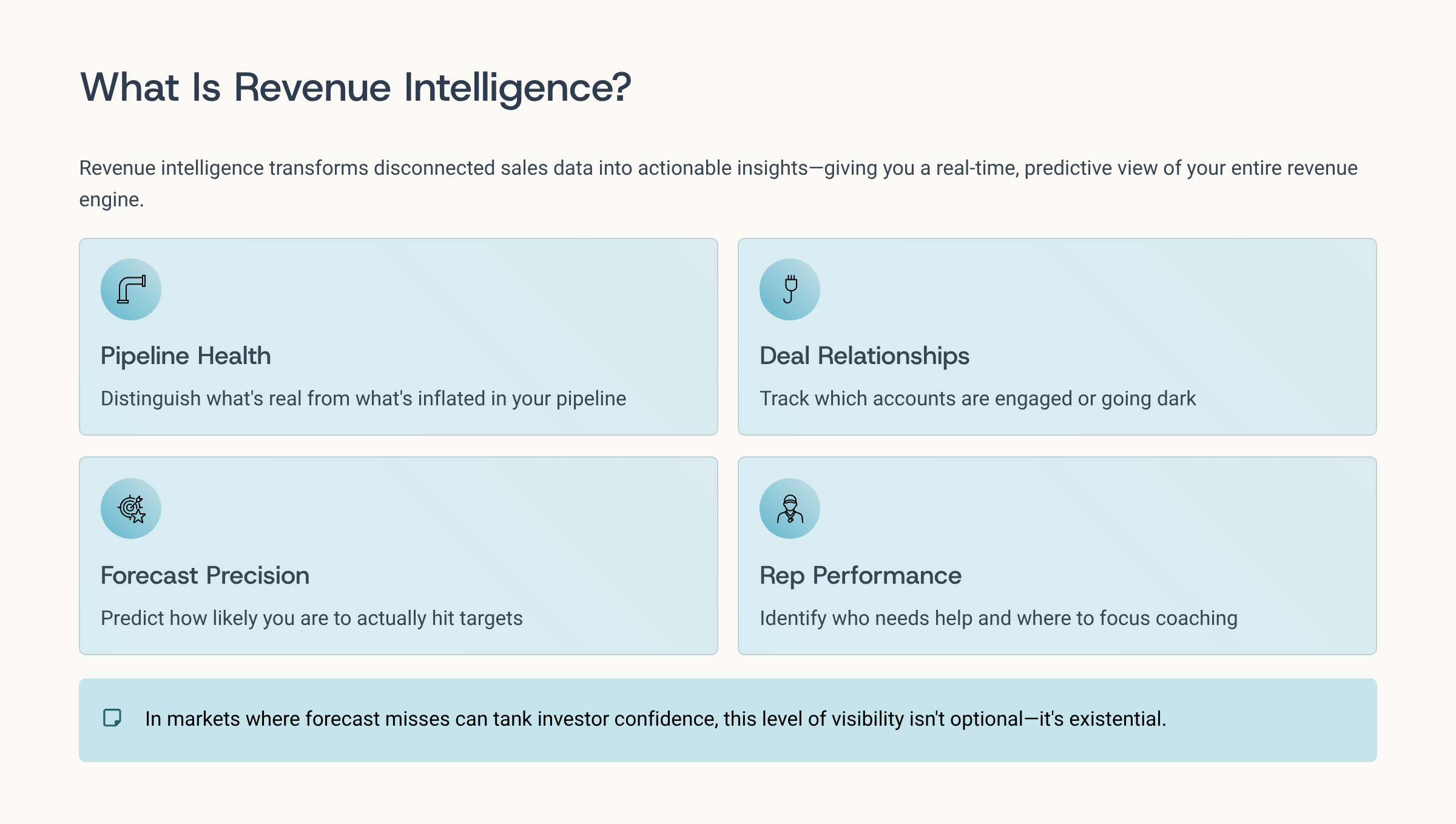
Revenue intelligence is the science of transforming disconnected sales data into actionable insights. Instead of looking backward through spreadsheets and stale CRM reports, it gives you a real-time, predictive view of your revenue engine — every deal, every rep, every stage.
At its core, it unifies:
- Pipeline health analytics – what’s real vs. inflated.
- Deal relationship intelligence – which accounts are engaged or going dark.
- Forecast precision – how likely you are to actually hit that target.
- Rep performance coaching – who needs help, and where.
In a market where forecast misses can tank investor confidence, having this level of visibility isn’t optional — it’s existential.
Revenue Intelligence vs. Everything Else
Most teams think they already have revenue intelligence. They don’t. They have reporting, analytics, or CRM dashboards — all useful, but none truly intelligent.
Here’s the reality:
Category | What It Does | Where It Falls Short |
|---|---|---|
CRM Systems | Store contact data, deal stages, and notes. | Great for record-keeping, but blind to deal health, engagement quality, or forecast accuracy. |
BI & Analytics Tools | Visualize data through dashboards and reports. | Offer descriptive insights, not predictive or prescriptive intelligence. They tell you what happened, not what to do next. |
Sales Enablement Platforms | Share playbooks, collateral, and training. | Help with content readiness, but can’t connect activities to revenue outcomes. |
Forecasting Spreadsheets | Capture rep estimates manually. | Error-prone, slow, and impossible to scale — especially when your pipeline crosses multiple regions or business units. |
Revenue Intelligence
Revenue intelligence isn’t a “better dashboard.” It’s a living ecosystem of insights that combines data, context, and AI to tell you:
- Which deals are healthy or at risk.
- Which reps need coaching (and on what).
- Which activities actually drive revenue growth.
- How to forecast predictably instead of optimistically.
Unlike traditional tools, revenue intelligence doesn’t just reflect reality — it interprets and improves it.
Revenue intelligence is the difference between looking at data and acting on it. While CRMs record what’s happening, and analytics tools describe it, revenue intelligence prescribes what to do next — instantly, accurately, and at scale.
It’s what turns your pipeline from a pile of numbers into a predictable revenue engine.
Why Revenue Intelligence Is Crucial in 2025
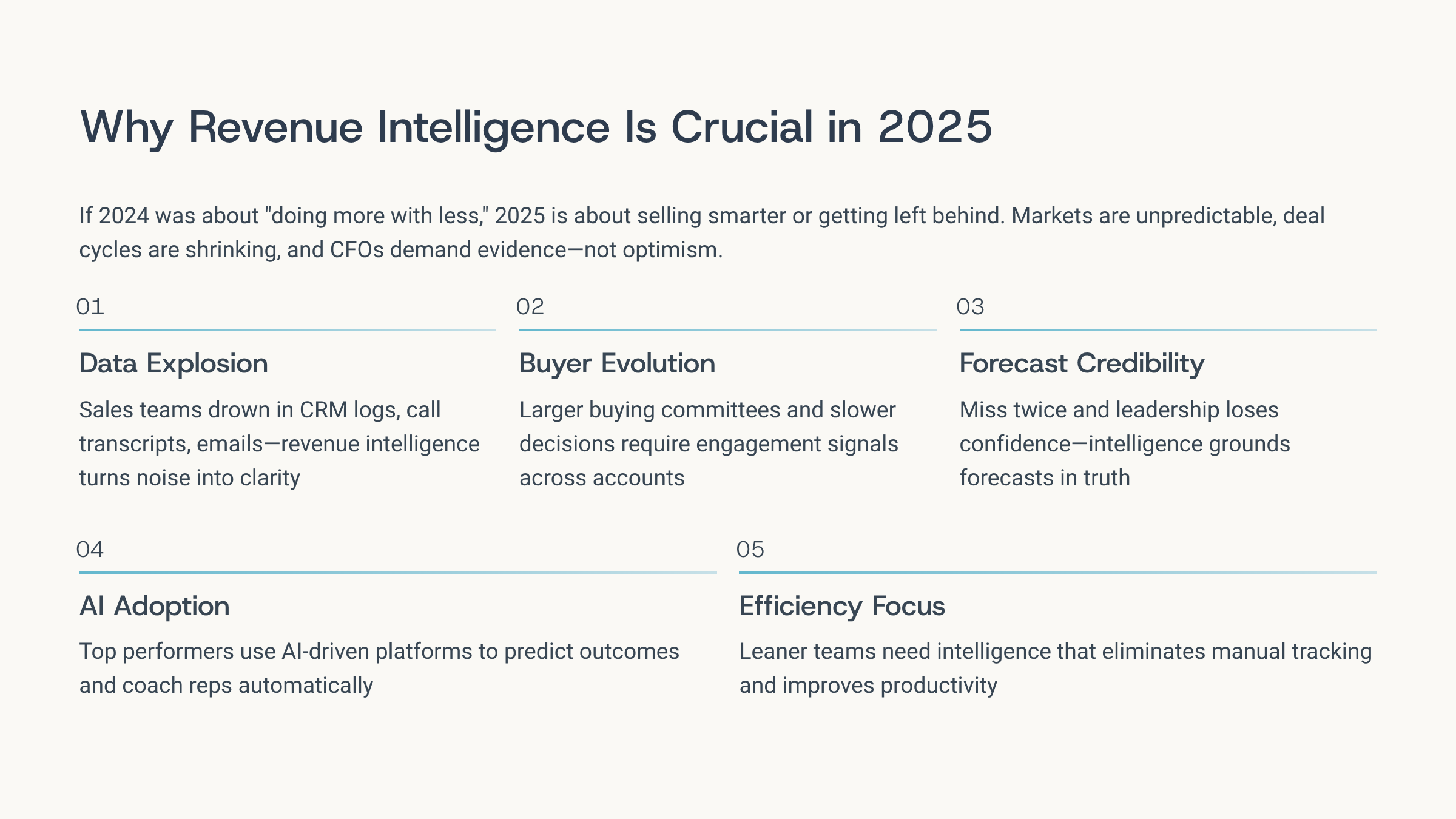
If 2024 was about “doing more with less,” 2025 is about selling smarter or getting left behind. Markets are unpredictable, deal cycles are shrinking, and CFOs now demand evidence—not optimism. Every number in your forecast needs to be backed by data, not instinct.
That’s exactly where revenue intelligence steps in.
1. The Data Explosion Demands Clarity
Sales teams are drowning in data — CRM logs, call transcripts, emails, Slack threads, and customer touchpoints. Without a unified layer of intelligence, this data remains noise. Revenue intelligence turns that noise into clarity—revealing patterns, predicting risks, and showing where to focus to protect pipeline health.
2. Buyers Have Changed
In 2025, buying committees are larger, decisions slower, and scrutiny higher. Traditional “relationship selling” alone can’t win. Revenue intelligence surfaces engagement signals across accounts, helping reps understand who’s leaning in, who’s blocking progress, and when to re-engage.
3. Forecast Accuracy = Boardroom Credibility
Miss your forecast once, it’s a red flag. Miss it twice, and leadership loses confidence. Revenue intelligence gives CROs and sales leaders real-time visibility into pipeline movement, deal health, and conversion probabilities—so every forecast is grounded in truth, not hope.
4. AI Is No Longer Optional
With AI adoption accelerating across RevOps, teams that don’t leverage intelligent forecasting and deal insights will fall behind. In 2025, top-performing organizations are using AI-driven platforms to predict outcomes, coach reps, and optimize revenue workflows—automatically.
5. Efficiency Is the New Growth
Budgets are tight, teams are leaner, and efficiency is currency. Revenue intelligence eliminates manual tracking, improves rep productivity, and reduces wasted cycles on low-value deals—all while increasing win rates.
If you’re planning to hit your number this year, you can’t rely on instinct alone. You need intelligence that sees what you can’t—and acts before you need to.
How a Revenue Intelligence Platform Transforms Your Sales Engine
Let’s break down the transformation it drives across your sales cycle:
1. Forecasting With Precision
AI-powered forecasting models analyze past patterns, pipeline velocity, and rep behavior to predict outcomes with uncanny accuracy. This means no more “best-case vs. worst-case” guesswork — just numbers you can trust.
2. Pipeline Inspection Made Simple
View your entire pipeline in one consolidated dashboard. Spot trends, bottlenecks, and movement by stage — from “new opportunity” to “negotiation.” Instantly see where revenue is leaking, and intervene before it’s too late.
3. Relationship Intelligence
A smart platform tracks every interaction — emails, meetings, calls — and scores account health. You’ll know who’s engaged, who’s ghosting, and where you might find cross-sell or upsell potential.
4. Activity Capture and Coaching
Automatic activity tracking means no more missing data. Sales managers can focus on coaching, not chasing, because insights show exactly which reps need guidance and on what.
5. Scenario Planning for CROs
Revenue leaders can model different pipeline outcomes — adjusting variables like deal velocity or conversion rates — to see how to close gaps before the quarter ends.
Each layer works together to turn data chaos into predictable performance.
How Revenue Intelligence Works
At its core, revenue intelligence bridges three worlds — data, context, and action. It doesn’t just collect information from your CRM; it interprets, connects, and predicts what will happen next in your revenue cycle.
Here’s how it really works under the hood:
1. Data Aggregation Across Systems
Revenue intelligence starts by integrating data from every touchpoint—CRM, emails, meetings, call transcripts, marketing automation tools, and even customer support platforms. It breaks down silos and centralizes everything into a single ecosystem. This unified view ensures your pipeline reflects reality, not fragmented guesses.
2. Activity Capture & Relationship Mapping
Every customer interaction is automatically captured—emails sent, calls logged, meetings attended, documents shared. AI then maps these signals to accounts and opportunities, building a 360° view of engagement health. This helps sales teams instantly see which relationships are active, dormant, or at risk.
3. Contextual Intelligence Layer
Once data is unified, the intelligence layer goes to work. Machine learning models analyze deal patterns, buying behaviors, and rep activity to flag anomalies—like deals stalling longer than average or accounts going quiet. It’s not just about visibility; it’s about early warning.
4. Predictive Forecasting
Next comes prediction. AI models assess past performance, conversion trends, and current pipeline velocity to forecast outcomes with high accuracy. Leaders can simulate “what-if” scenarios, compare forecasts across teams, and make adjustments before gaps appear.
5. Guided Actions & Coaching
Finally, the system turns insights into prescriptive actions. Instead of telling you what happened, it tells you what to do next. For example:
- Flagging deals likely to slip this quarter.
- Recommending next-best actions for stalled opportunities.
- Suggesting which reps need coaching based on activity trends.
6. Continuous Learning Loop
The more your teams use it, the smarter it gets. Each quarter’s data refines the models, improving deal predictions, engagement scoring, and forecast precision over time.
Revenue intelligence works by connecting the dots between people, data, and performance. It listens to every sales signal, learns from every win or loss, and feeds that intelligence back into your process—so you’re not just tracking deals, you’re steering them.
The Core Pillars of Revenue Intelligence
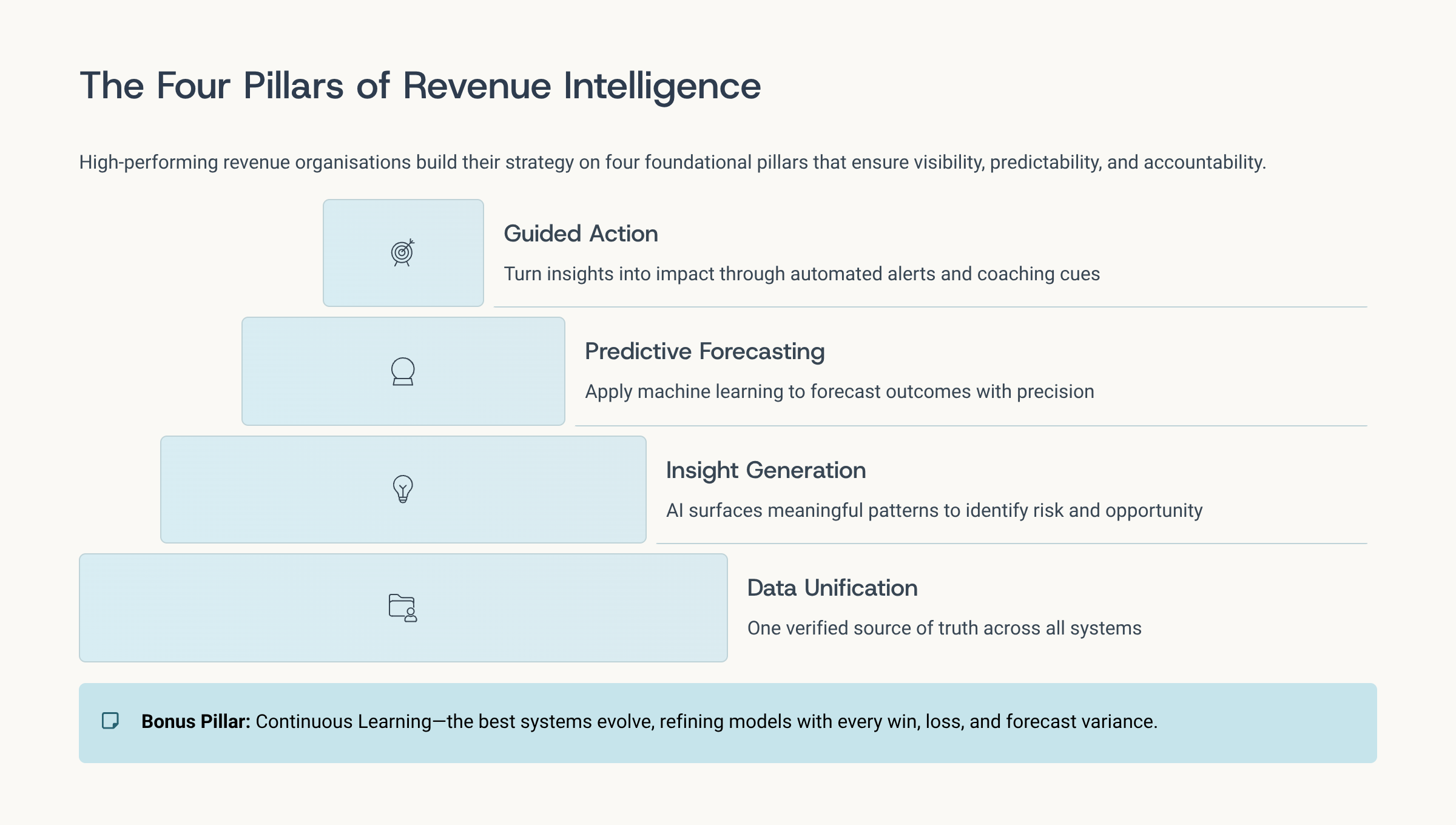
Every high-performing revenue organization builds its strategy on four key pillars of revenue intelligence. Together, they ensure visibility, predictability, and accountability — the trifecta every CRO chases.
1. Data Unification: One Source of Truth
The first pillar is data unification. Revenue intelligence pulls information from multiple systems — CRM, marketing automation, email, meetings, customer success tools — and merges it into one unified layer. This eliminates blind spots and ensures every team is working from the same verified dataset.
Without this foundation, insights are fragmented, and decisions stay reactive. With it, you unlock complete pipeline visibility and alignment across Sales, RevOps, and Leadership.
2. Insight Generation: From Raw Data to Revenue Signals
Once data is unified, AI models analyze it to surface meaningful insights. Think of it as the brain of the system — interpreting activity patterns, engagement signals, and deal progression to identify risk and opportunity. This pillar answers the “why” behind your performance:
- Why deals are stalling
- Why forecasts drift
- Why some reps outperform others
It’s what turns raw information into intelligence that drives action.
3. Predictive Forecasting: Seeing Before It Happens
The third pillar focuses on forecast accuracy and predictability. By applying machine learning to historical and real-time data, revenue intelligence forecasts outcomes with precision. Leaders can simulate best- and worst-case scenarios, understand where gaps exist, and proactively close them before the quarter ends.
This predictive layer moves your sales strategy from reactive reporting to revenue foresight.
4. Guided Action: Turning Insights Into Impact
Intelligence means nothing without execution. The final pillar — guided action — ensures insights are not just seen, but acted upon. Through automated alerts, prioritized deal recommendations, and coaching cues, revenue intelligence helps reps and leaders take the right action at the right time.
It closes the loop between analysis and action — ensuring your pipeline doesn’t just look healthy, it stays healthy.
Bonus Pillar: Continuous Learning
The best revenue intelligence systems don’t stop evolving. They learn from every win, loss, and forecast variance — refining models and insights over time. This self-optimizing loop keeps your organization adaptive and resilient, no matter how the market shifts.
In Essence, the pillars of revenue intelligence work like an ecosystem — Unified data builds visibility. Insights drive focus. Forecasting brings predictability. Guided action delivers results.
Together, they transform how teams sell, forecast, and scale — turning revenue intelligence from a tool into a strategic advantage.
Implementing Revenue Intelligence the Right Way
Buying a revenue intelligence platform is easy. Implementing it right — that’s where the real ROI lives. Too many teams treat it as another dashboard or plugin. In reality, it’s a revenue transformation initiative that needs structure, ownership, and alignment.
Here’s how to roll it out the right way:
1. Start With Clean, Unified Data
Garbage in, garbage out — it’s that simple. Before switching on intelligence, audit your CRM and connected systems.
- Eliminate duplicates and outdated contacts.
- Standardize naming conventions, deal stages, and fields.
- Map integrations across marketing, CS, and finance tools.
When your data foundation is clean, insights stay accurate and credible.
2. Align People and Process Before Tools
Technology only works when your team does. Define clear ownership for revenue operations, sales enablement, and forecasting. Document handoffs between sales stages and approval flows. When processes are aligned, AI can actually learn from consistent behavior rather than noise.
3. Integrate Across the Revenue Stack
Your revenue intelligence platform should connect seamlessly with the systems your teams already use — CRM, email, collaboration tools, and analytics dashboards. This integration ensures that intelligence flows bi-directionally — insights surface where your reps live, not in a separate tab they’ll never open.
4. Focus on Adoption, Not Just Access
Rolling it out doesn’t end at login credentials. Train teams on how to use insights, not just view them. Build coaching programs where managers rely on intelligence for deal reviews, pipeline inspection, and forecast validation. When it becomes part of daily rhythm, usage sticks.
5. Measure and Iterate
Set measurable KPIs before deployment — forecast accuracy, win-rate improvement, deal velocity, and rep productivity. Review these metrics quarterly and adjust the AI models, data inputs, or playbooks as needed. Revenue intelligence isn’t a one-time setup — it’s a living, learning system that evolves with your business.
Implementing revenue intelligence the right way means going beyond technology. It’s about creating a culture of insight-driven selling — where every rep trusts the data, every forecast is grounded in truth, and every decision is backed by intelligence.
Key Benefits of Revenue Intelligence
A well-implemented revenue intelligence platform doesn’t just improve visibility — it reshapes how your organization sells, forecasts, and grows. Here are the most critical business benefits that make it a must-have for modern sales and RevOps teams:
1. Forecast Accuracy You Can Trust
Manual forecasting is built on guesswork. Revenue intelligence replaces gut feeling with data-backed predictions that factor in pipeline velocity, rep performance, and engagement health. The result? Consistent, credible forecasts that leadership and investors can rely on — quarter after quarter.
2. End-to-End Pipeline Visibility
Instead of scattered data across CRMs, spreadsheets, and inboxes, revenue intelligence gives you a single pane of glass for your entire revenue engine. You can instantly see where deals are stalling, which accounts are at risk, and where momentum is building — enabling proactive action, not reactive firefighting.
3. Smarter Deal Prioritization
Not all deals are created equal. AI-driven scoring highlights high-probability opportunities and flags risky ones early. That means reps spend less time chasing the wrong deals and more time focusing where it matters — the opportunities most likely to close.
4. Data-Driven Coaching & Performance Management
Sales leaders can finally coach with clarity, not assumptions. By analyzing rep activity, conversion rates, and engagement patterns, revenue intelligence pinpoints who needs help, what kind of help, and when. It transforms sales management from subjective to scientific.
5. Better Cross-Functional Alignment
Revenue intelligence breaks silos between Sales, Marketing, and RevOps. By sharing one unified source of truth, it ensures every team speaks the same language — forecast numbers, deal health, and revenue projections are consistent across the board.
6. Faster, More Confident Decision-Making
When every data point is current, verified, and contextual, decision-making accelerates. Executives can identify revenue gaps, optimize strategies, and realign resources — without waiting for end-of-quarter surprises.
7. Continuous Optimization Through AI
The longer you use it, the smarter it gets. AI models continuously learn from historical trends and current signals, improving accuracy with each cycle — creating a self-optimizing revenue system.
8. Predictable Growth
Ultimately, the biggest benefit is consistency. With real-time intelligence guiding every decision, your business moves from unpredictable peaks and dips to steady, repeatable, scalable revenue growth.
Revenue intelligence turns your organization from data-rich but insight-poor into a revenue machine that sees ahead, acts fast, and delivers results.
When every decision is driven by intelligence instead of instinct, hitting your number stops being the goal — it becomes the norm.
Revenue Intelligence with SparrowGenie
A secure, AI-powered platform like SparrowGenie helps you democratize knowledge across sales, pre-sales, and RevOps teams. By turning fragmented data into verified, contextual insights, SparrowGenie enables leaders to forecast with confidence, identify risks early, and empower every rep to sell smarter — not harder.
It’s time to replace guesswork with governance and visibility with velocity. Because when intelligence powers your revenue engine, hitting your number isn’t luck — it’s process.
Conclusion: From Guesswork to Growth
At some point, every sales leader faces that familiar gut check — you’re halfway through the quarter, the numbers look shaky, and you’re wondering which deals will actually land.
That’s the old way of selling: relying on hope, hustle, and scattered data. The new way? Revenue intelligence.
It’s not just software. It’s your revenue GPS — guiding your team through noise, showing where deals stand, who needs coaching, and what needs fixing before it becomes a miss. It replaces uncertainty with clarity, and endless reviews with real-time visibility.
Because hitting your number isn’t about more effort anymore — it’s about better intelligence.
And that’s exactly what a secure, AI-powered platform like SparrowGenie delivers: one single source of truth for your entire revenue engine. It unifies your data, surfaces what matters, and empowers every rep, leader, and revenue team to move with precision.
In a world where every forecast is scrutinized and every deal counts, the edge belongs to those who see clearly and act early. That’s not luck — that’s intelligence. That’s revenue intelligence.
Ready to see how AI can transform your RFP process?
Product Marketing Manager at SurveySparrow
A writer by heart, and a marketer by trade with a passion to excel! I strive by the motto "Something New, Everyday"