Best RevOps Software in 2026: The Complete Guide

Article written by
Aparna Rajendran

INSIDE THE ARTICLE
SHARE THIS ARTICLE
Summary
This guide covers what RevOps software actually is, the 7 core categories of revenue operations tools, an honest comparison of the top platforms in 2026 with pricing and G2 ratings, the 5 biggest trends reshaping B2B revenue teams, how to build the right tech stack by company size, where proposal automation fits in, and why it's often the most overlooked piece.
Around 60% of revenue leaders say data silos are actively blocking their ability to forecast accurately.
That's not a technology problem. That's a revenue operations problem. And it's why RevOps software has gone from a niche category to a $3.7 billion market, growing toward $16 billion by 2033, with no signs of slowing down.
If you're searching for the best RevOps software in 2026, you already know the stakes. Your sales, marketing, and customer success teams are generating mountains of data, in CRMs, email platforms, call recording tools, marketing automation systems, and none of it is talking to each other. Deals slip. Forecasts miss. Everyone blames everyone else.
Revenue operations software exists to fix exactly that. And in 2026, the best platforms are doing it with AI agents, adaptive forecasting, and real-time pipeline intelligence that would have seemed like magic just three years ago.
Here's the thing: choosing the wrong RevOps tool doesn't just cost you money. It costs you pipeline velocity, deal accuracy, and sometimes whole quarters. This guide cuts through the noise. We'll break down the top RevOps platforms, compare them honestly, and help you figure out the right stack for your team — whether you're a 50-person startup or a 2,000-person enterprise.
Is your proposal process slowing down your revenue engine? SparrowGenie automates RFPs, DDQs, and security questionnaires so your RevOps machine keeps moving at full speed.
What Is RevOps Software?
Let's be clear about what we mean, because the term gets used loosely.
Revenue operations (RevOps) software refers to platforms that unify sales, marketing, and customer success data into a single operating model. The goal is to eliminate the silos that slow revenue, improve forecast accuracy, and help the right teams act on the right data at the right time.
Unlike standalone CRM platforms that track customer interactions and deal stages, RevOps software takes a broader view of the entire revenue engine, integrating your CRM with marketing automation, billing tools, call intelligence, and analytics to give you a complete picture of pipeline health, deal velocity, and revenue predictability.
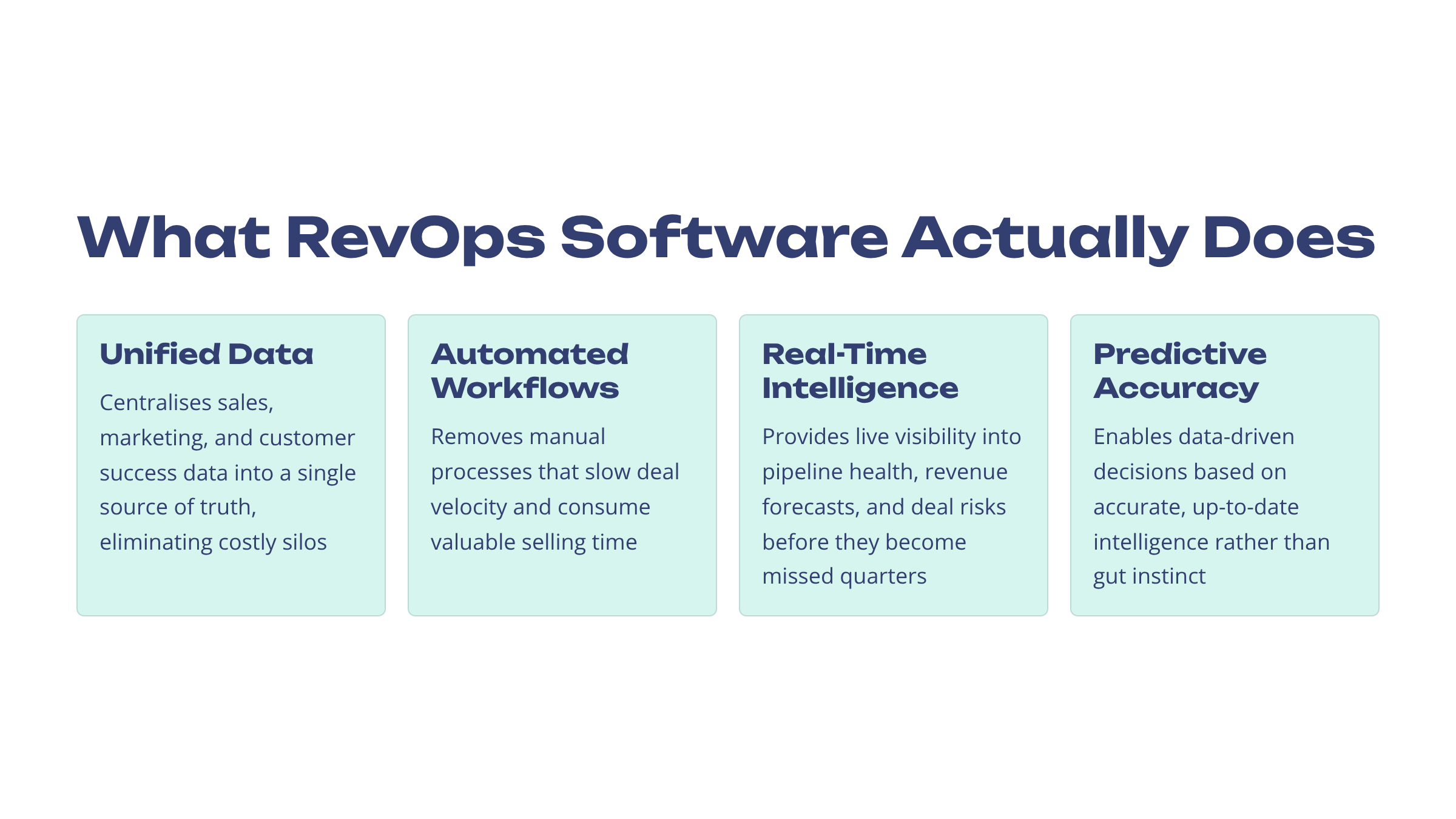
At its core, RevOps software centralizes data from multiple sources into a single source of truth, automates the manual processes that slow down sales cycles, gives real-time visibility into pipeline health and revenue forecasts, surfaces bottlenecks before they become missed quarters, and enables data-driven decisions based on accurate, up-to-date information rather than gut feel.
The market reflects how seriously companies are taking this. The RevOps software market was valued at $3.71 billion in 2023 and is projected to reach $10–18 billion by 2033, growing at a CAGR of 13.5–17.3%. North America dominates with 33%+ of global revenue share, while Asia-Pacific is the fastest-growing region. For SMBs specifically, the adoption rate is running at 17% annually, the highest of any segment.
The 7 Core Categories of RevOps Software
Not all RevOps tools do the same thing. The landscape spans seven distinct categories, each addressing a different part of the revenue lifecycle. Understanding which category solves which problem is the fastest way to cut through the noise when evaluating tools.
CRM and Customer Management
It is the foundation of every RevOps stack. CRM tools organize customer data, track interactions, and serve as the system of record for every deal in your pipeline. Salesforce Sales Cloud, HubSpot, and Pipedrive are the dominant players here. Without clean, well-structured CRM data, every other tool you layer on top is building on sand.
Revenue Intelligence
These platforms analyze calls, emails, and deal interactions to surface insights that would otherwise be invisible. Gong, Revenue Grid, and Clari lead this category. This is where conversation data meets forecasting, and where teams typically see some of the fastest ROI. Gong alone carries a 4.8/5 G2 rating, with conversation intelligence capabilities rated at 93%.
Pipeline Management and Forecasting
These tools provide deal-level analysis, risk scoring, and AI-driven revenue predictions. Clari, Forecastio, and InsightSquared are the standout platforms here. Teams using these tools report up to 95% forecast accuracy, a dramatic improvement over the spreadsheet-based estimates most revenue teams still rely on.
Data Hygiene and Enrichment
These doesn't get enough attention, but it's arguably the most important category. Platforms like Openprise, Clearbit, and Clay clean, deduplicate, and enrich your CRM and marketing data so your AI and automation tools actually work as advertised. With 38% of RevOps leaders citing poor data accuracy as their top growth barrier, this is less of a nice-to-have and more of a prerequisite for everything else.
Automation and Workflow
Tools like Zapier, Workato, Make, and Tray connect apps, automate lead routing, sync data across systems, and eliminate repetitive manual work. The workflow automation market alone is projected to reach $37.45 billion by 2030, which tells you everything about how seriously companies are investing in removing human bottlenecks from revenue processes.
Sales Enablement and Proposal Automation
This is where RevOps intersects most directly with day-to-day selling. Platforms like Outreach, Salesloft, and Showpad standardize playbooks and manage outreach cadences. This is also where proposal automation tools like SparrowGenie become critical, automating the RFP responses, DDQs, and security questionnaires that consume enormous amounts of SME time without any of the strategic value.
GTM Data and B2B Intelligence
Platforms like ZoomInfo, 6sense, and Demandbase provide intent data and account segmentation to power targeted outreach and ABM strategies. Intent data tells you not just who your ICP is, but who is actively in-market right now.
Top RevOps Software Platforms in 2026: An Honest Comparison
Here's a look at the platforms showing up consistently at the top of G2 ratings, analyst reports, and real buyer conversations in 2026, including SparrowGenie, which addresses the proposal automation gap most RevOps stacks leave open.
Salesforce Sales Cloud
G2 Rating: 4.4/5 | Pricing: From $25/user/month | Best For: Enterprise teams
Salesforce is an entire operating system for enterprise revenue teams. With predictive forecasting rated 90% on G2 and one of the largest AppExchange ecosystems in B2B SaaS, it's the default choice for large organizations with complex, multi-product sales motions. Worth noting: complex setup requires dedicated admin support, and costs climb quickly as you add modules. Over 80% of its users are mid-market or enterprise, smaller teams often find it overkill.
Gong
G2 Rating: 4.8/5 | Pricing: ~$250/user/month + $50K+ platform fee | Best For: Revenue AI
Gong has become the gold standard for conversation intelligence. It analyzes every call, email, and deal interaction to surface patterns that tell you not just what happened, but why. Ease of use is rated 94% on G2. The catch: total annual cost for 50 users can hit $82K–$110K. If you're budget-conscious, this is a meaningful investment to justify before committing.
Clari
G2 Rating: 4.6/5 | Pricing: ~$160K+/year | Best For: Enterprise forecasting
Clari's RevAI engine is purpose-built for revenue teams that need forecasting accuracy at scale. Pipeline management is rated 92% on G2, and its ability to flag at-risk deals in real time is where most teams see the clearest ROI. Built for enterprise buyers, if you're mid-market, there are more cost-effective forecasting options worth exploring first.
HubSpot Operations Hub
Pricing: From $720/month | Best For: Mid-market all-in-one RevOps
HubSpot's Operations Hub is the most accessible entry point for mid-market teams wanting genuine RevOps capabilities, data hygiene automation, programmable workflows, and deep CRM integration, without enterprise-level complexity. Fast setup, clean UX, and strong out-of-the-box workflows make it a consistent favorite for growing teams.
Substrata
G2 Rating: 4.9/5 | Pricing: From $510/user/year | Best For: Behavioral intelligence
Substrata's SoundWave tone analysis and AI emotional intelligence capabilities make it genuinely unique in the RevOps landscape. For teams selling through trust and long relationship cycles, understanding the emotional dynamics in a deal can be just as important as deal data. Ease of use is rated 99% on G2, the highest in its class.
SparrowGenie
G2 Rating: 4.5/5 | Pricing: Custom | Best For: Proposal automation, RFP responses, DDQs, security questionnaires | Integrates with Salesforce, HubSpot, Slack, Teams, Google Drive
Most RevOps stacks invest heavily in CRM, forecasting, and revenue intelligence, and then leave one of the most time-consuming parts of the sales cycle completely manual: proposal creation. That's exactly where SparrowGenie fits.
SparrowGenie is a secure, AI-powered RFP automation and sales enablement platform. It auto-generates accurate responses to RFPs, DDQs, and security questionnaires from your internal knowledge base, routes them through role-based approval workflows, and fills them directly into the original document format, no reformatting, no copy-paste, no chasing SMEs for the same answers they gave last quarter.
For teams handling 10+ RFPs or questionnaires per month, SparrowGenie delivers 50–60% faster proposal creation, enables teams to handle 3x more RFPs without adding headcount, and creates a centralized knowledge hub that gets smarter with every response. It integrates natively with the tools your team already uses, so it slots into your RevOps stack without disruption.
See how SparrowGenie eliminates the last manual bottleneck in your revenue engine.
5 RevOps Trends Reshaping Revenue Teams in 2026
Here are the top 5 trends that are reshaping the revenue teams in 2026.
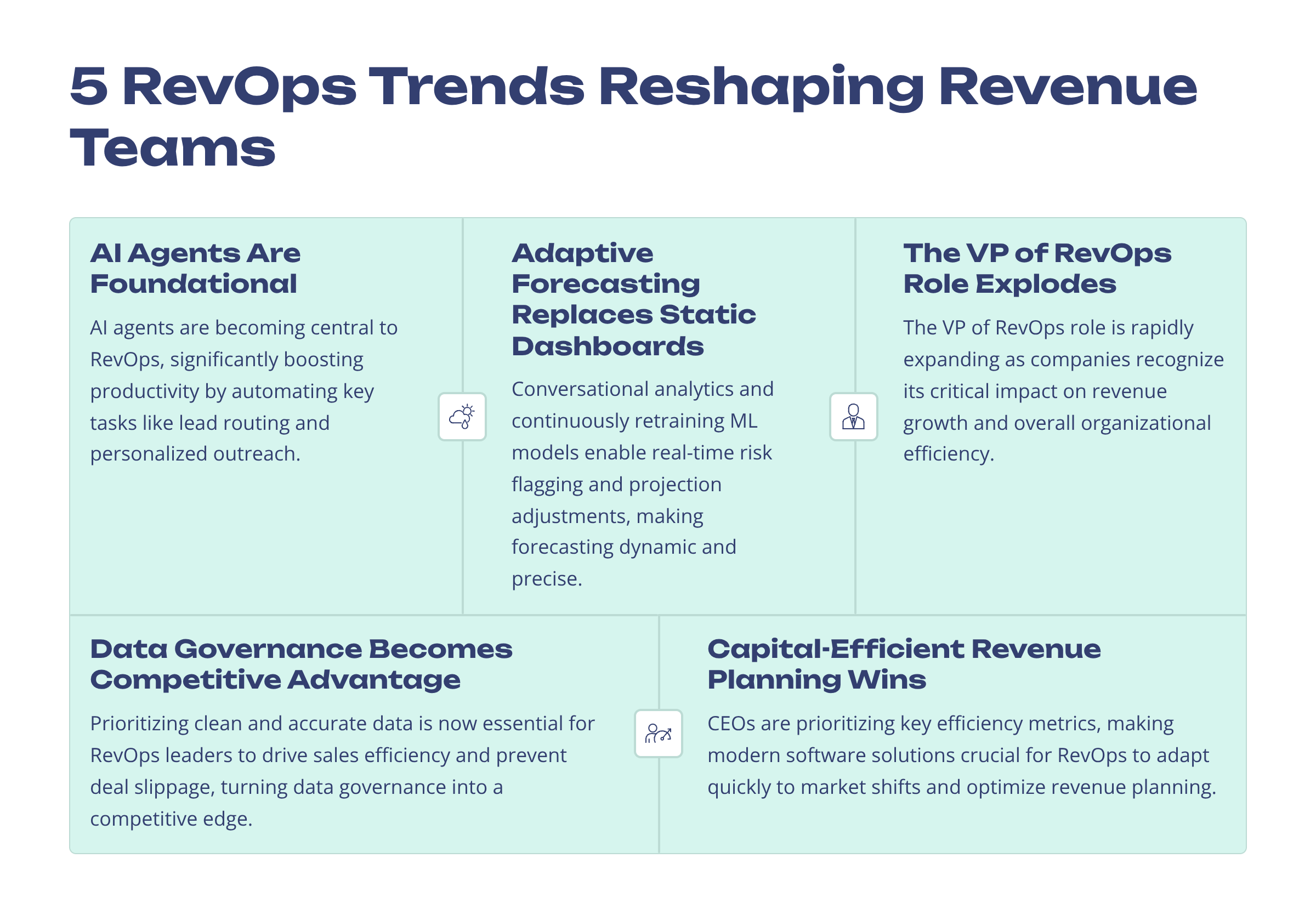
AI Agents Are Now Foundational, Not Experimental
Gartner predicts 75% of high-growth companies will adopt RevOps processes by 2026, and AI agents are at the center of how they're doing it. We're talking about intelligent systems that route leads, personalize outreach at scale, monitor pipeline health in real time, and flag risks before they become missed targets. AIOps agents are already delivering 66% productivity gains in RevOps teams that have made the shift. If your tech stack doesn't have an AI layer, you're operating at a structural disadvantage.
Adaptive Forecasting Is Replacing Static Dashboards
The most effective revenue teams in 2026 are using conversational analytics, where non-technical stakeholders can ask complex data questions in natural language and get real answers instantly. Machine learning models retrain continuously on live data, auto-flagging risks like declining win rates by product line and adjusting projections accordingly. The quarterly forecast-as-spreadsheet is becoming a relic.
The VP of RevOps Role Has Exploded
The title "VP of Revenue Operations" has grown by 300% in the past 18 months. Companies with formal RevOps functions report 36% higher revenue growth than those without. As of early 2025, 79% of organizations had a formal RevOps function, and there were 174,000+ active RevOps job postings on ZipRecruiter alone. This isn't a trend, it's a structural shift in how B2B companies build revenue teams.
Data Governance Is Now a Competitive Advantage
38% of RevOps leaders cite poor data accuracy as their top barrier to growth. Clean data foundations drive 40% increases in sales efficiency and 22% drops in deal slippage. The data governance market is projected to triple, from $5.38 billion to $18.07 billion by 2032. Every AI model, every forecast, and every AI-generated proposal will be better when it's grounded in clean, accurate data.
Capital-Efficient Revenue Planning Has Replaced Growth-at-All-Costs
CEOs and boards are now prioritizing LTV:CAC, NRR, and pipeline velocity over pure top-line growth. The problem is that 49% of RevOps leaders say their processes can't flex to market shifts, and 46% say their operations are still mostly manual. This is the gap that modern RevOps software is designed to close.
Stop running a manual bottleneck inside an automated revenue engine. Check out SparrowGenie.
Building the Right RevOps Tech Stack for Your Company Size
The right RevOps stack depends entirely on where you are in your growth journey. Investing in Clari at $160K/year when you have 8 sales reps doesn't make sense. Neither does expecting a $20/month automation plan to run an enterprise revenue operation.
For startups (up to 50 users, budget $5K–$15K/year), keep it simple. HubSpot CRM as your system of record, Google Looker Studio for reporting, Zapier for cross-app automation, and Clearbit for data enrichment. Spend the rest on tools that directly support revenue generation — like a proposal automation platform that helps your team respond to RFPs faster.
For SMB and mid-market teams (budget $50K–$150K/year), this is where investment in dedicated RevOps tooling starts to pay real dividends. Combine HubSpot or Salesforce with Gong or Clari for revenue intelligence, Workato for enterprise automation, and Forecastio for AI-powered forecasting. At this stage, proposal automation becomes genuinely critical, your team is handling enough RFP volume that manual responses are actively costing you deals and burning out your SMEs.
For enterprise teams (budget $200K–$500K+/year), the stack needs to handle real complexity: multiple products, global teams, intricate deal structures, and compliance requirements. The typical setup runs Salesforce as the CRM, Tableau or Power BI for business intelligence, Clari for forecasting, Gong for conversation intelligence, Openprise for data operations, Workato for automation, and Anaplan for revenue planning. Proposal automation tools like SparrowGenie integrate directly into this stack, automating the RFP and DDQ responses that would otherwise consume your most experienced SMEs.
The Missing Piece in Most RevOps Stacks: Proposal Automation
Here's a pattern that shows up again and again in RevOps audits. Companies invest heavily in CRM, forecasting, and revenue intelligence and then completely ignore the part of the sales process that's manually eating 35% of their team's time. Proposal creation.
RFPs, DDQs, security questionnaires, and sales proposals are the final mile of the sales cycle. They're also where deals slow down, SMEs get burned out, and inconsistent messaging creeps in. Companies handling 10 or more RFPs per month without automation are running a manual bottleneck inside an otherwise modern revenue engine.
The impact is measurable. Proposal automation delivers 50–60% faster proposal creation, enables teams to handle three times more RFPs without adding headcount, ensures consistent messaging across every response, creates a centralized knowledge hub that improves with every submission, and provides the audit trails and role-based workflows that compliance teams need.
SparrowGenie addresses exactly this gap. It auto-generates accurate responses from your internal knowledge base, routes them for expert review and approval, and fills them into the original document format, no reformatting, no copy-paste chaos, no more chasing the same SMEs for the same answers every quarter.
Ready to add proposal automation to your RevOps stack?
How to Choose the Right RevOps Software: 5 Questions to Ask
The RevOps software market is growing from $3.7 billion to $18+ billion for a clear reason: companies that align their sales, marketing, and customer success operations around a single source of revenue truth consistently outperform those that don't.
The platforms leading the category in 2026, Gong, Clari, Salesforce, HubSpot, Substrata, and SparrowGenie, each solve something specific very well. The best RevOps stacks aren't the ones with the most tools. They're the ones where every tool addresses a real bottleneck, integrates cleanly, and shows measurable ROI.
Most revenue teams have already invested in CRM, forecasting, and conversation intelligence. But the final mile, the RFPs, DDQs, and security questionnaires that sit between a great sales conversation and a signed contract, is still being handled manually. That's the gap SparrowGenie was built to close.
While Salesforce organizes your pipeline, Gong analyzes your calls, and Clari sharpens your forecasts, SparrowGenie makes sure your team never loses a deal because the proposal took too long, the SME was unavailable, or the response was inconsistent with the last one you sent. It auto-generates accurate responses from your internal knowledge base, routes them for expert approval, and delivers them in the exact format the client requested, in hours, not days.
That's what a complete RevOps stack looks like in 2026. Not just the tools that track revenue, but the tools that protect it, all the way to the finish line.
Ready to see how AI can transform your RFP process?
Product Marketer at SparrowGenie
Being a Product Marketer at SparrowGenie, Aparna helps sales teams work faster with secure, AI-powered proposal automation. She turns complex features into simple stories, builds messaging that resonates, and keeps a close pulse on what customers actually need. She loves shaping clear, helpful content that shows how SparrowGenie makes RFP work easier, faster, and a lot less stressful.