Best 10 AutogenAI Alternatives and Competitors in 2026

Article written by
Aparna Rajendran

INSIDE THE ARTICLE
SHARE THIS ARTICLE
Summary
This guide compares the 10 best AutogenAI alternatives in 2026, including Responsive, Loopio, Qvidian, Proposify, PandaDoc, QorusDocs, Ombud, Inventive AI, AutoRFP.ai, and DeepRFP, with G2 ratings, real pricing, key features, drawbacks, and honest opinions to help you find the right platform for your workflow.
AutogenAI has earned its reputation as a serious AI-first proposal writing platform. Built around a bespoke language engine trained on your past proposals, style guides, and win themes, it is particularly strong for long-form, narrative-heavy bids in sectors like government contracting, construction, and nonprofits.
The platform has a solid 4.4 out of 5 rating on G2 from over 120 reviews, and users consistently praise its speed in generating first drafts. AutogenAI claims a 70% increase in drafting speed and a 30% higher win rate for its customers.
But here is the thing. No single platform fits every team.
Common reasons teams look beyond AutogenAI include opaque enterprise pricing, a steep learning curve around prompt precision, interface inconsistencies, and limited support for questionnaire-heavy workflows like security questionnaires and DDQs. If your team runs on structured Q&A-style responses more than long-form narratives, AutogenAI may not be the right fit.
This guide breaks down the 10 best AutogenAI alternatives in 2026. For each, you will find key features, G2 ratings, strengths, drawbacks, and an honest opinion on who the tool is actually built for.
Let us get into it.
1. SparrowGenie
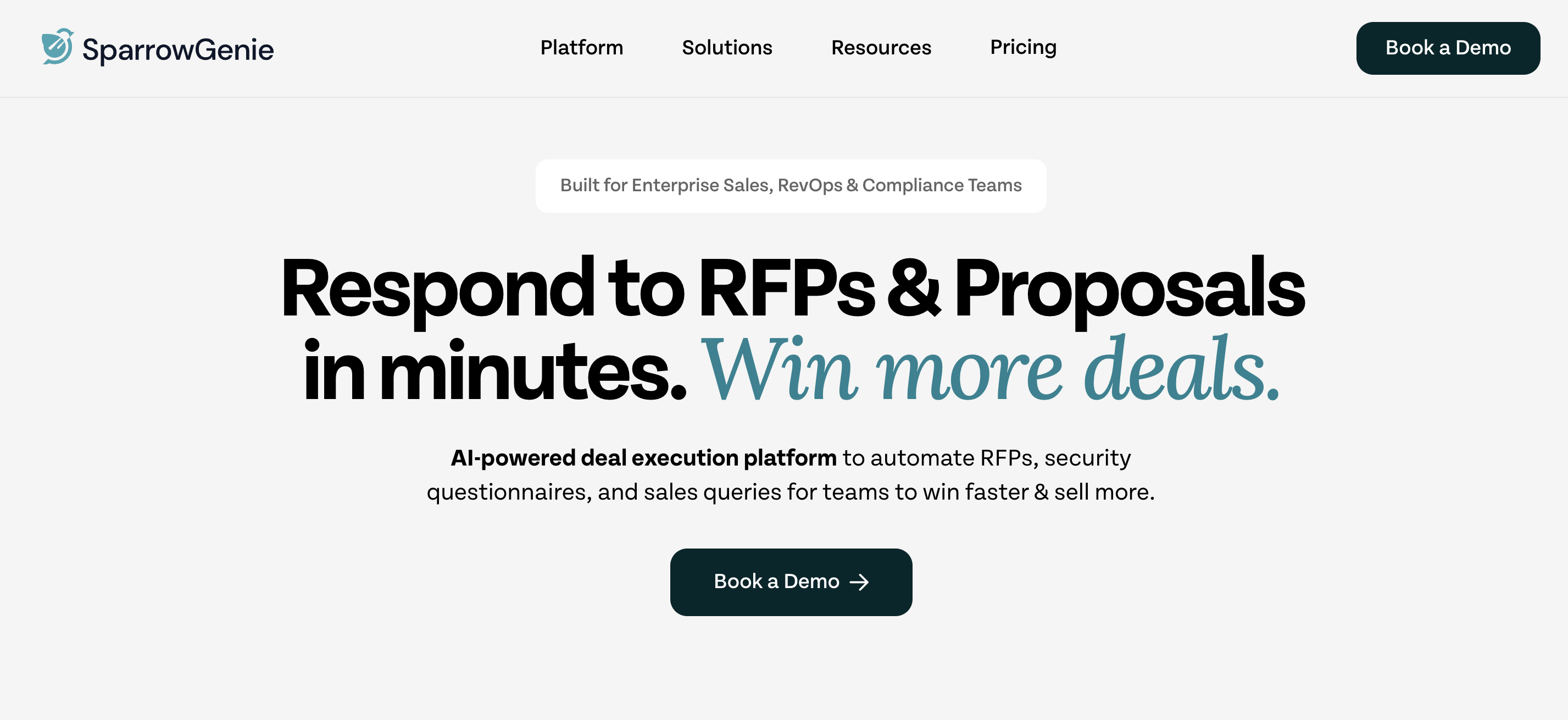
G2 Rating: 4.5 / 5 (newly listed, building review base)
Best For: B2B SaaS, fintech, cybersecurity, and professional services companies with 200 to 5,000 employees handling 10+ RFPs, DDQs, and security questionnaires per month.
Pricing: Three tiers: Essentials (SMBs), Professional (mid-market), Enterprise. Free 14-day trial available.
Key Features
- Confidence-scored AI answers: Every AI-generated response comes with a confidence score. Your team instantly knows which answers are safe to send, which need a second look, and where SME input is required. No other tool in this category offers this level of per-answer transparency.
- Knowledge Hub with Train-Test-Improve loop: SparrowGenie does not just store answers. It continuously learns from every approved response, detects conflicts between existing and new content, identifies growth gaps in your knowledge base, and improves answer quality over time. This is a self-improving system, not a static library.
- Ask Genie AI: Pull accurate, source-cited answers from your approved knowledge base, whether you are mid-RFP, responding to a security questionnaire, or fielding a live buyer question. No more pinging SMEs. No more stale docs. No more guessing.
- Company Intelligence: AI-generated prospect briefings that give your team context before every deal. Instead of going into an RFP blind, your team understands the buyer's business, priorities, and competitive landscape before writing a single word.
- Obligations module: Tracks every commitment made during the proposal process. Pricing promises, SLA guarantees, implementation timelines, everything your team said "yes" to gets captured and monitored so nothing falls through the cracks after the deal closes.
- SOC 2 Type II, ISO 27001, GDPR/CCPA compliance: Enterprise-grade security is the foundation, not a checkbox. Zero data retention means your proposal content is never stored beyond processing. Data isolation ensures your knowledge base is yours alone. Your data is never used to train AI models.
- Human-in-the-loop by design: Reviews, edits, and approvals are native to the workflow. Legal, InfoSec, Product, and Sales collaborate inside the same governed workspace, not across Slack threads and email chains.
Where It Shines
SparrowGenie solves the trade-off that every other tool on this list forces you to make. Legacy platforms give you governance and structure but bolt on AI that feels like an afterthought. AI-native platforms give you speed but leave you guessing whether the AI output is actually trustworthy.
SparrowGenie gives you both. The confidence scoring alone changes how teams work with AI-generated content. Instead of reviewing every answer line by line, your team focuses review time where it actually matters, on low-confidence answers and edge cases. High-confidence answers move through faster. The overall cycle time drops significantly.
The Knowledge Hub's continuous improvement mechanism is unlike anything in the category. Loopio and Responsive require you to manually maintain a library. AutoRFP.ai eliminates the library entirely. SparrowGenie takes a third path: it maintains a living, self-improving knowledge base that gets smarter with every project your team completes.
For InfoSec-heavy workflows, SparrowGenie is particularly strong. It understands the intent behind security questionnaire questions, identifies risk areas, auto-fills verified responses from your approved documentation, and routes exceptions to the right reviewer with a complete audit trail.
Where It Falls Short
- Still building its review base on G2 and Capterra. Enterprise procurement teams that rely heavily on peer review volume may want to see more social proof before committing.
- No publicly visible customer logos or named case studies yet, which is the single biggest gap compared to Loopio (1,700+ customers) and Responsive (Microsoft, Qualtrics).
- Pricing is gated behind a country selector rather than displayed transparently. Teams comparison-shopping may find this a friction point compared to AutoRFP.ai's fully transparent pricing.
- As a newer platform in the SurveySparrow ecosystem, some enterprise features are still maturing compared to decade-old incumbents.
My Opinion
Let me be straightforward. I work here, so take this with that context in mind. But here is what I genuinely believe after spending years in this space.
Most RFP tools ask you to choose between fast AI and trustworthy AI. SparrowGenie does not make you pick. The confidence scoring is not a gimmick. It fundamentally changes how proposal teams interact with AI-generated content. You stop reviewing everything and start reviewing what matters.
The Knowledge Hub is the feature that separates SparrowGenie from the newer AI-native tools. AutoRFP.ai and Inventive AI are strong on initial drafting, but they do not give you a self-improving knowledge system that gets better with every project. SparrowGenie does.
The Company Intelligence and Obligations features are things I have not seen anywhere else in this category. They turn the RFP response from a reactive, isolated task into a strategic, connected part of the sales process. That is a meaningful shift.
The gaps are real. We need more social proof, more visible customer stories, and more transparent pricing. We are working on all three. But if you are evaluating tools right now and you care about security, AI accuracy, and actually trusting what the AI gives you, SparrowGenie deserves 15 minutes of your time.
2. Responsive (formerly RFPIO)
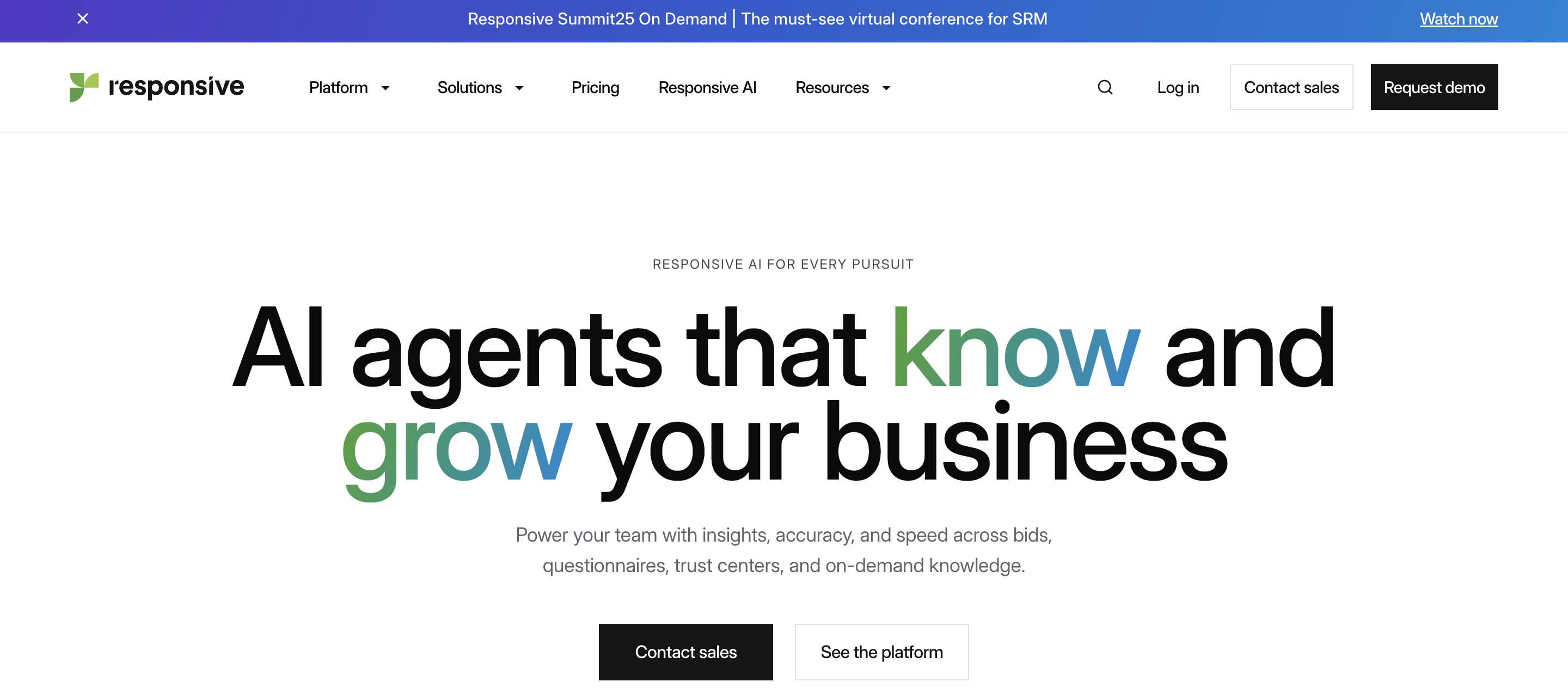
Source: Responsive
G2 Rating: 4.5 / 5 (1,260+ reviews)
Best For: Enterprise teams managing high-volume, multi-type responses across RFPs, RFIs, DDQs, and security questionnaires.
Pricing: Custom, quote-based. Four tiers: Lite, Emerging, Growth, Enterprise.
Key Features
- Unlimited content library storage with intelligent content reuse across every response type.
- AI Agents with TRACE Score for assessing response accuracy and quality.
- Intake Request, LookUp, eSignature, and AI Agent Studio for custom automation workflows.
- SSO, GovCloud hosting, and deep integrations with Salesforce, HubSpot, and other CRMs.
- Pioneered the Strategic Response Management (SRM) category.
Where It Shines
Responsive handles the broadest range of request types in a single platform. If your team juggles RFPs, DDQs, VSQs, and security questionnaires and you need structured workflows with enterprise-grade governance, Responsive is battle-tested. The TRACE Score gives real visibility into AI response quality, something most platforms skip entirely.
Where It Falls Short
- Requires significant upfront setup and ongoing library maintenance. If your library is stale, the AI underperforms.
- AI is largely retrieval-based rather than generatively powerful. It matches existing content well but does not create compelling new narrative from scratch.
- Interface can feel overwhelming. Users consistently report a steep initial learning curve.
- Named-user licensing means every reviewer, approver, or occasional contributor needs a paid seat, which drives up costs.
My Opinion
Responsive is the safe, enterprise-proven choice. If you have a large, well-maintained content library and a dedicated proposal operations team, it will deliver. But if your team is lean, fast-moving, or tired of spending hours maintaining a content library just so the AI can work properly, it might feel like the tool is working you instead of the other way around. The AI is functional, but it is not the kind of generative intelligence that writes a strong first draft from thin air. For teams wanting AI that thinks, not just retrieves, there are sharper options.
Looking for AI that drafts with confidence, not just keyword matches? SparrowGenie delivers AI-native responses with confidence scoring, so your team reviews and refines instead of starting from scratch.
3. Loopio
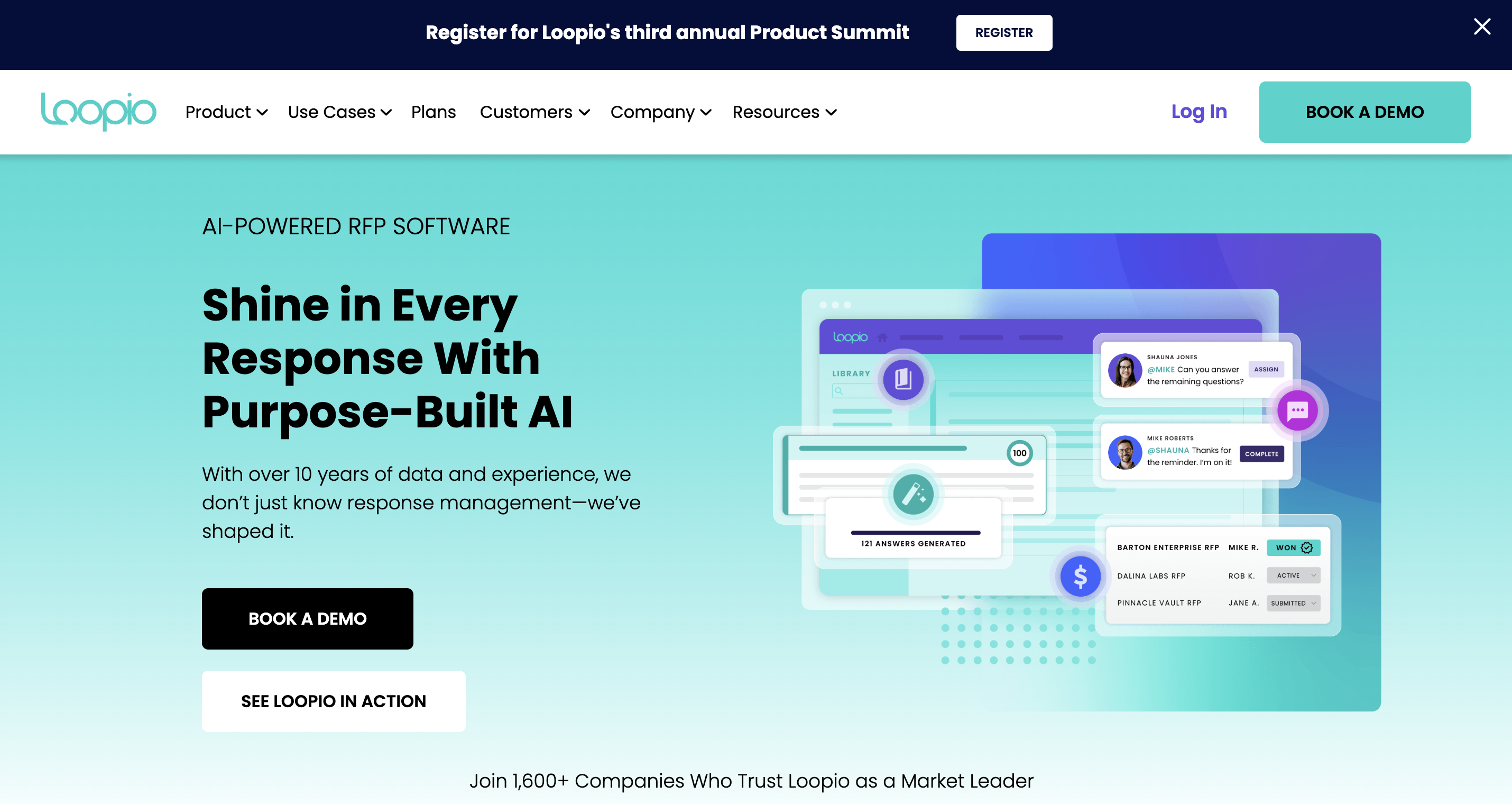
Source: Loopio
G2 Rating: 4.7 / 5 (700+ reviews)
Best For: Mid-market to enterprise teams with dedicated proposal managers and established content libraries.
Pricing: Starts at $20,000/year (Foundation, 10 seats). Enhanced and Enterprise tiers are custom-quoted.
Key Features
- Centralized Answer Library with smart auto-suggest and content governance.
- Magic AI for generating responses directly from maintained library content.
- Strong collaboration tools for assigning questions to SMEs, tracking status, and coordinating reviews.
- Integrations with Salesforce, Highspot, Slack, and other sales tools.
- Multi-library support on Enterprise tier.
Where It Shines
Loopio has the highest G2 rating in its category for a reason. The interface is clean, onboarding is smooth, and customer support scores an industry-leading 9.7 out of 10. For teams formalizing their RFP operations for the first time, Loopio is often the easiest on-ramp. The Answer Library is well-structured, and the collaboration workflow is intuitive even for occasional contributors.
Where It Falls Short
- Magic AI performance depends heavily on library quality and freshness. If your library is outdated, the AI suggestions will be too.
- Per-user pricing becomes a real barrier when you involve SMEs across departments. Inviting legal, security, and product teams adds up fast.
- Not optimized for long-form, narrative proposal writing. Works best for structured Q&A.
- Advanced features like SSO and CRM integrations often come as separately priced add-ons.
My Opinion
Loopio is the gold standard for usability in RFP software. If your team has a dedicated content manager who keeps the library fresh, it will perform well. But let us be honest about the underlying architecture. Loopio was built as a content management system with AI layered on later. The AI recommends from what exists, it does not generate what should exist. That distinction matters when you are responding to a nuanced, high-stakes RFP and the library does not have the right answer. For teams that want AI to do the heavy lifting without requiring a full-time librarian, that is where Loopio starts to feel limiting.
Tired of maintaining a content library just to get decent AI answers? SparrowGenie learns from your connected knowledge sources and generates accurate, confidence-scored drafts without manual library upkeep.
4. Qvidian (Upland Software)
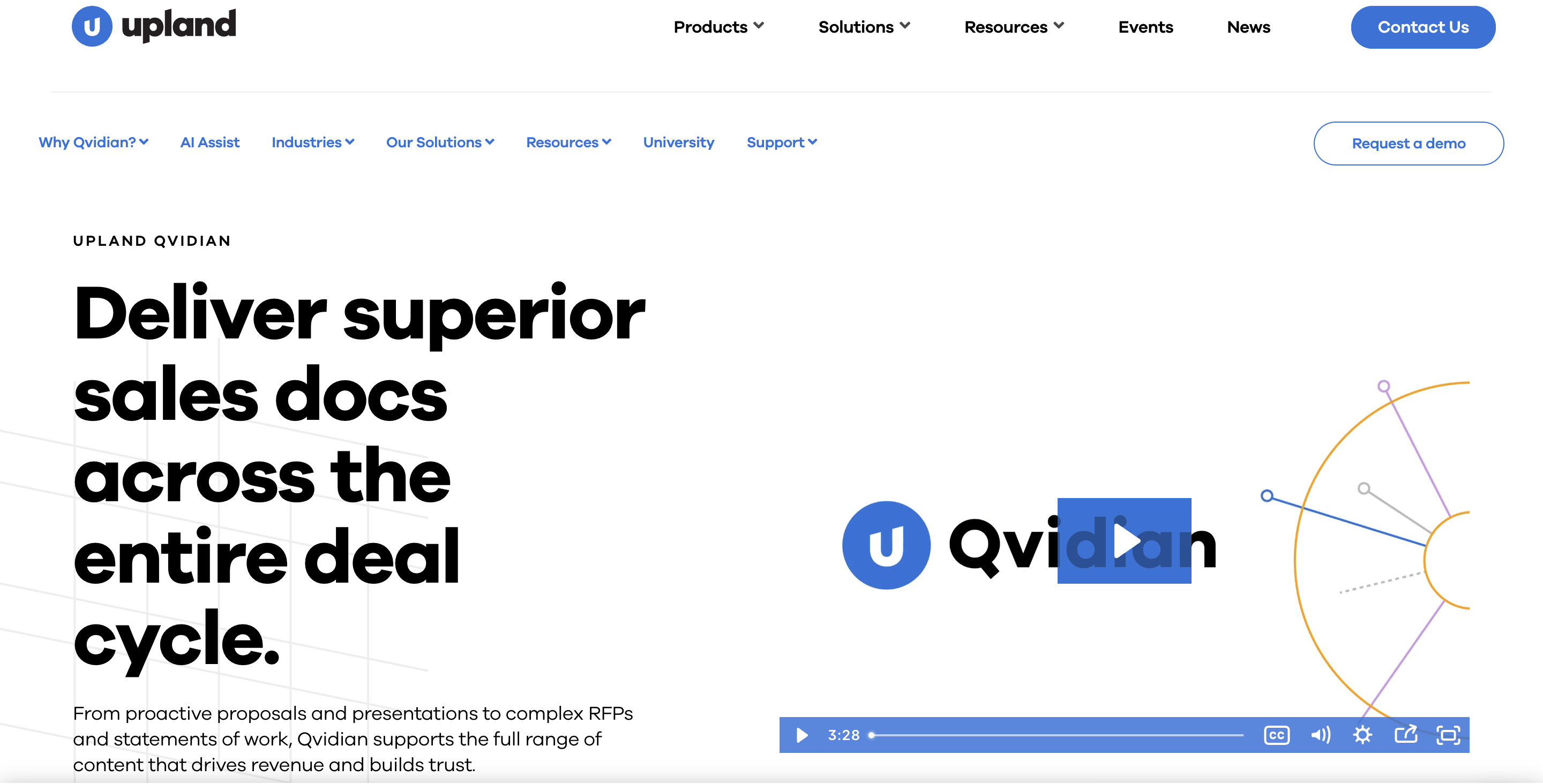
Source: Qvidian
G2 Rating: 4.3 / 5 (156 reviews)
Best For: Large enterprises with high-volume, template-driven RFP workflows in regulated industries.
Pricing: Enterprise-custom. Base licenses range from $15,000 to $25,000 per year, but total costs with implementation, professional services, and AI add-ons can reach $80,000+ annually.
Key Features
- Central content repository for reusable proposal sections and approved responses.
- Template-driven proposal creation with consistent formatting and AutoFill.
- Compliance management, version control, and approval workflows.
- AI Assist available as an add-on for drafting and content rewriting.
- 70+ reporting dashboards for content and process analytics.
Where It Shines
Qvidian has decades of enterprise experience. For organizations with strict governance requirements, especially in financial services, healthcare, and government, the compliance framework and approval workflows are mature and proven. If your proposal process is template-driven and high-volume, Qvidian handles that predictably.
Where It Falls Short
- Pre-dates the generative AI era. AI features are add-ons, not core to the platform.
- Dated user interface. Users report a steep learning curve and clunky collaboration experience.
- Requires significant investment in library setup and often a dedicated content manager.
- Not suited for smaller teams or organizations without a formal proposal function.
My Opinion
Qvidian is the tool your procurement team might choose based on compliance checkboxes. But in 2026, relying on a platform where AI is an afterthought bolted onto a legacy system is a hard sell. The total cost of ownership, including professional services, library setup, and personnel, makes it one of the most expensive options in the category when you calculate it honestly. If your team is evaluating RFP tools today, Qvidian should only be on the shortlist if governance and template compliance are non-negotiable and you have the budget and headcount to support it.
5. Proposify
Source: Proposify
G2 Rating: 4.6 / 5 (350+ reviews)
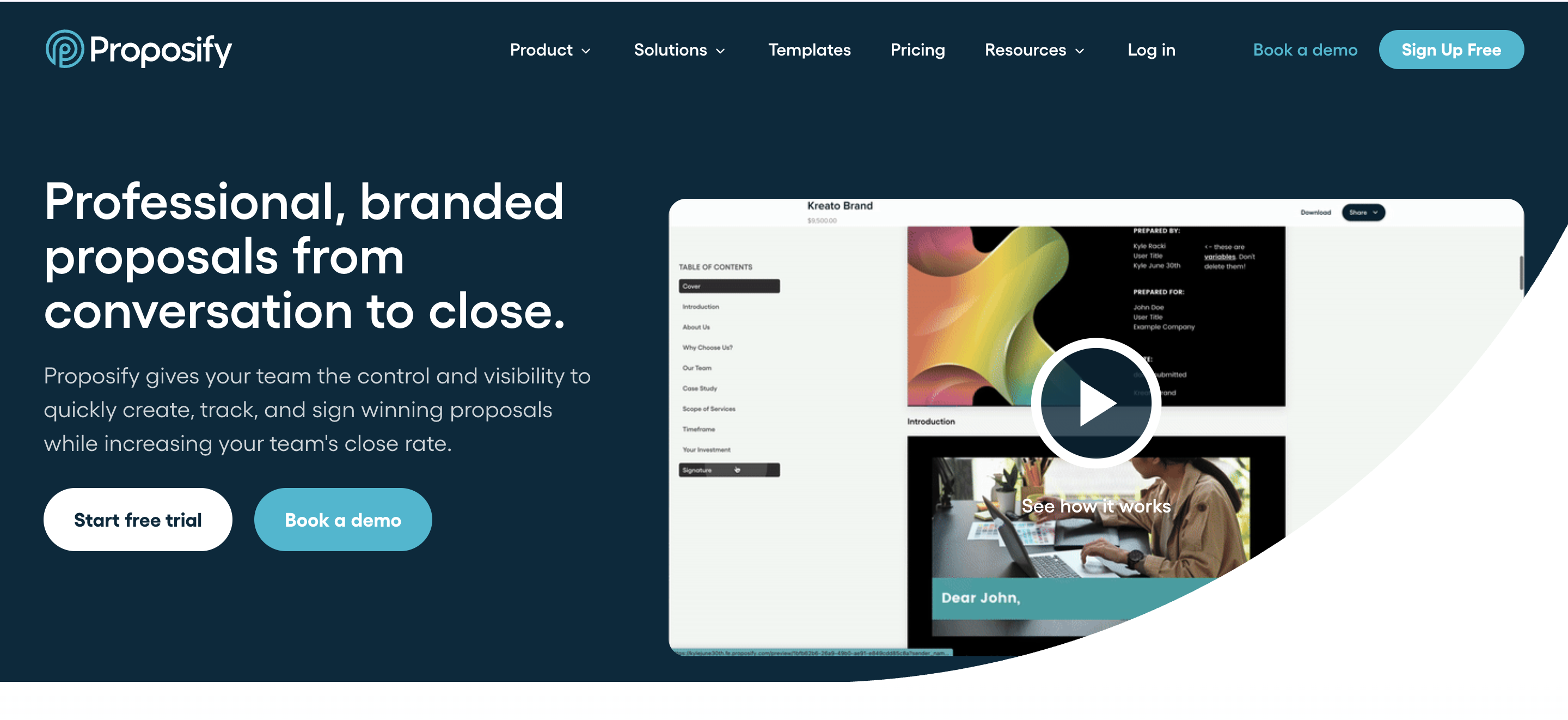
Best For: Sales teams, SMBs, and agencies focused on creating visually compelling sales proposals and closing deals faster.
Pricing: Basic at $19/user/month, Team at $41/user/month, Business at $65/user/month (all billed annually).
Key Features
- Drag-and-drop visual proposal editor with branded templates.
- Interactive quoting where buyers can adjust quantities and pricing in real time.
- Content, section, and snippet library for reusable modules.
- E-signatures, client input forms, and payment processing.
- CRM integrations with HubSpot, Salesforce, and Pipedrive.
Where It Shines
Proposify is the best-looking proposal tool on this list. If your sales process depends on polished, branded proposals that impress buyers visually, Proposify delivers. The interactive quoting feature is genuinely useful for sales-led deals. Transparent pricing with a free trial makes it easy to evaluate. For agencies and services firms where proposal design matters as much as content, Proposify is a strong choice.
Where It Falls Short
- Not designed for government bids, tenders, or structured RFP responses.
- Limited AI drafting capabilities. This is a design-first tool, not a content generation tool.
- Cannot handle complex questionnaire-heavy workflows like security questionnaires or DDQs.
- Per-user pricing gets expensive as teams scale.
My Opinion
Let me be direct. Proposify is a great proposal design tool, but it is not an RFP automation platform. If you are comparing it to AutogenAI, you are comparing two tools built for fundamentally different jobs. Proposify makes your proposals look beautiful. It does not help you answer 200 technical questions under a tight deadline. If your team handles formal RFPs, DDQs, or security questionnaires, Proposify is not the answer. But if your pain is sluggish, ugly sales proposals that do not convert, it is worth a serious look.
6. PandaDoc
Source: PandaDoc
G2 Rating: 4.7 / 5 (3,400+ reviews)
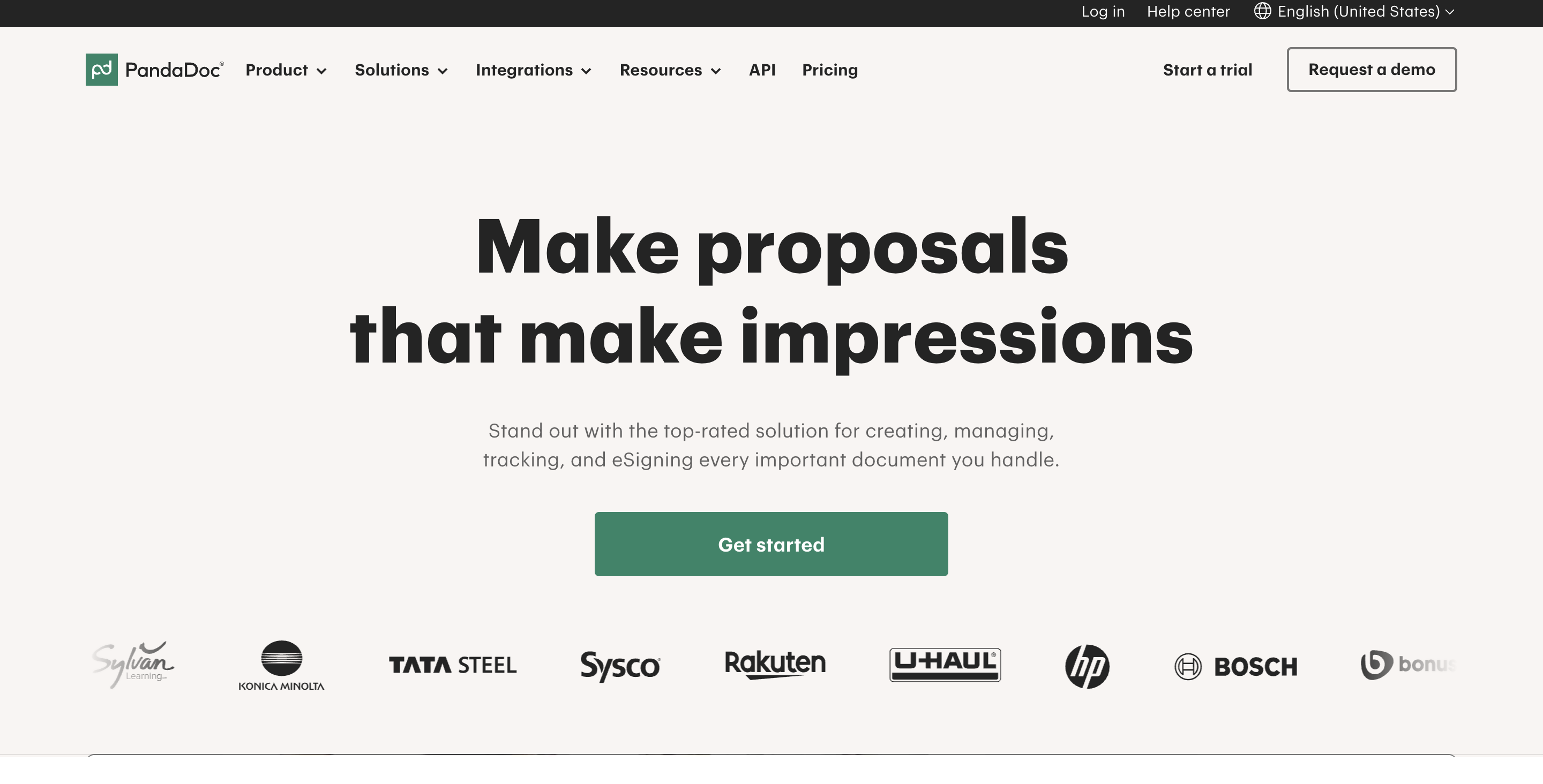
Best For: Sales and RevOps teams needing an all-in-one platform for proposals, contracts, quoting, and e-signatures.
Pricing: Starter at $19/user/month, Business at $49/user/month, Enterprise is custom.
Key Features
- Unlimited document uploads and e-signatures on all paid plans.
- Rich media drag-and-drop editor with real-time tracking and engagement notifications.
- CPQ (Configure Price Quote) for generating accurate, complex sales quotes.
- Smart content with conditional content blocks for dynamic proposals.
- CRM integrations with Salesforce, HubSpot, and more. API access on Enterprise tier.
Where It Shines
PandaDoc covers the broadest document lifecycle of any tool on this list. Proposals, quotes, contracts, NDAs, e-signatures, and even payment collection all happen in one platform. With over 3,400 G2 reviews, it has massive social proof. The real-time document tracking, where you can see who opened your proposal and which sections they spent time on, is genuinely valuable for sales follow-up.
Where It Falls Short
- Not designed for competitive bid management, tenders, or government RFPs.
- No AI-first drafting engine trained on proprietary content. The AI helps format and template, not write.
- Limited support for compliance-heavy or narrative-heavy bid writing.
- Advanced features have been moved to higher-priced tiers, frustrating some long-time users.
My Opinion
PandaDoc is one of the most popular document tools in the world for a reason. It does a lot of things well. But it is a document automation platform, not an RFP response platform. If your team mostly creates sales proposals, contracts, and quotes, PandaDoc is excellent. If your team responds to formal RFPs with 150 questions about your security posture, compliance certifications, and technical architecture, PandaDoc is not built for that. Know the job you are hiring the tool to do.
Need a platform built for RFP responses, security questionnaires, and DDQs, not just sales proposals? SparrowGenie handles the complexity enterprise buyers demand.
7. QorusDocs
Source: QorusDocs
G2 Rating: 4.4 / 5 (166 reviews)
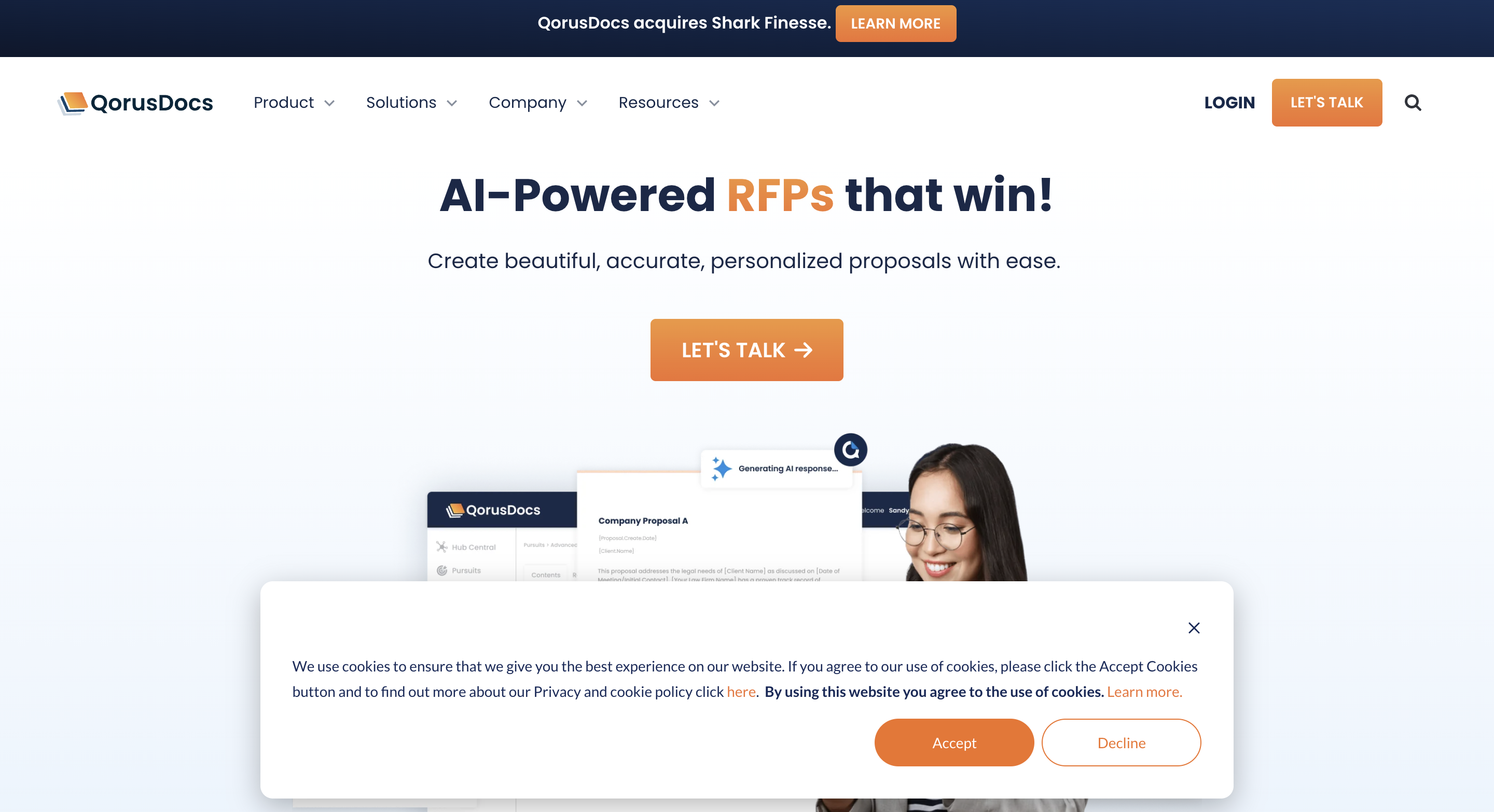
Best For: Professional services and financial firms that work primarily within Microsoft 365.
Pricing: Starts around $19/user/month (Proposal Pro). Enterprise plans are quote-based.
Key Features
- Native M365 integrations: works directly in Word, PowerPoint, Excel, and Outlook.
- QPilot AI for personalized content generation using Azure OpenAI (data stays private within your tenant).
- Centralized content library with governance, permissions, and smart layouts.
- Win-rate analytics, pursuit analytics, and ROI performance tracking.
- CRM integrations with Salesforce, Dynamics, and DealCloud.
Where It Shines
If your entire organization runs on Microsoft 365, QorusDocs is the most natural fit. There is no learning curve because your team works in Word and PowerPoint, the tools they already know. The Azure OpenAI integration means your data stays within your Microsoft tenant, which is a strong security story for enterprises with strict data residency requirements.
Where It Falls Short
- Requires Microsoft 365 infrastructure. If your team uses Google Workspace, this is not the right tool.
- AI is strong within the M365 context but may not match the depth of purpose-built LLM engines for complex bids.
- Smaller community and fewer integrations outside the Microsoft ecosystem.
- Some users report occasional system crashes and complex initial configuration.
My Opinion
QorusDocs is the right choice for a specific buyer: the Microsoft-first enterprise. If your team lives in Word, SharePoint, and Outlook, and your CISO wants data processed through Azure, QorusDocs makes a compelling case. But this also means it is inherently limited. Teams on Google Workspace, hybrid environments, or those wanting a standalone AI-native platform will find QorusDocs constraining. The analytics are a genuine differentiator, though. Win-rate tracking and pursuit analytics are features that most RFP tools still do not offer.
8. Ombud
Source: Ombud
G2 Rating: 4.7 / 5 (26 reviews)
Best For: Mid-size RevOps, sales engineering, and proposal teams managing a mix of RFPs, InfoSec questionnaires, and SOWs.
Pricing: Fully custom, quote-based. Pricing varies by team size, volume, integrations, and service scope.
Key Features
- OmMatch recommendation engine for automatic content matching and RFP auto-fill.
- Ombuddies: specialized AI agents for Sales Engineering, Response Management, and RevOps.
- Centralized knowledge storage with workflow coordination.
- Supports RFPs, RFIs, InfoSec questionnaires, proactive sales proposals, SOWs, and POC frameworks.
- Designed to scale RevOps operations without proportional headcount increases.
Where It Shines
Ombud is the most RevOps-centric tool on this list. If your challenge is unifying sales proposals, RFPs, security questionnaires, and SOWs under one workflow with role-specific AI support, Ombud is purpose-built for that. The Ombuddies concept, specialized AI agents for different team functions, is a smart design decision that maps to how real proposal teams actually work.
Where It Falls Short
- OmMatch relies primarily on traditional machine learning and keyword matching, not generative AI. It is less powerful than newer AI-first platforms.
- Complex enterprise workflows require extensive manual configuration.
- Governance and analytics are limited compared to newer platforms.
- Small review base on G2 (26 reviews), which can make procurement sign-off harder.
- Pricing is unpredictable at enterprise scale due to add-ons and onboarding fees.
My Opinion
Ombud has a clear identity: it is the RevOps team's proposal platform. That focus is both its strength and its limitation. If your organization has a unified revenue operations function that manages diverse document types across sales and pre-sales, Ombud fits well. But the AI feels a generation behind newer entrants. OmMatch is keyword-driven matching, not semantic understanding. For teams that want AI to genuinely draft and improve content rather than just surface existing answers, Ombud may feel like it is solving yesterday's problem with yesterday's technology.
9. Inventive AI
Source: Inventive.ai
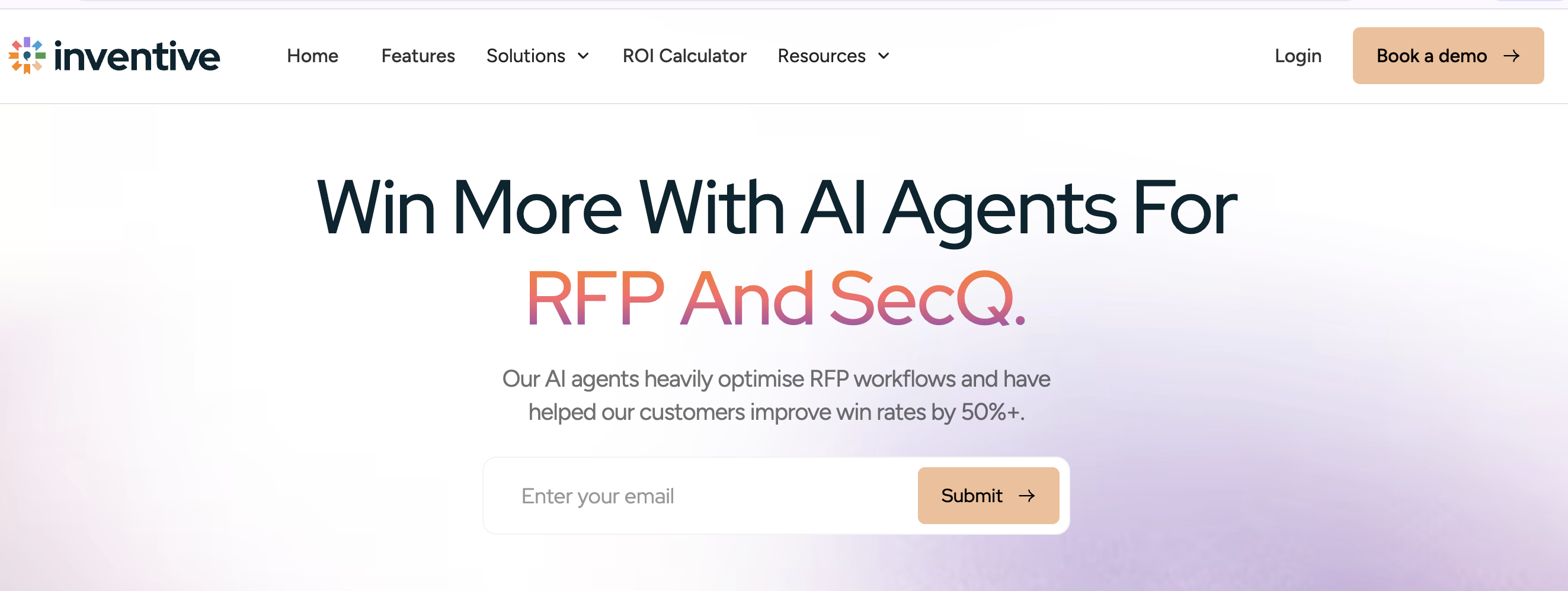
G2 Rating: 5.0 / 5 (86 reviews)
Best For: Scaling enterprises that need high-accuracy, high-volume RFP and security questionnaire responses.
Pricing: Usage-based (per RFP), unlimited users included. Custom pricing based on team size and features.
Key Features
- Multi-agent AI system with a Central Knowledge Hub for automated content management.
- Automated conflict detection to identify contradictory responses before submission.
- Content freshness automation with real-time governance.
- Claims 95% response accuracy and 2x higher response quality than competing platforms.
- Supports RFPs, RFIs, DDQs, and security questionnaires.
Where It Shines
Inventive AI is one of the most technically ambitious platforms in this category. The multi-agent architecture is genuinely different from single-model approaches, and the automated conflict detection is a feature compliance-heavy teams will appreciate. Usage-based pricing with unlimited users is a buyer-friendly model that removes the per-seat friction that kills collaboration on other platforms. The perfect G2 rating speaks to strong early customer satisfaction.
Where It Falls Short
- Less proven for long-form narrative proposals. Strongest on structured questionnaires.
- Newer platform with a smaller customer base and fewer independently verified case studies.
- Limited language support compared to some competitors.
- 86 reviews is a strong start but procurement teams may want more social proof before committing.
My Opinion
Inventive AI is the kind of platform that makes you pay attention. The multi-agent approach, conflict detection, and content freshness automation are forward-looking features that most established tools have not even attempted. The 5.0 G2 rating with 86 reviews is impressive, though it is worth noting that newer platforms tend to have higher early ratings before the broader market tests them. My take: if you are handling high-volume questionnaires and compliance-heavy responses, Inventive AI deserves a demo. But if your team also writes long-form narrative proposals, test that use case carefully before committing.
Want AI that gives you confidence scores on every answer, so your team knows exactly what to trust and what to review? SparrowGenie was built for that.
10. AutoRFP.ai
Source: AutoRFP.ai
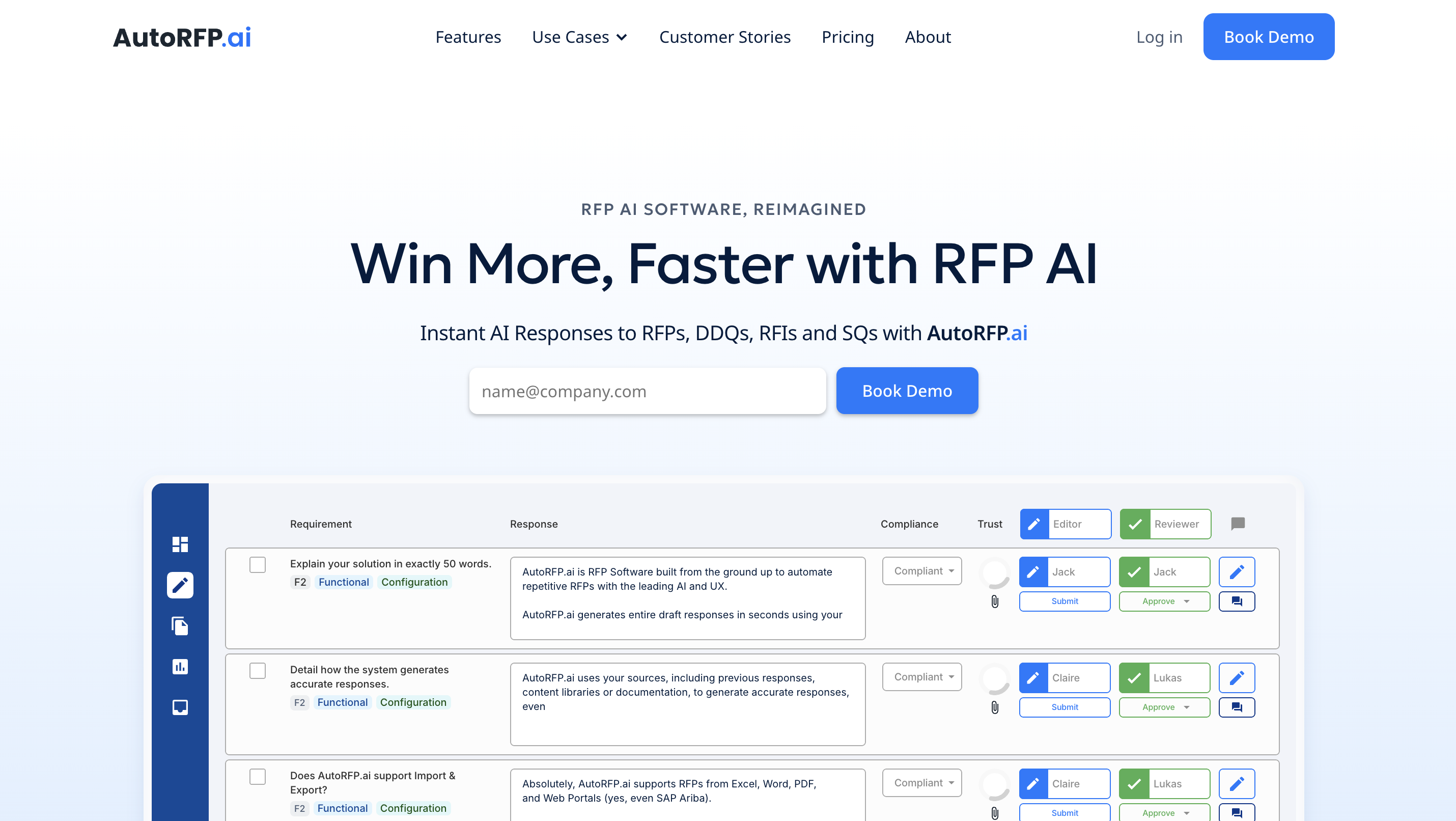
G2 Rating: 4.9 / 5 (80+ reviews)
Best For: AI-native teams that want zero manual library maintenance, transparent pricing, and unlimited user collaboration.
Pricing: Scale at $899/month (24 projects/year), Accelerate at $1,299/month (50 projects/year), Enterprise is custom. All features included on all plans.
Key Features
- AI-native content learning: no manual library maintenance required. AI learns in real time from uploaded content.
- Unlimited users on all plans, all features included with no paid add-ons.
- Supports RFPs, RFIs, tenders, DDQs, and security questionnaires.
- 18+ native integrations, ISO 27001:2022 certified.
- Browser extension for responding directly in procurement portals like SAP Ariba.
Where It Shines
AutoRFP.ai has the most transparent and buyer-friendly pricing in the category. All features on all plans, unlimited users, no paid add-ons. That alone sets it apart from every legacy competitor. The elimination of manual content library maintenance is a genuine relief for teams who have spent years fighting library rot on other platforms. The browser extension for web portals is a unique capability that adds real workflow value.
Where It Falls Short
- Newer platform with less track record on complex, narrative-heavy government bids.
- Project-based pricing can become expensive at very high volumes (60+ RFPs per year).
- Limited advanced reporting and analytics compared to mature platforms.
- Some users report UI quirks and a learning curve during initial setup.
My Opinion
AutoRFP.ai is the most disruptive pricing model in RFP software right now. And that matters, because pricing is one of the biggest friction points in this category. The library-less approach is a smart bet on where the market is heading. Every established vendor is still charging you to maintain a content library that their AI needs to function. AutoRFP.ai skips that step entirely. The trade-off is maturity. If you are a government contractor managing complex narrative bids, AutoRFP.ai is not there yet. But for mid-market teams handling structured questionnaires and standardized RFPs, it is one of the sharpest options available.
11. DeepRFP
Source: DeepRFP
G2 Rating: 4.3 / 5 (limited reviews)
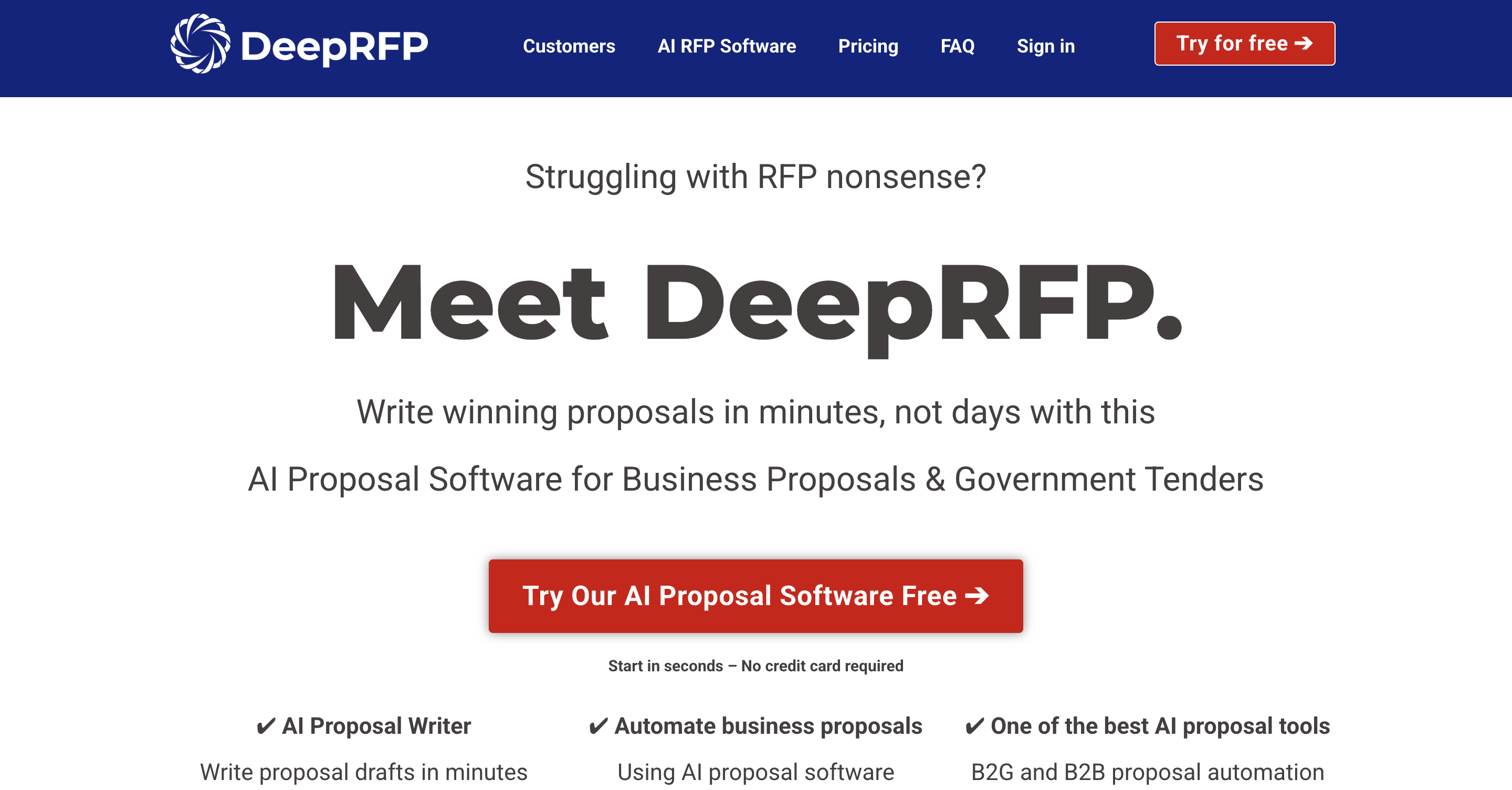
Best For: Bid managers, proposal writers, and lean teams handling compliance-heavy RFPs who need risk analysis alongside content drafting.
Pricing: Pro at $75/user/month, Elite at $125/user/month.
Key Features
- AI agent ecosystem: Proposal Writer, RFP Analyzer, Questionnaire Responder, Proposal Reviewer.
- RFP Shredder that automatically analyzes incoming RFPs for requirements, risks, and compliance matrices.
- Virtual SMEs and AI Agents that mimic internal subject matter experts.
- Multilanguage support covering up to 28 languages.
- Data privacy: does not train on client content beyond their own instance.
Where It Shines
DeepRFP's standout feature is the RFP Analyzer, which flags compliance gaps, risks, and requirements that human reviewers might miss. For bid managers who spend hours manually shredding RFP documents to build compliance matrices, this is a genuine time saver. The per-user pricing is transparent and accessible for individual consultants and small teams. The multi-agent approach with specialized agents for different proposal stages is a thoughtful design.
Where It Falls Short
- Seat-based pricing becomes expensive as teams scale. At $125/user/month (Elite), a team of 15 pays $22,500 per year.
- User interface has been described as basic. Lacks the polish of more established platforms.
- Limited enterprise-grade content library management, workflow automation, and governance.
- Better suited for individual contributors than large, cross-functional bid teams.
My Opinion
DeepRFP is a smart tool for a specific buyer: the solo bid manager or small proposal team that needs AI-assisted drafting with compliance awareness. The risk analysis capability is genuinely useful and differentiating. But it is not an enterprise platform. If your team is five people or fewer and you need affordable, AI-powered drafting with compliance checks, DeepRFP is worth evaluating. If you are building a proposal operations function at scale, you will outgrow it quickly.
How Do You Choose the Right AutogenAI Alternative?
The right platform depends on three things: your proposal workflow, your team size, and your budget.
Here is a quick decision framework:
- Large enterprises with complex narratives and GovCon bids: AutogenAI remains strong, or consider QorusDocs for M365-first organizations.
- Enterprise teams managing structured questionnaire volumes: Responsive or Loopio.
- AI-native teams wanting zero library maintenance: AutoRFP.ai.
- Compliance and risk-focused bid managers: DeepRFP.
- RevOps teams unifying sales and proposal workflows: Ombud.
- Sales teams focused on design and deal velocity: Proposify or PandaDoc.
- Scaling teams prioritizing accuracy and governance: Inventive AI.
- Teams that need secure, AI-native automation without compromising on compliance: SparrowGenie.
Conclusion
Choosing the right RFP platform is not about picking the tool with the highest G2 rating or the flashiest AI demo. It is about matching the platform to how your team actually works.
AutogenAI is a strong tool for what it was built to do: long-form, narrative-heavy proposals for enterprise bid teams. If that is your world, it delivers. But if your team handles structured questionnaires, security assessments, and DDQs alongside proposals, or if opaque pricing and library maintenance fatigue are slowing you down, the alternatives in this guide offer real paths forward.
Here is the honest takeaway after reviewing all 10 tools:
Legacy platforms like Responsive, Loopio, and Qvidian give you structure, governance, and enterprise credibility. But they were built before generative AI existed, and it shows. The AI works, but only if you feed it a well-maintained library. That is a cost most teams underestimate.
Sales-focused tools like SparrowGenie, Proposify and PandaDoc are excellent at what they do. But they are not RFP platforms. If someone on your team is evaluating them as AutogenAI alternatives, the real problem is that the use case has not been clearly defined yet.
AI-native challengers like Inventive AI, AutoRFP.ai, and DeepRFP are pushing the category forward with smarter pricing, library-less architectures, and multi-agent AI. They are worth watching closely, though maturity and enterprise-readiness vary.
And then there is the question that sits underneath every tool decision: do you trust what the AI gives you?
That is the question SparrowGenie was built to answer. Confidence scoring on every response. A Knowledge Hub that improves with every project. Security that does not ask you to compromise. And features like Company Intelligence and Obligations that turn RFP responses from a reactive chore into a strategic advantage.
Whatever you choose, pick the tool that solves your specific pain, not the one with the best marketing. Take demos. Involve your actual users. Test with a real RFP, not a sandbox scenario.
And if you want to see what AI-native, secure RFP automation feels like when it is built right, book a SparrowGenie. Fifteen minutes is all it takes.
Ready to see how AI can transform your RFP process?
Product Marketer at SparrowGenie
Being a Product Marketer at SparrowGenie, Aparna helps sales teams work faster with secure, AI-powered proposal automation. She turns complex features into simple stories, builds messaging that resonates, and keeps a close pulse on what customers actually need. She loves shaping clear, helpful content that shows how SparrowGenie makes RFP work easier, faster, and a lot less stressful.
Frequently Asked Questions (FAQs)
Related Articles

Why You Need a Revenue Intelligence Platform to Hit Your Number

How Choosing Proposal Management Software Transformed My Sales Team