10+ Best Inventive.ai Alternatives & Competitors for Modern RFP & Proposal Teams

Article written by
Aparna Rajendran

INSIDE THE ARTICLE
SHARE THIS ARTICLE
Summary
Evaluating Inventive.ai alternatives isn’t about features anymore; it’s about speed, trust, and risk. This in-depth guide breaks down the top 10 Inventive.ai alternatives, comparing AI depth, governance, collaboration, and real-world fit, so revenue teams can choose the right platform without costly trade-offs.
If you’re evaluating Inventive.ai alternatives, you’re at the right place. That also means, you’re not asking what RFP software is. You’re asking harder questions:
- Why do some tools still need armies of SMEs?
- Why does AI feel fast but not trustworthy?
- Why does every RFP still turn into Slack chaos and review hell?
Inventive.ai proved that AI-native RFP automation can materially improve win rates, not just speed. But it’s not the only option anymore, and it’s not the right fit for every team.
This guide goes deep into the best 10+ alternatives to Inventive.ai. Not feature lists. Not marketing fluff. Real architectural differences, real trade-offs, and real buyer guidance.
How We’re Evaluating These Tools
Each platform below is evaluated across five dimensions that actually matter in production RFP environments:
- AI architecture: Native vs bolted-on
- Response quality: Usable drafts vs placeholders
- Operational drag: Library maintenance, reviews, rework
- Governance & risk: Compliance, auditability, conflicts
- Cost realism: Licenses and hidden efforts
With that lens, let’s break them down.
Looking for an Inventive.ai alternative that doesn’t trade speed for trust?
1. SparrowGenie
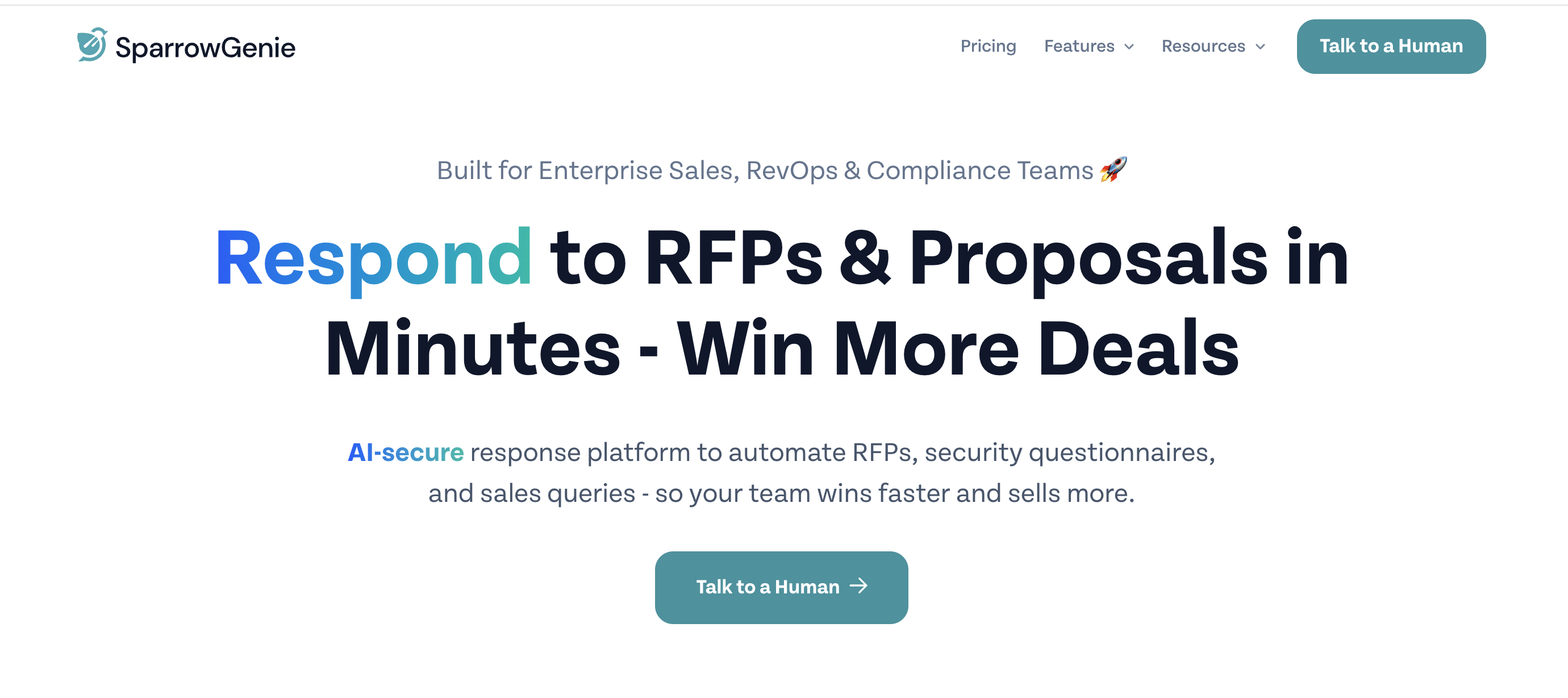
Secure AI Responses Without Losing Control
G2 Rating: 4.5/5
Most RFP tools force an uncomfortable trade-off. Either you move fast with AI and lose confidence… Or you stay compliant and drown in reviews. SparrowGenie is built specifically to break that trade-off. SparrowGenie operates as a secure AI sales assistant for revenue teams handling RFPs, security questionnaires, proposals, and ad‑hoc sales questions, all from one governed workspace.
Where SparrowGenie genuinely shines
1. Confidence-scored AI answers
Every AI-generated response comes with a confidence score. Teams immediately know which answers are safe to use, which need review, and where SME input is required. This single feature fundamentally changes trust in AI output.
2. Human-in-the-loop by design
Reviews, edits, and approvals are part of the native workflow, not bolted on later. Legal, InfoSec, Product, and Sales collaborate inside the same workspace, eliminating Slack ping-pong and version chaos.
3. One governed source of truth
Approved answers, compliance language, product messaging, and proposal content live in one centralized, permission-controlled workspace. No conflicting versions across docs, drives, or spreadsheets.
4. Built for real revenue workflows
SparrowGenie isn’t optimized just for proposal managers. It’s designed for sales reps, solution engineers, RevOps, InfoSec, and legal teams, reflecting how RFPs actually move through an organization.
5. Enterprise-grade security from day one
Designed for sensitive RFPs and security questionnaires, SparrowGenie emphasizes encryption, granular permissions, and compliance-ready controls, making it viable for enterprise and regulated environments.
Where SparrowGenie stands apart architecturally
Legacy tools organize content. Pure AI tools generate text. SparrowGenie does both but adds governance and confidence signaling in between. The result is AI that accelerates work while keeping humans in control, instead of asking teams to trust outputs they can’t validate.
Who SparrowGenie is a strong fit for
- Teams handling complex, cross-functional RFPs
- Organizations dealing with high volumes of security questionnaires
- Revenue teams where accuracy directly impacts win rates
- Enterprises that need AI speed and compliance discipline
- Teams tired of juggling multiple tools for answers, drafts, and reviews
Who should think twice
- Very small teams looking for the cheapest automation option
- One-off proposal needs with no repeat volume
- Organizations unwilling to invest minimal upfront setup for long-term gains
Bottom line on SparrowGenie
SparrowGenie isn’t trying to replace humans with AI. It’s designed to remove friction, reduce risk, and restore confidence in every response a team sends. For revenue teams that care about speed and credibility and don’t want to choose between them, SparrowGenie sets the bar for what modern RFP response software should look like.
See how teams respond faster without losing control with SparrowGenie.
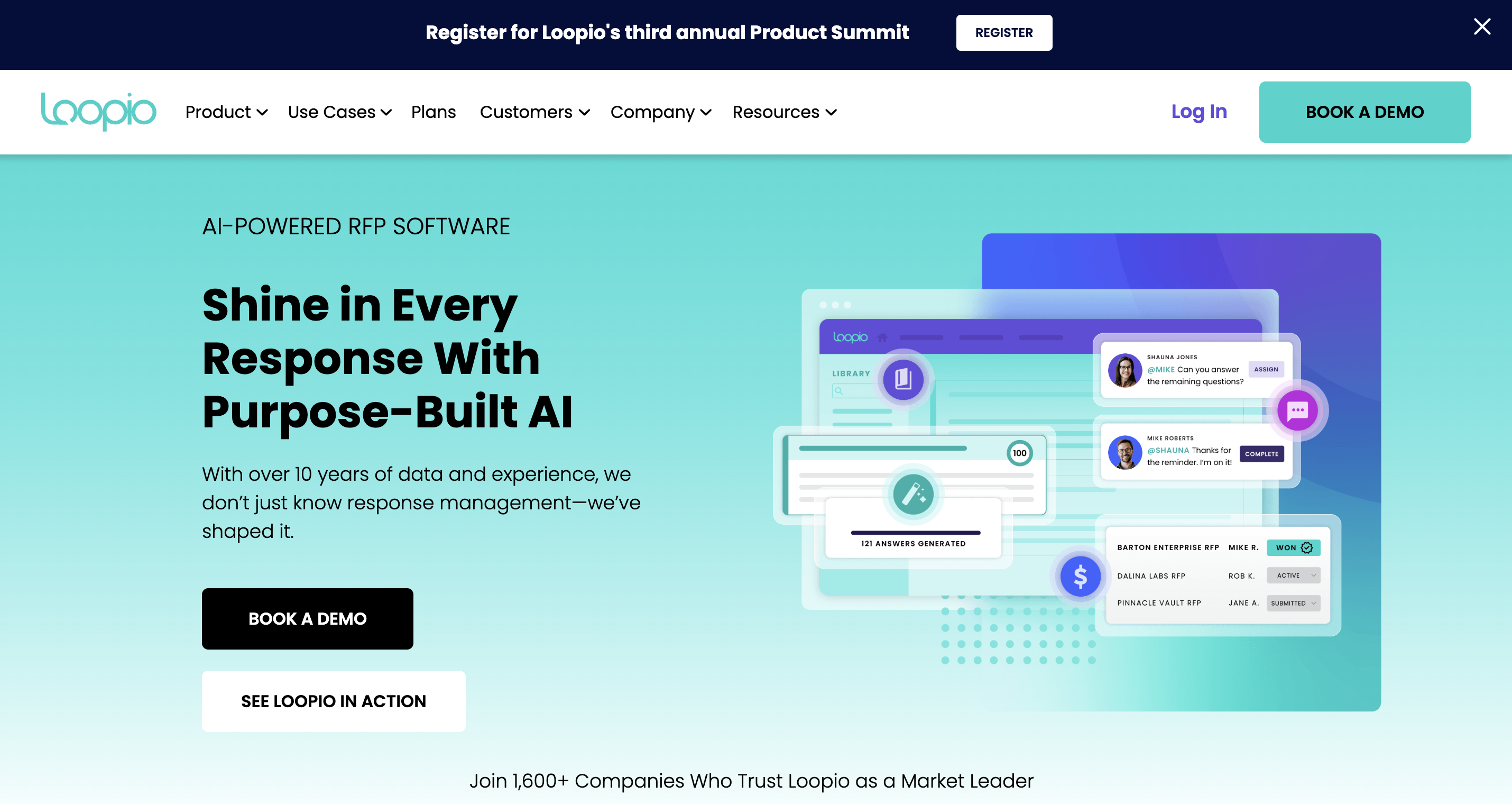
2. Loopio
Source: Loopio
Strong Content Governance, Heavy Maintenance Tax
G2 Rating: 4.6/5
Loopio is one of the most established names in RFP response software. It earned that position by solving a very real early problem: bringing order, consistency, and control to scattered proposal content.
At its core, Loopio is a content library-first platform. Everything works when your answers are approved, current, and well-maintained. And that’s also where the trade-off begins.
Where Loopio genuinely shines
1. Mature content governance
Loopio’s biggest strength is control. Versioning, approvals, content expiration, ownership, and audit trails are robust and dependable. For regulated industries, this level of governance reduces risk and keeps compliance teams comfortable.
2. Predictable reuse for repetitive RFPs
If your RFPs are highly repetitive and your messaging doesn’t change often, Loopio performs well. The system reliably surfaces previously approved answers and enforces consistency across submissions.
3. Enterprise-ready collaboration structure
Role-based permissions, review workflows, and structured task assignment make Loopio suitable for large, distributed teams, especially those with dedicated proposal managers.
4. Proven ecosystem and stability
Loopio integrates with major enterprise tools like Salesforce, Microsoft 365, and Slack, and it has years of operational maturity behind it. For conservative buyers, this stability matters.
Where Loopio starts to show its age
1. The library maintenance burden
Loopio’s value depends entirely on the health of its content library. Answers don’t stay current on their own. SMEs must continuously review, update, retire, and reapprove content. Over time, this becomes a quiet but significant operational tax.
2. AI as an add-on, not a foundation
Loopio’s AI assists with rephrasing, summarization, and content suggestions, but it does not deeply understand full RFP context. It helps polish answers; it does not reliably draft them from scratch. As a result, teams still spend considerable time editing and validating outputs.
3. Limited adaptability to nuanced questions
When RFP questions are slightly reworded, highly technical, or context-dependent, Loopio often surfaces “close enough” answers that require manual rewriting. This erodes trust in automation and pulls SMEs back into the loop.
4. Collaboration becomes a pricing decision
Loopio’s seat-based pricing can discourage broad participation. Adding legal, InfoSec, or product stakeholders often triggers cost conversations, which pushes collaboration back into email and Slack, outside the system.
Who Loopio is a strong fit for
- Large enterprises with dedicated proposal or content managers
- Teams in regulated industries prioritizing control and consistency
- Organizations with stable offerings and low messaging volatility
Who should think twice
- Teams trying to reduce ongoing SME involvement
- Organizations expecting AI to generate strong first drafts
- Mid-market companies without resources to maintain large libraries
Bottom line on Loopio
Loopio is a reliable content control system, not a modern AI-first response engine. It excels at governing what you already know. It struggles to adapt quickly when things change.
For organizations that value predictability and compliance over speed and flexibility, Loopio remains a safe choice. But for teams looking to escape constant content upkeep and move faster without sacrificing accuracy, newer AI-native platforms represent a meaningful shift forward.
3. Responsive (RFPIO)
Source: Responsive
Enterprise Workflow Muscle, AI That Still Needs Supervision
G2 Rating: 4.5/5
Responsive is best understood as a process-first RFP platform. It was built to bring structure, accountability, and visibility to large proposal operations long before AI became table stakes.
If your biggest problem is coordination, who owns what, when reviews happen, and whether deadlines slip, Responsive does a lot of things right.
Where Responsive genuinely shines
1. Workflow orchestration at enterprise scale
Responsive is excellent at managing complex, multi-department RFP motions. Intake workflows, task assignment, review stages, approvals, and audit trails are deeply configurable. For large organizations with rigid procurement and compliance processes, this structure is valuable.
2. Integration-heavy environments
Responsive plugs into a wide ecosystem: CRM, content repositories, collaboration tools, and sales enablement platforms. For enterprises already standardized on tools like Salesforce, SharePoint, or Seismic, Responsive fits neatly into existing infrastructure.
3. Visibility and reporting
Dashboards, response analytics, and win/loss tracking give leadership a clear view into proposal throughput and bottlenecks. This is especially useful for RevOps teams focused on operational efficiency rather than content quality.
Where Responsive starts to strain
1. AI that assists, but doesn’t truly reason
Responsive’s AI is largely optimized for search and reuse, not deep contextual drafting. It relies heavily on keyword matching and existing content, which often results in answers that feel technically correct but strategically shallow. Teams frequently report that AI outputs still need significant rewriting.
2. High operational overhead
Despite AI features, Responsive still depends on a well-maintained content library. That means ongoing SME involvement, tagging, reviews, and content hygiene, work that doesn’t scale well and quietly erodes the time savings AI is supposed to deliver.
3. Adoption friction across teams
The platform is powerful but complex. Many organizations enable dozens of users, yet only a fraction actively use the system. SMEs often stay in Slack or email, which reintroduces the very chaos Responsive aims to eliminate.
4. Cost escalates quickly
Per-user pricing becomes a real constraint as more contributors are added. Including legal, InfoSec, product, and engineering stakeholders can significantly increase total cost of ownership, making collaboration a budget conversation instead of a workflow decision.
Who Responsive is a strong fit for
- Fortune 500 or large enterprises with established proposal ops teams
- Organizations prioritizing process governance and reporting over AI-led drafting
- Teams willing to invest in ongoing content management and training
Who should think twice
- Teams expecting AI to handle first drafts with minimal editing
- Organizations trying to reduce SME dependency, not formalize it
- Mid-market companies seeking fast deployment and lower overhead
Bottom line on Responsive
Responsive is a strong operational backbone, but not a leap forward in AI-driven response quality. It helps large teams stay organized. It does not fundamentally change how responses are written.
For organizations where workflow control is the primary objective, Responsive remains a viable option. But for teams looking to move faster and trust what AI produces, newer AI-native platforms set a very different bar.
Experience one secure workflow for sales, legal, and InfoSec with SparrowGenie.
4. Arphie
Source: Arphie
AI-Native Speed With Minimal Legacy Baggage
G2 Rating: 4.9/5
Arphie represents a clean break from traditional RFP thinking. Instead of asking teams to curate and babysit content libraries, Arphie is built on a simple premise: your best answers already exist, AI should pull, synthesize, and write from them in real time. That architectural choice shapes everything the platform does well and where it still falls short.
Where Arphie genuinely shines
1. True AI-native architecture
Arphie connects directly to live sources like Google Drive, Confluence, SharePoint, and internal wikis. When those sources change, answers update automatically. There’s no separate “library maintenance” workflow, which removes a major operational drag found in legacy tools.
2. High-quality first drafts
Arphie’s biggest win is response usability. A large percentage of AI-generated answers are accepted with little to no editing, especially for technical and product-heavy sections. This materially reduces SME involvement and accelerates turnaround time.
3. Formatting and export reliability
Unlike many AI tools that break formatting during export, Arphie preserves structure well. Drafts remain aligned with original RFP formats, which matters more than vendors often admit, especially for Excel- or portal-heavy submissions.
4. Fast time-to-value
Implementation is measured in weeks, not months. Teams can connect sources, upload historical RFPs, and start responding quickly without a long configuration phase.
Where Arphie starts to show limits
1. Lighter enterprise governance
While Arphie handles drafting exceptionally well, its governance depth is thinner than platforms designed for highly regulated environments. Arphie's advanced conflict detection, multi-layer approval enforcement, and detailed audit controls are more limited.
2. Smaller enterprise footprint
Arphie is newer than legacy incumbents. For very large enterprises, this can raise questions around long-term scale, customization depth, and vendor maturity, even if the technology itself is strong.
3. Integration breadth is still growing
Core knowledge sources are covered, but Arphie doesn’t yet match the extensive integration ecosystems of long-established enterprise platforms.
Who Arphie is a strong fit for
- Growth-stage and mid-market SaaS companies
- Teams frustrated by content library upkeep
- Organizations prioritizing response quality and speed over heavy governance
- Technical sales and pre-sales teams handling evolving product narratives
Who should think twice
- Highly regulated industries with strict audit and compliance mandates
- Enterprises managing extremely high-risk, multi-million-dollar bids
- Teams needing complex approval hierarchies across many business units
Bottom line on Arphie
Arphie excels at what modern RFP teams feel most acutely: getting high-quality drafts fast, without maintaining a brittle content library. It dramatically reduces writing effort and SME load. But it’s optimized for velocity and accuracy, not maximum governance.
For teams that value modern AI-native workflows and can operate with lighter compliance overhead, Arphie is one of the strongest alternatives to Inventive.ai. For organizations where risk mitigation and auditability outweigh speed, a more governance-heavy platform may still be required.
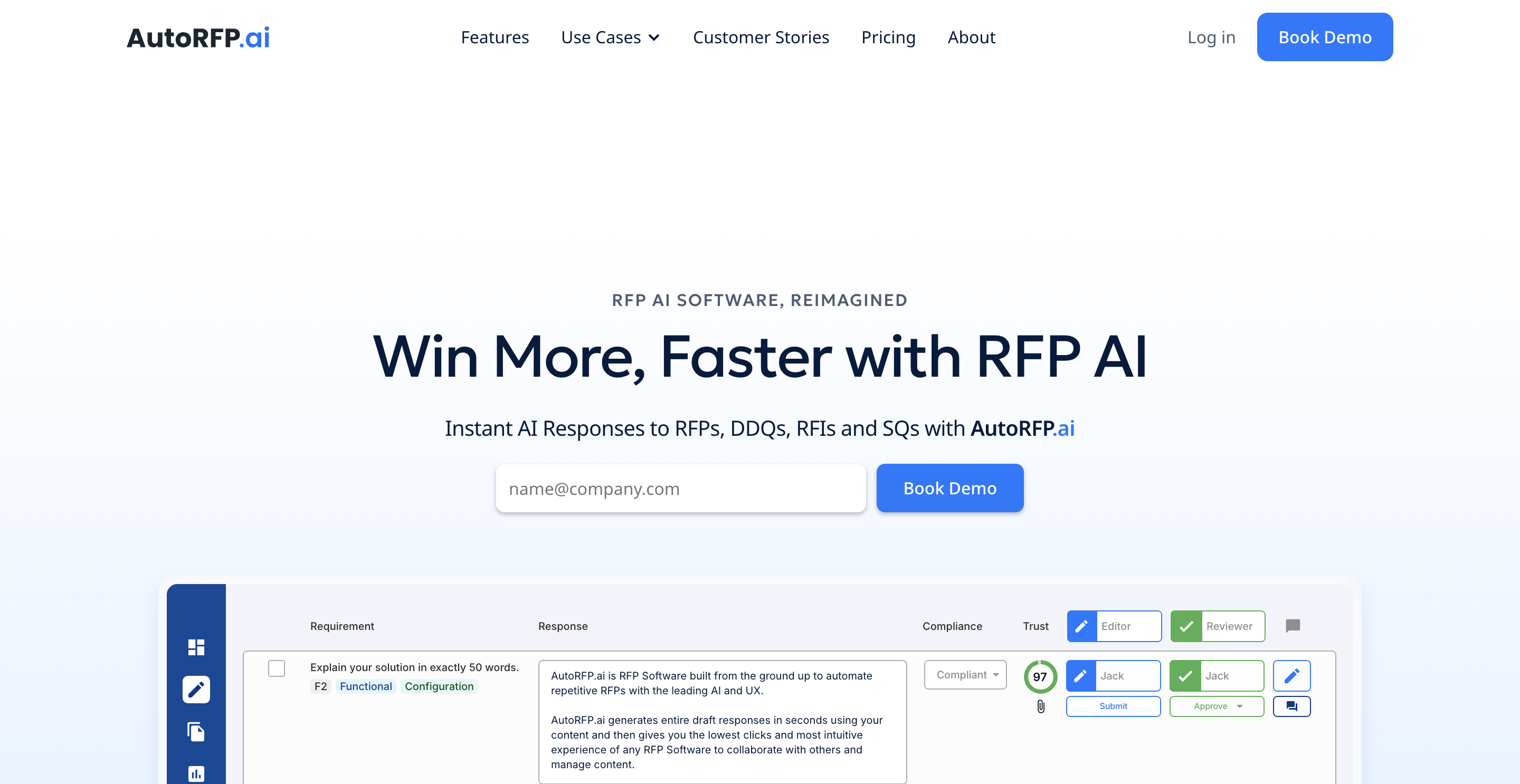
5. AutoRFP.ai
Source: AutoRFP.ai
Transparent Pricing, Fast Wins, Clear Limits
G2 Rating: 4.9/5
AutoRFP.ai stands out in the RFP landscape for one reason above all else: it removes the pricing friction that breaks collaboration.
Where most RFP tools charge per user and quietly penalize cross-functional input, AutoRFP.ai flips the model with project-based pricing and unlimited users. That design choice shapes both its strengths and its boundaries.
Where AutoRFP.ai genuinely shines
1. Pricing that encourages collaboration
Unlimited users means sales, pre-sales, legal, product, and InfoSec can all participate without triggering budget conversations. This benefit alone removes a major blocker in many RFP workflows.
2. Rapid time-to-value
AutoRFP.ai is designed to get teams productive fast. Past responses are imported quickly, and teams can start working on live RFPs within days, not weeks or months.
3. Strong automation for standard RFPs
For repetitive and moderately complex RFPs, AutoRFP.ai delivers solid first drafts. Over time, the system improves as teams approve and edit responses, increasing automation coverage.
4. Format flexibility
Support for Word, Excel, PDF, and common procurement formats reduces friction when handling real-world RFP documents, especially those with structured tables.
Where AutoRFP.ai starts to struggle
1. Moderate response accuracy
AutoRFP.ai performs well on familiar questions but is less reliable on nuanced, technical, or highly contextual sections. These still require careful human review.
2. Limited governance and risk controls
Advanced features like conflict detection, deep audit trails, and enforced approval hierarchies are not its core focus. For high-stakes bids, such limitations can introduce risk.
3. Project-based constraints
Each RFP consumes a project allocation regardless of complexity. Teams handling many small questionnaires may find this model less efficient over time.
4. Less suited for compliance-heavy environments
Industries with strict regulatory requirements often need stronger validation and control mechanisms than AutoRFP.ai currently provides.
Who AutoRFP.ai is a strong fit for
- Mid-market teams handling volume-driven RFPs
- Distributed organizations blocked by seat-based pricing
- Teams needing quick ROI without heavy setup
- Sales and pre-sales groups comfortable reviewing AI outputs
Who should think twice
- Enterprises responding to high-risk, high-value RFPs
- Regulated industries requiring strict governance and auditability
- Teams expecting AI outputs to be near-final with minimal review
Bottom line on AutoRFP.ai
AutoRFP.ai is optimized for speed, access, and cost clarity. It dramatically lowers the barrier to collaboration and delivers fast productivity gains for standard RFPs. But it trades depth of governance and top-tier accuracy for that accessibility.
For teams where volume and collaboration matter more than airtight compliance, AutoRFP.ai is a pragmatic and compelling alternative. For mission-critical proposals, a more governance-focused platform may be the safer bet.
Confidence-scored answers beat guesswork every time. Check out SparrowGenie.
6. Proposify

Source: Proposify
Excellent for Selling, Not Built for RFP Reality
G2 Rating: 4.6/5
Proposify often enters RFP conversations by accident. That’s because it’s a sales proposal platform, not an RFP response engine. And that distinction matters more than most buyers realize, especially once RFP complexity kicks in.
Proposify is designed to help sales teams send polished, on-brand proposals quickly, close deals faster, and track buyer engagement. It is not designed to manage long, technical, cross-functional RFP responses.
Where Proposify genuinely shines
1. Strong proposal presentation and branding
Proposify excels at creating visually polished proposals. Templates, layouts, and brand consistency are easy to manage, making it a favorite for agencies and services teams that care deeply about presentation.
2. Buyer engagement visibility
The platform tracks when prospects open proposals, which sections they view, and how long they spend reading. For sales teams, this insight helps prioritize follow-ups and tailor conversations.
3. Built-in e-signatures and pricing tables
Interactive pricing tables and native e-signatures streamline the final stages of deal closure. This removes friction between proposal delivery and contract execution.
4. Low-friction setup
Teams can start using Proposify quickly without heavy onboarding, configuration, or training. For straightforward proposals, time-to-value is fast.
Where Proposify breaks down for RFP teams
1. Not designed for complex RFP workflows
Proposify lacks core RFP functionality: no requirement tracking, no structured question management, no section-based ownership, and no validation that all questions are answered.
2. No AI-driven response intelligence
There’s no semantic search, contextual drafting, or AI-generated answers from prior content. Teams still manually write and copy-paste responses, which limits scalability.
3. Weak cross-functional collaboration
Legal, InfoSec, and product reviews are not first-class citizens. Collaboration quickly spills into email and Slack, creating version control issues and review delays.
4. Poor fit for technical and compliance-heavy content
Security questionnaires, DDQs, and regulated RFP sections are simply outside Proposify’s design scope.
Who Proposify is a strong fit for
- Agencies, consultancies, and service providers
- Sales teams sending short, branded proposals
- Organizations prioritizing presentation and buyer experience
- Teams with minimal compliance or technical depth
Who should think twice
- Companies responding to formal RFPs, RFIs, or RFQs
- Teams handling security questionnaires or compliance reviews
- Organizations needing AI assistance to scale responses
- Revenue teams with heavy cross-functional dependencies
Bottom line on Proposify
Proposify is a proposal closing tool, not an RFP response platform. It works well when the goal is to impress buyers visually and move quickly to signature. But once responses require accuracy, consistency, cross-team validation, and repeatability, Proposify shows its limits.
For RFP-heavy teams, Proposify is best used after the RFP is won, if at all, not as the system that creates the response.
7. PandaDoc
Source: PandaDoc
Powerful Document Automation, Not an RFP Brain
G2 Rating: 4.7/5
PandaDoc is often shortlisted in RFP conversations because it’s excellent at moving documents to signature quickly. And to be fair, it does that job extremely well. But PandaDoc is not an RFP response platform. It’s a document lifecycle automation tool optimized for proposals, contracts, quotes, and approvals, not for interpreting and answering complex RFPs. That distinction becomes obvious the moment RFP depth increases.
Where PandaDoc genuinely shines
1. End-to-end document lifecycle speed
PandaDoc excels at taking a document from draft to signed. Proposal creation, approvals, e-signatures, payments, and tracking all live in one flow, which shortens sales cycles once content is finalized.
2. Strong CRM-driven automation
Deep integrations with CRMs like Salesforce and HubSpot allow teams to auto-populate proposals with deal data, pricing, and customer details, reducing manual entry and errors.
3. Buyer engagement insights
Sales teams get visibility into when prospects open documents, which pages they view, and where they spend time. This is valuable for follow-ups and deal momentum.
4. Flexible templates and approvals
Branded templates and internal approval workflows make PandaDoc a solid tool for scaling standardized sales documents across teams.
Where PandaDoc falls short for RFP teams
1. No RFP intelligence layer
PandaDoc doesn’t understand RFP structure, requirements, or question-by-question response logic. There’s no semantic parsing, requirement tracking, or validation that all questions are answered.
2. No AI-driven response generation
While PandaDoc includes light AI for writing assistance, it doesn’t generate answers from past RFPs, knowledge bases, or approved content. Teams still manually write or paste responses.
3. Weak cross-functional review for technical content
Legal, InfoSec, and product reviews aren’t first-class RFP workflows. Collaboration often spills into email or Slack, increasing version risk.
4. Poor fit for security and compliance questionnaires
DDQs, vendor risk assessments, and technical annexes are outside PandaDoc’s design scope.
Who PandaDoc is a strong fit for
- Sales and RevOps teams focused on proposal-to-signature speed
- Organizations standardizing quotes, contracts, and commercial proposals
- Teams where document execution is the bottleneck, not content creation
Who should think twice
- Companies responding to formal RFPs, RFIs, or RFQs
- Teams handling technical, compliance-heavy, or security questionnaires
- Organizations expecting AI to meaningfully reduce RFP writing effort
Bottom line on PandaDoc
PandaDoc is a strong closer, not a strong responder. It’s excellent once the content is ready, and the goal is to move fast toward signature. But it doesn’t help teams figure out what to say in a complex RFP, or ensure it’s accurate, complete, and defensible.
For RFP-heavy teams, PandaDoc works best after the RFP is won, not as the system that creates the response.
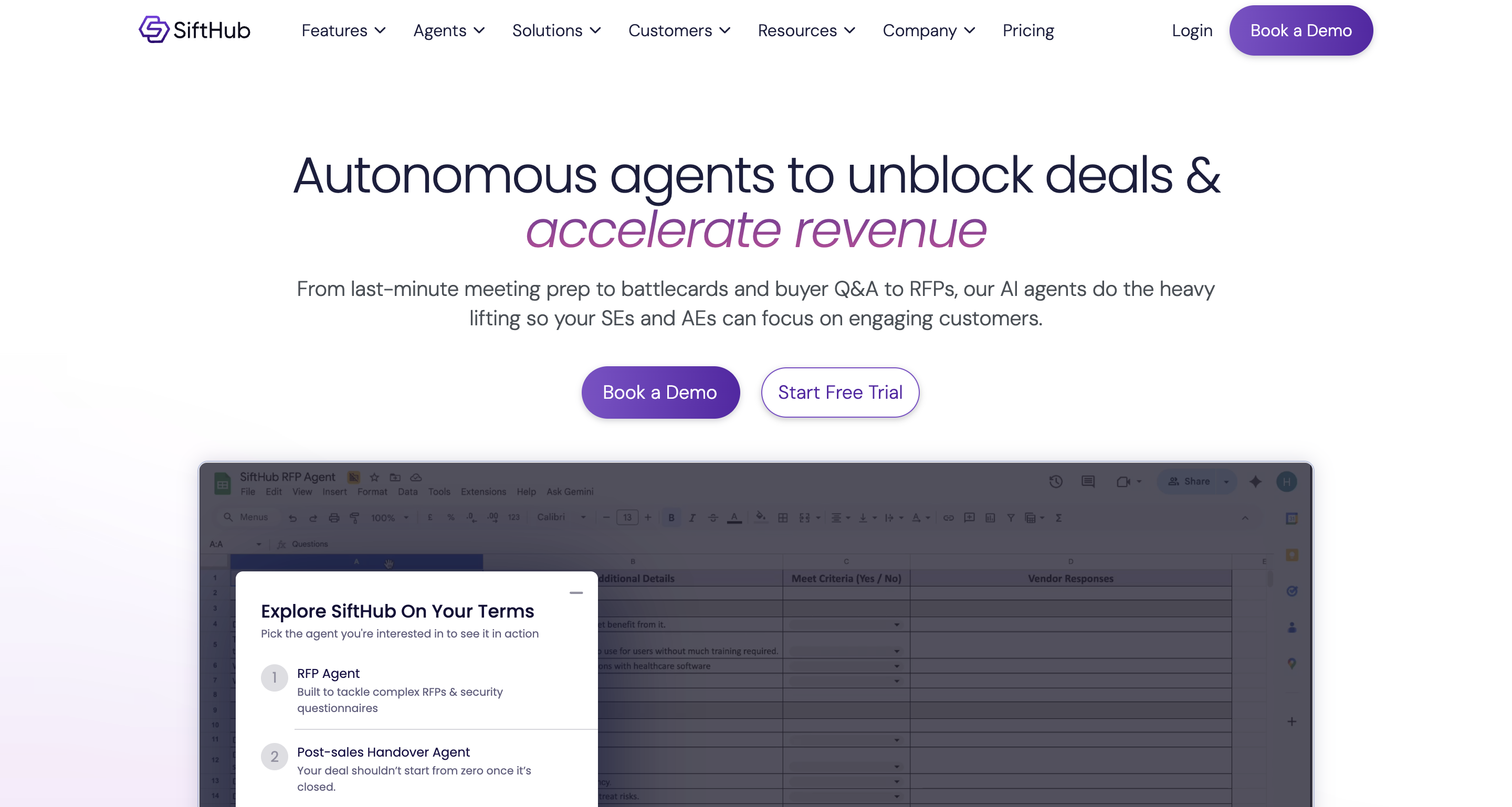
8. SiftHub
Source: SiftHub
Knowledge Where Work Happens, With Light Governance
G2 Rating: 4.5/5
SiftHub takes a context-first approach to RFP and questionnaire automation. Instead of forcing teams to build rigid libraries or move work into a separate system, it brings knowledge and answers to where people already work: Slack, Teams, browsers, and existing document stores.
That design makes it intuitive and fast but also reveals its trade-offs when rigor and control matter.
Where SiftHub genuinely shines
1. Workflows that match real team behavior
SiftHub meets SMEs wherever they are - Slack threads, Teams chats, and browser windows, reducing context switching. SMEs don’t need to log into a separate RFP app to contribute; they’re prompted inline.
2. Live knowledge ingestion
Instead of curating a static repository, SiftHub draws from live sources: wikis, docs, knowledge bases, and even published web content. This means answers reflect current reality without manual syncing or library housekeeping.
3. Browser-embedded responses
The browser extension lets users pull and submit answers directly into web-based questionnaires and portal forms without repetitive copy-paste. That’s a real time-saver when working with procurement or security portals.
4. Lightweight SME engagement
Because contribution is friction-free, SMEs participate more naturally. You don’t have to force them into a separate system or process just to get an answer reviewed or approved.
Where SiftHub starts to struggle
1. Limited governance depth
SiftHub’s emphasis on convenience comes at the expense of heavy compliance controls. Systems built for detailed audit trails, conflict detection, and multi-layer approvals still outpace it.
2. Modest analytics and reporting
While visibility into knowledge usage exists, the analytics surface isn’t as rich as tools designed for deep operational insights. Teams looking to fine-tune proposal ops will notice missing dashboards.
3. Not a full RFP lifecycle system
SiftHub is great for individual answer retrieval and portal entry, but it doesn’t manage full RFP workflows: intake, assignments, reviews, section coverage checks, or final exports; in the same way dedicated platforms do.
4. Collaboration still hybrid
Though easier for SMEs to participate, formal review and approval cycles can still spill into email and chat, which fragments the audit trail.
Who SiftHub is a strong fit for
- SaaS teams with distributed tribal knowledge
- Organizations where speed and context are more important than heavy governance
- Groups tired of static libraries and rigid RFP tools
- Teams that work heavily in Slack/Teams and want automation without new context switches
Who should think twice
- Regulated enterprises needing strict compliance controls
- Proposal teams needing structured workflows and auditability
- Organizations with formal approval hierarchies tied to risk and governance
Bottom line on SiftHub
SiftHub is optimized for frictionless knowledge access and real-time productivity. It’s a strong choice if your biggest bottleneck is finding the right answer quickly and getting SMEs to participate. It removes context switching and brings automation to the places people already work.
But if your RFP process requires deep governance, advanced workflow orchestration, and tight audit controls, SiftHub is a complement, not a complete solution. It accelerates answer retrieval and portal work, but doesn’t replace a full response management engine for complex, high-risk bids.
Stop fixing RFP chaos mid-deal. Explore SparrowGenie!
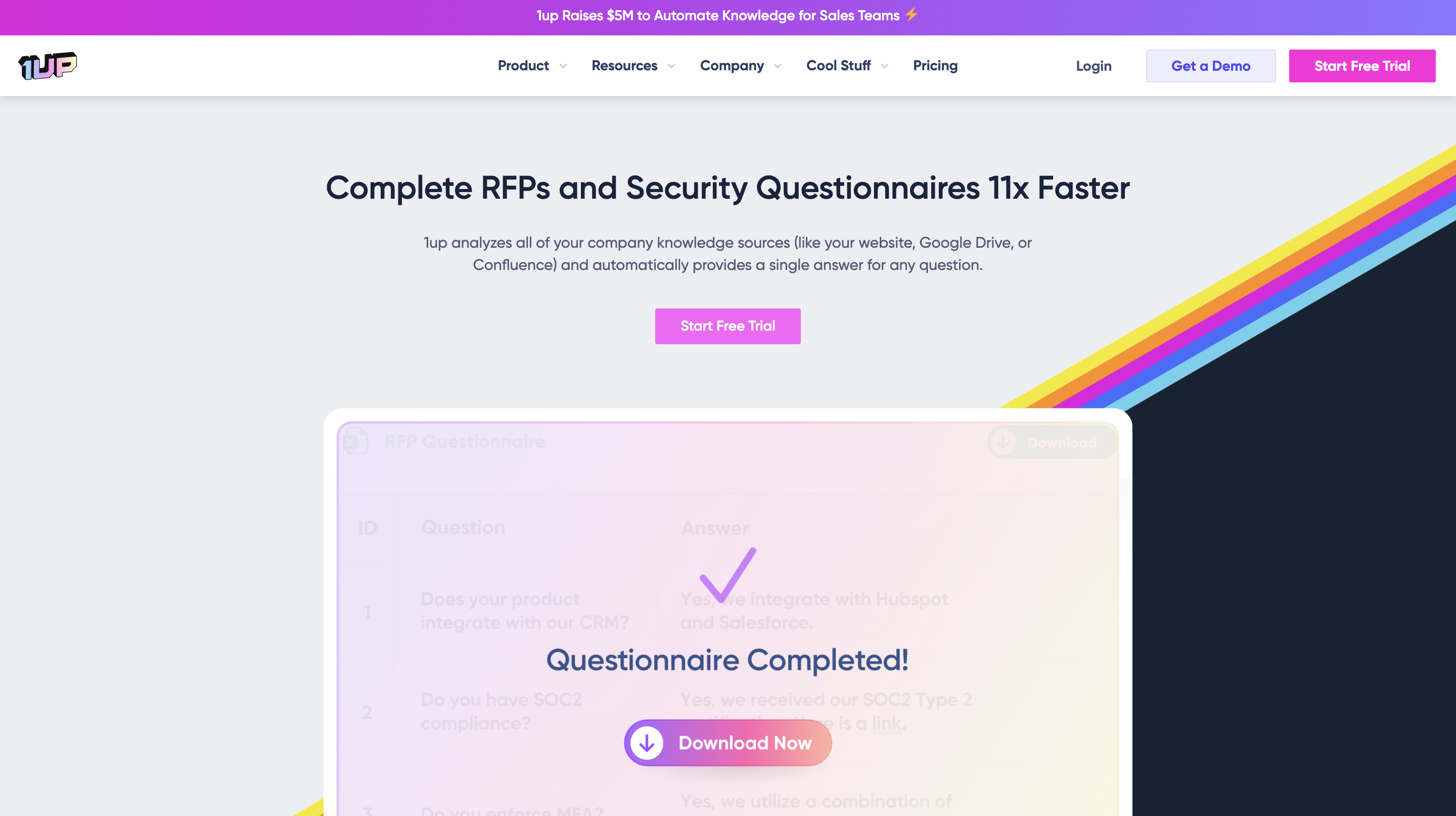
9. 1Up
Source: 1Up
Fast, Affordable Automation With Clear Ceiling
G2 Rating: 4.9/5
1Up is designed for teams that want answers now, without enterprise complexity or cost. It lowers the barrier to entry for AI-driven questionnaire completion and gets teams productive almost immediately. That accessibility is its biggest strength, and also where its limits show up.
Where 1Up genuinely shines
1. Extremely low barrier to entry
With affordable plans and quick setup, 1Up is one of the fastest ways for small teams to start automating RFPs and questionnaires. Teams can connect existing sources and generate answers the same day.
2. Automatic knowledge ingestion
1Up pulls content from websites, Google Drive, Confluence, Notion, and similar sources to auto-generate a usable knowledge base. There’s no upfront library-building project.
3. Browser-based questionnaire support
The browser plugin helps teams answer web-based questionnaires and portals without downloading files, which is especially useful for vendor assessments.
4. Self-improving over time
As teams edit and approve answers, the system learns and improves coverage, reducing manual work on repeat questions.
Where 1Up starts to struggle
1. Lower accuracy on complex questions
1Up performs well on standard, repeatable questions but struggles with nuanced, technical, or context-heavy sections. These often require careful manual review and rewriting.
2. Minimal governance and controls
There’s limited support for approval hierarchies, audit trails, conflict detection, or compliance workflows. For high-stakes bids, this can introduce risk.
3. Basic collaboration model
Multi-stakeholder coordination is lightweight. Legal, InfoSec, and product reviews often happen outside the platform, increasing version-control friction.
4. Not built for high-risk RFPs
As deal size and complexity increase, the lack of guardrails becomes more noticeable and more costly.
Who 1Up is a strong fit for
- Startups and small teams with tight budgets
- Organizations handling moderate-volume, low-to-medium risk questionnaires
- Teams looking for quick wins without long onboarding
- Groups comfortable treating AI output as a starting point, not a final answer
Who should think twice
- Enterprises responding to high-value or regulated RFPs
- Teams needing strict compliance, approvals, or auditability
- Organizations expecting near-final AI drafts with minimal review
Bottom line on 1Up
1Up is optimized for speed and affordability, not depth and control. It’s a practical choice for smaller teams that need to move quickly and can tolerate manual review. But as RFP complexity, deal value, and risk increase, most teams will outgrow its lightweight approach.
For early-stage automation, 1Up delivers value fast. For mission-critical proposals, a more governed platform is usually the safer long-term investment.
10. Qvidian
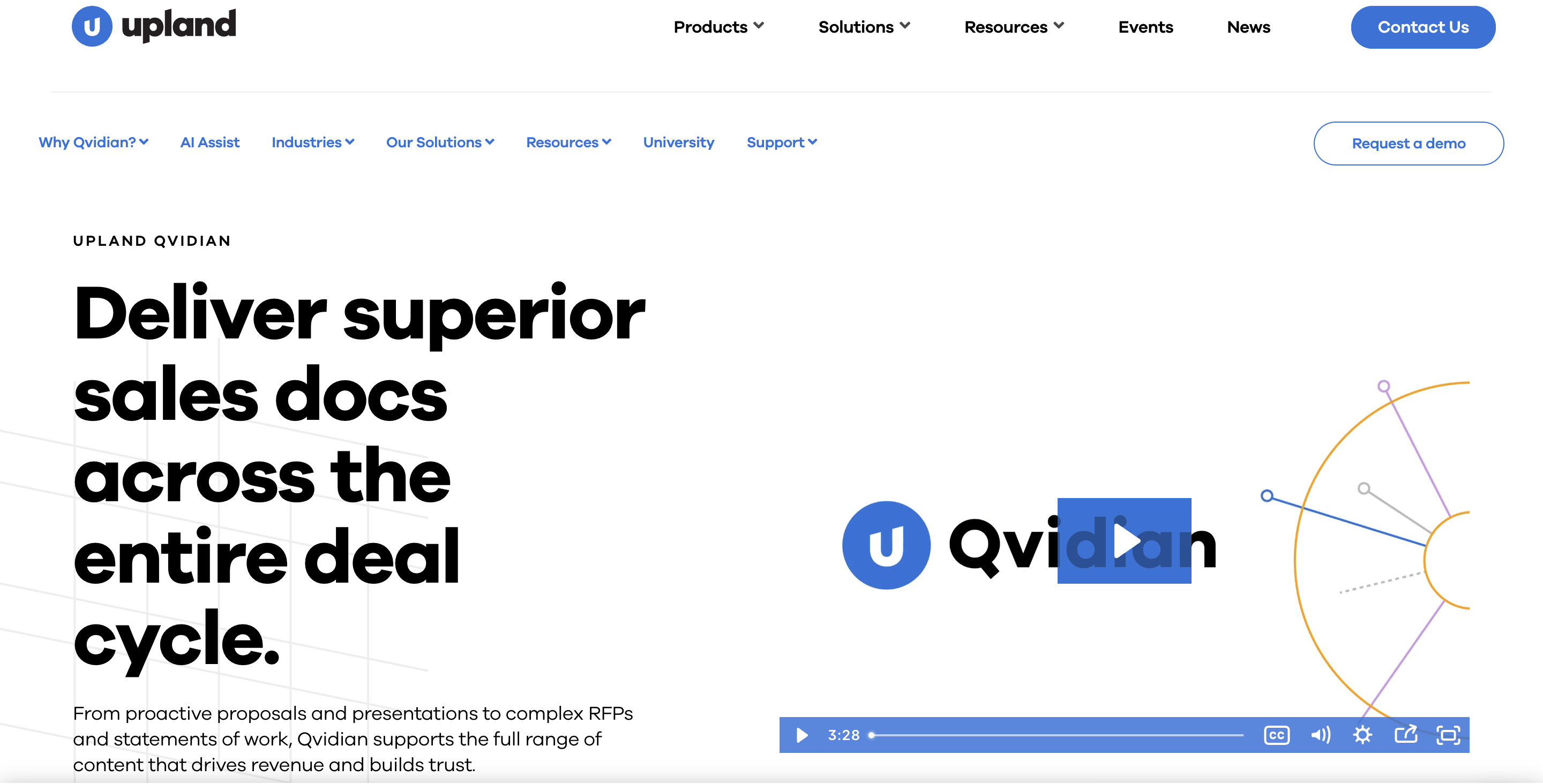
Source: Qvidian
Maximum Control, Minimal Agility
G2 Rating: 4.3/5
Qvidian is one of the longest-standing players in the RFP and proposal automation space. It was built for large enterprises with rigorous governance, compliance, and audit requirements, particularly in regulated industries where controls outweigh speed. That focus is its strength and its constraint.
Where Qvidian genuinely shines
1. Deep governance and compliance rigor
Qvidian’s core value lies in control, mature versioning, fine-grained permissions, audit trails, and compliance checkpoints. For organizations in finance, healthcare, government, or defense, this level of oversight is often non-negotiable.
2. Enterprise workflow orchestration
From intake to task assignment to multi-stage review, Qvidian supports structured workflows across large, distributed proposal operations. It brings clarity to who’s responsible for what and when.
3. Proven stability at scale
Years of enterprise deployments mean Qvidian has been battle-tested in conservative buying environments. That track record can ease procurement risk committees.
4. Large knowledge repository management
For teams with deep libraries of approved answers, templates, and compliance language, Qvidian manages complexity with robust taxonomy, approvals, and content governance.
Where Qvidian starts to strain
1. Dated user experience
Compared with modern AI-native platforms, Qvidian’s UX can feel clunky and unintuitive. That slows adoption and pushes some SMEs to work outside the system.
2. Slow implementations and heavy configs
Getting Qvidian live often requires significant configuration and change management. Weeks turn into months, which delays time-to-value.
3. AI feels bolted on
AI is present, but it hasn’t reworked the product around generative context awareness. Outputs tend to lean on static libraries and keyword heuristics, not dynamic drafting.
4. High total cost of ownership
License, implementation, and ongoing maintenance costs add up quickly. For mid-market teams or fast-moving revenue units, the ROI equation becomes less compelling.
Who Qvidian is a strong fit for
- Regulated enterprises with strict audit and compliance mandates
- Organizations that value control and reporting over drafting speed
- Teams with dedicated proposal ops and library management disciplines
- Firms responding to extremely formal, compliance-driven RFPs
Who should think twice
- Teams expecting modern AI to reduce first-draft effort
- Growth or mid-market buyers with limited implementation resources
- Revenue functions seeking agility and speed
- Organizations prioritizing intuitive collaboration over strict controls
Bottom line on Qvidian
Qvidian is a governance powerhouse. If your priority is oversight, auditability, and consistency across highly regulated environments, it delivers mature capabilities. But it doesn’t redefine how responses are authored, reviewed, or accelerated.
For teams that want AI-native intelligence, fast turnaround, and minimal content maintenance, newer platforms set a very different bar. Qvidian still feels like a controlled system first and an AI assistant second.
11. Conveyor
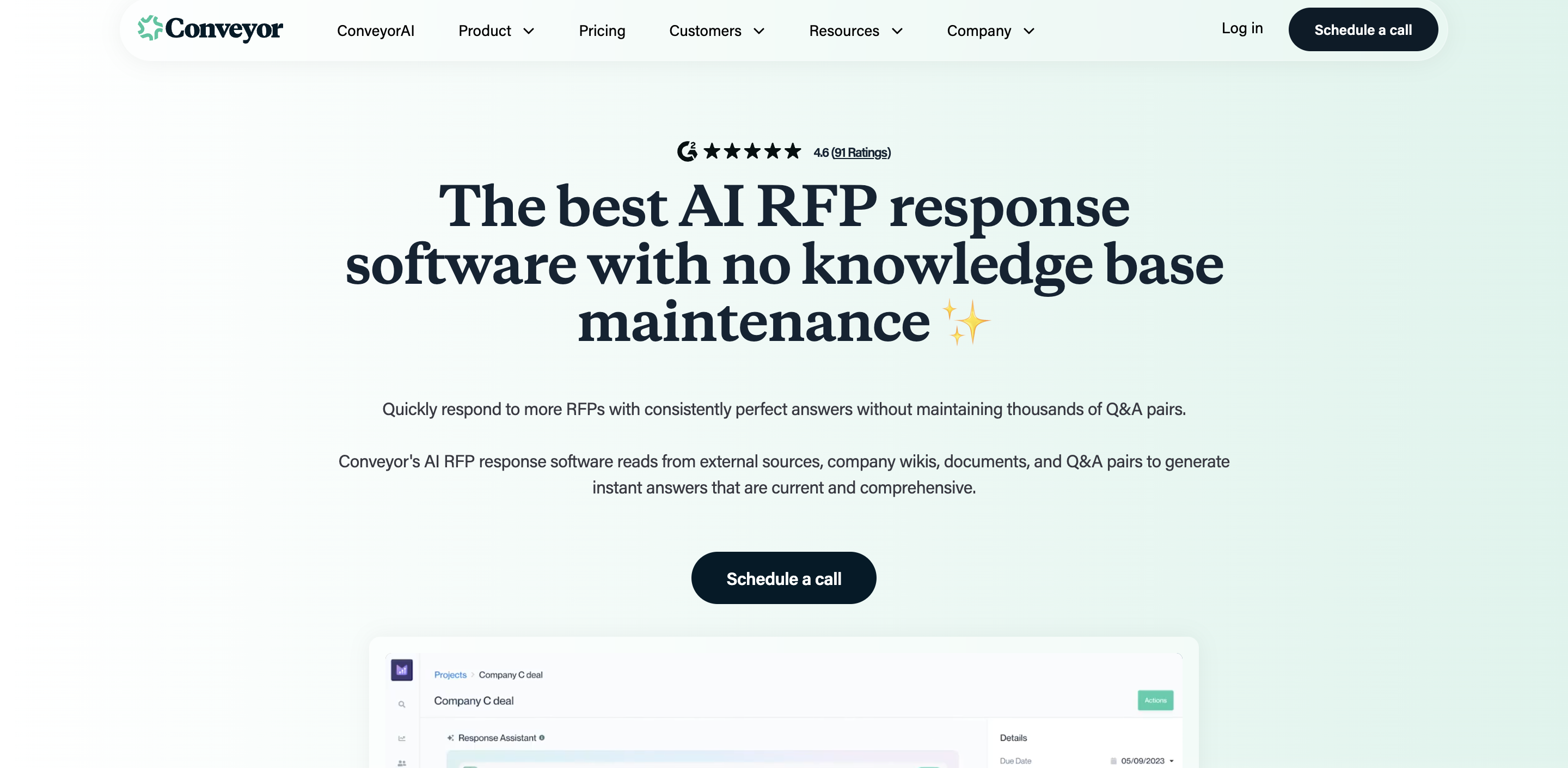
Source: Conveyor
Security Questionnaires on Autopilot, Not a Full RFP Engine
G2 Rating: 4.6/5
Conveyor is laser-focused on one painful problem: security questionnaires and vendor risk assessments. And to its credit, it solves that problem extremely well. But that focus is also its boundary. Conveyor is not trying to be an end-to-end RFP response platform. It’s built to offload repetitive InfoSec work, not to manage complex proposal narratives.
Where Conveyor genuinely shines
1. Best-in-class security questionnaire automation
Conveyor is purpose-built for DDQs, SIGs, CAIQs, and vendor security forms. For InfoSec teams drowning in repetitive assessments, it can save massive amounts of time.
2. Browser-based portal automation
Its browser extension fills answers directly into procurement and security portals, eliminating copy-paste work and reducing human error. This is a real advantage in vendor-managed platforms.
3. Strong security posture and trust model
Conveyor is designed with security teams in mind. Controls around data handling, permissions, and usage align well with InfoSec expectations, which helps with internal adoption.
4. Clear ROI for InfoSec teams
By removing repetitive questionnaire work, Conveyor frees up security engineers to focus on actual risk management instead of form filling.
Where Conveyor reaches its limits
1. Not designed for narrative RFPs
Conveyor does not handle long-form proposal sections, value narratives, or tailored sales responses. It’s optimized for structured Q&A, not storytelling.
2. Limited cross-functional collaboration
While excellent for InfoSec, Conveyor doesn’t deeply support collaboration with sales, RevOps, product, or legal across a full RFP lifecycle.
3. Narrow scope by design
There’s no intake management, requirement tracking, or proposal assembly. Teams still need another system to manage the broader RFP response.
4. Can become a point solution
For teams handling both RFPs and security questionnaires, Conveyor often becomes an add-on rather than a system of record.
Who Conveyor is a strong fit for
- InfoSec and IT teams handling high volumes of vendor security questionnaires
- SaaS companies frequently assessed by enterprise buyers
- Organizations looking to reduce security review bottlenecks
- Teams that already have an RFP tool but need to unblock security responses
Who should think twice
- Sales or proposal teams seeking a single RFP response platform
- Organizations needing end-to-end RFP workflow management
- Teams looking for AI-driven proposal drafting and narrative support
Bottom line on Conveyor
Conveyor does one thing and does it very well. It removes security questionnaires from the critical path, dramatically reducing friction between sales and InfoSec. But it’s not a replacement for an RFP response platform.
For teams struggling specifically with security assessments, Conveyor is a powerful accelerator. For teams looking to manage full RFPs, proposals, and cross-functional collaboration in one place, it works best as a complement, not the core system.
Thinking of opting for the best Inventive.ai alternative?
Final Thoughts
If there’s one thing this comparison makes clear, it’s this:
Choosing an Inventive.ai alternative isn’t about picking “the best tool.” It’s about choosing the trade-offs you’re willing to live with.
Some platforms optimize for governance and control but slow teams down. Others move fast with AI but leave teams guessing what’s safe to trust. A few solve one slice of the problem well, but force you to stitch together the rest. The real question is not how fast can a tool draft answers, but:
- Can your team trust those answers?
- Can legal and InfoSec review without becoming the bottleneck?
- Can sales move quickly without losing accuracy?
- Can everything live in one place, without chaos?
That’s where SparrowGenie stands apart. SparrowGenie isn’t trying to out-AI everyone or replace humans with automation. It’s built around a simpler idea: AI should accelerate revenue teams without taking control away from them.
With confidence-scored answers, human-in-the-loop workflows, and a secure, governed source of truth, SparrowGenie gives teams speed and credibility at the same time.
If your RFP process feels like a constant tug-of-war between speed and safety, SparrowGenie is worth a serious look. Because the best RFP tool isn’t the one that drafts the fastest. It’s the one your team trusts when the deal actually matters.
Ready to see how AI can transform your RFP process?
Product Marketer at SparrowGenie
Being a Product Marketer at SparrowGenie, Aparna helps sales teams work faster with secure, AI-powered proposal automation. She turns complex features into simple stories, builds messaging that resonates, and keeps a close pulse on what customers actually need. She loves shaping clear, helpful content that shows how SparrowGenie makes RFP work easier, faster, and a lot less stressful.
Frequently Asked Questions (FAQs)
Related Articles

AI-Powered Sales Intelligence Tools: Cutting Through the Hype to Find What Works

Team Collaboration on RFPs: Essential Steps to Build Winning Proposals