RFP Technology in 2026: AI, Automation, and More

Article written by
Aparna Rajendran

INSIDE THE ARTICLE
SHARE THIS ARTICLE
Summary
This blog delves into how AI-native platforms, agentic workflows, and smarter automation are rewriting the rules of proposal management.
Technology is everywhere. But, which would be the game changer for your sales team truly, especially when it comes to handling multiple RFPs every month?
RFP response has been one of the most underinvested, overworked functions in B2B for decades. But 2026 is turning out to be the year that changes. The proposal management software market is growing fast and showing no signs of slowing down. AI adoption among proposal teams has surged. And the technology itself has evolved from glorified search engines into something genuinely transformative.
This is not a trend piece you skim and forget. This is a deep, practical look at what is actually happening in RFP technology right now, what it means for your team, and how to make smart decisions about your proposal tech stack going forward.
Let's break it down.
Why Is RFP Technology Changing So Fast in 2026?
RFP technology is not evolving in a vacuum. Three converging forces are pushing the entire category forward.
Cloud Collaboration Became Non-Negotiable
The days of emailing Word documents back and forth are over. Cloud-based collaboration tools have shifted from convenient to strategically necessary. Proposal teams now expect real-time co-authoring, centralized knowledge access, and integrated review workflows as baseline capabilities. If your RFP process still lives in shared drives and email chains, you are operating with a structural disadvantage.
AI Technology Actually Works Now
Two years ago, generative AI was a curiosity. Teams were experimenting. Leaders were cautious. Fast forward to 2026, and AI is deeply embedded into how proposal teams operate. It has moved from a feature on a vendor's roadmap to an operational necessity that teams rely on daily. The majority of software-industry teams have already woven AI into their RFP process. The rest are scrambling to catch up.
Buyer Expectations Outpaced Manual Processes
Buyers expect faster response times, more personalized proposals, and higher-quality content. Teams still running manual processes simply cannot keep up with competitors using automation to respond to three to five times more opportunities. The volume pressure alone has made automation a survival requirement for any team managing a growing pipeline.
Here is the uncomfortable truth. RFPs remain one of the single largest revenue contributors for most B2B organizations. Yet a significant chunk of RFPs go unfinished every year simply because teams lack the capacity or the tools to respond. That is real money walking out the door.
See how SparrowGenie's AI-powered automation helps teams respond to more RFPs, faster and more accurately.
How Does AI Help Proposal Teams Respond to RFPs Faster?
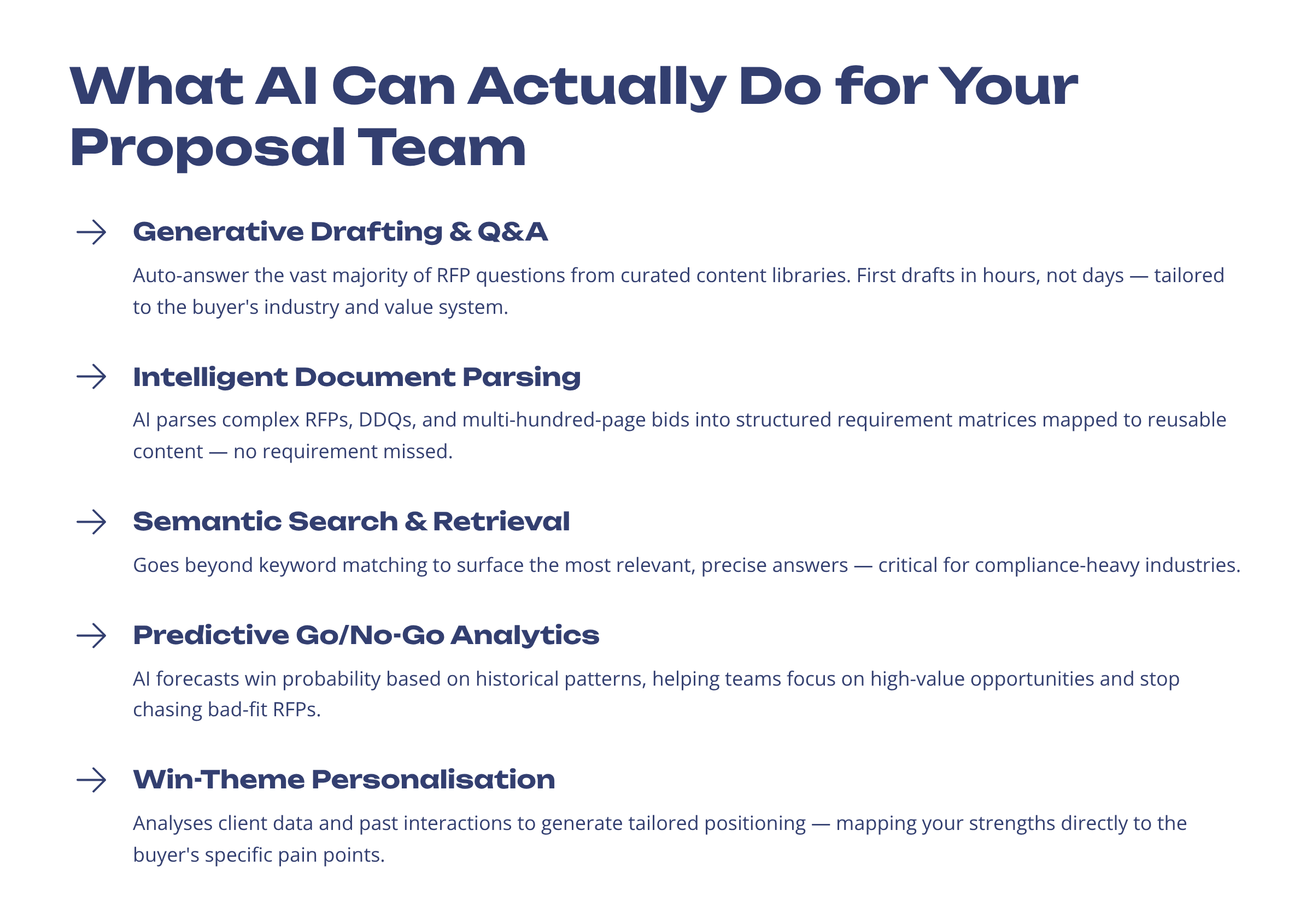
Let's move past the buzzwords. What can AI actually do for your proposal team today? A lot more than generate first drafts.
Generative AI for Drafting and Q&A
AI-powered platforms can now auto-answer the vast majority of RFP questions from curated content libraries, delivering a first draft in minutes instead of days. The AI does not just find matching keywords. It understands context, tailors language to fit the buyer's industry and value system, and produces responses that read like they were written by someone who actually knows the deal.
The practical impact? Teams that used to spend days on a single RFP are now completing first drafts in hours. Smaller firms have cut proposal creation time dramatically and started winning deals they would have passed on before. Larger organizations are freeing up thousands of hours that SMEs can redirect toward customer-facing work.
Intelligent Document Parsing
Modern RFP tools use AI to automatically parse complex RFP documents, including security questionnaires, DDQs, and multi-hundred-page bids, into structured requirement matrices mapped to reusable content. This eliminates hours of manual extraction and ensures no requirement gets missed. The best platforms are achieving accept-as-is rates that make human reviewers feel almost redundant (almost, not quite).
Semantic Search and Intelligent Retrieval
AI-powered semantic search goes beyond keyword matching to understand the context and nuance of complex requirements. Instead of returning results based on exact word matches, these systems understand what you actually need and surface the most relevant, accurate answers from your organizational knowledge. This is critical for compliance-heavy industries where the right answer must be precise, consistent, and verifiable.
Predictive Analytics and Go/No-Go Intelligence
Not every RFP is worth pursuing. AI-driven analytics now forecast the probability of proposal success based on historical patterns, helping organizations focus on high-value opportunities instead of spreading themselves thin. Teams using these capabilities are significantly more effective at predicting outcomes and managing risk. They stop chasing bad-fit RFPs and start investing their limited bandwidth where it counts.
Personalization and Win-Theme Generation
This is where things get really interesting. AI now analyzes client knowledge bases, past interactions, and market trends to generate tailored proposals with custom positioning. Win-theme mapping recommends messaging that resonates with the buyer by comparing your internal strengths against their specific pain points. Predictive models suggest strategies to amplify key proposal elements and forecast client responses.
The shift from generic to personalized is one of the biggest wins of AI-powered proposals. Every response starts to feel like it was written specifically for that buyer, because in a very real sense, it was.
What Is Agentic AI and How Does It Automate RFP Workflows?
Here is the thing. The most significant architectural shift in 2026 is not about writing better text. It is about AI that can execute entire workflows on its own.
The industry is transitioning from generative AI (which writes text) to agentic AI (which executes multi-step workflows autonomously). Instead of merely helping write proposal sections, agentic systems can handle end-to-end workflows: analyzing RFP requirements, pulling relevant case studies, customizing pricing, routing for internal approvals, checking compliance, and scheduling follow-ups. All with minimal human orchestration.
Workers at most Fortune 500 companies already use AI-powered agents for tasks like email management and meeting notes. The next frontier applies this capability to complex proposal documents.
Multi-Agent Orchestration
Enterprises are moving from single-agent design to orchestrated multi-agent systems, where specialized agents handle discrete capabilities (content generation, compliance checking, SME routing) under a coordinator agent that plans, sequences, and supervises execution. Think of it as microservices architecture, but with reasoning systems instead of APIs.
One agent drafts. Another checks compliance. A third pulls the right case study. A fourth flags anything that needs human review. And a coordinator agent manages the entire sequence. That is the direction RFP technology is heading, and some platforms are already there.
The Assistance to Autonomy Trajectory
Agentic AI is evolving through three distinct phases.
Assistance (current baseline): AI supports discrete, atomic tasks like drafting and search. This is where most teams are today.
Augmentation (emerging): AI manages multi-step processes within defined domains, overseeing draft creation, compliance review, and SME routing within guardrails. This is happening right now at forward-thinking organizations.
Autonomy (near-future): AI operates across domains, making decisions guided by high-level business objectives, with humans focused on strategic oversight and exception handling.
Companies implementing Agentic RAG (Retrieval-Augmented Generation) for RFP responses are already seeing dramatic drops in response time and meaningful improvements in win rates. The trajectory is clear.
Want to see agentic AI in action for RFP response? SparrowGenie's AI-native architecture is built for this exact evolution. See how it works for your team.
RFP Automation Capabilities
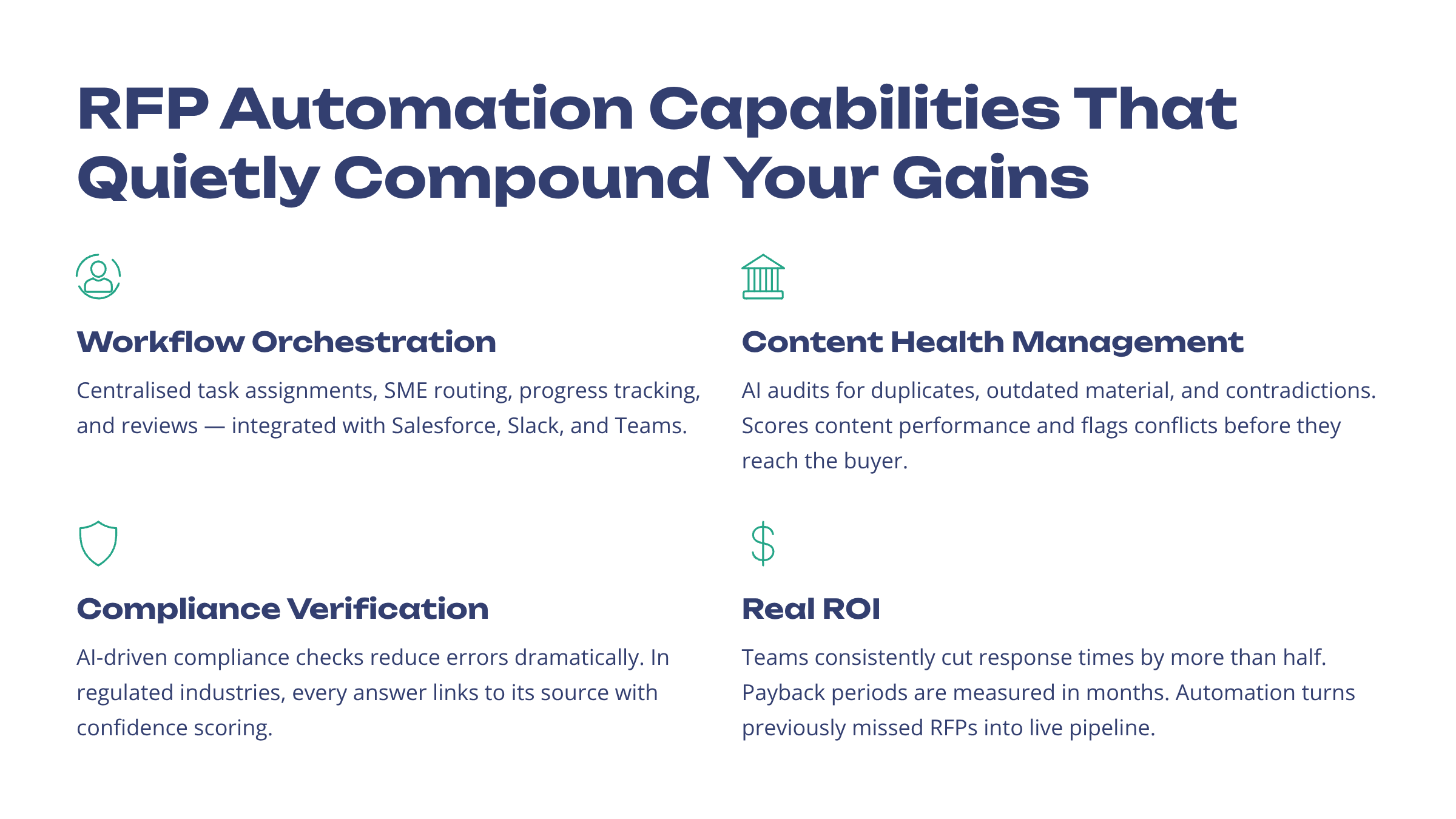
AI gets the headlines. But the automation story in RFP technology goes well beyond text generation. Here are the areas where smart automation is quietly compounding efficiency gains.
Workflow and Process Orchestration
Modern RFP platforms centralize knowledge, task assignments, progress tracking, and reviews to optimize the end-to-end response process. Teams can upload RFPs, assign sections to SMEs, track status in real time, and conduct reviews, all integrated with enterprise systems like Salesforce, Slack, and Microsoft Teams. The days of tracking proposal progress in spreadsheets are numbered.
Knowledge Management and Content Health
Centralized content libraries remain foundational, but AI now audits for duplicates, outdated material, and contradictions. It scores content performance and suggests the best answer among similar entries. Conflict detection features identify contradictory information across the response library, preventing inconsistencies when product details change. The best-performing teams maintain active, curated libraries and reuse a high percentage of content across proposals.
Here is a practical takeaway: if your content library is a mess, AI will only amplify that mess. Content hygiene is not optional anymore. It is the foundation your entire AI strategy sits on.
Compliance Verification and Risk Assessment
AI-driven compliance checks dramatically reduce errors. In regulated industries, AI systems assess compliance and regulatory risks associated with RFPs, ensuring all necessary documents are included before submission. For cybersecurity companies, evidence and citation traceability is critical. Every AI-generated answer must link to its source document with confidence scoring. No exceptions.
The Real ROI Story
The economics of RFP automation are straightforward. If your team processes a meaningful volume of RFPs annually and has moderate content standardization, the payback period is typically measured in months, not years. Teams consistently report cutting response times by more than half. Error rates drop. Proposal consistency improves. And the freed-up capacity allows your team to pursue opportunities they would have had to pass on before.
The ROI gets even more interesting when you factor in the revenue from deals you could not previously pursue. Most organizations leave a meaningful number of RFPs unanswered every year. Automation turns those missed opportunities into pipeline.
Legacy RFP Platforms vs AI-Native RFP Platforms
This is one of the most important strategic questions for anyone evaluating RFP technology in 2026. The software landscape has fundamentally split into two eras, and the difference matters more than most buyers realize.
Dimension | Legacy Platforms (2014-era) | AI-Native Platforms (2023+) |
|---|---|---|
Core engine | Static libraries, keyword search | LLMs, semantic search, agentic workflows |
Knowledge model | Static Q&A library, manual maintenance | Live integrations, dynamic knowledge graph |
AI approach | GenAI bolted on top of existing architecture | AI designed into the foundation |
Content source | Curated, manually updated library | Real-time sync with Drive, SharePoint, Confluence |
Library maintenance | Hundreds of hours per year | Near-zero (connects to living sources) |
Onboarding speed | Weeks to months | Days to a couple of weeks |
Time savings | Moderate | Significant (often 2-3x better) |
Legacy platforms like Loopio and Responsive built solid knowledge bases over a decade but now face the challenge of retrofitting AI onto architectures designed before large language models existed. AI-native entrants are designed around agentic workflows, live data integrations, and transparent source citations from the ground up.
One key debate worth watching is template preservation versus generation. Enterprises with significant investment in branded, compliance-approved templates increasingly prefer AI that enhances existing assets rather than generating from scratch. The best platforms respect what your team has already built while making it dramatically faster to use.
The question for buyers is not which era sounds better in a pitch deck. It is which architecture fits your team's actual workflow, compliance requirements, and growth trajectory.
How Do RFP Tools Prevent AI Hallucinations and Ensure Accuracy?
Let's address the elephant in the room. AI hallucinations, where generative models produce inaccurate or fabricated responses, represent the primary risk in RFP automation. In the high-stakes world of proposals, a single wrong answer can disqualify an entire submission.
Retrieval-Augmented Generation (RAG) has become the standard architecture for trustworthy AI-generated RFP responses. Instead of relying on broad, internet-based LLM training, RAG systems retrieve relevant documents from your organization's curated knowledge base and use that information to construct responses. The AI stays grounded in your verified content rather than making things up from its general training data.
The leading mitigation strategies in 2026 include source citations (every AI-generated answer links to the specific document it came from), confidence scoring (AI flags answers it is uncertain about so reviewers can prioritize verification), chain-of-thought prompting (forcing the model to explain its reasoning step-by-step), content library grounding (restricting AI to approved curated content rather than open-web data), and human-in-the-loop review for compliance-critical sections.
Agentic RAG is emerging as the next evolution, embedding LLM-driven agents inside the retrieval loop that can plan retrieval strategies, decide between tools, reflect on answers, and coordinate multiple sub-agents. This means the AI does not just find the answer. It evaluates whether the answer is good enough, looks for better sources if it is not, and flags anything that needs human judgment.
The key takeaway? Do not trust any RFP platform that cannot show you exactly where every answer came from. If a vendor says their AI is accurate but cannot demonstrate source traceability and confidence scoring, keep looking.
SparrowGenie's confidence scoring shows exactly where every answer originates. Book a demo to know more.
Integration Ecosystem: Proposals as Revenue Workflow Hubs
Proposals do not exist in isolation. They are touchpoints in complex sales processes. And the best RFP platforms in 2026 understand this.
The critical integration patterns to look for include CRM bi-directional sync (pulling client data into proposals and pushing proposal status and engagement data back to Salesforce, HubSpot, and others), document lifecycle management (automatic transition from proposal to contract to project kickoff), financial system integration (dynamic pricing reflecting current costs, margins, and approval thresholds), communication platform integration (automated stakeholder notifications through Slack, Teams, and email), and content platform sync (live connection to Google Drive, SharePoint, Confluence, Highspot, and Seismic for real-time knowledge access).
Platform leaders are increasingly positioning as workflow hubs rather than standalone proposal tools. The best RFP platforms sit at the center of your revenue operations, not in a silo next to them. If a tool requires you to copy-paste data between systems or manually update your CRM after submitting a proposal, it is already outdated.
Security, Compliance, and Data Governance
Enterprise RFP tools handle some of the most sensitive data in your organization: pricing strategies, technical architecture, client lists, proprietary security policies. The security bar in 2026 is higher than ever.
Baseline requirements now include SOC 2 Type II certification (which is table stakes for enterprise adoption), ISO 27001 compliance for information security management, data encryption at rest and in transit using AES-256, role-based access controls with granular governance permissions, data isolation guarantees ensuring customer data is not used to train shared AI models, and GDPR, NIS2, and DORA alignment for European operations.
Here is a critical question every buyer should ask: Does the vendor use my data to train AI models? Leading platforms explicitly guarantee data isolation and provide clear data retention and deletion policies. If your vendor cannot answer this question clearly, that is a red flag you should not ignore.
Security is not a checklist item. It is a deal-breaker. The proposals you upload contain competitive intelligence, pricing strategies, and client-specific commitments. Any platform that treats security as an afterthought does not deserve your business.
Emerging Trends in RFP Technology
The RFP technology story does not stop at AI drafting and workflow automation. Here is what is on the horizon.
ESG and Sustainability Integration
Environmental, social, and governance considerations are becoming essential in RFP evaluations. AI tools now track ESG data, suggest sustainable practices, and promote ethical standards in proposals. For proposal teams, this means integrating carbon footprint data, diversity information, and governance policies into responses, all automated by AI that pulls from sustainability databases. If your industry has ESG disclosure requirements, expect this to become a standard RFP section soon.
Multimodal AI
Future proposal systems will process text, images, charts, videos, and voice to create richer, more engaging proposals automatically. Video messaging integration already lets sales reps record personalized introductions within proposals. As multimodal models mature, expect AI to automatically generate infographics, data visualizations, and interactive elements as part of the proposal creation workflow. The static, text-heavy RFP response is on its way out.
Industry-Specific Vertical Solutions
The market is moving strongly toward vertical specialization. Government contractors need FAR compliance. Healthcare organizations require HIPAA-specific documentation. Financial services firms demand mandatory disclosure preservation. Cybersecurity companies need tools that handle SIG, CAIQ, SOC 2, ISO 27001, and custom questionnaire formats natively.
Vendors that develop deep expertise in specific verticals will capture disproportionate market share from generalist competitors. If your industry has unique compliance requirements, look for a platform that speaks your language out of the box rather than one that promises to customize later.
Risks and Limitations of AI-Powered RFP Technology
No technology piece is complete without an honest assessment of what can go wrong. Here are the real risks to keep in mind.
Hallucination risk remains real.
Even with RAG and guardrails, AI can misinterpret nuanced requirements or generate plausible-sounding but inaccurate responses, especially in regulated industries. Human review is not going away. It is evolving from reviewing everything to reviewing what the AI is least confident about.
Library quality dependency.
AI amplifies your existing content quality. It does not fix poor messaging, disorganized case studies, or unclear value propositions. If you feed it bad inputs, you get polished-sounding bad outputs. Content hygiene comes first.
The personalization paradox.
When your current responses are highly tailored and strategic, automation can sometimes make them feel more generic. The best approach layers AI efficiency on top of human strategic thinking, not as a replacement for it.
Change management is the real challenge.
Technology adoption succeeds only with executive sponsorship, user training, and process redesign. The vast majority of AI pilot programs fail to deliver measurable business impact, often because tools require organizations to abandon proven templates rather than enhancing them.
The lesson? AI is a force multiplier, not a magic wand. It works best when it is layered onto solid processes, strong content, and clear ownership.
How Should You Evaluate and Choose RFP Technology in 2026?
The RFP technology market in 2026 stands at an inflection point. AI has moved from experimental add-on to operational backbone. The platforms that win will be those that combine deep AI capabilities with enterprise governance, transparent sourcing, and integration into existing revenue workflows.
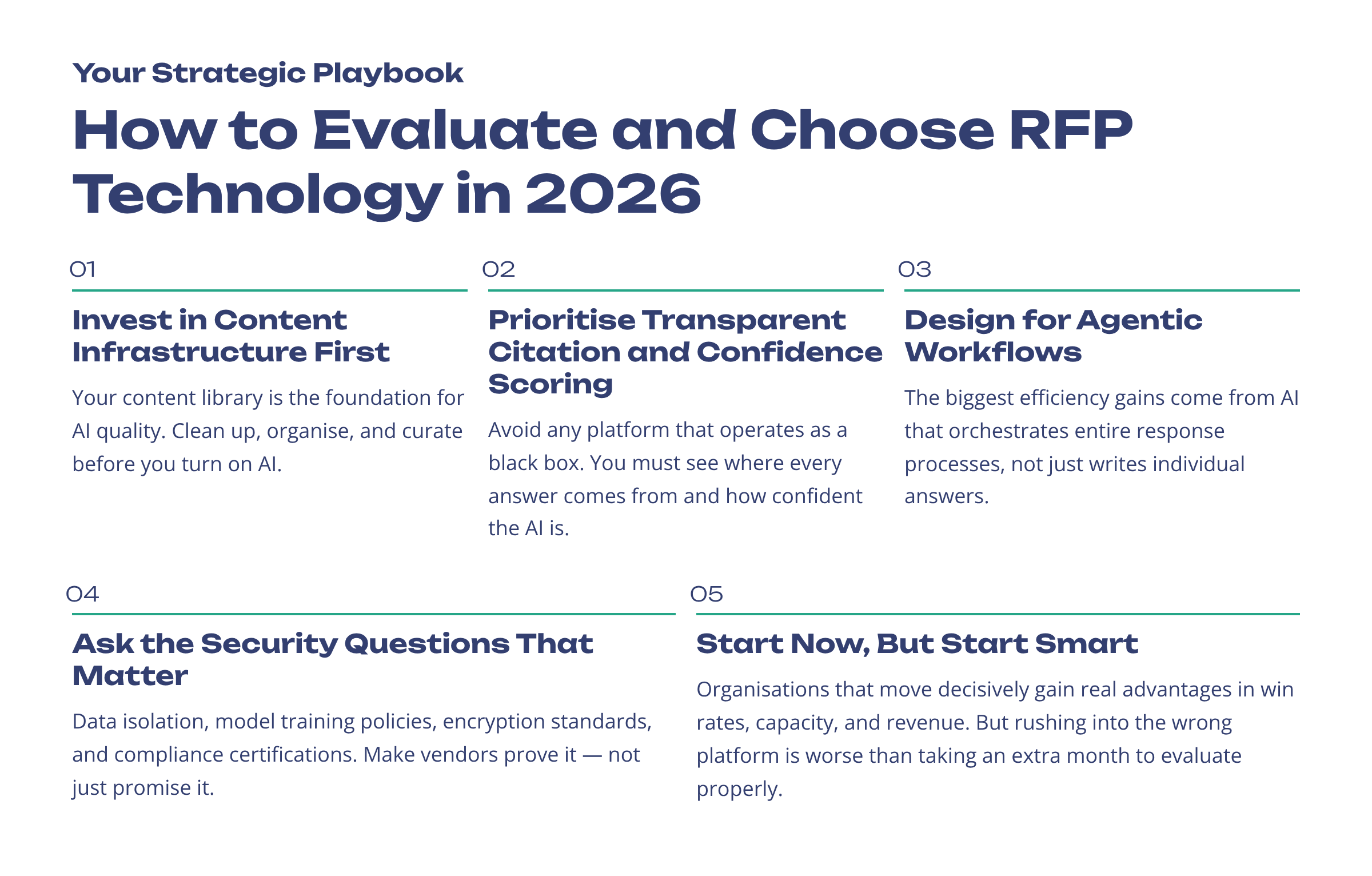
For organizations evaluating or upgrading their RFP technology stack, the strategic priorities are clear.
Invest in content infrastructure first.
Your content library is the foundation for AI quality. If the inputs are weak, the outputs will be too. Clean up, organize, and curate before you turn on AI.
Prioritize platforms with transparent citation and confidence scoring.
Avoid any platform that operates as a black box. You need to see where every answer comes from and how confident the AI is in that answer.
Design for agentic workflows.
The biggest efficiency gains will come from AI that can orchestrate entire response processes, not just write individual answers. Look for platforms that are building toward multi-agent orchestration.
Ask the security questions that matter.
Data isolation, model training policies, encryption standards, and compliance certifications are not optional. Make vendors prove it, not just promise it.
Start now, but start smart.
The organizations that move decisively will gain real advantages in win rates, capacity, and revenue. But rushing into the wrong platform is worse than taking an extra month to evaluate properly.
The question is not whether to adopt AI-powered proposal management. It is how quickly and how thoughtfully you make the move.
Conclusion
RFP technology has crossed a line it is not going back from. AI-native platforms, agentic workflows, and RAG-powered accuracy are no longer future promises. They are how the best proposal teams operate right now.
The playbook is simple. Fix your content library. Pick a platform that shows you where every answer comes from. Demand real security, not marketing copy. And move before your competitors do.
The teams that act now will respond to more RFPs, win more deals, and free their best people to do the work that actually closes revenue. The teams that wait will keep losing bids they never had time to finish.
Ready to see what AI-native RFP technology looks like? SparrowGenie combines secure AI automation, confidence scoring, and enterprise governance in one platform. Book your personalized demo today
Ready to see how AI can transform your RFP process?
Product Marketer at SparrowGenie
Being a Product Marketer at SparrowGenie, Aparna helps sales teams work faster with secure, AI-powered proposal automation. She turns complex features into simple stories, builds messaging that resonates, and keeps a close pulse on what customers actually need. She loves shaping clear, helpful content that shows how SparrowGenie makes RFP work easier, faster, and a lot less stressful.
Frequently Asked Questions (FAQs)
Related Articles

How RFP Workflow Automation is Transforming Enterprise Proposal Management in 2026

How to Write a Winning RFP Cover Letter (With Real Example)