The Great RFP Library Wars: Legacy vs AI-Native RFP Software (2026)

Article written by
Aparna Rajendran

INSIDE THE ARTICLE
SHARE THIS ARTICLE
Summary
Your RFP library is probably lying to you. Not maliciously; just quietly, one stale answer at a time. While your team is busy responding to the 150+ RFPs landing in your pipeline this year, the content you're pulling from is decaying at 22% per month. The RFP software market has officially split into two camps with two very different fixes for this, and in 2026, picking the wrong side isn't just a tech decision. It's a revenue decision.
The RFP software market has a dirty secret.
Most companies aren't running proposals from a clean, well-oiled content library. They're running them from a shared drive called "RFP_responses_FINAL_v7_really_final."
And in 2026, that's finally catching up with them.
The global RFP software market is on a trajectory from $2.6 billion to $7.5 billion by 2031, growing at a 16.2% CAGR. That kind of growth doesn't happen without a real problem underneath it. And the problem isn't just "manual work is slow." It's a full-blown philosophical war about where your organization's knowledge should actually live.
Two camps. Two very different answers. And the side you choose will directly impact your win rate, your team's sanity, and whether your proposals actually reflect what your product does today or what it did eighteen months ago.
Let's break it down.
Why Most RFP Libraries Are Already Broken
When Loopio launched in 2014 and Responsive (then RFPIO) in 2015, they solved a real problem. Proposal teams were drowning in "what did we say to Goldman last year?" chaos. The answer seemed obvious: centralize everything. Build one governed repository of pre-approved Q&A pairs. Tag them, search them, reuse them.
It worked. Loopio grew to 1,500+ enterprise customers. Responsive earned a 24-quarter G2 leadership streak. Teams with well-maintained libraries cut response times by up to 80% compared to going fully manual.
The content library became the product. Build it well, and it compounds in value over time.
The thing is that the logic made perfect sense for 2016. But 2026 looks very different.
How the RFP Content Library Became the Battleground
Content libraries degrade at roughly 22% per month without active governance.
Read that again. In fewer than five months, a library that nobody's actively maintaining becomes statistically unreliable. And the failure mode is silent, your AI confidently generates answers using outdated certifications, deprecated integrations, or product features you sunsetted two quarters ago.
The operational fallout compounds fast:
- 40% of saved responses may still reference old product features months after a product launch
- Compliance content with expired certifications creates real legal exposure
- Teams that discover stale content mid-RFP lose hours chasing SMEs for emergency fixes
- When the one person who owns the library leaves, institutional knowledge walks out the door with them
And still 70% of asset managers manage RFP and DDQ content through shared folders like SharePoint and OneDrive. The "RFP library" for most organizations is more fiction than fact.
The average organization submits over 150 RFPs annually, with influenced revenue approaching $256 million. At that scale, a broken content strategy isn't an inconvenience. It's a direct hit to the revenue pipeline.
See how SparrowGenie's Knowledge Hub stays current without the maintenance grind.
What Is a Static RFP Library Platform And Where It Still Wins
The philosophy: Governance requires a dedicated, human-curated source of truth. AI should surface pre-approved answers, not generate new ones.
Loopio
Source: Loopio
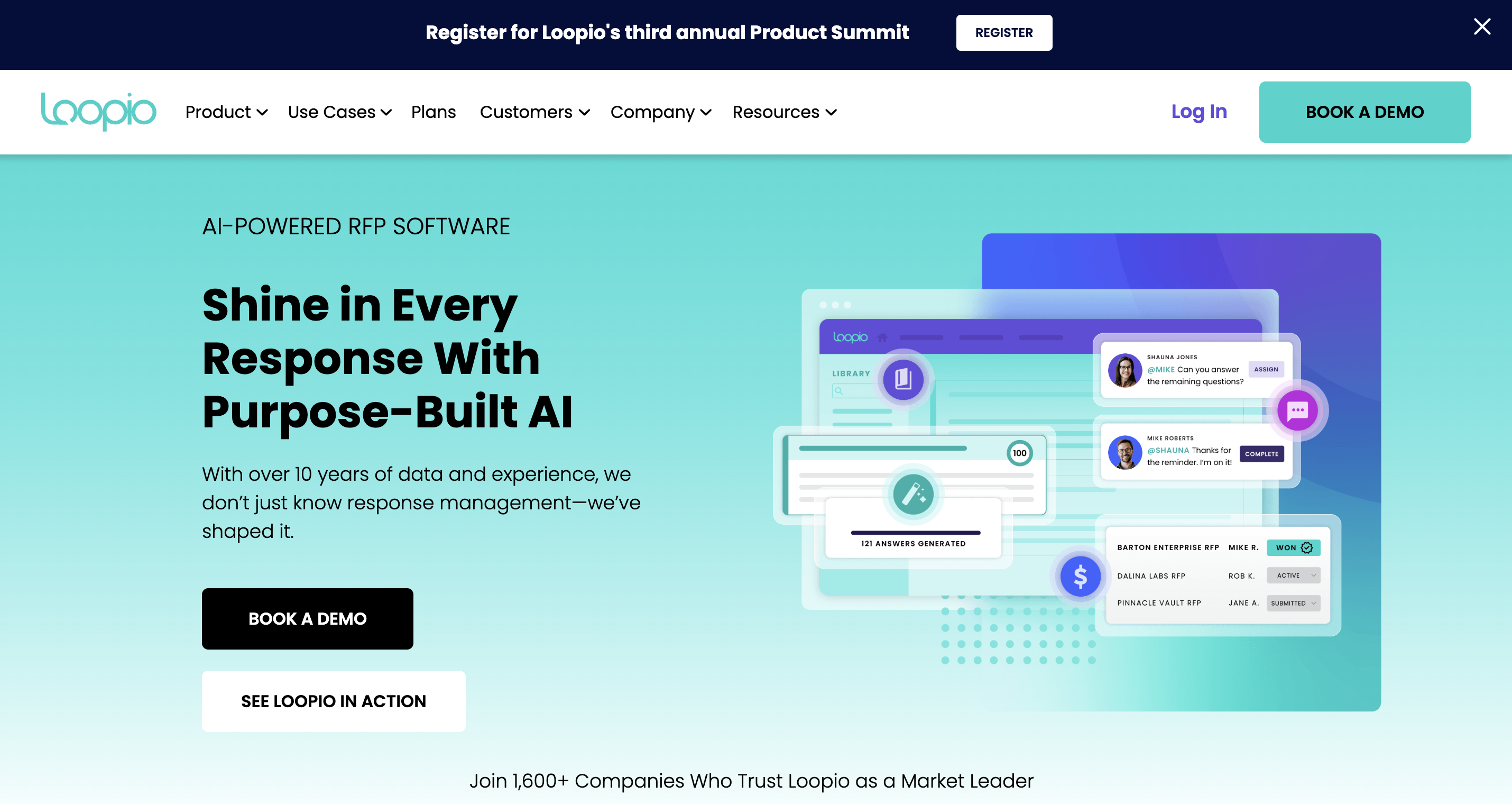
Loopio owns the content management standard. Its AI "Magic" finds the most statistically likely answer in your library when a new question arrives. Add version control, approval workflows, expiration tracking, and content health scoring, and you have the most complete library governance system in the market.
Where it wins: Fastest onboarding in its segment, exceptional customer support (9.7/10 on G2), and genuinely strong tooling for teams with a dedicated content manager and a stable library.
Where it struggles: The AI is additive, not generative, it surfaces existing answers rather than drafting from live knowledge. Keyword-dependent search misses semantic context (searching "cloud migration" won't surface your "AWS workload transition" answer). And at $54,000–$142,000/year, the pricing assumes you're extracting serious value from that library.
Responsive (formerly RFPIO)
Source: Responsive
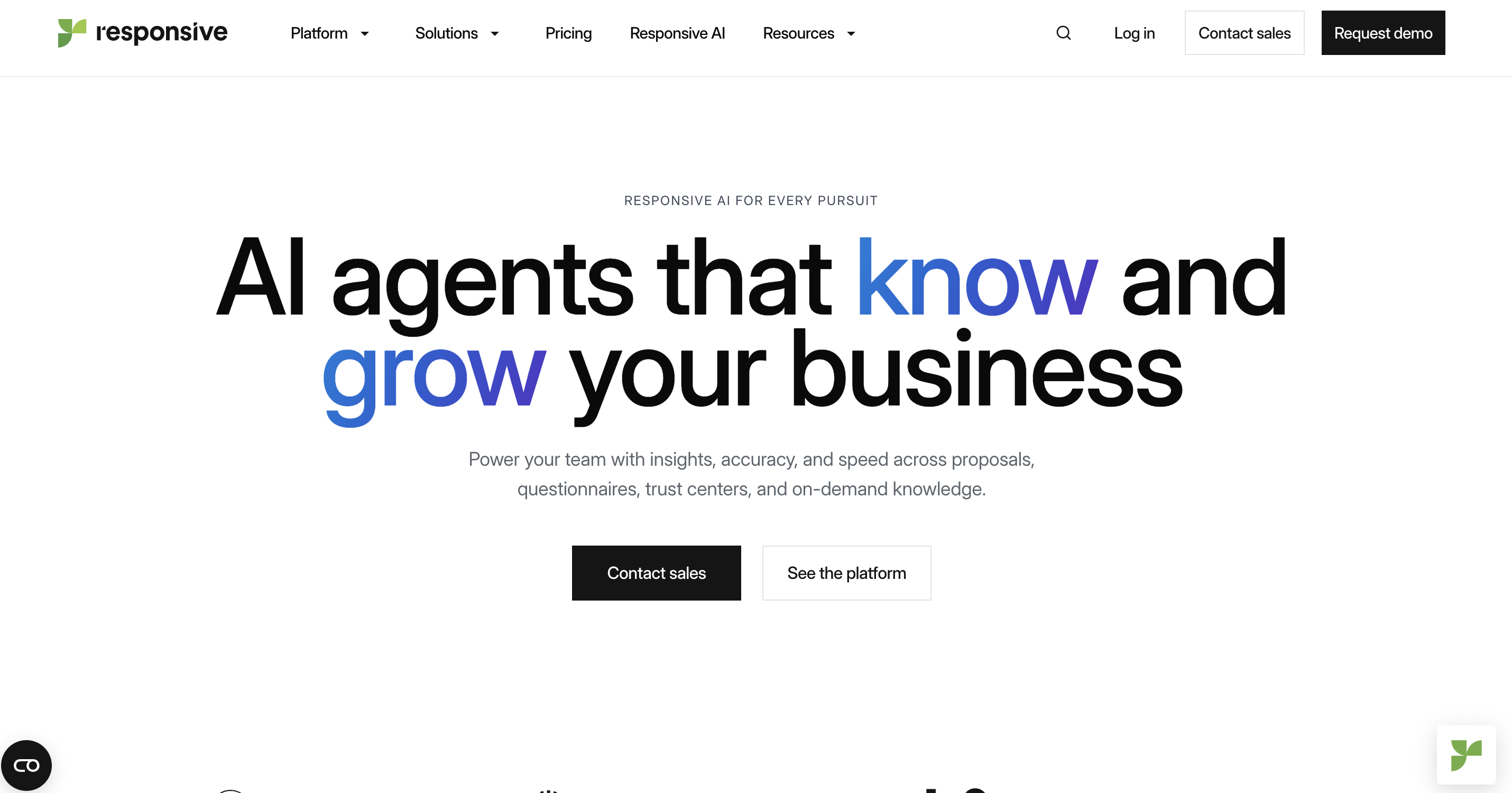
If Loopio owns content management, Responsive owns process management. Multi-department review cycles, configurable approval stages, deep CRM integrations, legal review gates — this is enterprise RFP orchestration at scale.
Where it wins: Best-in-class for complex, multi-stakeholder RFP motions. Auto-drafting addresses up to ~80% of questions. Broad ecosystem integrations including Salesforce, SharePoint, and Seismic.
Where it struggles: AI responses frequently require significant manual refinement. The platform helps teams stay organized, it doesn't fundamentally change how fast they write.
What Are AI-Native RFP Platforms and How Do They Work
The philosophy: Your knowledge already exists in Confluence, Google Drive, Gong calls, Salesforce. The job of AI isn't to surface pre-written answers. It's to synthesize responses in real time from live sources.
Arphie
Source: Arphie
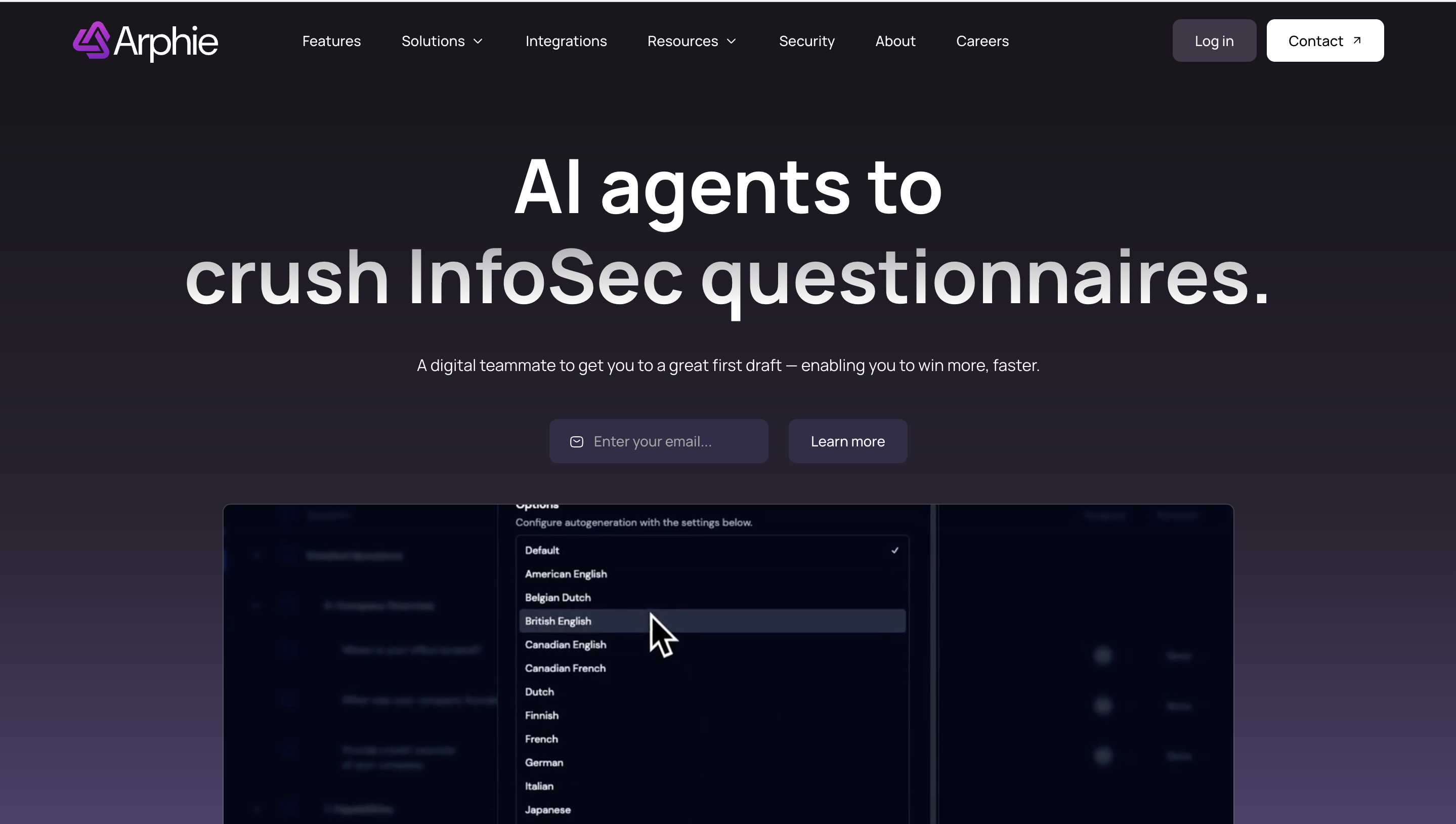
Arphie makes the cleanest break from library thinking. Connect it to your live sources like Google Drive, Confluence, SharePoint, internal wikis, and when those sources change, answers update automatically. No separate library maintenance workflow.
The performance data is striking: a 100-question RFP takes 17.5 hours in Loopio, 15 hours in Responsive, and 6 hours in Arphie. Users accept most of AI-written answers with minimal editing. Onboarding takes approximately one week compared to Loopio's twelve. G2 rating: 4.9/5.
SiftHub
Source: Sifthub
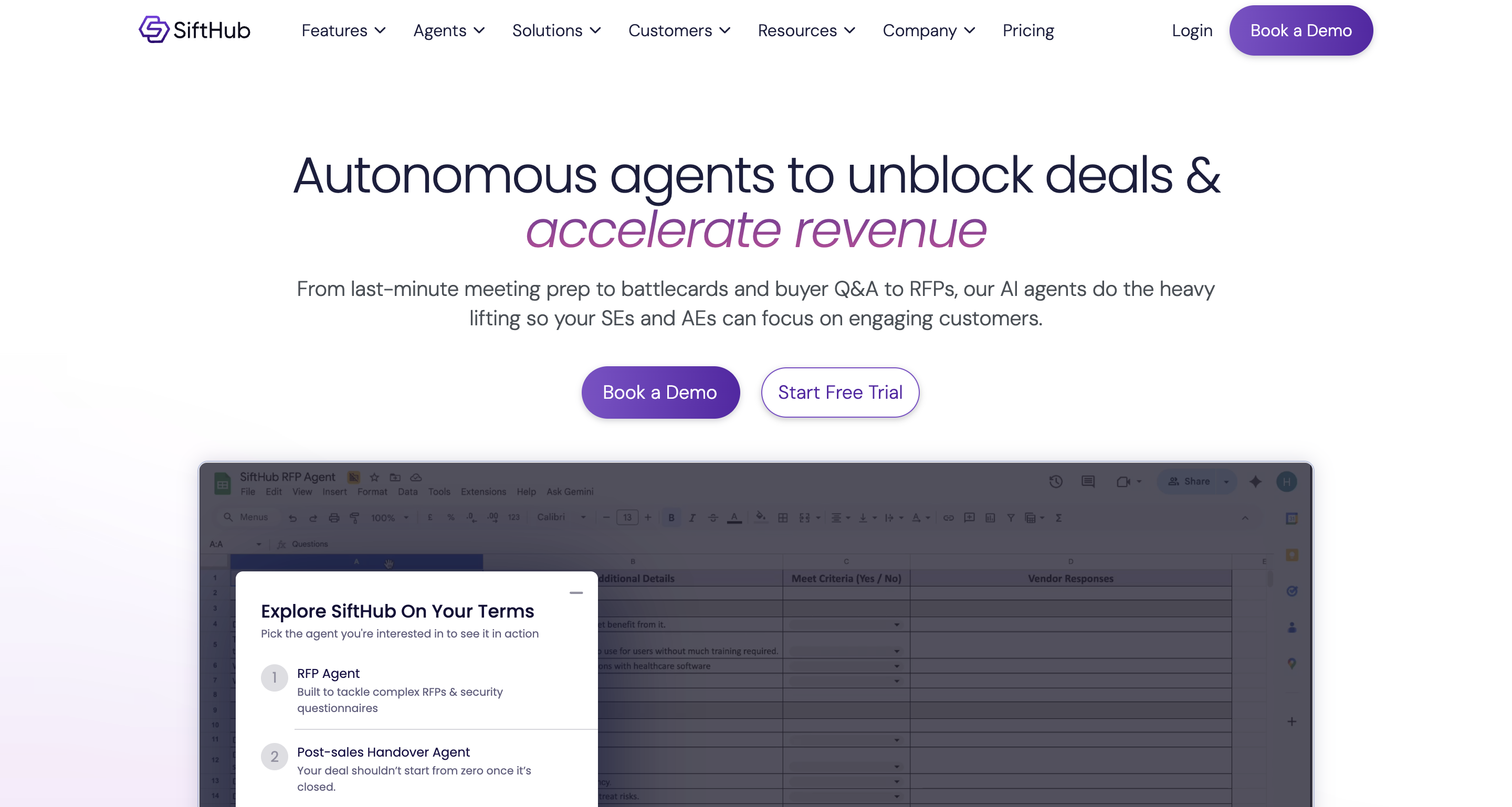
SiftHub acts as "connective tissue" indexing knowledge from Slack, Gong, Salesforce, and Drive. Allego reported achieving 90% auto-fill with SiftHub, compared to the 40–60% typical of Loopio customers. The platform claims responses 10x faster (from 1–2 weeks to 2–3 days) and handles the full RFP lifecycle including bid/no-bid analysis.
The key differentiator: if your product team updates a spec sheet in Drive, SiftHub knows immediately. You eliminate the library maintenance burden at the source.
1up
Source: 1Up
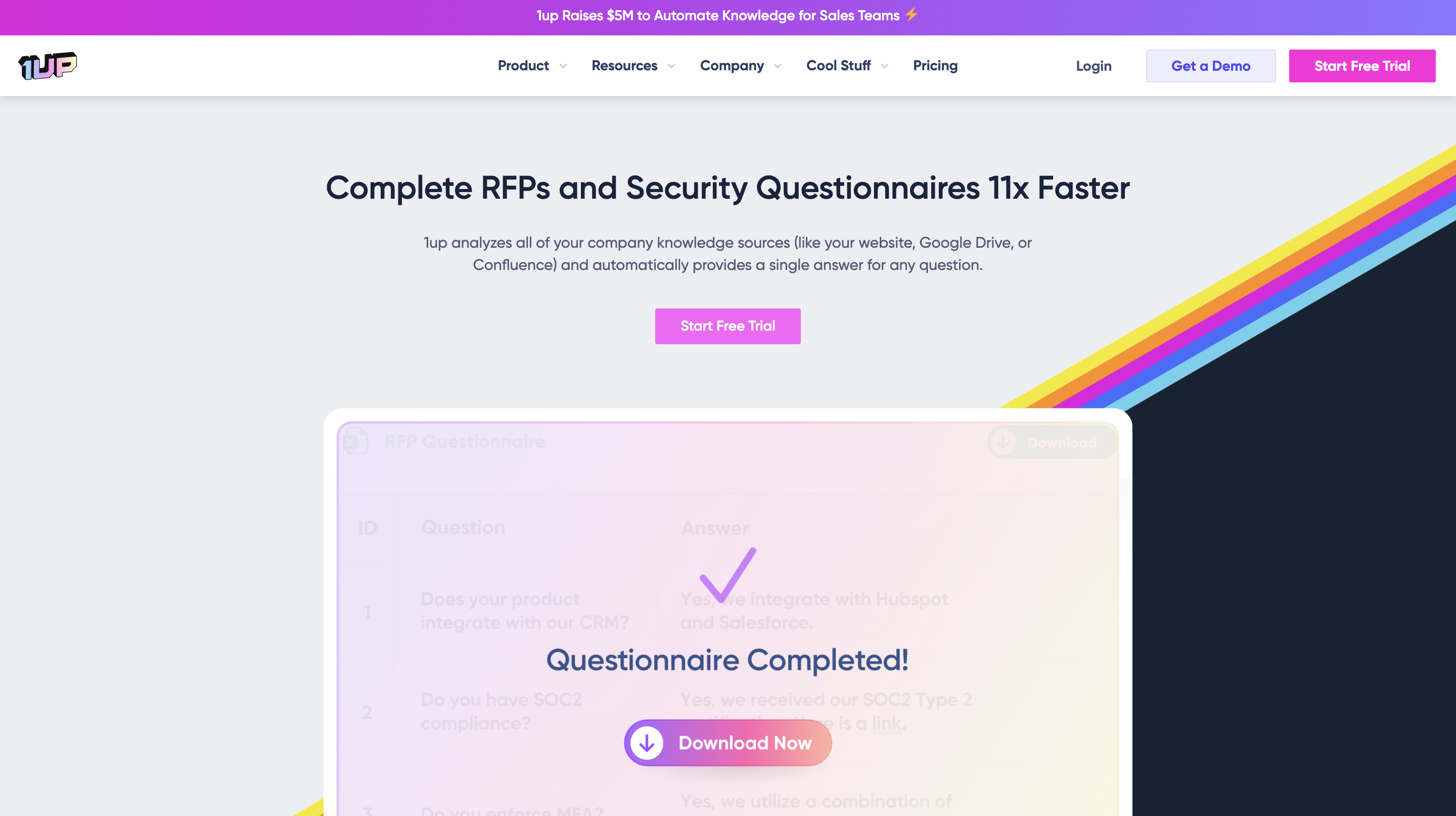
1up was among the first platforms to explicitly reject the answer library model. Connect it to your knowledge sources, and the workflow becomes: import RFP → auto-detect questions → click for AI answers. For teams migrating from legacy tools, it promises to be operational in minutes rather than weeks. Its pitch directly addresses why RFP software typically fails: nobody has time to tag and update the content.
Where Does SparrowGenie Fit: Governed Knowledge Hub vs Static Library
SparrowGenie occupies a deliberate middle ground and it's worth understanding why that matters.
Rather than choosing between "static library" (fragile, high maintenance) and "raw live-source AI" (fast but ungoverned), SparrowGenie built a full lifecycle knowledge hub with dedicated modules for Training, Testing, Improvement, and Conflict Resolution.
The distinction is meaningful: AI structures uploaded documents into a governed knowledge base automatically, no manual Q&A pair creation required. Genie (the platform's AI) drafts responses using secure, sanctioned information while maintaining role-specific approvals and comprehensive audit trails.
The March 2026 platform upgrade transformed RFP work into an AI-native workflow where each RFP becomes a structured project. Teams report 80% faster proposal creation and up to 3x more RFPs handled without adding headcount.
The Obligations module adds another layer that regulated-sector teams specifically need: monitoring commitments, exceptions, and dependencies tied to specific answers — addressing the "hidden commitments" risk that haunts financial services, healthcare, and government proposals.
The underlying argument: AI layered on a poorly governed source ecosystem doesn't fix the problem. It amplifies it. Governance can't be eliminated, it can only be redirected.
SparrowGenie helps teams handle 3x more RFPs without adding headcount.
Legacy vs AI-Native RFP Software
Metric | Legacy Static (Loopio/Responsive) | AI-Native (Arphie/SiftHub) |
|---|---|---|
Time per 100-question RFP | 15–17.5 hours | 6 hours |
Auto-fill rate | 40–60% | 80–90% |
AI answer acceptance rate | Significant editing needed | 84% accepted out of the box (Arphie) |
Onboarding time | 8–12 weeks | 1 week (Arphie); days (1up) |
Library maintenance | High (ongoing, dedicated owner) | Low/none (live source sync) |
Worth noting: well-governed libraries consistently achieve a 40–80% auto-response rate, and 59% of high-win teams use content library automation versus 36% of low-win teams, a 23 percentage point gap.
But here's the process maturity caveat that often gets buried: 65% of top-performing teams use AI proposal technology, but AI alone shows no independent correlation with wins. Process maturity determines whether the technology helps or exposes your gaps.
How to Choose the Right RFP Platform for Your Team in 2026
This isn't a features comparison. It's a philosophy decision. Here are the five factors that determine which side you actually belong on:
1. Library Maturity vs. Speed-to-Value
Got 500+ well-governed Q&A pairs maintained for 2+ years? Legacy platforms compound in value. Starting from scratch, or your existing content is scattered and unreliable? You get zero value from a library-first approach, you need quality responses from day one.
2. Workflow Complexity vs. AI Quality
If every claim must be traceable to an approved source with a named reviewer, Responsive's control layer is non-negotiable. If you're a fast-moving SaaS team responding to 50+ RFPs per month with a lean team, workflow overhead is your biggest bottleneck.
3. SME Availability vs. AI Autonomy
If your subject matter experts are genuinely bottlenecked, a platform that reduces their touchpoints to "only review RFPs, not library content" has a structural advantage. If you have dedicated proposal professionals who own content governance, the library model's quality ceiling is higher.
4. Content Volatility vs. Stability
Fast product iteration, frequent pricing changes, evolving compliance requirements? The 22% monthly decay rate hits you disproportionately hard under a static model. In stable, compliance-heavy industries with predictable update cycles, governed libraries deliver more consistent value.
5. Governance Philosophy
Where should governance live in a dedicated library, or upstream in source systems? Legacy platforms say: clean, controlled, auditable Q&A repository. AI-native platforms say: keep your source documents well-maintained and eliminate the library as a separate artifact. Neither is wrong in isolation. The right answer depends entirely on the state of your organization's existing knowledge ecosystem.
SparrowGenie users report 80% faster proposal creation. Book a demo to see it live.
What's Driving the RFP Software War Forward
RFP volume is accelerating. RFP volumes surged 77% in a single recent year. With 61% of companies planning to submit more RFPs in 2026, the math of manual library maintenance eventually breaks regardless of governance quality.
The burnout variable is real. 8 in 10 proposal professionals report burnout or stress related to manual RFP management. Companies fail to complete nearly 20% of RFPs simply because manual processes can't keep up with volume. Missed submissions are missed revenue.
DDQ and security questionnaire convergence. Standard DDQ acceptance has grown 46% over three years. Platforms that govern a single knowledge repository across RFPs, DDQs, VSQs, and security questionnaires have a structural advantage over those optimized for only one format.
How to Evaluate: The Criteria That Actually Matter
Industry practitioners recommend weighting your evaluation like this:
- 30% — Content Management & Knowledge Governance
- 25% — AI Intelligence & Automation
- 20% — Workflow & Collaboration
- 15% — Security & Compliance Controls
- 10% — Pricing & Contract Flexibility
The two criteria most commonly underweighted: content velocity (how fast the library updates when products change) and SME burden reduction (how much expert time the platform actually saves, not just promises to save).
The Bottom Line
The RFP library war isn't a software category dispute. It's a fundamental disagreement about where organizational knowledge should live, who governs it, and what role AI plays in turning it into competitive proposals.
Static library platforms say: trust requires structure. A pre-approved, version-controlled answer from a named SME is categorically different from an AI-generated response from a live document.
AI-native platforms say: freshness beats perfection. A slightly less polished answer based on yesterday's product documentation beats a perfectly worded answer referencing a feature you discontinued last year.
Both arguments are right in different contexts.
The companies losing this war aren't the ones who picked the wrong platform. They're the ones who picked no platform, still running proposals off scattered drives, chasing SMEs over email, wondering why their win rate stubbornly hovers at 41%.
The winning move in 2026 is simple: be deliberate about which side of the fault line your organization actually sits on. Then build from there.
Stop running proposals on scattered drives. See how SparrowGenie turns your existing knowledge into a winning RFP machine.
Ready to see how AI can transform your RFP process?
Product Marketer at SparrowGenie
Being a Product Marketer at SparrowGenie, Aparna helps sales teams work faster with secure, AI-powered proposal automation. She turns complex features into simple stories, builds messaging that resonates, and keeps a close pulse on what customers actually need. She loves shaping clear, helpful content that shows how SparrowGenie makes RFP work easier, faster, and a lot less stressful.