Why SparrowGenie Is the Modern Alternative to Responsive.io

Article written by
Aparna Rajendran

INSIDE THE ARTICLE
SHARE THIS ARTICLE
Summary
Responsive.io helped define RFP management for an earlier era. But RFPs today are faster, messier, and deeply AI-driven. This blog breaks down why AI-retrofitted tools are starting to show cracks, and how SparrowGenie’s AI-native architecture delivers speed, trust, and collaboration without the usual trade-offs.
Let’s get one thing straight. Responsive.io isn’t a bad product. It helped define RFP management for an earlier era. But the way RFPs get done today has changed dramatically and that’s exactly where the cracks start to show.
If you’re evaluating Responsive.io and wondering whether there’s a more modern, AI-native alternative, this comparison exists for you. Because SparrowGenie isn’t just another RFP tool with AI sprinkled on top. It’s built for how revenue teams actually work in 2026.
This isn’t about feature checklists. It’s about architecture, incentives, and outcomes.
What’s the real difference between Responsive.io and SparrowGenie?
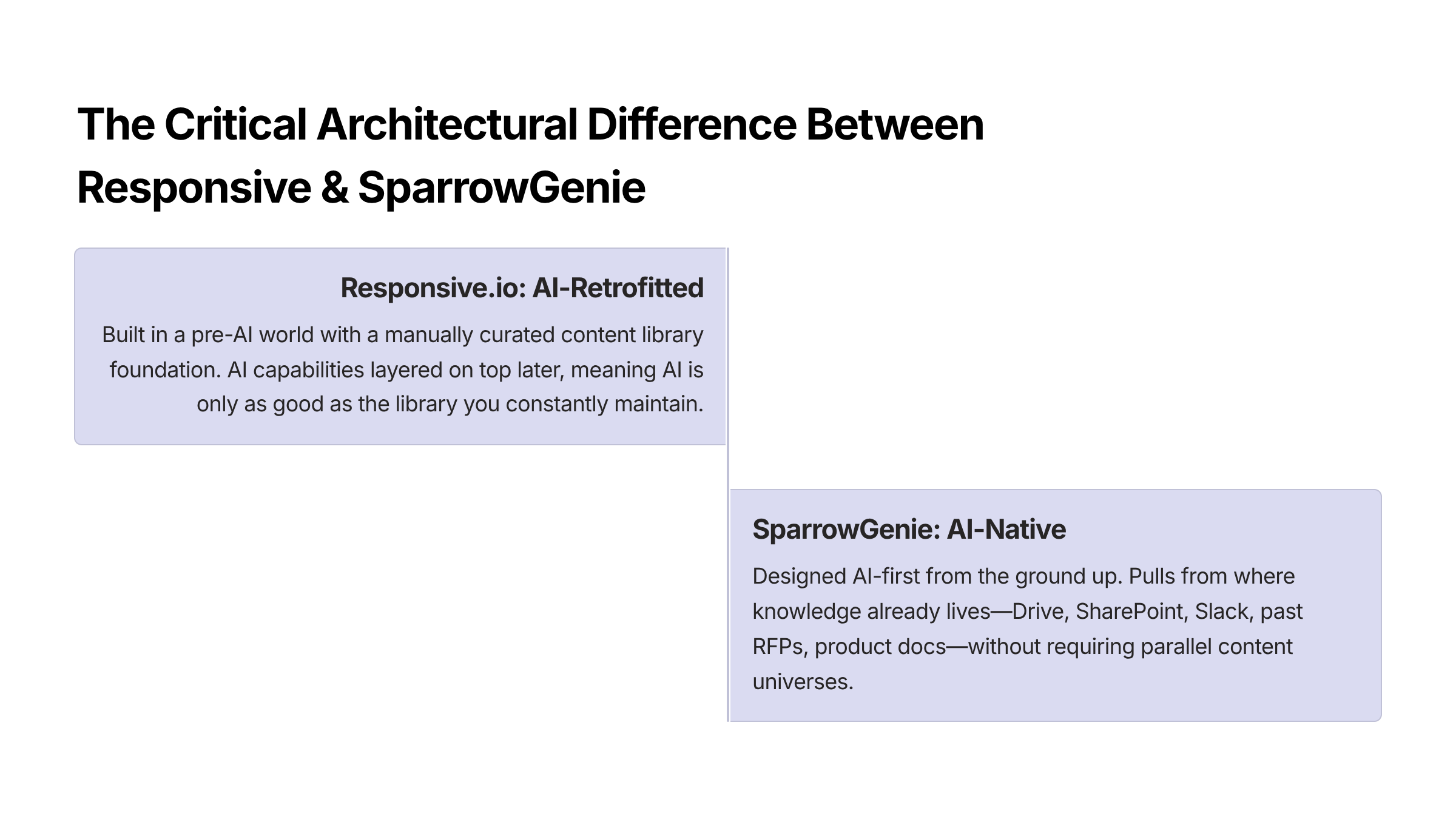
Here’s the thing most of them gloss over. Responsive was built in a pre-AI world. Its foundation is a manually curated content library. AI came later, layered on top of that structure. Which means the AI can only be as good as the library you constantly maintain.
That creates three problems teams feel every single day:
- You don’t fully trust AI answers without digging into the source
- You spend hundreds of hours pruning duplicates and outdated responses
- Search relevance breaks under real-world RFP complexity
Multiple user reviews echo the same frustration: AI suggestions feel noisy, generic, or flat-out irrelevant when the question is even slightly nuanced.
SparrowGenie took the opposite route. It was designed AI-first, not AI-retrofitted.
Instead of asking teams to maintain a parallel universe of approved answers, SparrowGenie pulls from where knowledge already lives: Drive, SharePoint, Slack, past RFPs, and product docs. Then it does three critical things differently:
- Confidence-scored answers so reviewers know exactly what needs human judgment
- Dual mapping that matches intent and requirements, not just keywords
- Conflict detection that flags contradictions instead of quietly reusing bad content
What this really means is simple: AI drafts the first 80 percent. Humans validate the important 20 percent. And every RFP makes the system smarter.
Teams using AI-native platforms like SparrowGenie consistently complete RFPs nearly 3× faster, with accept-as-is rates north of 80 percent. That’s not incremental improvement. That’s a workflow reset.
Let's dive into more details about the differences between Responsive.io and SparrowGenie.
Curious what AI-native RFP drafting actually looks like in practice?
The Pricing Models
Pricing isn’t just a number. It exposes product philosophy.
Responsive uses a seat-based, sales-led pricing model. Cost scales with:
- Number of users
- Role types
- AI usage
- Library size
- Integrations
- Support tiers
In practice, this creates a collaboration tax. The more people you involve to improve quality legal, InfoSec, product, and presales, the more expensive the software becomes.
So teams quietly limit access. And quality quietly suffers.
SparrowGenie does something refreshingly modern.
- Starts at $899 per month
- Unlimited users
- Project-based pricing
- No penalty for collaboration
The incentive is aligned with outcomes, not access.
Bring in legal. Pull in InfoSec. Loop in product. No budgeting gymnastics required. Over a year, that difference compounds. Mid-market teams routinely save tens of thousands by removing per-seat friction and reinvesting that budget into actual revenue work
Implementation
Responsive implementations are often described the same way:
“A project.”
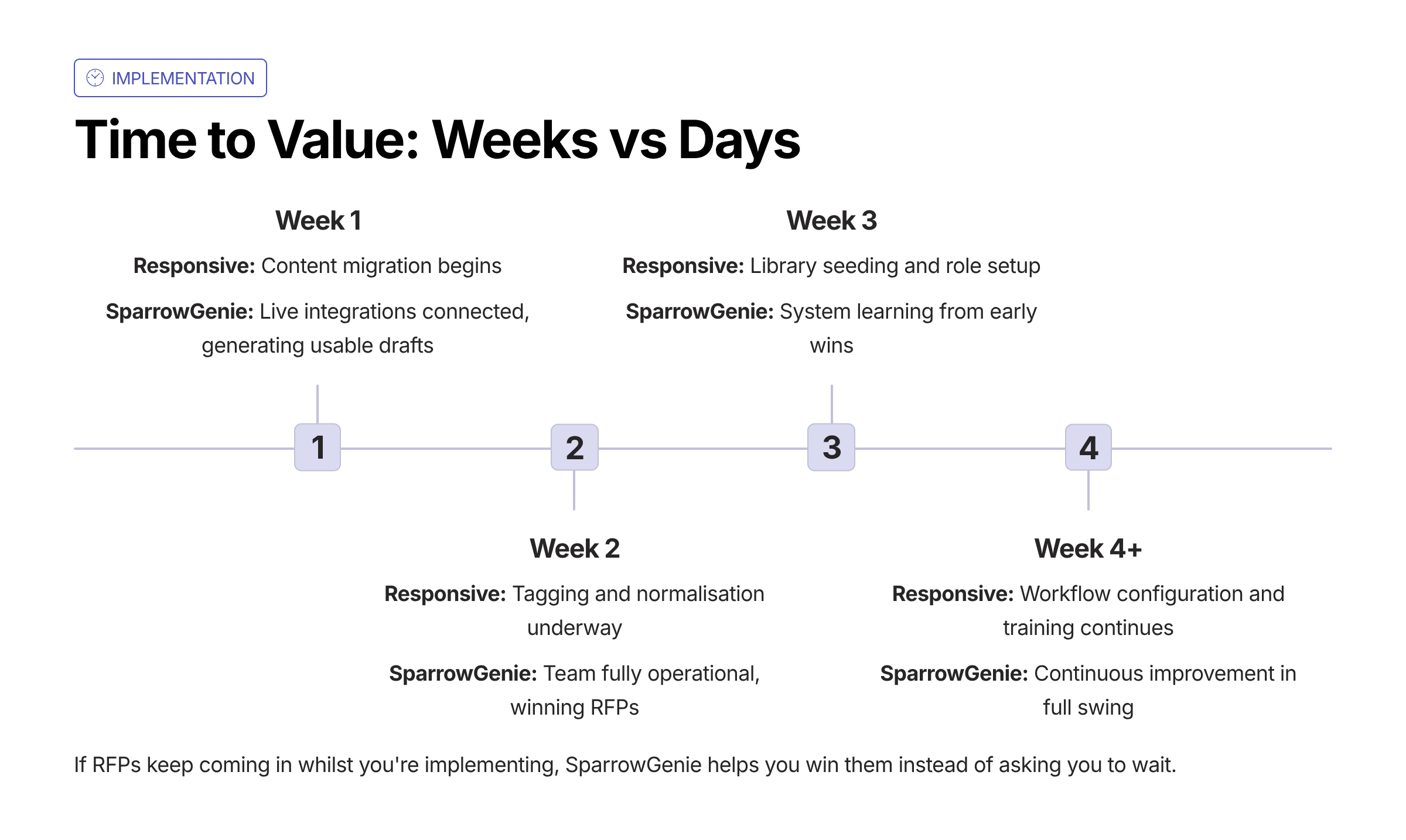
Weeks of:
- Content migration
- Tagging and normalization
- Library seeding
- Role setup
- Workflow configuration
- Training
All before the AI becomes useful. That’s not a knock on the team. It’s a consequence of depending on a pristine content library.
SparrowGenie flips the timeline.
Because it connects directly to live sources, onboarding usually takes less than a week. Teams generate usable drafts almost immediately. No cold start. No blank slate problem.
If RFPs keep coming in while you’re implementing, SparrowGenie helps you win them instead of asking you to wait.
See how SparrowGenie drafts real RFP answers in minutes.
Ease of Use for Sales and Cross-Functional Teams
Responsive is powerful. It’s also heavy. Long-time users regularly mention:
- Complex UI
- Multi-click workflows
- Frequent bugs
- Slow search performance
Proposal managers adapt. Everyone else avoids the tool. That creates a dangerous pattern: the people with the most context sales, SMEs, and leadership contribute the least.
SparrowGenie was built by people who lived inside RFP chaos. The UX reflects that:
- AI-guided workflows
- Section-level progress visibility
- Confidence indicators instead of guesswork
- Works inside tools teams already use
The result is broader adoption. And better answers. Because RFP quality improves when expertise flows freely.
Accurate Knowledge Base
Static libraries age badly. Products evolve. Policies change. Compliance updates roll out. But old answers linger and quietly resurface. Maintaining accuracy in legacy systems takes 200–250 hours per year, often requiring a dedicated librarian role.
SparrowGenie treats knowledge as dynamic.
- Live integrations auto-refresh content
- Edits feed back into future answers
- Conflicts get flagged, not buried
- No duplicate sprawl
Every RFP improves the next one without manual cleanup. That changes the total cost of ownership in ways spreadsheets often miss.
Watch how SparrowGenie pulls answers from live knowledge instead.
What G2 Reviews Really Say About Responsive.io
Across G2 reviews, Responsive.io is consistently recognized as a capable, enterprise-grade RFP platform. Long-time users appreciate its depth and maturity. But a clear pattern shows up once you read beyond the star ratings.
What users consistently like
- Strong central content repository once it’s fully set up
- Good audit trails and enterprise governance controls
- Works well for large, structured proposal teams
- Reliable for repeatable, standardized RFP workflows
Where frustration creeps in
- Setup and onboarding take significant time and effort
- AI suggestions feel generic or miss nuance in complex RFPs
- Search relevance degrades as libraries grow
- UI feels heavy, with too many clicks for simple tasks
- Collaboration becomes costly as more users are added
The subtext across many reviews is this:
Responsive works best after you invest heavily in maintaining it. When libraries are pristine and processes are rigid, it performs. But as RFPs become more contextual, cross-functional, and fast-moving, teams feel the drag.
In short, G2 reviews don’t say Responsive is broken. They say it’s expensive to keep sharp.
Why SparrowGenie Fits Where Responsive Starts to Strain
This is exactly the gap SparrowGenie was built to close.
Where Responsive assumes a clean, curated content universe, SparrowGenie assumes reality:
- Knowledge is scattered
- SMEs are busy
- RFPs are nuanced
- Answers need judgment, not blind reuse
Instead of forcing teams to maintain a static library, SparrowGenie works with live knowledge sources and makes AI accountable through confidence scoring and conflict detection. Reviewers don’t have to guess whether an answer is safe to use. They can see it.
And critically, SparrowGenie removes the collaboration penalty G2 users quietly complain about. Sales, legal, InfoSec, and product can all participate without worrying about seat costs or access control gymnastics.
So while Responsive reviews reflect a platform optimized for library governance, SparrowGenie aligns with teams optimizing for speed, trust, and real-world collaboration.
That’s why, when buyers read G2 carefully, the question shifts from
“Is Responsive good?” to “Is this how we want to work going forward?”
And for many modern revenue teams, SparrowGenie fits that future far more naturally.
Want to see SparrowGenie in action firsthand?
What Do Modern Buyers Expect From RFP Software Today?
Even Responsive’s own research shows the shift:
- 82 percent expect faster responses
- 75 percent expect higher personalization
- 84 percent operate under tighter budgets
Speed alone isn’t enough anymore. Accuracy alone isn’t enough either. Modern teams need both, without burning time or trust.
AI-native platforms consistently outperform legacy systems on:
- Response time
- Win rate lift
- Research effort reduction
- ROI per RFP
SparrowGenie users report:
- 60–80 percent efficiency gains
- 2.9× faster completion times
- Measurable revenue lift from higher win rates
When is Responsive.io Still the Right Choice?
To be fair, Responsive still fits certain scenarios. If you have:
- A massive, well-maintained content library
- Dedicated proposal operations teams
- Heavy legacy integrations
- Deep audit-first workflows
Staying put may be rational. But that’s a shrinking slice of the market. Most SaaS and growth-stage revenue teams need speed, flexibility, and frictionless collaboration more than library governance.
Explore an RFP platform that works from day one.
Final Thoughts
Responsive is optimized for an era where static content was unavoidable. SparrowGenie is optimized for a world where:
- AI drafts first
- Humans validate what matters
- Knowledge stays alive
- Collaboration is unlimited
- ROI is predictable
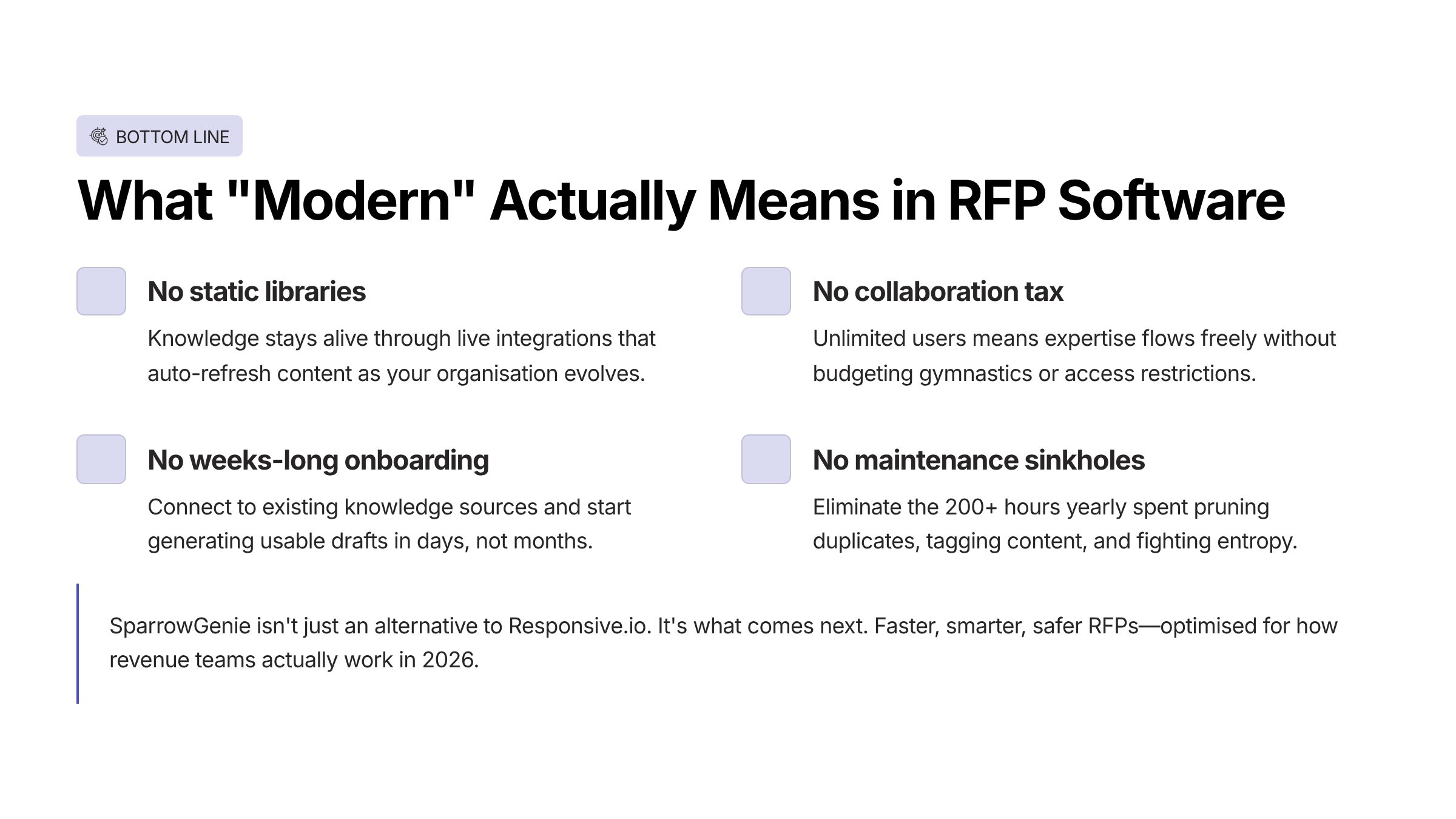
If you’re asking what “modern” actually means in RFP software, it looks a lot like this: No static libraries. No collaboration tax. No weeks-long onboarding. No maintenance sinkholes.
Just faster, smarter, safer RFPs. That’s why SparrowGenie isn’t just an alternative to Responsive.io. It’s what comes next.
Ready to see how AI can transform your RFP process?
Product Marketer at SparrowGenie
Being a Product Marketer at SparrowGenie, Aparna helps sales teams work faster with secure, AI-powered proposal automation. She turns complex features into simple stories, builds messaging that resonates, and keeps a close pulse on what customers actually need. She loves shaping clear, helpful content that shows how SparrowGenie makes RFP work easier, faster, and a lot less stressful.