AI-Powered DDQ Automation Software: Tools, ROI, & More

Article written by
Aparna Rajendran

INSIDE THE ARTICLE
SHARE THIS ARTICLE
Summary
A no-fluff buyer's guide for proposal teams, pre-sales leaders, and RevOps teams drowning in due diligence questionnaires (DDQs).
How many deals has your team lost because a DDQ response was late, inconsistent, or just exhausting to complete?
Investment managers alone spend 40+ hours monthly on ILPA questionnaires. Sales engineering teams watch deals stall for weeks while security queues pile up. Compliance teams drown in requests that never stop coming.
The real irony is that the companies sending these DDQs don't want to slow you down. They just need confidence you're the right partner. The process is the problem, not the intent.
That's exactly what AI software for DDQ automation is built to fix. Not to replace your team, but to give them their time back, so the right people are spending energy on judgment calls, not copy-paste marathons. Let's dive into the details
What is DDQ Automation Software?
DDQ automation software is a software that uses AI to automatically generate, route, and manage responses to DDQ, cutting what used to take days down to hours. Let's dive into the details.
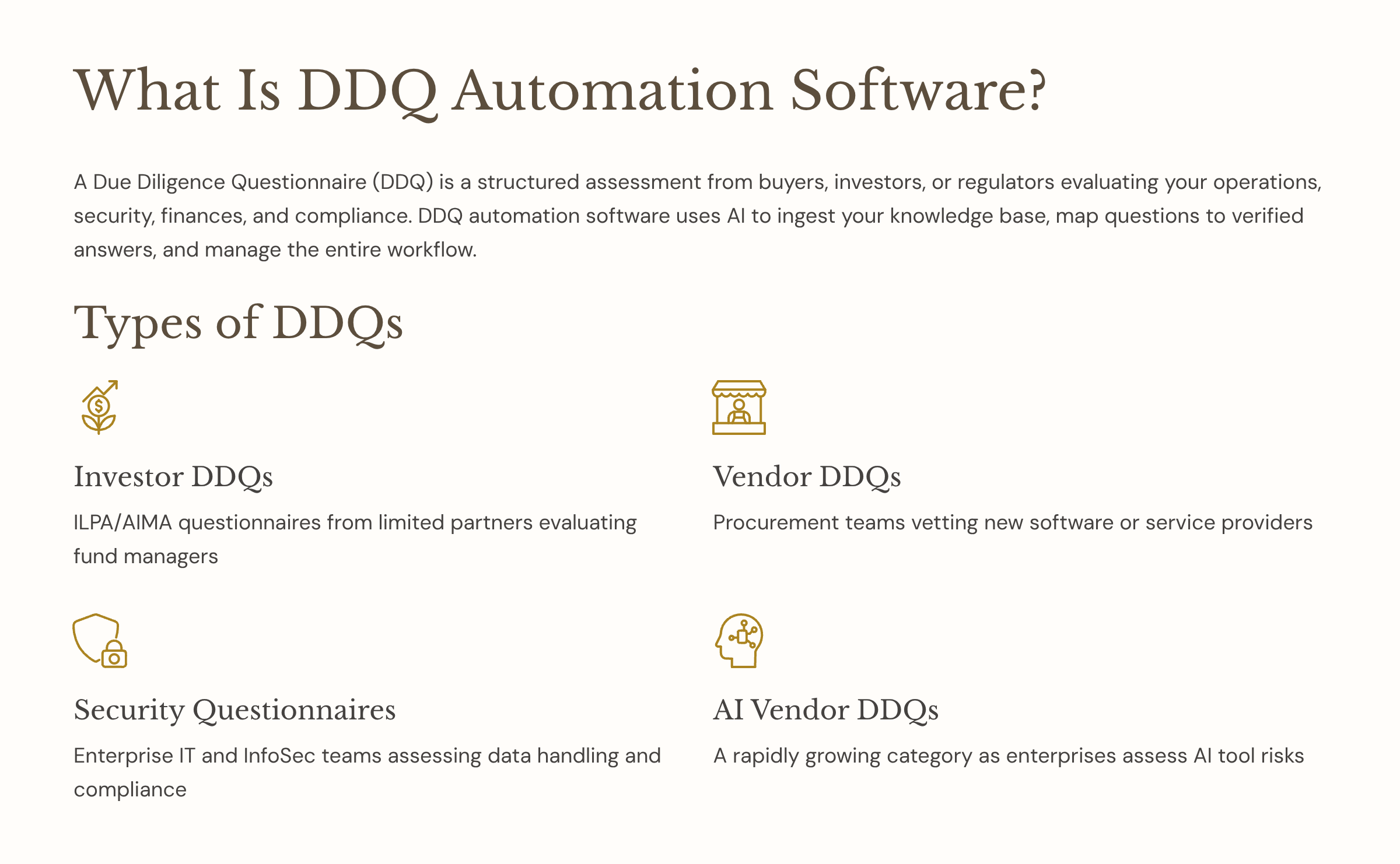
A Due Diligence Questionnaire (DDQ) is a structured set of questions from a buyer, investor, or regulator designed to assess your company's operations, security posture, financial health, and compliance readiness.
DDQs show up in many forms:
- Investor DDQs — ILPA/AIMA questionnaires from limited partners evaluating fund managers
- Vendor DDQs — Procurement teams vetting new software or service providers
- Security questionnaires — Enterprise IT and InfoSec teams assessing your data handling and compliance
- Banking and financial services DDQs — Regulatory due diligence for partnerships and onboarding
- AI vendor questionnaires — A rapidly growing category as enterprises assess AI tool risks
DDQ automation software uses AI to do the heavy lifting: ingesting your company's knowledge base, mapping incoming questions to the right answers, generating first drafts with context-aware language, routing sections to the right SMEs, and managing approvals, all within a single workflow.
The best platforms cut response time from 3-5 days down to 2-4 hours per questionnaire. That's not incremental improvement. That's a complete transformation of how your team operates.
See how SparrowGenie handles DDQs, RFPs, and security questionnaires in one place. Book a 15-minute demo.
How DDQ Automation AI Actually Works
Not all DDQ automation AI is equal. And if you've ever received a confidently wrong AI answer in a high-stakes compliance context, you know why this matters.
Most enterprise DDQ platforms today use a retrieval-augmented generation (RAG) architecture.This means the AI doesn't just generate answers from its training data, it searches your company's actual documents first, then generates a response grounded in your real content. This dramatically reduces hallucinations and keeps answers accurate to your specific policies, certifications, and product details.
What to look for in the AI layer:
- Source attribution — Does the tool show you which document or clause it pulled the answer from? If not, how do you audit it?
- Confidence scoring — Top platforms assign a Trust Score or confidence level to each generated response, so your team knows which answers need expert review and which are ready to go.
- Semantic search vs. keyword search — Keyword matching breaks when questions are phrased differently. Semantic search understands intent, so "How do you handle data residency?" and "Where is customer data stored?" return the same relevant answers.
- Hallucination mitigation — The best tools explicitly flag when they don't have enough information rather than fabricating a plausible-sounding answer.
- Knowledge graph integration — Some advanced platforms build relationships between concepts across your documents, enabling more nuanced and complete answers to complex multi-part questions.
The AI architecture isn't a vendor differentiator to gloss over. It's the core of whether the tool saves you time or creates liability.
SparrowGenie's knowledge hub is built for accuracy, traceability, and zero copy-paste chaos. Want to see how the AI layer works? Book a walkthrough.
Top AI DDQ Automation Tools: The Honest Comparison
Here are few of the top picks for AI-enhanced DDQ automation tools.
Tool | Best For | Key Strength | Starting Price |
|---|---|---|---|
SparrowGenie | B2B SaaS, IT Services, Fintech, Cybersecurity | Full RFP+DDQ+Security Q workflow with AI + human approval loops | Contact for pricing |
Arphie | Enterprise teams needing transparent AI reasoning | Patent-pending AI agents, 84% answer acceptance rate | Custom enterprise |
Loopio | Mid-market sales-focused teams | 10+ years market presence, large template library | $20,000/year+ |
AutoRFP.ai | SMBs wanting all-in-one without add-ons | Libraryless semantic search, Trust Scores 0-100 | $899/month+ |
Responsive | Large enterprises | Strong approval workflows, AI trained | Custom pricing |
DiligenceVault | Investment managers and institutional allocators | Purpose-built for ILPA/AIMA investment DDQs | Usage-based |
SecurityPal | Security-first teams | Human + AI hybrid for security questionnaire responses | Custom pricing |
Here's what makes each platform worth knowing.
Arphie: Transparent AI for compliance-critical teams
Source: Arphie
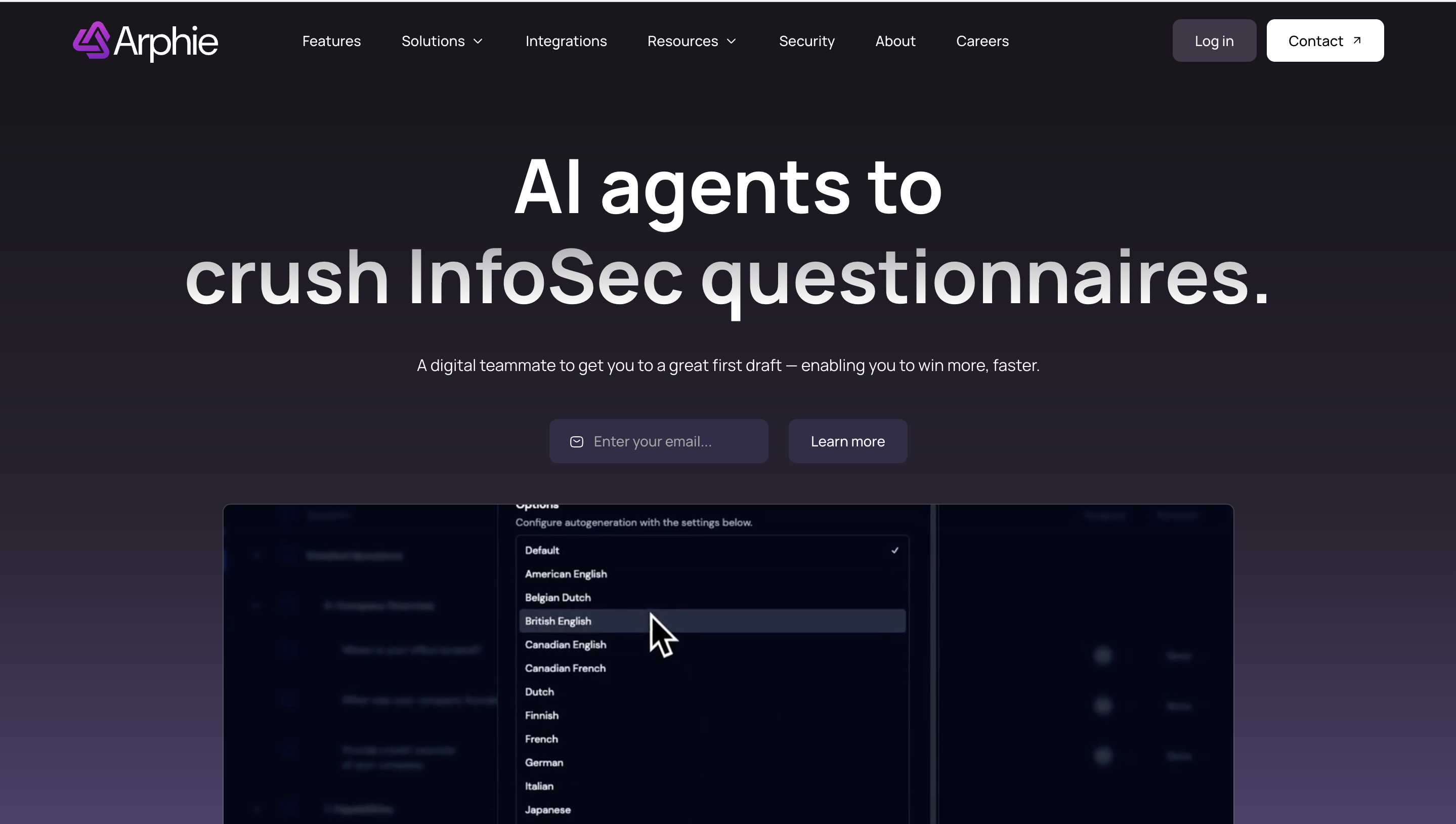
Arphie's strength is its commitment to source transparency. Every AI-generated response shows the exact document and confidence level it was drawn from. For teams where a wrong answer in a DDQ creates actual legal or regulatory exposure, this matters enormously. Their anti-hallucination architecture doesn't try to guess when it doesn't know, it tells you.
Loopio: The established workhorse
Source: Loopio
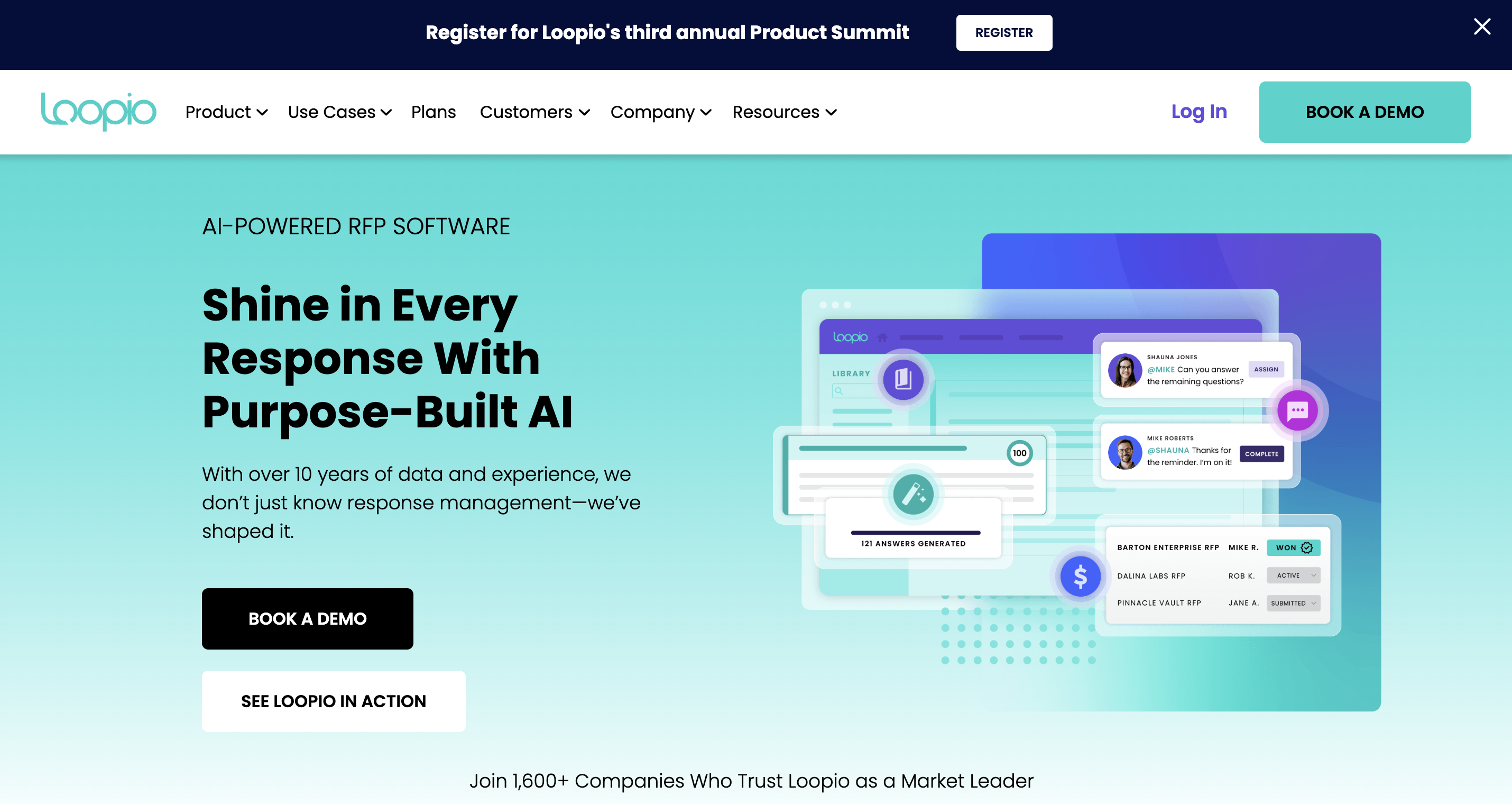
Loopio has been in this market for over a decade and their Response Intelligence ML, trained on 500,000+ projects, gives it a strong foundation. It's not the flashiest AI, but it works consistently. The main limitation is the library maintenance overhead: teams still need to keep content updated and tagged. For sales-focused organizations already using Loopio, it's a reliable option. For teams evaluating fresh, more modern architectures are worth a look.
AutoRFP.ai: No library, no problem
Source: AutoRFP.ai
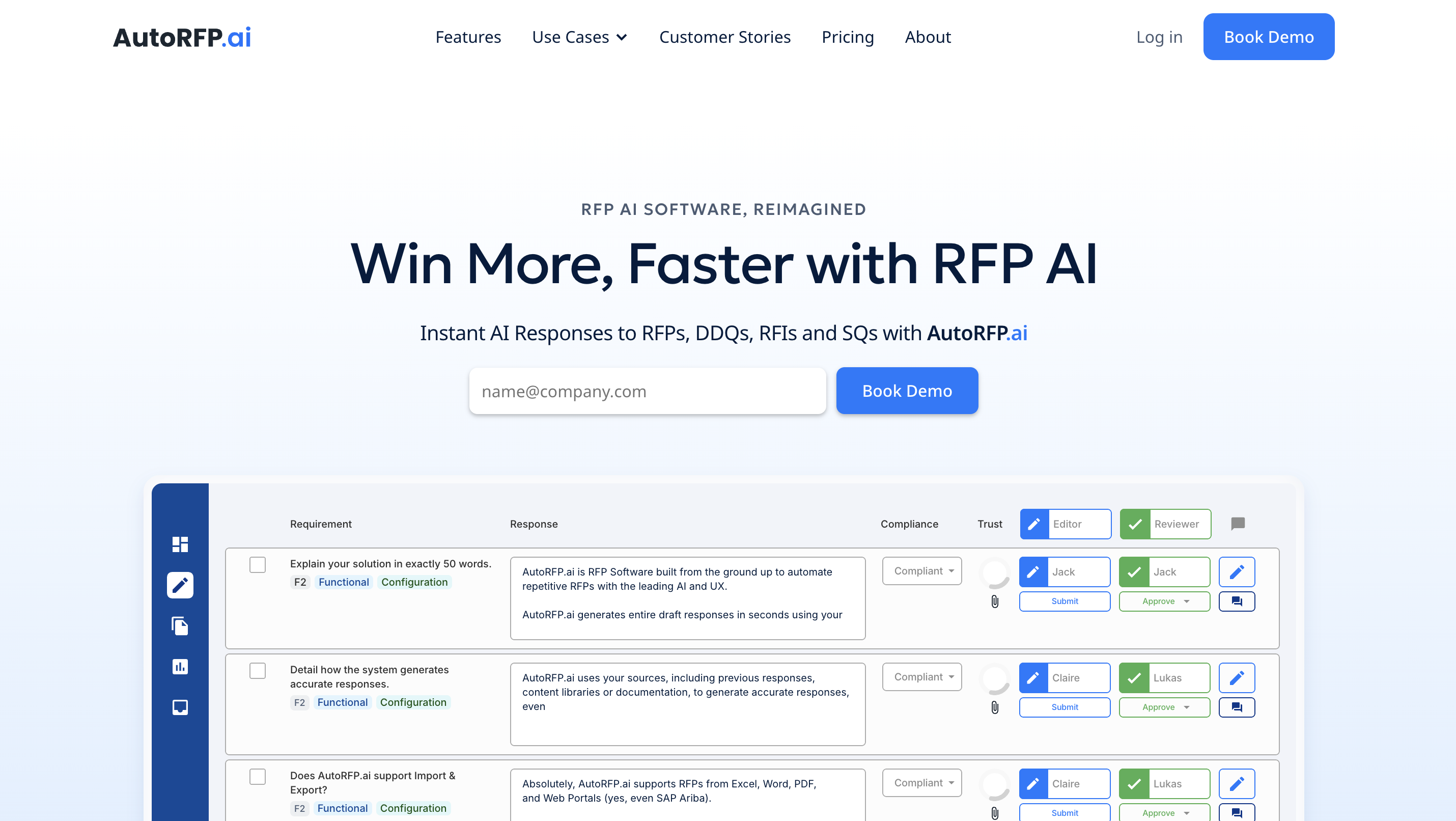
AutoRFP.ai takes a refreshing approach, semantic search that reads the meaning of questions and pulls answers from your existing documents, emails, and templates without requiring you to build and maintain a dedicated Q&A library. Their Trust Score (0-100) on each response gives teams clear signal on where human review is needed. Starting at $899/month with all-inclusive pricing, it's one of the more accessible options for growth-stage teams.
SecurityPal: When the stakes are highest
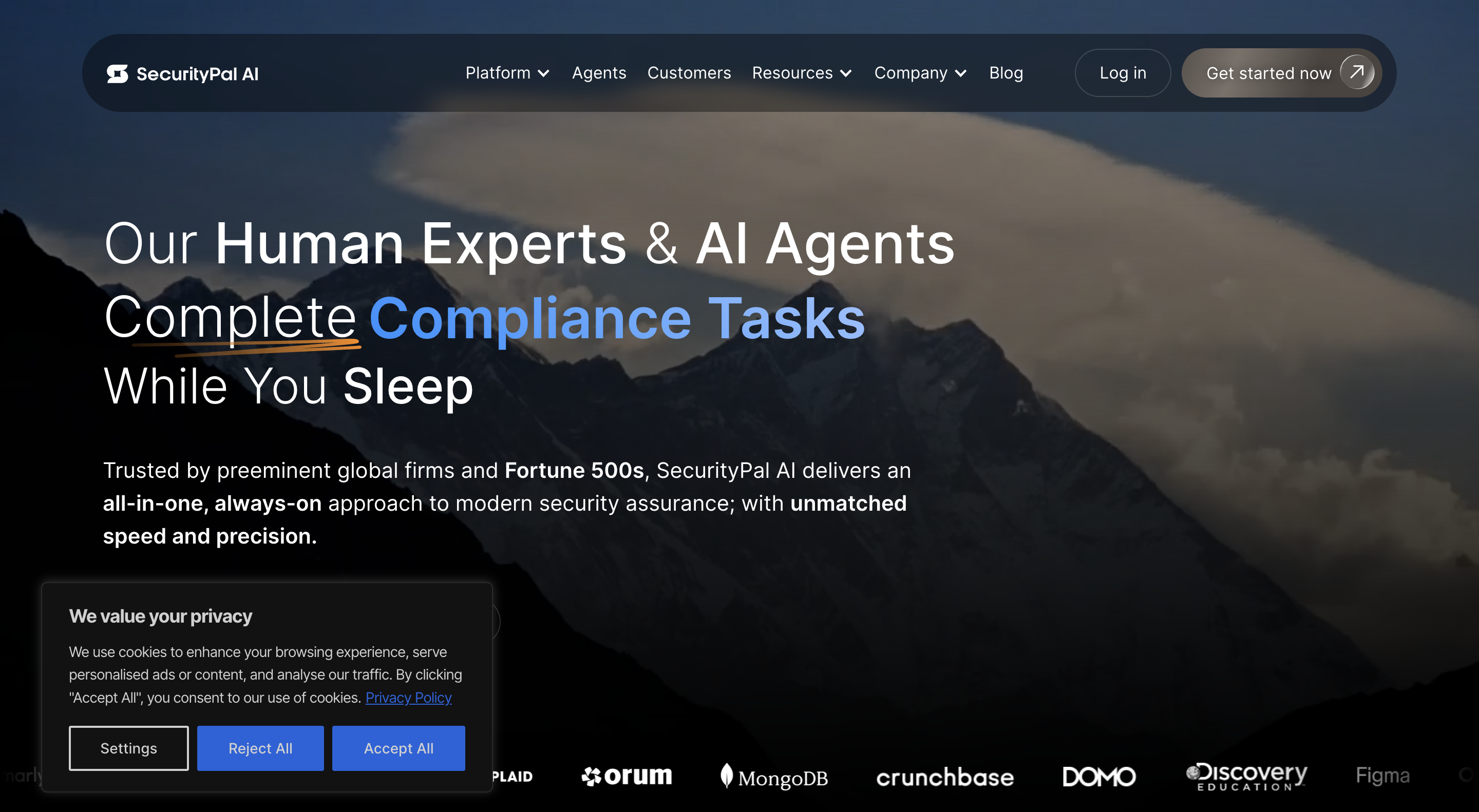
Source: SecurityPal
SecurityPal combines AI automation with a concierge model, their human security experts review AI-generated responses before they go out. This makes it ideal for companies handling sensitive security questionnaires where full automation feels risky. The trade-off is turnaround time and cost, but for enterprise deals with Fortune 500 buyers, the quality assurance is worth it.
SparrowGenie For Fast & Accurate DDQ Responses
Most DDQ tools in the market were built for one primary use case, either investment DDQs (DiligenceVault), security questionnaires (SecurityPal, Vendict), or RFP response (Loopio, Responsive). Very few handle the full spectrum of due diligence workflows that a modern B2B sales team actually faces.
Here's the reality for a typical growth-stage B2B SaaS or IT services company: in any given week, your team might be responding to a vendor DDQ from a procurement team, a security questionnaire from a new enterprise prospect, an RFP with 300 questions, and a compliance DDQ from a financial services client. Each one pulls from overlapping but not identical knowledge: product specs, security certifications, legal boilerplate, case studies.
The problem isn't just volume. It's that the same core knowledge lives in different silos, gets reformatted repeatedly, and loses consistency every time someone copy-pastes from a stale document.
SparrowGenie is built for exactly this scenario. Here's what's different:
- Full lifecycle coverage — RFPs, DDQs, security questionnaires, and vendor registration forms all handled in one platform. No context switching.
- Lightning-fast first drafts — Auto-generate high-quality initial responses in minutes by pulling from your centralized, verified knowledge hub.
- Role-based approval flows — Security questions route to InfoSec, legal clauses go to Legal, commercial terms go to Finance. The right people see the right questions.
- The only Knowledge Hub with lifecycle intelligence — Dedicated modules for Training, Testing, Improvement, and Conflict Resolution. No other platform offers this.
- Real-time project dashboard — Bird's-eye view of all active DDQs and RFPs: deadlines, blockers, who owes what, all in one place.
- White-glove onboarding — High-touch support from day one, tailored to your workflow. Not a self-serve onboarding maze.
For teams handling 10+ RFPs and DDQs monthly, which is SparrowGenie's sweet spot, the ROI compounds fast. Less SME time wasted, fewer missed deadlines, more consistent responses, and a team that can actually scale bid volume without burning out.
Already evaluating DDQ tools? See how SparrowGenie stacks up in a live demo, no slide decks, just your real use case.
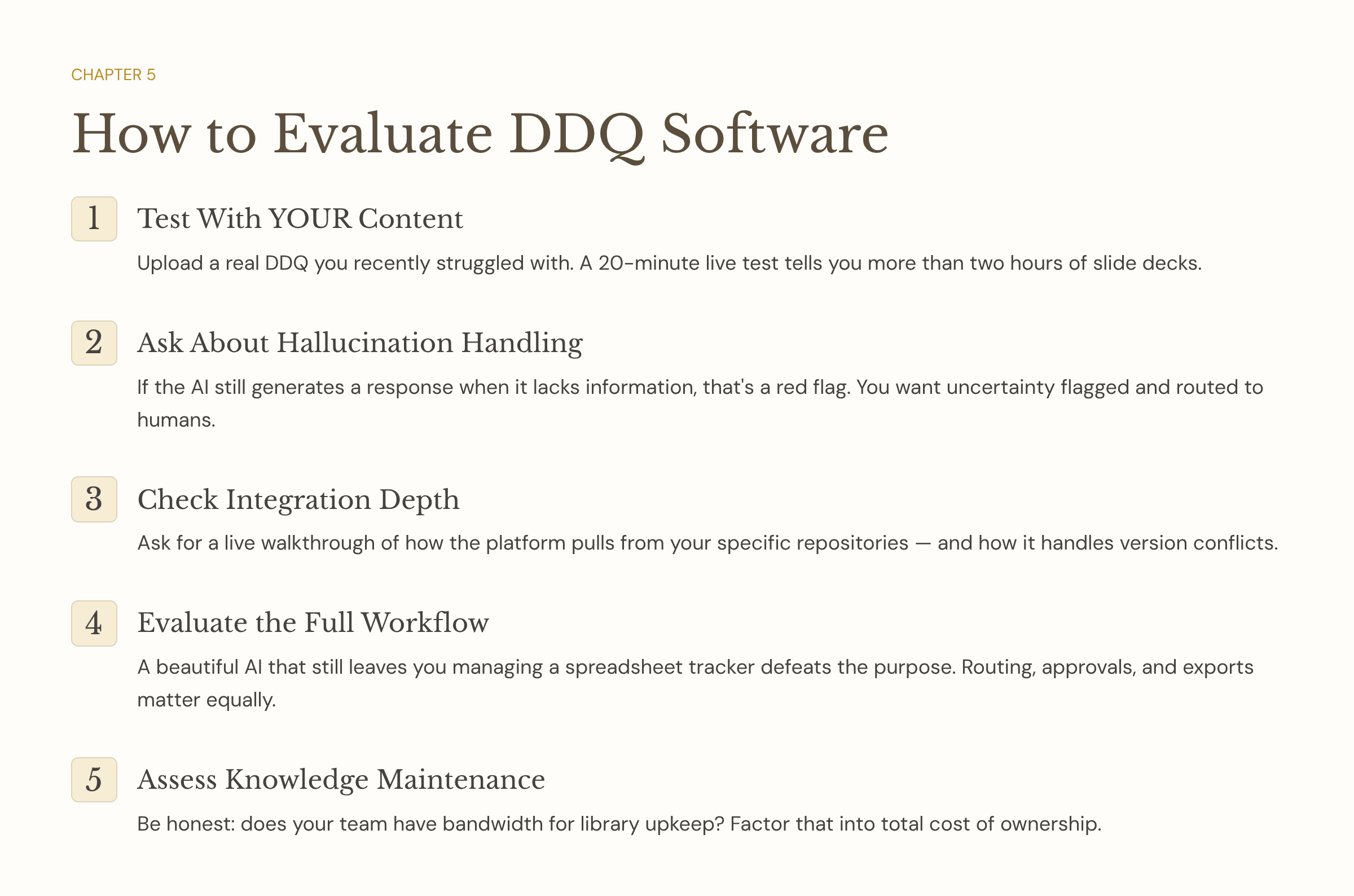
How To Evaluate DDQ Automation Software
Every platform looks good in a scripted demo. Here's a more honest evaluation framework:
1. Test with YOUR content, not their sample data
Upload a real DDQ you recently struggled with. See how the AI performs on your actual document structure, your industry-specific questions, and your knowledge base. A 20-minute live test tells you more than 2 hours of slide decks.
2. Ask about hallucination handling
Ask the sales rep: "What happens when the AI doesn't have enough information to answer confidently?" If the answer is "it still generates a response," that's a red flag. You want platforms that flag uncertainty and route to a human reviewer rather than fabricating plausible-sounding answers.
3. Check the integration depth
Integrations listed on a pricing page and integrations that actually work in production are two different things. Ask for a live walkthrough of how the platform pulls from your specific document repositories: Google Drive, SharePoint, Confluence, whatever you use. And ask how it handles version conflicts when the same topic appears in multiple documents.
4. Evaluate the collaboration workflow, not just the AI
The AI is one piece. The workflow, routing questions to SMEs, tracking approvals, managing deadlines, exporting in the right format is equally important. A beautiful AI that still leaves you manually managing a spreadsheet tracker defeats the purpose.
5. Look at the knowledge maintenance burden
Some platforms require you to build and maintain a large, structured Q&A library to function well. Others use semantic search to work off your existing documents. Be honest about whether your team has the bandwidth for library maintenance, and factor that into total cost of ownership.
The DDQ Sotware ROI in Real
Let's run a quick numbers exercise.
If your team handles 15 DDQs and RFPs per month, each taking an average of 12 hours of team time (proposal manager + 3 SMEs + review cycle), that's 180 hours per month on response work alone.
AI DDQ automation typically reduces that by 50-70%. At even a conservative 50% reduction, you're recovering 90 hours per month. That's more than 2 full-time working weeks returned to your team every month, without adding headcount.
Enterprise case studies put the annual savings between $90,000 and $544,000+ depending on team size, deal volume, and existing process maturity. For a team managing $30K+ ACV deals that depend on fast, accurate DDQ responses, the cost of slow is often the cost of losing deals.
The real ROI isn't just time saved. It's deals that don't slip because you missed a deadline, answers that don't embarrass you in front of a CISO, and an SME team that doesn't quietly resent proposal managers.
Teams using SparrowGenie recover 90+ hours per month on proposal work. What would your team do with that time back? Let's find out.
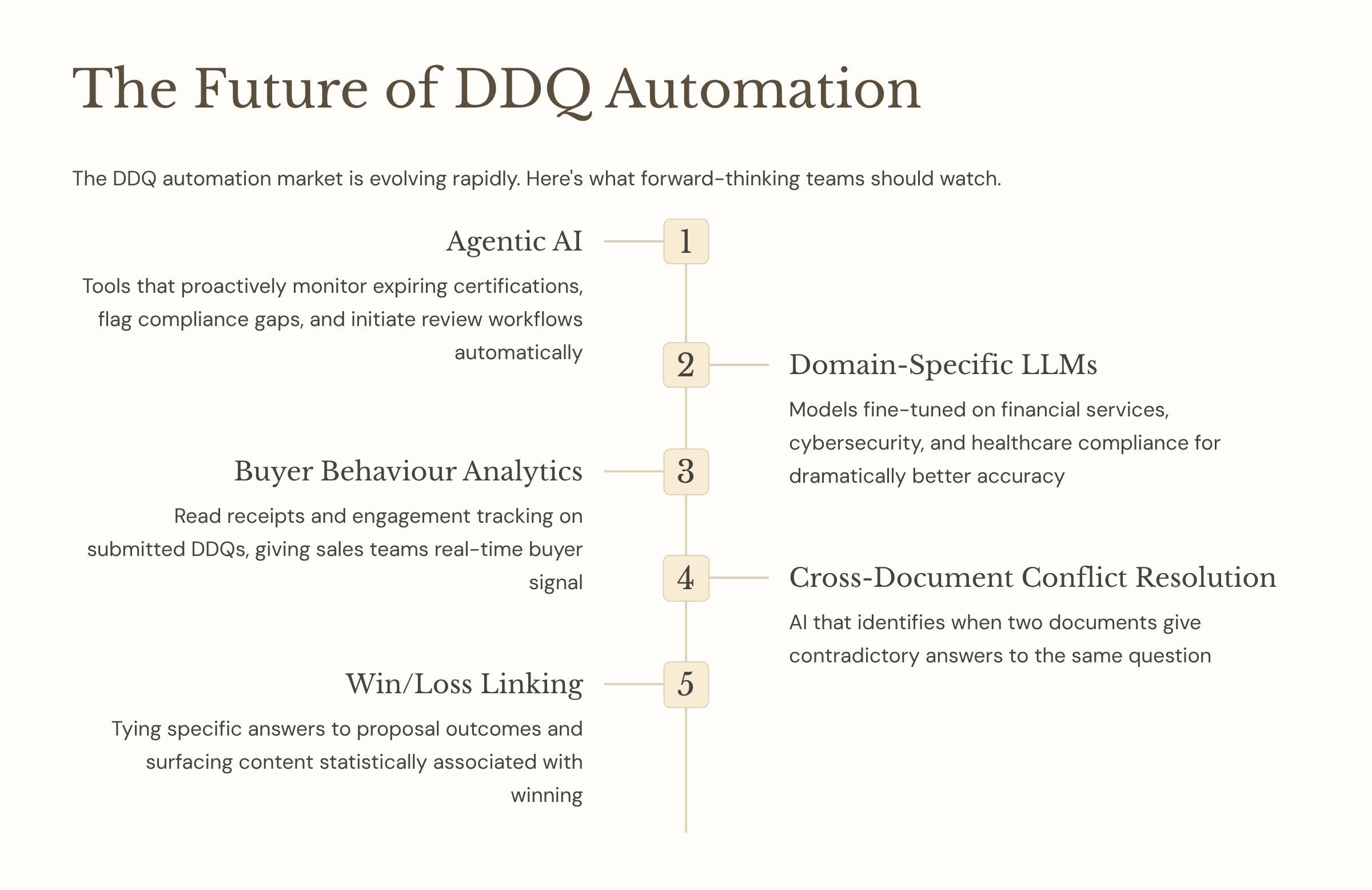
Future of DDQ Automation: Agentic AI & Domain-Specific Models
The DDQ automation market is moving fast. Here's what's worth watching:
Agentic AI
The next generation of DDQ tools won't just respond to questions, they'll proactively monitor for expiring certifications, flag compliance gaps, suggest knowledge base updates, and initiate review workflows automatically.
Domain-specific LLMs
General-purpose models are giving way to models fine-tuned on financial services, cybersecurity, and healthcare compliance language. Expect significantly better accuracy on specialist questions.
Buyer behavior analytics
Some platforms are starting to incorporate read receipts and engagement tracking on submitted DDQs, giving sales teams signal on when buyers are actively reviewing responses.
Cross-document conflict resolution
As knowledge bases grow, AI that can identify and flag when two documents give contradictory answers to the same question will become a major differentiator.
Win/loss linking
The ability to tie specific answers to proposal outcomes (won/lost) and surface which content is statistically associated with winning deals.
Conclusion
DDQ automation isn't a nice-to-have anymore. For any B2B company handling 10+ due diligence requests per month, it's becoming table stakes for staying competitive.
The right AI software for DDQ automation doesn't replace the expertise of your pre-sales, legal, or security teams, it amplifies it. It handles the retrieval, the formatting, the routing, and the first draft. Your people handle the judgment, the relationships, and the nuances that AI still can't capture.
The platforms that will win in this space are the ones that combine genuinely transparent AI (so you can trust and verify every answer), seamless collaboration workflows (so the right people review the right sections), and a knowledge management approach that gets smarter over time rather than requiring constant manual upkeep.
SparrowGenie was built with exactly that philosophy. If your team is spending more time chasing down DDQ answers than they are closing deals, that's worth a conversation.
Ready to see it in action?
See how SparrowGenie handles your DDQs, RFPs, and security questionnaires, all in one platform.
Book a 15-minute demo and see the difference real workflow intelligence makes.
Ready to see how AI can transform your RFP process?
Product Marketer at SparrowGenie
Being a Product Marketer at SparrowGenie, Aparna helps sales teams work faster with secure, AI-powered proposal automation. She turns complex features into simple stories, builds messaging that resonates, and keeps a close pulse on what customers actually need. She loves shaping clear, helpful content that shows how SparrowGenie makes RFP work easier, faster, and a lot less stressful.
Frequently Asked Questions (FAQs)
Related Articles

Content Libraries for Proposals: Your Edge for Consistent Wins

What is Sales Content Management? A Definitive Guide 2026