RFP Management Software: How to Choose the Right Tool for Enterprise Sales

Article written by
Aparna Rajendran

INSIDE THE ARTICLE
SHARE THIS ARTICLE
Summary
Choosing the right RFP management software in 2026 is no longer about speed alone; it’s about accuracy, governance, and measurable revenue impact. With AI flooding the market, buyers need clarity on what actually works at scale. This guide breaks down the must-have features, real trade-offs, and a vetted shortlist of leading RFP tools. Use it to make a confident, defensible decision that delivers long-term ROI, not short-term hype.
RFP management software has quietly become one of the most expensive bottlenecks in modern B2B sales. Not because the tools are bad. But because most teams choose them for the wrong reasons.
In 2026, RFP software is no longer about storing answers or shaving a few hours off response time. It directly impacts the number of deals you can pursue, the speed at which your team operates, the confidence that legal and security teams have when signing off, and the frequency of sales wins without exhausting subject matter experts (SMEs).
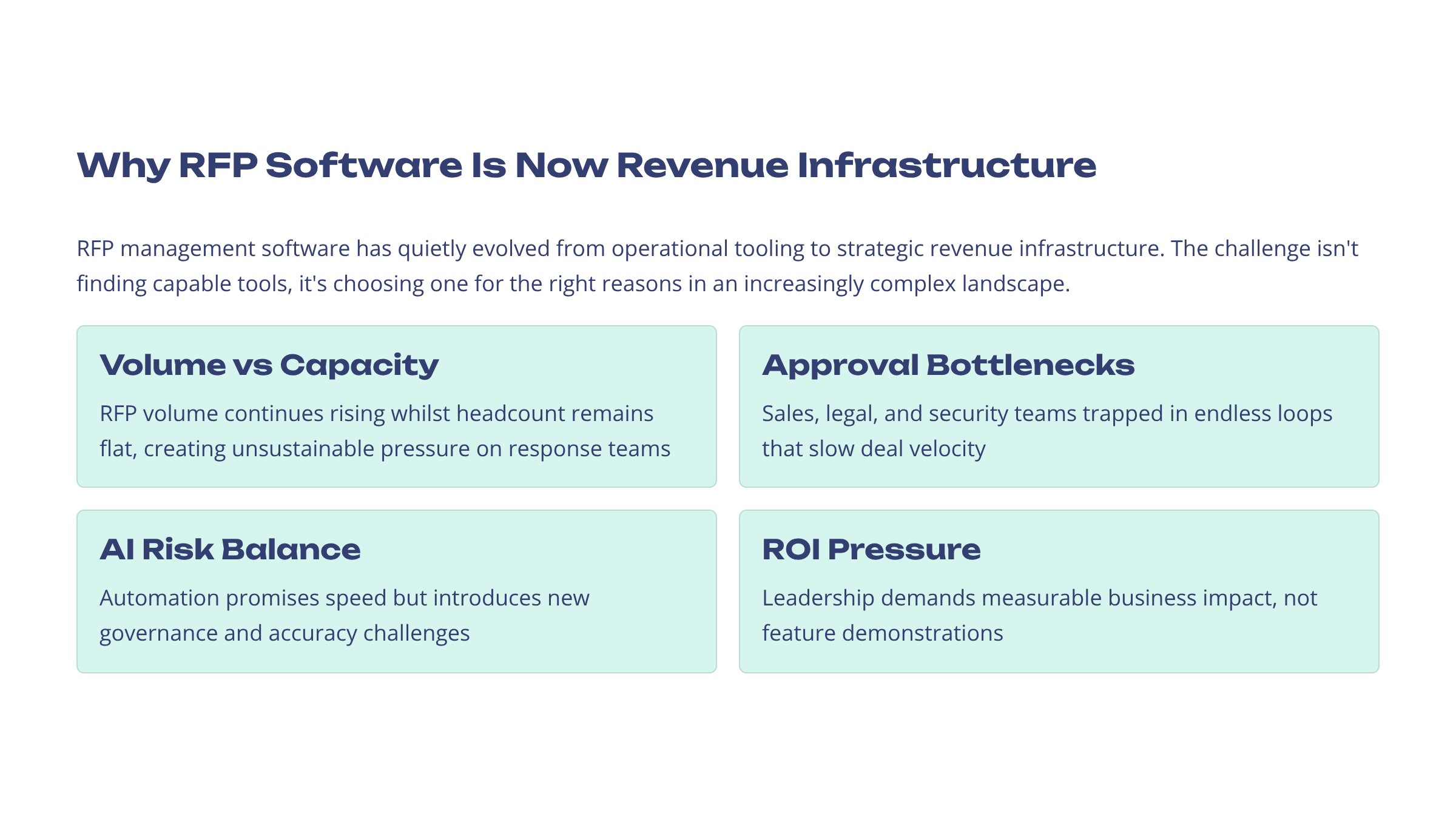
If you’re evaluating RFP management software right now, you’re likely dealing with one or more of these realities:
- RFP volume is rising, but headcount isn’t
- Sales, legal, and security are stuck in approval loops
- AI tools promise speed but introduce risk
- Leadership wants ROI, not feature demos
Let’s break down how to choose an RFP management tool that actually works in the real world.
Why Choosing the Right RFP Management Software Matters
Most RFP teams don’t fail because they lack effort. They fail because their systems don’t scale with deal complexity.
The data is consistent across industries:
- Teams using RFP management software submit ~46% more responses per year
- Average time savings range from 40–80% per RFP
- Win rates improve by 2–15%, depending on implementation maturity
- Teams reclaim 7–16 months of productive capacity annually
That last point is the one most buyers underestimate.
When RFPs are manual, every increase in volume creates a nonlinear increase in chaos. More Slack pings. More email threads. More “Can someone confirm this answer?” moments. Software doesn’t just save time; it stabilizes throughput.
And the stakes are high. For teams handling hundreds of RFPs annually, even a 2% win-rate improvement can translate into millions in incremental revenue. Choosing the wrong platform doesn’t just slow you down. It quietly caps growth.
Looking for an AI-powered RFP management software?
How to Evaluate RFP Management Software
Most RFP tools look impressive in demos, but only a few drive real ROI after rollout. This checklist focuses on the eight criteria that actually determine adoption, scalability, and long-term revenue impact.
1. Ease of Use and Adoption (Weight: 20%)
Adoption is the silent killer of RFP tools. A platform can have powerful automation and still fail if sales, legal, or SMEs avoid using it. The best RFP management software doesn’t feel like “another system” to learn. It fits naturally into how teams already work.
What strong platforms get right:
- New users become productive in days, not weeks
- Interfaces are readable for non-technical reviewers
- Review, comment, and approval actions are obvious and guided
What usually goes wrong:
- Platforms optimized for admins instead of contributors
- Training-heavy setups that require power users
- Dashboards that overwhelm instead of clarify
If your SMEs need a walkthrough every time they log in, adoption will stall. And when adoption stalls, ROI disappears.
2. Automation and AI Depth (Weight: 30%)
This is where the market has fragmented. Some tools use AI as a drafting assistant. Others use it as a reasoning engine. The difference matters. High-performing RFP platforms don’t just autocomplete answers. They:
- Parse RFP structure across PDFs, Word files, and Excel
- Detect requirements, not just keywords
- Recommend answers with confidence indicators
- Cite sources so reviewers can verify accuracy
- Learn from edits to improve future responses
Accuracy benchmarks tell the story:
- AI-native systems routinely reach 90–95% accuracy
- Assistive tools land closer to 70–85%
- Generic AI layers often fall below 30%, creating more rework than value
A simple rule: If a vendor can’t explain how their AI avoids hallucinations, it’s not production-ready.
3. Content Library and Knowledge Management (Weight: 15%)
Every RFP team has a content problem. Most just don’t realize how expensive it is. Static Q&A libraries decay fast. Answers go stale. Policies change. Product features evolve. And suddenly no one trusts the content enough to reuse it without double-checking.
Modern RFP management software treats content as a living system:
- Semantic search understands intent, not exact phrasing
- Answers carry review dates and ownership
- Conflicting or duplicate content is flagged automatically
- Version history supports audits and compliance reviews
The biggest differentiator now is live integrations. Platforms that sync with Google Drive, SharePoint, or Confluence dramatically reduce manual upkeep and restore trust in the library.
When content is trusted, reuse increases. When reuse increases, response time collapses.
4. Collaboration and Workflow Management (Weight: 15%)
RFPs don’t fail in drafting. They fail in coordination. Sales, presales, legal, security, finance, and product all touch the same response. Without clear workflows, teams default to email threads, Slack reminders, and manual follow-ups.
Strong RFP platforms replace chaos with structure:
- Role-based permissions control who edits, reviews, or approves
- Parallel workflows prevent bottlenecks
- Automated reminders eliminate manual chasing
- Slack or Teams integrations keep work contextual
This isn’t about convenience. It’s about throughput. Teams using structured workflows complete RFPs 50–90% faster than those relying on ad-hoc coordination.
5. Security, Compliance, and Governance (Weight: 15%)
In regulated industries, this is the buying decision.
Baseline expectations in 2026:
- SOC 2 Type II or ISO 27001 certification
- Encryption at rest and in transit
- SSO and MFA
- Long-term audit logs
- Data residency controls
AI adds another layer of scrutiny. Buyers must understand:
- Whether customer data trains shared models
- How content is isolated between tenants
- Whether every AI answer can be traced to a source
If a vendor can’t give clear, documented answers here, legal and security will block rollout no matter how excellent the product looks.
Use these criteria to cut through feature noise and score vendors objectively. The right choice isn’t the most powerful tool, it’s the one that delivers sustained ROI in your real operating environment.
6. Integrations and Ecosystem Fit (Weight: 10%)
RFP tools don’t exist in isolation. They sit inside a revenue stack.
CRM integration, especially with Salesforce, has become table stakes because it:
- Anchors RFPs to real pipeline
- Gives sales visibility without extra logins
- Enables reporting that leadership actually trusts
Beyond CRM, look for:
- Native integrations over API-only connectors
- Collaboration tools like Slack and Teams
- Document systems your team already uses
The goal isn’t more integrations. It’s fewer context switches.
7. Analytics and ROI Visibility (Weight: 10%)
If leadership asks, “Is this working?”, you need numbers.
Best-in-class platforms provide:
- Time-to-complete metrics
- Win-rate tracking by segment
- Content usage and decay analysis
- Bottleneck identification across stages
This turns RFPs from a cost center into a measurable revenue lever. Teams that track these metrics course-correct faster and justify expansion without friction.
8. Pricing and Scalability (Weight: 10%)
Pricing models shape behavior more than buyers expect.
- Per-seat pricing discourages SME involvement
- Project-based pricing scales better for growing teams
- Enterprise pricing adds flexibility but slows decisions
Hidden costs are where budgets break:
- Paid integrations
- Onboarding fees
- Content migration
- Professional services
Always ask for a 3-year total cost of ownership, not just year-one pricing.
Key RFP Software Trade-Offs That Impact ROI
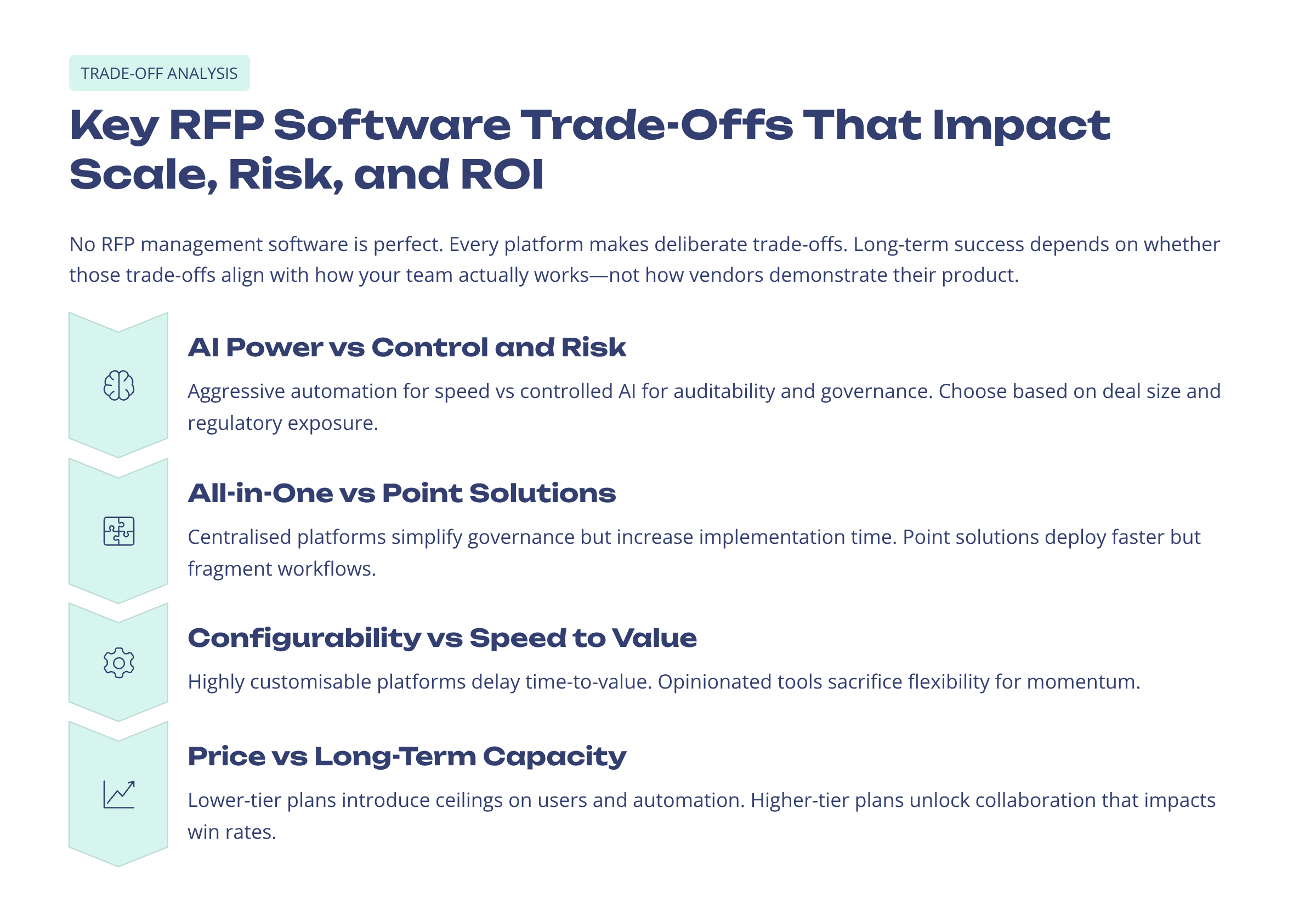
No RFP management software is perfect. Every platform makes deliberate trade-offs, and long-term success depends on whether those trade-offs align with how your team actually works, not how vendors demo their product.
Understanding these trade-offs upfront prevents regret six months after rollout, when adoption stalls or hidden constraints surface.
AI Power vs Control and Risk
AI can dramatically reduce drafting time, but not all automation is created equal. Platforms that push aggressive, autonomous AI workflows can handle high-volume, repetitive RFPs with impressive speed. The trade-off is risk, especially in regulated environments where every claim must be defensible.
More conservative platforms prioritize human approval and explainability, which slows response time but increases trust across legal, security, and compliance teams. The right balance depends on deal size, regulatory exposure, and how comfortable your organization is with AI-led decisions.
Choose aggressive AI if you handle large volumes of standardized questionnaires and have strong internal review processes.
Choose controlled AI if accuracy, auditability, and governance outweigh speed.
All-in-One Platform vs Point Solutions
All-in-one RFP platforms centralize RFPs, RFIs, security questionnaires, content, and reporting in a single system. This simplifies governance, reporting, and compliance but often comes with longer implementation timelines and higher upfront costs.
Point solutions deploy faster and solve specific pain points well, but they fragment workflows. Over time, teams end up stitching together multiple tools, which creates reporting gaps and ownership confusion.
Choose all-in-one if multiple teams contribute to responses and leadership needs unified visibility. Choose point solutions if your use case is narrow and speed matters more than consolidation.
Configurability vs Speed to Value
Highly configurable platforms promise flexibility, but customization comes at a cost. Complex setup delays time-to-value, and every additional workflow or rule increases admin overhead.
More opinionated tools limit customization but get teams live faster. These platforms trade flexibility for momentum, which often matters more for mid-market teams under revenue pressure.
The key question isn’t “How customizable is this tool?” It’s “How fast can we be productive with real RFPs?”
Price vs Long-Term Capacity
Lower-tier plans often look attractive during procurement but introduce ceilings on users, projects, or automation. As adoption grows, teams are forced into expensive upgrades or reimplementations.
Higher-tier plans cost more upfront but usually unlock collaboration, automation, and analytics that materially impact win rates and throughput. Short-term savings can quietly cap long-term growth. The right choice supports how many RFPs you want to win, not just how many you handle today.
The best RFP management software isn’t the most powerful or the cheapest. It’s the one whose trade-offs you can live with as your RFP volume, deal size, and compliance needs evolve.
Top RFP Management Software Tools to Consider
1. SparrowGenie
What SparrowGenie Gets Right
SparrowGenie is built for teams that want AI speed without giving up control. Its biggest strength is how it balances automation with trust, especially in complex, high-value RFPs where accuracy and accountability matter more than raw speed.
Instead of treating AI as a shortcut, SparrowGenie treats it as a secure AI sales assistant that works only from approved knowledge and always keeps humans in the loop. This makes it particularly effective for RevOps, presales, legal, and security teams that need confidence before sign-off.
Key strengths:
- AI-generated answers with confidence scoring
- Clear source attribution from approved knowledge
- Designed around real presales and RevOps workflows
- Secure, human-in-the-loop controls for sensitive data
- Strong ROI impact for teams handling high-value deals
This is why SparrowGenie resonates with teams that see RFPs as a revenue lever, not just an admin task.
Where SparrowGenie Starts to Strain
SparrowGenie is AI-native, which means it expects intentional setup upfront. Teams need to invest time early in structuring and approving their knowledge sources to unlock high AI accuracy.
It also has a smaller public review footprint compared to long-established legacy vendors. That said, the upfront effort replaces months of ongoing content maintenance common in legacy tools.
When SparrowGenie Is the Right Choice
Choose SparrowGenie if:
- You handle complex RFPs, RFIs, or security questionnaires
- Accuracy, auditability, and confidence matter as much as speed
- Legal, InfoSec, and product reviews are part of every deal
- You want AI assistance without hallucinations or blind trust
- You’re focused on measurable ROI, not just faster drafts
Avoid it if you’re looking for a lightweight, plug-and-play tool with minimal setup and no governance requirements.
Interested in exploring SparrowGenie?
2. Loopio
Source: Loopio
What Loopio Gets Right
Loopio remains one of the most trusted names in RFP management, especially among large enterprises with established proposal teams. Its biggest strength is operational consistency.
The platform is built around a structured content library model. Answers are centrally managed, tagged, approved, and reused across RFPs. For teams with mature proposal operations, this brings immediate order to chaos.
Key strengths:
- Excellent usability and low learning curve
- Strong content library with auto-suggestions
- Clear approval workflows
- Reliable Salesforce integration
- Proven at scale with enterprise customers
This is why Loopio is often the first RFP tool teams successfully adopt.
Where Loopio Starts to Strain
Loopio’s architecture was designed before AI-native workflows became the norm. While it has added AI-assisted features, automation remains assistive rather than autonomous.
The hidden cost shows up in content maintenance. Most successful Loopio customers end up needing:
- A dedicated content manager
- Regular manual audits
- Ongoing library cleanup
Seat-based pricing also discourages broad SME participation. Teams often limit licenses to proposal managers, which reintroduces bottlenecks.
When Loopio Is the Right Choice
Choose Loopio if:
- You are an enterprise with a stable, repeatable RFP process
- You value predictability over cutting-edge automation
- You have the resources to maintain content rigorously
- Compliance and structure matter more than speed
Avoid it if you’re expecting AI to radically reduce manual effort.
3. Responsive
Source: Responsive
What Responsive Gets Right
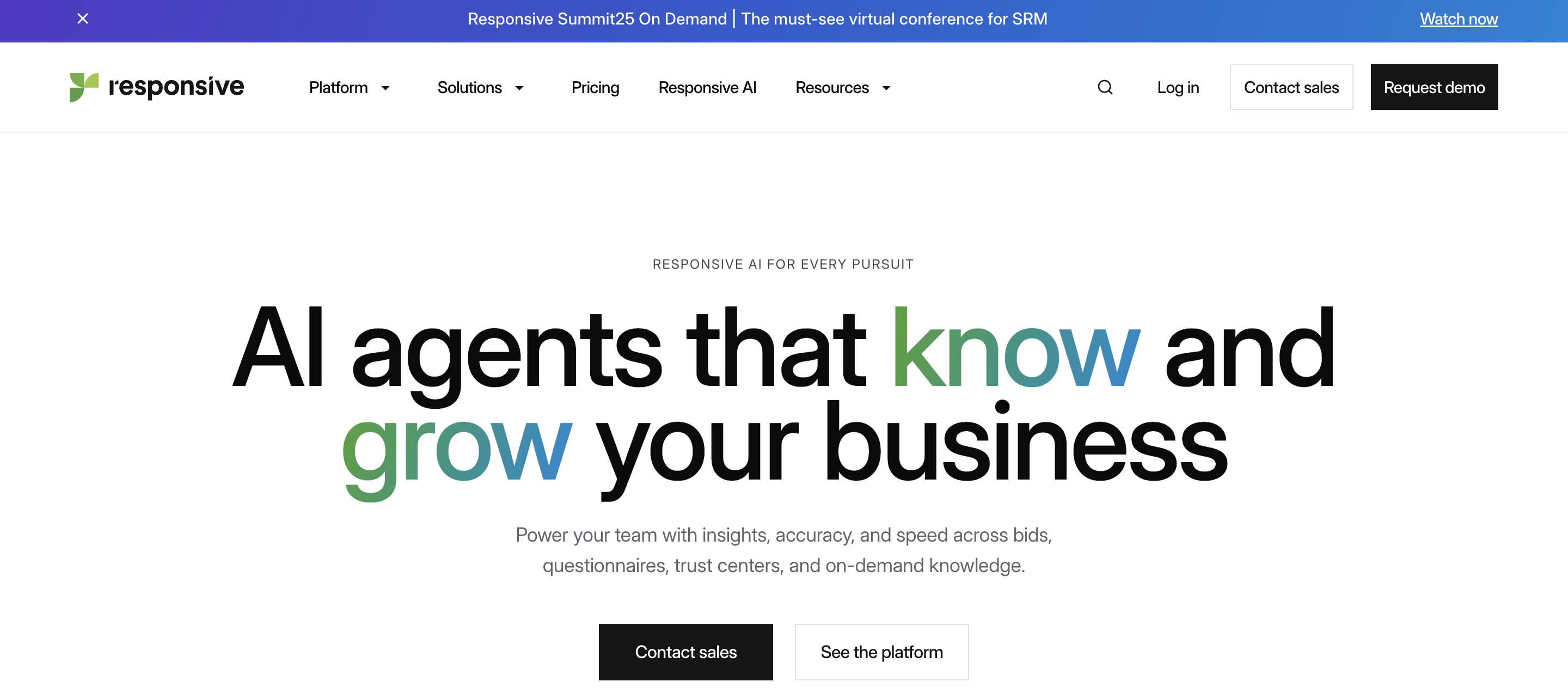
Responsive is built for complex, multi-stakeholder environments. It shines when RFPs intersect with security questionnaires, compliance workflows, and global teams.
Its biggest differentiator is workflow depth and analytics. The platform treats RFPs as governed processes rather than documents.
Key strengths:
- Deep native and API integrations
- Strong reporting and analytics
- Robust workflow orchestration
- Multi-language support
- Better governance than most competitors
For large organizations managing RFPs across regions or business units, this control is valuable.
Where Responsive Starts to Strain
The power comes with complexity.
Responsive has a steeper learning curve than Loopio and requires thoughtful configuration. Pricing is opaque and seat-based, which can inflate costs as more stakeholders are involved.
AI capabilities exist, but they are layered onto a legacy architecture. This means automation helps, but rarely eliminates review cycles.
When Responsive Is the Right Choice
Choose Responsive if:
- You operate in a large, complex organization
- Governance, reporting, and integrations are critical
- You manage both RFPs and DDQs at scale
- You can support onboarding and admin efforts.
Avoid it if speed-to-value and simplicity are top priorities.
4. Inventive AI
Source: Inventive
What Inventive AI Gets Right
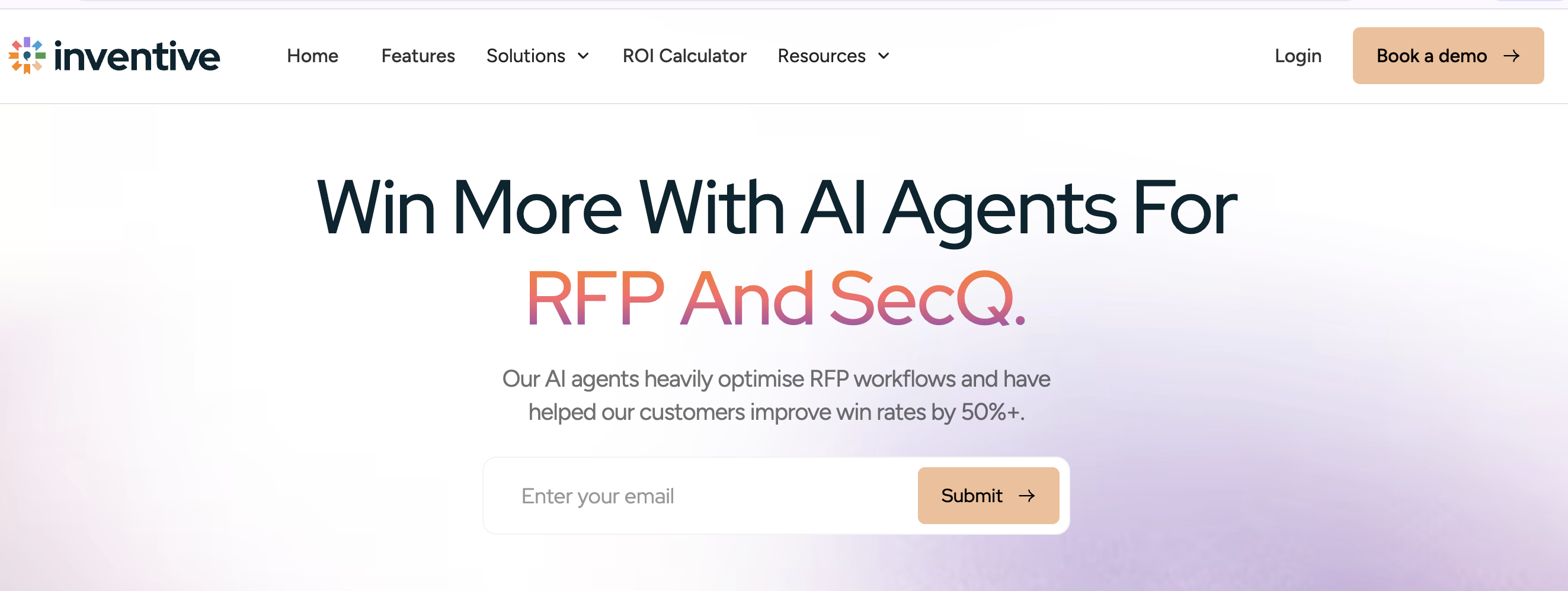
Inventive AI is designed from the ground up as an AI-native RFP platform. Unlike legacy tools, AI is not an add-on. It is the core engine.
Its standout capability is accuracy with explainability. Answers are generated with citations, confidence scoring, and traceability back to source content.
Key strengths:
- Advanced AI agents for drafting and analysis
- 90–95% accuracy benchmarks
- Automatic detection of stale or conflicting content
- Live integrations with content sources
- Strong security posture
For teams pushing aggressive automation, this is one of the most capable platforms available.
Where Inventive AI Has Trade-Offs
Inventive AI is still a newer entrant. Brand recognition is lower, and pricing is enterprise-only with limited public transparency.
It also assumes a certain level of AI readiness. Teams without clean content or clear governance may struggle to unlock full value quickly.
When Inventive AI Is the Right Choice
Choose Inventive AI if:
- You want AI to do real work, not just assist
- You handle high RFP volume with repeatable patterns
- Accuracy and traceability are non-negotiable
- You’re comfortable adopting newer technology
Avoid it if your organization is highly risk-averse to AI change.
5. AutoRFP.ai
Source: AutoRFP.ai
What AutoRFP.ai Gets Right
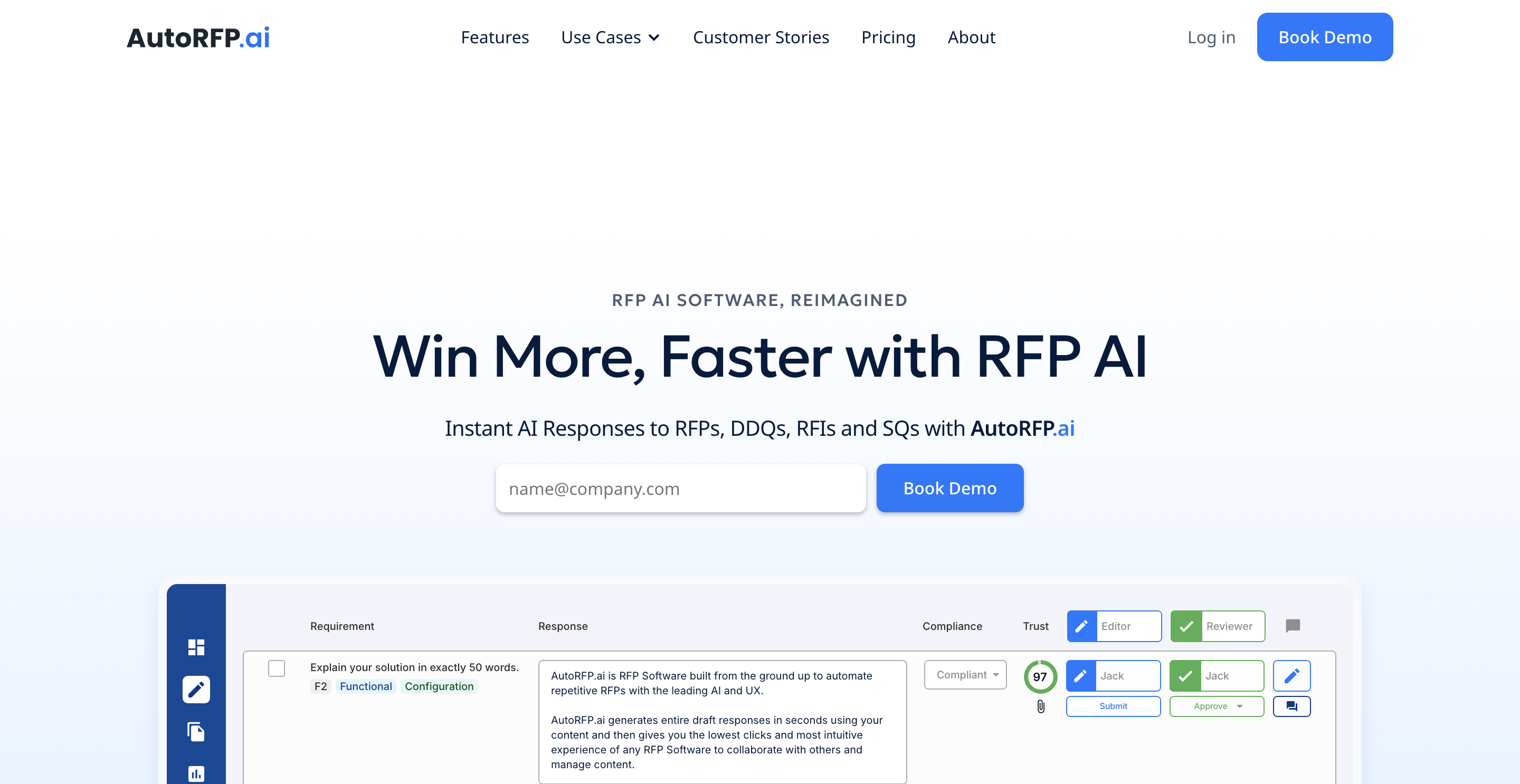
AutoRFP.ai is built for speed, transparency, and ROI clarity. It strips away enterprise complexity and focuses on getting teams productive fast.
The pricing model is refreshingly simple. The inclusion of unlimited users on all plans eliminates the primary adoption barrier that most tools create.
Key strengths:
- Flat, project-based pricing
- Unlimited users across plans
- Fast onboarding (often live in 48 hours)
- AI-generated drafts with trust scores
- No hidden add-ons for core features
This makes it especially attractive to RevOps-led teams.
Where AutoRFP.ai Has Limits
The project-based model can feel restrictive for teams handling many small RFPs simultaneously. It also lacks some deep enterprise features found in heavier platforms.
For very large global deployments, governance controls may feel lighter.
When AutoRFP.ai Is the Right Choice
Choose AutoRFP.ai if:
- You’re a mid-market or growth-stage company
- You want fast ROI without enterprise friction
- You value pricing clarity
- You want broad team participation
Avoid it if you need heavy compliance workflows across multiple business units.
Exploring RFP management tools? Experience a live demo and know more!
6. Qvidian
Source: Upland Qvidian
What Qvidian Gets Right
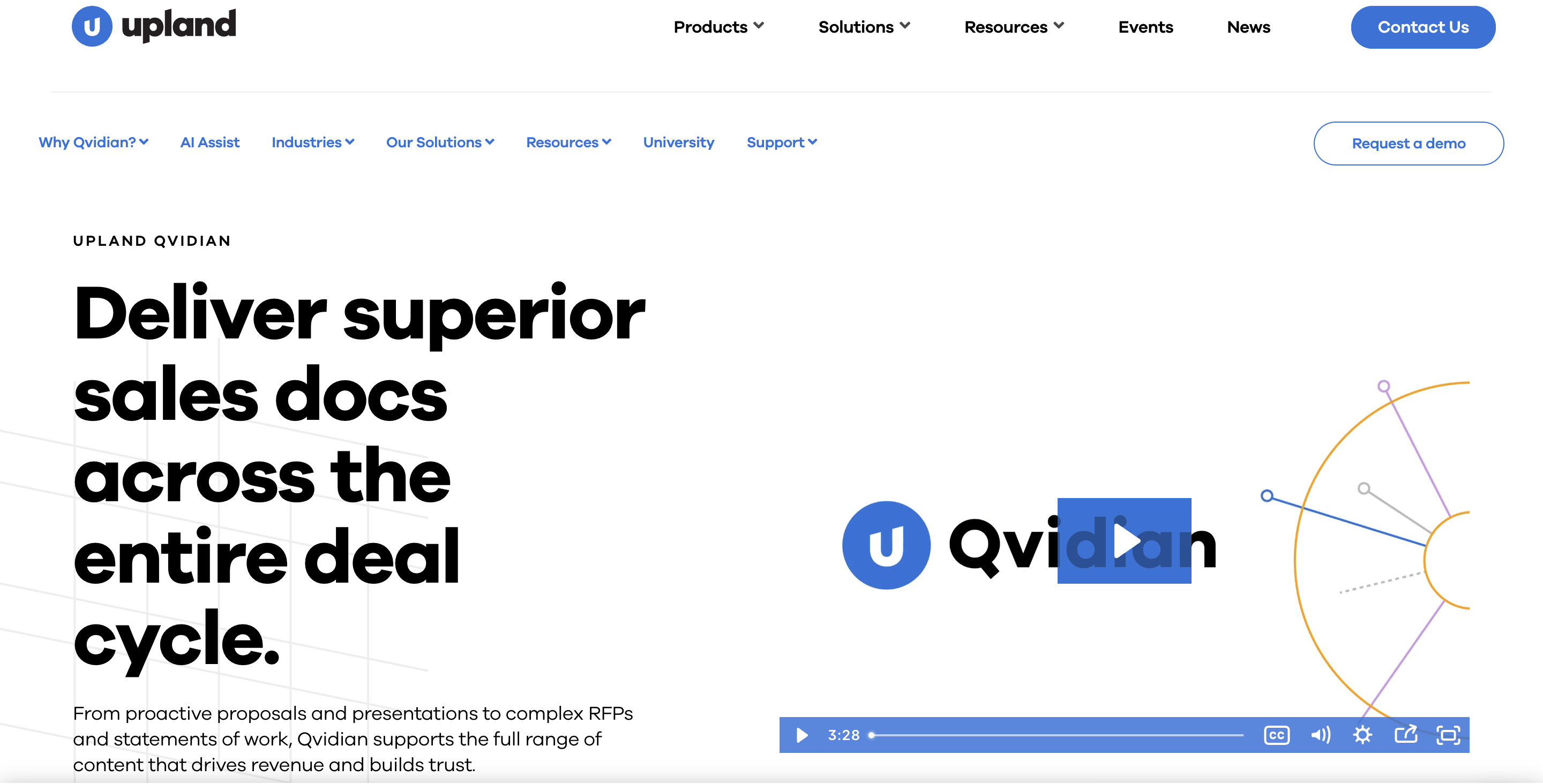
Qvidian is the most compliance-hardened platform on this list. It’s trusted in banking, insurance, and government environments where security certifications outweigh usability.
Its strength lies in longevity and risk mitigation.
Key strengths:
- Deep compliance and audit support
- Trusted by highly regulated institutions
- Mature content automation features
- Strong document governance
For some organizations, that trust history is decisive.
Where Qvidian Falls Behind
The user experience feels dated, and AI capabilities lag behind modern platforms. Implementation is slow, and customization often requires professional services.
Teams frequently report higher operational overhead compared to newer tools.
When Qvidian Is the Right Choice
Choose Qvidian if:
- You operate in heavily regulated industries
- Security and compliance outweigh speed
- You can invest in long implementations
- Innovation is secondary to stability
Avoid it if usability and automation are top priorities.
7. SiftHub
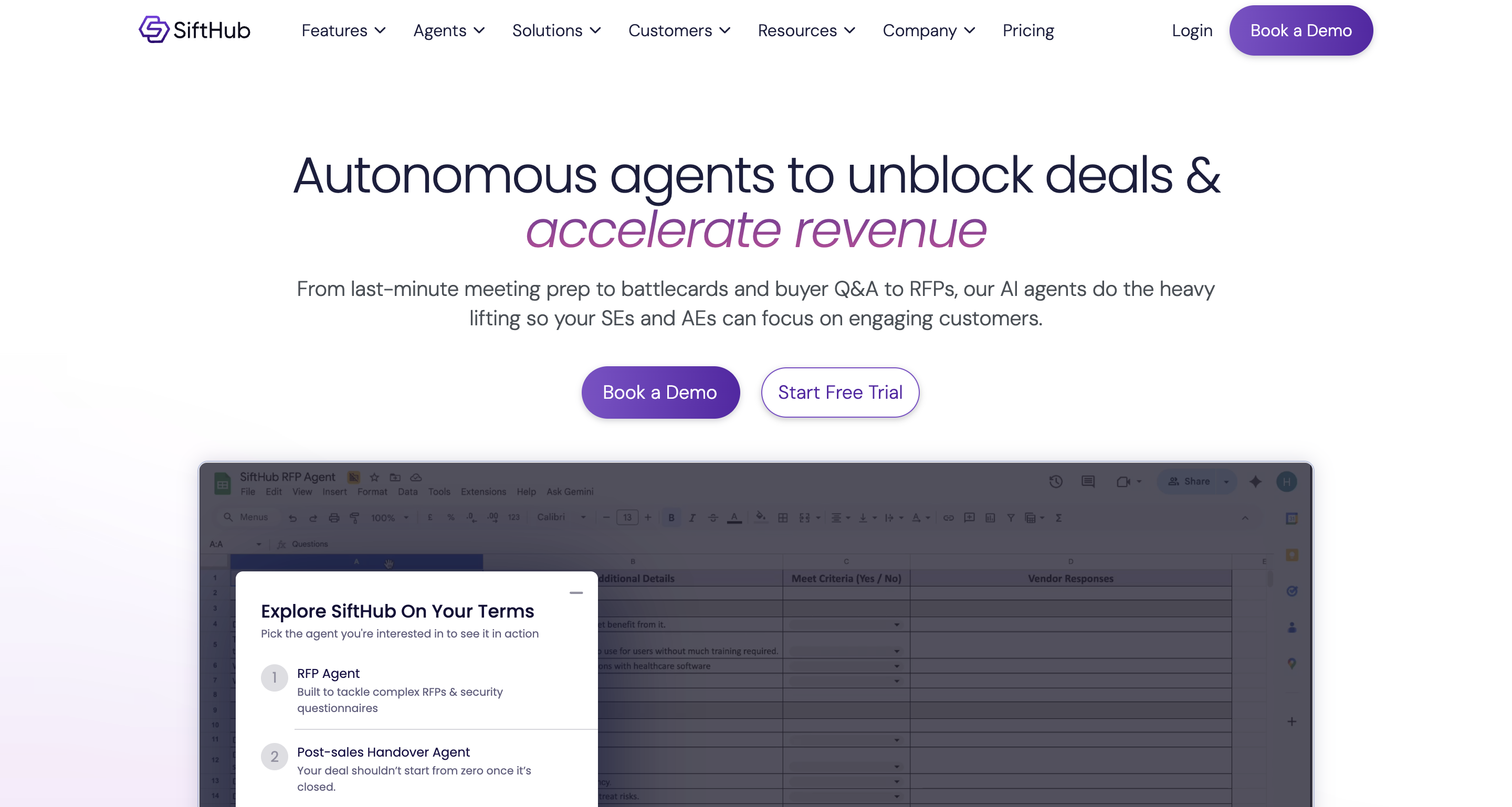
Source: SiftHub
What SiftHub Gets Right
SiftHub is optimized for questionnaire-heavy workflows rather than long narrative proposals. It excels at pulling accurate answers from conversations, documents, and prior responses.
Key strengths:
- Conversation intelligence integrations
- Intelligent content search
- Strong citation-based responses
- Fast setup for small teams
It’s particularly effective for security questionnaires and DDQs.
Where SiftHub Is Limited
SiftHub is not designed for complex, multi-section proposal writing. Content maintenance still requires human oversight, and large-scale enterprise workflows are out of scope.
When SiftHub Is the Right Choice
Choose SiftHub if:
- You’re an SMB or small SaaS team
- Questionnaires dominate your RFP workload
- You want fast answers, not proposal orchestration
Avoid it if you manage large, narrative-heavy RFPs.
Common Mistakes Buyers Make When Choosing RFP Management Software
Most RFP software failures don’t happen because teams chose the “wrong” vendor. They happen because teams optimized for the wrong things during evaluation.
The most common mistakes include:
- Buying feature breadth instead of solving real bottlenecks.
Long feature lists look impressive, but they rarely address the actual pain points slowing responses, such as SME availability, review delays, or content trust. - Ignoring long-term content maintenance costs.
Static libraries decay quickly. Tools that require constant manual updates create hidden operational overhead that erodes ROI over time. - Skipping pilots with real RFPs.
Demos are controlled environments. Only live RFPs expose how a platform handles messy formats, edge cases, and cross-team collaboration. - Assuming AI accuracy without validation.
Not all AI is production-ready. Tools that can’t explain where answers come from or how accuracy is measured introduce risk, not efficiency. - Underinvesting in change management.
Even the best platform fails without adoption. Training, governance, and executive sponsorship matter as much as the software itself.
Every failed implementation shares at least two of these mistakes.
Looking for an RFP management tool that can accelerate ROI?
RFP Management Software Benchmarks after Go-Live
Successful RFP implementations show clear, measurable improvements early. If those signals aren’t visible, something is misaligned.
Within the first 90 days, high-performing teams typically see:
- A 40–60% reduction in time spent per RFP
- 80% or higher adoption across sales, presales, and SMEs
- The majority of standard questions auto-filled with minimal editing
Within the first 12 months, outcomes become unmistakable:
- A measurable improvement in RFP win rates
- ROI breakeven, often well before the one-year mark
- Significantly reduced reliance on SMEs for repeat content
- Faster deal cycles with fewer review bottlenecks
If you’re not seeing these outcomes, the issue usually isn’t effort or discipline. It’s platform fit, implementation strategy, or both.
Final Take
RFP management software has become a core revenue infrastructure. The difference between winning and losing often comes down to how fast you respond, how confidently you answer, and how smoothly your teams work together under pressure. The right platform removes friction. The wrong one quietly adds risk, rework, and fatigue.
As you evaluate tools, remember this: Speed without accuracy is dangerous, and automation without governance doesn’t scale.
That’s why many modern revenue teams are rethinking what “good” RFP software actually means. Instead of chasing flashy AI or bloated feature lists, they’re choosing platforms that combine secure AI assistance, human control, and measurable business outcomes.
This is where SparrowGenie stands out quietly. It’s built for teams that want AI to move deals forward while keeping trust, compliance, and confidence intact, especially when the stakes are high.
Choose deliberately. Pilot with real RFPs. Optimize for long-term ROI, not short-term demos.
Because in RFPs, the cost of choosing wrong isn’t just inefficiency. It’s lost deals you never get back.
Ready to see how AI can transform your RFP process?
Product Marketer at SparrowGenie
Being a Product Marketer at SparrowGenie, Aparna helps sales teams work faster with secure, AI-powered proposal automation. She turns complex features into simple stories, builds messaging that resonates, and keeps a close pulse on what customers actually need. She loves shaping clear, helpful content that shows how SparrowGenie makes RFP work easier, faster, and a lot less stressful.