Why Sales Enablement Is Critical for Successful RFP Responses

Article written by
Kate Williams

INSIDE THE ARTICLE
SHARE THIS ARTICLE
Summary
Sales enablement for RFP responses helps cut time, boost win rates, and retain top reps, turning your biggest sales pain into a growth opportunity.
I get it. RFPs are a real pain. It costs your team time, effort, and money. But did you know that with the right sales enablement framework, what was once your biggest time suck can become your most powerful competitive advantage? The right sales enablement framework helps you in faster responses, sharper messaging, and a consistent voice that wins trust before the first signature.
Let’s explore how.
What Sales Enablement Really Means
Sales enablement is often misunderstood. Many teams assume it means creating more slide decks, more training sessions, or buying another tool. In reality, sales enablement is the revenue engine’s operating system—a coordinated framework that connects people, process, content, and technology to make every sales motion repeatable, measurable, and scalable.
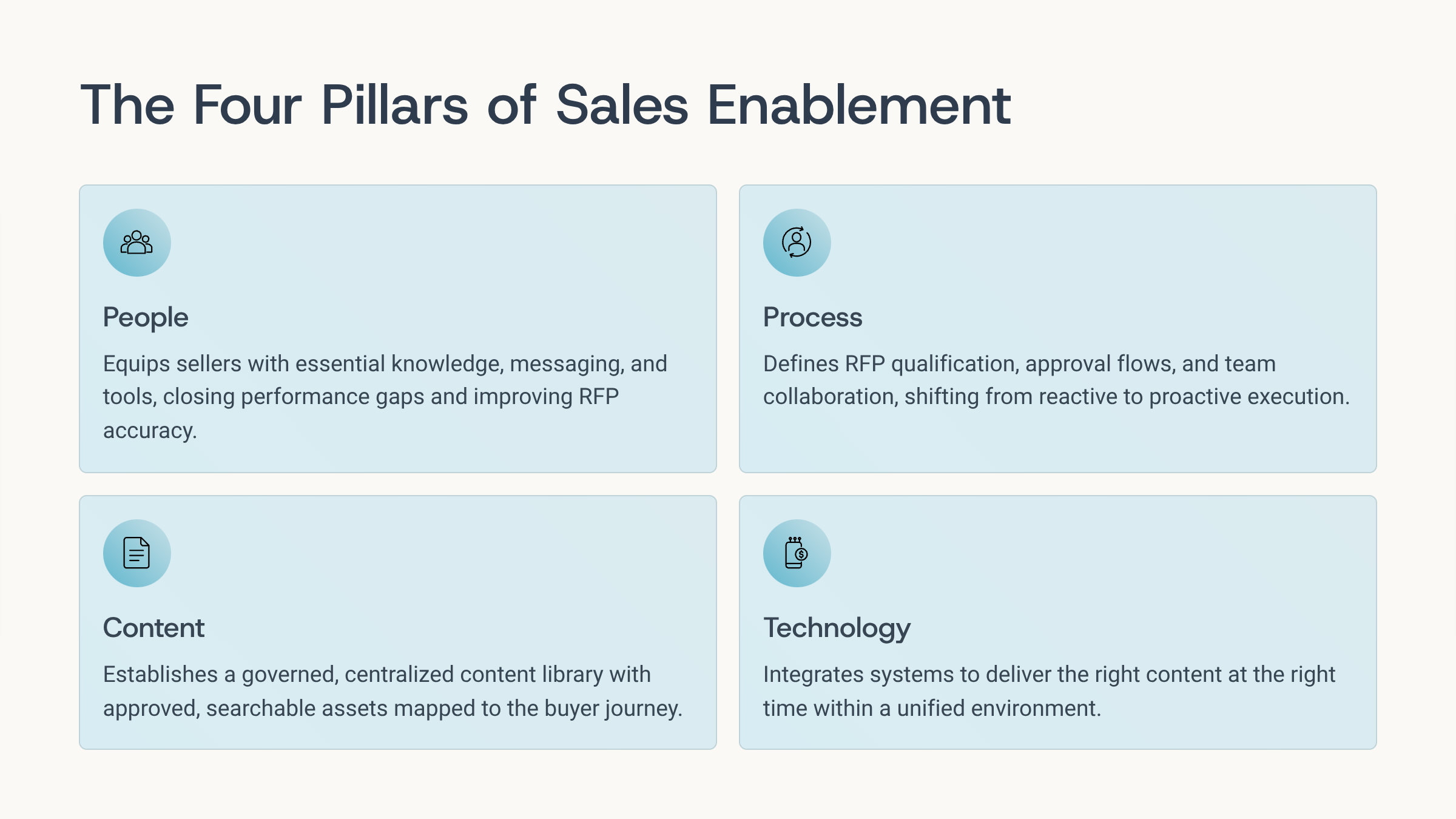
The goal of sales enablement is not to add complexity but to remove friction. It ensures that sales, marketing, product, and compliance teams share the same language, the same approved content, and the same customer narrative—especially during complex RFP responses. Here are the pillars of sales enablement:
1. People
Sales enablement equips every seller with the same foundation of knowledge, messaging, and tools. It closes performance gaps and helps new reps ramp faster. When every rep has access to the same trusted information, win rates rise and RFP accuracy improves.
2. Process
Enablement creates structure. It defines how RFPs are qualified, how approvals flow, and how teams collaborate without chaos. Clear process design turns reactive work into proactive execution.
3. Content
Enablement replaces random acts of content creation with a governed, centralized content library. Every asset—case study, compliance document, product sheet—is approved, searchable, and mapped to the buyer journey. Sellers no longer waste time fishing for the “latest version.”
4. Technology
Enablement connects these components through integrated systems. Tools like CRMs, RFP response platforms, and collaboration suites surface the right content at the right time. Sellers work within one unified environment instead of switching between apps or folders.
When these four pillars align, sales enablement transforms how RFP responses happen. What used to take weeks of chasing inputs becomes a guided, data-driven workflow. Sellers spend less time searching and more time selling.
Looking for an AI-powered sales enablement tool?
Why RFP Responses Break Without Sales Enablement
RFP responses are complex, cross-functional projects that demand precision, speed, and consistency. Without a structured sales enablement system, they quickly break down. What begins as collaboration turns into chaos—multiple stakeholders, outdated answers, missing proof, and last-minute edits that drain time and trust.
Sales enablement fixes this by aligning people, content, and process under one governed framework. Without that alignment, three major breakdowns occur.
1. Random Acts of Content Creation
Without enablement, every team creates content in isolation. Marketing writes a new product overview. Product teams update feature sheets. Legal revises a compliance statement. All of them mean well—but none of them speak the same language.
The result is a pile of disconnected materials with no ownership or version control. Sales reps end up reusing outdated documents or rewriting answers from scratch, wasting hours on tasks that should already be automated.
Impact: Inconsistent messaging, compliance risk, and lost productivity across every RFP cycle.
2. The “Go-Fish” Problem
Centralized repositories are not the same as centralized intelligence. When content is simply stored—not mapped, tagged, or governed—sales teams are forced to “go fish.” They search across drives, Slack channels, or legacy tools hoping to find the right case study or policy statement before a deadline.
In a large organization, this can mean sifting through thousands of assets with no clear guidance on which one to use. The more content you create, the harder it becomes to find what matters.
Impact: Valuable time is lost, proposal quality drops, and team morale suffers.
3. No Buyer-Aligned Mapping
The most overlooked reason RFPs fail is that sellers don’t know which content belongs where. Without enablement, there’s no connection between the buyer’s journey and the sales cycle. Reps might send deep-technical documents during awareness stages or generic marketing sheets during due diligence.
Mapping assets to the right stage of the buying process gives teams clarity:
- What to send
- When to send it
- Why it converts
Without that map, even the best content gets buried at the wrong moment.
Impact: Missed storytelling opportunities and lower conversion rates.
4. Lost Insight and Zero Feedback Loops
When RFP responses happen in disconnected systems, there’s no way to track what content actually works. Was that case study ever opened? Did the new pricing format improve win rates? Which sections caused delays? Without enablement, there’s no analytics layer to answer these questions.
That means teams keep repeating mistakes—same delays, same edits, same inefficiencies—because there’s no data to learn from.
Impact: Every RFP feels like starting from zero, and the organization never compounds its learning.
Without sales enablement, RFP responses collapse under their own weight. Information becomes tribal, approvals slow down, and content loses purpose. Sales enablement doesn’t just organize the chaos—it transforms RFP response from a manual task into a measurable, repeatable revenue workflow.
Respond to RFPs in minutes with SparrowGenie
The New Model: Purpose-Driven Sales Enablement for RFPs
Traditional RFP management is reactive. Teams scramble to collect information, chase reviewers, and rewrite the same answers from scratch. Purpose-driven enablement replaces this chaos with clarity. It’s a system where every piece of content, every workflow, and every handoff serves a defined purpose—measurable, repeatable, and aligned to revenue outcomes.
Instead of treating RFPs as administrative tasks, this model positions them as strategic sales assets. It’s not about creating more content; it’s about creating the right content and ensuring it reaches the right person at the right time.
Below are the four pillars of purpose-driven enablement that transform RFPs from time sinks into revenue multipliers.
1. Map the Buyer Journey to the Sales Cycle
Most RFP responses fail because teams focus only on the document—not the buyer behind it. Purpose-driven enablement begins by aligning the buyer journey (awareness → evaluation → decision) with your internal sales cycle (qualify → propose → close).
Each stage should define:
- What the buyer is trying to learn
- What narrative or proof point best supports that stage
- Which team owns each deliverable
For example, during the awareness phase, the right asset might be a thought-leadership brief or success metric. During evaluation, it’s a detailed technical document or compliance report. By mapping content to stages, sellers always know what to send and when—turning guesswork into guided execution.
Impact: Consistent buyer alignment, faster response time, and higher engagement throughout the sales cycle.
2. Centralize, Don’t Just Collect
A shared folder is not an enablement system. The new model replaces the “pile of PDFs” with a governed, searchable content hub—a single source of truth for every RFP asset.
Key principles:
- Every document has an owner, version, and approval status.
- Expired or unverified content is automatically flagged for review.
- Tags and metadata connect each asset to product lines, industries, and deal types.
This structure turns scattered materials into a knowledge engine that teams can trust. Instead of hunting through 6,000 files, sales reps access 15–25 curated, proven assets per sales play.
Impact: Reduced content duplication, improved compliance, and less time wasted searching for answers.
3. Automate Context and Delivery
Purpose-driven enablement integrates directly into the tools where sellers already work—CRM, RFP response platforms, and collaboration suites. Instead of switching tabs or chasing updates, the right content appears automatically based on deal stage, region, or product line.
Automation ensures:
- The latest approved answers are always surfaced first.
- Response templates are pre-filled with verified data.
- Reviewers are automatically notified when their input is required.
This automation doesn’t replace human expertise—it enhances it. Reps focus on strategy, tone, and personalization while the system handles retrieval, accuracy, and formatting.
Impact: 50–70% faster RFP turnaround time and measurable improvement in response accuracy.
4. Measure, Learn, and Refine
Purpose-driven enablement is never static. Each RFP response generates data—content usage, reviewer turnaround time, response accuracy, and final outcomes. Those insights feed back into your system, continuously improving future proposals.
Key metrics to monitor:
- Velocity: Time to first draft, total review cycle time
- Quality: Content freshness, compliance pass rate
- Effectiveness: Win rate correlation by content usage
- Engagement: Buyer open and interaction data
This creates a closed feedback loop between sales enablement, content owners, and leadership. Over time, the organization builds a living, data-driven library of what actually wins deals.
Impact: Predictable performance, data-backed decisions, and higher proposal ROI.
When RFP enablement has purpose, every response tells a consistent, evidence-backed story. Sellers stop firefighting and start orchestrating. Content becomes a living system of truth rather than a static archive. And leadership finally gains visibility into what drives real revenue impact.
Purpose-driven enablement doesn’t just make RFPs easier—it makes them smarter, faster, and far more valuable.
Modern sales need modern tools. Check out SparrowGenie.
Why Every Winning RFP Starts with Sales Enablement
Most teams chase speed in RFP responses—but what they really need is structure. The true differentiator isn’t more tools or templates; it’s sales enablement.
Sales enablement bridges strategy, process, and execution. It ensures every RFP response is accurate, consistent, and repeatable—no more guesswork, no more firefighting.
1. A Unified Source of Truth
RFPs involve multiple teams—sales, marketing, product, and compliance. Without enablement, each works in isolation, creating version chaos and mixed messaging. Enablement unifies all approved content in one governed library, keeping everyone aligned.
Impact: Faster collaboration and one consistent brand voice across every proposal.
2. From Reactive to Predictable
Enablement replaces last-minute rushes with clear workflows and mapped playbooks. Teams know what to use, who approves it, and how to measure results.
Impact: 40–60% faster turnaround and fewer review bottlenecks.
3. Compliance Without the Chaos
With pre-approved, version-controlled responses, legal and security reviews take hours, not days. Enablement builds compliance-by-design into every RFP cycle.
Impact: Lower risk and faster submission timelines.
4. Data That Drives Improvement
Enablement turns every RFP into a data source. Teams see which assets win, where delays occur, and what to optimize next.
Impact: Continuous improvement and smarter future responses.
5. Confidence That Converts
When sellers have clarity and guidance, confidence follows. Buyers feel it too—consistent, professional responses build trust and credibility.
Impact: Higher morale internally, higher trust externally.
RFPs fail without enablement because effort alone can’t scale. With the right sales enablement system, responses become faster, smarter, and far more predictable—turning RFPs from a time sink into a revenue engine.
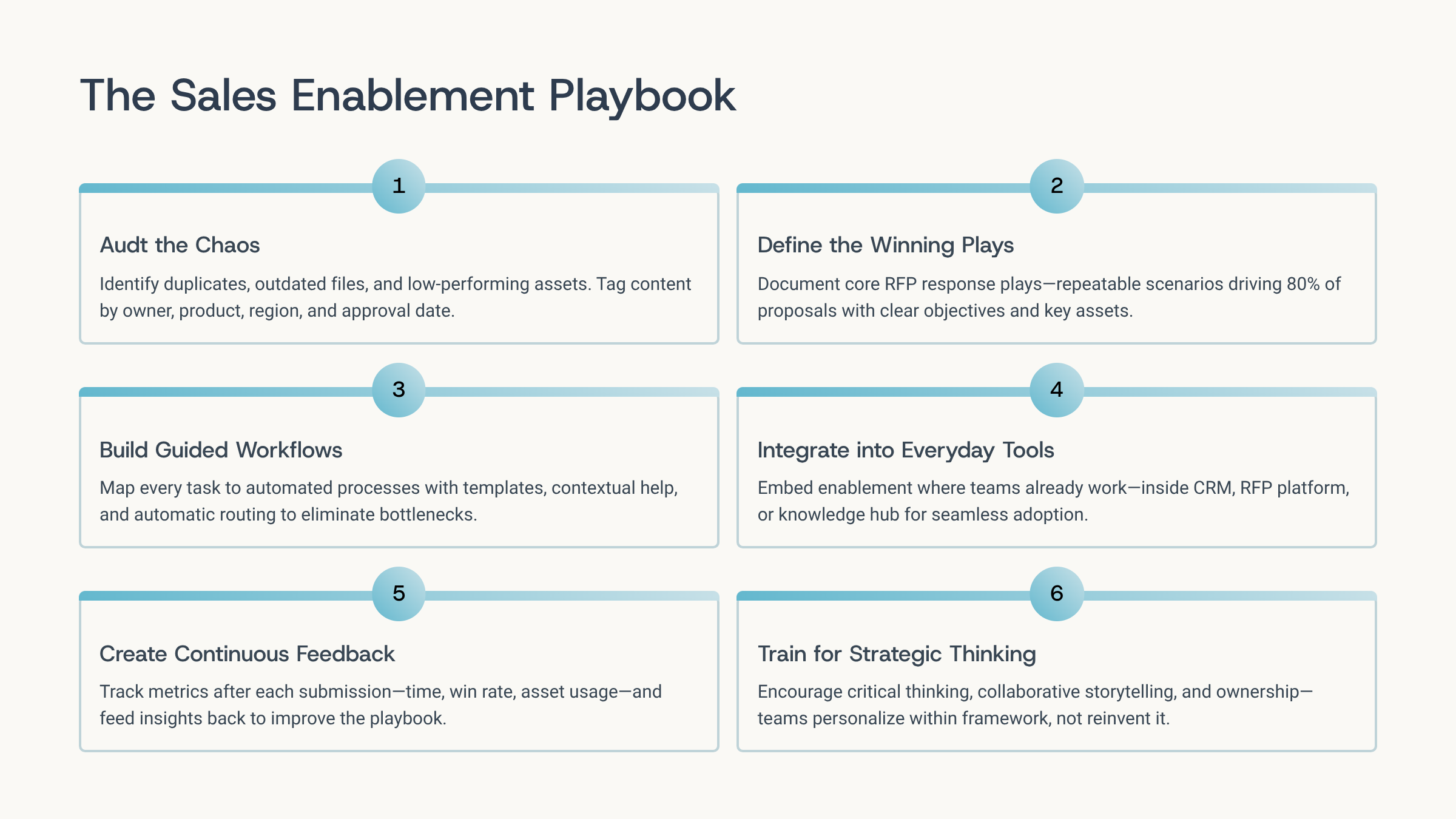
The Sales Enablement Playbook
RFP chaos doesn’t start with bad intentions—it starts with good teams trying to move fast without structure. Every new deal brings another request, another document, another “urgent” deadline. The result? Teams firefight through every RFP instead of following a framework that actually compounds value over time.
A sales enablement playbook solves this by transforming unstructured effort into predictable outcomes. It gives sales, pre-sales, and proposal teams a shared blueprint for how to approach every RFP—from qualification to submission—without starting from scratch.
Here’s what a strong enablement playbook looks like.
1. Audit the Chaos
Start with a content and process audit. Gather every asset your teams use in RFPs—data sheets, compliance statements, pitch decks, and FAQs—and evaluate them for relevance, accuracy, and performance.
Key actions:
- Identify duplicates, outdated files, and low-performing assets.
- Tag each piece of content by owner, product, region, and approval date.
- Separate what drives revenue from what adds noise.
The audit phase lays the foundation for clarity. You can’t fix what you don’t see.
Impact: Visibility into what exists, what’s missing, and what needs immediate cleanup.
2. Define the Winning Plays
Once the noise is cleared, document your core RFP response plays—repeatable scenarios that drive 80% of your proposals.
Each play should outline:
- Scenario: Type of opportunity (renewal, new enterprise deal, government tender, etc.)
- Objective: What success looks like for that play.
- Key Assets: The approved responses, case studies, or metrics that support it.
- Ownership: Who approves what and in what sequence.
These plays give your teams muscle memory. When a new RFP arrives, they already know which narrative, data points, and answers to deploy.
Impact: Predictable, repeatable workflows that reduce setup time and improve consistency.
3. Build Guided Workflows
Turn your plays into step-by-step guided workflows. Map every task—content retrieval, SME input, compliance check, and review—to an automated or assignable process.
In practice:
- Use templates with pre-tagged sections for security, pricing, and product responses.
- Embed contextual help (“why this answer works”) to train while executing.
- Route approvals automatically to reduce email chains and bottlenecks.
These workflows eliminate the guesswork from execution. Teams no longer ask “what’s next?”—they follow the map.
Impact: Faster collaboration, fewer errors, and higher compliance rates.
4. Integrate Enablement into Everyday Tools
A playbook only works when it’s used. That means embedding it where your sales and proposal teams already live—inside your CRM, RFP platform, or knowledge hub.
Instead of making people switch systems, bring enablement to their workflow:
- Surface recommended content based on deal stage.
- Auto-suggest relevant case studies or policies during RFP completion.
- Sync updates across all connected tools to ensure consistency.
When enablement becomes invisible and effortless, adoption soars.
Impact: Seamless alignment between sales operations, proposal management, and deal execution.
5. Create a Continuous Feedback Loop
Enablement is never “done.” It evolves with every deal. After each RFP submission, gather performance data and qualitative feedback.
Track metrics like:
- Time to first draft and total response time.
- Win rate per RFP type or industry segment.
- Asset usage frequency and effectiveness.
- Review bottlenecks or approval delays.
Feed these insights back into your playbook—retire outdated plays, improve strong ones, and create new ones based on data.
Impact: Continuous learning that compounds efficiency and win rates over time.
6. Train for Strategic Thinking, Not Template Filling
Purpose-driven enablement doesn’t replace human insight—it enhances it. Train your teams to use the playbook as a guide, not a crutch.
Encourage:
- Critical thinking when adapting answers to unique buyer needs.
- Collaborative storytelling between sales, product, and marketing.
- Ownership of data accuracy and brand voice.
When your team understands both the “what” and the “why,” RFPs stop feeling like paperwork and start feeling like opportunities to win trust.
Impact: Empowered teams who know how to personalize within a framework, not reinvent it.
Looking for the perfect tool for sales enablement?
The Result: Predictable, Scalable, Repeatable Success
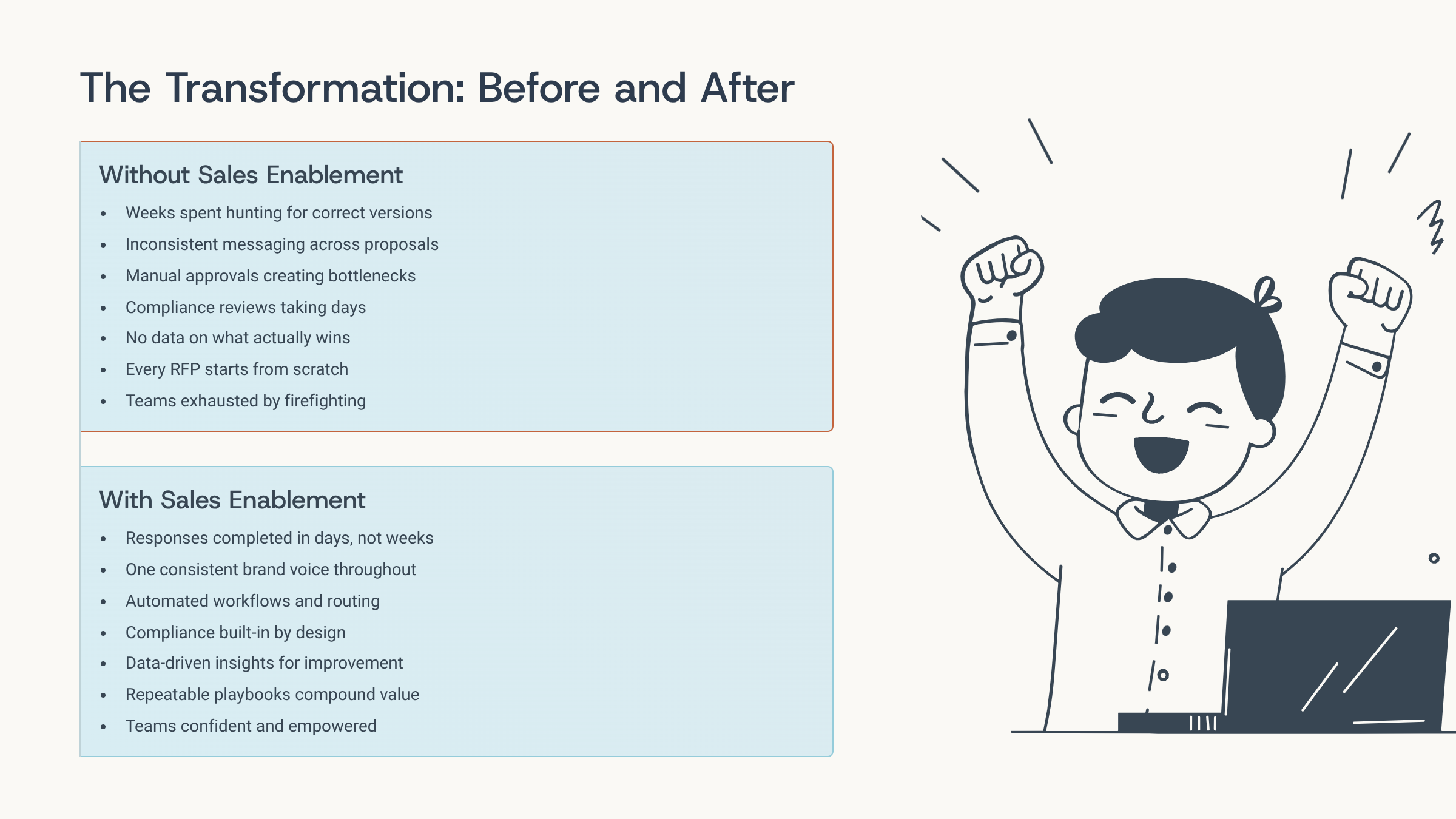
A sales enablement playbook transforms RFP chaos into a measurable process. No more hunting for assets, waiting on sign-offs, or recreating responses from memory. Each team knows their role, each asset serves a purpose, and each submission improves the next one.
It’s the difference between hoping to win and knowing how to win.
Benefits of Sales Enablement in RFP Responses
Here are the key business benefits that sales enablement brings to RFP response management:
1. Faster Response Cycles
Enablement removes friction at every step—content search, reviews, and approvals. With mapped workflows and pre-approved libraries, RFPs that once took weeks can now be completed in days.
Impact: Reduction in response time and a measurable boost in team productivity.
2. Consistent, High-Quality Messaging
Every buyer touchpoint should sound like your brand—accurate, compliant, and confident. Sales enablement ensures all content comes from a single governed source, so no matter who’s responding, your message stays consistent.
Impact: Stronger brand credibility and higher buyer trust across all submissions.
3. Reduced Compliance and Legal Risk
RFPs often include sensitive data, certifications, and security details. Enablement embeds compliance-by-design through role-based permissions, version control, and audit trails.
Impact: Lower review overhead and reduced exposure to compliance errors.
4. Smarter Content Reuse
Rather than reinventing answers for every RFP, enablement helps teams reuse proven, approved content—customized only where it adds real value. This not only saves time but also captures organizational knowledge in a sustainable way.
Impact: Higher response accuracy and less dependency on subject-matter experts.
5. Data-Driven Insights and Continuous Improvement
Enablement turns every RFP into a feedback loop. It tracks which answers perform best, which assets convert, and where bottlenecks appear. These insights help teams refine processes and improve win rates over time.
Impact: Measurable performance improvement and data-backed decision-making.
6. Empowered and Engaged Teams
With clear playbooks, automated workflows, and easy access to information, sellers and proposal teams spend less time chasing answers and more time building relationships.
Impact: Stronger morale, better collaboration, and sustained productivity.
7. Higher Win Rates and Revenue Impact
At its core, sales enablement turns RFP management from a cost center into a growth engine. Faster turnarounds, sharper storytelling, and consistent accuracy directly translate into higher win rates and revenue growth.
Impact: A measurable return on every RFP effort—and a scalable path to predictable success.
Conclusion: From RFP Fatigue to Revenue Flow
RFPs will never stop being complex—but they don’t have to be chaotic. When every response feels like a fresh battle, it’s not a sign of hard work; it’s a sign of missing enablement.
Sales enablement brings order, purpose, and predictability to a process most teams dread. It turns disconnected efforts into orchestrated plays, replaces panic with precision, and transforms RFPs from administrative overhead into strategic opportunities to win trust and revenue.
The companies that win tomorrow aren’t the ones sending the fastest responses—they’re the ones sending the most enabled ones.
And that’s exactly where SparrowGenie comes in. It helps organizations democratize knowledge with one single source of truth, so every RFP response is accurate, confident, and secure—delivered faster, governed better, and aligned with every buyer expectation.
Because when your sales enablement is strong, every RFP stops feeling like a chore—and starts working like a growth engine.
Ready to see how AI can transform your RFP process?
Product Marketing Manager at SurveySparrow
A writer by heart, and a marketer by trade with a passion to excel! I strive by the motto "Something New, Everyday"