Automated RFP ROI Calculator for Enterprise Sales Teams

Article written by
Aparna Rajendran

INSIDE THE ARTICLE
SHARE THIS ARTICLE
Summary
RFPs quietly drain revenue when teams don’t measure their true cost. This guide explains how an RFP ROI calculator helps teams quantify time saved, win-rate lift, and deal velocity, and why automating RFPs delivers measurable, defensible ROI for sales teams.
No leadership team approves RFP software because it “feels useful.” They approve it when you show, in plain numbers, that the current way of handling RFPs is slowing revenue, draining senior teams, and quietly increasing risk.
That’s precisely what an RFP ROI calculator for sales teams is designed to do. A well-built sales ROI calculator makes the hidden cost of RFP work visible by tying time, effort, and accuracy directly to revenue outcomes. Let’s break it down in detail.
What Is an RFP ROI Calculator?
An RFP ROI calculator is a tool that helps sales teams quantify the real cost and revenue impact of responding to RFPs. Instead of relying on gut feel, it translates RFP effort into measurable outcomes like time spent, cost of human effort, win-rate impact, and deal velocity.
A well-built RFP ROI calculator for sales teams shows the ROI of automating RFPs by connecting response quality and speed directly to revenue, helping leaders make confident decisions about sales automation investments.
Why Is RFP ROI Often Invisible?
RFP work sits in a weird blind spot for most sales teams. It’s mission-critical, but no one owns its economics or tracks it through a sales ROI calculator or RFP ROI calculator.
Sales feels the pressure on quotas and timelines. Security and legal feel the interruptions from repeat reviews. Finance never sees the full cost because RFP effort rarely shows up in a ROI calculator for sales or revenue models.
What this really means is poor RFP response software ROI hides in plain sight and shows up as:
- Slower deal velocity that drags pipeline forecasts
- Lower win rates that quietly shrink revenue
- Internal friction that never appears in a sales ROI calculator dashboard
Without a way to measure the ROI of automating RFPs, these losses stay invisible.
An RFP automation ROI calculator forces clarity. It translates effort into numbers, links RFP activity to revenue outcomes, and finally gives leadership a way to see what RFP inefficiency is actually costing the business.
Explore SparrowGenie to know more!
What Does an RFP ROI Calculator Measure?
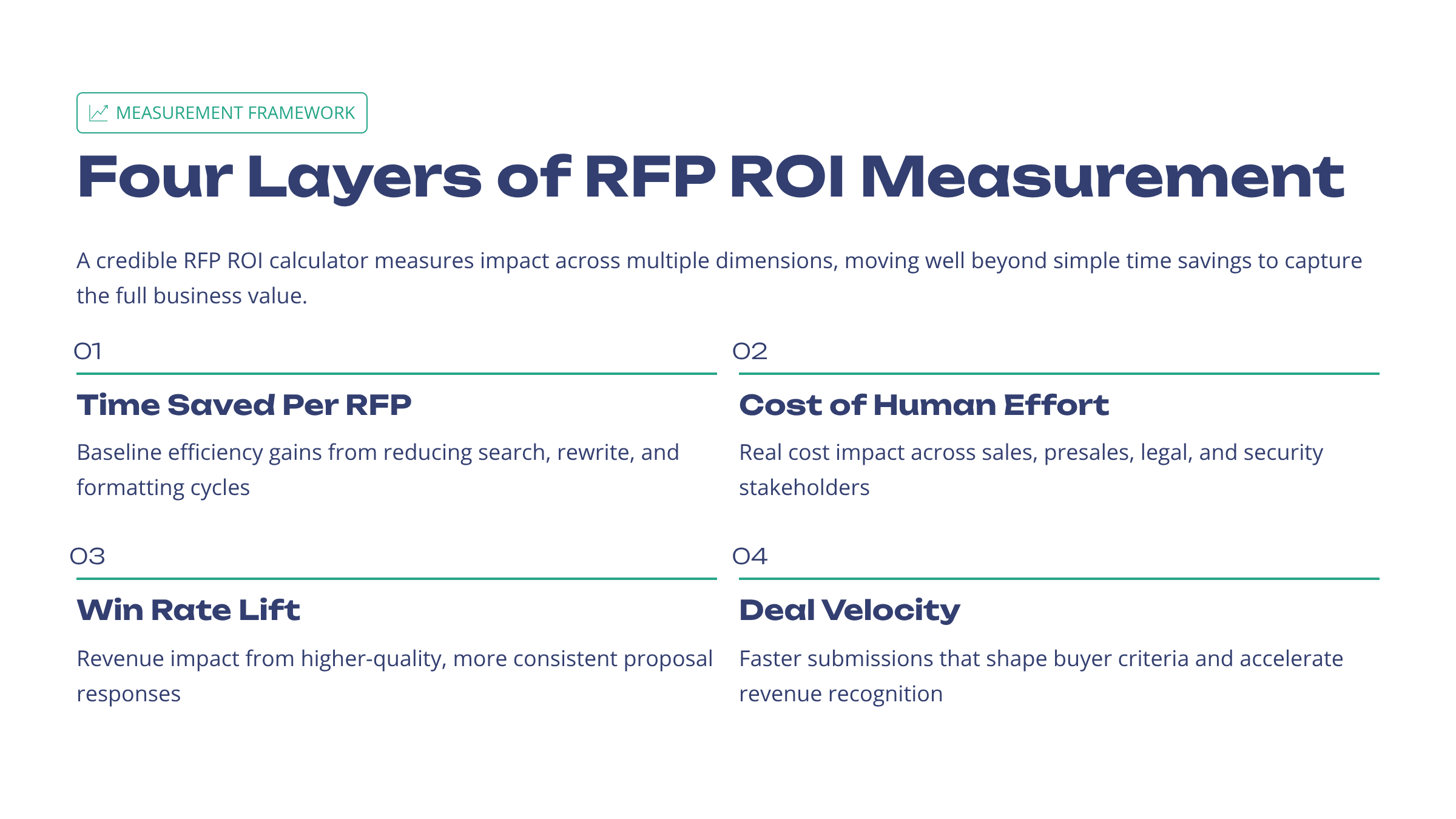
Most calculators stop at time saved. That’s only step one. A credible RFP response software ROI model measures impact across four layers.
1. Time Saved Per RFP
Every RFP ROI calculator for sales teams starts with time. Not because time is the only metric that matters, but because it’s the easiest way to expose inefficiency in the RFP response process.
A credible ROI calculator sales tool looks at three core inputs:
- Average hours spent per RFP today
- Number of contributors involved in each response
- Percentage of effort lost to searching for answers, rewriting existing content, or formatting documents
When teams measure this honestly, a pattern shows up fast.
In mid-market and enterprise sales, 30–50% of total RFP time is typically spent on work that adds no new value to the buyer. That includes hunting for the “latest approved answer,” reworking language for different formats, and clarifying ambiguous questions after drafting has already started.
From an ROI perspective, this wasted time directly inflates the cost side of any RFP response software ROI model. It also skews planning because teams underestimate how much capacity RFPs are actually consuming.
This is why time saved per RFP becomes the baseline metric in a sales ROI calculator. Until you reduce and stabilize this number, it’s impossible to accurately measure the ROI of automating RFPs or compare different sales automation investments.
Modern RFP automation platforms improve this metric by automatically understanding RFP structure, reducing guesswork around unclear questions, and producing usable first drafts from governed sources. The result is fewer false starts, faster first drafts, and a predictable reduction in total response time.
That time reduction becomes the foundation on which every other sales ROI calculator metric is built, and it’s an area where platforms like SparrowGenie are designed to deliver measurable gains.
2. Cost of Human Effort
A credible ROI calculator for sales translates hours saved into real cost impact by multiplying them across the people actually involved in RFP responses. This typically includes:
- Sales rep hourly cost
- Presales and solution engineering cost
- Legal and compliance review cost
- Security and IT validation time
This is where most RFP ROI calculators uncover uncomfortable truths.
RFPs rarely rely on junior staff. They pull in senior, high-cost talent whose time is already stretched across deals, customer calls, and strategic work. When these contributors are repeatedly answering similar questions, the cost of human effort quietly balloons and skews the true RFP response software ROI.
Many sales teams underestimate this cost because it doesn’t appear in standard sales reports or pipeline dashboards. Without a sales ROI calculator, leadership sees RFP effort as operational overhead rather than a measurable revenue expense.
From an ROI standpoint, reducing this cost is one of the fastest ways to improve the ROI of automating RFPs. Fewer interruptions, fewer rework cycles, and fewer reviews by senior stakeholders directly lower the most expensive inputs in the process.
Platforms designed for secure, centralized knowledge management help achieve this by reducing repeated SME involvement, minimizing legal rework through consistent language, and limiting unnecessary security reviews. This structural reduction in high-cost human effort is a key reason tools like SparrowGenie tend to deliver stronger, more defensible ROI outcomes.
3. Win Rate Lift
This is the point where RFP ROI moves from operational efficiency to real revenue impact.
Time savings reduce cost. Win-rate improvements increase revenue.
That’s why every serious RFP ROI calculator for sales teams treats win rate as a core input. Better RFP responses win more often, but not because they are longer or more detailed. They win because they are:
- Consistent across every section and attachment
- Clearly aligned to buyer priorities and evaluation criteria
- Free of contradictions that trigger doubt during review
Even small improvements here dramatically change ROI math. In a sales ROI calculator, a 3–5% win-rate lift often outweighs all time savings combined, especially for mid-market and enterprise deals.
Most teams fail to capture this because win rate is rarely connected to RFP quality in a ROI calculator sales tool. It’s treated as a sales performance issue rather than a response quality issue.
From an ROI perspective, this is a blind spot. Modern ai automation ROI metrics for sales teams focus on reducing uncertainty in RFP responses. When sales teams know which answers are reliable, which need review, and where risk exists, they submit stronger, more confident proposals without increasing RFP volume.
This clarity directly supports higher win rates by improving trust with buying committees and reducing internal errors, which is why platforms like SparrowGenie consistently help teams unlock measurable win-rate lifts without changing how many RFPs they respond to.
4. Deal Velocity
Speed in RFP responses isn’t just about efficiency. It’s about influence.
In competitive deals, when you submit often matters as much as what you submit. Yet most sales ROI calculators and RFP ROI calculators for sales teams stop measuring impact the moment a draft is complete.
That’s a mistake.
Early RFP submissions consistently:
- Shape buyer evaluation criteria before scoring is locked
- Signal operational maturity and execution confidence
- Reduce deal slippage caused by prolonged evaluations
Late submissions, on the other hand, tend to compete on price and compliance. Early submissions compete on value and trust.
From an ROI standpoint, faster submission directly impacts deal velocity, which is why it should be modeled in any serious roi calculator for sales. Faster responses lead to faster evaluations, shorter sales cycles, and earlier revenue recognition.
This is especially critical when measuring the rfp automation ROI timeline for mid-market sales, where even small delays can push deals into the next quarter and distort forecasts.
Modern RFP automation reduces deal friction by improving coordination across sales, presales, legal, and security. Fewer review loops, clearer ownership, and buyer-ready outputs eliminate last-minute chaos that slows submissions and creates risk.
Your sales rep ROI calculator should account for faster time-to-submit and faster time-to-close, because deal velocity is often the biggest multiplier in the ROI of automating RFPs, and it’s an area where platforms like SparrowGenie are built to deliver measurable gains.
Interested in SparrowGenie?
What Is the ROI of Automating RFPs? (Mid-Market Example)
Let’s move from theory to numbers and run a realistic mid-market scenario using an RFP ROI calculator for sales teams. No inflated assumptions. No best-case fantasies. Just what most growing sales orgs actually see.
Baseline inputs:
- RFPs per year: 180
- Average hours per RFP: 38
- Estimated time reduction with automation: 45%
- Blended hourly cost (sales, presales, legal, security): $85
- Average deal size: $55,000
- Expected win-rate lift: 4%
These inputs reflect a typical mid-market sales environment where RFPs are frequent, cross-functional, and handled by senior contributors.
Annual impact
When you plug these numbers into a roi calculator for sales, the impact becomes immediately visible:
- ~3,078 hours saved annually Time reclaimed from searching, rewriting, reformatting, and repetitive reviews.
- ~$261,000 in productivity value Direct labor cost savings captured through reduced human effort, a core input in any rfp response software ROI model.
- ~$396,000+ in incremental revenue Driven by a modest 4% win-rate improvement, which most teams underestimate until they see it modeled in a sales ROI calculator.
Why this matters
What’s important here is not the exact dollar figure. It’s the structure of the math.
This example shows how the ROI of automating RFPs compounds across:
- Cost reduction (time and human effort)
- Revenue lift (win-rate improvement)
- Deal momentum (faster responses and earlier closes)
Without an rfp roi calculator for sales teams, these impacts stay fragmented and invisible. Teams feel the pain, but leadership never sees the full picture.
This is the kind of clear, defensible ROI most sales organizations miss simply because they’re not measuring RFP work through a proper sales ROI calculator.
Why Traditional RFP Tools Undersell ROI
Most legacy RFP tools were built for a very different era. They focus almost entirely on content storage and retrieval, assuming that if teams can find past answers faster, ROI will naturally follow. In practice, this creates a narrow and often misleading RFP ROI calculator view.
These platforms implicitly assume:
- Answers stored in the library are always correct
- Context rarely changes between RFPs
- Review cycles are unavoidable and fixed
Because of these assumptions, traditional tools measure ROI almost exclusively in hours saved, which significantly understates the true RFP response software ROI.
What gets missed is everything that actually drives revenue:
- Win-rate improvement
- Deal velocity
- Reduced risk from inconsistent or outdated responses
- The real cost of senior human effort
As a result, the ROI of automating RFPs appears incremental instead of transformational when modeled through basic tools.
Modern ROI modeling takes a broader view. It factors in governed AI assistance, secure collaboration, and confidence-driven workflows that reduce uncertainty, rework, and risk across sales, presales, legal, and security teams.
This is why platforms like SparrowGenie model the ROI of automating RFP and contract review differently and why the ROI compounds over time instead of plateauing at simple productivity gains.
Check out SparrowGenie's ROI Calculator now! Eager to know more? Dive in!
SparrowGenie’s ROI Calculator
Most ROI calculators stop at surface-level math. SparrowGenie’s RFP ROI calculator for sales teams is built to answer a deeper question: what is RFP inefficiency really costing us, and what changes when we fix it properly?
This calculator is designed for sales, RevOps, and leadership teams who want a clear, defensible view of the ROI of automating RFPs, not inflated projections.
What the SparrowGenie ROI Calculator Measures
The SparrowGenie ROI calculator focuses on inputs that reflect real RFP workflows, not ideal scenarios. It captures:
- RFP volume and complexity
How many RFPs your team handles and how resource-intensive they actually are. - Time spent per RFP
Including drafting, searching for answers, reviews, and last-minute fixes. - Cost of human effort
Across sales reps, presales, legal, and security, giving you a true RFP response software ROI view. - Win-rate impact
Modeling how faster, more consistent, and higher-confidence responses affect deal outcomes. - Deal velocity gains
Showing how earlier submissions reduce slippage and accelerate revenue recognition.
Together, these inputs create a business intelligence-style ROI model that connects RFP execution directly to revenue outcomes.
Why This ROI Calculator Is Different
The SparrowGenie ROI calculator doesn’t assume automation magically fixes everything. It uses conservative assumptions and highlights where value actually comes from:
- Reduced rework and review loops
- Fewer interruptions to senior SMEs
- Faster, buyer-ready submissions
- Measurable improvements in win rate and deal speed
This makes it especially useful for mid-market and enterprise teams looking for a realistic rfp automation ROI timeline, not best-case scenarios.
How Teams Use the SparrowGenie ROI Calculator
Sales leaders use it to:
- Build CFO-ready business cases
- Prioritize high-ROI RFPs
- Forecast capacity without adding headcount
- Align sales, presales, and legal around impact
RevOps teams use it to:
- Quantify the ROI of sales automation tools
- Track improvements over time
- Tie RFP performance to revenue metrics
The SparrowGenie RFP ROI calculator isn’t just a justification tool. It’s a decision framework that shows where revenue is leaking today and what changes when RFPs are handled with speed, confidence, and control.
When teams run their numbers through it, the ROI of staying manual becomes hard to defend, and the value of governed RFP automation becomes easy to explain.

Excited to know more about SparrowGenie?
Final Take
The ROI of automating RFPs is rarely about speed alone. Speed helps. But real ROI comes from control. Control over how answers are sourced. Control over risk and inconsistency. Control over deal momentum when timelines get tight.
That’s why a modern RFP ROI calculator for sales teams measures more than hours saved. It looks at how automation protects revenue by:
- Keeping deals moving forward
- Reducing risk from errors and outdated responses
- Giving sales teams confidence at scale
RFPs are no longer administrative paperwork. They are high-stakes revenue moments that directly influence trust, evaluation, and outcomes.
SparrowGenie exists because once you run RFP work through an ROI calculator, the true cost of staying manual and ungoverned becomes impossible to ignore.
Ready to see how AI can transform your RFP process?
Product Marketer at SparrowGenie
Being a Product Marketer at SparrowGenie, Aparna helps sales teams work faster with secure, AI-powered proposal automation. She turns complex features into simple stories, builds messaging that resonates, and keeps a close pulse on what customers actually need. She loves shaping clear, helpful content that shows how SparrowGenie makes RFP work easier, faster, and a lot less stressful.