Loopio vs Responsive (2026) | Side-by-Side RFP Software Comparison

Article written by
Aparna Rajendran

INSIDE THE ARTICLE
SHARE THIS ARTICLE
Summary
Choosing between Loopio and Responsive for your RFP automation? Both are solid legacy players, but they serve different needs. Loopio wins on ease of use and stellar support (9.7/10 on G2). Responsive dominates with enterprise-grade workflows and GenAI capabilities. The catch? Neither truly solves the library maintenance burden nor delivers AI that doesn't need heavy editing. This guide breaks down features, pricing, real user feedback, and pros and cons for each platform and gives you a modern alternative, SparrowGenie, built for teams who want fast time-to-value without the legacy baggage.
Your team just got another RFP. The deadline is tight, your SMEs are swamped, and somewhere in a shared drive, there's a response from 2019 that might still be relevant. Sound familiar?
If you're evaluating RFP automation software, you've probably landed on two names repeatedly: Loopio and Responsive (formerly RFPIO). Both are established players with solid track records. Both promise to cut your response time and boost win rates.
But it's a lot more than picking up a platform for you. Choosing the wrong platform can cost you more than just subscription fees. It can mean missed deadlines, frustrated SMEs, and deals slipping through your fingers.
This guide breaks down everything you need to know about Loopio vs Responsive, from features and pricing to real user reviews. We'll also introduce you to a compelling alternative that addresses the gaps both legacy tools leave behind.
Need an alternate tool that is AI-native, faster, and better? Check out Genie AI now.
Quick Overview: Loopio vs Responsive at a Glance
Before we dive deep, let's establish the fundamentals. Both platforms serve proposal teams, but they've carved out slightly different niches in the market.
Criteria | Loopio | Responsive |
|---|---|---|
Best For | Small-mid teams, first-time RFP software buyers | Mid-large enterprises with complex tech stacks |
G2 Rating | 4.6/5 | 4.5/5 |
Starting Price | ~$20,000/year (10 seats) | Custom |
AI Capability | Magic (keyword-based suggestions) | AI Assistant (GenAI drafting) |
Primary Use Cases | RFPs, RFIs, Security Questionnaires, DDQs | RFPs, DDQs, VSQs, Assessments across departments |
Support Rating | 9.7/10 (G2) | Mixed (premium tiers for dedicated support) |
Loopio
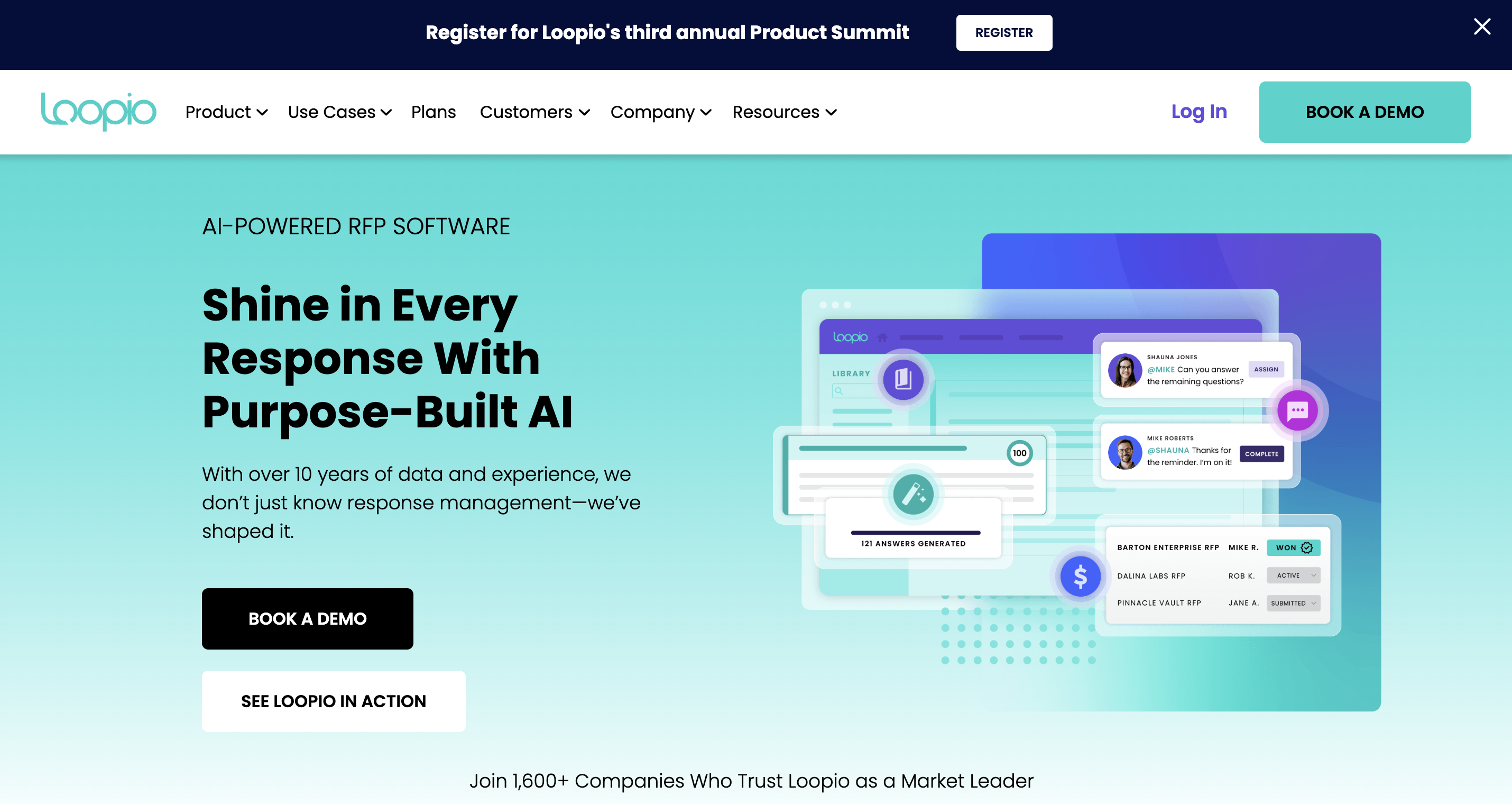
Source: Loopio
G2 Rating: 4.6/5
Founded in Toronto, Loopio has built its reputation on simplicity. The platform markets itself as the intuitive solution for teams formalizing their RFP operations for the first time.
Key Features
Loopio has built its platform around one core promise: making RFP chaos manageable. Here's what you get under the hood.
Content Library Management: Centralized repository with stacks, categories, and tags. Users consistently praise this as the biggest time-saver, eliminating the need to dig through old RFPs and shared drives.
Response Intelligence AI: One-click answer suggestions from your approved content. Built on 10+ years of proposal data, though users report the "Magic" feature works better for basic, repetitive questions than nuanced requirements.
Project Collaboration: Milestone tracking, SME assignments, and integrations with Salesforce, Slack, Microsoft Teams, and Copilot 365.
Content Analytics: Library health monitoring, proposal effectiveness insights, and team completion time tracking.
Portal-Based Response Management: Recently launched capability to respond directly in web-based portals, addressing a common pain point in RFP workflows.
On paper, it's a solid feature set for teams looking to centralize and streamline. The real question is how well these features perform when deadlines hit and SMEs go MIA.
What Real Users Say About Loopio
After analyzing 800+ verified reviews from G2, Capterra, and TrustRadius, clear patterns emerge:
The Good: Users rave about the intuitive interface that "simplifies complex tasks" and reduces email clutter. The customer support team earns consistent praise as "stellar," "quick," and "thorough."
"Loopio keeps all company-specific bid content organized, clean, and easy to access in one central library." – Enterprise Proposal Manager
The Not-So-Good: The AI "Magic" feature receives mixed feedback. One user even noted, "Magic, great potential, not very helpful" after 2+ years of use. Others mention pricing concerns for smaller teams and a learning curve during initial rollout.
Loopio: Pros and Cons
Here's the honest breakdown based on what real users are saying.
PROS | CONS |
|---|---|
Clean, intuitive UI for fast onboarding | AI capabilities limited for complex queries |
Exceptional customer support (9.7/10) | Higher price point for smaller teams |
Strong library organization features | User-based pricing limits SME participation |
Reliable integrations (Salesforce, Slack) | Duplicate detection needs improvement |
The pattern is clear. Loopio delivers on usability and support, but falls short when you need AI that thinks, not just matches. For teams outgrowing basic automation, that gap becomes expensive.
My Take on Loopio
Loopio is a solid choice if your priority is getting a focused RFP team up and running quickly. The platform excels at the fundamentals: organizing content, facilitating collaboration, and keeping projects on track. If you have a dedicated content manager who can maintain the library and you're not expecting AI to do the heavy lifting, Loopio delivers. However, if you're looking for advanced RFP automation that truly reduces manual work, you may find the "Magic" underwhelming.
Tired of AI that promises magic but delivers mediocre results?
Responsive
Source: Responsive
G2 Rating: 4.5/5
Responsive (formerly RFPIO) positions itself as the leader in Strategic Response Management. With nearly 2,000 customers managing over $600B in opportunities through their platform, they've built serious enterprise credibility.
Key Features
Responsive didn't earn its 24-quarter G2 leadership streak by accident. The platform packs serious firepower for teams operating at scale.
AI-Driven Content Library: Governed, single source of truth for all RFX types. Smart Search returns contextual results quickly, going beyond basic keyword matching.
GenAI Response Generation: Draft entire proposals in minutes with AI that cites sources. Users report it significantly speeds up complex RFPs, though responses sometimes require manual refinement.
Advanced Workflow Automation: Task routing, status tracking, requirements analysis, and approval chains for large teams managing multiple concurrent projects.
Multi-Language Support: Translates proposals into 23+ languages with version linking, making it ideal for global organizations.
Extensive Integration Ecosystem: Bi-directional connections with enterprise systems and an open API for complex tech stacks.
It's an impressive toolkit, especially for global enterprises juggling complexity. But all that power means nothing if your team spends months figuring out how to use it.
What Real Users Say About Responsive
With 1,200+ reviews and a G2 Leader position for 24 consecutive quarters, Responsive has built a strong user base. Here's what they're actually saying:
The Good: The content library and AI Assistant receive high marks for boosting efficiency. Users report answering 90% of 300-question security questionnaires using the platform.
"We were able to reduce the time maintaining our content library by 50% through the elimination of writing/editing tasks." – Verified User
The Not-So-Good: Users mention the UI can feel complex with key actions buried in menus. The pricing structure is also a common concern, with standard support sometimes feeling basic without premium tiers.
Responsive: Pros and Cons
Power and complexity often go hand in hand. Here's what users love about Responsive, and where it leaves them frustrated.
PROS | CONS |
|---|---|
Powerful GenAI response capabilities | Complex UI with steep learning curve |
Extensive enterprise integrations | Confusing pricing with hidden add-ons |
Multi-language support (23+ languages) | Basic support on standard tiers |
Robust workflow for complex projects | AI suggestions sometimes require heavy editing |
Responsive can do a lot, but only if you have the budget, bandwidth, and patience to unlock it. For leaner teams, that trade-off rarely pays off.
My Take on Responsive
Responsive is the right choice for large enterprises with complex tech stacks and high RFP volumes. The platform's depth is impressive, particularly for global teams managing multi-language responses. However, that depth comes at a cost, both financially and in terms of adoption. If your organization doesn't have dedicated resources for implementation and ongoing optimization, you may struggle to realize the platform's full potential.
Looking for enterprise features without the enterprise complexity?
See How SparrowGenie Works
Loopio vs Responsive Deep Dive
Let's break down how these platforms stack up across the criteria that matter most to proposal teams.
Ease of Use
Winner: Loopio. Reviews consistently mention Loopio's clean, intuitive interface that's easy to navigate even for non-technical users. Responsive is powerful but more complex; users report a longer learning curve despite acknowledging its effectiveness once mastered.
AI and Automation
Winner: Responsive. While both platforms have AI features, Responsive's GenAI capabilities are more advanced, enabling first-draft generation with source citations. Loopio's Magic relies on keyword-based matching, which struggles with nuanced queries. However, both fall short of true AI-native solutions that understand context beyond basic pattern matching.
Pricing Transparency
Winner: Loopio (marginally). Loopio starts at ~$20K/year with user-based pricing that's relatively predictable. Responsive's pricing model combines per-user and project-based fees, which users describe as complex. Neither offers transparent public pricing, requiring sales conversations for accurate quotes.
Customer Support
Winner: Loopio. With a 9.7/10 G2 support score, Loopio's support team is consistently praised as "reliably excellent." Responsive support is rated positively but feedback is more mixed, particularly on standard tiers.
Enterprise Scalability
Winner: Responsive. For organizations with high RFP volume, complex approval chains, and enterprise IT requirements, Responsive's workflow automation and integration depth provide clear advantages.
What if you could have the best of both worlds, plus AI that actually works? Explore SparrowGenie
The Gaps Both Legacy RFP Tools Leave Behind
After analyzing hundreds of user reviews and comparing features, certain pain points emerge consistently for both platforms:
1. Library Maintenance Burden: Both platforms require significant ongoing effort to keep content libraries relevant and organized. Teams report spending substantial time on content curation rather than strategic proposal work.
2. AI Limitations: Neither platform offers truly intelligent AI that understands context, learns from approvals, or generates responses that don't require significant editing. Users describe AI features as "good starting points" rather than productivity multipliers.
3. Pricing Complexity: Both platforms make it difficult to forecast costs, with add-ons, user-based fees, and premium features creating budget uncertainty.
4. SME Bottlenecks: While both claim to streamline SME involvement, users consistently report that chasing down subject matter experts for input remains a significant challenge.
The Modern Alternative: SparrowGenie
G2 Rating: 4.5/5
If you've read this far and found yourself nodding at the limitations of legacy tools, there's good news. A new generation of RFP automation platforms is emerging, and SparrowGenie represents the best of this evolution.
Why SparrowGenie Stands Out
We built SparrowGenie to fix what legacy tools keep getting wrong. Here's what that looks like in practice.
Lightning-Fast First Drafts: Auto-generates high-quality initial responses in minutes, not hours. Our AI doesn't just match keywords; it understands context and delivers responses that require minimal editing.
No Library Maintenance Required: Unlike Loopio and Responsive, SparrowGenie's AI learns from your approved content without requiring manual library curation. Upload your documents, and let the platform do the heavy lifting.
Real-Time Collaboration: Role-based workflows and in-line commenting make cross-functional teamwork frictionless. No more chasing SMEs through email chains.
Contextual Understanding: Leverages advanced heuristics to accurately interpret even the most unstructured RFPs and questionnaires, including Excel-based formats that trip up other platforms.
Full Lifecycle Intelligence: The only platform with dedicated modules for Training, Testing, Improvement, and Conflict Resolution.
White-Glove Onboarding: High-touch support from day one, with dedicated customer success tailored to your workflows.
This isn't about adding more features to an already bloated stack. It's about giving your team time back and letting AI do what it should have been doing all along.
SparrowGenie vs Legacy Tools
Specs and feature lists only tell part of the story. Here's how SparrowGenie stacks up where it actually matters.
Feature | Loopio | Responsive | SparrowGenie |
|---|---|---|---|
AI Quality | Keyword-based | GenAI (needs editing) | Contextual AI |
Library Maintenance | Manual curation | Manual curation | Auto-learns |
First Draft Speed | Hours | 30+ minutes | Minutes |
Onboarding | Weeks | Weeks to months | Days |
Format Handling | PDF issues reported | Ariba issues | Any format |
Legacy tools were built for a different era. If you're still measuring success by how well you manage your content library, you're solving yesterday's problem.
SparrowGenie: Pros and Cons
We're not going to pretend we're perfect. Here's the honest picture, strengths and limitations included.
PROS | CONS |
|---|---|
Contextual AI that truly understands RFPs | Newer entrant (smaller market presence) |
No manual library maintenance | Building integration ecosystem |
Real-time collaboration built-in | Best suited for mid-market focus |
White-glove onboarding |
|
Full lifecycle intelligence modules |
|
Yes, we're the new kid on the block. But sometimes that's exactly what it takes to build something that actually works the way modern teams need it to.
My Take on SparrowGenie
I do work at SparrowGenie. But I can tell you honestly why I believe in this platform. We built it specifically to address the frustrations that users of legacy tools like Loopio and Responsive consistently report. Our AI doesn't just match keywords; it understands context. Our library doesn't require constant curation; it learns from your approvals. And our onboarding doesn't take months; we get teams productive in days. For growth-stage B2B companies handling 10+ RFPs monthly who want the speed of automation without sacrificing quality, SparrowGenie delivers.
Ready to see the difference contextual AI makes?
Making the Right Choice: Which Platform Fits Your Team?
There's no universal "best" RFP software. The right choice depends on where your team is today and where you're headed.
Choose Loopio if: You're implementing RFP software for the first time, have a dedicated content manager who can maintain the library, prioritize ease of use over advanced automation, and work primarily in English-speaking markets.
Choose Responsive if: You're a large enterprise with complex tech stacks, need multi-language support for global operations, have resources for lengthy implementation, and require deep workflow customization.
Choose SparrowGenie if: You're a growth-stage B2B company (200-5000 employees), handle 10+ RFPs monthly, want AI that actually reduces manual work, need fast time-to-value, and want human-centered automation that doesn't replace your team's expertise.
The worst decision? Picking a platform based on a demo that looked slick, only to realize six months later it doesn't fit how your team actually works. Choose for your reality, not your wishlist.
Final Thoughts
The RFP software market is evolving rapidly. Loopio and Responsive have earned their positions as established players, each serving distinct segments of the market well. Loopio excels at simplicity and support; Responsive delivers enterprise depth and global capabilities.
But if you're looking beyond legacy tools to what's next in RFP automation, platforms like SparrowGenie represent where the industry is heading: AI that truly understands context, libraries that maintain themselves, and onboarding measured in days rather than months.
The question isn't just which tool has the best features today. It's which partner will help you respond faster, win more, and free your team to focus on what humans do best: building relationships and crafting compelling value propositions.
Whatever you choose, make sure it solves your actual problems, not just the ones vendors want to tell you about.
Ready to transform your RFP response process? See how SparrowGenie can help you respond faster and win more.
Ready to see how AI can transform your RFP process?
Product Marketer at SparrowGenie
Being a Product Marketer at SparrowGenie, Aparna helps sales teams work faster with secure, AI-powered proposal automation. She turns complex features into simple stories, builds messaging that resonates, and keeps a close pulse on what customers actually need. She loves shaping clear, helpful content that shows how SparrowGenie makes RFP work easier, faster, and a lot less stressful.
Frequently Asked Questions (FAQs)
Related Articles

RFP Metrics Guide: Essential Numbers That Drive Better Win Rates

100+ Employee Self Evaluation Examples for Key Workplace Skills in 202