Top 10 Responsive Alternatives to Watch Out For in 2026

Article written by
Aparna Rajendran

INSIDE THE ARTICLE
SHARE THIS ARTICLE
Summary
Choosing an RFP tool today isn’t about who has the longest feature list. It’s about which platform actually reduces effort without increasing risk. Traditional tools like Responsive and Loopio bring structure and control but often struggle with speed and AI depth. Newer AI-native platforms move fast, yet can fall short on governance and consistency. This guide breaks down the top Responsive alternatives with a clear lens on what matters most: answer quality, collaboration, content freshness, and time to value. You’ll also see where SparrowGenie fits, bridging AI speed with human-led review, so teams can respond faster without sacrificing trust or accuracy.
The RFP/proposal tooling market has shifted fast, mostly because AI moved from “nice-to-have” to “if it’s not saving time, why are we paying for it?” Traditional platforms have mature workflows and integrations, but AI quality often feels bolted on; newer AI-native platforms can be dramatically faster but may lack enterprise depth or predictable governance.
So the search for the top 10 responsive alternatives usually isn’t about replacing a tool; it’s about replacing:
- verification fatigue (AI that creates more review work than it saves),
- collaboration friction (pricing or access that discourages expert input),
- implementation drag (time-to-value measured in quarters),
- and content rot (libraries that quietly go stale and cause risk).
How to Evaluate Any RFP Tool Without Falling for Demos
Before jumping into the list of Responsive alternatives, here’s a field-tested way to judge tools fairly:
What to test | What “good” looks like | What to watch for |
|---|---|---|
Answer quality | Drafts that are usable with light edits | “Confident” answers that are vague, generic, or off |
Traceability | Clear sourcing or confidence signals | Black-box outputs that force manual hunting |
Collaboration | Many contributors can participate without penalty | Seat costs or complex UX that scares people away |
Governance | Approvals, controlled content, auditability | Anything that risks inconsistency or compliance mistakes |
Implementation | Useful in weeks, not months | Heavy services + slow onboarding |
Knowledge upkeep | Low-maintenance freshness and conflict detection | Content libraries that become a full-time job |
Performance gaps between AI-native and legacy tools are real, and integrations plus switching costs can lock teams into “good enough.”
Top 10 Responsive Alternatives
Ground rule for this list: every tool has strengths and trade-offs. The goal isn’t to “pick a winner,” it’s to help you shortlist based on your reality: volume, complexity, risk tolerance, and how your team actually works.
1) SparrowGenie
SparrowGenie’s positioning as a human-led, AI-powered sales enablement platform isn’t just branding. It’s a deliberate bet on how RFP work actually succeeds: AI can draft fast, but humans still own accuracy, nuance, and credibility.
Interested in checking out SparrowGenie?
What SparrowGenie genuinely does well
- Speed at scale
Drafting is accelerated through dual mapping, confidence-scored answers, and a trained Knowledge Hub, but nothing assumes humans vanish. The system is built for faster starts and cleaner handoffs, not blind auto-submit. - Human-first review by design
Confidence scores, section-level progress, and conflict detection push reviewers exactly where attention is needed. Legal, presales, and InfoSec don’t wade through noise. They validate what matters. - One governed workspace, not tool sprawl
Sales, presales, legal, and IT work inside a single secure hub with role-based access, audit trails, and ownership clarity. This reduces the real bottleneck: coordination, not writing. - Knowledge that improves over time
Train, test, improve, and conflict resolution turn every RFP into feedback for the system. Misses and weak spots don’t get buried; they become inputs for the next response.
Where to pressure-test
- Ecosystem maturity: Newer tools can be excellent at AI but still be building integrations and admin depth.
- POC performance matters: Head-to-head proofs (same RFP, same sources) are where confidence is won or lost.
Who it usually fits
- Teams drowning in cross-functional RFP chaos, not just writing time
- Organizations that need AI speed but still require auditability and accountability
- Sales motions where legal, InfoSec, and presales are deeply involved
- Buyers who care as much about trust, accuracy, and governance as velocity
G2 Rating: 4.5/5
Pricing: Custom
Interested in SparrowGenie?
2) Loopio
Source: Loopio
Loopio is one of the most established names in the category, known for a mature content library model and broad integrations.
What Loopio tends to do well
- Content library depth
Loopio shines when it comes to building and maintaining a structured answer library. For teams answering high volumes of similar RFPs, this reduces repetitive writing fast. - Mature collaboration patterns
The platform is built around reviewers, SMEs, and contributors working in parallel. Assignments, comments, and approvals feel predictable and stable, which large teams value. - Enterprise-grade consistency
Standardized responses, controlled updates, and permissions help keep answers aligned across regions and teams. This matters when brand, legal, and compliance consistency is non-negotiable. - Proven at scale
Loopio has been around long enough to support global rollouts, multi-geo teams, and complex sales orgs without falling apart operationally.
Where the reality bites
- Speed vs setup tradeoff
Most of Loopio’s value shows up after significant content population and tuning. Early-stage teams may feel friction before they feel acceleration. - AI as assist, not driver
While AI exists, the experience still leans heavily on manual curation and retrieval. Teams expecting aggressive first-draft automation should test expectations carefully. - Cost-to-value curve
Pricing often scales with users, add-ons, and implementation support. ROI makes sense at volume, but lighter-use teams should validate fit closely. - Workflow rigidity
Loopio excels in structured environments, but teams with evolving processes may find customization slower compared to newer, workflow-native platforms.
Best-fit scenario
- Large proposal teams with stable, repeatable RFP patterns
- Organizations prioritizing answer consistency over rapid drafting
- Enterprises with dedicated proposal operations or content managers
- Teams willing to invest upfront in library hygiene for long-term payoff
If your RFP world is built on repeatability, scale, and consistency and you’re prepared to invest in structure, Loopio remains a reliable, enterprise-safe choice. If speed, adaptive workflows, and AI-led drafting are the priority, it’s worth pressure-testing alternatives alongside it.
G2 Rating: 4.6/5
Pricing: Starts from $20,000
3) Inventive AI
Source: Inventive.AI
Inventive AI is widely viewed as one of the more technically sophisticated AI-native platforms, built around synthesis rather than classic library retrieval.
Where Inventive AI shines
- Strong first-draft acceleration
Inventive AI is built to get teams from a blank page to a usable draft quickly. For proposals that aren’t rigidly templated, this alone can save hours early in the cycle. - Context-aware answer generation
The platform leans heavily into understanding the question context, not just keyword matching. This helps reduce generic filler and improves relevance in narrative-heavy sections. - Lightweight setup
Compared to traditional RFP tools, Inventive AI requires less upfront configuration. Teams can start experimenting without months of content normalization. - Helpful for non-RFP-native teams
Sales or marketing-led teams without formal proposal ops often find it easier to adopt, especially for ad-hoc proposals and custom asks.
Trade-offs to account for
- Governance depth
Inventive AI is faster on generation than control. Enterprises should validate versioning, audit trails, and role-based approvals if compliance is critical. - Knowledge durability
AI-generated answers improve with better inputs, but long-term knowledge management is less structured than library-first platforms. Drift can creep in over time. - Cross-functional workflows
Legal, InfoSec, and presales collaboration is possible, but not as tightly orchestrated. High-stakes reviews may still rely on external tools. - Repeatability at scale
For teams responding to dozens of complex RFPs monthly, consistency across answers should be stress-tested before standardizing on it.
Best-fit scenario
- Teams prioritizing speed over heavy process
- Sales-led orgs handling bespoke or narrative-driven proposals
- Companies early in formalizing proposal operations
- Users who want AI help now, without heavy setup overhead
If your biggest pain is staring at a blank page and losing time early in the proposal cycle, Inventive AI can be a powerful accelerator. Just make sure its governance and repeatability match the stakes of the deals you’re pursuing.
G2 Rating: 4.9/5
Pricing: Custom
4) AutoRFP.ai
Source: AutoRFP.ai
AutoRFP.ai competes aggressively on economics and collaboration by offering unlimited users and predictable pricing.
What it does well
- Fast AI-led responses
AutoRFP.ai is designed to move quickly from question to answer. For standard RFPs with familiar patterns, it can dramatically reduce initial response time. - Low-friction adoption
Setup is relatively simple. Teams can upload documents, connect basic sources, and start generating answers without a long onboarding cycle. - Good coverage for common questions
Security, company overview, and product capability sections are where the platform tends to perform best, especially when prior documentation is available. - Attractive for smaller teams
For lean sales teams without dedicated proposal managers, AutoRFP.ai can feel like an immediate productivity boost.
Looking for an alternative RFP tool that checks all your boxes?
Reality check
- Answer depth and nuance
AI-generated responses can sound correct but shallow. Teams should validate whether answers truly reflect their differentiation or just general best practices. - Knowledge control
Content updates, conflict management, and long-term accuracy require attention. Without strong governance, outdated answers can quietly resurface. - Cross-team collaboration
Legal, InfoSec, and presales workflows are lighter than enterprise-focused platforms. Complex reviews may still happen outside the tool. - Scalability beyond early wins
As RFP volume and complexity increase, teams should test whether the platform keeps up without adding manual cleanup.
Best-fit scenario
- Early-stage or mid-market teams handling predictable RFPs
- Organizations optimizing for speed over process depth
- Sales teams without formal proposal operations
- Buyers testing AI-led RFP automation for the first time
AutoRFP.ai can be a strong entry point into AI-driven RFP automation, especially when speed is the primary goal. Just be clear-eyed about how much governance, review structure, and scalability you’ll need as deal sizes grow.
G2 Rating: 4.9/5
Pricing: Starts at $899/month
5) SiftHub
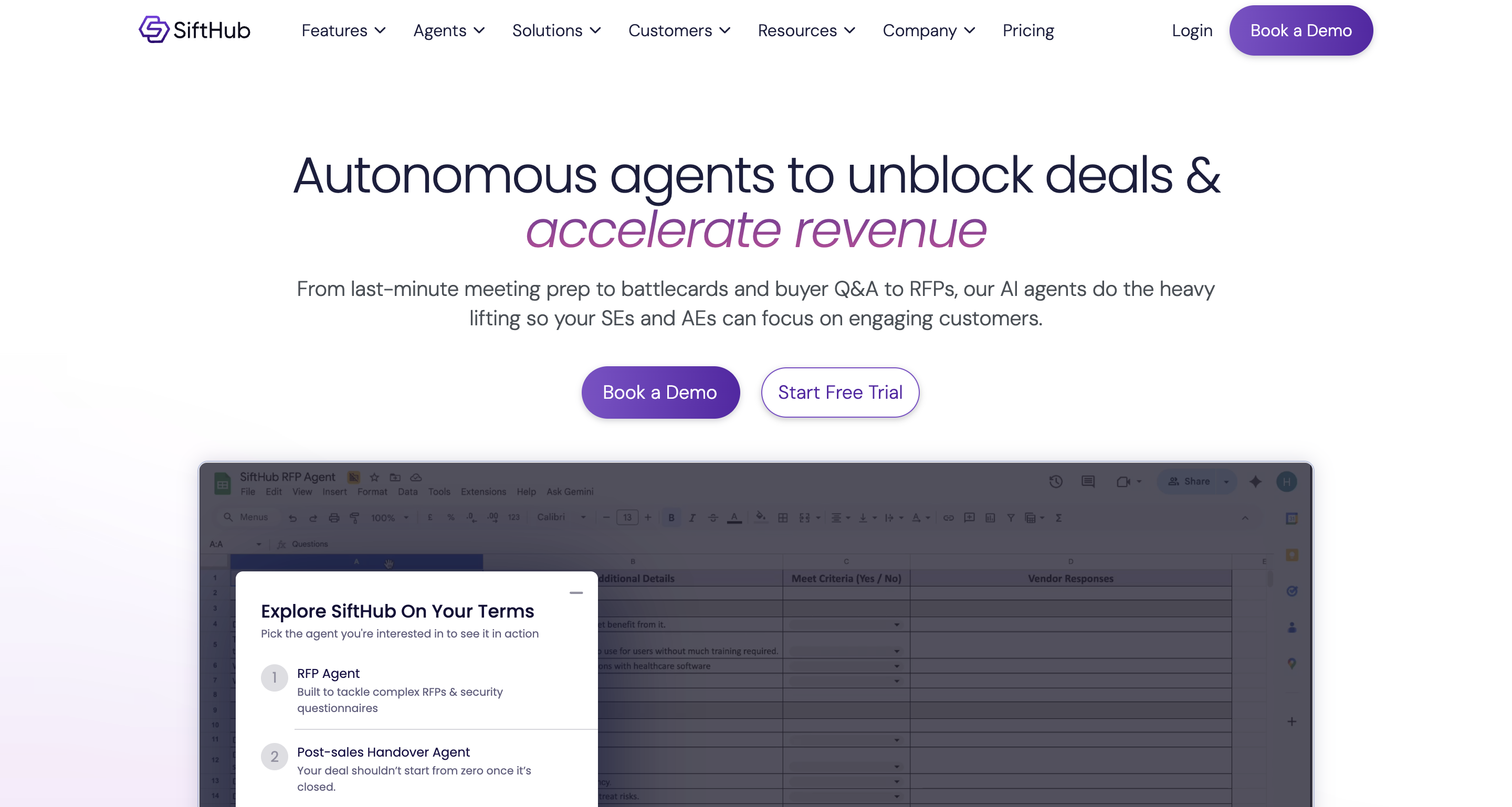
Source: Sifthub
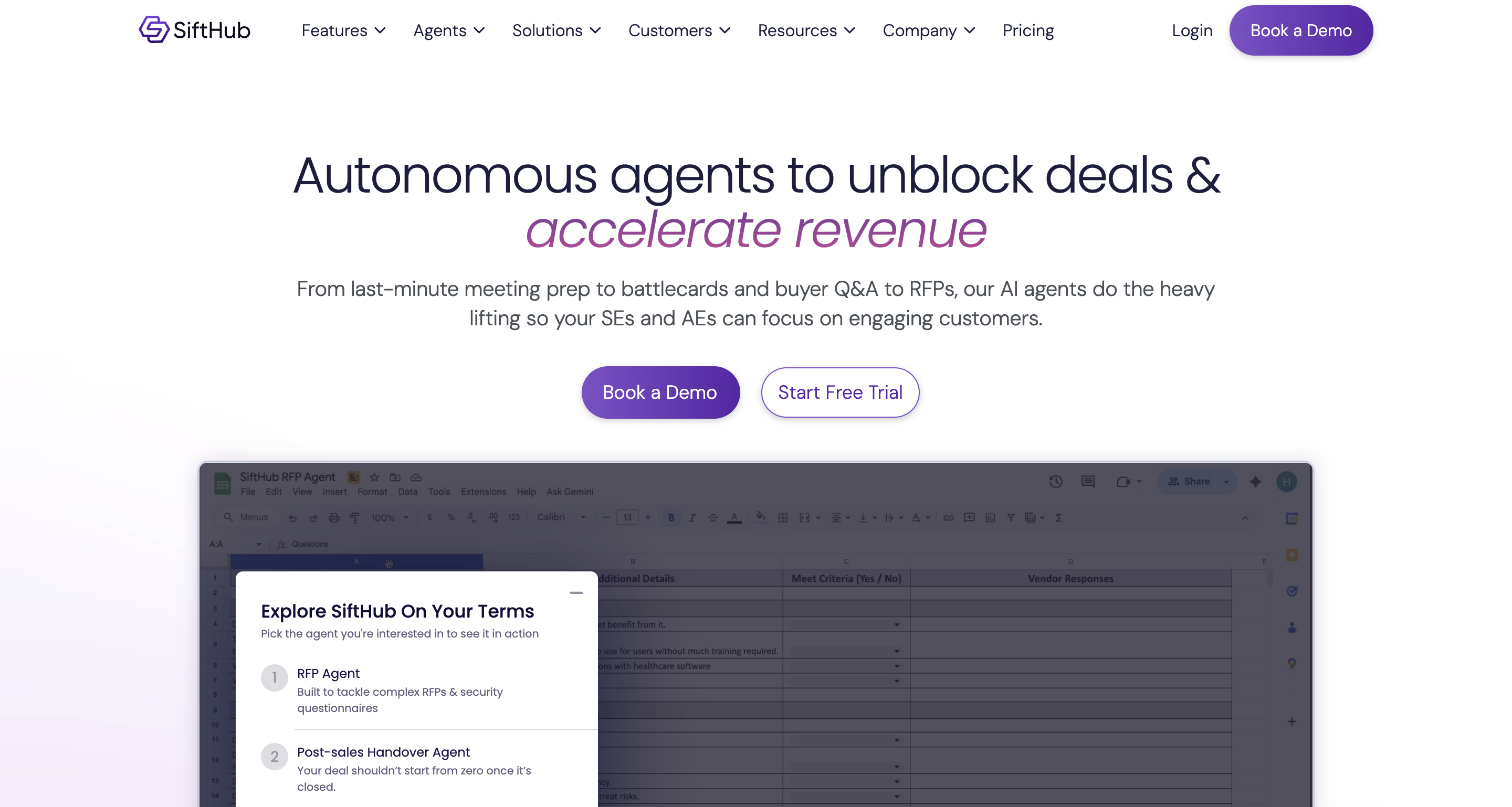
SiftHub takes a distinct architectural approach by pulling live data from connected systems instead of relying on static libraries.
Where SiftHub stands out
- Instant answer retrieval
SiftHub is very strong at pulling answers fast from existing documents, Slack threads, Notion pages, and internal wikis. For “where is this info?” moments, it saves real time. - Low learning curve
Adoption is quick. Users don’t need to understand proposal workflows or complex setups. Ask a question, get an answer. That simplicity is the product. - Works well inside daily tools
Slack and browser-based usage make it feel like a background assistant rather than another platform teams have to remember to log into. - Great for pre-sales velocity
Sales and SEs can respond faster to security questionnaires, ad-hoc buyer questions, and early-stage RFP inputs without digging through folders.
Where to be careful
- Not a full RFP workflow
SiftHub retrieves answers but doesn’t orchestrate end-to-end RFP execution. Ownership, reviews, SLAs, and final packaging still live elsewhere. - Answer authority
Without strict controls, answers can reflect whatever exists in source systems, even if outdated or conflicting. Enterprises should validate trust mechanisms carefully. - Limited buyer-ready outputs
It helps with answers, not final deliverables. Formatting, structuring, and submission readiness remain manual. - Scaling beyond Q&A
As RFP complexity grows, teams may feel the gap between fast answers and governed proposal management.
Best-fit scenario
- Sales and pre-sales teams drowning in internal knowledge sprawl
- Organizations needing fast, conversational access to existing content
- Teams early in formal RFP or proposal tooling adoption
- Buyers optimizing for speed in early deal stages
If your biggest bottleneck is finding the right answer quickly, SiftHub is genuinely effective. Just don’t mistake fast retrieval for full RFP execution, many teams pair it with deeper proposal or workflow tools once stakes rise.
G2 Rating: 4.6/5
Pricing: Custom
6) Qvidian
Source: Qvidian
Qvidian is a long-standing platform often favored in regulated environments and Microsoft-heavy ecosystems.
Where it’s strong
- Enterprise-grade control
Qvidian is built for environments where governance matters more than speed. Versioning, permissions, and controlled content updates are first-class citizens. - Consistency across large orgs
For global teams responding to complex, regulated RFPs, Qvidian helps ensure answers don’t drift across regions, business units, or product lines. - Deep proposal structure
The platform handles long, multi-section proposals well, especially when responses must follow strict templates and compliance rules. - Familiar to legacy proposal teams
Teams coming from traditional proposal management setups often find Qvidian aligns with how they already work, reducing cultural friction.
Trade-offs
- Speed of execution
Qvidian prioritizes control over velocity. Drafting and iteration cycles can feel heavy for fast-moving sales teams. - AI expectations
While AI capabilities exist, they tend to support retrieval and assistance rather than end-to-end drafting acceleration. Expectations should be set accordingly. - User experience
The interface reflects its enterprise heritage. New users may face a steeper learning curve compared to newer, AI-native platforms. - Cost vs flexibility
Qvidian is often priced and packaged for large enterprises. Mid-market teams should validate whether they’ll fully utilize its depth.
Best-fit scenario
- Highly regulated industries with strict compliance needs
- Large enterprises with established proposal operations
- Teams prioritizing accuracy, auditability, and consistency over speed
- Organizations with long sales cycles and formal evaluation processes
If your proposal process demands tight control, predictable governance, and enterprise-grade rigor, Qvidian remains a dependable choice. Just be sure its pace and complexity align with how quickly your sales teams need to move.
G2 Rating: 4.3/5
Pricing: Custom
7) PandaDoc
Source: PandaDoc
PandaDoc is a strong proposal and document platform, but it is not purpose-built for RFP response automation.
Where PandaDoc wins
- Fast proposal creation
PandaDoc excels at getting proposals, quotes, and contracts out the door quickly. Templates, drag-and-drop blocks, and reuse make it easy to move fast. - Strong buyer-facing experience
E-signatures, real-time viewing alerts, and clean presentation help sales teams understand buyer intent and follow up at the right moment. - Sales-friendly workflows
The product is clearly designed for sales teams, not proposal ops. Creating, sending, tracking, and closing documents happens in one flow. - Great for outbound proposals
For pricing-led, sales-driven documents, PandaDoc is often faster and simpler than traditional RFP tools.
Where it’s not a true replacement
- Not RFP-native
PandaDoc wasn’t built for long, complex RFPs. Handling hundreds of questions, SME reviews, and compliance-heavy sections can feel forced. - Knowledge reuse limits
While templates help, long-term answer governance and knowledge accuracy aren’t its core strengths. Answers can drift across deals. - Cross-functional collaboration
Legal and finance workflows work well, but presales and InfoSec-style reviews aren’t deeply orchestrated. - Scaling complexity
As deal size and document complexity grow, teams often need additional tools to manage RFP-specific workflows.
Best-fit scenario
- Sales-led teams focused on outbound proposals and quotes
- Organizations optimizing for speed and buyer engagement
- SMBs and mid-market teams without heavy compliance needs
- Teams prioritizing close velocity over deep RFP governance
If your world is proposals, pricing, and signatures, not multi-week RFP marathons, PandaDoc is extremely effective. Just be clear about where proposal automation ends and true RFP management begins.
G2 Rating: 4.7/5
Pricing: Has a free plan, but the business plan starts from $49.
8) Proposify
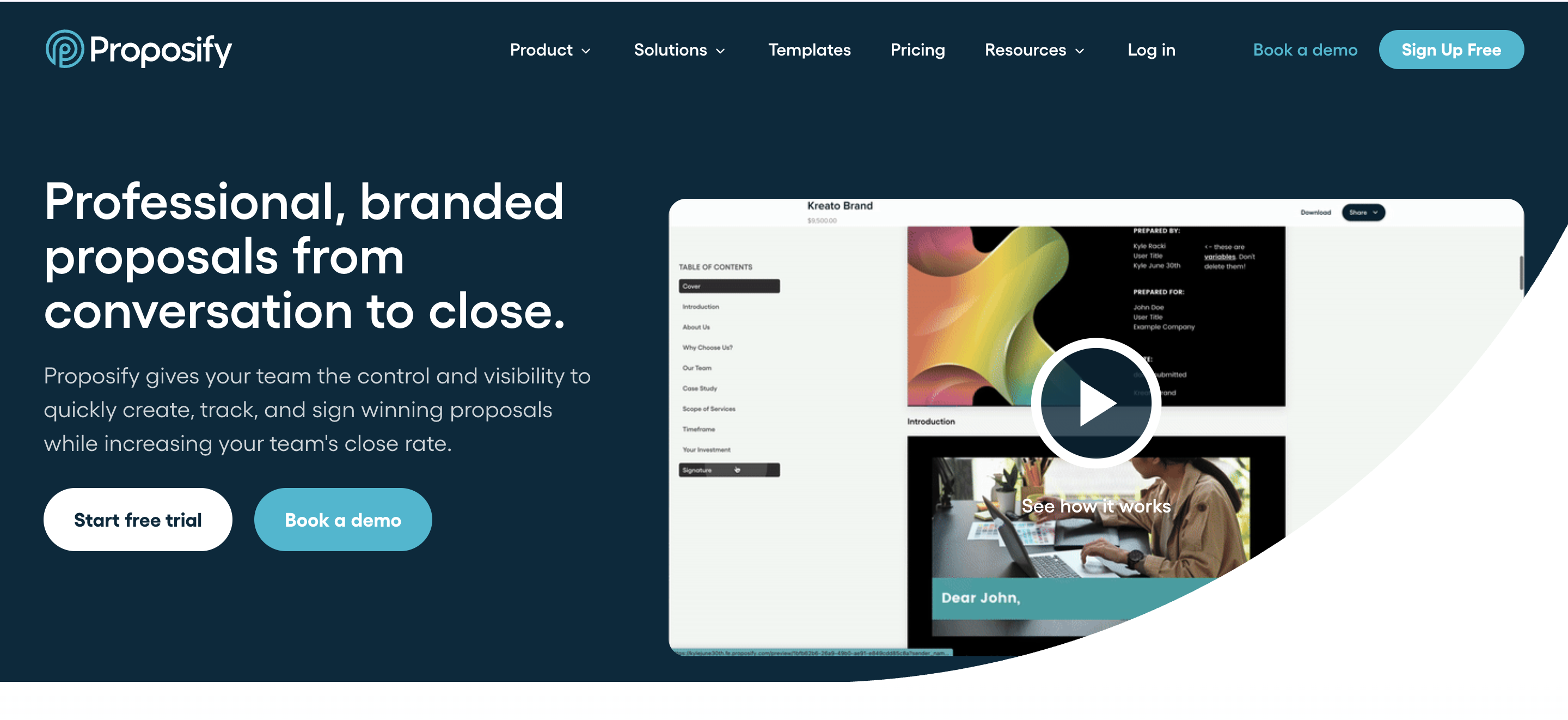
Source: Proposify
Proposify focuses on design quality, brand consistency, and proposal engagement.
Where it’s strong
- Clean, sales-friendly proposal creation
Proposify is built for speed and presentation. Its templates, content blocks, and editor make it easy for sales teams to create polished proposals without design help. - Strong focus on outbound deals
For proposals driven by pricing, scope, and services, Proposify keeps things moving. It works especially well when proposals are part of a high-volume outbound motion. - Clear visibility into buyer behavior
Tracking, notifications, and activity insights help reps know when prospects open, review, or stall, making follow-ups more intentional. - Low barrier to adoption
Teams can get started quickly without deep onboarding or process changes. That simplicity is a real advantage for lean sales orgs.
Reality check
- Not built for RFP complexity
Proposify isn’t designed to handle long, questionnaire-style RFPs with hundreds of structured questions and cross-functional reviews. - Limited knowledge governance
Content reuse exists, but there’s no strong system for enforcing answer accuracy, resolving conflicts, or managing long-term knowledge integrity. - Lack of collaboration depth
Internal collaboration works, but legal, InfoSec, and presales workflows aren’t deeply orchestrated the way enterprise RFP tools require. - Scaling beyond sales proposals
As deals become more compliance-heavy or documentation-intensive, teams often outgrow Proposify and layer in additional tools.
Best-fit scenario
- Sales-led teams creating outbound proposals at volume
- Agencies and services companies selling defined scopes
- SMBs prioritizing speed and presentation over governance
- Teams without formal proposal or RFP operations
If your proposals are about moving fast, looking professional, and closing efficiently, Proposify does that job well. Just don’t expect it to carry the weight of complex, multi-stakeholder RFP processes as stakes rise.
G2 Rating: 4.6/5
Pricing: Starts from $29
9) 1up
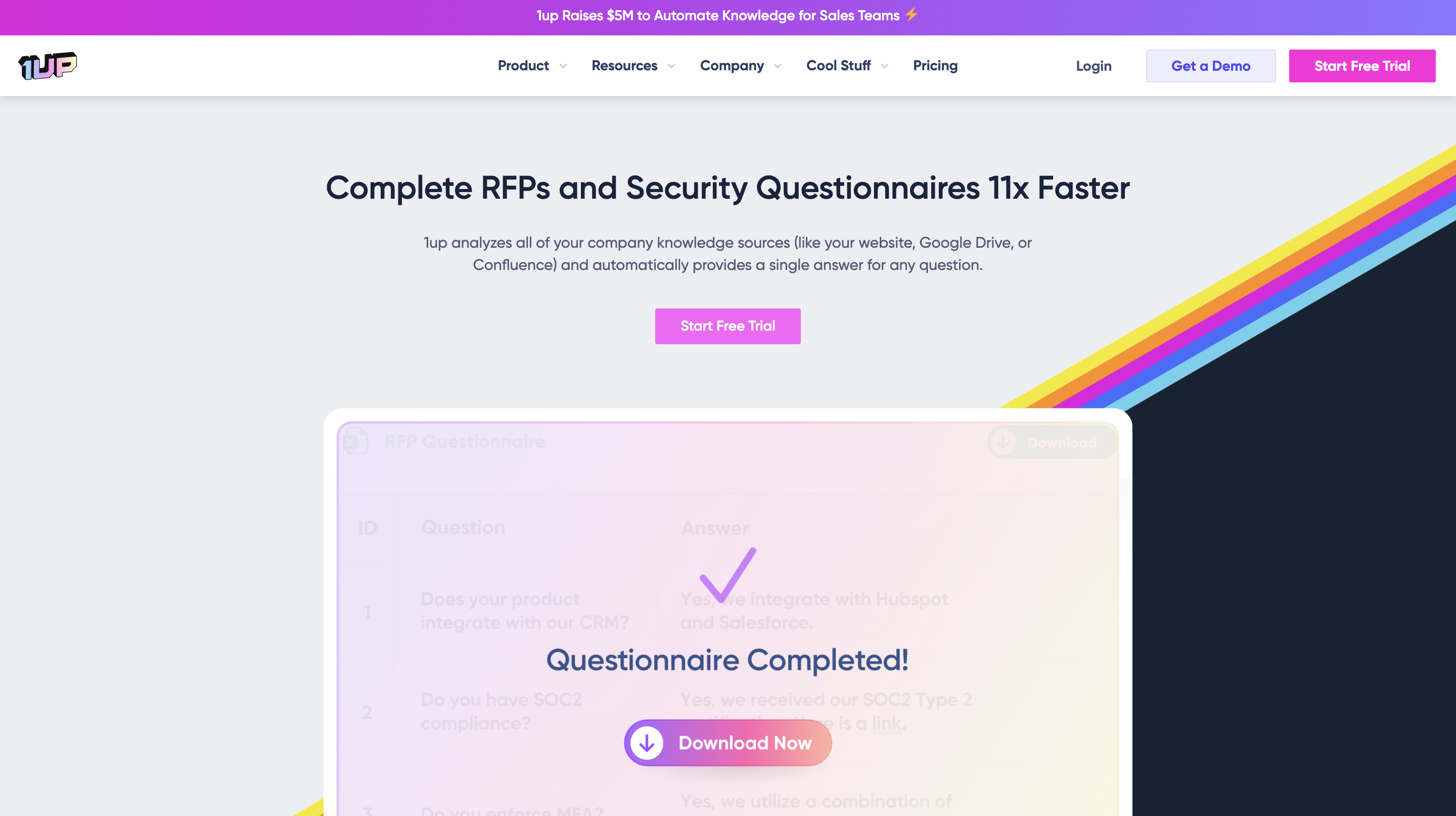
1up is best described as a knowledge automation assistant rather than a full RFP platform.
What it does well
- AI-first answer generation
1up is very focused on using AI to generate responses directly from uploaded documents and prior answers. For repetitive RFP sections, this can save meaningful drafting time. - Quick time to value
Teams can upload content, point the AI at an RFP, and start seeing usable answers fast. There’s less upfront structure required compared to legacy tools. - Good fit for standard questionnaires
Security, compliance, and product capability questions are where 1up tends to perform best, especially when source material is already well-documented. - Appealing for lean teams
Smaller sales or proposal teams often appreciate how little overhead is required to get started.
Where it falls short
- Answer confidence and explainability
AI-generated responses may look solid, but teams should validate traceability back to approved sources, especially for high-risk sections. - Knowledge lifecycle management
Content ingestion is easy, but long-term governance, conflict resolution, and systematic improvement are lighter than in library-centric platforms. - Collaboration depth
Review workflows exist, but legal, InfoSec, and presales coordination may still happen partly outside the platform for complex deals. - Consistency at scale
As RFP volume increases, teams should test whether answers remain consistent across deals or drift subtly over time.
Looking for an alternative RFP tool that checks all your boxes?
Best-fit scenario
- Small to mid-sized teams handling predictable RFPs
- Organizations experimenting with AI-led response generation
- Sales teams without heavy compliance requirements
- Buyers prioritizing speed over deep process control
If your main goal is to reduce manual writing and get decent answers on the page quickly, 1up can be an effective accelerator. Just make sure its governance and review controls align with the risk level of the deals you’re pursuing.
G2 Rating: 4.9/5
Pricing: Has a free plan, but the starter plan starts from $250/month
10) Arphie
Arphie is often grouped with AI-native RFP tools, but it’s best understood as an AI-first drafting engine rather than a full proposal or RFP management platform. It focuses heavily on generating accurate first drafts from connected knowledge sources, with less emphasis on long-running workflows, approvals, or enterprise orchestration.
Where Arphie stands out
- Strong AI-first drafting
Arphie is designed to answer RFP questions quickly using AI trained on your uploaded content. For teams stuck in manual copy-paste cycles, this feels like immediate relief. - Fast onboarding
You can upload documents, past proposals, and FAQs and start generating answers without a heavy setup phase. Time-to-first-draft is one of its strengths. - Good handling of repetitive sections
Company overviews, security responses, and standard capability questions are where Arphie performs best and saves the most time. - Accessible for smaller teams
The product is straightforward and doesn’t assume a mature proposal ops function, which makes adoption easier for lean sales teams.
Where the limitations show
- Answer reliability at scale
AI-generated responses should be reviewed carefully for nuance and accuracy, especially when differentiation or compliance language matters. - Knowledge governance
Long-term management of approved answers, versioning, and conflict resolution is lighter compared to enterprise-grade RFP platforms. - Cross-functional workflows
Collaboration works, but legal, InfoSec, and presales reviews may still need external coordination for complex deals. - Repeatability over time
Teams responding to many RFPs should test whether answers remain consistent across submissions or gradually drift.
Best-fit scenario
- Small to mid-market teams handling frequent but predictable RFPs
- Sales-led organizations prioritizing speed over heavy process
- Teams early in adopting AI for proposal responses
- Buyers looking to reduce manual effort without a long rollout
G2 Rating: 4.9/5
Pricing: Custom
Responsive Alternatives: Quick Comparison
Platform | Core Features | Pricing | G2 Rating | Key Benefits | Key Shortcomings |
|---|---|---|---|---|---|
Responsive | Enterprise RFP workflows, approvals, deep integrations | Custom (not publicly listed) | 4.4/5 | Strong enterprise workflows, compliance-ready, proven at scale | AI feels bolted on, slow onboarding, high verification effort |
SparrowGenie | End-to-end RFP workflows, Knowledge Hub, confidence scores, audit trails | Starts at $9,999 | 4.5/5 | Fast drafts without losing control, strong governance, cross-team coordination | Newer ecosystem vs legacy incumbents |
Loopio | Content library, assignments, approvals, integrations | Starts at $20,000 | 4.6/5 | Proven at scale, strong answer consistency | Slow time-to-value, heavy library upkeep |
Inventive AI | AI drafting, contextual synthesis | Custom | 4.9/5 | Excellent blank-page elimination, fast setup | Governance and repeatability need validation |
AutoRFP.ai | AI Q&A, unlimited users, basic workflows | From $899/month | 4.9/5 | Affordable, low-friction adoption | Limited nuance, weaker controls at scale |
SiftHub | Live answer retrieval from docs & Slack | Custom | 4.6/5 | Instant answers, no library maintenance | Not a full RFP execution platform |
Qvidian | Enterprise controls, MS Office integration | Custom | 4.3/5 | Strong governance and compliance | Slow, complex UX, limited AI acceleration |
PandaDoc | Proposal templates, e-signatures, tracking | From $49/user/month | 4.7/5 | Excellent for outbound sales proposals | Not RFP-native, weak knowledge governance |
Proposify | Design-led proposals, templates | From $29/user/month | 4.6/5 | Fast, polished proposals | Breaks down for complex RFPs |
1up | AI answers from uploaded docs | From $250/month | 4.9/5 | Very fast setup, reduces manual writing | Limited explainability, light governance |
Arphie | AI-first RFP drafting from sources | Custom | 4.9/5 | Rapid drafting, minimal setup | Lighter workflows, weaker orchestration |
A Shortlist Playbook
If your biggest pain is AI answer quality
Start with SparrowGenie. Then pressure-test against Inventive AI and SiftHub. AutoRFP.ai can help for simpler, repeatable sections, but SparrowGenie is better suited when accuracy and nuance actually matter.
If your biggest pain is collaboration and licensing friction
SparrowGenie is designed to bring Sales, Presales, Legal, and InfoSec into one governed workspace without turning access into a tax. AutoRFP.ai works for lightweight teams, but SparrowGenie holds up better as contributors and review depth increase.
If your biggest pain is content rot and upkeep
Look closely at SparrowGenie’s Knowledge Hub and feedback loops first. SiftHub reduces manual upkeep through live retrieval, and Inventive AI helps surface conflicts, but SparrowGenie is built to turn every RFP into a learning cycle, not just a one-off answer.
If your biggest pain is enterprise workflow complexity
Responsive, Loopio, and Qvidian remain strong benchmarks for control. The question to ask is whether you still need all that weight. SparrowGenie is often the better choice when you want enterprise-grade governance without enterprise-grade drag.
Looking for your perfect RFP solution?
Conclusion
The strongest platforms today don’t just generate answers. They reduce coordination drag, prevent content decay, and make review faster, not riskier. Tools like Responsive, Loopio, and Qvidian bring maturity and control. AI-native platforms push speed. SparrowGenie sits at the intersection of both, pairing AI acceleration with human-led governance so teams move faster without losing trust.
If you’re still comparing, shortlist two established leaders and two AI-native or hybrid options, including SparrowGenie, then measure edit time, not just draft time. That metric rarely lies.
If you came here for the top 10 Responsive alternatives, the real win isn’t picking a single tool. It’s building a shortlist you can defend with confidence, one that balances speed, accuracy, and accountability as deal stakes rise.
Ready to see how AI can transform your RFP process?
Product Marketer at SparrowGenie
Being a Product Marketer at SparrowGenie, Aparna helps sales teams work faster with secure, AI-powered proposal automation. She turns complex features into simple stories, builds messaging that resonates, and keeps a close pulse on what customers actually need. She loves shaping clear, helpful content that shows how SparrowGenie makes RFP work easier, faster, and a lot less stressful.