AI Proposal Generation: How Robots Learned to Write Better Sales Docs Than Humans

Article written by
Kate Williams

INSIDE THE ARTICLE
SHARE THIS ARTICLE
Summary
AI proposal tools are augmenting human capabilities in many ways. From parsing complex RFPs to drafting compliant, high-impact responses in minutes, they’re redefining how sales teams win deals. This guide breaks down how AI learned to write better proposals, the types of AI proposal tools that actually work, and how leading teams use platforms like SparrowGenie to scale accuracy, speed, and collaboration. If your team is still juggling drafts and email approvals, you’re not just slow, you’re losing ground. AI isn’t here to replace proposal writers; it’s here to make them unstoppable.
If you’ve ever been trapped in a proposal loop, with versions labeled final_v12, midnight edits, and approval purgatory, you’ve lived the pain. Sales proposals have long been a human headache: high-stakes, repetitive, and full of “can you just tweak this one line” requests.
But the new twist? Robots are learning to write better proposals than humans. Not because they’re smarter but because they’re finally trained on what makes a proposal win. Let's see how.
How Did Sales Proposals Shift From Chaos to Patterns?
Long before AI entered the room, the entire proposal and procurement process was a grind. You’d start with an RFI (Request for Information) just to understand who’s out there. Then came the RFQ (Request for Quotation), to see what it costs. Finally, you’d reach the RFP (Request for Proposal), where the real battle began comparing vendors, evaluating capabilities, and trying to make sense of a dozen PDFs that all looked the same.
Every step generated more data: requirements, pricing tables, compliance checklists, vendor bios, attachments, and clarifications. Multiply that across departments like sales, legal, product, and finance, and suddenly, a single deal was buried under a mountain of disconnected documents.
The real issue wasn’t lack of information; it was the impossibility of connecting it all. Teams had the data but no time to see the patterns hidden inside. Which responses actually helped win the deal? Which phrasing made evaluators score higher? Which compliance clauses were most likely to trigger legal back-and-forth? None of it was visible because it all lived in silos, shared drives, inboxes, and spreadsheets labeled “Final_v12”.
That’s the chaos AI learned to read.
Modern AI proposal generation tools started by doing what humans couldn’t at scale: turning unstructured proposal data into something searchable, analyzable, and reusable. Instead of reinventing the wheel with every new RFP, AI recognized recurring intent. It learned that a cybersecurity clause in one RFP might echo a data privacy requirement in another. It mapped the relationships between pricing logic, technical explanations, and compliance wording, identifying patterns faster than any human review cycle ever could.
In other words, AI transformed procurement from an endless loop of copy-paste into a data-driven feedback system. Each proposal became both an output and a learning opportunity. Every win refined future answers; every loss added context to what didn’t resonate.
The chaos didn’t vanish; it evolved. It became structured, indexed, and ready to serve the next proposal cycle in seconds. That’s not just automation. That’s pattern recognition in action, and it’s how modern AI learned to think like your best proposal writer, only faster.
Stop digging through folders labeled "Final_v12". Let SparrowGenie turn your unstructured proposal data into a data-driven feedback system.
How AI Learned Winning Proposal Language
For years, proposal writing was a mix of craftsmanship and chaos, a small group of SMEs hoarding tribal knowledge, and everyone else scrambling to find the “right” phrasing buried somewhere in a shared folder. The irony? Every company already had a perfect playbook hidden inside years of past RFPs, responses, and win/loss data. It just took an AI to finally read it.
When AI entered proposal management, it didn’t start by writing. It started by listening to the patterns, phrasing, and decision cues buried across thousands of proposals. That listening became learning.
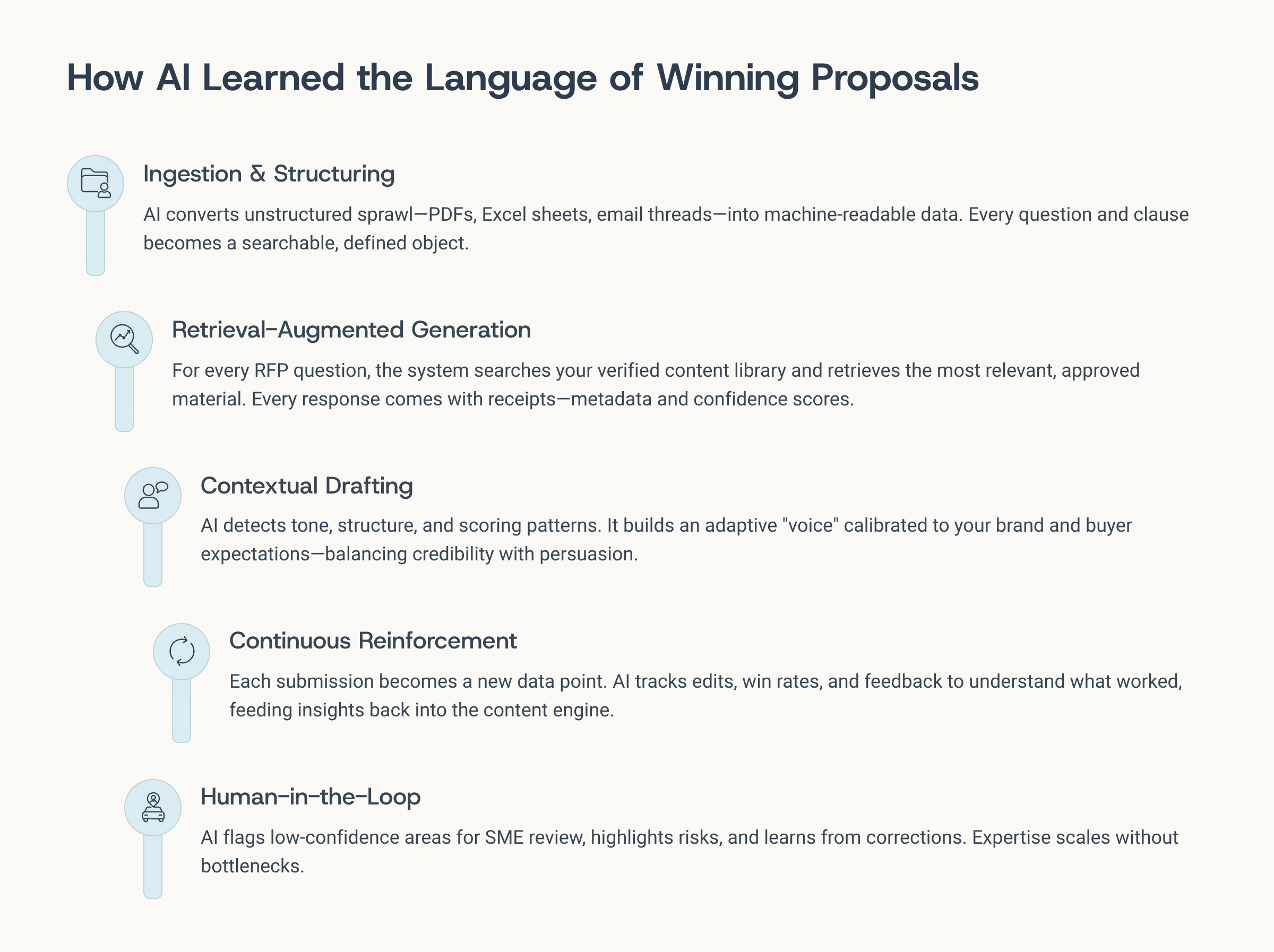
Step 1: Ingestion and Structuring
AI begins by taking the unstructured sprawl of RFP PDFs, Excel pricing sheets, compliance matrices, and email threads, and converting them into structured, machine-readable data. An OCR layer captures text from scans, while a parsing engine keeps context intact (tables, bullets, hierarchy). Every question, clause, and metric becomes a defined object the AI can reason over: requirement, constraint, deliverable, and justification.
The result? What once looked like chaos now becomes a searchable map of every past proposal your team ever touched.
Step 2: Retrieval-Augmented Generation
Instead of relying on generic text prediction, modern proposal AIs use retrieval-augmented generation (RAG). Here’s how it works: for every new RFP question, the system searches your verified content library, product documentation, SLA language, security notes, case studies, compliance answers and retrieves the most relevant, approved material.
The large language model doesn’t invent answers; it grounds them in real, traceable sources. This means every generated response comes with receipts, metadata, citations, and confidence scores that reviewers can verify. It’s proposal writing that’s compliant by design.
Step 3: Contextual Drafting
AI learned that winning proposals don’t just answer questions; they anticipate intent. Through training on historical response data and feedback loops, the system detects tone, structure, and scoring patterns.
- When evaluators reward precision, AI stays concise.
- When they favor clarity over jargon, AI simplifies technical language.
- When storytelling moves the needle, it enriches answers with measurable impact.
Over time, the system builds an adaptive “voice” calibrated to your brand tone and buyer expectations, striking that perfect balance between credibility and persuasion.
Step 4: Continuous Reinforcement
Each submission becomes a new data point. AI tracks reviewer edits, win rates, and compliance feedback to understand what worked and what didn’t. Those insights feed back into the content engine, tightening phrasing, improving alignment, and increasing the confidence of future drafts.
In essence, your proposal process evolves from static templates to a self-improving feedback system. The more you use it, the more precise it gets.
Step 5: Human-in-the-Loop
Despite its speed, AI doesn’t replace human discernment. It flags low-confidence areas for SME review, highlights potential risks, and learns from human corrections. The best proposal platforms don’t automate people out of the process, they make sure expertise scales without bottlenecks.
This hybrid workflow is how AI truly learned the language of winning proposals: by combining the nuance of human intent with the consistency of machine logic.
The end result? Proposals that don’t just read well; they perform well. Every word is backed by data, every claim by evidence, every draft by pattern intelligence.
That’s not AI replacing writers; that’s AI finally giving them the superpower to write, adapt, and win at scale.
Reduce Your Drafting Time by 70% with SparrowGenie
What Changes Before vs. After AI Proposal Generation?
Here is a quick glimpse into the before-and-after AI era in the proposal generation.
Challenge | AI-Powered Solution | Outcome |
|---|---|---|
Blank page & duplication | Auto-drafts from verified blocks | Drafts in minutes |
Version chaos | Centralized workspace with audit logs | Clean history, fewer errors |
Stale content | Owners, expiries, and confidence checks | Always current |
Missed requirements | AI parsing & gap detection | Fewer compliance misses |
Pricing errors | CRM/CPQ integration | Faster, accurate quotes |
SME overload | Exception-only routing | Less burnout, quicker turnarounds |
What Does AI Proposal Generation Actually Do?
Most people think AI proposal generation just “writes faster.” But under the hood, it’s doing something far more sophisticated, it’s rebuilding the entire proposal process from intake to submission, automating what used to be dozens of disconnected workflows into one intelligent, traceable system of action.
Here’s what that actually means.
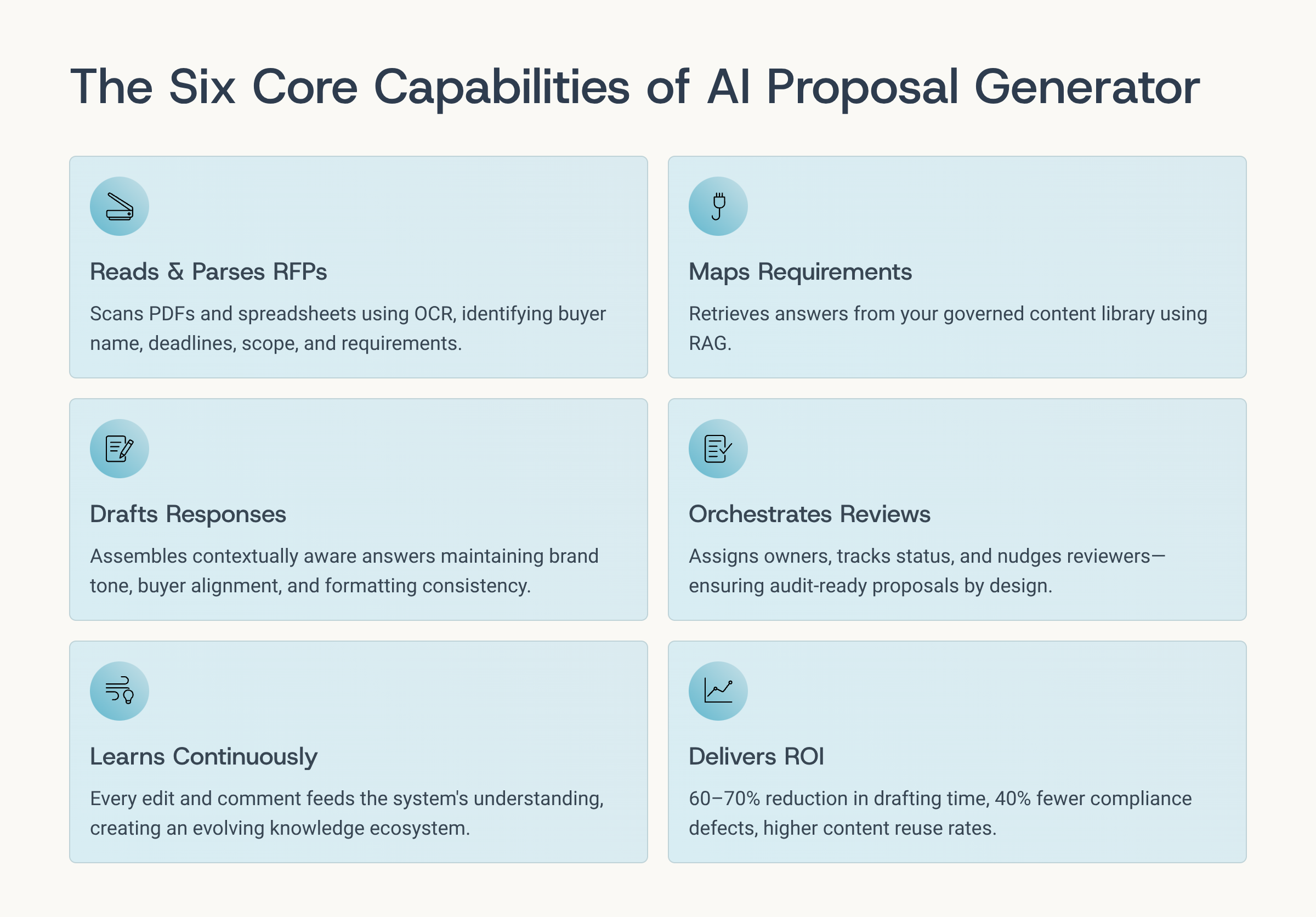
1. Reads, Parses, and Understands RFPs
AI starts where every human groans at the RFP document itself. It scans PDFs, spreadsheets, and portal exports using OCR and layout analysis, preserving structure (tables, bullet points, and sections). Then, through named-entity recognition (NER), it identifies key elements: buyer name, deadlines, scope, requirements, pricing tables, and legal clauses.
Instead of dumping text, the system labels intent, turning every line into a data point: Requirement → Constraint → Deliverable → Question. It’s like giving your proposal team X-ray vision; they see what matters immediately.
2. Maps Requirements to Verified Knowledge
Once the RFP is structured, AI retrieves the best possible answers using Retrieval-Augmented Generation (RAG). It searches your governed content library for product documentation, security statements, past proposals, SLAs, and case studies and ranks each snippet by relevance, freshness, and compliance level.
No hallucinations. No guessing. Every draft is grounded in your organization’s approved knowledge base, complete with metadata and citations that reviewers can verify.
3. Drafts Responses That Mirror Human Clarity
Then comes composition. The LLM assembles answers that are not only correct but also contextually aware, maintaining brand tone, buyer persona alignment, and formatting consistency. It can summarize long technical details for executives or expand a single line into a persuasive paragraph for evaluators.
AI doesn’t just fill blanks; it crafts answers with intent, persuasive where it should be, and procedural where it must be.
4. Orchestrates Reviews, Compliance, and Collaboration
Every draft enters a governed workflow: SMEs validate low-confidence sections, legal checks compliance, and sales leadership approves tone and positioning. AI assigns owners, tracks status, and even nudges reviewers before deadlines. This orchestration layer is where hours of manual coordination simply vanish.
By automating these checkpoints, AI ensures your proposals are audit-ready by design, traceable, consistent, and compliant across every submission.
5. Learns and Improves With Every Submission
The real magic isn’t in writing; it’s in learning. Each response, edit, and reviewer comment feeds the system’s understanding of what “good” looks like. Over time, the AI identifies which phrasing improves scores, which sections slow review cycles, and which narratives help win deals.
This feedback loop turns your proposal library into a living, evolving knowledge ecosystem getting sharper, faster, and more aligned with every RFP.
6. Delivers a Predictable, Measurable ROI
Here’s what teams see after implementing AI proposal generation:
- 60–70% reduction in drafting and review time.
- 40% fewer compliance defects.
- Higher reuse rates of approved content across deals.
- Faster submissions and stronger evaluator scores.
That’s not an improvement in writing; that’s a transformation in operational efficiency.
AI proposal generation doesn’t just automate documents; it automates decision-making, turning knowledge, governance, and creativity into one seamless system that finally scales.
Why AI Wins and Humans Still Matter
When AI began writing proposals, skeptics rolled their eyes. “You can’t automate persuasion,” they said—and they were right, at least partly. The secret to AI’s success in proposal generation isn’t that it replaced humans; it’s that it augmented them.
What used to take teams days hunting for approved phrasing, formatting documents, and aligning tone now happens in minutes. But the reason AI wins isn’t just speed. It’s what that speed unlocks.
AI Wins Because It Removes Friction
We all know that proposal management used to be death by a thousand small tasks. Formatting tables. Rewriting the same compliance clause for the tenth time. Searching through old RFPs to find that one “perfect” answer from last year’s bid.
AI eliminates this drag layer by layer.
- It pulls the right answers from verified sources.
- It formats responses automatically.
- It tracks version histories and reviewer feedback.
- It keeps the entire process compliant and auditable.
By removing repetitive, low-value work, AI frees teams to focus on what they’re actually paid to do: strategize, differentiate, and win.
AI Wins Because It Scales Human Precision
Humans are brilliant at nuance but terrible at repetition. Machines are the opposite. AI proposal generators bridge that gap scaling your best writing, logic, and positioning across hundreds of deals without losing consistency.
Think of it this way: every time your SME perfects an answer, the AI captures it, tags it, and makes it instantly reusable. That’s institutional knowledge on autopilot, no more “who wrote that last time?” or “where’s the latest version?” chaos.
AI doesn’t just copy humans; it institutionalizes excellence.
Humans Matter Because They Shape the Message
Winning a proposal isn’t about answering the question; it’s about answering it persuasively. That’s where humans come in. AI can find the facts, but only people can find the story.
Humans still:
- Read the buyer’s tone and adapt messaging accordingly.
- Add emotional context like empathy, urgency, and credibility.
- Make judgment calls when requirements conflict or interpretations differ.
- Decide the deal strategy: what to emphasize, what to leave out, and what to negotiate.
The best teams use AI as their co-author, not their replacement. It handles the scaffolding so humans can focus on the strategy that wins hearts and contracts.
Humans Matter Because Trust Still Needs a Name
In high-stakes enterprise sales, buyers don’t just evaluate proposals they evaluate people. A technically flawless AI-generated proposal still needs a human signature, a sense of ownership, and a voice that says, “We understand your world.”
That trust cannot be automated. AI can write with authority, but it takes a human to write with accountability.
The Hybrid Future: AI as the Muscle, Humans as the Mind
The winning model isn’t man or machine; it’s both. AI proposal platforms now act as the system of action, powering through the heavy lifting, while humans act as the system of intent, steering direction, tone, and ethics.
Every proposal becomes a co-created artifact: human-led, AI-built, and data-backed. That’s why teams that adopt AI proposal generation aren’t just faster; they’re more aligned, more confident, and far more scalable than their manual counterparts.
AI wins because it finally lets humans do what they do best: think, persuade, and connect. And humans still matter because, in the end, every great proposal is more than a document; it’s a promise between people.
Empower Your Sales Team with a SparrowGenie Co-Author
The Updated AI Proposal Playbook
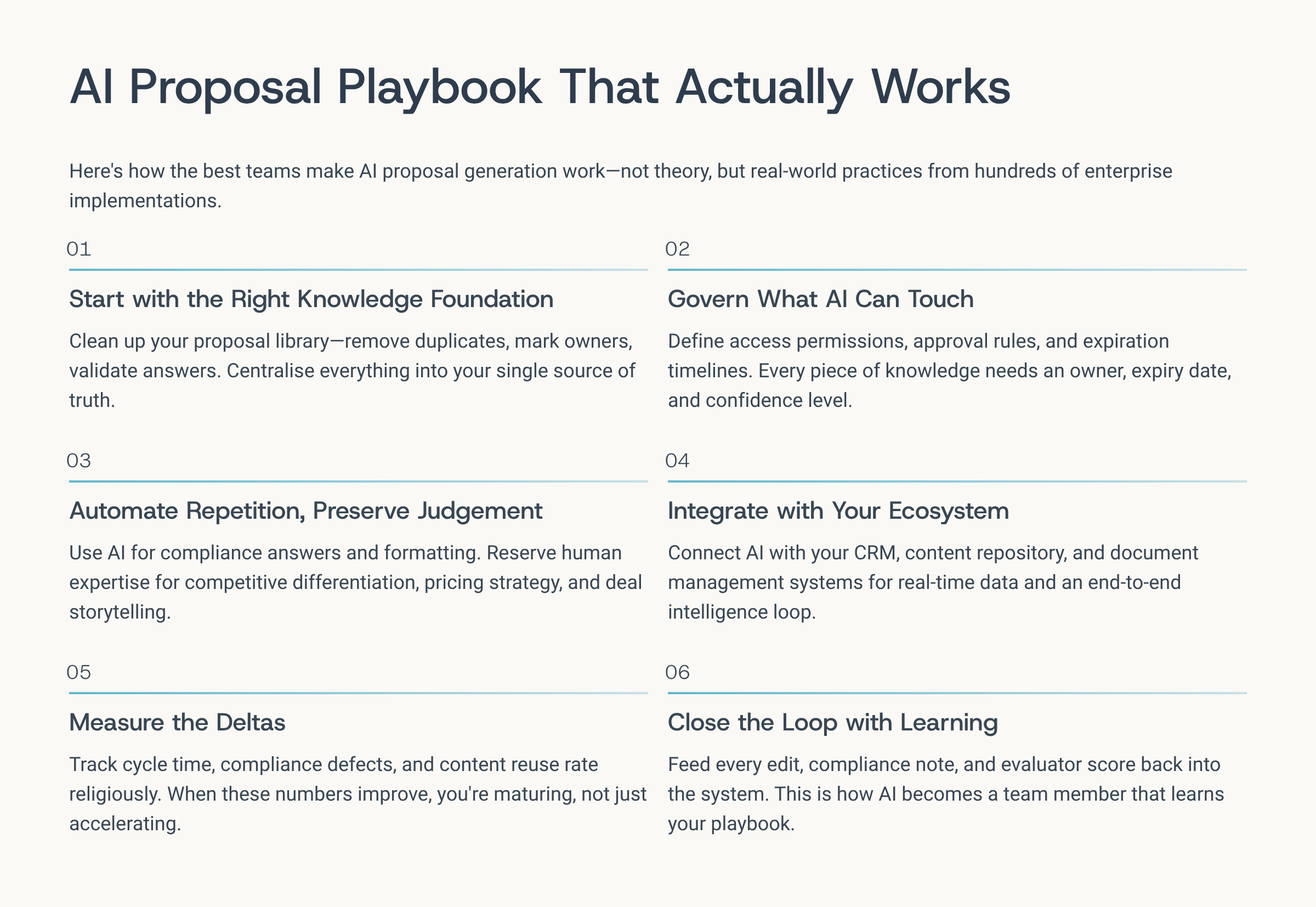
You’ve seen what AI proposal generation can do. Now, here’s how the best teams actually make it work. Not theory. Not vendor hype. A real-world playbook drawn from hundreds of enterprise implementations where AI isn’t a shiny add-on but the engine behind every winning response.
1. Start with the Right Knowledge Foundation
AI is only as smart as the content it’s trained on. The first step is cleaning up your internal proposal library, removing duplicates, marking owners, and validating answers. Centralize everything: product sheets, SLAs, case studies, security notes, and compliance clauses.
Once curated, this becomes your single source of truth, the bedrock that keeps every AI-generated answer accurate, compliant, and on-brand.
2. Govern What the AI Can and Can’t Touch
Before automation comes control. Define access permissions, approval rules, and expiration timelines. Every piece of knowledge should have an owner, an expiry date, and a confidence level.
Governance isn’t bureaucracy; it’s insurance. It ensures every proposal leaving your desk is defensible, verifiable, and audit-ready, even at enterprise scale.
3. Automate Repetition, Preserve Judgment
Use AI where consistency matters and human time doesn’t:
- Repetitive compliance answers.
- Standard company intros or credentials.
- Formatting and document styling.
Then reserve human expertise for where nuance drives value:
- Competitive differentiation.
- Pricing strategy.
- Deal storytelling.
Automation scales precision; humans scale persuasion.
4. Integrate AI into Your Sales and Legal Ecosystem
Your AI proposal engine shouldn’t live in isolation. Connect it with your CRM, content repository, and document management systems so it pulls real-time data including pricing, product updates, contracts, and win/loss signals.
This creates an end-to-end intelligence loop: each new proposal draws from the latest truth, and every submission feeds back insights that refine the next one.
5. Measure the Deltas and Keep Iterating
Track three metrics religiously:
- Cycle time: How long it takes from RFP intake to submission.
- Compliance defects: How many errors reviewers find.
- Content reuse rate: How often approved blocks get repurposed.
When these numbers move in your favor, you’re not just faster — you’re maturing. That’s how AI proposal automation compounds its ROI over quarters, not just weeks.
6. Close the Loop with Continuous Learning
Every edit your SME makes, every compliance note from legal, every evaluator score — all of it teaches the AI what “good” looks like. Feed that data back into the system. This is how your AI becomes not just a tool, but a team member that learns your voice, your buyers, and your playbook.
That’s the real secret: AI proposal success isn’t about the tool — it’s about the system you build around it. Governed data. Grounded automation. Guided human expertise.
That’s what separates teams who “experiment with AI” from those who win with it.
Create Winning Proposals with AI-Powered Tools
AI-powered proposal generation tools like SparrowGenie transform how teams handle proposals, from chaotic document juggling to a streamlined system of action. It reads complex RFPs, extracts key requirements, and builds accurate, compliant drafts using verified content from your governed knowledge base. Every response comes with confidence scoring and traceability, so reviewers focus only where it matters.
Beyond automation, tools like SparrowGenie unite sales, pre-sales, and legal around one secure source of truth. Real-time collaboration, version control, and audit trails replace endless email loops. The platform learns from every submission, measuring speed, accuracy, and reuse rates to continuously improve performance. The result? Proposals that are faster to produce, easier to trust, and smarter with every deal cycle.
Build a proposal engine that actually learns. SparrowGenie identifies which phrasing improves scores to make your team sharper with every deal cycle.
Why Leading Sales Teams Choose SparrowGenie For Proposal Generation
While the shift toward AI is inevitable, not all tools are built for the high-stakes environment of enterprise sales. SparrowGenie is more than just a writing assistant; it is a secure, human-led AI workspace designed to turn your proposal process into a competitive advantage.
1. Speed Without the "Bot" Feel
SparrowGenie completes complex RFPs and security questionnaires 60–80% faster by intelligently mapping your previous winning answers to new requirements. It handles the heavy lifting of document "shredding" and drafting, so your team can focus on the 20% of the message that actually closes the deal—the strategy and the relationship.
2. Accuracy You Can Defend
Generic AI "hallucinates"; SparrowGenie grounds its output. Every response generated is pulled from your governed content library and assigned a confidence score. This ensures that your technical specs, pricing, and legal clauses remain 100% accurate, with full traceability back to the original source.
3. Enterprise-Grade Security & Governance
In sales, your data is your moat. SparrowGenie is built with a "Security-First" architecture, featuring SOC 2 Type II compliance and private AI processing. You retain full control over who sees what, with role-based access and automated approval workflows that keep your legal and IT teams happy.
4. Built for Collaboration (Not Just Storage)
Stop the "email tennis." SparrowGenie centralizes sales, pre-sales, and legal teams in one workspace. Assign questions, track real-time progress, and manage reviews without ever leaving the platform. It turns a chaotic 10-day scramble into a sane, 2-day predictable workflow.
SparrowGenie doesn't replace your proposal writers, it makes them unstoppable.
Ready to see it in action? Book a 15-minute demo today.
Before Vs. After SparrowGenie's AI Proposal Generation
The "Before vs. After" shift isn't just about speed; it's a total structural transformation of how your team handles revenue-critical documents.
Feature/Challenge | The Manual Era (Before AI) | The SparrowGenie Era (After AI) |
Drafting Speed | "Blank page" syndrome; hunting through old folders for snippets. | 60-80% of drafts generated instantly using verified knowledge. |
Cycle Times | Average of 10 days from intake to submission. | Response cycles cut down to 2 days. |
Accuracy | Prone to "hallucinations" or copy-pasting outdated specs. | Every answer is grounded in a verified source with a confidence score. |
Version Control | The "Final_v12.doc" loop in email chains. | A single, secure, enterprise-grade hub with full audit trails. |
Deal Capacity | Limited by headcount; scaling requires hiring more writers. | 3X deal capacity without adding more people. |
SME Involvement | Subject Matter Experts are constantly pestered for the same info. | SMEs only handle high-value exceptions and strategy. |
Work Culture | Heroic all-nighters and last-minute panic. | Sane, predictable workflows that protect your team's time. |
Don’t let your sales process get stuck. Automate the repetition so your humans can focus on the persuasion.
Conclusion
If proposals could talk, they’d probably say, “Finally, someone automated the chaos.” Because that’s exactly what’s happening: the days of chasing versions, rewriting the same boilerplate, and begging SMEs for responses are fading fast. AI isn’t replacing proposal pros; it’s upgrading them.
The next winning proposal your team sends out might not just be written by hand — it’ll be guided by data, governed by logic, and finished by AI that already knows what “good” looks like. So here’s your cue: pick your next RFP, plug it into an AI-powered proposal tool like SparrowGenie, and watch what happens when speed meets accuracy.
You’ll still bring the story, the judgment, and the human touch. Let SparrowGenie handle the rest—securely, intelligently, and at scale.
Ready to see how AI can transform your RFP process?
Product Marketing Manager at SurveySparrow
A writer by heart, and a marketer by trade with a passion to excel! I strive by the motto "Something New, Everyday"