Why E-Signatures Are Critical for Sales in 2026

Article written by
Kate Williams

INSIDE THE ARTICLE
SHARE THIS ARTICLE
Summary
In 2026, asking for a printed signature is a sales killer. This post unpacks why e-signatures are no longer optional—from accelerating deal velocity to improving customer experience. You'll see how modern platforms with CRM integration, automation, and analytics aren’t just convenient—they’re essential for scaling. Includes a real-world rollout plan and business case math.
If your “closed-won” still hinges on someone printing, signing, scanning, and emailing a PDF, you’re leaking revenue at the very last mile. In 2026, buyers expect tap-to-sign on any device, instant counter-signatures, and a verifiable audit trail that Legal won’t side-eye. This isn’t a point feature. It’s the control plane of revenue.
In this blog we’ll start with a quick, executive view of why now, then deepen into what enterprise-grade e-signature actually entails, how it transforms buyer experience, the security & compliance bar, workflow impact, an evaluation checklist, and more—before shortlisting the best e-signature platforms for proposals and closing with common pitfalls to avoid.
Why E-Signature Matters Now
Sales cycles have more stakeholders, tighter InfoSec scrutiny, and mobile-first buyers. Every extra step is friction. Electronic signature software removes the last bottleneck between intent and revenue—turning “I’m in” into booked.*
Here are a few reasons in detail:
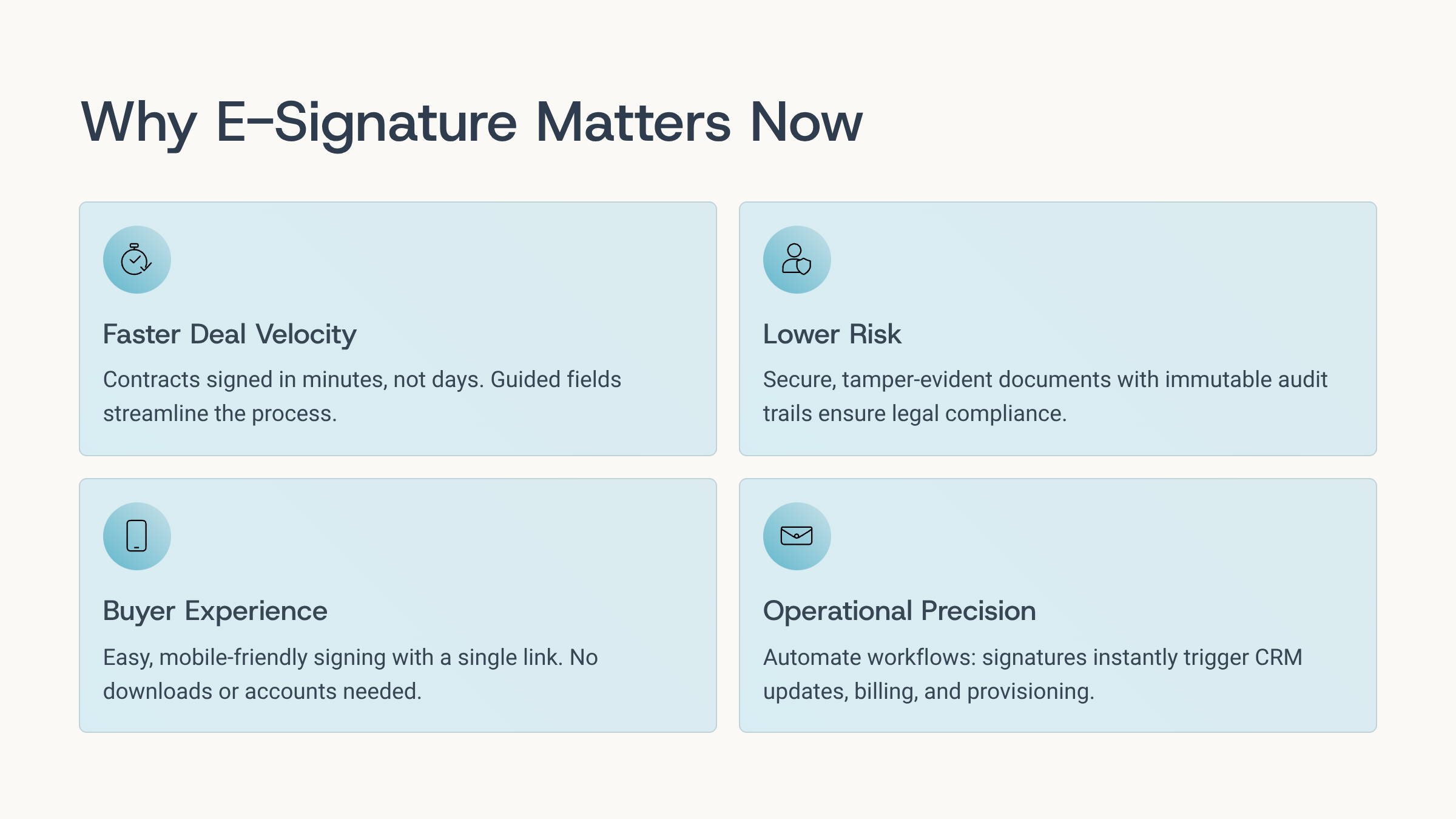
- Faster deal velocity: Contracts go from minutes-to-open to minutes-to-sign. Guided fields + signing order collapse back-and-forth.
- Lower risk: Tamper-evident seals, immutable audit trails, delegated authority capture, and retention policies make Legal breathe easy.
- Buyer experience: A single, accessible link that works on mobile—no plugins, no accounts, no confusion.
- Operational precision: Signatures trigger CRM stage changes, provisioning, billing, and commissions—zero swivel-chair.
- Forecast confidence: When signature → booking is automated, commit accuracy improves.
We’ve said “e-signature” a lot—so let’s clarify what a sales-grade e-signature actually includes beyond the act of signing.
What “E-Signature” Really Means in a Sales Context
Calling it “just a signature” undersells the stack. Enterprise revenue teams need identity, integrity, evidence, and orchestration. The significance of e-signatures mainly includes:
- Identity & intent verification: Email/SMS codes, SSO, signer roles, delegated authority, and 2FA where risk demands it.
- Document integrity: Hashing, tamper seals, post-sign locking, and certificate chains.
- Evidence model: IP addresses, timestamps, signer journey, approvals, and version lineage—attached to the artifact and queryable by API.
- Governed content: Template and clause libraries with expiries, region tags, and redline rules to enforce consistency.
- System orchestration: Native CRM/CPQ/billing integrations and webhooks so “countersign” equals “go live.”
Now that we know what it is, let’s shift to buyer experience—the difference between a smooth tap-to-sign and a drop-off.
The 2026 Buyer Lens
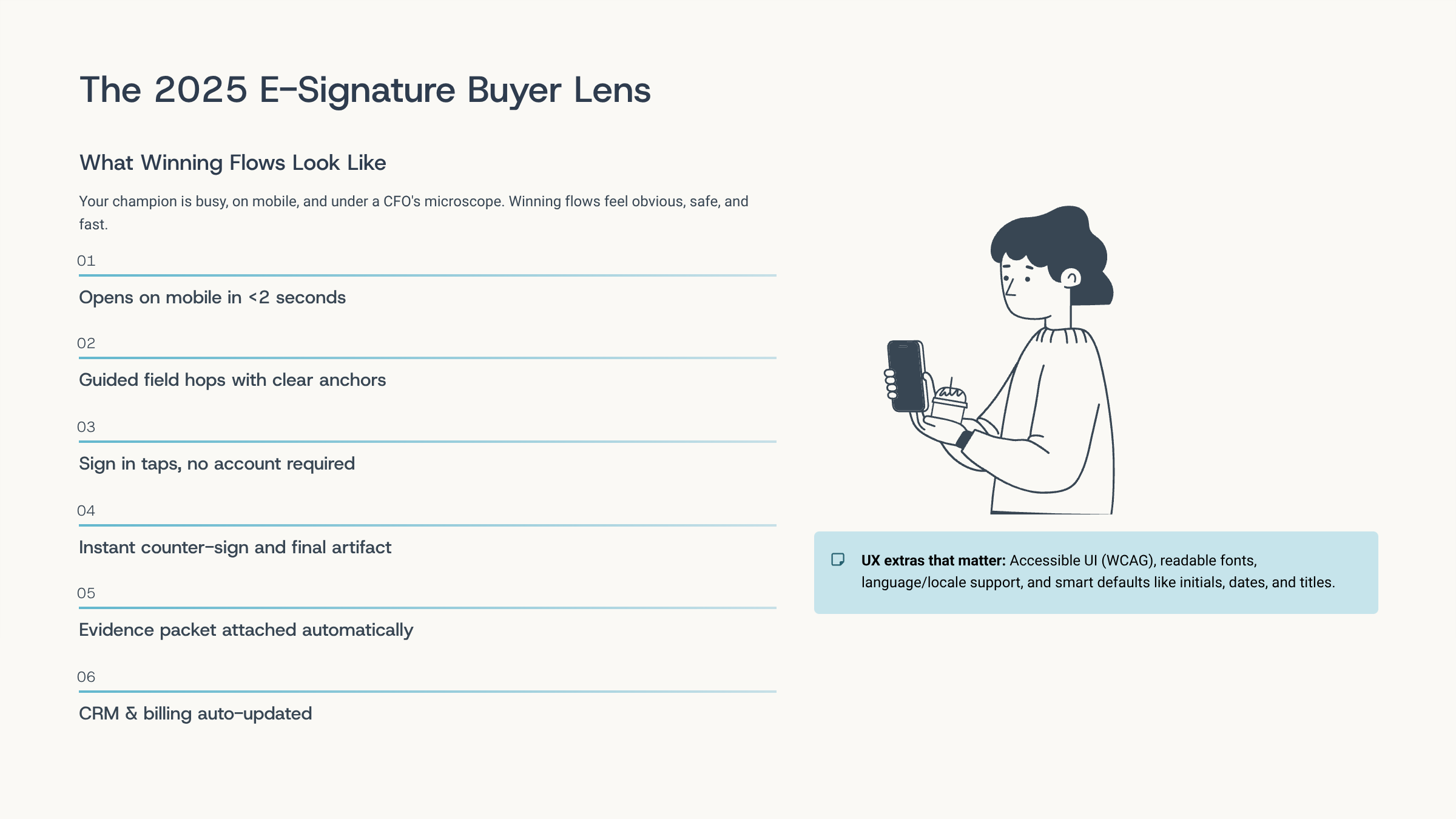
Your champion is busy, on mobile, and under a CFO’s microscope. Winning flows feel obvious, safe, and fast.
But here are a few features to look for in an e-signature UX that converts:
- Opens on mobile in <2 seconds
- Guided field hops (no hunting, clear anchors)
- Sign in taps, no account required
- Instant counter-sign and final artifact sent automatically
- Evidence packet attached for audit and procurement portals
- CRM & billing auto-updated, welcome email triggered
UX extras that matter: Accessible UI (WCAG), readable fonts, language/locale support, and smart defaults (initials, dates, titles).
Buyer trust is built on security. Let’s define the security & compliance bar that CIOs, CISOs, and counsel expect in 2026.
E-Signature Security & Compliance for Enterprises
If Legal has to chase logs, you’ll re-negotiate closing dates. Compliance must be provable, predictable, and retrievable.
- Standards & regimes: ESIGN & UETA (US), eIDAS (EU); attestations like SOC 2 Type II, ISO 27001; data residency where needed.
- Access controls: Role-based permissions, SSO/SCIM, least-privilege admin, and approval workflows.
- Key management: KMS options and (where offered) bring-your-own-key.
- Evidence retention: Retention windows, legal holds, revocation/expiration policies, and immutable audit trails.
- Change governance: Template versioning, clause expiries, and approval logs to prove who changed what, when, and why.
With trust in place, the question is: where does e-signature compress the cycle? Answer: every stage.
How E-Signatures Speed the Sales Cycle
Think beyond the sign event. The compounding gains start at intake and run through post-signature handoffs.
- Intake → Draft: Pre-approved proposal templates and clause libraries reduce assembly time, prevent version drift, and keep branding tight.
- Review → Approval: Conditional routing (e.g., discount > X% → Legal) moves from tribal knowledge to governed rules.
- Signature: Ordered signers + guided fields end “Who signs first?” threads.
- Post-signature: Automatic CRM stage change, entitlement creation, invoice kick-off, and renewal workflow creation.
To buy well, you need a testable, no-fluff checklist. Let’s arm your vendor evaluation.
E-Signature Evaluation Checklist
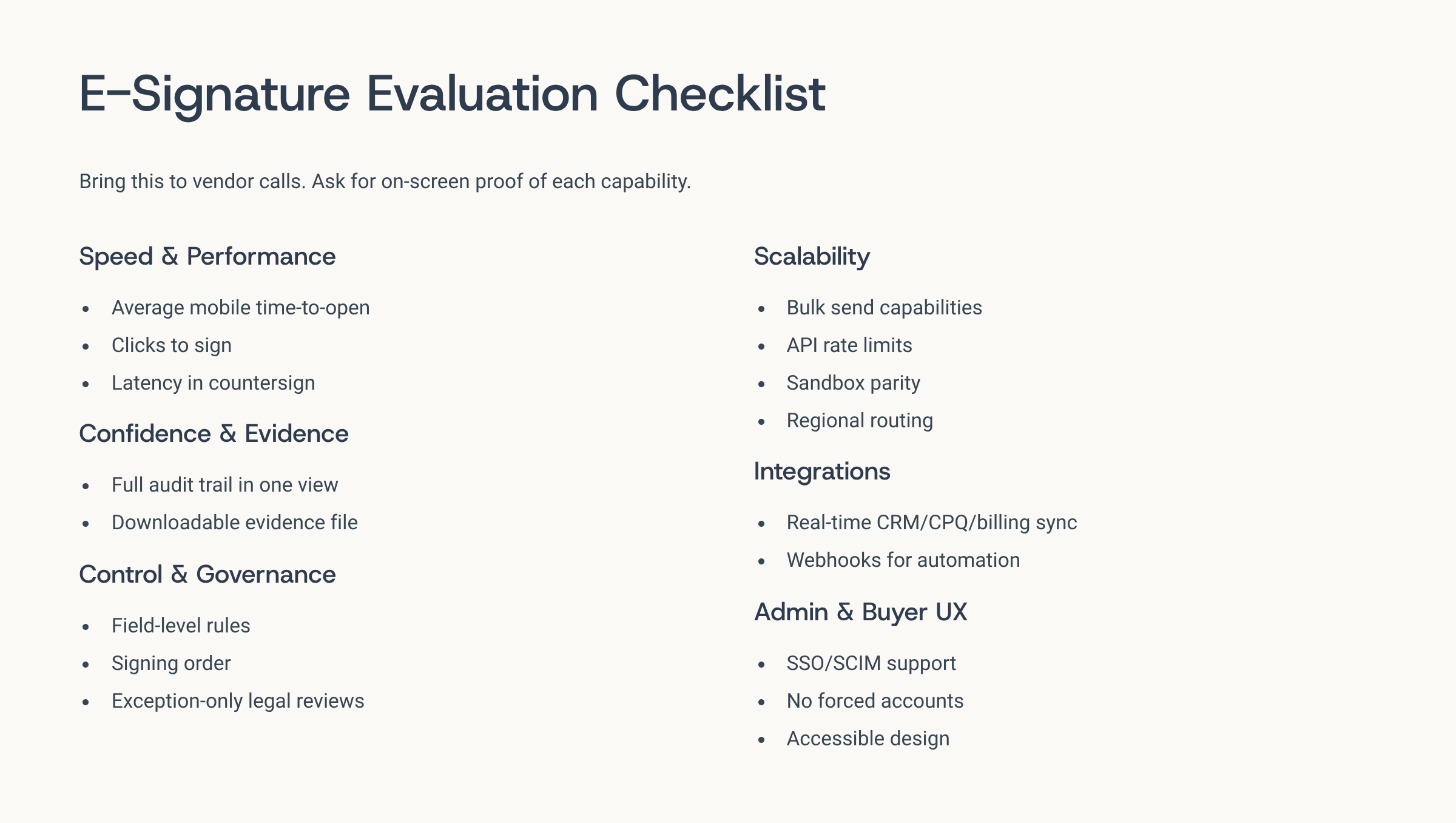
Bring this to vendor calls. Ask for on-screen proof.
Here are a few must-haves while choosing e-signature tools:
- Speed: Avg mobile time-to-open, clicks to sign; latency in countersign.
- Confidence: Full audit trail in one view; downloadable evidence file.
- Control: Field-level rules, signing order, exception-only legal reviews.
- Scalability: Bulk send, API rate limits, sandbox parity, regional routing.
- Governance: Template versioning, clause expiries, approval logs.
- Integrations: Real-time CRM/CPQ/billing sync; webhooks for everything else.
- Admin UX: SSO/SCIM, delegated admins, content governance, org units.
- Buyer UX: No forced accounts; accessible design; offline fallback.
Passed the sniff test? Great. Here’s a RevOps-friendly rollout that lands value in weeks—not quarters.
Implementation Playbook (RevOps-Friendly and Practical)
Aim for two fast wins and one structural improvement in 30–60 days.
Here are 7 steps:
- Define the golden path: Select 3–5 contract types (NDA, MSA, Order Form, SOW).
- Template & clause governance: Lock headers/footers; tag clauses by region/segment; set expiry dates.
- Field logic & routing: If discount > X% → Legal; if deal > $Y → Finance; if new logo → InfoSec.
- Identity policies: Tiered verification (SMS/2FA/ID) based on risk.
- System updates: Signature → CRM stage, product provisioning, billing, commissions.
- Evidence retention: Define retention, legal holds, and retrieval APIs.
- Enable & measure: Train AEs/SEs; track KPIs weekly; fix defects; publish wins.
E-Signature Buyer Journey: What Works—and What to Watch For
Consistent, professional proposal e-signature flows reinforce trust—like standardized email signatures do across touchpoints.
- Consistency: Templates, fonts, and messaging feel like one company.
- Clarity: Clear CTAs, signer guidance, and confirmation states reduce anxiety.
- Follow-through: Final artifact and evidence sent instantly; renewal prompts logged; onboarding kicks off.
Volume is not the answer—quality touchpoints are. Let’s itemize how signatures fit into a multi-touch journey.
Touchpoints Still Matter (But Make Them Count)
Modern deals require multiple impressions. E-signature should consolidate confidence, not add noise.
- Pre-sign: Proposal preview + short Loom or FAQ cheat sheet.
- Sign moment: Frictionless, accessible, mobile-optimized flow.
- Post-sign: Automatic receipt, onboarding, kickoff scheduling, and renewal seed.
A few pitfalls can unravel even the best flow. Here’s what to avoid.
Red Flags to Avoid in E-Signature Software
If you see these in a pilot, escalate—or walk.
- Forced account creation for signers.
- No per-template governance (anyone can change anything).
- Weak audit trails or evidence only via support.
- Nightly syncs that delay CRM/billing updates.
- Poor mobile UX and no accessibility attention.
You’ve got the blueprint.
Top 5 E-Signature Platforms for Proposals (2026)
This short list emphasizes proposal workflows, governance, and enterprise readiness. Your stack and buyer UX may tilt the choice.
Adobe Acrobat Sign
Best for: PDF-heavy orgs needing deep document control.
Why it wins: Acrobat Sign has robust audit trails, strong admin guardrails, mature enterprise features.
DocuSign
Best for: Teams needing broad ecosystem coverage and global compliance.
Why it wins: DocuSign has a huge integration network, scalable governance, and proven reliability.
PandaDoc
Best for: Revenue teams that want content + pricing tables + analytics in one flow.
Why it wins: PandaDoc has a proposal-first UX, collaborative editing, streamlined e-signature.
Dropbox Sign
Best for: Fast-moving teams who want clean, lightweight e-signature with auditability.
Why it wins: Dropbox Sign has minimal friction, simple admin, good developer experience.
SparrowGenie
Best for: Organizations that need proposal automation + governed approvals + secure e-signature living in one workflow.
Why it wins: SparrowGenie is a secure, AI-powered sales enablement platform that has a proposal content library, guided approvals, confidence-scored answers, and e-signatures that are tightly integrated—so Sales, Pre-Sales, Legal, and Finance move in lockstep from draft → approval → sign → handoffs with measurable deal velocity gains.
Platform chosen? Great. Don’t let brand experience break the illusion of trust at the moment of signing.
Conclusion
Electronic signature software in 2026 is the revenue control plane: it compresses cycles, reduces risk with audit-ready evidence, elevates buyer experience, and triggers the downstream systems that book revenue and start value delivery.
Evaluate on speed, governance, integrations, and buyer UX; implement with a golden path, template governance, conditional routing, and tiered identity; measure time-to-sign, abandon, exceptions, defects, and post-sign lag.
If your proposals still bounce between inboxes, you’re not “waiting on signature”—you’re leaking revenue. Make signing the easiest, most trusted step of the entire journey.
When you want proposal automation, governed approvals, and secure e-signatures in one flow, SparrowGenie brings it together—AI-secured, human-powered, and sales-focused.
Ready to see how AI can transform your RFP process?
Product Marketing Manager at SurveySparrow
A writer by heart, and a marketer by trade with a passion to excel! I strive by the motto "Something New, Everyday"