Multi-Product SaaS: Managing RFP Responses Across Product Lines

Article written by
Jeku Jacob Philip

INSIDE THE ARTICLE
SHARE THIS ARTICLE
Summary
This guide breaks down the seven failure modes that trip up multi-product teams, shows you how to build a tiered content library with the right metadata architecture, walks through Go/No-Go frameworks built for portfolio complexity, and lays out a 180-day implementation roadmap to get from chaos to competitive advantage. Whether you are managing two product lines or ten, this is your playbook for winning more RFPs without adding headcount.
When you expand from one product to three, your RFP response process does not scale linearly. It breaks exponentially.
Single-product SaaS teams already face a tough enough coordination challenge. Sales, Product, Security, Legal, and Finance all jockeying to get their sections right under tight deadlines. Add a second product line and the complexity doubles. Add a third, and your proposal team is now managing three separate content sets, three SME pools, three compliance postures, and three different value narratives. Often at the same time, for the same buyer.
When a buyer asks whether they want a single module or an integrated suite, the wrong answer can kill a deal. An inconsistent one? Even worse.
And the stakes are real. RFPs now influence a significant share of company revenue, the average SaaS team handles over 150 RFPs annually, and nearly 8 in 10 teams are already using AI in their response process. Yet the gap between top-performing multi-product teams and the rest remains stark: top performers hit win rates above 60%, while the industry average sits around 45%.
The difference? It almost always traces back to how well they manage content, route expertise, and present cross-product value coherently.
This guide covers the unique challenges of multi-product RFP management, the architectural principles that solve them, and the tools and frameworks leading SaaS teams are using in 2026.
Need to unify RFP responses across product lines? See how SparrowGenie's AI-native Knowledge Hub structures content by product, module, and compliance framework.
Why Multi-Product Compounds Every RFP Challenge
Let us be direct. If you are running a multi-product SaaS company and still managing RFP responses the same way you did with one product, you are leaving deals on the table.
Single-product teams have it hard enough. Multi-product companies inherit all of those challenges and stack new ones on top. Each product brings its own content sets, subject matter experts, compliance requirements, and positioning narratives. When these do not coordinate, buyers notice.
Consider this scenario: a Human Capital Management vendor offers Scheduling, HR, and Payroll as distinct products. Each product requires different content strategies depending on whether it is sold standalone or as part of an integrated solution. Without a systematic approach, the team falls into a cycle of repetitive response creation that leaves minimal time for strategic customization.
Sound familiar? You are not alone.
The Seven Failure Modes of Multi-Product RFP Teams
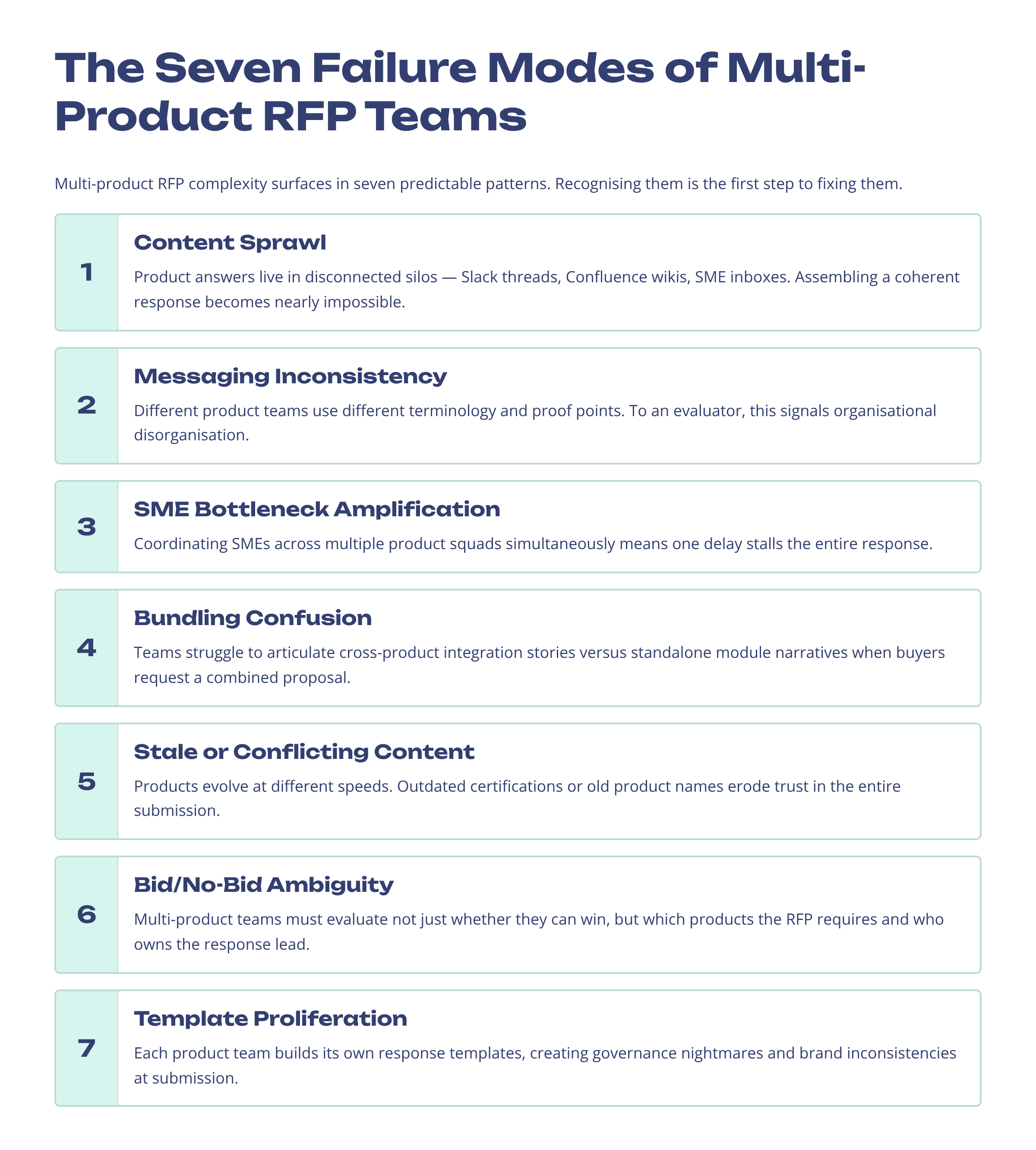
Multi-product RFP complexity typically surfaces in seven predictable patterns. Recognizing them is the first step to fixing them.
- Content sprawl. Product-specific answers live in disconnected silos like Slack threads, Confluence wikis, and individual SME inboxes. Assembling a coherent response quickly becomes nearly impossible.
- Messaging inconsistency. Different product teams contribute sections using different terminology, positioning, and proof points. To an evaluator, this signals organizational disorganization.
- SME bottleneck amplification. Multi-product teams must coordinate subject matter experts across multiple product squads simultaneously. A delay in one product area stalls the entire response.
- Bundling confusion. When a buyer asks for a combined or modular proposal, teams struggle to articulate cross-product integration stories versus standalone module narratives.
- Stale or conflicting content. Products evolve at different speeds. Outdated certifications or old product names for one module can erode trust in the entire submission.
- Bid/no-bid ambiguity. Multi-product companies must evaluate not just whether they can win, but which products the RFP actually requires and who should own the response lead.
- Template proliferation. Each product team builds its own response templates, creating governance nightmares and brand inconsistencies at submission time.
What this really means is: every failure mode that plagues single-product RFP teams gets amplified when you have multiple product lines. The fix is not working harder. It is working differently.
How to Build a Content Library That Works Across Product Lines
The single most impactful infrastructure decision a multi-product SaaS team can make is the architecture of their content library. And here is the critical insight from teams that get this right: organize around buyer questions and outcomes, not product features.
The Atomic Block Principle
Think of your content library as a collection of modular building blocks. Each entry covers exactly one idea, has a single owner, an approval date, and an expiration signal. This modularity is what enables answers to be assembled and reassembled across different product contexts without rewriting.
A security answer about SOC 2 compliance may apply to all your products. A data residency answer may be product-specific. An integration answer may depend on which module the buyer is evaluating. Atomic blocks let teams mix and match without starting from scratch every time.
The payoff is significant. Teams with an active content library reuse 60 to 80 percent of content across proposals, while teams without one spend roughly 40 percent more time writing from scratch.
What Metadata Should You Tag?
Tags and metadata are the connective tissue of a multi-product content library. A flat folder structure organized by product feature breaks down the moment a single security or compliance answer applies to three products simultaneously.
Here is the metadata schema leading multi-product SaaS teams use:
Metadata Field | Purpose | Multi-Product Application |
|---|---|---|
Product / Module | Links answer to specific offering | Platform, Analytics Module, API Layer |
Content Type | Classifies the answer format | Capability claim, SLA, Case study, Security |
Industry Vertical | Enables sector filtering | Healthcare, FinServ, Government |
Geography / Region | Supports regional compliance | NA, EU, APAC |
Compliance Framework | Maps to regulatory requirements | GDPR, HIPAA, SOC 2, ISO 27001 |
Buyer Persona | Targets role-specific language | CISO, Procurement, IT Director |
Confidence Level | Controls reuse without review | Auto-Use, Review Required, Restricted |
Owner | Accountability for updates | Product Team, Security, Legal |
Review Date | Content freshness signal | Quarterly minimum cadence |
The golden rule: a single answer should be retrievable through multiple paths (by product, by topic, by buyer role) without being duplicated across multiple entries. Duplication is how content libraries die.
The Three-Tier Content Model
Not all content in a multi-product library is equal. High-performing teams structure their library across three distinct tiers:
Tier 1: Shared Foundation.
These answers apply to all products. Company overview, corporate security posture (SOC 2, ISO certifications), data privacy and GDPR compliance, executive team and financial stability, standard SLAs and support tiers. Maintained by a central team with quarterly review cycles.
Tier 2: Cross-Product Integration Content.
These answers apply when products are sold together. Platform architecture diagrams, unified data models, cross-module workflow narratives, shared API documentation, combined implementation methodology, and multi-product pricing structures. This tier requires co-ownership between product teams and a solutions architect or product marketing function.
Tier 3: Product-Specific Content.
These answers apply to individual modules. Feature capability matrices, product-specific security configurations, module-level SLAs, product roadmap highlights, and per-product case studies. Each product team owns and maintains its own Tier 3 content, with expiration signals triggered by product releases.
Here is the thing. Every time your team answers a new question during an RFP, that response should be reviewed, approved, and added to the library. The library grows incrementally after each submission rather than requiring periodic bulk reorganization. This is what leading teams call the Solve Loop.
SparrowGenie's Knowledge Hub supports product-line tagging, confidence scoring, and metadata schemas out of the box. Your team uploads docs, the AI structures the knowledge. Explore how it works.
How to Decide Which Multi-Product RFPs to Pursue
Multi-product SaaS teams face a unique bid qualification challenge. Before asking whether you can win a deal, you need to ask which products this RFP actually requires and whether pursuing it aligns with your product strategy.
An undisciplined bid process that chases every RFP regardless of product fit leads to mediocre responses across all opportunities. Your best people get spread thin, and win rates drop.
Start with Binary Filters
Before you score anything, run a quick pass/fail check. Any single hard no ends the evaluation:
- Technical compliance: Can all mandatory requirements be met across the applicable products?
- Timeline feasibility: Can the delivery commitment be made with available capacity?
- Commercial model fit: Is the pricing and contract structure workable?
- Legal and security constraints: Are there jurisdictional, data sovereignty, or ethical barriers?
- Product coverage alignment: Does the buyer's requirement map cleanly to existing modules, or does it require cross-product assembly that introduces new delivery risk?
That last filter is the one unique to multi-product teams and the one most often missed.
Then Apply Weighted Scoring
Once binary filters pass, a weighted scoring model guides the go/no-go decision. Here is what a representative weighting looks like for a B2B SaaS company with multiple product lines:
Criterion | Weight | Multi-Product Consideration |
|---|---|---|
Win probability | 25% | Incumbent relationship, language signals, competitive landscape |
Profitability | 20% | Deal size, margin after delivery, multi-product bundling economics |
Capability fit | 20% | Mandatory requirements match across ALL required modules |
Strategic alignment | 15% | ICP fit, ARR expansion potential, platform adoption signal |
Resource availability | 10% | Capacity across multiple product SME pools |
Risk and red flags | 10% | Legal, data/security, reputational, multi-product delivery risk |
One thing leadership must enforce explicitly: trade-off accountability. If you spend time and resources on this RFP, you will de-prioritize deals X, Y, and Z. Sales leadership must own that calculation. Without this discipline, the RFP burden concentrates on your highest-performing SMEs, eventually burning them out and degrading response quality across all product lines.
How to Structure Your Team and Route SMEs Across Product Lines
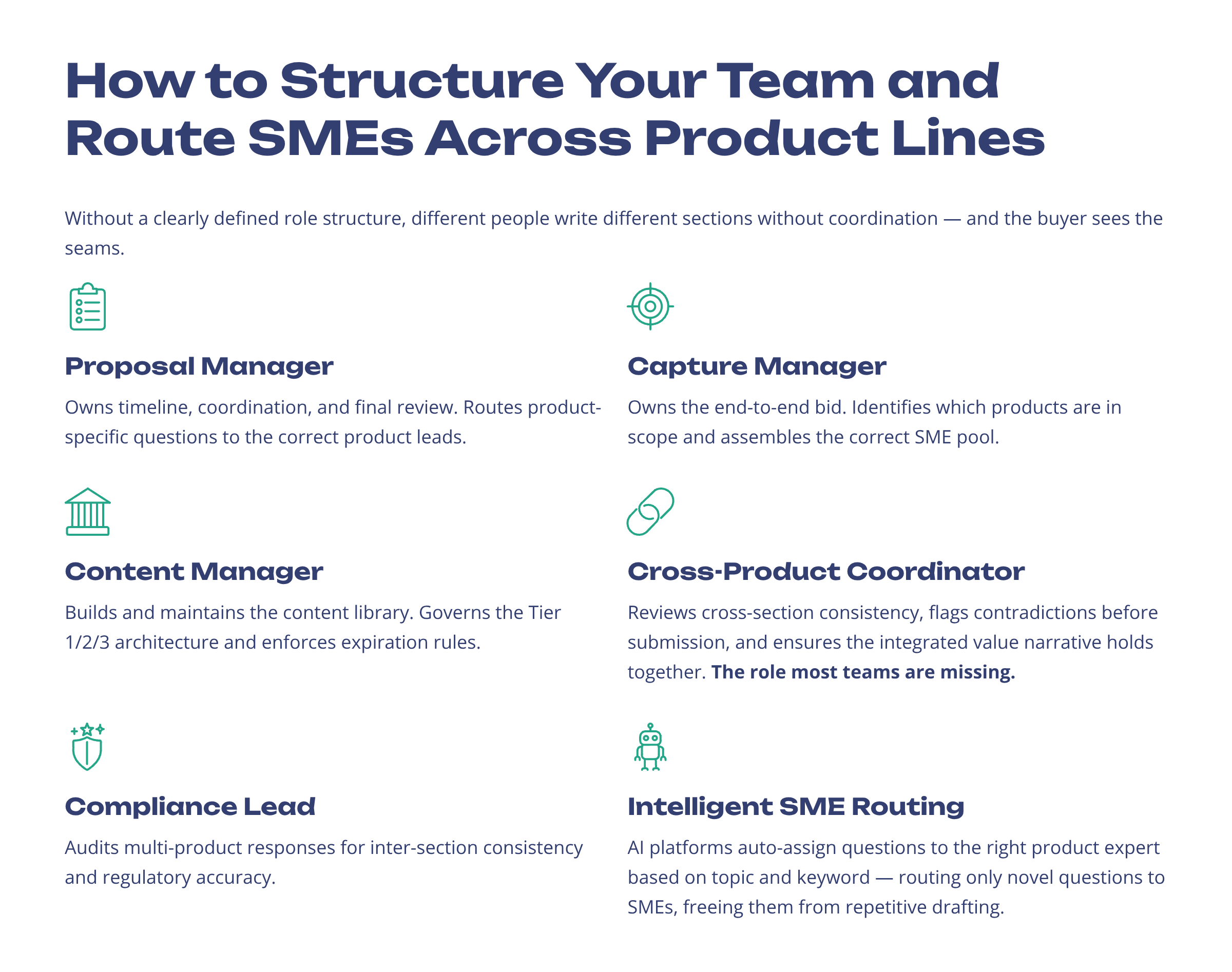
A multi-product RFP team needs a clearly defined role structure. Without it, different people write different sections without coordination, and the buyer sees the seams.
The Core Roles
Standard RFP team roles apply, but multi-product companies need specific extensions:
- Proposal Manager: Owns timeline, coordination, and final review. Routes product-specific questions to correct product leads.
- Capture Manager: Owns end-to-end bid from opportunity stage. Identifies which products are in scope and assembles the correct SME pool.
- Content Manager: Builds and maintains the content library. Governs the Tier 1/2/3 architecture and enforces expiration rules.
- Product SMEs: Answer domain-specific technical questions. Assigned per product line, maintaining their own Tier 3 content.
- Sales Enablement: Aligns messaging across product lines for bundled proposals.
- Compliance Lead: Audits multi-product responses for inter-section consistency.
Why You Need a Cross-Product Coordinator
Here is a gap that most multi-product teams do not realize they have: nobody is explicitly responsible for ensuring that answers from Product A's SMEs do not contradict answers from Product B's SMEs.
This is particularly critical for integration questions. When a buyer asks how your scheduling module connects to your payroll system, that requires orchestrated input from multiple product teams. Not independent answers stitched together during final editing.
A dedicated Cross-Product Coordinator fills this gap. Their job is to review cross-section consistency, flag contradictions before submission, and ensure the integrated value narrative holds together.
How Intelligent SME Routing Works
For multi-product teams, manual SME assignment does not scale. Modern RFP automation platforms solve this through SME recommendation dictionaries that auto-suggest the right expert based on question topic and keyword.
Technical questions route to engineering. Security questions to InfoSec. Pricing to Finance. And critically, product-specific questions are routed to the SME pool for that particular module, not the first available person.
The automation benefit is significant. Most SME time is wasted answering repeated questions, not solving complex issues. AI-powered RFP tools route only novel or edge-case questions to SMEs, freeing them from repetitive drafting.
SparrowGenie auto-routes questions to the right SME based on product line, topic, and expertise. Your experts spend time on what matters. See it in action.
How to Position Your Multi-Product Portfolio: Suite vs. Module
One of the most strategically important elements of multi-product RFP management is the positioning narrative. And most teams get it wrong by defaulting to a single story regardless of what the buyer actually wants.
When to Lead with the Platform Story
Enterprise buyers have a documented preference for platform solutions. The vast majority prefer to purchase one tool for multiple business problems and prefer to buy complementary products from a single vendor they already work with. This is a structural tailwind for multi-product SaaS vendors, but only if your RFP responses articulate the integrated value proposition coherently.
Lead with the suite narrative when the buyer's evaluation criteria emphasize total cost of ownership, implementation simplicity, data coherence, and vendor consolidation. Your value articulation should include shared data model benefits, unified reporting across modules, single contract and support relationship, lower onboarding friction, and cross-module workflow automation.
When to Lead with the Module
When the buyer's RFP scopes a specific capability, the opening narrative should lead with the point-solution strength of that module. Positioning as a platform when the buyer wants a focused solution can create perception of complexity and hinder adoption.
The multi-product risk is real: buyers can be overwhelmed by the breadth of features and unsure about which modules are relevant. Module-first positioning with a clear upgrade path to adjacent products is typically more effective for new logos.
Let the deal context decide your narrative. Do not force-fit a platform story onto a buyer who wants a scalpel, not a Swiss Army knife.
AI-Powered Tools for Multi-Product RFP Management in 2026
The 2026 market offers a range of AI-powered platforms purpose-built for multi-product complexity. The primary differentiator across tools is how they handle context-aware content retrieval, the ability to surface the right product's answer for the right question rather than returning the most recently used answer regardless of product relevance.
What to Look for in a Multi-Product RFP Platform
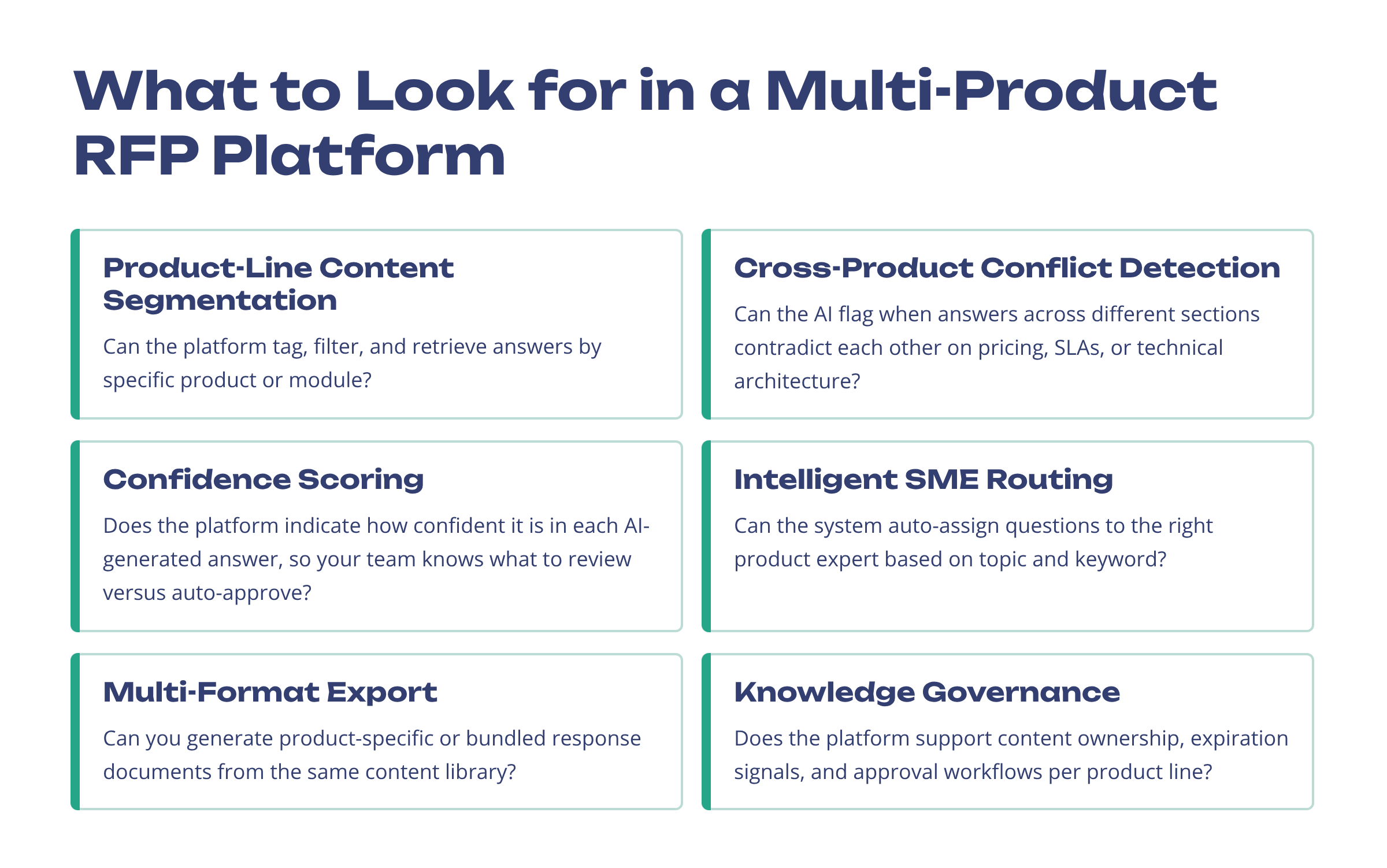
When evaluating RFP automation software for a multi-product SaaS environment, these capabilities matter most:
- Product-line content segmentation: Can the platform tag, filter, and retrieve answers by specific product or module?
- Cross-product conflict detection: Can the AI flag when answers across different sections contradict each other?
- Confidence scoring: Does the platform tell you how confident it is in each AI-generated answer, so your team knows what to review versus what to auto-approve?
- Intelligent SME routing: Can the system auto-assign questions to the right product expert based on topic and keyword?
- Multi-format export: Can you generate product-specific or bundled response documents from the same content library?
- Knowledge governance: Does the platform support content ownership, expiration signals, and approval workflows per product line?
The Shift to Agentic AI
The primary trend in 2026 is the shift from generative AI (writing text) to agentic AI (executing workflows). This matters for multi-product teams because agentic systems can autonomously parse incoming RFPs for product scope, route sections to the correct product-specific content pools, flag cross-product questions for human review, and assemble compliant first drafts across all modules without manual orchestration.
The average time per proposal has already dropped significantly over the past two years, with top-performing teams completing responses in under five hours using automation. That is a competitive advantage multi-product teams cannot afford to ignore.
SparrowGenie's AI-native architecture was built for this. Confidence scoring on every answer. Product-line tagging in the Knowledge Hub. Zero data retention for enterprise security. See the difference.
How to Keep Multi-Product Content Accurate and Up to Date
Multi-product companies face an acute content freshness challenge. Products evolve at different speeds, certifications expire, pricing changes, and SMEs turn over across multiple concurrent product lines.
The biggest content library problem is not size. It is freshness. Outdated answers with expired certifications or old product names erode trust and compliance faster than anything else.
The Governance Model That Works
A structured governance model assigns content owners per product area, sets review cadences, and enforces approval workflows before answers enter the live library. Here is how it maps to the three-tier content model:
- Tier 1 (Shared): Centralized team owns it. Quarterly review cycle.
- Tier 2 (Cross-product): Product marketing or solutions architecture co-owns. Reviewed at major product releases.
- Tier 3 (Product-specific): Individual product teams own. Triggered by sprint releases or certification changes.
The confidence level metadata field is the operational enforcement mechanism. Content is labeled Auto-Use, Review Required, or Restricted. This prevents outdated answers from being auto-filled without human validation.
Why Cross-Product Conflict Detection Matters
Cross-product inconsistency is an invisible risk. A solutions engineer writes the technical architecture section assuming on-premise deployment. Sales already told the buyer cloud deployment in their preferred region. These contradictions surface during buyer review, not internal review.
AI-powered conflict detection automatically identifies when responses contain contradictory technical specifications, pricing models, or SLAs across different sections. This addresses a failure mode that is uniquely acute when multiple product SMEs contribute independently.
Your 180-Day Implementation Roadmap
Here is a phased approach to building multi-product RFP excellence from the ground up.
Phase 1: Foundation (Days 0 to 30)
- Inventory existing content across past proposals, product docs, decks, and internal wikis for all product lines
- Define your metadata schema and taxonomy: product/module, confidence level, owner, review cadence, buyer persona
- Goldenize your top 200 entries across tiers: company foundation (50), cross-product integration (50), product-specific per module (25 to 50 each)
- Assign owners to every content category with no orphaned content
- Onboard two pilot teams to start using the library on active RFPs
Phase 2: Process Systematization (Days 30 to 90)
- Formalize the Go/No-Go framework with binary triggers and weighted scoring criteria
- Design the multi-product SME routing model: product-specific SME dictionaries loaded into your RFP platform
- Set internal SLAs for each stage: 24 hours for bid/no-bid, 48 hours for team assembly, fixed draft and review windows
- Build bundled and modular response templates for the most common deal configurations
- Implement post-submission win/loss analysis tied to which content was used
Phase 3: AI Automation and Scale (Days 90 to 180)
- Integrate your AI-powered RFP platform with existing knowledge sources (CRM, Drive, Confluence, Slack)
- Enable intelligent SME routing using keyword dictionaries per product line
- Activate cross-product conflict detection for final review automation
- Measure and optimize: track SME response time, review cycle count, compliance error rate, and win rate per product line
- Scale volume and aim for 150+ submissions per year without adding headcount
Key Performance Benchmarks for 2026
Multi-product SaaS teams should track performance against these industry benchmarks:
Metric | Industry Average | Top Performers | Your Target |
|---|---|---|---|
45% | 60%+ | 50%+ with structured content | |
Time per response | 25 hours | Under 5 hours | 8-12 hours for complex multi-product |
Annual submissions | 166 | 176+ | 150+ without adding headcount |
Content reuse rate | 60-80% | 90%+ with AI | 80%+ with structured library |
AI autofill rate | ~68% | 90% | 70-85% on standard questions |
The Bottom Line
Multi-product SaaS companies that treat RFP management as a shared-responsibility process with unified content architecture, intelligent SME routing, product-specific governance, and coherent positioning narratives convert their portfolio breadth from a coordination liability into a competitive advantage.
The buyers evaluating you are explicitly looking for vendors who can deliver multiple capabilities from a trusted single partner. Your RFP response is often the first place they test whether that promise is real.
The architecture we covered here, atomic content blocks with multi-dimensional metadata, tiered content pools, AI-powered autofill with conflict detection, and a formal go/no-go framework, is not aspirational. It is table stakes for multi-product SaaS teams competing for enterprise deals in 2026.
Teams that respond to over 150 RFPs annually and win 45% of them can, with the right infrastructure, handle more opportunities and win more often. Without additional headcount. And without sacrificing the customization that closes deals.
Ready to unify your multi-product RFP process? SparrowGenie gives you AI-native content management, product-line tagging, confidence scoring, and SME routing in one platform. Book a demo and see for yourself.
Ready to see how AI can transform your RFP process?
Jeku Jacob is a seasoned SaaS sales leader with over 9 years of experience helping businesses grow through meaningful customer conversations. His approach blends curiosity, empathy, and practical frameworks—rooted in real-world selling, not theory. Jeku believes the best salespeople don’t just follow scripts—they listen, adapt, and lead with purpose.
Frequently Asked Questions (FAQs)
Related Articles