The Tender Process: A Complete 7-Stage Guide for 2026

Article written by
Kaushik Natarajan

INSIDE THE ARTICLE
SHARE THIS ARTICLE
Summary
Tender volumes are climbing. Evaluation criteria are getting sharper. Response windows are tightening. In 2026, winning tenders isn't about effort anymore, it's about running a process disciplined enough to survive the scrutiny. This guide walks through the seven real stages of the tender process, what actually happens at each one, and where most bid teams quietly break.
What does tenders in 2026 look like? The volume is up, the scrutiny is up, and the margin for error has shrunk to almost nothing.
On a single day in February 2026, buyers published 1,966 new tenders worth $7.8 billion in contract value, with an average response window of 37.6 days. Meanwhile, the tender management software market is on track to more than double, from $1.83 billion in 2024 to $4.07 billion by 2032.
What this really means: more opportunities, yes. But also tighter evaluation criteria, stricter compliance, and faster turnarounds. If your bid team still treats tendering as a last-minute scramble, you're going to lose, not because your solution is weak, but because your process is.
This guide breaks the tender process into its seven real stages, the ones that actually decide who wins. No fluff, no procurement textbook jargon. Just what buyers do, what suppliers should do, and where most bid teams quietly break.
What is a tender, really?
A tender is a formal invitation issued by a buyer asking suppliers to compete for a contract through documented bids and scored evaluations.
The terminology shifts by region, which trips up teams bidding across markets:
- ITT (Invitation to Tender): common in UK and EU public procurement.
- RFP (Request for Proposal): dominant in the US, emphasizes solution approach and value.
- RFQ (Request for Quotation): price-first, for clearly scoped commodity work.
- RFT (Request for Tender): standard in Australia.
Different labels. Same underlying process. Whether you're responding to an ITT in London or an RFP in Chicago, the seven stages below apply.
Tired of scrambling for the same ISO certificates every quarter? SparrowGenie keeps your live credential library always current.
What are the main types of tender processes?
Before the seven stages even begin, the buyer picks a tender structure. That choice shapes how much prep suppliers need, how competitive the field gets, and how quickly things move.
Tender Type | How It Works | Best Used For |
|---|---|---|
Open Tender | Any supplier can bid without prescreening | Maximum competition, public transparency |
Restricted Tender | Suppliers apply first; shortlisted ones submit full bids | Filtering by capability before full evaluation |
Selective Tender | Only invited, pre-vetted suppliers bid | Specialist or niche contracts |
Negotiated Tender | Buyer negotiates terms with one or more suppliers | Complex solutions needing commercial refinement |
Competitive Dialogue | Structured discussions before final bids | Large projects with undefined solutions |
Two-Stage Tender | Outline stage, then detailed final bid | Projects with early contractor involvement |
Framework Agreement | Pre-agreed terms for future call-off orders | Recurring procurement where speed matters |
Design and Build | One contractor handles design and delivery | Construction and capital projects |
Direct Award | Single supplier, no competition | Urgent or highly specialized situations |
Most B2B technology and services deals run as RFPs, restricted tenders, or framework agreements. Construction leans toward design-build and two-stage. Knowing which type you're in tells you how much the evaluation is going to weigh price versus approach.
The 7 stages of the tender process
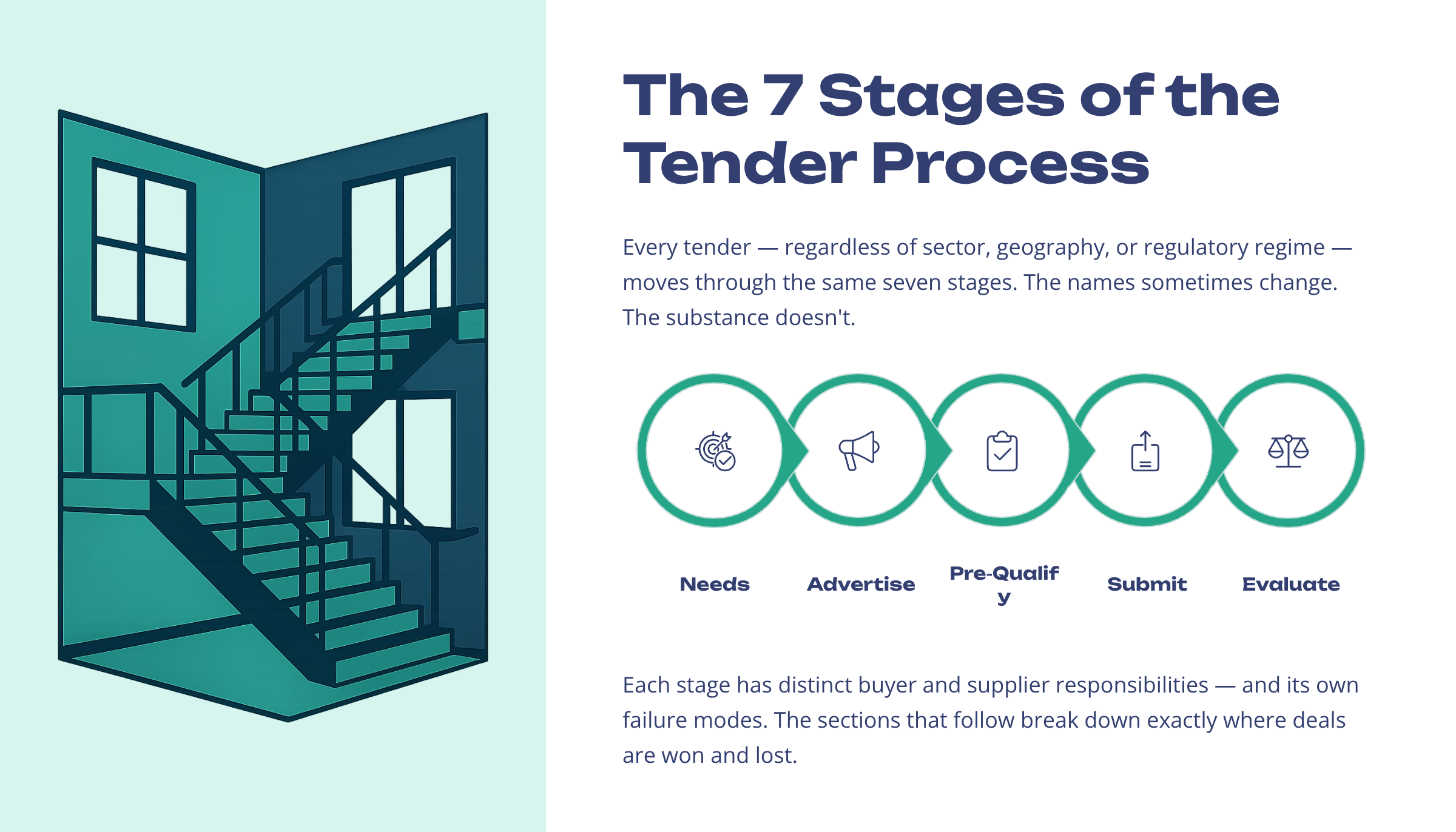
Every tender regardless of sector, geography, or regulatory regime, moves through the same seven stages. The names sometimes change. The substance doesn't.
Stage 1: Needs identification and tender preparation
This stage sets everything. The buyer builds the business case, defines specs, locks in evaluation criteria, and aligns stakeholders. On the supplier side, this is where opportunity monitoring and early go/no-go calls happen.
Weak specs at this stage create compounding pain later: confused suppliers, inconsistent bids, disputes during evaluation. Rushed preparation is the single biggest reason smart buyers end up with bad outcomes.
What buyers do:
- Define scope, functional requirements, performance criteria, and acceptance standards.
- Determine evaluation methodology and weight criteria before publishing anything.
- Pick the right tender type for contract complexity and supplier pool.
What suppliers do:
- Monitor public portals, industry networks, and warm client relationships continuously.
- Run early qualification using go/no-go criteria: strategic fit, delivery capability, estimated value, win probability.
- Engage with buyers (where permitted) before the formal ITT drops.
Typical timing: 2–4 weeks for simple projects; longer for complex initiatives with senior approvals.
Most tenders aren't lost at award. They're lost here, when suppliers miss the opportunity or qualify it poorly.
Stage 2: Tender advertisement and supplier notification
The buyer publishes the ITT through official portals, supplier networks, or industry platforms. A complete pack includes specs, commercial terms, evaluation methodology, submission instructions, and deadlines.
What buyers do:
- Publish a clear, unambiguous ITT with consistent documentation.
- Set a structured clarification process with firm cutoff dates, usually 7–10 days before submission.
- Set response windows that respect complexity: 3–4 weeks for simple, 6–8 weeks for complex technical tenders.
What suppliers do:
- Run an immediate go/no-go review on discovery. Scope fit? Geography serviceable? Timeline realistic?
- Read the full tender document, not the summary. Flag mandatory requirements and vague clauses early.
- Start assembling the bid team and assigning section ownership before drafting.
Typical timing: 1–2 weeks for the buyer to prepare the pack. Global bid windows average 33–38 days in 2026.
Stage 3: Pre-qualification and selection (SQ stage)
Pre-qualification is the gate. Before a buyer invests evaluation time on full submissions, they filter for baseline capability, financial stability, relevant experience, certifications, insurance, security.
This stage is an elimination filter, not a competition. Missing a mandatory document or an expired ISO certificate can knock you out regardless of how strong your solution is.
Common SQ elimination reasons:
- Missing mandatory documents.
- Expired certifications (ISO, SOC 2, insurance).
- Annual turnover below minimum threshold.
- Insufficient comparable project references.
- Non-compliant insurance coverage levels.
The practical takeaway for suppliers: maintain a live credential library year-round. Current ISO certificates, insurance documents, financial statements, case studies, and references should never need last-minute scrambling.
Typical timing: 2–4 weeks for buyer evaluation and shortlisting (usually 3–5 suppliers invited to full tender).
Stop losing tenders to expired certificates and missing docs. Book a SparrowGenie demo now.
Stage 4: Tender submission and deadline management
This is the most resource-intensive stage for suppliers, and the most process-critical for buyers. Content quality, compliance accuracy, and deadline management all collide here.
What buyers do:
- Manage the clarification window, share all Q&A simultaneously with every bidder to maintain fairness.
- Use tender management software to centralize questions and maintain audit trails.
- Publish FAQs proactively to reduce duplicate queries.
What suppliers do:
- Interpret every requirement carefully. Misreading a single mandatory item can disqualify the entire bid.
- Build the response with a structured outline and assignment matrix, who writes what, by when.
- Run structured internal reviews for technical accuracy, legal alignment, financial consistency, and editorial clarity.
- Test portal access several days before the deadline. Portals close on the dot. A strong bid that arrives late still loses.
Effort benchmarks:
- Most responses take 40–80 person-hours over 4–8 weeks.
- Complex tenders (healthcare, infrastructure, enterprise tech) regularly cross 100 hours.
- AI-assisted teams report up to 80% reduction in drafting time, with most AI-generated answers usable after light review.
Stage 5: Bid evaluation and scoring
Buyers score submissions against pre-set, weighted criteria. The process has two phases: mandatory compliance checking, then scored technical and commercial evaluation.
How evaluation actually works:
- Compliance review: non-compliant bids get eliminated first, regardless of price or technical strength.
- Independent scoring: each evaluator scores against defined criteria on their own.
- Moderated panel: scores get reconciled through group discussion to reduce evaluator bias.
- Evaluation report: final moderated scores, price analysis, and written rationale for selection and rejection.
Typical evaluation weightings:
Criterion | Typical Weighting | What Evaluators Look For |
|---|---|---|
Price and commercial value | 30–40% | Competitiveness, clear cost breakdowns, long-term value |
Technical capability | Varies | Solution fit, methodology, evidence it will work |
Delivery approach | Varies | Implementation plan, milestones, governance, risk management |
Team and personnel | Varies | Relevant qualifications, clear responsibilities, seniority |
Track record | Varies | Comparable case studies, measurable outcomes, same sector |
Compliance | Pass/fail + scored | All required forms, certificates, declarations |
Social value and sustainability | Up to 10%+ | Specific, quantifiable commitments tied to the contract |
Worth flagging: the UK's Procurement Act 2023 is deliberately shifting evaluation from MEAT (Most Economically Advantageous Tender) to MAT (Most Advantageous Tender). The point is to broaden evaluation beyond price alone, which is why social value, sustainability, and delivery approach are getting more weight in 2026.
Typical timing: 2–6 weeks depending on the number of bids and evaluation complexity.
Stage 6: Contract award and negotiation
The highest-ranked compliant bidder enters award discussions. This stage refines terms before signature. It's not a victory lap, it's where margins, risk allocation, and delivery commitments get renegotiated.
What buyers do:
- Negotiate contract terms, delivery schedules, payment milestones, and performance measures.
- Complete legal review and internal approvals (adds 1–2 weeks typically).
- Issue award notifications and debriefs, where required — to unsuccessful bidders.
What suppliers do:
- Decide in advance which terms are negotiable and where flexibility affects margin or delivery capacity.
- Bring in legal, finance, and delivery leadership, not just the bid team.
- Document key assumptions, risk allocation, and any scope changes agreed during negotiation.
Award negotiations aren't just about price reduction. Buyers may shift delivery timelines, risk transfer, service levels, or payment structures. Walking in unprepared costs margin.
Stage 7: Contract execution and mobilization
This is where the tender becomes operational reality. The service actually starts. The trust earned in the bid is either reinforced or quietly eroded in the first 60 days.
What buyers do:
- Set up governance, KPI frameworks, SLAs, reporting cadence, escalation paths.
- Run quarterly vendor reviews for strategic vendors, annual for others.
- Issue rejection notices and debrief feedback to unsuccessful bidders.
What suppliers do:
- Assign the delivery team and prepare for onboarding.
- Run a structured kickoff: detailed project plans, governance, milestone commitments.
- Capture the experience — win themes, delivery methodologies, case study material — in a central knowledge library for future tenders.
Typical timing: 2–8 weeks depending on project complexity.
How long does a tender process actually take?
Timelines vary by procurement type, complexity, and sector. Useful benchmarks for planning:
Procurement Type | Typical Duration | Key Characteristics |
|---|---|---|
Simple single-stage tender | 8–12 weeks | Clear specs, limited bidders |
Complex tender | 16–24 weeks | Multi-stage, technical complexity, extensive evaluation |
Two-stage tender | 20–32 weeks | SQ phase (4–6 weeks) + full tender phase (16–26 weeks) |
Framework agreement | 24–40 weeks | Multiple suppliers, staged awards, longer evaluation |
Urgent procurement | 4–6 weeks | Accelerated timeline, limited scope |
EU above-threshold | Minimum 30 days | Mandated by EU procurement directives |
Why do tenders fail? Common mistakes on both sides
Let's break it down. Tender efforts don't fail because the people involved are bad at their jobs. They fail because of predictable, repeatable mistakes.
Common buyer failures
- Vague evaluation criteria that create scoring inconsistency and invite disputes.
- Unrealistic timelines that force rushed, low-quality submissions.
- Poor Q&A management: late answers, inconsistent clarifications.
- Misaligned stakeholders between technical, commercial, legal, and finance during evaluation.
- No go/no-go discipline - pursuing every tender without qualification drains internal bandwidth.
Common supplier failures
- Copy-paste responses that ignore the buyer's specific requirements and scoring criteria.
- Incomplete compliance - missing mandatory documents, wrong formats, expired certificates.
- Late submissions caused by underestimating review, approval, and portal upload time.
- Siloed coordination between sales, technical, finance, and legal producing contradictory answers.
- Outdated content reuse - inconsistent product descriptions, stale security responses, conflicting compliance answers.
That last one deserves a closer look, because it's where most modern bid teams quietly lose deals. When your SMEs answer the same security question three different ways in three different RFPs, evaluators notice. Confidence drops. Scores drop.
Inconsistent answers cost deals. SparrowGenie's Knowledge Hub keeps every response aligned.
Best practices for buyers and suppliers in 2026
Here are few best practices for buyers & suppliers.
For buyers
- Define requirements precisely. Clear specs reduce supplier confusion and improve bid quality.
- Use transparent, weighted criteria. Suppliers perform better when they understand the scoring model.
- Set realistic timelines. Thoughtful responses need real time.
- Pre-qualify for complex contracts. Filtering capability early reduces evaluation burden.
- Balance price with total value. Lowest bid is rarely the best outcome for long-term contracts.
- Involve all stakeholders early — procurement, legal, finance, operations, technical.
- Provide debrief feedback. It supports a healthier supplier market over time.
For suppliers
- Apply structured go/no-go criteria. Focus resources on winnable, strategically fit opportunities.
- Build a centralized content library. Reduces rewrite time while maintaining accuracy.
- Start with customer insight. Understand the buyer's goals, fears, and success criteria before drafting.
- Develop clear win themes - 3–5 consistent messages carried through the whole response.
- Assign clear roles and review gates. A single bid owner with section owners prevents deadline failures.
- Build a compliance matrix before drafting. Track every mandatory requirement from day one.
- Test portals 2–3 days before deadline. Technical failures are not accepted as submission excuses.
- Capture lessons learned. Post-tender reviews compound into better win rates over time.
How is AI changing the tender process in 2026?
The digitization of procurement is no longer optional. By 2026, most government and many large private-sector tenders run end-to-end on e-procurement platforms - notice publication, document management, Q&A, submissions, evaluation.
AI is reshaping the supplier side across multiple stages:
- Opportunity identification: AI scans government portals, corporate procurement pages, and industry boards to surface relevant tenders faster than manual monitoring.
- Go/no-go analysis: AI surfaces deal-breaker requirements early, scores fit against predefined bid criteria, and flags vague clauses before resources are committed.
- First-draft generation: AI generates accurate, on-brand first drafts grounded in validated internal knowledge, cutting the rewrite cycle.
- Consistency checks: AI flags outdated information, conflicting statements, and missing compliance details across technical, commercial, and legal sections.
- Predictive analytics: AI analyzes historical win/loss data to predict win probability and flag sections that correlate with past losses.
What documented results look like in 2026: one organization reported 80–85% of AI-generated responses were immediately usable with only light review. Another cut proposal creation time by 40% and lifted win rate by 20% within three months of adopting AI-powered automation.
Here's what's genuinely different about 2026: the competitive advantage has shifted from effort to process discipline plus AI support. Teams that still treat every tender as a bespoke scramble are losing to teams that treat it as a repeatable operating system.
2026 belongs to AI-augmented bid teams. SparrowGenie is built AI-native, not bolt-on. See how it works for you.
Where modern RFP and tender platforms come in
Most legacy RFP tools were built before generative AI existed. They added AI as a feature on top of library-based search. That works for finding an old answer. It breaks down when you need confidence that the answer is still current, still consistent, and still compliant across every proposal your team ships.
SparrowGenie is built AI-native for exactly this problem. A few pieces matter in a tender context:
- Confidence scoring on every answer - so reviewers know which responses need human verification and which don't.
- A self-improving Knowledge Hub that runs a Train → Test → Improve loop, so your content library stays current instead of quietly rotting.
- Ask Genie AI for draft generation grounded in your validated knowledge, not the open internet.
- Company Intelligence that builds a prospect briefing before you start Stage 1 qualification.
- The Obligations module that tracks every commitment from bid to mobilization, so Stage 7 doesn't quietly undo what Stage 4 promised.
- Zero data retention, data isolation, and SOC 2 Type II compliance - because enterprise procurement teams can't use a tool that can't pass their own security questionnaire.
The point isn't AI for its own sake. It's process discipline you can actually run at scale, across every tender, without your best people burning out on the same repetitive work.
The bottom line
The tender process in 2026 is simultaneously more structured and more competitive than it's been in any previous cycle. Regulatory reforms, the UK's Procurement Act 2023, India's GeM expansion, global threshold updates, are raising the compliance bar while expanding the opportunity pipeline.
For buyers, winning means clear specs, fair evaluation, and governed mobilization. For suppliers, it means disciplined qualification, structured response management, centralized knowledge, and AI-augmented execution.
Organizations that treat tender management as a repeatable operating system consistently outperform those that rely on effort alone. The competitive advantage has decisively shifted toward teams with both process discipline and technology support.
Pick any stage in this guide. Ask your bid team honestly: do we have a system here, or do we have a habit? That's where 2026 is won or lost.
Ready to run a tighter tender process?
See how SparrowGenie helps bid teams qualify faster, respond stronger, and win more, without burning out the people doing the work.
Ready to see how AI can transform your RFP process?
Kaushik Natarajan is the Head of Solution Engineering at SurveySparrow with over a decade of experience in the CRM and customer experience industry. He has previously worked with companies such as Yellow.ai, Freshworks, Newgen Software, and CRMNEXT. Kaushik specializes in requirements gathering, solution architecture, and bridging the gap between technical capabilities and business objectives. His hands-on experience with CRM consulting and implementations gives him unique insight into what drives successful technology adoption.
Frequently Asked Questions (FAQs)
Related Articles

How to Build a Proposal Content Repository That Closes Deals

What is Sales Content Management? A Definitive Guide 2026