How to Write a Winning RFP Cover Letter (With Real Example)

Article written by
Jeku Jacob Philip

INSIDE THE ARTICLE
SHARE THIS ARTICLE
Summary
Most RFP cover letters lose deals before the proposal is even opened. This guide covers everything you need to write one that actually gets read: the 7 must-have components, an 8-step writing process, a real annotated example, industry-specific tips, and a printable pre-submission checklist. If you only have five minutes, jump straight to the example and the checklist.
What you will learn:
- What an RFP cover letter is (and what it is not)
- How it differs from the executive summary
- The 7 components every winning cover letter needs
- A step-by-step writing process
- A complete, annotated real-world example
- Common mistakes that kill good proposals
- A 15-point pre-submission checklist
Your proposal could be technically brilliant. The pricing could be competitive. The team behind it could be genuinely the best fit. But if the cover letter reads like a copy-paste template, evaluators may never get that far.
Nearly 90% of decision-makers expect vendors to demonstrate a clear understanding of their business from the very first page. Yet most cover letters still open with some version of "Thank you for this opportunity to submit..." It is the proposal equivalent of showing up to a job interview without knowing what the company does.
This guide walks you through exactly what an RFP cover letter is, why it matters, how to write one that actually gets read, and what a strong example looks like in practice. You will also find a quick-reference checklist at the end.
Let us get into it.
What Is an RFP Cover Letter?
An RFP cover letter is the one-page letter that sits at the very front of your proposal response. It is not the executive summary. It is not a table of contents. It is a tailored introduction that tells the evaluator: we read your RFP, we understand what you are trying to achieve, and we are the right team for this.
You might also see it called a proposal transmittal letter, bid proposal cover letter, or RFP response cover letter. Different names, same job.
Think of the cover letter as the firm handshake before the pitch. It is your first impression, and it sets the tone for everything that follows.
The cover letter is deliberately not the place for technical details, pricing breakdowns, or lengthy methodology explanations. That is what the rest of the proposal is for. The cover letter exists to make a personal connection, establish credibility at a high level, and compel the reader to keep going.
Already spending hours on RFPs that should take minutes? SparrowGenie auto-generates accurate first drafts, routes them for approval, and fills responses directly into your original document format.
Cover Letter vs. Executive Summary: What Is the Difference?
This is one of the most common sources of confusion in proposal writing. Both pieces live near the front of the document. Both are reader-facing. But they serve completely different purposes, and writing them as if they are the same thing is a mistake.
Aspect | RFP Cover Letter | Executive Summary |
|---|---|---|
Purpose | Build rapport, introduce the company, express genuine interest | Detail the proposal's core strategy and make the business case |
Focus | Personal connection and relationship | Solution overview, ROI, and measurable outcomes |
Length | 1 page maximum | 1–3 pages (up to 10% of narrative for large proposals) |
Tone | Warm, conversational, human | Analytical, data-driven, persuasive |
Signed by | Senior leader on company letterhead | Typically not signed |
The short version: the cover letter earns attention. The executive summary earns buy-in. Neither should repeat the other.
Why Your RFP Cover Letter Actually Matters
Many proposal teams treat the cover letter as the last thing they write, something to quickly draft after everything else is done. This is one of the most costly shortcuts in the bidding process.
Evaluators reviewing dozens of competing submissions will use the cover letter to form their first impression. A generic one tells them this vendor is not very invested. A specific, well-crafted one signals exactly the opposite.
A strong cover letter can:
- Create or deepen the connection between vendor and buyer
- Reinforce your brand values and relevant expertise
- Promote 3–4 key differentiators that make your solution stand out
- Establish a clear point of contact for follow-up
- Signal that this proposal was built specifically for this client, not recycled from a template
In competitive bidding environments, a personalized cover letter can move your proposal from the "maybe" pile to the "yes" pile before a single technical section is read.
7 Key Components of a Winning RFP Cover Letter
Every effective cover letter shares these core elements. Skip any of them and you are leaving value on the table.
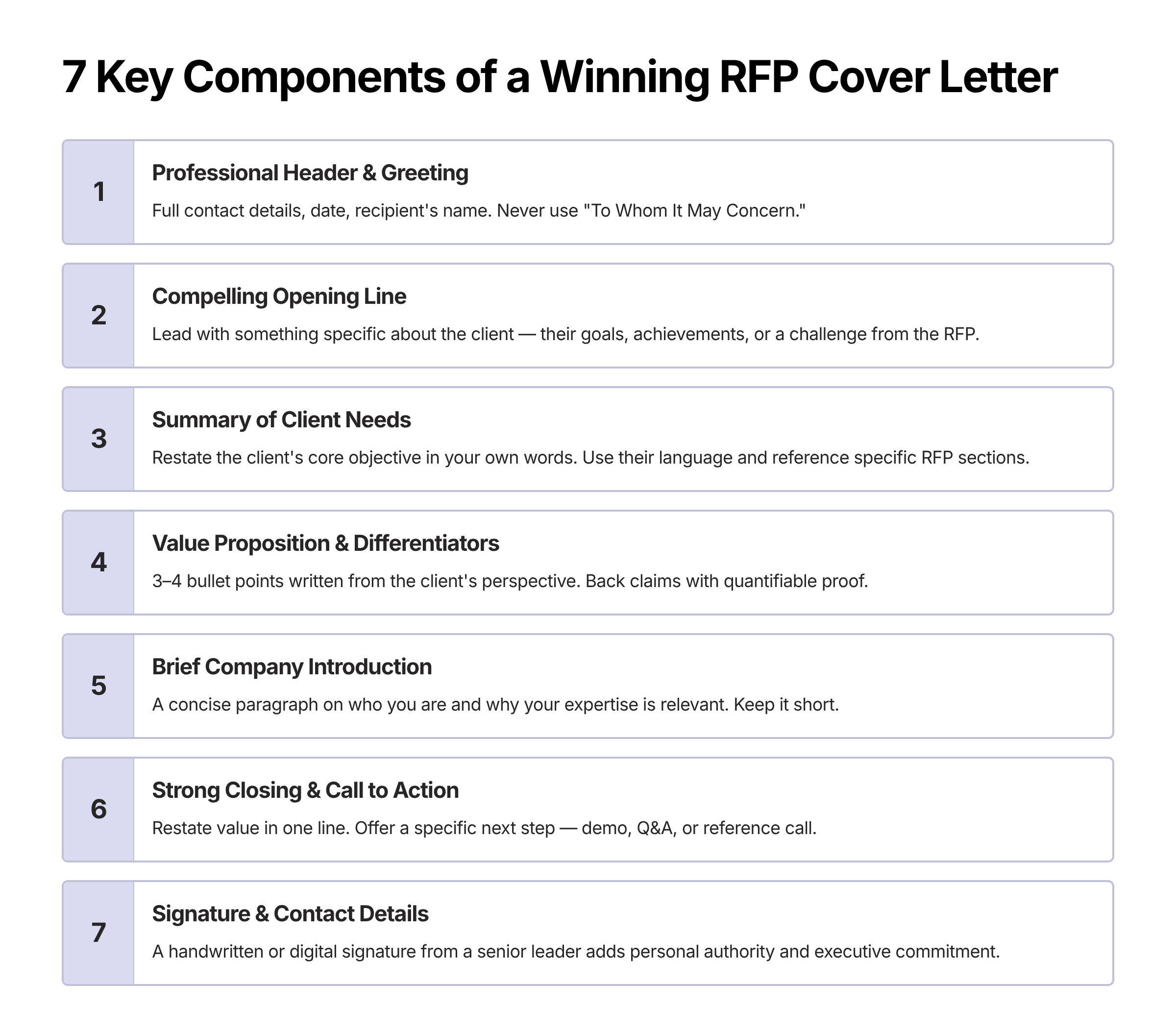
1. Professional Header and Greeting
Include your full contact information (company name, address, phone, email), the date, and the recipient's details. Address the letter to a named individual. "To Whom It May Concern" tells the evaluator you did not even spend five minutes looking up who reviews these submissions. If a name is unavailable, "Dear Evaluation Committee" is the acceptable fallback.
2. A Compelling Opening Line
The opening line is the most valuable real estate in your cover letter. Evaluators are scanning for one thing: does this vendor actually understand what we are trying to achieve?
Do not start with "Thank you for the opportunity." It is what almost every competitor writes. Start with something specific about the client, their goals, their recent achievements, or a challenge explicitly mentioned in the RFP. This immediately signals that the letter is customized.
3. Summary of Client Needs
Briefly restate the client's core objective in your own words. This does two things: it confirms you read the RFP thoroughly, and it demonstrates you genuinely understand the buyer's situation. Use their language. Reference specific RFP sections where relevant.
4. Your Value Proposition and Differentiators
Highlight 3–4 key differentiators using bullet points. Write from the client's perspective, not yours. "You gain" and "you will benefit from" work better than "we offer" and "we are the industry leader in." Back up at least one claim with a quantifiable success story.
5. A Brief Company Introduction
A concise paragraph establishing who you are and why your core expertise is relevant here. Keep it brief. The detailed credentials belong in the main proposal.
6. A Strong Closing With a Call to Action
End by restating your value in a single line and expressing clear readiness to move forward. Always include a specific next step such as an offer for a demo, a Q&A session, or a reference call.
7. An Actual Signature and Full Contact Details
A handwritten or digital signature from a senior representative adds a personal touch that reinforces executive commitment. Include full name, title, phone, and email.
Your cover letter is only as strong as the proposal behind it. SparrowGenie gives your team a structured company intelligence brief the moment a new RFP lands, so the opening line practically writes itself.
How to Write an RFP Cover Letter: Step by Step
Here is a detailed step-by-step guide on how to write an efficient and impactful RFP cover letter that could win the deal for you.
Step 1: Study the RFP Line by Line
Before you write a single word of the cover letter, read the entire RFP. Highlight keywords around timeline, budget, scope, and expected outcomes. Note any mandatory instructions about format and submission requirements. Missing even one instruction can get a proposal rejected before anyone reads it.
Step 2: Identify Your Win Themes
Strong proposals start with clear win themes: concise statements linking your strengths to the client's desired outcomes. Two or three themes are enough. Each should follow this flow:
- Capability: what you do
- Value: what the client gains
- Differentiator: why it is unique to you
Use these themes consistently throughout the cover letter to build a coherent narrative.
Step 3: Research the Decision Makers
Understanding who will read the proposal matters. Use LinkedIn or your CRM to identify key stakeholders and their priorities. A cover letter personalized to their specific interests and industry context will land very differently from a generic one.
Step 4: Open With the Buyer's Objective, Not Your Company Background
Lead with what the client is trying to accomplish. Your background can come in the third paragraph.
Example opening: "We understand your priority is reducing onboarding time across departments while maintaining compliance, and our proposed approach is designed to support that objective directly."
Step 5: Personalize Everything
Refer to specific RFP sections. Use the client's industry language. Mention relevant experience from their sector. The reader should feel this response was built exclusively for them, not pulled from a shared template folder.
Step 6: Back Up Your Claims With Numbers
Include at least one concrete success story with real figures: "increased engagement by 120%" or "reduced delivery costs by 25%." Specific numbers build credibility fast. Vague claims do the opposite.
Step 7: Close With Confidence and Next Steps
Reinforce your intent and readiness. Signal that your team is prepared to engage immediately. A strong close echoes the buyer's primary goal and confirms your availability.
Step 8: Review, Polish, and Proofread
Check that the tone matches your brand voice. Clean formatting, appropriate bullet usage, and one-page length matter. And proofread carefully. A misspelled client name will undo everything else you did right.
RFP Cover Letter Formatting Best Practices
Clean formatting is not cosmetic. It directly affects whether the letter gets read. Here is what works:
- Length: One page maximum. Longer letters signal inability to synthesize.
- Font: Arial or Times New Roman at 11–12pt.
- Layout: Consistent margins and spacing. Clear visual hierarchy.
- Bullet points: Use in the center section to draw the eye to your key differentiators.
- Branding: Company logo at the top, company letterhead, subtle brand colors.
- Three focal points: Hook readers at the opening line, the center bullet section, and the closing call to action.
- Signature: Use an actual signature image, not a typed name. It reinforces the personal touch.
Common Mistakes to Avoid in RFP Cover Letter
These pitfalls can undermine even the strongest proposals:
- Using a recycled letter: Every RFP requires specific alignment. Reusing the same letter signals laziness.
- Opening with "Thank you for this opportunity": Boring, generic, and exactly what every competitor writes.
- Repeating the executive summary: They serve different purposes. Do not duplicate content.
- Overloading with jargon: The cover letter should be accessible, not a technical deep dive.
- Making it too long: If it exceeds one page, the reader likely will not read every word.
- Focusing too much on your company: The client's name should appear more than yours. Structure it from the buyer's perspective.
- Ignoring RFP instructions: If the RFP specifies what to include, follow those instructions precisely.
- Forgetting the call to action: Always close with a clear next step and your contact information.
The fastest way to avoid all of these mistakes? Stop building proposals manually. SparrowGenie handles the research, drafting, and collaboration so your team focuses on winning, not formatting.
Full RFP Cover Letter Example (Annotated)
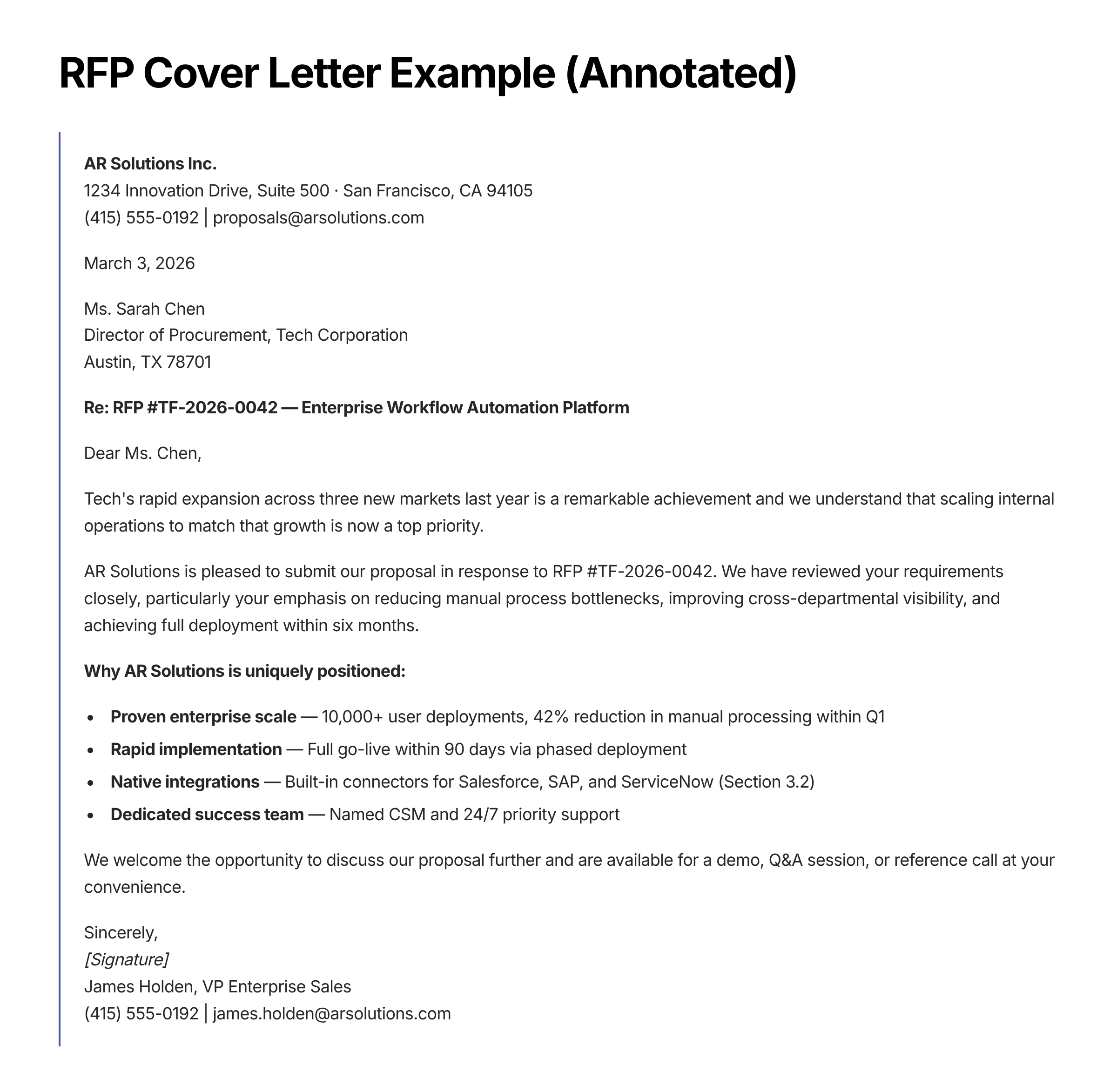
Below is a complete example for a B2B SaaS procurement RFP, incorporating every best practice covered above.
AR Solutions Inc. 1234 Innovation Drive, Suite 500 San Francisco, CA 94105 (415) 555-0192 | proposals@arsolutions..com
March 3, 2026
Ms. Sarah Chen Director of Procurement Tech Corporation Austin, TX 78701
Re: RFP #TF-2026-0042 — Enterprise Workflow Automation Platform
Dear Ms. Chen,
Tech's rapid expansion across three new markets last year is a remarkable achievement — and we understand that scaling internal operations to match that growth is now a top priority. AR Solutions is pleased to submit our proposal in response to RFP #TF-2026-0042 for an Enterprise Workflow Automation Platform.
We have reviewed your requirements closely, particularly your emphasis on reducing manual process bottlenecks, improving cross-departmental visibility, and achieving full deployment within six months. Our proposed approach is designed to address these objectives directly.
Why AR Solutions is uniquely positioned for this engagement:
- Proven enterprise scale: Successfully deployed workflow automation for organizations with 10,000+ users across distributed teams, reducing manual processing time by 42% within the first quarter.
- Rapid implementation: Our phased deployment model consistently delivers full go-live within 90 days, well within your stated six-month timeline.
- Native integrations: Built-in connectors for Salesforce, SAP, and ServiceNow — the three platforms identified in your technology stack requirements (Section 3.2).
- Dedicated success team: Every enterprise client receives a named Customer Success Manager and 24/7 priority support during and after rollout.
We understand that Tech is prioritizing operational efficiency and cross-functional collaboration as it scales. Our approach is built around these outcomes, and we are confident our platform will deliver measurable impact within your timeline.
We welcome the opportunity to discuss our proposal further and are available for a demo, Q&A session, or reference call at your convenience. Please do not hesitate to reach out directly.
Sincerely,
[Signature]
James Holden Vice President, Enterprise Sales AR Solutions Inc. (415) 555-0192 | james.holden@arsolutions..com
Why this example works:
- Opens with a client-specific observation, not a generic "thank you"
- References the exact RFP number and title to anchor the submission
- Restates client objectives in the vendor's own words
- Uses bullet points in the center to highlight differentiators and draw the eye
- Includes quantifiable proof: 42% reduction, 90-day deployment
- References a specific RFP section (Section 3.2) to demonstrate thorough reading
- Closes with multiple call-to-action options: demo, Q&A, reference call
- Fits on a single page with clean, readable formatting
RFP Cover Letter Industry-Specific Adaptations
Different industries require different tones and different proof points:
Industry | Key Emphasis | Proof Points to Highlight |
|---|---|---|
Government / Public Sector | Compliance, accessibility, transparency | Certifications, past government contracts, sustainability metrics |
Healthcare | Patient outcomes, regulatory compliance, data security | HIPAA compliance, readmission reduction stats, patient satisfaction scores |
Technology / SaaS | Integration, scalability, adoption speed | Onboarding speed, win rate improvements, platform uptime |
Marketing / Creative | Brand consistency, measurable ROI | Recognition lifts, impression counts, multi-market campaigns |
Construction / Engineering | Scope adherence, safety | On-time delivery rates, safety records, compliance history |
RFP Cover Letter Quick-Reference Checklist
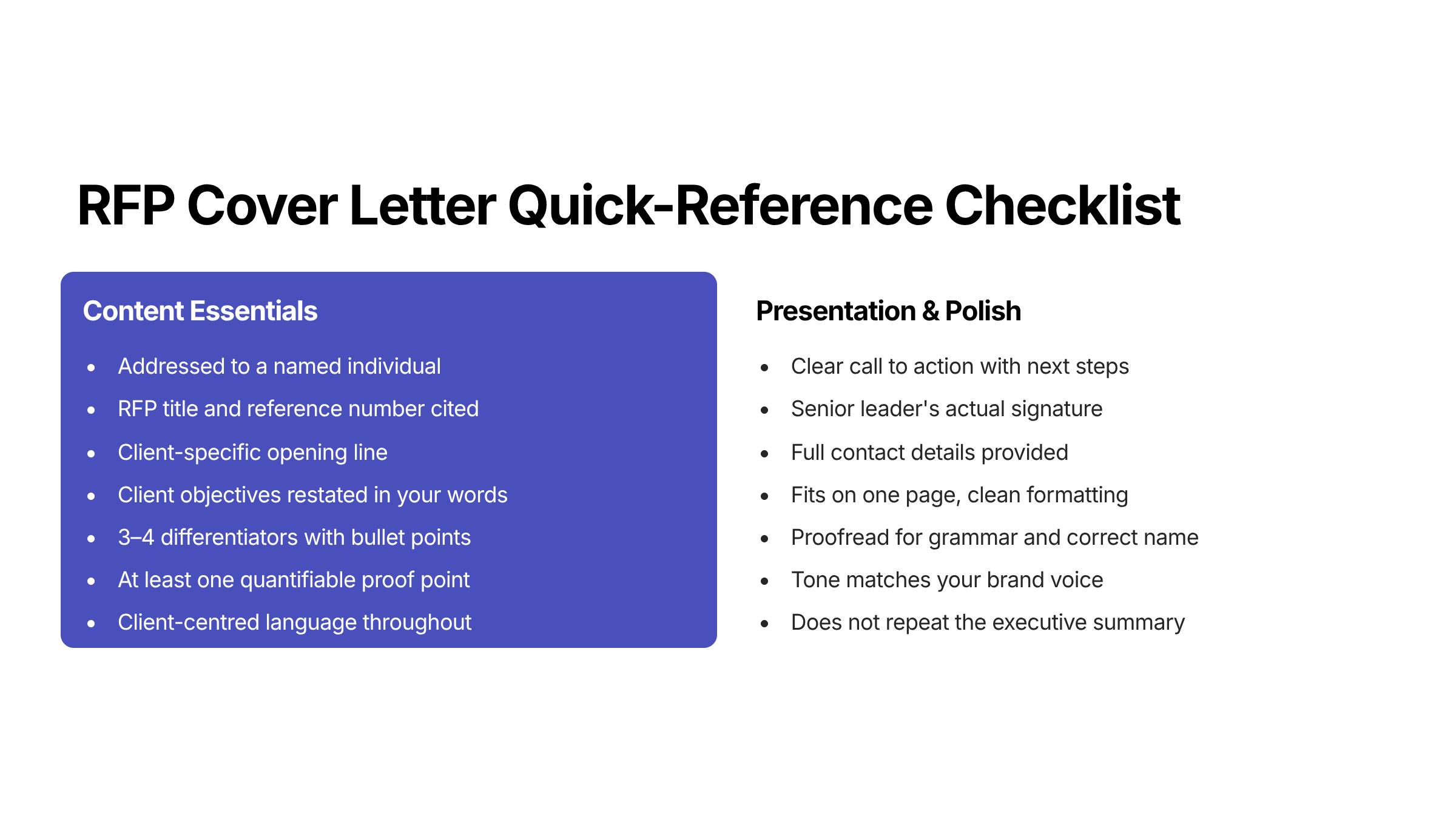
- ☐ Addressed to a named individual or evaluation committee
- ☐ RFP title and reference number mentioned
- ☐ Opens with a client-specific statement, not "thank you"
- ☐ Client's objectives restated in your own words
- ☐ 3–4 differentiators highlighted with bullet points
- ☐ At least one quantifiable proof point included
- ☐ Client-centered language throughout ("you gain" vs. "we offer")
- ☐ Clear call to action with specific next steps
- ☐ Senior leader's actual signature included
- ☐ Full contact details provided
- ☐ Fits on one page with clean formatting
- ☐ Proofread for grammar, spelling, and correct client name
- ☐ Tone matches your company's brand voice
- ☐ Does not repeat the executive summary
- ☐ Follows any specific RFP instructions for the cover letter
Want a template you can actually use? SparrowGenie users start every proposal with AI-generated context on the prospect, pre-built response drafts, and role-based approval workflows, not a blank page.
How SparrowGenie Helps You Write Better Cover Letters Faster
The biggest reason cover letters end up generic is time. When a proposal is due in 48 hours and 12 people are still chasing down SME inputs, the cover letter becomes a rushed afterthought.
SparrowGenie is built to change that workflow. When a new RFP lands, the platform auto-generates a structured company overview of the prospect using only verified public information. Before a single response is drafted, your team already has factual grounding on what the client does, their industry context, and their product ecosystem.
That context feeds directly into smarter, more relevant proposal content. And when it comes to the cover letter, having that structured intelligence at your fingertips means the opening line practically writes itself.
Beyond research, SparrowGenie's role-based collaboration tools mean the right people review and approve the right sections without endless email chains. The cover letter gets the same attention as the technical response, not less.
The result is proposals that feel tailored because they actually are.
Closing Thoughts
The RFP cover letter is simultaneously the shortest document in your proposal and the one with the most riding on it. A generic letter communicates disinterest. A personalized, evidence-backed letter that mirrors the buyer's language and priorities signals a vendor worth evaluating seriously.
Spend 30 to 60 minutes on it. Study the RFP. Identify your win themes. Write for the buyer, not about yourself. That investment will pay off more times than you expect.
Want to streamline your entire RFP response process? SparrowGenie helps proposal teams generate accurate first drafts, track SME commitments, manage approvals, and fill responses directly into the original document format. No copy-paste chaos, no formatting headaches. Just faster, better proposals.
Ready to see how AI can transform your RFP process?
Jeku Jacob is a seasoned SaaS sales leader with over 9 years of experience helping businesses grow through meaningful customer conversations. His approach blends curiosity, empathy, and practical frameworks—rooted in real-world selling, not theory. Jeku believes the best salespeople don’t just follow scripts—they listen, adapt, and lead with purpose.
Frequently Asked Questions (FAQs)
Related Articles

Why Fast Proposal Responses Win More Deals (Proven Results)

What is Sales Content Management? A Definitive Guide 2026