RFP Database Guide: How to Find IT & SaaS RFPs in 2026

Article written by
Aparna Rajendran

INSIDE THE ARTICLE
SHARE THIS ARTICLE
Summary
The RFP world has changed. IT and SaaS teams can no longer rely on old tender sites to track RFPs issued today or find real active RFPs. This blog breaks down the 2026 ecosystem where bids actually live, how procurement filters work, and the exact workflows teams need to win more RFPs.
If you’re still checking tender lists or refreshing government portals to catch “RFPs issued today,” you’re already playing yesterday’s game. Procurement has shifted so quickly that old search habits now miss almost half of all active RFPs, especially in IT and SaaS.
And the real issue it that it’s not just about volume. It’s about visibility. IT RFPs 2026 now surface across scattered databases, AI-curated portals, invite-only networks, and SaaS buying platforms that never publish anything publicly. While most teams are still scrolling, the top performers are filtering, automating, and spotting opportunities before they even show up.
This blog walks you through the new landscape, where real SaaS and IT RFPs actually live, how to filter them with precision, and how modern AI workflows help you track everything without drowning in noise.
How IT and SaaS RFPs Actually Surface in 2026
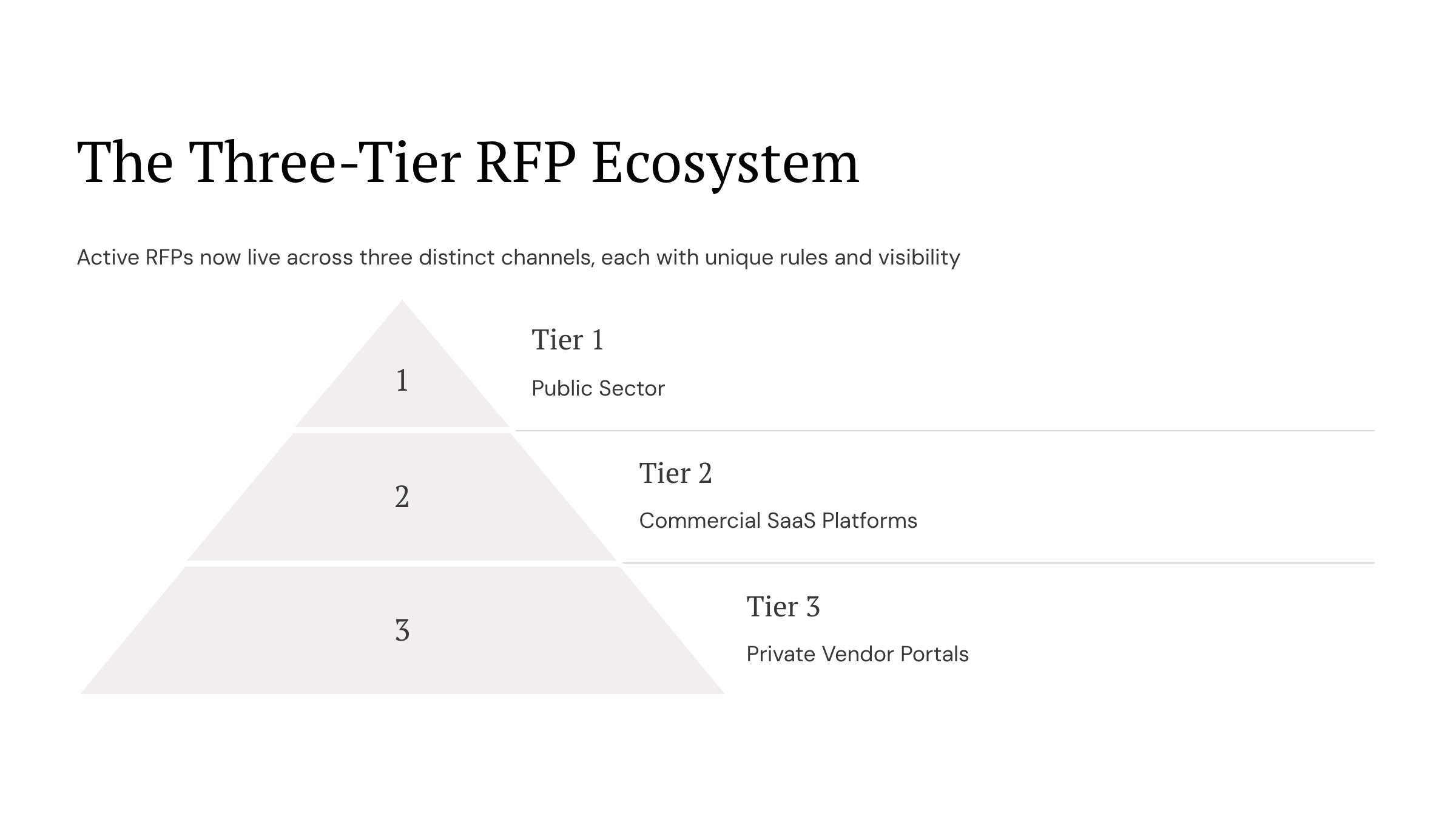
Most of them talk about “top tender websites” as if procurement hasn’t changed in a decade. But active RFPs now surface across three different ecosystems, each with their own rules.
Let’s break down where IT RFPs 2026 and SaaS RFPs are really being issued today.
Tier 1: Public Sector RFPs
The public sector RFP is a structured but crowded world. These government channels still matter, especially for teams searching for “RFPs issued today.” The public sector remains the most transparent place to track active RFPs, but competition is intense.
1. SAM.gov — The Federal Hub for IT RFPs 2026
The official federal RFP database where all contracts >$25k must be listed. Why it’s essential:
- Daily listings of RFPs issued today
- New 2026 feature: GenAI Disclosure filters
- Clear indexing of IT, software, cloud, and cybersecurity solicitations
- Reliable attachments and SOW documents
If your team wants a real-time feed of active RFPs, SAM.gov is your anchor.
2. GovWin IQ (Deltek) — The Intelligence Engine
GovWin is the backbone for early-stage IT procurement forecasting. Key advantages include:
- Forecasts IT RFPs 2026 12+ months before release
- AI agent “Ask Dela” summarizes opportunities instantly
- Predicts re-compete cycles
- Shows incumbent vendors and past awards
If you want to shape the RFP before it drops into an RFP database, this is where you begin.
3. BidNet Direct / GovSpend — SLED RFPs (State, Local, Education)
SLED agencies like BidNet Direct or GovSpend publish smaller but faster-moving active RFPs, especially:
- Cloud migrations
- School technology upgrades
- District cybersecurity programs
- Municipal digital services
These IT RFPs rarely reach SAM.gov, so monitoring this layer matters for 2026 pipeline building.
4. GSA eBuy — Where Federal SaaS RFPs Hide
Not all government RFPs go public. Many SaaS RFPs sit exclusively within GSA eBuy under:
- SIN 518210C (Cloud Computing)
- SIN 511210 (Software Licenses)
If your product is already FedRAMP-ready, this “hidden RFP lane” is a goldmine.
Tier 2: The Shadow Commercial Market —The New Home of SaaS RFPs
Here’s the shift most teams miss: Active SaaS RFPs are rarely public. They live inside buying platforms like:
These platforms have changed the RFP format entirely. Enterprises upload their needs → platforms match vendors → you get auto-invited.
This is where most SaaS RFPs happen today, with zero public listing and no traditional paperwork. If you’re not listed in these networks, your product simply never appears as an option.
Tier 3: Vendor Portals — The Private RFP Universe
This is the “dark pool” of private IT procurement. Large enterprises like JP Morgan, Kaiser Permanente, Walmart, Lockheed Martin, Microsoft suppliers, and Anthem Healthcare run internal procurement systems instead of public portals. These portals generate active RFPs but restrict them to registered suppliers only. To see them, you must:
- register in each portal
- pass onboarding checks
- enable email alerts
- upload compliance documents
Teams that ignore these portals miss millions in unlisted IT & SaaS opportunities.
Need an RFP management tool that helps you respond to RFPs in minutes?
Filtering IT and SaaS RFPs Using Procurement Codes
Most proposal and RevOps teams search using keyword-based filters like “software,” “cloud,” or “SaaS.” But procurement officers don’t use keywords. They use procurement codes. Using these codes is the difference between wasting 10 hours a week and spotting the right opportunities instantly.
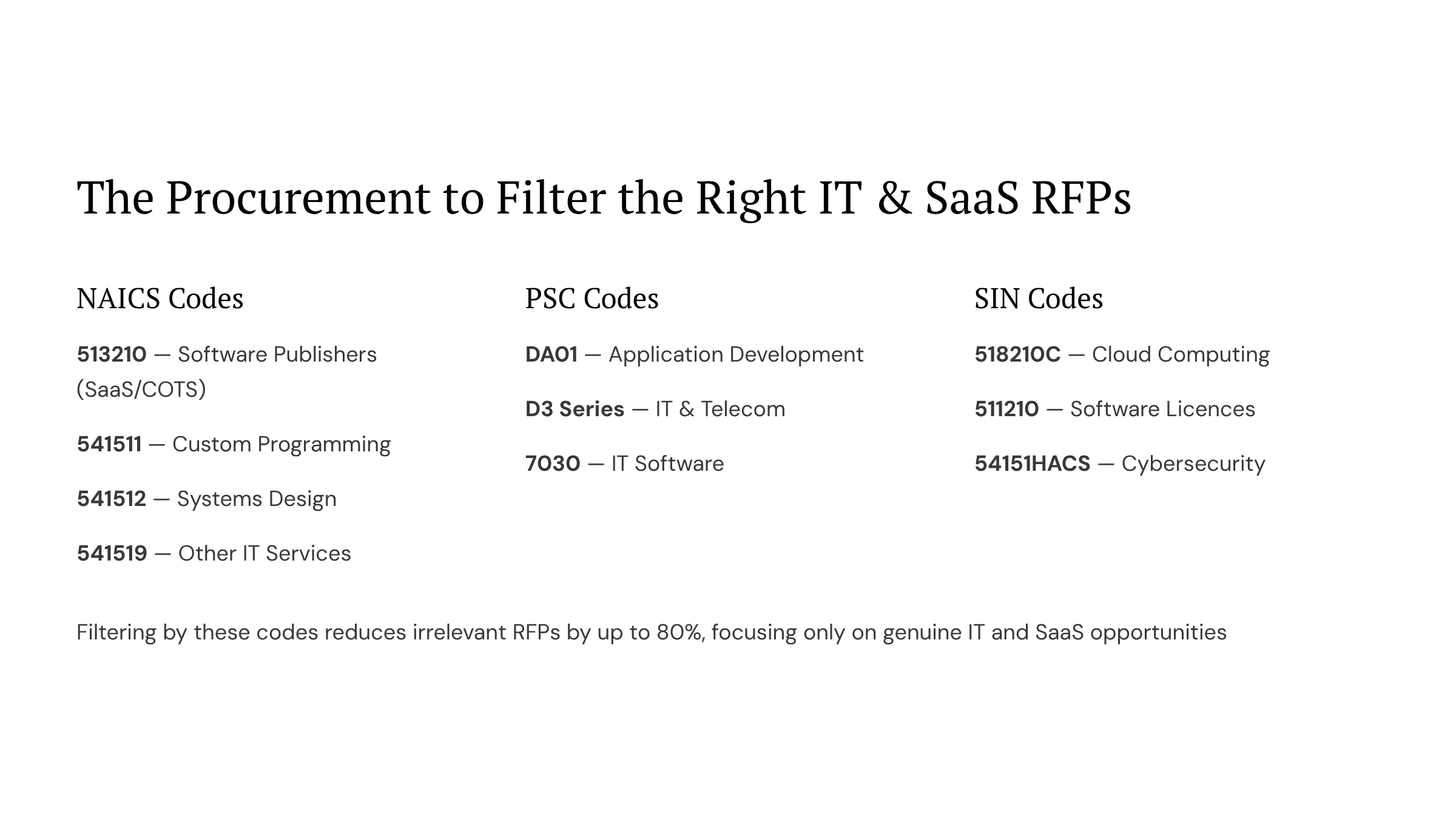
A. NAICS Codes for IT RFPs 2026
These codes classify IT service categories inside every major RFP database.
NAICS | Category | Relevance |
|---|---|---|
513210 | Software Publishers | For SaaS RFPs and COTS platforms |
541511 | Custom Computer Programming | Dev shops, integrations, backend builds |
541512 | Systems Design Services | MSPs, digital transformation vendors |
541519 | Other Computer Services | Catch-all for IT service providers |
Filtering by NAICS reduces irrelevant active RFPs by up to 80%.
B. PSC Codes for IT & SaaS RFPs
PSC codes describe what is being purchased.
PSC | Description | Ideal For |
|---|---|---|
DA01 | IT Application Development Support | Implementation-heavy SaaS RFPs |
D3 Series | IT & Telecom Services | Broad IT services |
7030 | Information Tech Software | Software licenses, SaaS products |
Most databases allow combining NAICS and PSC, the cleanest way to detect real IT RFPs in 2026.
C. SIN Codes for Federal SaaS RFPs
If you're selling to the government:
- 518210C — Cloud Computing (SaaS, PaaS, IaaS)
- 511210 — Software Licenses
- 54151HACS — Cybersecurity
These codes establish eligibility criteria prior to your review of the RFP.
Key Compliance Filters for 2026 RFPs
You can’t win every active RFP, but you can avoid wasting time. Your file highlights the three compliance filters that now act as automatic approval or rejection criteria.
A. FedRAMP in 2026
Teams responding to SaaS RFPs must align with:
- LI-SaaS
- FedRAMP Authorized
- FedRAMP boundary documentation
If a solicitation requires FedRAMP, and you don’t have it, skip it.
B. AI Transparency Requirements
2026 RFPs include new fields such as:
- “AI model disclosure”
- “NIST AI RMF compliance”
- “Model card submission”
- “LLM governance documentation”
Government and regulated industries mandate AI explainability. This affects both SaaS companies and IT service providers.
C. CMMC Level 2
For DoD, aerospace, defense, or security-associated IT RFPs 2026, CMMC is mandatory.
No certification = instant disqualification.
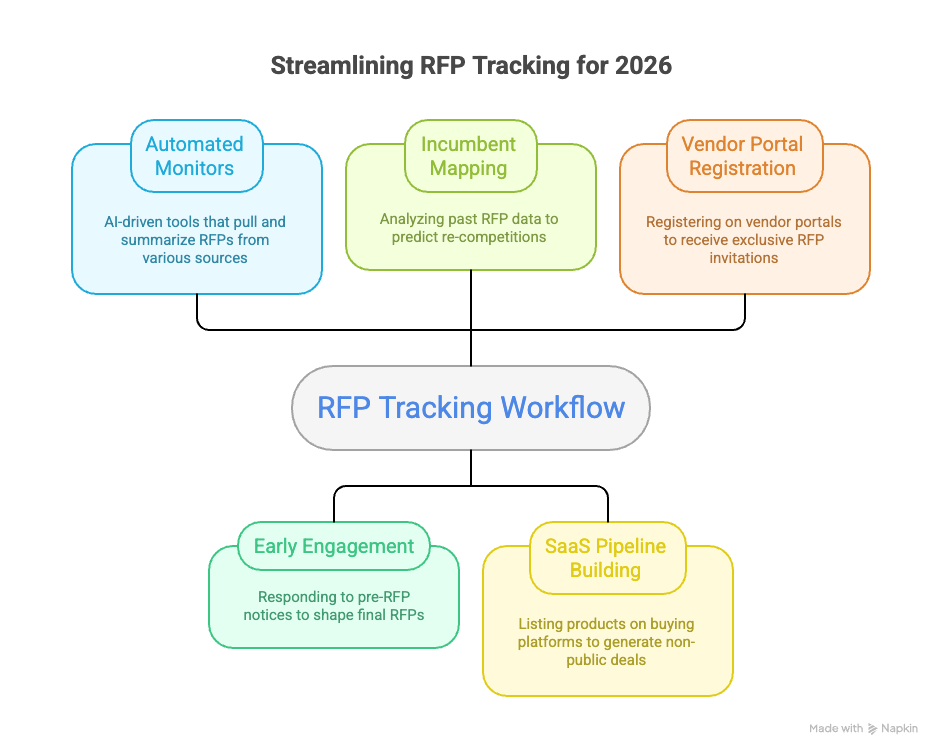
Agentic Workflow to Track Active RFPs in 2026
The high-performing proposal teams don’t “search.” They orchestrate automated flows. Here is the core framework.
Step 1: Build Automated Monitors (“Active RFP Agents”)
AI-driven watchers pull RFPs issued today from:
- SAM.gov
- GovWin
- SLED portals
- GSA eBuy
- SaaS buying platforms
- Private vendor portals
These agents summarize:
- SOW
- Evaluation criteria
- Compliance requirements
- Data rights clauses
This replaces manual triage.
Step 2: Engage Early Through Pre-RFP Notices
Don’t wait for the RFP. Respond to:
- Sources Sought
- RFIs
- Market surveys
This shapes the final RFP and increases win probability.
Step 3: Incumbent Mapping Using USAspending.gov
Every active RFP has a history. Check:
- incumbent vendor
- expiration dates
- award amounts
- past performance patterns
This predicts which IT RFPs 2026 are guaranteed to re-compete.
Step 4: Build a Commercial SaaS Pipeline Using Buying Platforms
This is where SaaS RFPs are silently decided. Quarterly tasks have to include:
- List your SaaS product in Vendr, Tropic, Spendflo, Vertice
- Update your product metadata
- Upload security/compliance documents
- Track buyer intent signals
This generates non-public IT deals, the ones that never hit any RFP database.
Step 5: Register in 20–50 Vendor Portals
These portals generate hundreds of active RFPs that don’t exist publicly. Every enterprise has one. If you want to be invited, you must be registered.
Where SparrowGenie Fits Into Your 2026 RFP Workflow
Finding the right active RFPs is only half the battle. The real challenge starts the moment an opportunity lands on your desk: hundreds of questions, security disclosures, compliance checks, SME dependencies, version chaos, and shrinking deadlines. That’s exactly where SparrowGenie steps in. SparrowGenie becomes your secure AI partner across the entire RFP lifecycle:
- Automatically reads and interprets new RFPs from any source
- Suggests accurate, pre-approved answers using your centralized knowledge
- Flags compliance gaps (FedRAMP, CMMC, AI transparency) before you submit
- Generates first drafts for technical, functional, and security sections
- Scores responses with Confidence Levels so teams know what needs human review
- Keeps every contributor aligned with structured workflows and audit trails
The result? Your team spends less time chasing answers and more time shaping strategy, turning every SaaS RFP or government bid into a faster, more predictable win.
SparrowGenie removes the chaos, accelerates execution, and gives sales and proposal teams a clear advantage in a competitive 2026 procurement landscape.
Explore SparrowGenie
Conclusion: Smarter RFP Discovery in 2026
Most teams eventually realize that winning in 2026 isn’t about hunting for more RFPs; it’s about spotting the right ones before anyone else. The advantage now comes from building a system that filters out noise and surfaces real opportunities early.
When you combine public databases, AI-powered RFP agents, SaaS buying networks, invite-only vendor portals, precise code filters like NAICS/PSC/SIN, and strong compliance positioning, you stop reacting to RFPs and start anticipating them. That’s how you gain visibility into RFPs issued today, upcoming IT RFPs for 2026, and the high-value SaaS opportunities that never get published. The teams who win aren’t lucky; they’re organized, automated, and driven by signal, not noise.
Ready to see how AI can transform your RFP process?
Product Marketer at SparrowGenie
Being a Product Marketer at SparrowGenie, Aparna helps sales teams work faster with secure, AI-powered proposal automation. She turns complex features into simple stories, builds messaging that resonates, and keeps a close pulse on what customers actually need. She loves shaping clear, helpful content that shows how SparrowGenie makes RFP work easier, faster, and a lot less stressful.
Frequently Asked Questions (FAQs)
Related Articles

Why Sales Enablement Is Critical for Successful RFP Responses

How RFP Workflow Automation is Transforming Enterprise Proposal Management in 2026