Best AI RFP Response Tools in 2026: An Honest, Side-by-Side Breakdown

Article written by
Aparna Rajendran

INSIDE THE ARTICLE
SHARE THIS ARTICLE
Summary
This guide covers all about the AI RFP response tools and throws light on 7 of the most talked-about AI RFP response tools in 2026: SparrowGenie, Loopio, Responsive, AutoRFP.ai, Inventive AI, 1up, and Arphie. For each tool, you'll find a straight-talking breakdown of what it does, what real users say on G2, key features, honest pros and cons, and who it's actually built for. Just the information you need to make a confident decision.
Every time an RFP hits your inbox, instead of excitement, your brain starts fogging.
Feels familiar? You're not alone. We have all been there.
But, things have drastically changed in 2026. AI RFP response tools have gotten genuinely good! The only hard part is now figuring out which one actually fits how your team works, because they're not all built the same.
This article is an honest breakdown of the leading platforms, what they do well, where they fall short, and how to think about the decision for your specific situation.
What AI RFP Response Tools Actually Do
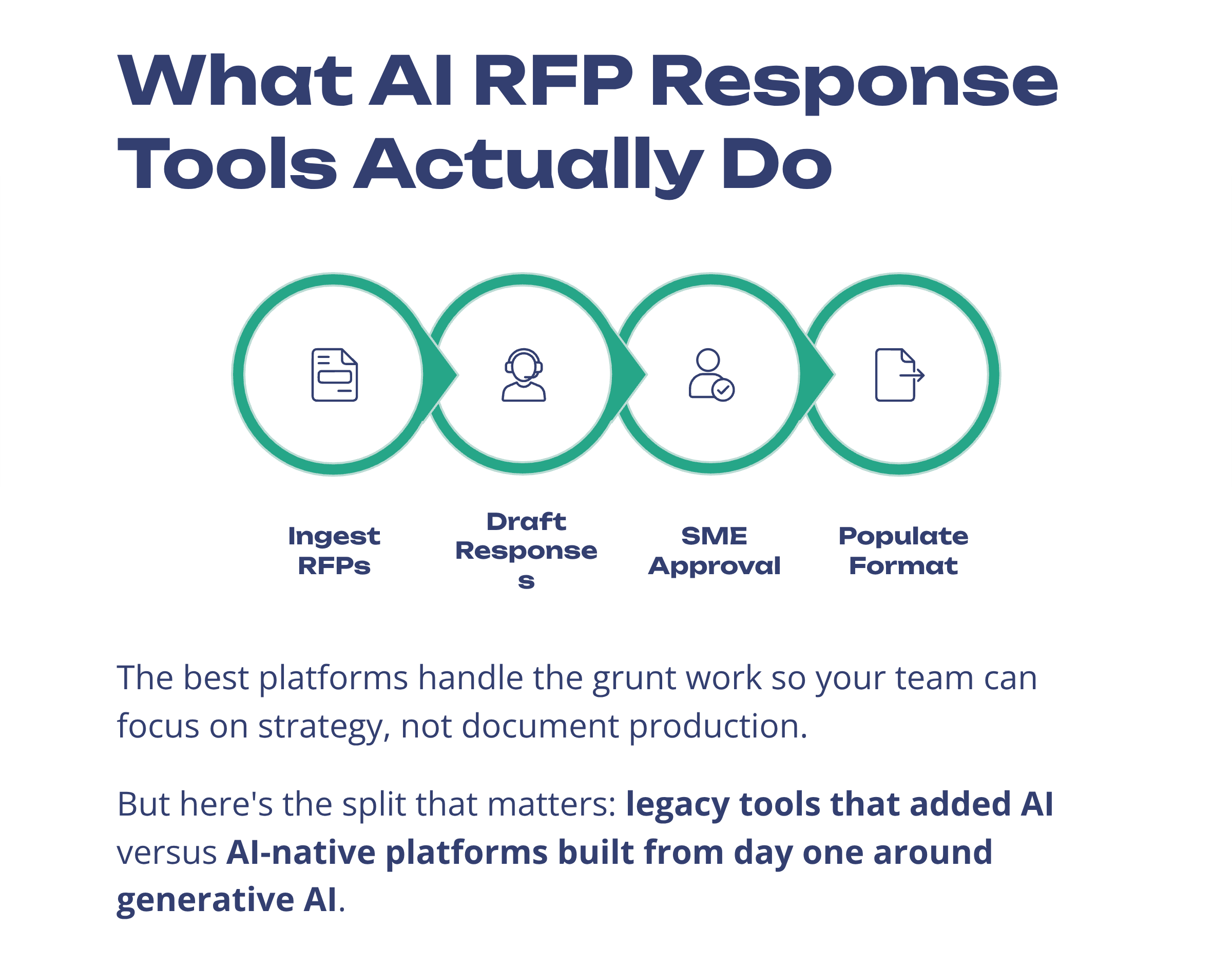
At their core, AI RFP tools do a few things:
- Ingest RFP documents — Word, PDF, Excel, procurement portals — and extract questions into a structured workspace
- Draft answers by pulling from your knowledge library, past proposals, and connected sources
- Route sections to the right SMEs, track progress, and manage approvals
- Fill responses back into the original format so you're not reformatting everything manually
The best platforms cover 60–90% of a first pass with AI. That means your team spends time reviewing and refining instead of starting from scratch every single time.
Here's the thing: this category has split into two very different camps, legacy tools that added AI on top of content libraries, and AI-native platforms that were built around generative AI from day one. Which camp fits you depends a lot on your team's maturity, volume, and appetite for automation.
Looking for an ideal AI RFP response tool? Check out Genie AI.
The Four Categories of AI RFP Tools
The AI RFP tools available in the market are generally divided into four major categories.
1. Library-Centric Legacy Tools + AI
Examples: SparrowGenie, Loopio, Responsive (formerly RFPIO), Qvidian
These platforms have been around the longest and have the most mature content governance, analytics, and enterprise integrations. They added AI as an accelerator, suggesting answers from the library, summarizing content, routing to SMEs. If your team has built a large, well-curated content library, these tools maximize that investment.
Trade-off: The AI is only as good as your library. Setup takes time, and the "agentic" capabilities are lighter compared to newer entrants.
2. AI-Native Platforms
Examples: SparrowGenie, AutoRFP.ai, Inventive AI, 1up, Arphie
Built around generative AI from the ground up. They connect to live knowledge sources, Google Drive, SharePoint, Confluence, Salesforce, and use semantic search to draft answers without requiring teams to manually curate a Q&A library. Faster to get started, more adaptive.
Trade-off: Complex approval workflows and deep governance can lag behind legacy tools in some cases.
3. Security & Trust Center-Centric Tools
Examples: SparrowGenie, 1up, Conveyor
Built for teams with heavy DDQ and security questionnaire workloads. These include AI-powered Trust Centers where prospects can self-serve security questions from your SOC 2/ISO documentation, a major differentiator for compliance-heavy sales cycles.
4. Proposal & Content Tools with RFP AI
Examples: SparrowGenie, Qorus/Highspot, Proposify
Stronger on proposal quality, branding, and Office/PowerPoint integration than on questionnaire volume. Great if your pain is more about proposal design consistency than response automation.
The Best AI RFP Response Tools in the Market
Here are the top picked AI RFP response tools that helps sales teams win 5x faster.
1. SparrowGenie
If you've been managing RFPs long enough, you know the real problem isn't finding the answers; it's the chaos around finding them. Chasing SMEs, reformatting Excel sheets at midnight, watching a $300K deal slip because the response was three days late. SparrowGenie was built specifically to solve that whole mess, not just one piece of it.
Unlike most RFP tools that started as content libraries and bolted AI on top, SparrowGenie was architected from day one as an AI-powered deal execution platform. It ties RFP and questionnaire automation directly to your broader revenue workflow; sales content, proposals, pitch decks, and cross-functional collaboration all in one place.
G2 Rating: 4.5/5.
Key Features:
- AI-powered RFP, DDQ, and security questionnaire response, auto-generates first drafts from your knowledge hub and past proposals in minutes
- Fills responses directly into the original document format, no copy-paste, no reformatting
- Centralized knowledge hub with intelligent search, tagging, and version control
- Role-based approval workflows for sales, pre-sales, legal, and security teams
- Real-time project dashboard with full visibility into active RFPs, deadlines, and blockers
- White-glove onboarding and dedicated customer success from day one
- Integrations with Salesforce, HubSpot, Slack, Teams, Google Drive, SharePoint, and more
Benefits:
- Up to 60% faster RFP responses and 5x more proposals handled without adding headcount
- AI that drafts, humans that decide. The platform keeps your team in control of every submission
- One unified workspace for RFPs, security questionnaires, DDQs, and sales proposals; no more tool-switching
- Built for cross-functional teams: no seat-cost penalties for involving legal, InfoSec, or product contributors
- Every completed RFP makes the knowledge hub smarter, creating a continuous improvement loop
Drawbacks:
- Still building ecosystem visibility on review platforms like G2, which can make procurement sign-off harder in organizations that rely heavily on peer review scores
- As a newer platform, long-term reference volume is smaller compared to incumbents though the white-glove onboarding model helps offset this
SparrowGenie is built for the way modern revenue teams actually work; fast-moving, cross-functional, and increasingly AI-first. If you're a growth-stage B2B company tired of legacy tools that require a full-time librarian to maintain, this platform is worth a serious look.
Best fit: B2B SaaS, IT services, fintech, cybersecurity, and professional services companies with 200–5,000 employees handling 10+ RFPs per month.
Interested to check out SparrowGenie? Book a demo now.
2. Loopio
Source: Loopio
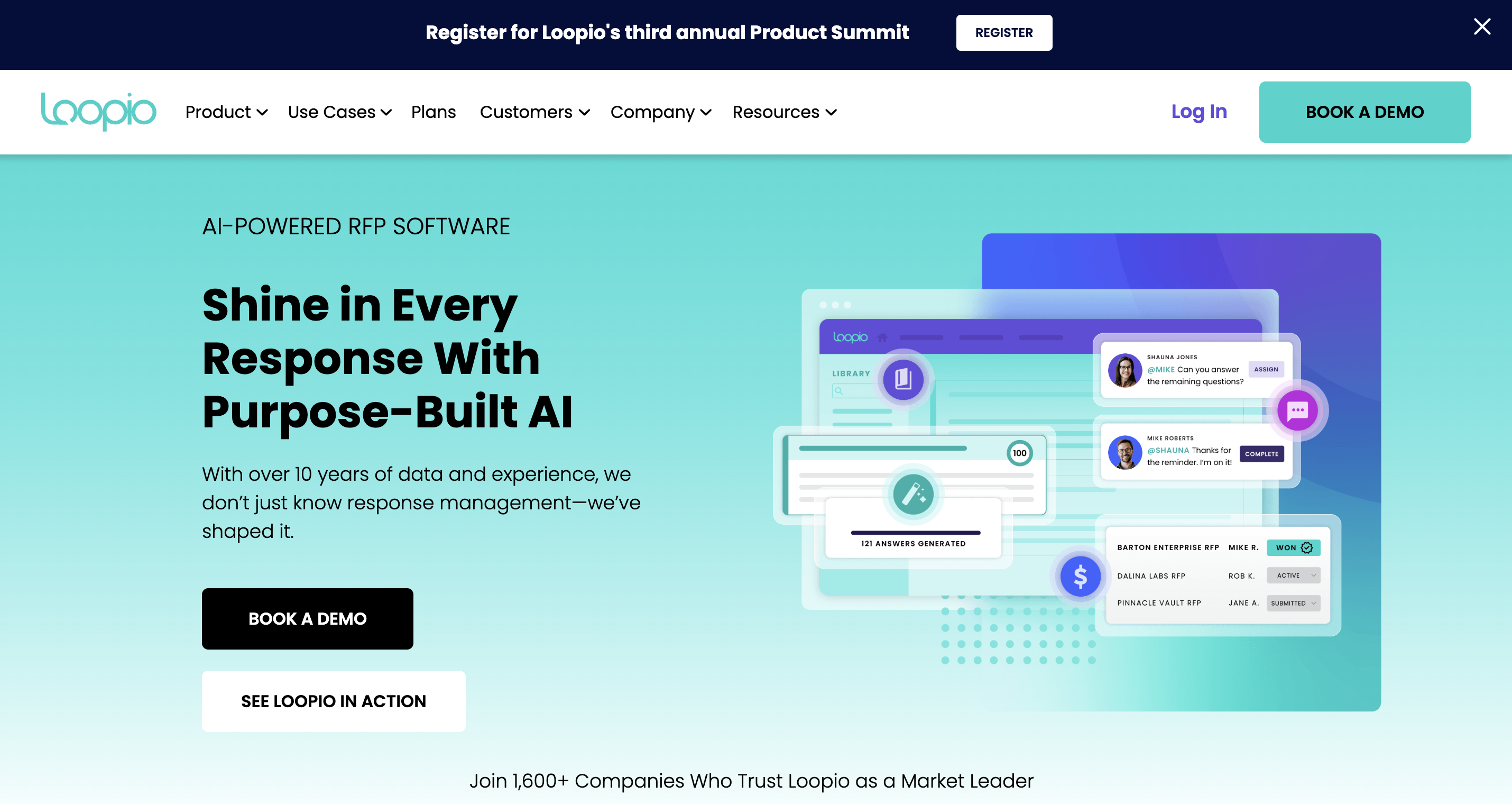
Loopio has been the gold standard for proposal teams with large, well-established content libraries. Ask any senior proposal manager at a Fortune 500 company which tool they grew up on, chances are, it's Loopio. And for good reason. It's mature, well-governed, and built for teams where proposal management is a dedicated function, not an afterthought.
G2 Rating: 4.6/5
Key Features:
- Centralized content library with freshness indicators, tagging, and intelligent categorization
- "Magic" AI, auto-suggests answers from the library and routes to SMEs when confidence is low
- Portal automation via browser extension that autofills procurement portals directly
- In-app commenting, co-editing, task assignment, and version control
- AI writing assistant (2026 update) for rephrasing, tone consistency, and duplicate/stale content detection
- Confidence scoring and SME routing based on historical contributions
- Integrations with Salesforce, Slack, HubSpot, Microsoft Teams, and more
Benefits:
- Exceptionally strong content governance and audit trails, a trusted choice in regulated industries
- Reliable, intuitive interface that teams adopt quickly without long training cycles
- Portal automation is a genuine differentiator, directly autofilling procurement sites saves significant time
- 9.7/10 customer support score is not a marketing claim; reviewers back it up consistently
Drawbacks:
- Library-centric model requires ongoing, disciplined content curation, if your library isn't healthy, the AI isn't either
- "Magic" AI gets mixed reviews for complex or nuanced RFP questions; it's strongest on standard, repetitive sections
- Pricing starts at $20,000+ annually, cost can be hard to justify for teams below enterprise scale
- Integrations can require workarounds and are more complex to configure than the marketing implies
Loopio is a dependable, battle-tested platform. If your team has the capacity to maintain a strong library and you're operating at enterprise scale, it delivers. The challenge is that its AI capabilities are catching up, not leading.
Best fit: Large proposal teams (50+ RFPs/year) in enterprise environments with dedicated content managers and established governance needs.
3. Responsive (formerly RFPIO)
Source: Responsive
Responsive rebranded from RFPIO a few years back, and the name change reflected a genuine product evolution. This is an enterprise-grade, workflow-first platform built for organizations managing high RFx volumes across complex stakeholder networks and global teams. If Loopio wins on simplicity, Responsive wins on depth, and SparrowGenie wins on both.
G2 Rating: 4.5/5
Key Features:
- AI recommendation engine that auto-suggests answers and improves over time
- "LookUp" integration — Chrome extension, Slack/Teams app, and Office add-in that lets reps search the knowledge base from anywhere
- Compliance matrix automation — AI reviews documents, highlights key requirements, and assesses fit
- 20+ native integrations and 75+ API connections for complex enterprise tech stacks
- 10 built-in reporting templates for cycle time, content effectiveness, and performance analytics
- Document analysis for summarization and requirement mapping
- Patented import technology for Word, Excel, and PDF RFPs
Benefits:
- Deepest integration network in the category, if your team lives in Salesforce, Office, Slack, and a custom tech stack, Responsive fits in without friction
- Strong analytics give leadership clear visibility into RFP cycle performance and bottlenecks
- LookUp feature genuinely empowers sales reps to self-serve answers without filing tickets
- Scales well for global teams with multilingual and content translation capabilities
Drawbacks:
- Complex to implement and configure, setup requires significant time investment and IT involvement
- Platform accuracy improves as the library matures, which means early performance may disappoint
- Some users report a steep learning curve, and the interface can feel heavy compared to newer tools
- Seat-based pricing can make cross-functional collaboration expensive at scale
Responsive is a powerful platform in the right hands. The key word is "in the right hands." Teams with experienced proposal managers, clean content libraries, and complex enterprise workflows will get significant value. Teams looking for something fast and lightweight will likely struggle.
Best fit: Mid-to-large global enterprises with high RFx volumes, complex stakeholder workflows, and a mature proposal management function.
4. AutoRFP.ai
Source: AutoRFP.ai
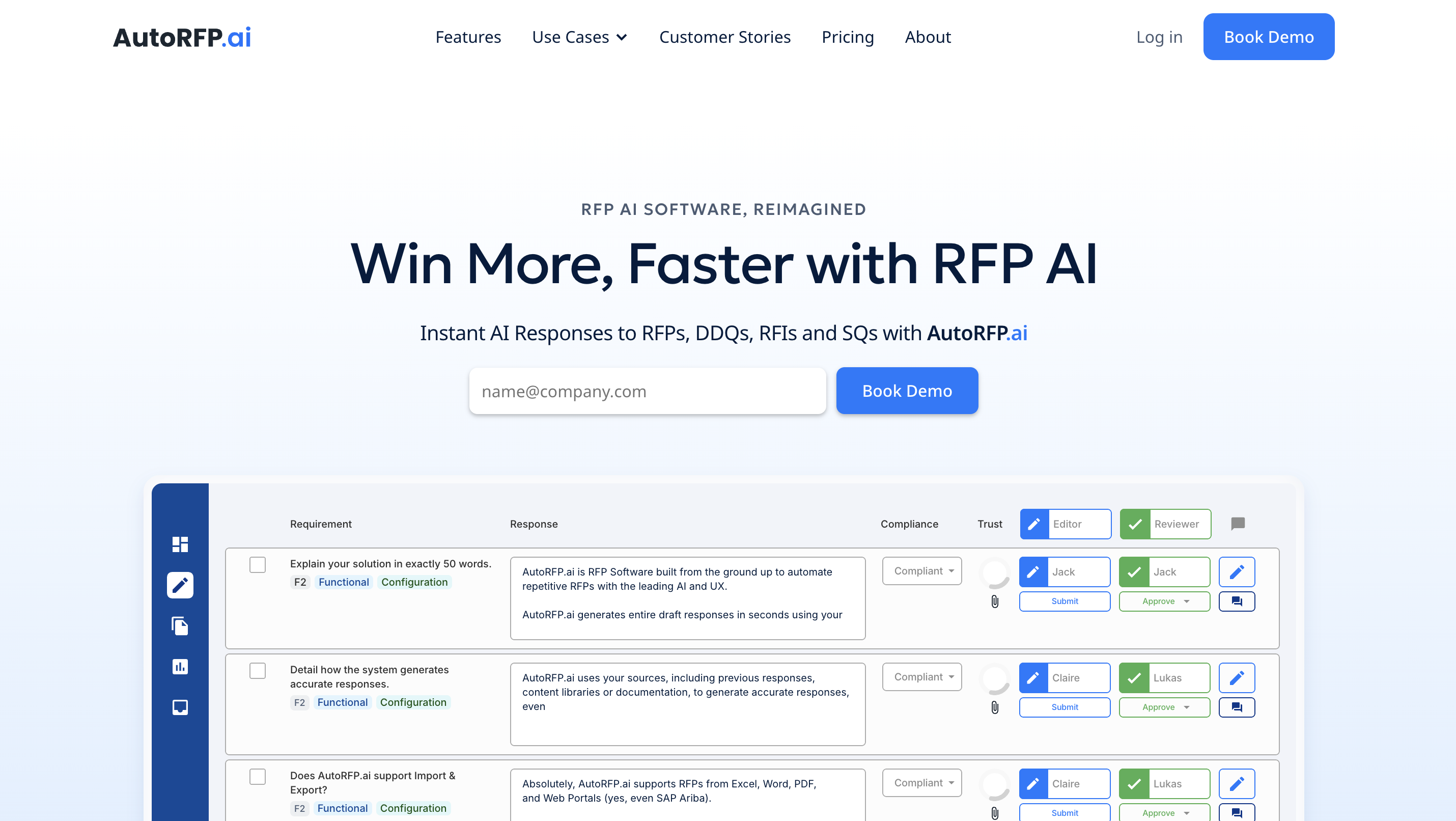
AutoRFP.ai didn't retrofit AI onto a legacy platform, it was built AI-first from day one. That architectural choice shows up in everything from how quickly it gets you to a first draft to how it handles multi-format RFPs without manual reformatting. For teams that want maximum automation and minimal library maintenance overhead, this is one of the strongest options in the category.
G2 Rating: 4.9/5
Key Features:
- AI agents that ingest RFPs and auto-draft responses across Excel, Word, PDF, and web portals
- Connects to 15+ integrated knowledge sources: Salesforce, Slack, Confluence, Google Drive, and more
- "Trust Scores" on every AI-generated answer show teams where the content came from and how confident the system is
- Go/no-go AI evaluator to triage RFPs before committing team resources
- Multi-language support across 30+ languages for global teams
- Unlimited users on all plans, no per-seat penalties as teams grow
- 30-day money-back guarantee, 48-hour onboarding path
Benefits:
- High automation rate up to 80% of questions auto-completed, customers report 30% more RFPs handled and 60% faster response times
- No library maintenance tax: the AI flywheel learns from every completed RFP, keeping content fresh automatically
- Unlimited user model removes collaboration friction, anyone can contribute without licensing concerns
- Fast to get started; teams see value within days, not months
Drawbacks:
- Complex approval chains and deep governance workflows are lighter compared to legacy platforms
- Some users report navigation challenges and limited template flexibility for evolving or non-standard workflows
- Better suited for AI-forward organizations; teams in conservative compliance environments may find the governance controls insufficient
- Reporting depth can be limiting for teams that need granular analytics on content effectiveness
AutoRFP.ai is genuinely impressive for what it does fast, smart, format-agnostic AI drafting with minimal setup. If your team handles a high volume of relatively standardized RFPs and wants to move fast, this platform delivers.
Best fit: SaaS and B2B teams handling 40–200 RFPs/year who want aggressive automation, quick onboarding, and a collaborative model that scales without seat-based cost creep.
Searching a simple, effective, and quick AI RFP response tool? Check out Genie AI.
5. Inventive AI
Source: Inventive AI
Most AI RFP tools draft answers. Inventive AI goes further. It's built on a multi-agent architecture where separate AI agents handle response drafting, competitive research, brainstorming win themes, and analytics, independently and in parallel. That's not a marginal difference. It means your team isn't just filling in answers faster; it's actually thinking more strategically about why it should win.
G2 Rating: 5/5
Key Features:
- Multi-agent AI system: dedicated agents for RFP drafting, competitive research, win strategy brainstorming, and analytics
- Unified knowledge hub pulling from Google Drive, SharePoint, Salesforce, Confluence, legacy tool Q&A exports, and websites
- AI content manager that automatically detects stale, duplicate, or conflicting content across all connected sources
- Multi-format response generation, Excel questionnaires, narrative Word/PDF proposals, security docs
- Real-time conflict detection and content health monitoring
- Task assignments, comments, and customizable permissions for managing contributors
- Supports narrative content like executive summaries and long-form business responses
Benefits:
- The only platform in this roundup with dedicated competitive research and win-theme brainstorming agents, genuinely useful for high-stakes deals
- Content health management is proactive, not reactive; the AI surfaces conflicts before they become submission errors
- Claims 70%+ efficiency improvement with 2x usable answers requiring only minor tweaks
- Strong performance on nuanced, value-statement questions, not just factual yes/no answers
Drawbacks:
- Newer entrant; long-term ecosystem maturity and complex enterprise governance are still developing relative to incumbents
- Some users note the platform rewards teams that invest time in knowledge integration setup, the ROI is high, but the setup isn't always instant
- Reference volume is smaller than legacy platforms, which can matter in enterprise procurement evaluations
Inventive AI is the right choice for teams that think of proposal work as a competitive strategy, not just document production. If you're tired of tools that just fill in the blanks and want one that helps you win, this is worth evaluating seriously.
Best fit: Revenue and proposal teams that want AI to support not just drafting but win strategy, competitive positioning, and continuous knowledge improvement.
6. 1up
Source: 1Up
1up was built by cybersecurity engineers, and that context shapes everything about how the platform works. Security is baked in, not bolted on. SOC 2 compliant, end-to-end encrypted, and explicitly designed to never use your customer data to train models. For teams with heavy security questionnaire and DDQ workloads, that combination of fast AI and bulletproof security posture is hard to find elsewhere.
G2 Rating: 4.9/5
Key Features:
- AI agents that generate complete, first-try responses using semantic search over a unified knowledge base
- Connects to Google Drive, Confluence, Salesforce, Slack, Notion, company websites, and more
- Automatic freshness guarantee; flags outdated, duplicate, or conflicting content without manual curation
- Trust Hub: customer-facing portal where prospects can self-serve security questions from your SOC 2/ISO documentation
- Supports Excel, Word, PDF, and web-based questionnaire formats
- Migration support to help teams move existing RFP libraries into the new workflow
- SOC 2 compliant, end-to-end encryption, zero customer data used for model training
Benefits:
- Security-first architecture makes it the go-to for compliance-heavy sales cycles, particularly in fintech, healthcare, and cybersecurity
- Self-healing knowledge base means less ongoing maintenance compared to library-centric tools
- Freemium entry point and transparent pricing tiers make it accessible for teams not ready for enterprise contracts
- Fast onboarding, teams are typically operational within days
Drawbacks:
- Fewer deep proposal-management features (complex multi-level approvals, intricate project dashboards) compared to Responsive or Loopio
- Better known for speed and security than for strategic depth on complex, narrative-heavy proposals
- Governance and audit controls, while solid, don't quite match the maturity of legacy enterprise platforms
1up is a strong, clean platform for what it does best: fast, secure, format-agnostic RFP and questionnaire automation. If security questionnaires are eating your team's time and you want AI that earns trust rather than just claiming it, put 1up on your shortlist.
Best fit: Security-focused teams with heavy DDQ and questionnaire workloads, or teams migrating from legacy tools who want fast time-to-value and a strong security posture.
7. Arphie
Source: Arphie
Arphie has a clear and deliberate positioning: transparency first. In a market where most AI tools confidently generate answers and move on, Arphie asks a different question, do you actually know where that answer came from? Every AI-generated response comes with citations and confidence scores so your team can inspect the source, validate the accuracy, and submit with genuine confidence.
G2 Rating: 4.9/5
Key Features:
- Every AI answer includes citations and confidence scores; full source attribution, fully inspectable
- Imports Excel and Word questionnaires and auto-organizes sections for response
- Tone and vocabulary customization to match your organization's voice
- Deadline tracking with real-time notifications via email, Slack, or in-app alerts
- Connects to SharePoint, Google Drive, internal wikis, and company documentation
- Combined RFP response and proposal management in a single interface
- Customizable workflows with role-based assignments and approval routing
Benefits:
- Best-in-class transparency in the category, for regulated industries, this isn't a nice-to-have, it's a requirement
- Confidence scoring lets teams prioritize review effort intelligently, spend time where it actually matters
- Fast onboarding with minimal setup; connect your sources and start generating answers
- Strong fit for security and compliance teams who need audit-ready AI outputs
Drawbacks:
- Newer brand with fewer deep ecosystem integrations compared to incumbents, some enterprise tools aren't yet supported
- Less suited for teams that need heavy proposal project management, complex approval chains, or large-scale RFP orchestration
- Reference volume and long-term case studies are limited compared to Loopio or Responsive
Arphie is the honest, careful choice in a category that sometimes oversells AI confidence. If your team operates in a high-stakes, compliance-first environment and you need AI that shows its work — not just its output, Arphie is worth a close look.
Best fit: Teams in regulated industries, fintech, healthcare, legal, cybersecurity, where AI explainability, source attribution, and audit-readiness are non-negotiable.
Quick Comparison: AI RFP Response Tools at a Glance
Tool | Best For | AI Approach | Key Strength | Key Limitation |
|---|---|---|---|---|
Loopio | Large proposal teams, mature libraries | Library + AI assist | Content governance, portal automation | Requires disciplined library maintenance |
Responsive | Mid-to-large enterprises, complex workflows | AI recommendation engine | Deep integrations, strong analytics | Complex setup, slow to mature |
AutoRFP.ai | High-volume, AI-forward teams | AI-native agents | Speed, multilingual, minimal library upkeep | Lighter governance/approval flows |
Inventive AI | Teams wanting strategic AI beyond responses | Multi-agent platform | Win strategy, competitive research agents | Newer entrant, maturing governance |
1up | Security-heavy teams, migrations | Semantic AI + auto-freshness | Security posture, fast onboarding | Fewer deep proposal management features |
Arphie | Regulated industries, risk-sensitive teams | Citation-first AI | Transparency, confidence scores, audit-readiness | Smaller footprint, fewer integrations |
SparrowGenie AI | Growth-stage B2B, RevOps-connected teams | Revenue execution AI | End-to-end deal execution, white-glove support | Building ecosystem visibility vs. incumbents |
Explore the best AI RFP response tool with Genie AI.
How to Actually Choose AI RFP Response Tool for Your Team
Before you schedule demos, get clear on these six dimensions.
1. What's your RFP mix?
Are you mostly handling narrative Word/PDF proposals, Excel-grid questionnaires, security questionnaires, or procurement portal submissions? AutoRFP and 1up shine on multi-format automation. SparrowGenie, Loopio and Responsive are strongest for narrative-heavy proposals with complex governance.
2. How's your knowledge base today?
If you've already spent years building a curated Q&A library, tools like Loopio and Responsive maximize that investment. If you're starting fresh or want AI to learn from live connected sources, AI-native platforms like Inventive, 1up, or SparrowGenie get you to value faster.
3. How much automation do you want?
There's a spectrum from "AI suggests, humans do the work" to "AI agents plan, draft, and route, humans review." The right answer depends on your team's risk tolerance and the complexity of your deals. High-stakes enterprise proposals often warrant more human oversight; high-volume standardized questionnaires benefit from heavier automation.
4. What does collaboration look like for your team?
If you have complex multi-stakeholder approval chains, SparrowGenie, Responsive and Loopio have the deepest workflow management. If your team collaborates asynchronously across Slack/Teams and wants AI embedded in those tools, AI-native platforms often integrate more naturally.
5. What are your security and compliance requirements?
For regulated industries, pay close attention to SOC 2 status, data residency options, SSO/SCIM support, and audit trails. Arphie and 1up are built with these as first-class features. SparrowGenie's role-based workflows and version control address this directly as well.
6. What's the true cost of onboarding?
Some platforms are fast to get started but require heavy customization later. Others take longer upfront but have a more structured path to ROI. Ask every vendor: what does week one look like? What does month three look like? Where do teams typically get stuck?
Three Trends Shaping AI RFP Response Tools in 2026
Let's have a look at the top trends shaping the AI RFP responses in 2026.
From static libraries to live knowledge graphs
The shift is clear: the best tools are moving away from manual Q&A curation toward live connections to Google Drive, SharePoint, Confluence, Salesforce, and websites, with AI that detects and resolves conflicting information in real time. Less maintenance, more accuracy.
Agentic workflows are replacing simple suggestions
Earlier tools suggested answers and let humans do the rest. Newer platforms run multi-step agents that plan the response, map requirements, identify the right SMEs, and draft content, with humans reviewing rather than building from scratch. That's a fundamentally different productivity model.
Security as a strategic differentiator
As AI handles more sensitive proposal content, security posture has moved from checkbox to key differentiator. Platforms with Trust Centers, NDA-gated information sharing, and SOC 2 compliance are pulling ahead in enterprise evaluations, especially for security questionnaire workloads.
The Bottom Line
There's no universal best AI RFP response tool. There's the best tool for your team, your volume, your existing tech stack, and your specific pain points.
If you're a growth-stage B2B company handling 10+ RFPs a month, especially in SaaS, IT services, fintech, or cybersecurity, and you want AI that works across the full deal cycle rather than just the response phase, SparrowGenie is worth a serious look.
But whatever you choose, the right AI RFP tool should do one thing above all else: give your proposal team their time back so they can focus on winning, not just responding.
The best proposals aren't written under pressure at 11 PM. They're crafted by teams with the right tools, the right content, and enough breathing room to think strategically about why they should win, not just what the client asked.
That's what AI RFP response tools, at their best, make possible.
Want to See SparrowGenie in Action?
SparrowGenie helps B2B teams generate accurate RFP responses in minutes, collaborate across functions without the email chaos, and close more deals without burning out their proposal team.
Book a 15-minute demo now.
Ready to see how AI can transform your RFP process?
Product Marketer at SparrowGenie
Being a Product Marketer at SparrowGenie, Aparna helps sales teams work faster with secure, AI-powered proposal automation. She turns complex features into simple stories, builds messaging that resonates, and keeps a close pulse on what customers actually need. She loves shaping clear, helpful content that shows how SparrowGenie makes RFP work easier, faster, and a lot less stressful.