15+ Arphie Alternatives: The Complete Guide to RFP Software in 2026

Article written by
Aparna Rajendran

INSIDE THE ARTICLE
SHARE THIS ARTICLE
Summary
Looking for Arphie alternatives? We analyzed 15+ RFP tools across G2 ratings, AI capabilities, and real user feedback to help you find the right fit.
Are you tired of the one RFP tool you have been working on or casually looking for an RFP automation tool that makes your sales team's life hassle-free?
I completely get it!
And right now, trust me, the RFP software market has exploded. Literally!
What used to be a two-horse race has turned into a battlefield. AI-native platforms like SparrowGenie are emerging left and right, legacy tools are bolting on machine learning features, and sales teams are drowning in options.
If you're evaluating Arphie and wondering what else is out there, you're not alone. Maybe the pricing doesn't fit. Maybe you need deeper integrations. Or maybe you just want to see what else the market offers before committing.
We dug into G2 data, combed through user reviews, and analyzed 15+ tools to give you a clear picture of the Arphie alternatives landscape.
The Market at a Glance
Before we dive into individual tools, let's break down where the market stands:
Enterprise RFP Suites
SparrowGenie, Responsive, Loopio, Qvidian, QorusDocs, and RFP360 sit in the 4.3-4.7 G2 rating range with hundreds to thousands of reviews. Battle-tested and feature-rich but often criticized for complexity.
AI-First RFP Platforms
SparrowGenie, AutoRFP, Inventive, SiftHub, 1up, Thalamus AI, and SEQUESTO are pushing 4.8-5.0 ratings with smaller but highly enthusiastic user bases. These tools were built around AI from day one.
Broader Proposal Tools
SparrowGenie, PandaDoc, Proposify, and YoroCRM handle RFPs as part of a wider sales automation suite. Good if you want fewer tools; less deep on RFP-specific workflows.
Now, let's get into the details.
The Complete List: 16 Arphie Alternatives
Here are around 15+ Arphie alternatives that you can look for if you're planning a switch soon:
1. SparrowGenie
G2 Rating: 4.5/5
Secure AI enablement meets cross-functional collaboration.
What makes it stand out:
- Cross-functional workspace that brings Sales, Presales, Legal, and InfoSec into one governed, AI-assisted environment. No more chasing down SMEs across Slack and email.
- Speed with built-in trust. Features like dual mapping, confidence-scored answers, and conflict detection mean reviewers focus only where they need to. Less noise, faster turnarounds.
- Review-first design philosophy. Unlike tools that optimize for speed at the expense of accuracy, SparrowGenie is built for teams where compliance and precision matter as much as velocity.
- Strong early user sentiment. G2 reviewers highlight ease of use, faster proposal processes, and enhanced collaboration across departments.
Where it falls short:
- Ecosystem still evolving. Integrations and partner networks are growing but are not as mature as decade-old incumbents.
The verdict: SparrowGenie is built for teams that need AI speed without sacrificing governance. If your RFP process involves multiple stakeholders (legal review, security sign-off, compliance checks), this is one of the few tools designed specifically for that reality. The review-first approach means AI assists the process without becoming a black box.
Best for: Mid-market to enterprise teams where cross-functional review is non-negotiable. Particularly strong for regulated industries, financial services, and any organization where getting an answer wrong isn't just embarrassing but risky.
Ready to explore SparrowGenie?
2. Responsive (formerly RFPIO)
G2 Rating: 4.5/5
The enterprise standard. Powerful, proven, and feature-packed.
Source: Responsive
What makes it stand out:
- Enterprise-grade depth covering RFP, RFI, and RFQ automation with advanced Answer Library, collaboration tools, and integrations with Salesforce, Microsoft 365, Slack, and Seismic.
- Category leader status. G2 and analyst reports consistently position Responsive as a top global RFP platform, especially for large enterprises.
- AI-assisted writing and search. AI writing and content lookup cut time-to-first-draft significantly.
Where it falls short:
- Complexity and learning curve. The interface can feel overwhelming. Power users thrive, but occasional users often struggle.
- Implementation overhead. Onboarding, configuration, and content library setup require serious investment, especially for smaller teams.
- Premium pricing. Frequently noted as one of the more expensive options in the category.
The verdict: Responsive is the safe enterprise choice. If you have a budget, resources for implementation, and need every feature imaginable, it delivers. Just be prepared for the learning curve.
Best for: Large RFP teams with dedicated admins and a budget for thorough onboarding and governance.
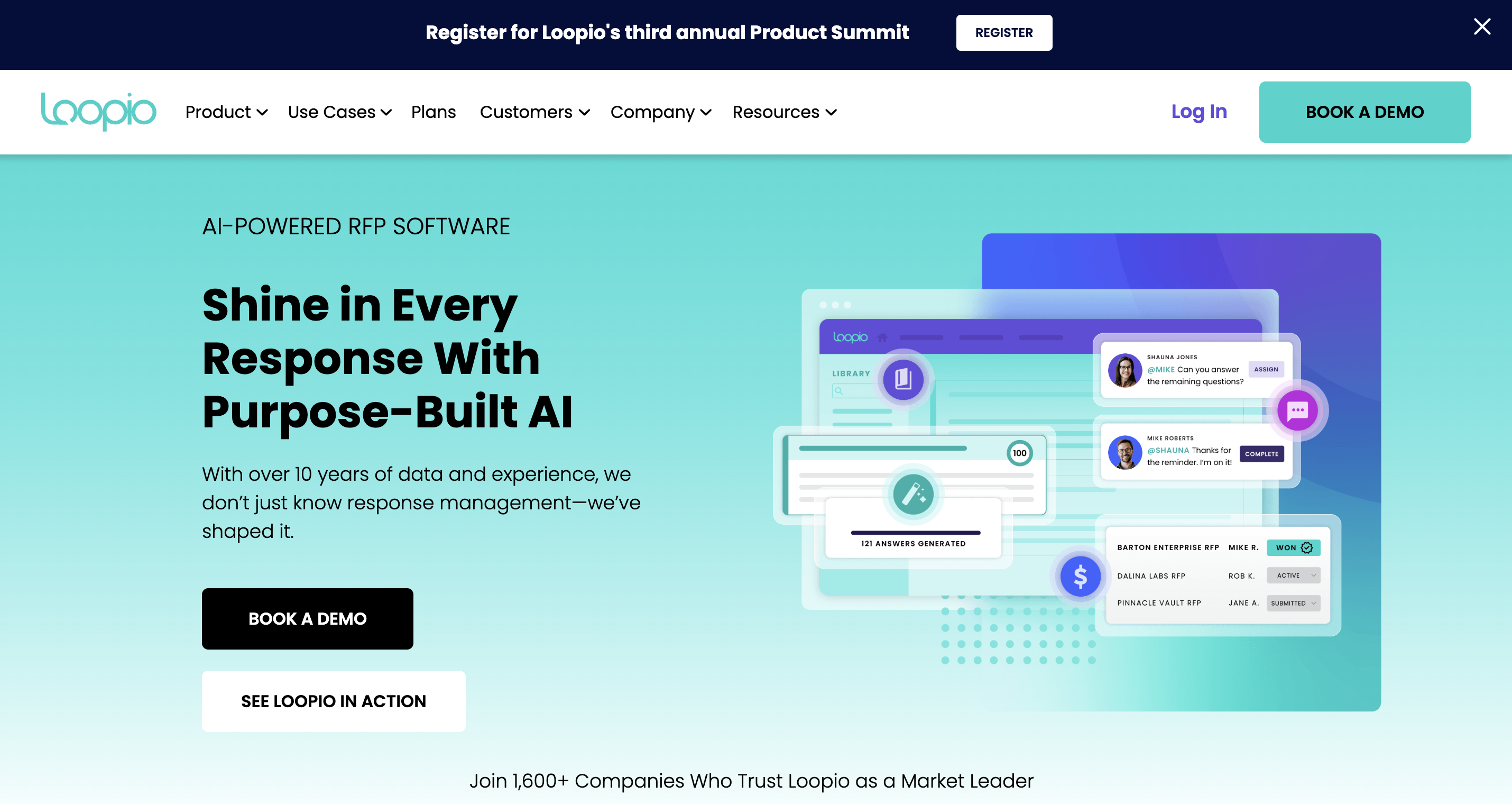
3. Loopio
G2 Rating: 4.6/5
Best-in-class content library with excellent support.
Source: Loopio
What makes it stand out:
- Superior content library UX. Users consistently praise the tagging, search, and organization capabilities.
- Ease of use and support. Loopio often outscores competitors on ease-of-use metrics, with support scores around 9.7/10.
- Governed AI approach. GenAI features are grounded in approved content, giving you automation without losing control.
Where it falls short:
- Library maintenance overhead. Keeping content deduplicated, updated, and governed as libraries grow requires ongoing effort.
- Less agentic AI. Compared to AI-native platforms, Loopio's AI feels more like smart search than autonomous assistance.
The verdict: Loopio hits the sweet spot between capability and usability. If you want a governed platform with excellent support and don't need fully autonomous AI, this is a strong contender.
Best for: Mid-market and enterprise teams seeking a mature, easy-to-adopt RFP platform with a strong content library.
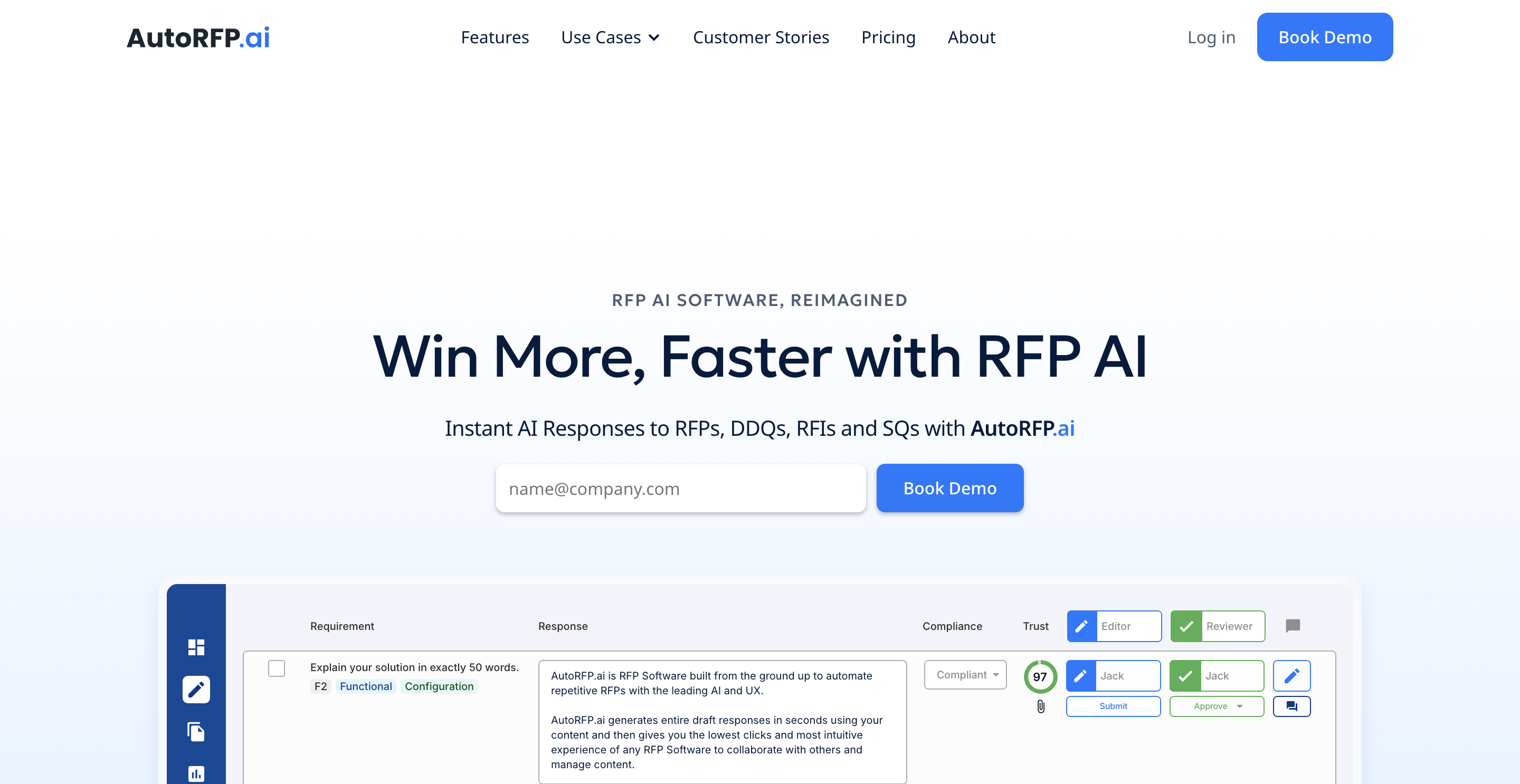
4. AutoRFP.ai
G2 Rating: 4.9/5
AI-first architecture with aggressive automation.
Source: AutoRFP.ai
What makes it stand out:
- Built from day one around AI automation for RFPs, security questionnaires, and DDQs. Not legacy software with AI bolted on.
- High adoption rates. Marketed as having the highest user adoption across G2's RFP category.
- Modern, clean UX. Makes AI features accessible even for non-technical teams.
Where it falls short:
- Premium pricing. Multiple comparisons note AutoRFP as more expensive than some alternatives.
- Younger ecosystem. Less established than Loopio or Responsive in terms of partner network and long-term roadmap visibility.
The verdict: AutoRFP is for teams that want aggressive AI automation and are willing to pay for it. If turnaround time is your primary metric, this belongs on your shortlist.
Best for: Teams prioritizing speed and AI-driven automation over deep legacy workflows.
Looking for an alternate RFP management platform?
5. Inventive AI
G2 Rating: 4.9/5
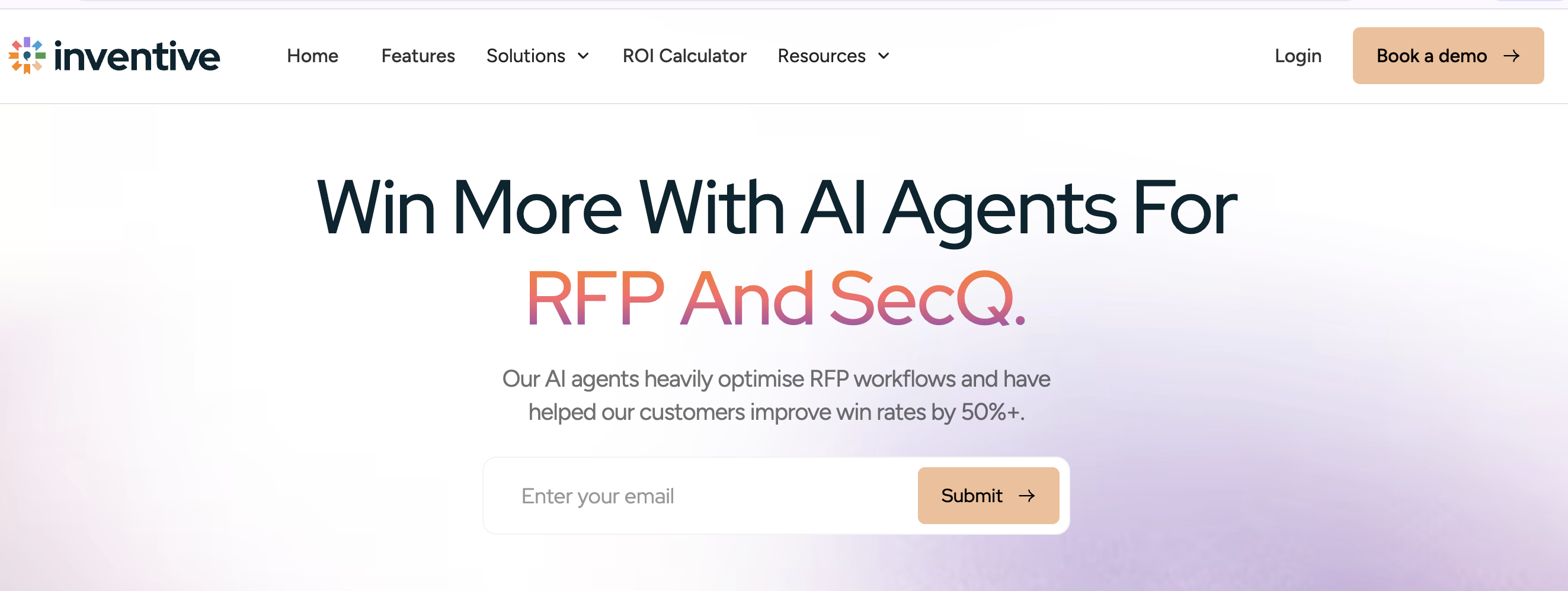
Multi-agent architecture with context-aware reasoning.
Source: Inventive AI
What makes it stand out:
- Agentic architecture with specialized AI agents for RFP drafting, competitive research, and answer refinement.
- Context Engine that reasons across multiple source documents, meeting notes, and even live web research.
- Content health automation that auto-detects stale, duplicate, or conflicting content.
Where it falls short:
- Newer platform with a shorter reference list for risk-averse enterprise buyers.
- Power-user orientation. The configurability and AI depth may require strong enablement for less mature teams.
The verdict: Inventive positions itself as the thinking platform. If you want AI that reasons across documents rather than just matching keywords, this is worth serious consideration.
Best for: Teams wanting best-in-class AI reasoning and willing to invest in proper enablement.
6. SiftHub
G2 Rating: 4.5/5
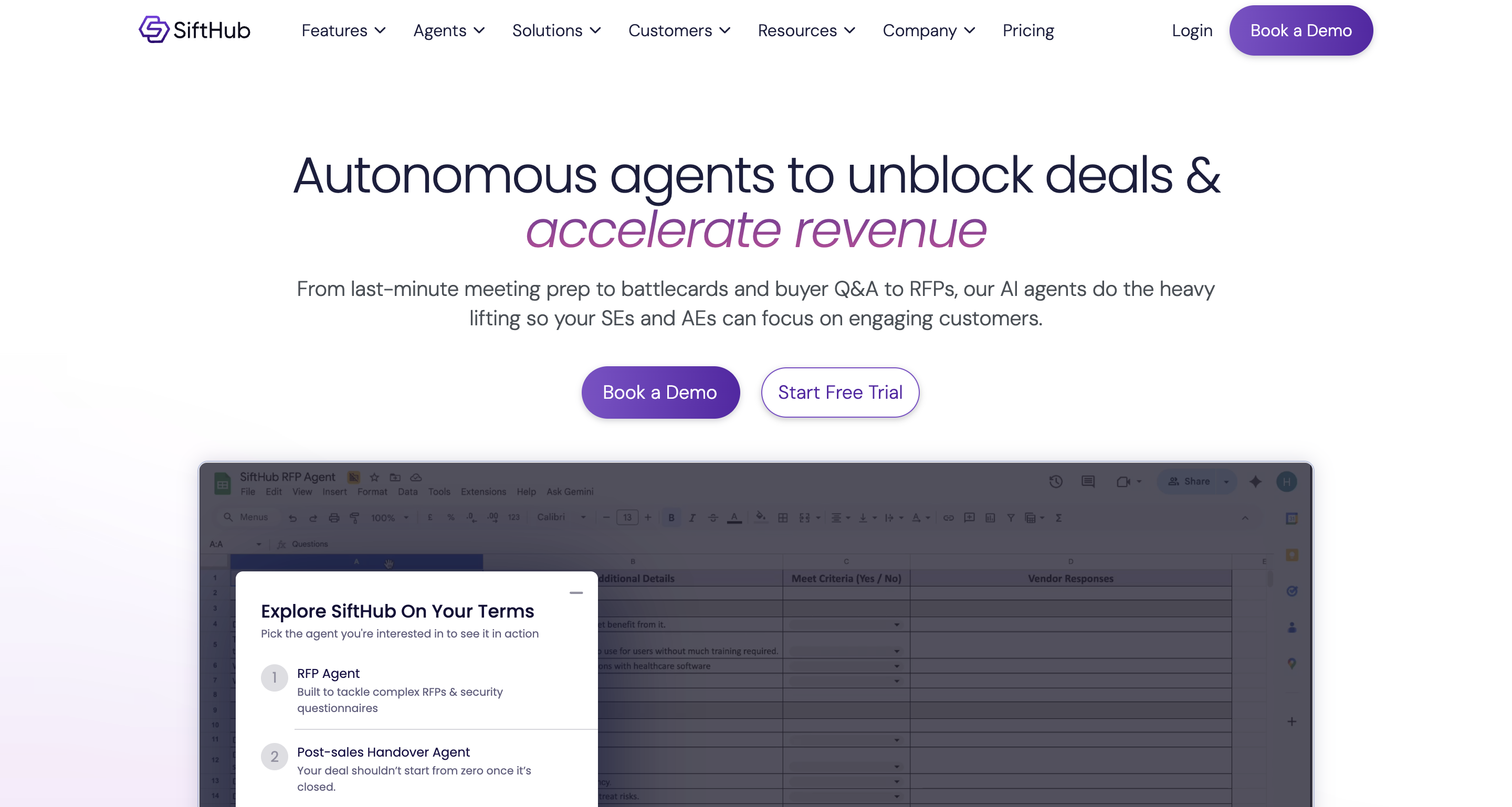
AI Sales Engineer that goes beyond RFPs.
Source: Sifthub
What makes it stand out:
- Unified GTM knowledge hub. An AI platform that centralizes knowledge for battlecards, Q&A, RFPs, and collateral creation.
- Strong RFP use case with fast search across connected sources and auto-filling questionnaires.
- High support and usability scores around 9.7/10.
Where it falls short:
- Integration gaps. Users note some missing integrations like direct Salesforce write-back, though actively being addressed.
- Accuracy ramp. Early deployments sometimes need tuning, though accuracy improves over time.
The verdict: SiftHub is best viewed as an AI GTM knowledge layer that happens to do RFPs very well. Ideal if you want one AI brain for all sales knowledge.
Best for: Teams wanting a single AI hub for Q&A, battlecards, and RFPs without separate point solutions.
7. 1up
G2 Rating: High (20+ reviews)
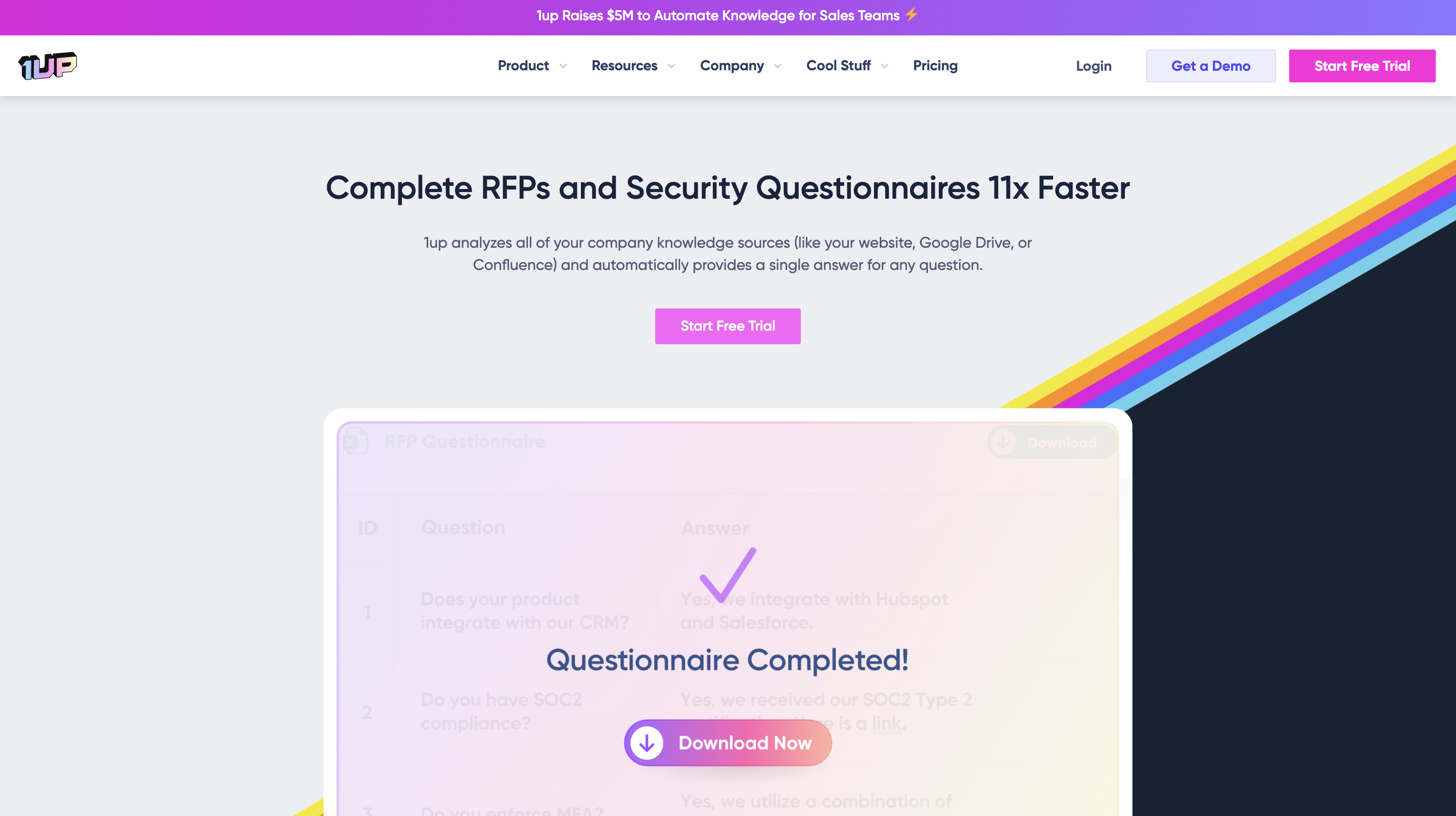
Sales-first knowledge automation.
Source: 1up
What makes it stand out:
- Sales-first positioning that automatically answers RFPs, questionnaires, and ad hoc questions from trusted sources.
- Strong centralization. Users praise going from scattered answers across SharePoint, Confluence, and Slack to a single source of truth.
- Fast implementation. Users describe setup as super smooth, implemented in days.
Where it falls short:
- Early-stage product with a smaller review count and shorter track record.
- Feature depth may be lighter on RFP-specific workflows like complex Excel mapping compared to specialist platforms.
The verdict: 1up is compelling if you view RFPs as one of many sales knowledge problems. A good fit for teams wanting one AI hub rather than a dedicated RFP suite.
Best for: Sales teams wanting unified knowledge automation across Q&A, battlecards, and RFPs.
8. Thalamus AI
G2 Rating: 5.0/5 (Limited reviews)
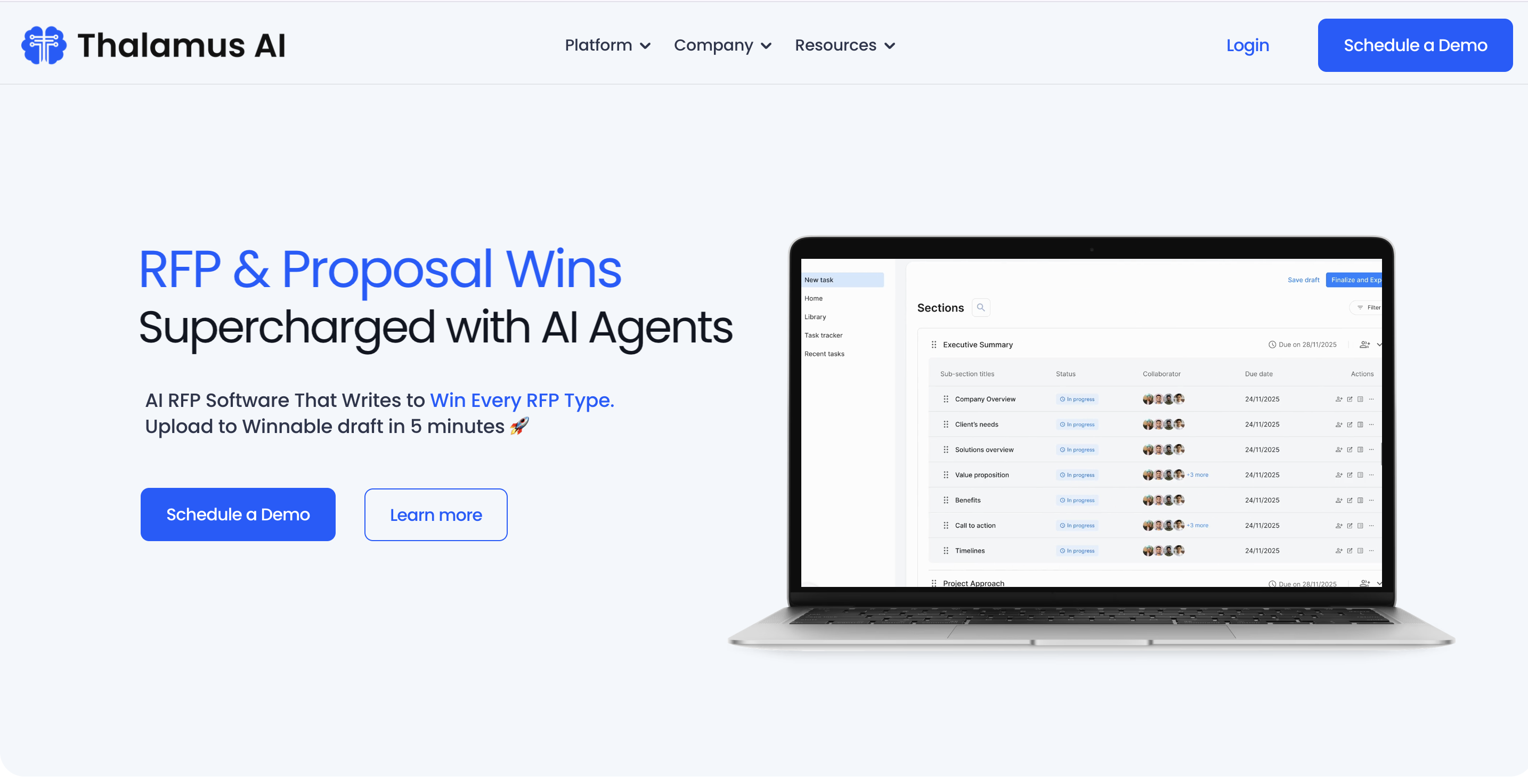
Agentic AI with 20+ specialized agents.
Source: Thalamus AI
What makes it stand out:
- Multi-agent architecture with 20+ specialized agents for shredding, tagging requirements, bid/no-bid analysis, drafting, and more.
- Enterprise and compliance focus targeting complex government, infrastructure, healthcare, and defense RFPs.
- Excellent usability. G2 cites a 5/5 usability rating with an intuitive interface for non-technical users.
Where it falls short:
- Early-stage stability. Some reviews mention occasional bugs like freezing screens, framed as early issues.
- Enterprise-only posture. Lack of clear pricing may exclude smaller teams.
The verdict: Thalamus is top-tier agentic AI for compliance-heavy workflows. Overkill for small teams, but powerful for large enterprises in regulated industries.
Best for: Large enterprises and government/regulated players wanting deep multi-agent automation.
Explore SparrowGenie to experience seamless AI-powered RFP management
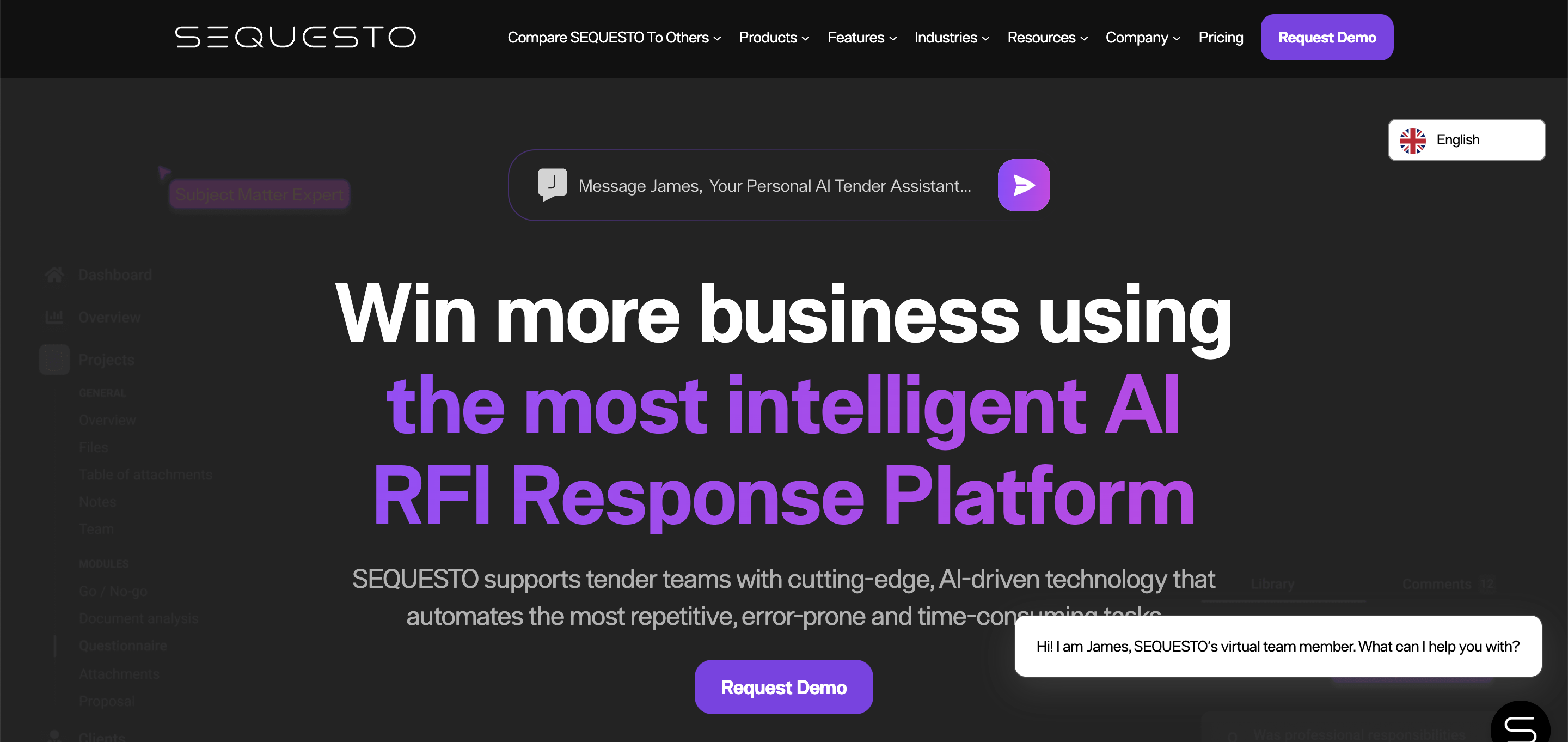
9. SEQUESTO
G2 Rating: 4.9/5
Next-gen RFP and tender platform with multilingual capabilities.
Source: Sequesto
What makes it stand out:
- Powerful AI Assistant called a game changer by reviewers, with highly accurate, fast answers and auto-fill of questionnaires.
- Collective Memory knowledge base with summarization, rephrasing, and translation directly in embedded Word/Excel editors.
- Dramatic speed-ups on repetitive tasks with stronger bid/no-bid analysis and elimination of knowledge loss when staff leave.
Where it falls short:
- Premium positioning. Value is seen as high, but budget-constrained teams may hesitate.
- Small but enthusiastic sample. Only a handful of G2 reviews so far.
The verdict: SEQUESTO is one of the strongest modern AI RFP platforms. For teams with budgets, it offers top-tier AI plus rich tender workflows.
Best for: Teams with budgets seeking next-gen AI capabilities, especially for tender responses and multilingual needs.
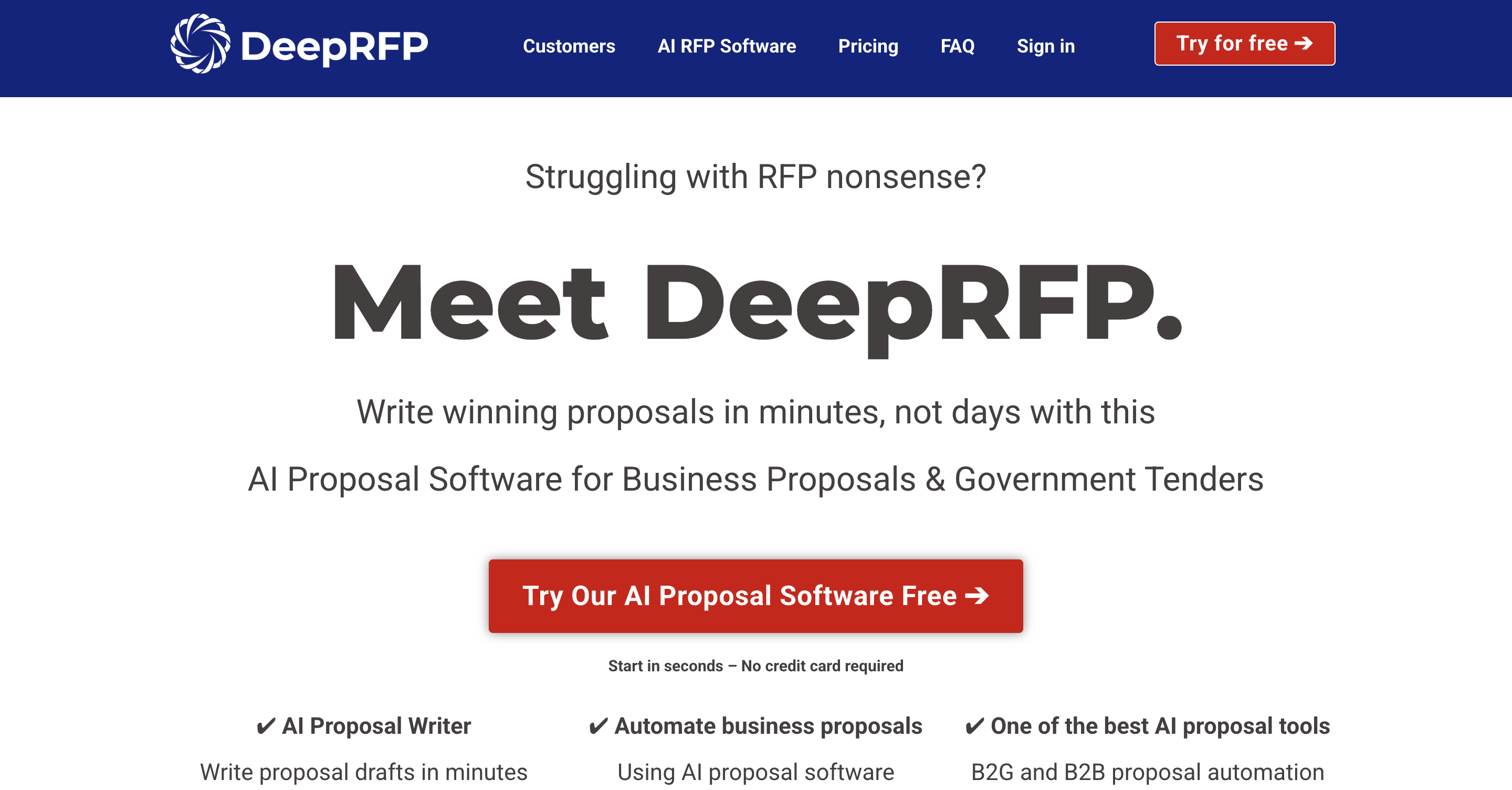
10. DeepRFP
G2 Rating: 4.3/5
Purpose-built AI for autonomous proposal management.
Source: DeepRFP
What makes it stand out:
- Focused AI RFP platform for shredding, drafting, and managing proposals.
- Versatile across commercial B2B RFPs, government tenders, and grants with flexible tone and style.
- Security posture with SOC 2-aligned practices for sensitive proposal content.
Where it falls short:.
- Less public review volume makes benchmarking harder compared to established players.
The verdict: DeepRFP is a solid AI-native alternative for teams wanting more autonomy than legacy tools without heavyweight enterprise processes.
Best for: Mid-market and services firms wanting AI to carry most of the drafting load.
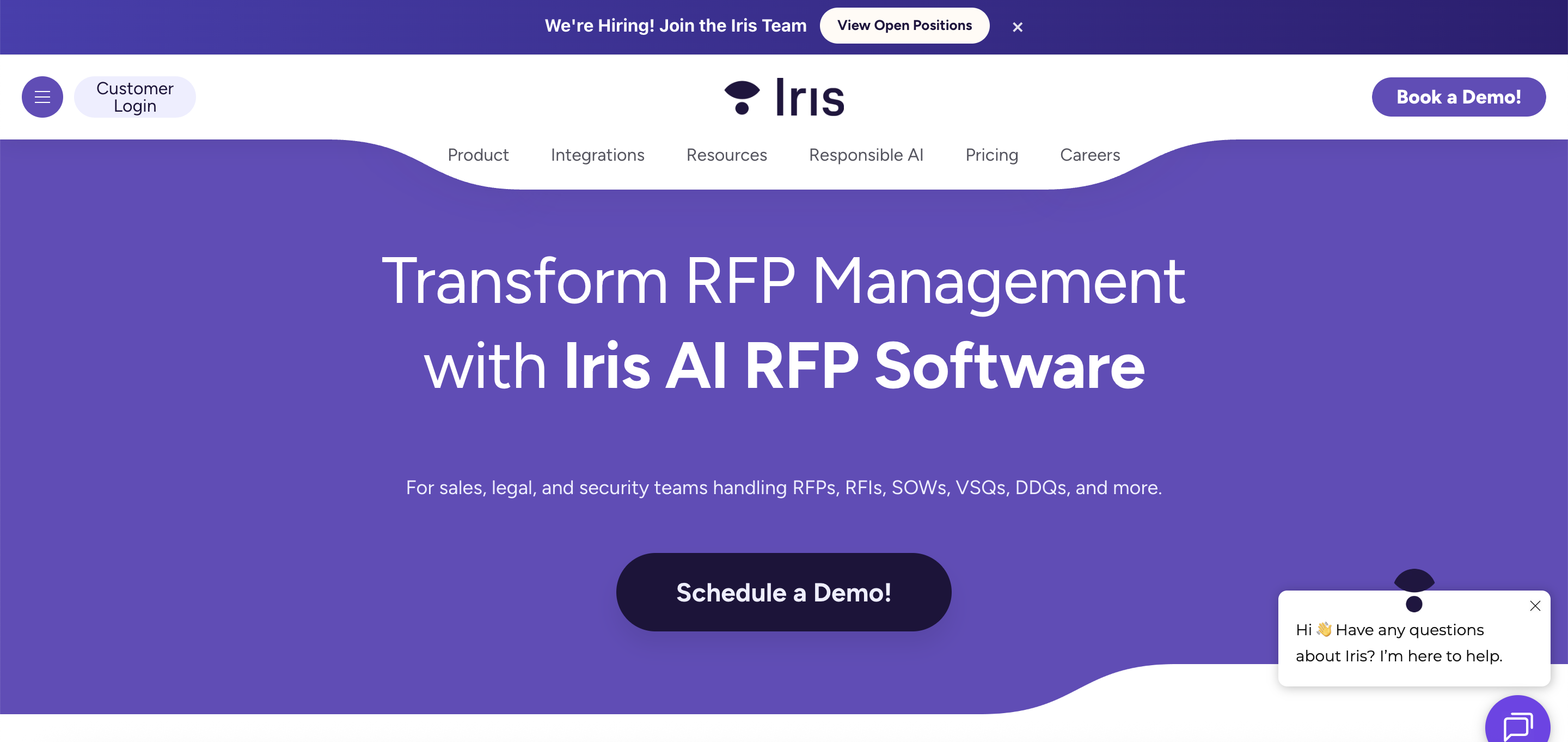
11. Iris (HeyIris.ai)
G2 Rating: 4.9/5
RFP completion plus research intelligence.
Source: HeyIris.ai
What makes it stand out:
- Dual-purpose platform for RFP questionnaire completion (especially Excel-based) and consolidating research and competitive insights.
- Major time savings gathering context and producing summaries vs. manual digging.
- More advanced reporting features than some competitors like 1up or AutoRFP.
Where it falls short:
- AI tone can sometimes produce robotic-sounding responses or aggregate multiple answers instead of picking one.
- Missing mobile support and some desired integrations, plus minor technical glitches.
The verdict: Iris is an AI RFP plus research copilot. Good for teams wanting one tool for RFPs and broader revenue intelligence.
Best for: Teams needing RFP completion combined with research and competitive insights in one platform.
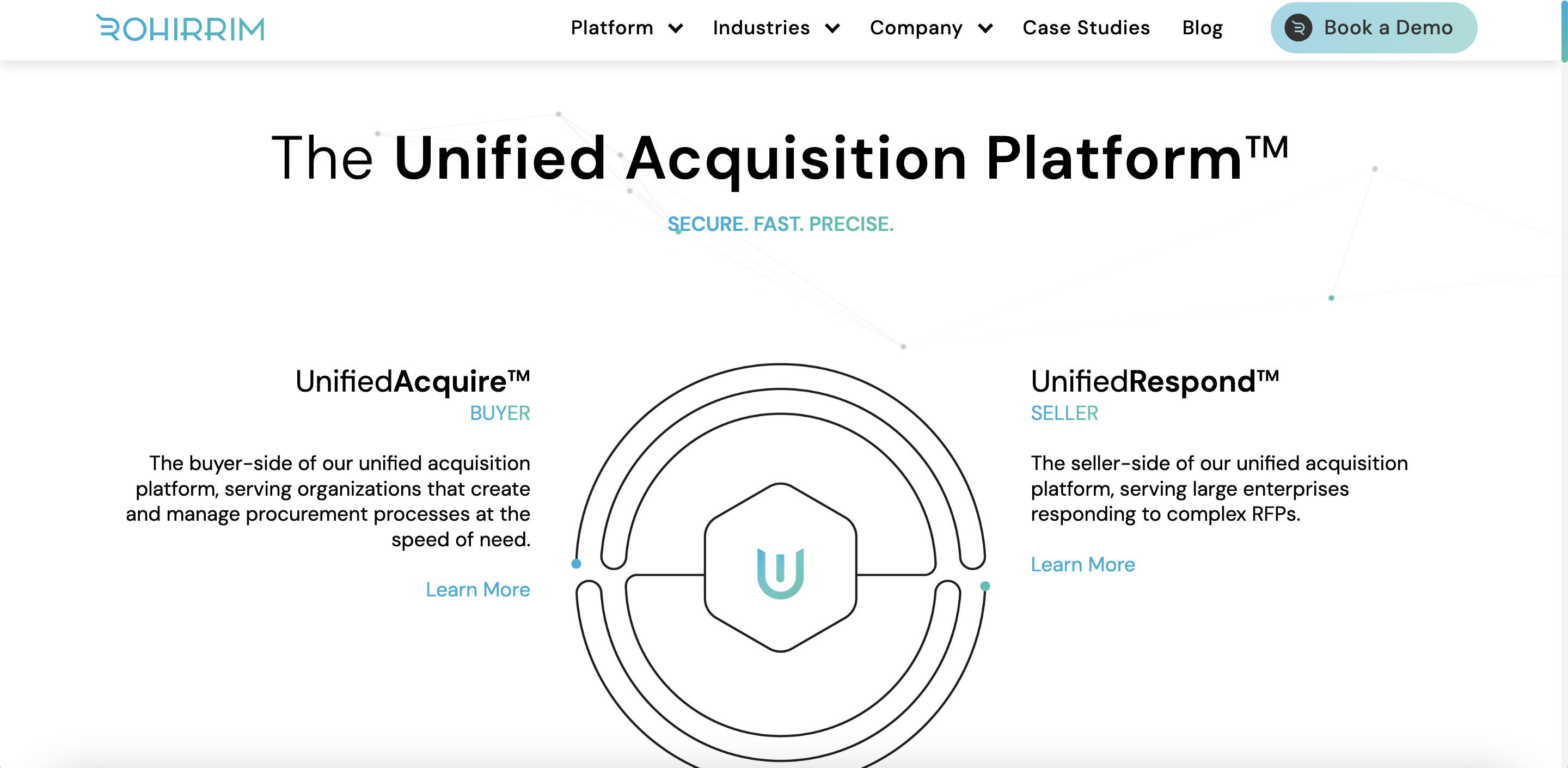
12. Rohirrim
G2 Rating: 4.8/5
Organization-specific generative AI.
What makes it stand out:
- Tailors responses to your company's own data, style, and terminology via patented AI tuned to your organization.
- Specialist roles, including dedicated Answer Engine, Solutions Architect, and Proposal Writer features.
- Strong outcomes with claims like 4000% faster first drafts and handling more RFPs without growing headcount.
Where it falls short:
- Interface nits. Some users request UX improvements like sticky folder selections.
- Limited public reviews make benchmark comparisons less robust.
The verdict: Rohirrim is a highly satisfactory and org-specific AI-RFP platform. Compelling for professional services and regulated sectors where nuanced, brand-aligned drafts matter.
Best for: Professional services and regulated sectors needing organization-specific AI with brand alignment.
13. Upland Qvidian
G2 Rating: 4.3/5
Legacy proposal automation with deep Office integration.
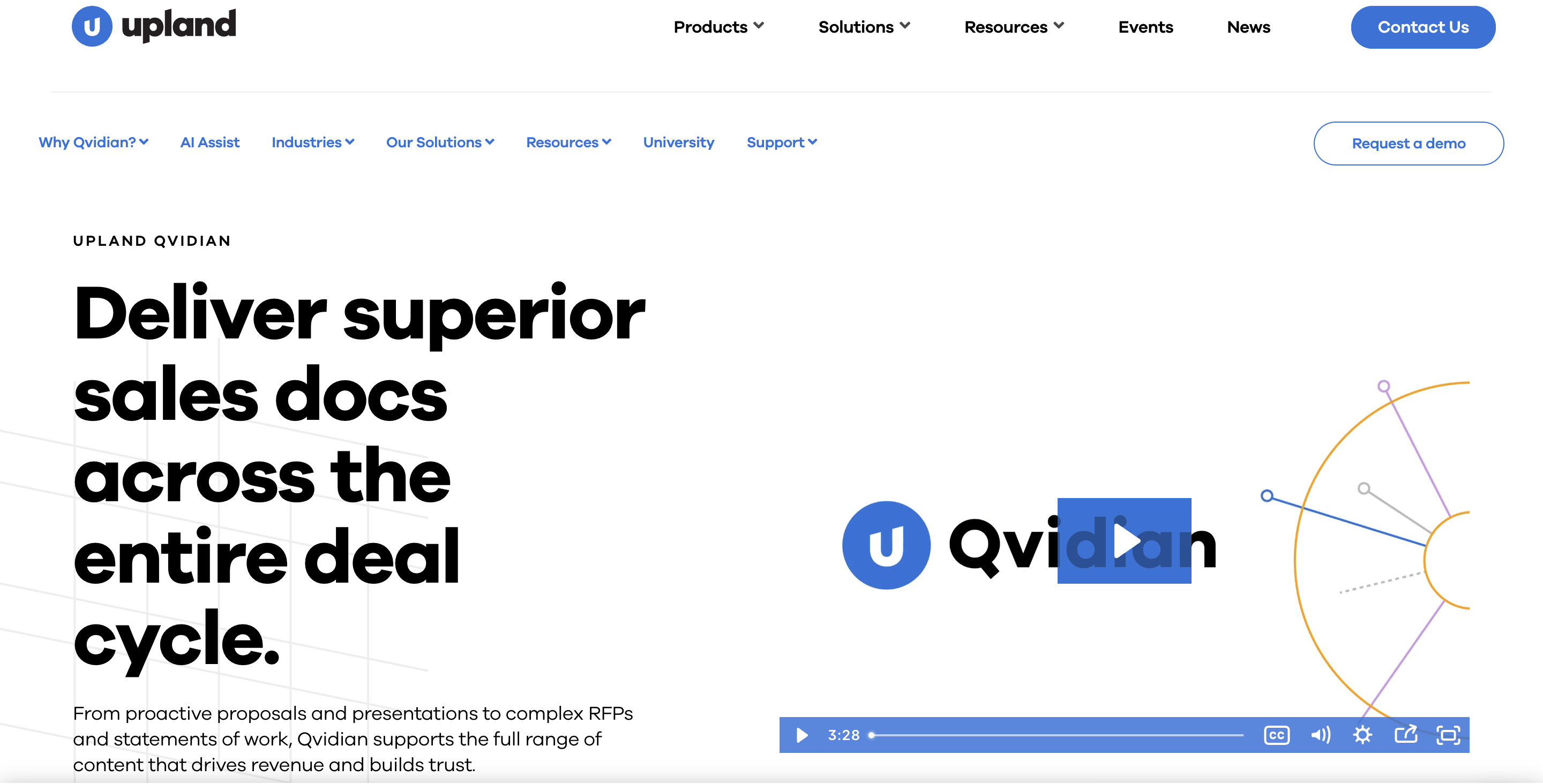
Source: Upland Qvidian
What makes it stand out:
- Long-standing proposal and RFP automation with strong Microsoft Office integration and multi-page document handling.
- Content repository depth with central library, search within folders, and feedback workflows.
- Reliable infrastructure with minimal downtime and consistent behavior over years.
Where it falls short:
- Complex UI and learning curve. Users describe it as sometimes too complex and non-intuitive compared to newer tools.
- Slower innovation. While it now has AI Assist, many comparisons show it lagging AI-native platforms.
The verdict: Qvidian is reliable and document-centric. Qvidian excels in office-embedded workflows, but it is generally outclassed by AI-native platforms in terms of automation and usability.
Best for: Teams with heavy Microsoft Office dependencies and standardized template-driven workflows.
Ready to switch to an AI-powered RFP management platform?
14. QorusDocs
G2 Rating: 4.4/5
Tight Microsoft 365 integration for proposal creation.
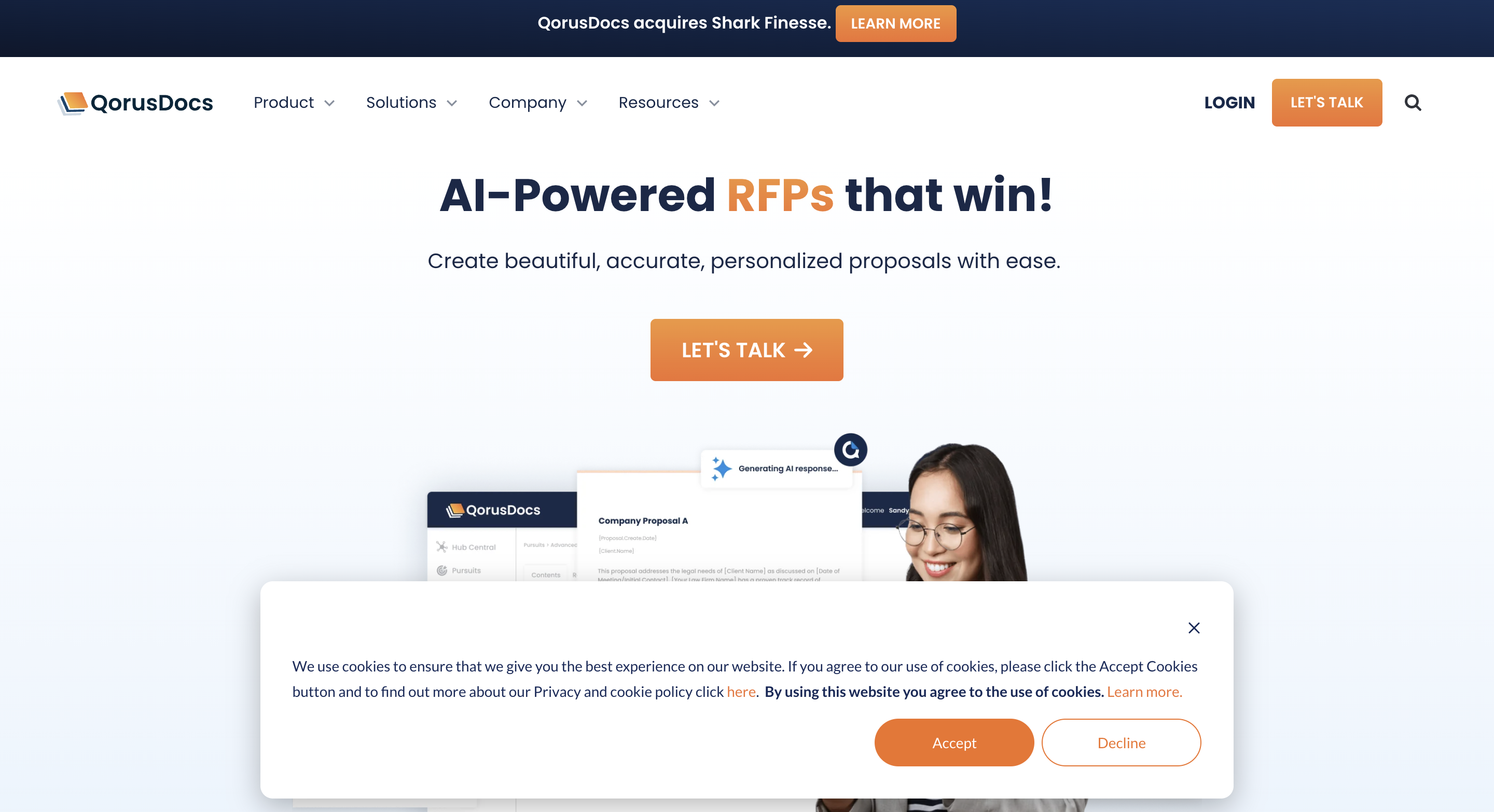
Source: Qvidian
What makes it stand out:
- Deep Word, PowerPoint, and SharePoint add-ins for proposal and pitch creation directly in familiar Office environments.
- Big time savings when setting up opportunities and creating associated SharePoint structures.
- Good collaboration features for updating SharePoint environments.
Where it falls short:
- Dashboard and visibility limits. Some users note dashboards limited to a small number of pursuits.
- Learning curve and complexity in certain advanced features.
The verdict: QorusDocs is attractive for Microsoft-centric sales and proposal teams. A bridge between classic proposal tools and newer AI-enhanced suites.
Best for: Microsoft-centric teams wanting document automation inside Office with proposal and RFP capabilities.
15. PandaDoc
G2 Rating: 4.7/5
End-to-end proposal, quote, and e-sign platform.
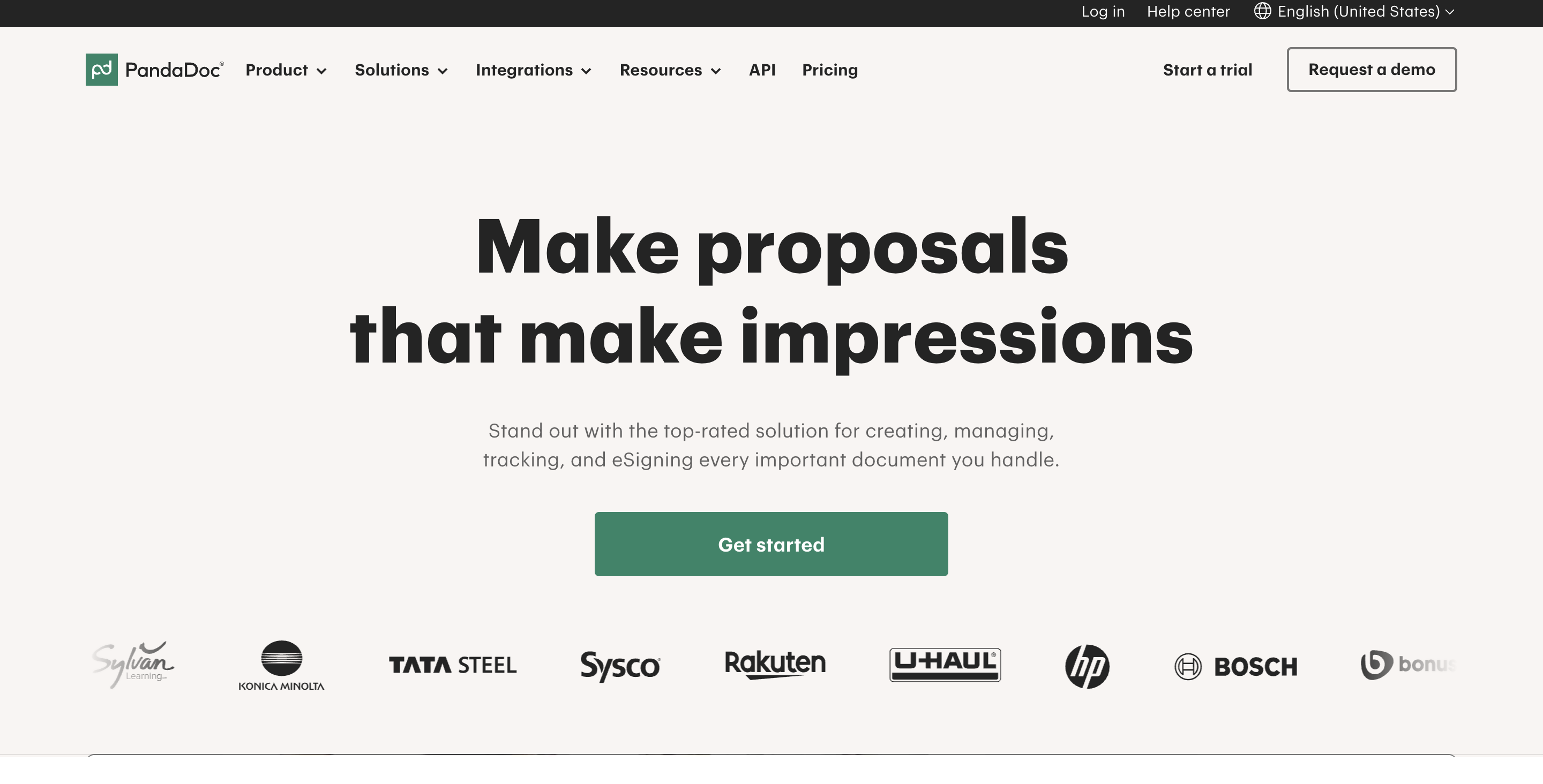
Source: PandaDoc
What makes it stand out:
- Streamlines creation, sending, tracking, and signing of proposals and agreements with strong analytics.
- High usability with simple document workflows and scaled automation.
- Solid ratings across G2 and Capterra in proposal software rankings.
Where it falls short:
- Implementation and template migration can be time-consuming at scale.
- Reporting and mobile limitations were noted by users.
- Not an RFP specialist. Excellent for proposals but lacks deep questionnaire workflows.
The verdict: PandaDoc is ideal when your primary need is sales proposals, quotes, and e-signing with only light RFP requirements. More adjacent than a direct competitor to Arphie.
Best for: Teams needing proposal, quote, and e-sign capabilities with light RFP requirements.
16. Proposify
G2 Rating: 4.6/5
Visual proposal design with engagement analytics.
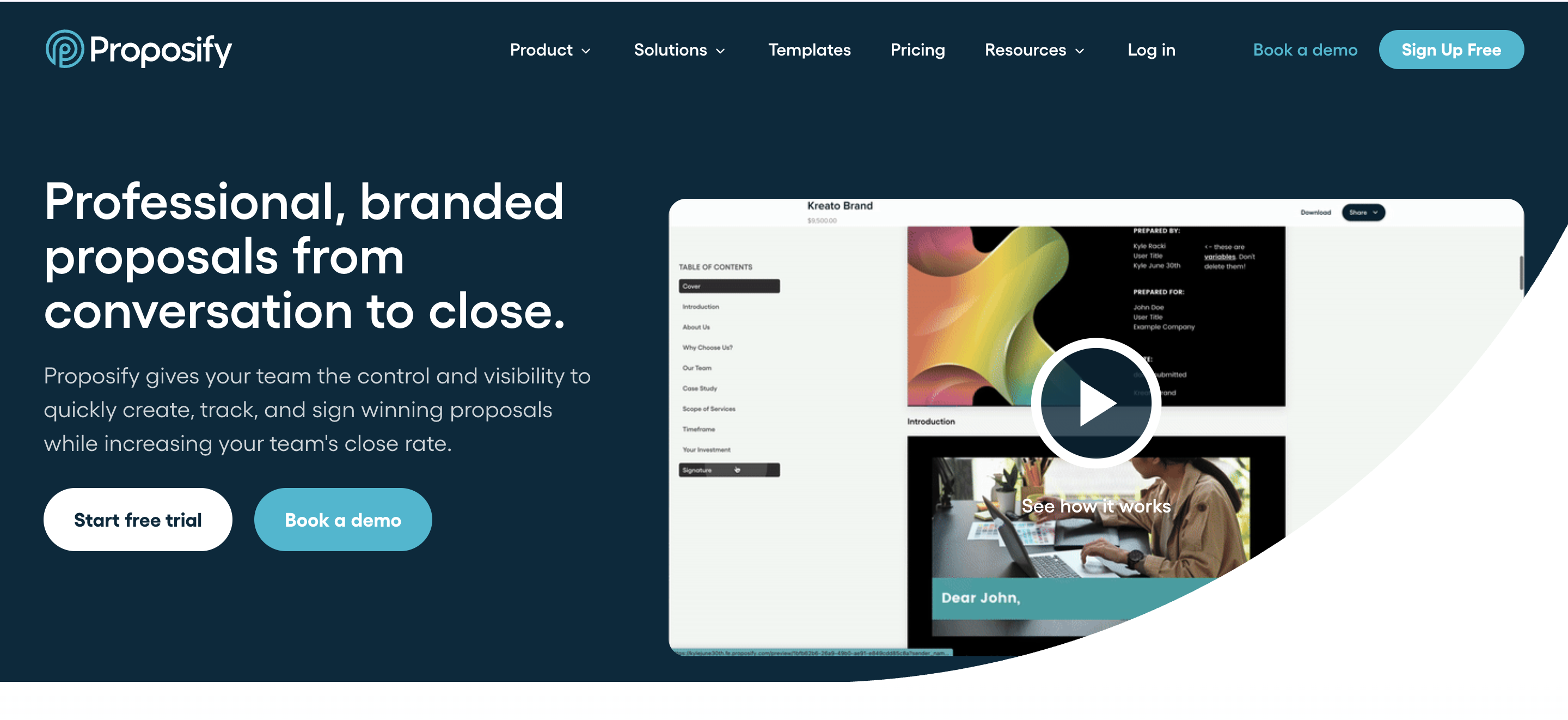
Source: Proposify
What makes it stand out:
- Focused on creating polished, on-brand proposals with strong analytics on engagement.
- Team-wide template discipline with consistent templates, reporting dashboards, and approval workflows.
- Good small-business fit for teams wanting structure in proposal operations.
Where it falls short:
- Less suited to heavy questionnaires. Strong for narrative proposals but not optimized for massive Excel-style RFPs.
- Some learning curve and cost considerations for very small teams.
The verdict: Proposify is best for visual, sales-driven proposals. Can complement an RFP tool but isn't a one-for-one replacement for heavy questionnaire automation.
Best for: Small to mid-sized teams wanting polished, visual proposals with engagement tracking.
17. YoroFlow
G2 Rating: 4.3/5
CRM plus workflow plus RFP in one platform.
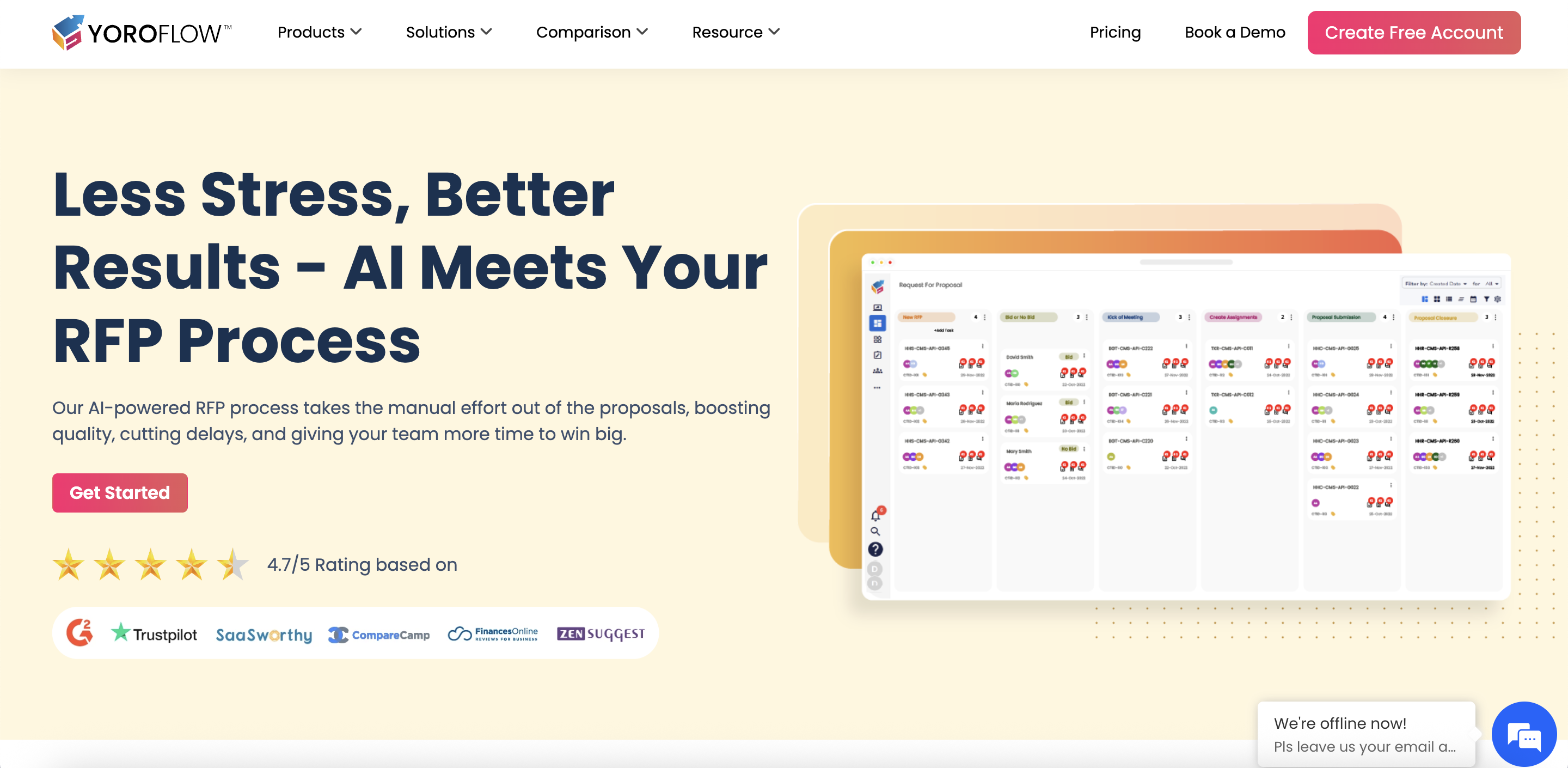
Source: YoroFlow
YoroFlow
G2 Rating: 4.7/5
No-code workflow automation that handles RFPs as part of broader business process management.
What makes it stand out:
- Visual workflow builder with drag-and-drop simplicity. Build approval chains, task routing, and notification triggers without writing a single line of code.
- Process-first approach. Unlike tools that bolt on workflows as an afterthought, YoroFlow treats business process automation as the core product, with RFP management being one of many use cases.
- Strong template library for common business workflows, including document approvals, request management, and multi-step reviews.
Where it falls short:
- Not RFP-native. The platform handles RFPs through general workflow automation rather than purpose-built RFP features like answer libraries, AI drafting, or questionnaire parsing. Also, it has limited AI capabilities.
- Smaller ecosystem. Fewer integrations and less community support compared to established workflow platforms like Monday.com or Asana.
The verdict: YoroFlow is a solid choice if your RFP challenge is really a workflow challenge. If you're struggling with approvals getting stuck, tasks falling through cracks, or stakeholders not knowing when it's their turn to act, YoroFlow can impose structure on that chaos. But if you need intelligent answer suggestions, content libraries, or AI-assisted drafting, you'll want a dedicated RFP tool alongside it.
Best for: Teams where RFP bottlenecks are process-related (approvals, handoffs, tracking) rather than content-related (finding the right answers, maintaining libraries). Also works well as a complementary tool alongside an RFP platform for managing the human workflow layer.
How to Choose the Right Arphie Alternative
After analyzing 15+ tool, here's how to think about your decision:
If you need cross-functional governance and compliance:
SparrowGenie is built for exactly this. Legal review, security sign-off, and compliance checks, all in one governed workspace.
If you want the safe enterprise choice:
SparrowGenie, Responsive, or Loopio. Battle-tested, feature-rich, and widely adopted. Just budget for implementation time.
If AI automation speed is everything:
SparrowGenie, AutoRFP.ai, Inventive AI, or Thalamus AI. These are AI-first platforms pushing the boundaries of what's possible.
If you want one tool for all sales knowledge:
Sparrowgenie, SiftHub, or 1up. RFPs become one use case among many in a unified knowledge layer.
If you live in Microsoft 365:
SparrowGenie, QorusDocs, and Qvidian offer deep Office integration.
If RFPs are secondary to proposals and e-sign:
SparrowGenie, PandaDoc, or Proposify. While these platforms excel in their respective fields, they are not experts in RFP management.
Delve into the perfect AI-powered RFP platform
Final Thoughts
The RFP software market is splitting into two camps: legacy platforms adding AI features and AI-native platforms building RFP workflows.
G2 ratings tell an interesting story. AI-native tools are consistently hitting 4.8-5.0 ratings, while enterprise incumbents cluster around 4.3-4.6. That gap reflects something real: modern tools built around AI tend to deliver faster time-to-value and better user experiences.
But ratings aren't everything. Some teams need the deep feature sets and proven track records of enterprise suites. Others need the speed and simplicity of AI-first platforms.
The right choice depends on your specific situation: team size, budget, compliance requirements, existing tech stack, and how much you're willing to invest in implementation and training.
Whatever you choose, the days of manually copying and pasting RFP answers are over. The only question is which flavor of automation fits your workflow best.
Ready to see how SparrowGenie handles cross-functional RFP collaboration?
Book a demo and see why teams trust our review-first approach to AI-powered proposals.
Ready to see how AI can transform your RFP process?
Product Marketer at SparrowGenie
Being a Product Marketer at SparrowGenie, Aparna helps sales teams work faster with secure, AI-powered proposal automation. She turns complex features into simple stories, builds messaging that resonates, and keeps a close pulse on what customers actually need. She loves shaping clear, helpful content that shows how SparrowGenie makes RFP work easier, faster, and a lot less stressful.